Home Blog Page 4623

Telco tower sale expected to cut costs, boost competition

THE SALE of inactive tower assets by mobile network operators (MNOs) will result in more carrier-neutral cell towers and lower costs to consumers, said advocacy coalition Better Internet PH.

Mary Grace Mirandilla-Santos, the lead advocate for Better Internet PH, said the divestment by MNOs of these assets “is something that’s happening globally.”

“If we are to look at what’s happening in other countries, the practice is that the MNOs will now focus on active infrastructure,” she said in a chance interview.

Ms. Mirandilla-Santos said the move lets MNOs be more concerned about the quality of services, the speed, or coverage.

“Then, the tower assets will now be managed and operated by an independent power entity,” she said, describing the move as a “global best practice.”

She said under an independent entity, the business model will be different because tower companies will be more profitable if there are multiple operators attaching their equipment.

“Ideally, this will result in more competition. So, in a location, you can have multiple operators coming in because there’s a tower already there. This practice will ideally result in more competition, thereby better services and lower costs,” she added.

Carrier-neutral towers allow multiple MNOs to share the tower and serve the communities.

“Because the asset is shared, it’s supposed to lower the cost for the operators. Therefore, we should expect lower costs to be passed on to the consumers,” she said.

Ms. Mirandilla-Santos said these benefits are the reason why the group is pushing for the passage of the Open Access bill that will institutionalize the Department of Information and Communications Technology’s (DICT) Common Tower Policy.

She said the Open Access bill has a provision where passive infrastructure, including towers, poles, and underground ducts, can be shared by multiple broadband operators.

The common use of telecommunications infrastructure aside from towers will push for business and economic activities through the deployment of fiber broadband.

“And to do that, you need to make sure that it’s easier and more affordable to deploy fiber broadband cables in those communities,” she said.

“So, if you have shared underground, where different fiber broadband operators can actually put in their fiber inside those ducts, sharing the cost, sharing also the right of way, then we can expect that it’s not only more efficient, and more affordable, it will also lessen the disruption to the communities,” she added.

Ms. Mirandilla-Santos said the Open Access bill will provide a policy framework that the DICT and the National Telecommunications Commission can use to put out guidelines for sharing passive infrastructure. — Justine Irish D. Tabile

Paris Fashion Week: Haute couture shows feature contemporary gowns, capes, and shimmer

GIORGIO ARMANI

PARIS — Italian fashion house Fendi took to the former Paris bourse headquarters on Thursday for its fall haute couture catwalk show, where designer Kim Jones showed a contemporary lineup of light, sensual gowns for formal occasions.

Models marched steadily down the marble runway of a stark, white space set up in the neoclassical Palais Brongniart while dramatic opera singing played on the soundtrack.

They wore the slender, floor-sweeping silhouettes crafted with elaborate draping techniques and no apparent hems — as if the fabric had been snipped clear of any extra weight.

The show opened with a long, nude-toned dress with a full skirt, covering just one shoulder and wrapped tightly around the bust.

Other monochrome looks followed, mostly in dusty pastels or black, worn with chunky heels, curved like cowboy boots, and delicate clutches held close to the chest.

Adding texture, jacket and trouser ensembles came coated in chunky crystals, while furry pieces like short jackets worn off the shoulders appeared to be weightless, including a sleeveless gown in mint green.

Mr. Jones, who is also creative director for the menswear line of Dior, another LVMH-owned fashion house, took his bow with Delfina Delettrez Fendi, artistic director of jewelry.

The Paris haute couture shows, which ran through July 6, have drawn fashion press and celebrities to the French capital.

Riots that swept through France last week after the deadly police shooting of a teenager added uncertainty to the fashion program, but only a handful of labels canceled events.

ELIE SAAB’S CAPES
Elie Saab doubled down on capes for his autumn haute couture lineup presented in Paris on Wednesday, offering them in a variety of forms that added volume to silhouettes.

Models paraded down an arched corridor of the Louvre’s Musee des Arts Decoratifs in sheer, pastel dresses with elaborate sequin embellishments adorning the bodices, shoulders and skirts. Airy, see-through capes billowed out behind, some worn over the head, attached to the arms.

In contrast were black dresses worn with hooded capes that swept the floor, including one covered in bright red roses.

Following up on the introduction of menswear to his haute couture lineup a year ago, the Lebanese designer also included male models, outfitting them in regal, robe-like capes, black with elaborate gold embroidery.

GIORGIO ARMANI PRIVÉ GLITTERS
Giorgio Armani layered on the shimmer and shine for his fall haute couture collection, sending sparkling pantsuits and ballgowns down a slick runway.

The 88-year-old designer worked a somber color palette for the Giorgio Armani Privé lineup, mostly restricted to red, black, and gold.

He coated red dresses with rows of beads of the same color, while evening jackets were often embellished with floral motifs. Three-dimensional roses of all sizes appeared throughout the collection, accenting necklines and adorning shoulders.

Models walked slowly and deliberately in stilettos with pointed toes, which poked out from under the raw hems of mesh skirts and silk trousers.

Slicked-back hairstyles, slender clutches and prominent earrings completed the looks.

The Italian designer closed the show with a crimson bridal dress, the sparkling white bodice covered in red flowers.

STEPHANE ROLLAND NODS TO MARIA CALLAS
Stephane Rolland took to the Paris Opera house on Tuesday last week for his fall haute couture show honoring Maria Callas, offering a dramatic line-up of voluminous ball gowns

Models glided up the building’s grand marble staircase in floor-sweeping dresses as the audience watched from the balcony above, while the voice of Ms. Callas echoed throughout.

The French designer played with symmetry, with off one shoulder gowns and skirts slit on one side.

Long trains were offset by bare backs, and one dress was slashed across the middle to reveal the model’s midriff.

Cuff necklaces, sculptural earrings, and metallic body ornaments were prominent, including a gold, coral-like piece with tentacles that stretched out of an upward turned collar.

The designer is known for his flamboyant designs, including a white-winged gown worn by Celine Dion for a performance at the 2017 Billboard Music awards in Las Vegas.

RELAXED ELEGANCE AT CHANEL
Chanel creative director Virginie Viard chose a quai on the Right bank of the bustling Seine River for her fall haute couture catwalk show, a setting that added breeziness to a relaxed and elegant lineup.

Models strode across the cobblestones lining the river, parading tweed suits lined with tufts of tulle or embellished with flower motifs in autumn tones as tourists floated by on the city’s famous bateaux mouches (tourist boats), exchanging waves with the audience.

French model Caroline de Maigret opened the show, her brown hair worn loose over her shoulders, in a long tweed overcoat cinched at the waist and gold-tipped heels.

Dressier looks followed, including a shimmery, black dress coated in sequins and an all-gold skirt and jacket ensemble, while more bohemian silhouettes included a loose pink and orange blouse paired with a full skirt in gold and black tweed.

Adding to the nonchalant spirit, one model was accompanied by a sleek, black labrador, while other models carried baskets of flowers.

Closing the show, they walked in pairs and trios, and the jazzy soundtrack gave way to the 1980s duet by Elton John and France Gall, “Donner pour donner.”

THOM BROWNE DEBUTS HAUTE COUTURE
Thom Browne marked his debut on the Paris haute couture calendar on Monday last week with a dramatic display of voluminous fashion in the French capital’s famous opera house.

The American designer drew his audience in through the back door of the baroque monument, up dusty flights of wooden stairs to the runway set — the middle of the stage, with the audience seated on both sides.

The curtain lifted at the start of the show to reveal a full theater — the red velvet seats and gilded balconies occupied by rows of cardboard cutouts of a man in a grey suit and sunglasses.

Models emerged slowly, on towering platform shoes, marching past a flock of fabric-covered pigeons and pausing under an enormous grey, fabric-covered bell hanging above the set.

Some wore headgear in the shape of birds, while others had bandages wrapped around their heads, worn with elaborate grey wigs.

Browne puffed out the volumes of dresses, giving them balloon-like sleeves, and paired tweed ensembles and pleated skirts with long coats embroidered with pigeons or seaside motifs like starfish.

Mr. Browne, who is chairman of the Council of Fashion Designers of America, is best known for his signature grey suit, but he has also built a reputation for showmanship — last fall, for example, he closed a Cinderella-themed show with Mj Rodriguez dancing in a pink Cadillac made of tulle.

DIOR’S CLASSICAL ROME INSPIRATION
For her fall show, Dior designer Maria Grazia Chiuri reined in the volumes often associated with haute couture fashion and sent out a line-up of slender dresses and capes in neutral tones and touches of gold and silver.

“The complexity is not so visible,” Ms. Chiuri told Reuters, pointing to tiny stitches fixing pleats on a dress.

The designer mined styles associated with classical antiquity — she grew up in Rome, surrounded by statues from the era — and, moving away from pinched waists, offered long, column dresses, opera coats and capes.

Embellishments were kept to a minimum, and included pearls and flat braids, while metallic threads added texture to jacquard fabrics.

“I like to transform the traditional jacquard and brocade into something more natural — I like the contradiction between the two materials, I think I can create something new,” she said, noting raw silk was woven into the fabric of a dress and jacket ensemble, alongside metallic thread.

The show, which kicked off Haute Couture Week in Paris, was held at the entrance of the Rodin museum, in a tent lined with artwork by artist Marta Roberti. Towering scenes of animals, plants and naked women in yoga positions sought to evoke goddesses and animals associated with them. — Reuters


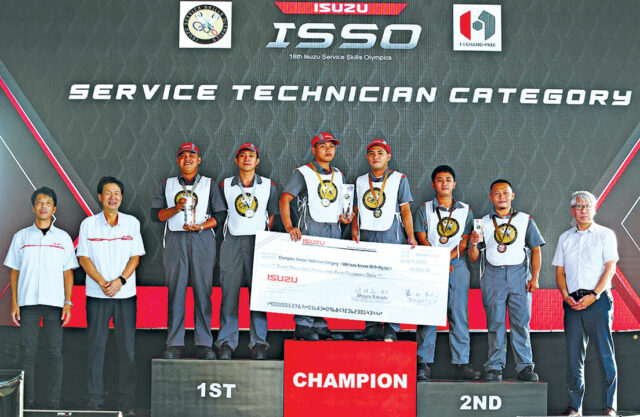
Isuzu Bulacan wins 18th Isuzu Service Skills Olympics

Awarding the winning teams of the Isuzu Philippines Corp. (IPC) Isuzu Service Skills Olympics are VP for After-sales Wataru Miyamoto (second from left), IPC President Tetsuya Fujita (extreme right), and Isuzu Motors Limited Executive Officer and VP for After-Sales Naohiko Yanagawa (leftmost). — PHOTO FROM ISUZU PHILIPPINES CORP.

ISUZU PHILIPPINES CORP. (IPC) recently held the 18th edition of the Isuzu Service Skills Olympics (ISSO) in its assembly plant in Laguna. The annual dealer network competition showcases the technical competency and service knowledge of Isuzu after-sales personnel nationwide.

Participated in by 29 teams coming from different dealerships nationwide, each is composed of a service advisor, parts staff and two service technicians — all displaying their knowledge and skill in the service shop.

In his welcome remarks, IPC President Tetsuya Fujita commended the “excellent after-sales service” of the dealer network, saying, “With your commitment, we are able to achieve the ‘number one truck brand’ title for 23 consecutive years. People continue to trust the Isuzu brand because of the Isuzu advantage that we offer which is our top-notch after-sales service and support.” Mr. Fujita also acknowledged the effort that enabled the company to achieve the coveted Triple Star Award for four consecutive years — bestowed by its principal company Isuzu Motors Limited, Japan (IML).

The winners of this year’s ISSO for Service Advisor Category were Maria Noemi Cabaltera (Isuzu Makati), followed by Marius Adrian Pablo (Isuzu Cabanatuan), and Cryser Ryan Carmona (Isuzu Pasig). The Parts Staff Category winners were Riza May Cabus (Isuzu Pagbilao), Felipines Bangcaya (Isuzu Bulacan), and Hazel Ann Ramos (Isuzu Calapan). The Service Technician Category Champions were Deolito Galono and Raymundo Eduque III (Isuzu Bulacan), followed by Christopher Jateco and Romeo Nayanga, Jr. (Isuzu Pasig), and Sani James Maghanoy and Alex Roble (Isuzu Cagayan de Oro). After computing all the category points, Isuzu Bulacan was hailed as the Dealer Grand Champion.

Present during the event was IML Executive Officer and Vice-President for After-Sales Naohiko Yanagawa, who expressed his sincere appreciation for Filipino service personnel. “Globally, Filipinos are known to be very talented and dedicated workers, which is why it is not surprising that almost every year Isuzu Philippines will get a podium finish at the Isuzu I-1 Grand Prix World Technical Competition (I-1GP),” he said.

ISSO also serves as a platform for selecting the team that represents IPC in the prestigious I-1GP Competition in Japan to be held later this year. Since joining in 2006, IPC has been a consistent top performer for both the commercial vehicle (CV) and light commercial vehicle (LCV) categories, competing against other Isuzu serving countries worldwide.

For more information, visit www.isuzuphil.com.

The dying of the Left

CHARANJEET DHIMAN-UNSPLASH

It used to be that the revolutionary Left (the Communist Party of the Philippines-New People’s Army or CPP-NPA) had a mythic place in people’s imaginations, especially among the activist youth. The NPA was considered “Nice People Around.” The youth looked up to the late CPP Founder and Chairman, Jose Ma. Sison, whose nom de guerre was “Amado Guerrero” or “Beloved Warrior” and the former NPA Chief, Bernabe Buscayno, aka “Ka Dante,” as revolutionary gods on the altar of activism and patriotism.

Even in upper and middle-class households, the Left was respected and revered. Ed Jopson, the Jesuit-educated former Ateneo Student Council president and son of a prosperous supermarket owner, turned his back on his moderate roots and joined the revolutionary underground. He died as a high-ranking leader of the CPP-NPA in Mindanao on a raid in his house in Davao in 1982.

The attraction of the Left was such that priests, nuns, and convent schoolgirls could cite Guerrero’s Philippine Society and Revolution as much as the Bible, and some even joined the NPA in the hills.

That was then. Fast forward 50 years later. Last May, the Economist magazine wrote what could probably be an obituary of the CPP-NPA. In the article titled “The Philippines Once Proud Insurgents are Out of Ammo,” the Economist declared that the CPP-NPA guerrillas had become a relic. It had ceased to be an internal security threat, dwindling to about 2,000 fighters from about 25,000 at its height during the anti-Marcos struggle. As its ranks dwindled, according to the article, the CPP-NPA became lost in arcane ideological debate and turned to extorting “revolutionary taxes.” The old man Sison died in exile in December 2022 while its Chairman and Secretary General, the revolutionary couple Benito and Wilma Tiamzon, perished in a boat explosion while being pursued by Philippine government armed forces. The revolution didn’t work out, the Economist cynically declared.

How did it come to this? Putting it in their own dialectical terms, how could heroes transform into its opposite, and become heels? There are many reasons. I will attempt to cite them all.

Geopolitics suddenly put the CPP-NPA backward in history. In other words, geopolitics made the CPP-NPA ideology irrelevant. The Soviet Union collapsed, and the Berlin Wall fell in 1989. Communist China, which Sison et. al. regarded as the revolutionary utopia, ceased being communist under Deng. Ideology was ditched in favor of capitalist practicality. “I don’t care whether the cat is black or white as long as it catches mice.” Under capitalism — euphemistically called “socialism with Chinese characteristics” — China transformed from being a poor Third World country into a global economic superpower.

Also, driven by its quest for revolutionary purity at all costs, the CPP-NPA tarnished its brand. Under its Operation Ahos, it committed involuntary disappearances and executions of its own members and red fighters in the 1980s on suspicions that they were DPAs or Deep Penetration Agents. Its commitment to human rights proved to be a sham.

It was also shown that the CPP-NPA was behind the Plaza Miranda bombing in 1971. According to sources and witnesses, Sison ordered the bombing of the Liberal Party rally in Plaza Miranda, believing that it would be blamed on Marcos Sr. and the ensuing repression would radicalize the moderate opposition, generating more fighters and cadres for the revolution. No less than Lt. Victor Corpus, former PMA graduate and former defector to the NPA, and journalist and Manila Times columnist Rigoberto Tiglao, a former leading official of the CPP, have attested to the truth of Sison being behind this terrorist incident.

However, the Philippine government’s programs also succeeded in taking the oxygen out of the insurgency. One was the agrarian reform program that started in 1987. Although there were flaws in its design and execution so that the comprehensive land reform program failed to raise agricultural productivity and deliver the farmers out of poverty, it was a success as a land distribution program. The World Bank has declared the country’s land reform program the most successful land distribution program in the world, attaining 70% of its target.

With former tenants owning a tiny piece of land, the revolutionary Left could no longer cry “land to the landless.” Its analysis of the country being “semi-feudal” became bereft of reality. This is why the CPP-NPA moved its operations to the uplands and tried recruiting disaffected lumads and other indigenous peoples.

The other program was the 4Ps or the Conditional Cash Transfer Program, which directly distributes cash aid to the poorest of the poor and marginalized families. It was started under former President Gloria Macapagal Arroyo, expanded under former President Benigno Aquino III, and was codified into law under former President Rodrigo Duterte. The program counts more than 4 million beneficiary households.

Why did it also help to take the oxygen out of the insurgency? Because the program enabled the government to be felt in poor households, whereas before, it was absent or non-existent. Because the program was a threat to the insurgency, former Department of Social Welfare and Development (DSWD) Secretary Judy Tagiwalo, a leftist in Duterte’s Cabinet, opposed it.

However, more than external events, the revolutionary Left was a victim of its own ideological dogmatism. It wasn’t only its political blunder of boycotting the 1986 elections when Cory Aquino was elected that presaged the Left’s demise. Rather, due to its nationalist, anti-foreign ideology, it became allies of domestic monopolists as it continued to oppose opening the economy to more competition from foreign corporations. (Alliance with the oligarchy is rationalized in their ideology as forging a united front with the “nationalist bourgeoisie.”)

Its political and economic program verged on the ridiculous. For example, its program called for the nationalization of industries. A government that can’t even run an MRT well is expected to run steel and telecommunications companies just because Jose Ma Sison has taken over the government?! The people who daily experience the state’s incompetence and corruption saw through the bankruptcy of the Left’s vision for the country.

The election to the presidency of the son of the dictator Ferdinand Marcos, Sr., under which the CPP grew, is an exclamation point to the demise of the revolutionary Left. So pathetic has the Left become that it has suffered politically in the aboveground. The Socialist candidate for President in the last elections, Leody de Guzman, got a mere 0.2% of the vote. The leftist parties got three seats under the party-list system (pasang awa by the Comelec) where they used to get nine or more seats.

Hail to the death of the old Left, but a new Left needs to be reborn. To infuse political dynamism and creative change in Philippine society, a new Left is needed to struggle with the Right. It’s not only about human rights that the voice of the Left must be heard, but also on social issues like divorce, gender equality, and LGBTQ rights, and on economic issues of inequality, rent-seeking, inclusion, competition, consumer welfare, poverty alleviation, and market failures. Instead of siding with the monopolists as the old Left has done, the new Left must be progressive and be on the side of consumers.

In the meantime, the dying of the Left gives President Bongbong Marcos, Jr. the historic opportunity to pursue development under favorable political conditions and without dealing with internal security threats to the state. The other internal security threat, the Moro rebellion, has largely been defused with the signing of a Bangsamoro Autonomous Peace Agreement. Further, the dying of the revolutionary Left means less political support for anti-foreign, anti-capitalist, anti-market ideas. The political environment has never been more hospitable to development and pro-market reforms.


Calixto V. Chikiamco is a member of the board of IDEA (Institute for Development and Econometric Analysis).

totivchiki@yahoo.com

SteelAsia exports 36,000-MT steel bars to Canada

LOCAL steel producer SteelAsia Manufacturing Corp. has exported over 36,000 metric tons (MT) of steel bars for infrastructure construction in Canada.

The company said in a statement over the weekend that the high-strength steel bars will be used for Canadian infrastructure and were manufactured via green steel production methods.

According to SteelAsia, the latest figure is the company’s fifth shipment, bringing the total value of its exports to $24 million or around P1.32 billion.

“We have broken through the first world market where quality and performance standards are the highest. We have invested in the best available technology to produce the highest quality steel products and these shipments are our initial reward, and a validation of our reliability and capability,” SteelAsia Chair and Chief Executive Officer Benjamin O. Yao said.

SteelAsia said it had been utilizing geothermal energy to recycle steel scrap into high-value, infrastructure-grade steel bars.

“This technology not only supports the Philippines’ infrastructure program but also promotes sustainability in steel production,” the company said.

Meanwhile, Mr. Yao said there is an opportunity for the Philippines to have its local integrated steel industry that will spark new industries such as the production of ships, cars, and appliances, as well as provide support to other sectors like construction and housing.

SteelAsia said the country currently imports most of its steel needs, which can be solved by investing in a local steel mill, Mr. Yao.

“In the Philippines, we export our resources such as steel scrap and iron ore, then import back finished steel products. This is a tragedy because the value and the jobs are created in another country and, in the meantime, the Philippines is import-dependent,” Mr. Yao said.

“We need job creation here, and that’s what having our own steel industry does,” he added.

SteelAsia currently operates three steel mills in Luzon, two in Visayas, and one in Mindanao. — Revin Mikhael D. Ochave

Rustan’s goes green and local

LUXURY retailer Rustan’s is embracing sustainability with the Rustan’s Eco-Living Soirée running this month. More interestingly, it’s also onboarding a lot of local brands.

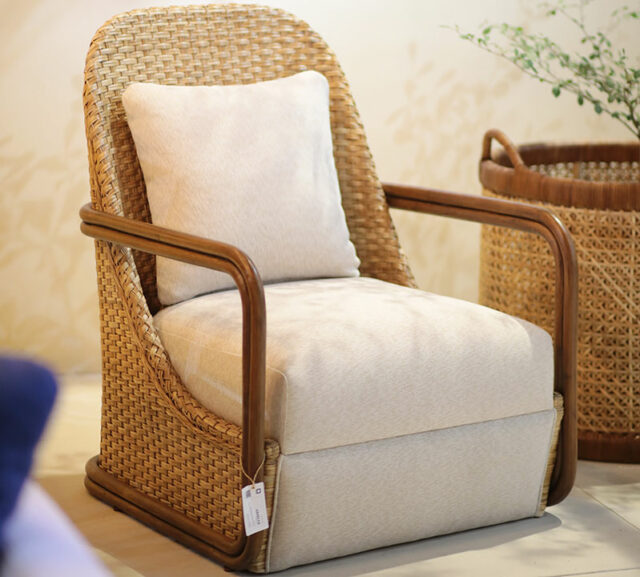
During an event on July 6 in Rustan’s Makati, on view were the products of brands like Caljje (abaca rugs), Calfurn (a luxury furniture brand from Pampanga), and Ugu Bigyan (pottery from Quezon by artist Augusto “Ugu” Bigyan). Other brands included local clean beauty brand For Keeps, with soaps made with coconut and pili oils, and Gourmet Farms, with lettuce chips and other healthy products.

GOING GREEN
In an interview with Michael Tantoco Huang, Rustan’s Senior Vice President for Development and Support, he discussed why sustainability is an important value for the retail chain. In recent years, more companies have embraced sustainability to adjust to changing moods and a changing planet. Luxury is keeping up, with many brands adopting, for example, renewable materials and the like. “I think it’s more for how we have to think about the future for our kids,” said Mr. Huang.

“My parents would show me the way the Pasig River used to look — it used to be blue. With the way things have gone, I know it’s because of technology and development. We gave way to all of this. But what we forgot to do is make sure that we don’t destroy the things around us,” he said.

Internally, some of the measures they’ve taken to reduce their carbon footprint is to reduce their travels when meeting with their foreign suppliers. As well, “We’re looking into using recycled papers for our packaging, or even recycled plastics. That’s in the works,” he said.

GOING LOCAL
Rustan’s is best known for bringing foreign luxury brands to the Philippines, but in recent years, they’ve begun to carry more local luxury brands. For example, there’s Randolf, a barong brand by local designer RJ Santos, showing off colorful embroidery and more casual looks for the traditionally staid barong.

“Our founders (his grandparents, Bienvenido and Gliceria Tantoco) have always said when they first started the business, it was bringing the best of the world to the Philippines. They also made sure that we had a Filipiniana section to promote Philippine products,” said Mr. Huang. “It’s our own. Why don’t we work with these people as well? Why don’t we also help them?”

Citing for example, Calfurn, which makes furniture for resorts around the world, he said, “People go abroad, and they see it, and (they say), why can’t I have it for myself?” here in the Philippines. — JL Garcia

Nine days of celebration for Foodpanda delivery partners

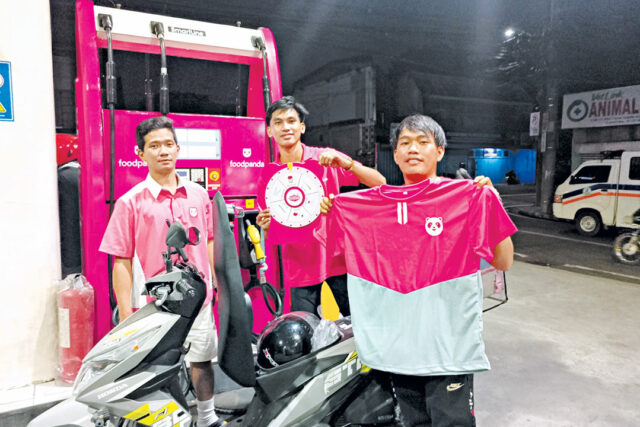
Foodpanda deliver riders receive freebies and discounts at a Seaoil station. — PHOTO FROM FOODPANDA

FOODPANDA LOGISTICS PHILIPPINES held nine “special days of rewards and activities” in tribute to hardworking “ka-panda” delivery partners. Benefits included an exclusive fuel discount which allowed partners to gas up with a discount of P9 per liter at Seaoil gas stations across the country.

During the height of the many fuel hikes last year, Foodpanda Logistics established tie-ups with several fuel providers offering exclusive discounts to delivery partners, and assisting them in enrolling for the fuel subsidy program of the national government. Foodpanda Logistics Philippines Operations Manager Ruben Mariano highlighted the P9 discount per liter of fuel as one of the treats for their riders, saying, “We wanted to recognize the efforts of one of our largest stakeholders, our ‘ka-pandas.’”

With the expansion of the Foodpanda delivery fleet, bikers, e-scooters and walkers also enjoyed special rewards. Double Bamboo Rewards, where delivery partners earned twice the “Bamboos” for every successful delivery, was also in effect. The rewards program allows delivery partners to earn points in-app for every completed delivery and redeem them later for various items, such as vouchers, merchandise, electronics, vehicle accessories and more. For the nine-day special celebration, ‘ka-pandas’ also got to exchange their Bamboos for cash.

Partners had the opportunity to join a nationwide raffle with prizes ranging from smartphones, e-bikes, to motorcycles. A special sale on Foodpanda gear was also held.

“We believe that these items will help them in their daily livelihood. But all year round, we have partnerships with leading motorcycle dealers nationwide to provide accessible and flexible motorcycle loan options as well as exclusive deals on equipment and accessories for their vehicles,” added Mr. Mariano.

Partners received an additional P9 for every tip made on the app. Earlier this year, the double tip campaign was launched where, for a day, delivery partners could earn twice the amount of tips received from customers on the Foodpanda app. To help them augment their income, the company also provides special incentives based on accomplished tasks. They will also be offered exclusive and enticing incentives for successful deliveries as part of the anniversary surprises.

Mr. Mariano mentioned that these incentives aim to help delivery partners at this time when prices of basic commodities are rising. “We have been investing in incentives they can get from accomplishing particular milestones or quests, and by ramping it up during this special occasion, we can be of greater assistance to them,” he announced.

Ka-panda” Denyo Jovero from Manila expressed his gratitude to the company for the special treats. “Malaking tulong po ito sa aming mga riders kaya lubos kaming nagpapasalamat (This is a big help to us riders, so we are deeply grateful), ” he shared.

Foodpanda Logistics also recently visited the areas of Pampanga and Bulacan for its Panda Patrol Hub roadshow, where partners experienced games and activities, learn more about the support and assistance afforded to them, and provide a support hub for their concerns.

“It’s important that we personally hear what our delivery partners have to say and get to see them face to face. This way, we can address their concerns on the spot and make them feel that we truly value the ka-panda community,” Mr. Mariano shared. The roving bus is set to visit more cities and provinces in Luzon this month, along with areas in Visayas and Mindanao in the coming months.

Rates of Treasury bills, bonds may rise on hawkish Fed bets

STOCK PHOTO | Image by RJ Joquico from Unsplash

RATES of the Treasury bills and bonds on offer this week could rise slightly amid hawkish bets on the US Federal Reserve’s next move.

The Bureau of the Treasury (BTr) will auction off P15 billion in Treasury bills (T-bills) on Monday, or P5 billion each in 91-, 182- and 364-day papers.

On Tuesday, it will offer P30 billion in fresh 15-year Treasury bonds (T-bonds).

T-bill and T-bond rates may track the rise in secondary market yields last week due to expectations of a rate hike from the Fed this month, Rizal Commercial Banking Corp. Chief Economist Michael L. Ricafort said in a Viber message.

At the secondary market on Friday, the 91-, 182-, and 364-day T-bills rose by 2.5 basis points (bps), 1.24 bps, and 6.59 bps week on week to end at 6.1088%, 6.1939%, and 6.2834%, respectively, based on the PHP Bloomberg Valuation (BVAL) Service Reference Rates data published on the Philippine Dealing System’s website.

“The upcoming 15-year Treasury bond/FXTN auction yield could be similar to the comparable 15-year PHP BVAL yield at 6.73% as of July 7, 2023, sharply up by 0.53 week on week,” Mr. Ricafort added.

The US central bank paused its tightening cycle last month after hiking borrowing costs for 10 straight meetings by a total of 500 bps, bringing the fed funds rate to a range between 5% and 5.25%.

Fed Chair Jerome H. Powell earlier said the Fed could hike by 25 bps two more times within the year due to stronger-than-expected economic data.

The Fed will likely raise its benchmark interest rate later this month to a 5.25%-5.5% range, traders bet on Friday, even as they priced in a slightly lower chance of any further increase after a government report showed hiring slowed more than expected in June, Reuters reported.

Traders now see about a 20% chance of a rate hike in September and a 40% chance of one by November, after what is nearly universally expected to be a quarter-point increase at the US central bank’s late-July meeting.

Before the Labor department report, they had seen a nearly even chance that rates would get to a 5.5%-5.75% range by November.

Nonfarm payrolls increased by 209,000 jobs last month, the smallest gain since December 2020, the survey of establishments showed. Economists polled by Reuters had forecast payrolls rising 225,000. It was the first time in 15 months that payrolls missed expectations.

Job growth averaged 278,000 per month in the first half of the year. The economy needs to create 70,000-100,000 jobs per month to keep up with growth in the working-age population.

“[The] GS (government securities) market will likely have no reprieve over the weekend regardless… Demand should be fairly decent though as we think investment books will be supportive, triggering another notch higher for the yield curve,” a trader said in an e-mail.

The trader sees the fresh 15-year notes fetching yields from 7% to 7.25% on Tuesday.

Last week, the BTr raised just P9.219 billion via the T-bills it auctioned off on Monday versus the P15-billion program, even as total bids reached P17.419 billion.

Broken down, the Treasury raised only P2.954 billion via the 91-day T-bills out of the planned P5 billion, even as tenders for the tenor reached P6.584 billion. The average rate of the three-month papers went up by 6.4 bps to 6.15%, with accepted yields ranging from 6.044% to 6.198%.

The government also made a partial P2.67-billion award of the 182-day securities versus the P5-billion program as bids reached just P4.63 billion. The six-month T-bill was quoted at an average rate of 6.266%, up by 12.2 bps from the previous week, with accepted rates from 6.11% to 6.293%.

Lastly, the BTr raised just P3.595 billion via the 364-day debt papers out of the P5 billion on the auction block, even as demand for the tenor reached P6.205 billion. The average rate of the one-year T-bill rose by 6.7 bps to 6.286%. Accepted yields were from 6.18% to 6.375%.

The BTr wants to raise P180 billion from the domestic market this month, or P60 billion via T-bills and P120 billion via T-bonds.

The government borrows from local and foreign sources to help fund its budget deficit, which is capped at 6.1% of gross domestic product this year. — Aaron Michael C. Sy with Reuters

Sugar industry backs import order, argues for ‘timely release’ of stocks

BOC - PUBLIC INFORMATION AND ASSISTANCE DIVISION (BOC-PIAD)

THE sugar industry said it supports the newly approved round of imports, but added that any reserves built up with foreign sugar must not interfere with the start of the milling season, where prices for domestically-grown sugar are set.

“As a buffer stock, the 150,000 MT might just be enough. The key is in the timely release and volume at which such buffer stock will be introduced in the market,” Enrique D. Rojas, president of the National Federation of Sugarcane Planters, said in a text message.

The Sugar Regulatory Administration (SRA) approved Sugar Order (SO) No. 7 which authorizes imports of 150,000 metric tons (MT) of sugar.

The shipments are required to arrive not later than Sept. 15, which means volumes will be on hand when the harvest starts being brought in for milling, making the supply-demand situation largely a matter of when the government opts to release stocks.

“The intention of this sugar import program is to ensure sufficient actual supply of sugar for domestic consumption, as well as a two-month buffer stock,” according to SO 7.

SO 7 is the third import program for the crop year 2022-2023 and the second for this year.

In February, the SRA approved SO 6, which allowed the entry of 440,000 MT of refined sugar intended to augment the shortfall in sugar output and help bring down the retail price of refined sugar.

The shipment was privately awarded to three entities — All Asian Countertrade, Inc. (240,000 MT); Edison Lee Marketing Corp. (100,000 MT); and S&D Sucden Philippines, Inc. (100,000 MT).

However, despite the imports from SO 6, the SRA “finds it imperative to open a second import program to address the demand” due to the further reduction in domestic sugar production.

The new sugar import program will “bridge the gap between supply and the demand,” as well as increase buffer stock volumes, according to SO 7.

According to SO 7, the sugar import program is open to “duly registered SRA international sugar traders in good standing; and compliant with the documentary requirements of the SRA/government.

Manuel R. Lamata, president of the United Sugar Producers Federation of the Philippines, also backed SO 7 as it will account for the delayed milling season this year.

“This will act as a buffer stock to the delay in the opening of the harvest season from August to September. This one-month delay is good because this will ripen the sugarcane, meaning there will be more sugar to process,” he said.

Mr. Rojas said that the SRA must control the releases as not all mills will start simultaneously on Sept. 1. He estimates that it takes about two weeks for domestically-milled sugar to reach the retailers.

“We expect that SRA will be judicious enough to release the additional imported sugar in a calibrated manner, in such small volumes that will answer the gap in production, so that millgate prices at the start of milling are not adversely affected by this 150,000 MT shipment,” he added.

On Friday, the prevailing price of refined sugar in Metro Manila markets was between P86 and P110, with washed sugar at P82-P90, and brown sugar P78-P90. — Sheldeen Joy Talavera

Philippine competitiveness

PHILIPPINE STAR/ MIGUEL ANTONIO N. DE GUZMAN

“Does competitiveness matter?”

That was the opening question of the moderator of the forum on “2023 World Competitiveness Yearbook Philippine Results.” It might seem to be a throwaway question. The panelists might have thought that the answer was a no-brainer.

Jamil P. Francisco, Asian Institute of Management (AIM) associate professor, intended it to be a trick question. Indeed, the moderator’s opening question led to a stimulating discussion.

Ser Percival Peña-Reyes, director of the Ateneo Center for Economic Research and Development, emphasized that competitiveness is essentially about productivity. Productivity should frame the discussion about national competitiveness.

The tendency of many is to reduce competitiveness to attracting foreign capital, increasing exports and global market share, luring foreign tourists, and comparing the Philippines to the rest of the world in terms of economic performance. To be sure, productivity underpins all this. But productivity has a broader meaning, beyond making the Philippines compete with other countries.

Productivity thus is principally about Adam Smith’s “nature and causes of the wealth of nations.” The forum on world competitiveness, without saying so, became an inquiry into the nature and causes of Philippine growth and wealth.

A word about the World Competitiveness Yearbook (WCY). The WCY describes itself as “a comprehensive annual report and worldwide reference point on the competitiveness of countries.” It shows trends and creates benchmarks, drawn from statistics and surveys.

Something to ponder over WCY: What is more important for us? How we improve our relative ranking vis-à-vis the rest of the world? Or how we achieve our medium-term goals and grow the economy and human development, irrespective of our ranking?

I am not exactly a fan of global rankings and indices as a concrete guide to national policymaking. Let’s take the WCY. It contains a lot of information and many variables. The information overload can only confound a policymaker or investor. All in all, the 2023 WCY has 336 criteria! They fall under four categories, namely economic performance, government efficiency, business efficiency, and infrastructure. Each general category has sub-sections containing a set of indicators.

Such a comprehensive but dizzying report does not offer the specific insights into how the Philippines can sustain its growth. One must still determine which criteria, and they cannot be many, are the weightiest at a particular time.

The 2023 WCY identifies many strengths and weaknesses for the Philippines, based on the scores and ranking. The task is to identify a narrow set of critical variables — those that really matter — at a conjuncture.

To illustrate, the 2023 WCY indicates a big improvement in the country’s “university education index.” Nice, but is this the index that is decisive at this stage for growth momentum? Or the 2023 WCY states that access to financial services based on gender ratio has suffered a decline. Not nice, but does this index currently represent a big bottleneck to productivity?

On a positive note, the 2023 WCY provides comprehensive information that the decision maker can use in doing the diagnostics. And that was what the AIM forum did: Use the 2023 WCY as a takeoff to discuss the “key challenges faced by the Philippines.”

And the forum was successful in steering the discussion towards the identification of the key issues. As pointed out by Ernesto Perez, director-general of the Anti-Red Tape Authority, the main concern is to attract or generate private investments. In this regard, Christopher Caboverde of the AIM’s Policy Center for Competitiveness provided a neat summary of the main challenges.

Drawing from the 2023 WCY and from the studies of the World Bank, the International Monetary Fund, and the Asian Development Bank, inter alia, Mr. Caboverde enumerated the main issues. To wit: high inflation, fragile fiscal position and revenue enhancement, cheap access to food, climate change vulnerability and transition to clean energy, weak social protection (particularly about universal healthcare), and poor performance in elementary education.

To be sure, the above still says a lot. But this exemplifies the practical approach of doing the diagnostics towards identifying the binding constraints on investments, productivity, or competitiveness.


Filomeno S. Sta. Ana III coordinates the Action for Economic Reforms.

www.aer.ph

Century Pacific Food bullish on meat alternative brand

CENTURY Pacific Food, Inc. is studying several market expansions for its meat alternative unMeat after the brand’s success in US markets, a company official said.

“We are scoping other opportunities, developmental work in Asian markets such as Singapore. We limited our approach to five key markets to see how much traction we can get,” said Century Pacific Food Executive Vice-President and Chief Operating Officer Gregory H. Banzon in an online briefing on July 6.

The company has been making significant gains for its meat alternative brand in Singapore, Mr. Banzon said, adding that unMeat is set to be introduced in Australian markets in the next few months.

He added that the company is also studying opportunities to expand the plant-based product in European markets.

“Before we enter a market there are certain criteria we use to evaluate the opportunity and before we pull the trigger,” Mr. Banzon said.

“So far, Europe looks very attractive, but we are doing the due diligence to see if we can achieve the same level of success we have in the US,” he added.

The company announced earlier that it had expanded market reach in the US for the unMeat product line as it began to roll out in about 2,000 Albertsons outlets.

In January, it introduced the brand across more than 2,000 Walmart stores, while making it available through Harris Teeter, HEB, Meijer, and select grocery stores in the US.

For the first quarter, the company reported an attributable net income of about P1.5 billion, up 6.4% from P1.41 billion in the same period last year.

Consolidated revenues rose by 13% to P15.62 billion from P14.8 billion in the prior year mainly driven by the performance of its business units.

Century Pacific Food is a holding firm with business interests in buying and selling, processing, canning, packaging, and manufacturing food products.

It went up by 0.99% or 25 centavos to P215.50 per share on Friday. — Adrian H. Halili

From ‘facekinis’ to arm sleeves, sun protection gear sells out in China heatwave

There are now Chinese brands like Beneunder that focus on sun protection products like face covers, arm sleeves, and sun hats, and OhSunny that has “facekinis,” among other items. — OHSUNNY.COM

BEIJING — As temperatures hit a record roasting 40° Celsius (104° Fahrenheit) across multiple cities in China, how to shield one’s skin from the sun and stay cool has become a hot topic in the country.

Accessories such as hats boasting ultraviolet (UV) protection to coverings known as “facekinis” which hide most of the face apart from the eyes are selling out — sported mostly by women seeking head-to-toe protection.

The trend has led to a boom in local brands that focus on sun protection products, such as Bananain, Beneunder, and OhSunny.

Other larger brands, such as Anta, Uniqlo, Lululemon, and Decathalon have also added clothing such as UV tinted hats and jackets to their local product assortment.

Data from Shanghai-based China Insights Consultancy shows that China’s sun protection apparel market will grow at a compound annual growth rate (CAGR) of 9.4% from 2021 to 2026, with the market size reaching 95.8 billion yuan ($13.24 billion) in 2026.

“We’re concerned about getting sunburned and tanned so we’re fully prepared,” said a 34-year-old business owner who gave her surname as Hong, referring to her outfit of a hat and arm sleeves as she visited Beijing’s downtown tourism area of Qianmen on Thursday.

Many female consumers in east Asia favor fair skin and sun protection products are also popular in neighboring countries such as South Korea. Analysts say the trend has really taken off in China this year.

Data from Alibaba Group’s mall shopping platform showed that during this year’s 618 shopping festival held last month, sales of “new generation” sun protection apparel grew 180% year-on-year, with the number of pieces of sun protection gear purchased per consumer two to three times higher than in previous years.

“Sunscreen blush masks” are also particularly popular, according to Tmall. The bottom half of the mask is white with pink at the top, so it appears the wearer has makeup on from a distance.

Li Hongmei, a 26-year-old Beijing resident, said she’s a fan of such masks, and also wears a sun protection jacket when going out.

“During the pandemic I didn’t put on makeup often because I’d wear a mask anyway,” she told Reuters as she browsed through a rack of sun protection clothing at Adidas. “Now I’m too lazy to return to makeup, I’d rather wear a sun protection mask and go out.” — Reuters

ADVERTISEMENT
ADVERTISEMENT