Home Blog Page 4571

Gov’t fully awards T-bills at lower rates

WIKIPEDIA/JUDGE FLORO

THE GOVERNMENT made a full award of the Treasury bills (T-bills) it offered on Monday as rates went down across all tenors on expectations that the US Federal Reserve would end its tightening cycle soon amid slower inflation.

The Bureau of the Treasury (BTr) raised P15 billion as planned via the T-bills it auctioned off on Monday, with total bids reaching P44.748 billion or nearly thrice the amount on the auction block.

Broken down, the Treasury made a full P5-billion award of the 91-day T-bills as tenders for the tenor reached P17.716 billion. The three-month papers were quoted at an average rate of 5.884%, 8.9 basis points (bps) below the 5.973% seen for the tenor last week, with accepted rates ranging from 5.86% to 5.9%.

The government also raised P5 billion as planned from the 182-day securities as bids stood at P14.31 billion. The average rate for the six-month T-bill was at 6.095, lower by 17.1 bps than the 6.266% fetched last week, with accepted rates from 6.09% to 6.11%.

The BTr likewise borrowed P5 billion as programmed via the 364-day debt papers as demand reached P12.732 billion. The average rate of the one-year T-bill went down by 11.3 bps to 6.226% from the 6.339% quoted for the tenor last week. Accepted yields were from 6.098% to 6.3%.

At the secondary market before Monday’s auction, the 91-, 182- and 364-day T-bills were quoted at 5.9793%, 6.0911%, and 6.1789%, respectively, based on PHP Bloomberg Valuation Reference Rates data provided by the Treasury.

“The Auction Committee fully awarded bids for Treasury bills (T-bills) at today’s auction. The 91-, 182-, and 364-day T-bills fetched average rates of 5.884%, 6.095% and 6.226%, respectively, all lower than previous auction results,” the BTr said in a statement on Monday.

“The auction was nearly 3 times oversubscribed with total bids reaching P44.4 billion. With its decision, the Committee raised the full program of P15 billion for the auction,” it added.

The Treasury fully awarded its T-bill offer as rates dropped across the board amid expectations that the Fed would end its tightening cycle sooner than later amid slowing inflation in the world’s largest economy, Rizal Commercial Banking Corp. Chief Economist Michael L. Ricafort said in a Viber message.

“The lower T-bill rates awarded today moved in line with the softer-than-expected US consumer inflation report last week. Market expectations of further rate hikes after this week’s policy meeting have dimmed significantly following the data release,” a trader likewise said in an e-mail on Monday.

US consumer prices rose modestly in June and registered their smallest annual increase in more than two years as inflation subsided further, but probably not fast enough to dissuade the Fed from resuming raising interest rates this month, Reuters reported.

The consumer price index (CPI) gained 0.2% last month after edging up 0.1% in May.

In the 12 months through June, the CPI advanced 3%. That was the smallest year-on-year increase since March 2021 and followed a 4% rise in May.

Meanwhile, US producer prices barely rose in June and the annual increase in producer inflation was the smallest in nearly three years, further evidence that the economy had entered a period of disinflation even as the labor market remains tight.

The producer price index (PPI) for final demand nudged up 0.1% last month. Data for May was revised to show the PPI falling 0.4% instead of the previously reported 0.3%.

In the 12 months through June, the PPI climbed 0.1%. That was the smallest year-on-year gain since August 2020 and followed a 0.9% increase in May.

The run of softer inflation readings likely will push the Fed closer to ending its fastest monetary policy tightening campaign since the 1980s.

The US central bank is expected to raise interest rates again when it meets on July 25-26 after holding them steady in June.

Before last month’s pause, the Fed had hiked its target interest rates by 500 bps to a range between 5% and 5.25% from March 2022 to May 2023.

On Tuesday, the BTr will auction off P30 billion in reissued seven-year Treasury bonds (T-bonds) with a remaining life of six years and two months.

The BTr wants to raise P180 billion from the domestic market this month, or P60 billion via T-bills and P120 billion via T-bonds.

The government borrows from local and foreign sources to help fund its budget deficit, which is capped at 6.1% of gross domestic product this year. — A.M.C. Sy with Reuters
Filipino resilience — our pillar in a highly disruptive future 

There has been a flurry of bad press about the Philippines: the dismal state of our education system, the drop in our global competitiveness ranking, and more recently the decline in Metro Manila’s ranking in a global live-ability index. In addition, international reports, such as those by the World Bank and Federal Reserve Board, clearly show that disruptions are going to be more frequent and severe in the future.

So when I was invited to speak to business leaders about elevating Filipino talent competitiveness at the Management Association of the Philippines (MAP) Strategic Human Resource Summit, I had to rethink how best we tackle this issue.   

To elevate our competitiveness in an increasingly disruptive business environment, we need to build on what we are uniquely strong at.

In the Global Leadership Forecast (GLF) 2023 — a study by a human resource (HR) consultancy Development Dimensions International (DDI), there is tangible support for what makes us different from the rest of the world — our RESILIENCE.

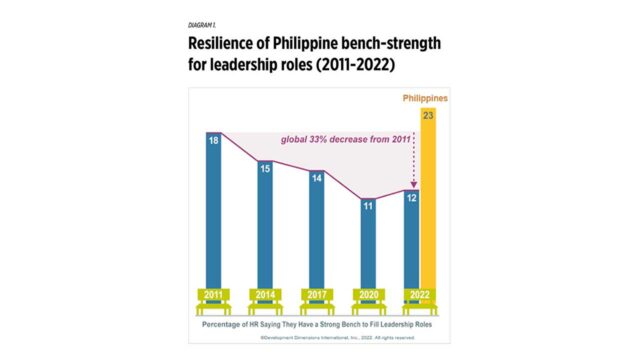
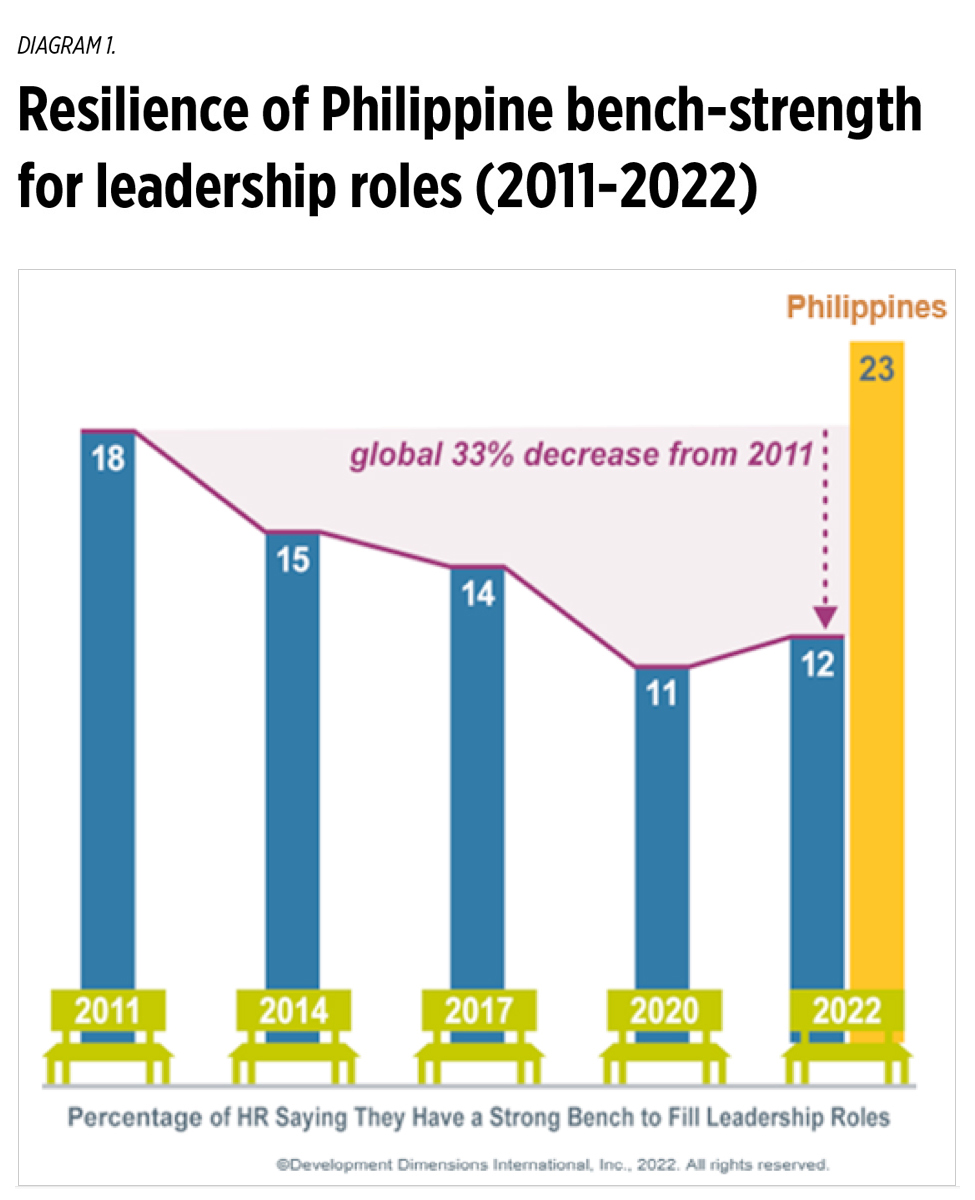
When HR leaders around the world were asked about their leadership bench-strength, there was a continuing decline from 18% in 2011 to 12% in 2022 — a 33% decrease in leadership bench-strength. However, in the Philippines, the leadership bench-strength in 2022 was at 23% — much higher than the rest of the world — before, during and after the global pandemic.

One big reason for this resilience is that Filipino leaders clearly stand out in terms of finding meaning and purpose in their work. The same DDI 2023 report showed that nearly three out of four (74%) Filipino mid-level leaders find their jobs to be full of meaning and purpose, compared to less than half (47%) for the rest of the world.

And what provides meaning and purpose for Filipinos? In discussions with seasoned leaders and professionals around the country, including members of OD Practitioners Network (ODPN), thanks to Vivien Arnobit — there are three things which resonate most: family, relationships and faith.

FAMILY MATTERS
For the Filipino, the reason for going to work and persevering is about making a difference in shaping and caring for the well-being and future of their family and loved ones. For business leaders, knowing the individuals who matter most to the Filipino, why, when and how is the first step to making and building that connection.

RELATIONSHIPS MATTER
For the Filipino, joining and fully engaging with an organization happens because they know the time and effort invested in relationships are worth nurturing beyond their time in the organization. This holds true when working long hours online to beat the deadline, or when learning a new skill to be more effective at work. 

Filipinos work and learn best as part of a group they trust and depend on. For business leaders, knowing the individuals the Filipino depends on, trusts, and confides in and the bonds that hold the Filipino’s group together will be the building block to accelerating learning, growth and performance.

FAITH MATTERS
For the Filipino, beyond the numerous celebrations, rituals and traditions, faith transcends work. The Filipino’s faith is a continuing source of hope, inspiration and strength not only during the most difficult and challenging periods but also when going the extra mile in giving back to the community and building spirituality. For business leaders, understanding the Filipino’s life beyond the day-to-day work success and failures will be key to their engagement and motivation.

Resilience is about showing up and this is half the battle in elevating our competitiveness. But as my respected colleague Jo-ann Tacorda, CAO of PJ Lhuillier, says, having resilient people does not automatically mean you have a fully resilient organization.

For an organization to be truly resilient, it requires: addressing flexibility in supply chains, managing cyberthreats and technology breakdowns, and maintaining business models that are innovative and entrepreneurial. In addition, building and maintaining people’s resilience requires seriously looking at the way companies select, onboard, upskill, recognize and drive performance that is sustainable. Consider the following:

Gerry Plana, chief executive officer of Investors in People Philippines and one of the reactors during the HR Summit, suggested that we should add resilience as part of our recruitment criteria. I have spoken to a number of companies that have invested much time and effort in recruiting leaders with significant international knowledge experience, but unfortunately have no staying power. 

When it comes to upskilling, the DDI 2023 report showed that a large majority (82%) of Filipino leaders prefer face-to-face learning, compared to only slightly more than half for the rest of the world. Filipinos tend to be much more social in our learning versus individual — not only gaining knowledge but also meaningful relationships which help buttress and solidify learnings in the workplace, well after the formal sessions are concluded.

Finally, when it comes to managing performance and to drive accountability, the focus is necessarily on individual performance. Knowing Filipinos’ preference for learning and working in groups, providing supplementary emphasis on achieving the group’s performance can get the overall performance message across more effectively.

The “natural” resilience of the Filipino is an under-leveraged strength in an increasingly disruptive local and global environment. However, this natural strength needs to be continually maintained and strengthened through: (1) business leaders who are able to fully and deeply connect with what matters most to the Filipino family, relationships and faith when driving transformation and growth; and (2) HR leaders and professionals who review how the Filipino workforce is selected, upskilled and made to perform well by leaning on long-standing preferences that value relationships, and learning and performing as a group.

This article reflects the personal opinion of the author and does not reflect the official stand of the Management Association of the Philippines or MAP.


Rolando Paulino “Roland” R. Ruiz is a member of the MAP Strategic HR Management Committee. He is founder and principal of Workforce & Strategy.

map@map.org.ph

rolprruiz@gmail.com

Asking prices for UK homes slip as BoE’s rate hikes bite

A MAN looks at houses for sale in the window of an estate agents in Manchester, Britain, June 22, 2023. — REUTERS

LONDON — Asking prices for residential homes in Britain fell in July as rising mortgage costs and increasing buyer affordability constraints prompted sellers to temper their price expectations, an industry survey showed on Monday.

Property website Rightmove said average asking prices of homes coming onto the market declined by 0.2% last month, compared with the 0% norm for this time of the year.

Tim Bannister, director of property science at Rightmove, said stubborn inflation and further mortgage rate rises contributed to the fall in prices and number of agreed sales.

Britain’s housing market has been hit by rapid increases in interest rates, which financial markets expect to rise to 6.25% by the end of this year from 5% now, adding to pressure on homeowners and buyers.

“The interest-rate brakes being applied more strongly to slow the economy are now beginning to bite in the housing market,” Mr. Bannister said.

House prices have also shown the impact from higher rates, with mortgage lenders Nationwide and Halifax both reporting falls in annual prices in June as buyer demand softened.

The Bank of England (BoE), which has raised interest rates at its last 13 meetings, is tasked with bringing persistent inflation, running at 8.7% in May, back to its 2% target.

The central bank increased its bank rate by more than expected to 5% in June, pushing up the cost of mortgage borrowing. Average two-year fixed mortgage rates reached a 15-year high last week.

Rightmove’s monthly survey showed buyer demand remained resilient this month, up 3% compared to the pre-COVID market of 2019.

“There remains a large volume of motivated buyers who can factor rate rises into their budgets and are continuing to enquire about homes for sale, which is keeping the market functioning,” Mr. Bannister said. — Reuters

Converge set to roll out internet connectivity in  more McDonald’s stores

CONVERGE ICT Solutions, Inc. has partnered with the McDonald’s Philippines operator Golden Arches Development Corp. to roll out internet connectivity in more branches of the restaurant chain.

“This is a supplier-vendor relationship. Converge provides connectivity to McDonald’s branches, improving their everyday operations and overall customer experience,” said a Converge representative via an e-mail inquiry.

Under the partnership, Converge will bring priority connectivity so long as the area where the branch is located is serviceable.

At present, Converge serves nearly 40% or 700 of McDonald’s branches in the Philippines.

“Converge provides a wide range of options that allows us to determine the most optimal connection at each Converge-enabled restaurant,” said Kenneth S. Yang, president and chief executive officer (CEO) of McDonald’s Philippines, in a statement on Monday.

Before the latest partnership, Converge has been the restaurant’s partner in transforming the latter’s stores into NXTGEN.

NXTGEN McDonald’s stores have split counters, digital menu boards, and self-order kiosks. These digital payment-enabled branches comprise 60% of the restaurant’s stores.

“Our continued partnership with McDonald’s Philippines exemplifies our mission with Philippine businesses: to digitally transform their operations to elevate their competitive edge and customer service as they expand their businesses. We are glad to walk hand-in-hand with McDonald’s Philippines in their digital transformation journey and cement their reputation as a technology-enabled fast-food giant,” said Converge CEO and Co-Founder Dennis Anthony H. Uy.

Meanwhile, the two companies said in a joint statement that they are both bullish on their growth this year.

McDonald’s is set to open at least 50 stores this year, or one store per week, this is alongside its plan of accelerating its “Green and Good” stores.

“One of our flagship Green and Good stores in Nuvali is powered by Converge, and we hope that these stores will be the blueprint for a more carbon footprint-less future,” said Margot Torres, McDonald’s Philippines Managing Director.

“We are one with McDonald’s Philippines in promoting sustainable practices in business. For us at Converge, sustainability begins at the core as our main business — fiber optic connectivity — is green by design as this technology consumes less energy,” said Converge President and Co-Founder Maria Grace Y. Uy. — Justine Irish D. Tabile

Hollywood actors, writers team on picket lines

STRIKING Hollywood actors joined film and television writers on picket lines for the first time in 63 years on Friday, cheering and chanting outside major studios with calls for higher streaming-era pay and curbs on use of artificial intelligence (AI).

The twin strikes will add to the economic damage from the writers’ walkout that started on May 2, increasing the pressures facing the multibillion-dollar media industry as it struggles with seismic changes to its business.

In New York City and Los Angeles, actors marched outside the offices of Netflix Inc., Paramount Global, and other companies, voicing demands for higher compensation for working-class actors and other gains.

“We’re in an old contract for a new type of business and it’s just not working for most people,” actress Susan Sarandon said outside Warner Bros. Discovery offices in New York.

“The corporate greed that the studios have shown has made it very difficult for people to have lives,” she said.

Although the SAG-AFTRA ranks include the most famous, and wealthiest, Hollywood movies stars, the picket lines on Friday were filled with less familiar faces that make up the majority of the union’s 160,000 members.

“Most of us are middle class actors and writers, and we just want to be able to do the things that everyone else has in life and own homes and have families and pay for our lives,” actor Caitlyn Knisely said outside the palm tree-lined Paramount Pictures lot in Los Angeles.

Across town outside Netflix headquarters, picketers chanted “Netflix pay up!”

SAG-AFTRA President Fran Drescher, former star of the The Nanny TV show, joined the crowd and linked the actors’ fight to a broader surge in US labor activity. Unions nationwide have been taking harder lines in negotiations with companies including Amazon.com and Starbucks.

“If we don’t take control of this situation from these greedy megalomaniacs, we are all going to be in threat of losing our livelihoods,” Ms. Drescher said.

The Alliance of Motion Picture and Television Producers (AMPTP), the group that negotiates on behalf of Netflix, Walt Disney Co. and other studios, said it had offered significant increases in compensation to SAG-AFTRA and Writers Guild of America (WGA) members.

Sources close to studios also argue that the companies are facing a challenging time. Many streaming services have yet to turn a profit after spending billions of dollars on programming to try and attract customers.

Disney, Comcast Corp’s NBCUniversal, and Paramount each lost hundreds of millions of dollars from streaming in the most recent quarter. At the same time, the rise of online video has eroded television ad revenue as traditional TV audiences shrink and movie ticket sales remain below pre-pandemic levels.

The unions are seeking assurances that their jobs will not be replaced by generative AI. SAG-AFTRA leaders said studios had proposed paying actors for one day’s work and using their digital images in perpetuity.

The AMPTP said that characterization was false and that studios had offered “groundbreaking” protections around AI use.

EVERYONE WANTS TO WORK
The WGA’s work stoppage has rippled through California and beyond, hitting caterers, prop suppliers and others who rely on Hollywood productions. The economic damage is expected to spread with actors now on the picket lines.

The writers’ strike sent late-night television talk shows into endless reruns, disrupted most production for the autumn TV season and halted work on big-budget movies.

The actors’ walkout will shut down the studios’ remaining US-based productions of film and scripted television and hamper many overseas shoots.

Outside the adjacent Sony and Amazon studio lots near Los Angeles, picketers said they hoped the simultaneous strikes by actors and writers would help speed a resolution.

“Everyone wants to work,” said L.A.’s Finest actor Jason Fielders. “I don’t want to sit out here on the picket lines and sweat and not get paid.” — Reuters

RCBC looks to make all loan products available via digital platforms

PHILSTAR FILE PHOTO

RIZAL COMMERCIAL Banking Corp. (RCBC) is looking to make all its loan products available through multiple digital channels, starting with the launch of its enhanced mobile application.

“We will make it really easy for any Filipino, may it be individual or MSME (micro, small, and medium enterprises) or corporate, to be able to access funds digitally,” RCBC Executive Vice-President and Chief Innovation and Inclusion Officer Angelito “Lito” M. Villanueva said in an interview last week.

The mobile app is the first of several digital channels to be launched by RCBC this year, Mr. Villanueva noted.

He added that the bank expects a significant increase in loans disbursed digitally following the launch of these platforms, with bulk of the demand for credit expected to come from the corporate sector.

“Of course, the big ones would be from corporate loans. Those are the big-ticket loans… But it’s really more having to cover more sectors and having to cater to them through the most convenient way possible, which is through digital,” Mr. Villanueva said.

The Yuchengco-led bank is also looking to use social media or social messaging apps to increase loan disbursements, he said.

FINANCIAL INCLUSION
Aside from the digital platforms, Mr. Villanueva said RCBC is looking to roll out more initiatives to boost financial inclusion this year following the launch of Moneybela in November 2022, the country’s first mobile human-assisted remote banking service. It uses e-tricycles to offer banking services through DiskarTech.

RCBC also targets to deploy 10,000 ATM Go terminals by yearend, a 643% increase from the 1,500 terminals it had as of end-2022, Mr. Villanueva added.

“We are also the only Philippine bank that is present in all 82 provinces nationwide through our ATM Go terminals,” he said.

About 90% of all transactions made through ATM Go are done outside of the National Capital Region, Mr. Villanueva said.

More than 65% of the transactions made via ATM Go being cash withdrawals for the Department of Social Welfare and Development’s Pantawid Pamilyang Pilipino Program, he added.

“That’s why if you noticed, RCBC has been very aggressive in terms of scaling its products and services and having that impact and number in terms of scale and traction, given its target market,” Mr. Villanueva said. — A.M.C. Sy

Year 1 of Marcos Jr.: Trade and investments

FREEPIK

(3rd of 4 parts)

In this part 3 assessment of the year 1 economic performance of the Marcos Jr. administration, we will discuss trade and investment. Part 2 (July 11) discussed inflation and interest rates and Part 1 (July 4) discussed the budget deficit and unemployment.

Last week the Philippine economic team went on a US-Canada Non-Deal Roadshow (NDR) with a series of meetings with American investors, like US asset management firms and investors on July 10 at the Citi Headquarters in New York City. Then the 8th Philippine Economic Briefing (PEB) and first in Canada, held on July 13 in Toronto.

The Economic Team is composed of Budget Secretary Amenah F. Pangandaman, Finance Secretary Benjamin E. Diokno, NEDA Secretary Arsenio M. Balisacan, and Bangko Sentral ng Pilipinas (BSP) Governor Eli M. Remolona, Jr. They presented the country’s macroeconomic performance and outlook, investment opportunities, and priority expenditures.

In 2022, Canada was the Philippines’ 20th largest trading partner with total trade (exports + imports) of $1.5 billion, and cash remittances of $1.2 billion from the nearly one million overseas Filipinos in Canada.

I checked the UN Conference on Trade and Development (UNCTAD) World Investment Report (WIR) 2023, on what countries are the largest net exporters of capital. Then I checked the BSP data on sources of FDI in the Philippines, whether these big exporters of capital have poured investments in the country.

In the table below, I grouped the countries into four: Group A is G7 member countries, B is  other big FDI sources in Europe, C is north and south Asia big economies, and D is ASEAN-6 countries. Then I traced a three-decades time series of FDI outward stock from 1992-2022. The results are interesting.

One, the top eight largest exporters of capital and their respective FDI outward stocks in 2022 are: US $8 trillion, Netherlands $3.2 trillion, China $2.9 trillion, UK $2.2 trillion, Hong Kong and Canada $2.0 trillion each, Japan and Germany $1.9 trillion each.

Two, from 1992 to 2022, the expansion in FDI outward stock were: Netherlands 27x, Canada 23x, US and UK 10x, Germany 6x. In Asia, China 312x, S. Korea 147x, HK 93x, Singapore 15x, Taiwan 13x, Japan 8x. The Philippines has low FDI outward stock (SMC, Jollibee, Unilab, etc) but high expansion of 149x.

Three, the largest sources of FDI in the Philippines are Singapore, Japan and US. Canada is not even in the top 20 with $19 million in net outflows from 2020-2022 (see Table 1). Perhaps this is one of the reasons why the economic team chose to go to Canada to meet investors there.

See some recent stories on trade and investments reported in BusinessWorld: “Europe roadshow yields P73B in ‘investment leads’” (July 10), “FDI net inflows decline 14% in April” (July 11), “PEZA approves P80.6-B investments in first half” (July 11), “$88-M investments from Marcos’ trips to materialize this year” (July 13), “Marcos signals more liberal economic measures” (July 14).

On the decline in FDI net inflows, the cumulative numbers for January-April are $3.561 billion in 2022 and $2.918 billion in 2023, or a change of minus $643 million. Big declines came from Net debt instruments: minus $504 million, and Net equity other than reinvestment of earnings: minus $119 million.

There was a net increase of $78-million FDI from Singapore, Japan and South Korea, but a net decrease of $89 million from Malaysia and $50 million from the US.

At the Philippine Economic Zone Authority (PEZA), investment values were P22.49 billion in January-June 2022 and P80.59 billion in January-June 2023, or an increase of P58 billion, huge.

I do not know how to reconcile the net decrease in FDI in the first four months and net increase in PEZA investments in the first six months; perhaps big investments came in May-June this year.

Next, international trade. Total trade in the first six months of the administration (July-December 2022) was $109 billion, exceeding the 2021 level and the same period in previous years. But in January-May 2023, total trade was only $80 billion, lower than the year-earlier level but higher than those of previous years.

We have a beautiful, firm statement by President Marcos Jr. for free trade in the report “Marcos signals more liberal economic measures.” He said, “No country ever got wealthy by following a protectionist policy… wealth of a nation is defined by the amount of trade that it has gone (through). We can look back many centuries and it has always been trade that has been the key to the wealth of any nation, of any system, of any economic system.”

Spot on, bright statement, Mr. President. High imports, high trade deficit are not necessarily bad if those imports — oil, machines, tractors, electronics, etc. — help improve overall productivity in the country. The merchandise trade deficit can be funded by non-merchandise trade surpluses, from BPO revenue, OFW remittances, or tourism revenues.

So in the first year of the Marcos Jr. administration, investment, especially in PEZA is up, exports especially in the second half of 2022 are up. He also reiterated his intention to stay the course of free trade. Good performance in year one in trade and investment by the administration.

Meanwhile, Secretary Diokno and Secretary Pangandaman are alumni of the Program in Development Economics (PDE) of the UP School of Economics and they will be the guest speakers in the PDE Alumni Homecoming on Aug. 19, Saturday at 4 p.m. at the School Auditorium. PDE graduates from various batches, from the late 60s to 2023, are encouraged to attend. No registration fee.


Bienvenido S. Oplas, Jr. is the president of Bienvenido S. Oplas, Jr. Research Consultancy Services, and Minimal Government Thinkers.

minimalgovernment@gmail.com

China property sales fall at faster pace in first half

RESIDENTIAL houses are seen in a valley in Tengchong, Yunnan province, in this Aug. 7, 2015 file photo. — REUTERS/STRINGER/FILES

BEIJING — Property sales by floor area in China fell at a faster pace in January-June from a year earlier, down 5.3% compared with a 0.9% fall in the first five months, official data showed on Monday, as the crisis-hit sector struggles to regain its footing.

Property investment fell 7.9% in the first six months, after slumping 7.2% in January-May from the same period a year earlier, according to data from the National Bureau of Statistics.

New construction starts measured by floor area fell 24.3% year on year, after a 22.6% drop in the first five months.

Funds raised by China’s property developers were down 9.8% on year after a 6.6% slide in January-May.

China’s property sector, which accounts for about a quarter of the economy, was badly hit last year as cash-squeezed developers were unable to finish apartment construction, prompting a mortgage boycott by some buyers. — Reuters

CREC to supply SM Prime’s power needs

CITICORE Renewable Energy Corp. (CREC) has signed an agreement with SM Prime Holdings, Inc. to supply the latter’s power needs with renewable energy.

“We are happy to partner with SM Prime in providing clean and safe renewable energy for their power requirements,” Oliver Y. Tan, president of CREC, said in a media release on Monday.

CREC said the power supply to SM Prime will be sourced from its 90-megawatt alternating current Lumbangan solar power plant in Tuy, Batangas.

The energy company said the supply deal will start in the first semester of next year and is in line with the Retail Competition and Open Access (RCOA) policy of the Department of Energy.

RCOA introduces retail competition to the energy industry. It allows consumers with an average monthly consumption of at least 1 MW to obtain retail supply contracts from retail electricity suppliers. Energy consumers can also customize their supply contracts according to dispatch, technology, or power plant.

“This partnership marks our strong commitment to providing sustainable operations in our developments nationwide. It is aligned with SM Prime’s target of achieving net zero by the year 2040. SM Prime ensures that its risk-informed investments catalyze sustainable development and positive change in the communities where it operates,” SM Prime Chief Finance Officer John Nai Peng C. Ong said.

CREC is aiming to further expand its renewable energy portfolio with about 1 gigawatt (GW) scheduled for development in 2023. The company is aiming to build about 5 GW of renewable energy in the next five years. — Ashley Erika O. Jose

Overseas Filipinos’ cash remittances (May 2023)

CASH SENT HOME by overseas Filipino workers (OFWs) rose to a two-month high in May, data from the Bangko Sentral ng Pilipinas (BSP) showed. Read the full story.

Overseas Filipinos’ cash remittances (May 2023)

How PSEi member stocks performed — July 17, 2023

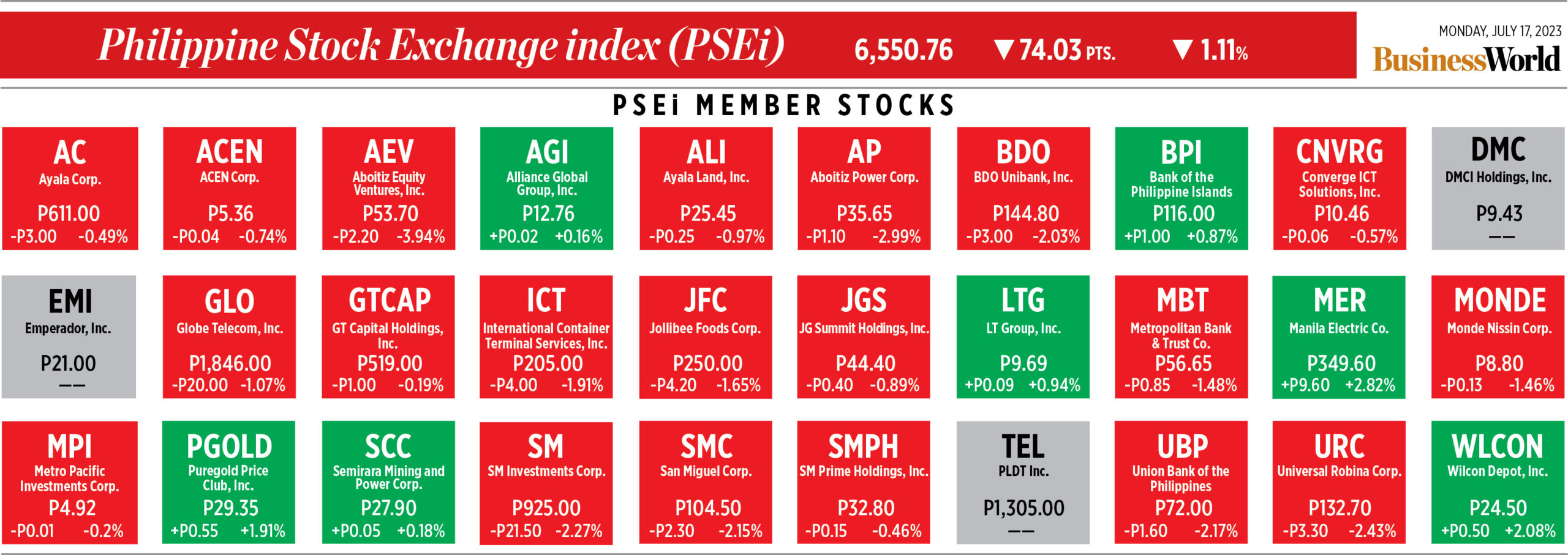
Here’s a quick glance at how PSEi stocks fared on Monday, July 17, 2023.


Peso strengthens vs dollar

BW FILE PHOTO

THE PESO climbed to a new three-month high versus the dollar on Monday following hawkish comments from the Bangko Sentral ng Pilipinas (BSP) chief.

The local currency closed at P54.38 against the dollar on Monday, inching up by two centavos from Friday’s P54.40 finish, data from the Bankers Association of the Philippines’ website showed.

This was the peso’s strongest finish since it closed at P54.36 a dollar on March 31.

The local unit opened Monday’s session weaker at P54.44 per dollar. Its worst showing for the day was at P54.51, while its intraday best was at P54.30 against the greenback.

Dollars traded went down to $977.4 million on Monday from the $1.15 billion seen on Friday.

The peso was supported by hawkish comments from BSP Governor Eli M. Remolona, Rizal Commercial Banking Corp. Chief Economist Michael L. Ricafort said in a Viber message.

“The peso appreciated after BSP Governor Remolona remarked that any local policy rate cuts remain premature this year,” a trader likewise said in an e-mail.

The central bank remains on the “tightening side” as it monitors upside risks to inflation, including El Niño and wage hikes, Mr. Remolona said in a Bloomberg Television interview on Friday.

“For now, we’re contemplating whether to hike or not to hike,” he told Bloomberg TV’s Kathleen Hays on Saturday. “We’re not thinking about whether to cut or not to cut.”

Mr. Remolona added that the central bank is also watching out for any immediate effects the US Federal Reserve’s tightening cycle has on the peso.

The BSP has held its key rate at a near 16-year high of 6.25% for two straight meetings after hiking by a cumulative 425 basis points.

Its next policy meeting is on Aug. 17.

For Tuesday, the trader said the peso could weaken due to recession concerns after a weaker Chinese gross domestic product  (GDP) report for the second quarter.

China’s GDP grew 0.8% in the second quarter from the previous quarter on a seasonally adjusted basis, versus the 2.2% expansion in the January-March period.

Year on year, GDP expanded 6.3% in the second quarter, faster than the 4.5% growth logged in the previous three-month period.

The trader sees the peso moving between P54.30 and P54.55 per dollar on Tuesday, while Mr. Ricafort expects it to range from P54.30 to P54.50. — A.M.C. Sy with Bloomberg