PSEi inches higher as investors pick up bargains
STOCKS climbed on Wednesday as investors picked up bargains and stayed on the sidelines while awaiting key events happening next week.
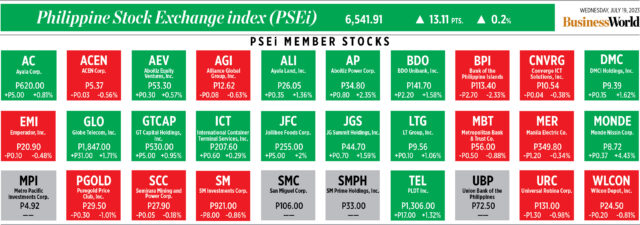
The Philippine Stock Exchange index (PSEi) rose by 13.11 points or 0.2% to 6,541.91 on Wednesday, while the broader all shares index went up by 8.16 points or 0.23% to 3,490.91.
“Bargain hunting helped give the market a slight lift amid continued consolidation and a lack of fresh leads,” China Bank Capital Corp. Managing Director Juan Paolo E. Colet said in a Viber message.
“Daily value turnover was modest… as many investors remain on the sidelines ahead of major news flows expected next week, including the State of the Nation Address and the Federal Reserve’s policy rate announcement and interest outlook,” Mr. Colet added.
Value turnover went up to P3.66 billion on Wednesday with 489.05 million shares changing hands from the P3.2 billion with 486.7 million issues seen on Tuesday.
President Ferdinand R. Marcos, Jr. will deliver his first State of the Nation Address on July 24.
Meanwhile, the Fed will hold its policy meeting on July 25-26, where it is expected to raise borrowing costs by 25 basis points (bps). Analysts have said this hike could be the last one for the year amid easing inflation in the world’s largest economy.
The US central bank paused its tightening cycle in June after hiking the fed funds rate by 500 bps to a range between 5% and 5.25%.
The local market ended higher to track gains on Wall Street overnight, Papa Securities Equity Strategist Manny P. Cruz added in a Viber message.
On Tuesday, the US stock market went up, partly boosted by solid financial earnings during the period which helped put the Dow on track for its longest streak of daily gains in more than two years, Reuters reported
The Dow Jones Industrial Average rose 366.58 points or 1.06% to 34,951.93; the S&P 500 gained 32.19 points or 0.71% at 4,554.98; and the Nasdaq Composite added 108.69 points or 0.76% at 14,353.64.
Meanwhile, Asia’s stock markets were mixed on Wednesday with growth concerns dragging on China’s equities while shares rose in Japan and Australia after healthy US company earnings and retail data bolstered hopes the world’s biggest economy could avoid a recession.
Back home, sectoral indices closed higher on Wednesday, except for financials, which declined by 5.81 points or 0.3% to 1,892.04.
Meanwhile, mining and oil rose by 111.38 points or 1.13% to 9,962.35; industrials increased by 51.52 points or 0.55% to 9,276.82; services climbed by 6.97 points or 0.44% to 1,586.05; property jumped by 8.47 points or 0.32% to 2,653.74; and holding firms inched up by 3.85 points or 0.06% to 6,369.45.
Decliners outnumbered advancers, 92 versus 80, while 48 names closed unchanged.
Net foreign buying stood at P43.99 million on Wednesday versus the P71.29 million in net selling seen on Tuesday. — A.H. Halili with Reuters
Peso weakens further due to US, China data
THE PESO weakened further against the dollar on Wednesday following slower-than-expected US retail sales data and amid persistent worries over the weak China gross domestic (GDP) growth in the second quarter.
The local currency closed at P54.515 versus the dollar on Wednesday, declining by 10.50 centavos from Tuesday’s P54.41 finish, data from the Bankers Association of the Philippines’ website showed.
The local unit opened Wednesday’s session at P54.45 per dollar, which was also its intraday best. Its weakest showing for the day was at P54.65 against the greenback.
Dollars traded jumped to $1.05 billion on Wednesday from the $753.4 million seen on Tuesday.
The peso dropped following data on US retail sales and economic growth in China, Rizal Commercial Banking Corp. Chief Economist Michael L. Ricafort said in a Viber message.
“The peso weakened amid lingering recession worries from downbeat US retail sales and weaker Chinese GDP reports this week,” a trader likewise said in an e-mail.
US retail sales increased 0.2% last month. Data for May was revised higher to show sales gaining 0.5% instead of 0.3% as previously reported, Reuters reported.
Meanwhile, China GDP grew just 0.8% in April to June from the previous quarter, on a seasonally adjusted basis, data released by the National Bureau of Statistics showed on Monday, versus analysts’ expectations in a Reuters poll for a 0.5% increase and compared with a 2.2% expansion in the first quarter.
On a year-on-year basis, GDP expanded 6.3% in the second quarter, accelerating from 4.5% in the first three months of the year, but the rate was well below the forecast for growth of 7.3%.
The peso declined following the recovery of the US dollar, Mr. Ricafort added.
The dollar index was last up 0.04% on the day at 99.924 after earlier falling to 99.549, the lowest since April 2022.
For Thursday, the trader said the peso could continue to weaken following the release of June inflation data from Europe.
The trader sees the peso moving between P54.35 and P54.60 per dollar on Thursday, while Mr. Ricafort sees it ranging from P54.40 to P54.60. — AMCS with Reuters
Philippines says ICC undermining sovereignty with drug war probe
THE INTERNATIONAL Criminal Court (ICC) is undermining the Philippine government’s sovereignty by continuing its investigation of ex-President Rodrigo R. Duterte’s deadly war on drugs, the Department of Justice (DoJ) said on Wednesday
“The ICC’s rejection of our appeal is based on a flawed interpretation of its own jurisdiction,” it said in a statement. “It fails to acknowledge that the Philippines has a functioning and capable domestic legal system that is fully capable of investigating and prosecuting crimes within its jurisdiction.”
The ICC Appeals Chamber on Tuesday rejected a state plea in a 3-2 vote to suspend the probe, saying the ICC-Pre-Trial Chamber had correctly allowed its prosecutor to do its mandate.
President Ferdinand R. Marcos, Jr. should support accountability for grave crimes in the Philippines and uphold the country’s obligation under the ICC’s founding Rome Statute to cooperate with the court, Human Rights Watch said.
“The ICC Appeals Chamber decision rejects Philippine government claims that the ICC should not investigate in the country,” Bryony Lau, deputy Asia director at Human Rights Watch, said in a statement. “President Marcos should back up his stated commitment to human rights by cooperating with the ICC prosecutor’s inquiry.”
In March, the United Nations-backed tribunal based in the Hague denied the government’s request to stop the ICC Pre-Trial chamber from reopening its investigation of Mr. Duterte’s anti-illegal drug campaign.
The Justice department said the dissenting opinions of the two judges cast doubt on the chamber’s ruling.
“These dissenting Justices rightly recognized the Philippines’ commitment to uphold the rule of law and maintain an independent and effective legal system.”
Appeals Chamber Presiding Judge Marc Perrin de Brichambaut and Judge Gocha Lordkipanidze, who dissented, said the pre-trial chamber has no jurisdiction over the Philippines after it withdrew from the ICC in 2018.
DoJ said the ICC should abide by the principle of complementarity, a concept of international law that ensures a state’s national authorities take precedence in handling criminal cases.
“We urge the ICC to reconsider its decision and recognize the Philippines’ unwavering commitment to the rule of law and the pursuit of justice,” the agency said.
‘HUMAN RIGHTS OF ALL’
Meanwhile, the Commission on Human Rights (CHR) said the government of President Ferdinand R. Marcos, Jr. should view the decision as an opportunity to show its commitment to punish human rights violators.
“From the lens of justice, CHR acknowledges the continuation of the investigation as part of the due process meant to uphold the rights of victims, as well as the accused, through a fair and impartial procedure with the end view of exacting truth and, later on, accountability from the perpetrators if and when guilt is established,” it said in a statement.
“CHR is willing, ready, and able to assist the government so it may better comply with its obligations to respect, protect and fulfill the human rights of all.”
The agency earlier said the Duterte government had encouraged a culture of impunity by hindering independent inquiries and failing to prosecute erring cops.
Last year, Mr. Marcos Jr. said the Philippines would not rejoin the ICC, which political experts said is meant to protect his predecessor from prosecution.
In a statement on Tuesday night, the Office of the Solicitor General said it was disappointed with the ruling, but said it would continue to focus on domestic investigations of the previous government’s anti-illegal drug campaign.
Solicitor General Menardo I. Guevarra told reporters in a Viber message the ICC ruling had a “gaping hole” after failing to rule on the issue of jurisdiction.
“This unresolved issue of jurisdiction will be a powerful argument for any person who may be investigated or charged by the ICC,” he added.
The ICC Pre-Trial Chamber in January reopened its probe of Mr. Duterte’s campaign against illegal drugs, saying it was not satisfied with government efforts to probe human rights abuses.
It was also set to probe vigilante-style killings in Davao City when the former president was still its vice mayor and mayor.
The tribunal, which tries people charged with crimes against humanity, genocide, war crimes and aggression, suspended its probe of the deadly drug war in 2021 upon the Philippine government’s request.
ICC Prosecutor Karim Ahmad A. Khan earlier said the Philippines had not raised new arguments to justify halting the probe.
The Philippines has accepted 200 recommendations from the United Nations Human Rights Council, including investigating extralegal killings and protecting journalists and activists.
The government estimates that at least 6,117 suspected drug dealers were killed in police operations. Human rights groups say as many as 30,000 suspects died.
“Our justice system stands ready to ensure a fair and impartial investigation, prosecution and appropriate punishment for any proven crimes,” the DoJ said. — John Victor D. Ordoñez

SC affirms dismissal of ill-gotten wealth case vs late dictator, cronies
THE SUPREME Court (SC) has affirmed the anti-graft court’s dismissal of a P1.052 billion ill-gotten wealth lawsuit against the late dictator Ferdinand E. Marcos, Sr., his wife Imelda and their business associates for insufficient evidence.
In a 26-page decision dated March 29 and made public on July 18, the tribunal agreed with the Sandiganbayan that government prosecutors had failed to prove that Mr. Marcos and his wife conspired with their cronies to amass ill-gotten assets.
“Upon the Sandiganbayan’s evaluation of the remaining admissible evidence, it concluded that such pieces of evidence were either insufficient to prove the allegations of the expanded complaint, or were unrelated to the facts sought to be proved by the petitioner,” it said.
The Presidential Commission on Good Government (PCGG) filed the case in 1987 and accused the Marcos family’s business associates of acting as dummies by buying and acquiring properties.
The agency alleged that Dominador R. Santiago, who owned Tourist Duty Free Shops, allowed 5% of its taxes to be diverted to the Nutrition Center of the Philippines, which was headed by Mrs. Marcos, and the Manila Seedling Bank, which was run by businessman Bienvenido Tantoco, Sr.
The PCCG said the associates gained tax exemptions in exchange for illegally acquiring assets for the Marcoses.
Cleared were Mr. Santiago, Mr. Tantoco and his son Bienvenido Jr., Maria Lourdes Tantoco-Pineda and Gliceria R. Tantoco.
“In the face of such gaps, the petitioner’s allegations in its expanded complaint are reduced to mere speculations, insinuations and conjectures,” the High Court said.
A popular street uprising toppled the dictator’s regime in February 1986, forcing him and his family to flee into exile in the United States.
That same year, his successor, the late Corazon C. Aquino, set up the PCGG to go after ill-gotten assets of the elder Marcos, his family and cronies that were amassed during his two-decade rule.
His son and namesake is now the Philippine president.
The Sandiganbayan in March denied the Marcos family’s appeal to regain control of some frozen bank accounts and properties seized by the government.
Political experts have said an unfavorable judgment against the Marcoses could lead to a constitutional crisis since law enforcers are under the president.
In 2003, the High Court awarded the Philippine government $658 million (P36 billion) of the dictator’s frozen Swiss bank deposits. — John Victor D. Ordoñez
Maritime zones seen to enforce Philippine arbitral win
By Beatriz Marie D. Cruz, Reporter
MARITIME experts on Wednesday urged Congress to prioritize the passage of a bill that seeks to establish the Philippines’ maritime zones.
“We would actually be taking a step to implement and enforce the South China Sea arbitration award [if the maritime zone bill is passed],” Jay L. Batongbacal, director of the University of the Philippines Institute for Maritime Affairs and Law of the Sea, told a forum.
The measure would give a “very clear idea of what it is that we are trying to preserve and manage, and what it is that we will not be giving up,” he added.
The proposed law would establish “with clarity and certainty” the exact bounds of the Philippines’ maritime entitlements under the United Nations Convention on the Law of the Sea (UNCLOS) and other international laws, said Toff Lamug, senior program officer at think tank Waypoints, which organized the forum.
China, which claims more than 80% of the South China Sea, has ignored a 2016 ruling by a United Nations-backed arbitration court that voided its claim based on a 1940s map.
The Philippines, which is being backed by the United States and its allies to ensure freedom of navigation in the South China Sea, has been unable to enforce the ruling and has since filed hundreds of protests over what it calls encroachment and harassment by China’s coast guard and its vast fishing fleet.
Enacting a law declaring the country’s maritime zones will have more implications for China, Mr. Batongbacal said, because it shows that other Southeast Asian countries with territorial claims can “act consistently with the award and that undermines [China’s] position that they own the South China Sea.”
The House passed the bill in March, while it is still pending in the Senate.
Julio S. Amador III, chief executive officer at Amador Research Services, said the country’s marine security policy needs to be updated.
“The mention and importance given to nontraditional security issues including protection and conservation of our marine resources and the importance of sustainable development is not sufficient,” he told the forum.
The Philippines maritime threats including illegal fishing, sea terrorism, piracy, smuggling, human trafficking, marine pollution and environmental degradation, and gray zone activities, Mr. Amador said, citing Waypoints’ 2022 civil maritime security report.
He said the county’s maritime agenda and framework is no longer responsive to current realities. “The 1994 National Marine Policy has neither been fully implemented nor updated.”
He also said the country’s three-way cooperation deal with Indonesia and Malaysia had not been fully operationalized. Maritime law enforcement agencies have inadequate workforce, infrastructure and assets, he added.
The government should focus on nontraditional security such as human security concerns and the development of the country’s blue economy, Mr. Amador said.
Mr. Batongbacal said passing the maritime zone bill would also help promote the sustainable use of ocean-based resources through green infrastructure and technology.
“Having an effective and efficient maritime governance necessitates the clear identification of the maritime areas over which the Philippines exercises sovereignty,” Mr. Lamug said.
SC upholds Makati tax liabilities worth P1.3 billion plus interest
THE SUPREME COURT (SC) has upheld with modification the Makati City’s tax liabilities worth P1.33 billion for 1999 to 2001 and 2002 to 2004.
In a resolution dated March 15 and made public on July 18, the tribunal ordered the Bureau of Internal Revenue (BIR) to impose a 20% interest until 2017 for the unpaid taxes.
It said Makati had admitted its liability by failing to contest the tax bureau’s assessments.
“On top of that, the city of Makati did not submit any relevant documents to support its protest,” the High Court said.
In 2002, the BIR regional director of Makati assessed the city of tax liabilities worth P1.04 billion for 1999 to 2001 and P217.8 million for 2002 to 2004.
They agreed on another compromise of P100 million to settle the tax liabilities for 2002 to 2004 on the condition that 30% of the amount would be paid by the end of October that year.
Makati and the BIR settled on a compromise of P100 million for the tax liabilities for 1999 to 2001, with the city government paying P20 million that year. But a newly appointed regional director in 2006 rejected the compromise deal.
The High Court ordered the BIR to deduct the initial payments already made by Makati worth P400 million and P301.98 million for the covered years.
In 2007, the BIR ordered the collection of P1.15 billion still due from Makati City, forcing it to elevate the case to the Court of Tax Appeals.
Makati argued that the collection of taxes was a disservice to residents, saying basic services would be affected.
The appellate tax court dismissed Makati City’s appeal to set aside its deficiency value-added tax and withholding compensation taxes, saying it had failed to file the claim on time. — John Victor D. Ordoñez

Marcos names new AFP chief
PRESIDENT Ferdinand R. Marcos, Jr. has appointed Philippine Army commanding general Romeo S. Brawner, Jr. as chief of the Armed Forces of the Philippines (AFP), according to the presidential palace.
He would replace General Andres Centino, who is set to be appointed presidential adviser on the West Philippine Sea, the palace said in a statement.
Mr. Brawner Jr. served as the commanding general of the Philippine Army, a post that he took in December 2021.
He graduated No. 2 in the Philippine Military Academy Makatao Class of 1989 and has since served the military in various capacities for 34 years now, the palace said.
Mr. Brawner also served as commandant of cadets in the Philippine Military Academy where he, according to the palace, “played an important role in the total eradication of hazing and maltreatment in the Cadet Corps.”
Meanwhile, Mr. Marcos Jr. also appointed lawyer Vigor Mendoza as assistant secretary of the Transportation department. He will head the Land Transportation Office (LTO).
BIR raids 747 establishments
THE BUREAU of Internal Revenue (BIR) said it raided 747 establishments and warehouses this month as part of its second nationwide enforcement initiative.
“The total tax liability of these noncompliant businesses is still unclear since the BIR is still in the process of making an inventory of all the goods that were confiscated,” it said in a statement on Wednesday.
The agency said it would file criminal cases against the owners of the establishments. “Comply with our regulations on excisable products. Pay your excise taxes. We will raid noncompliant businesses. We will close their operations,” BIR Commissioner Romeo B. Lumagui, Jr. said.
He said his agency is monitoring excisable products such as cigarettes, vape and alcohol products, sweetened beverages, petroleum and mineral products and automobiles. — Luisa Maria Jacinta C. Jocson
OFWs jailed for debt back home
THE DEPARTMENT of Migrant Workers (DMW) on Wednesday said four overseas Filipino workers (OFWs) who were jailed in Saudi Arabia over debt have been released and returned to the Philippines.
“We are thankful to the Saudi government for the assistance, and we will be providing them with financial and reintegration assistance,” Migrant Workers Undersecretary Hans J. Cacdac told a virtual news briefing.
He said the four OFWs, who were jailed for four years over debt, arrived in the country on Monday. The DMW will provide jobs and psychological assistance to the migrant workers and their families.
“Eventually, the Saudi authorities saw that it was time for their release, and this is illustrative of the work we will do to assist our OFWs,” the DMW official said.
In March, Migrant Workers Secretary Maria Susanna V. Ople said Saudi Arabia plans to hire about a million skilled Filipino workers in the next 18 to 24 months through a special employment program.
The Saudi government promised President Ferdinand R. Marcos, Jr. in November that it would settle the unpaid wages and other benefits of Filipino workers who were laid off by private Saudi employers in 2015 to 2016. — John Victor D. Ordoñez

SC clears PSALM of tax liability
THE SUPREME COURT (SC) has upheld a Court of Appeals (CA) decision that cleared the Power Sector Assets and Liabilities Management Corp. (PSALM) of business tax liability for assets it bought from the National Power Corp. (Napocor).
In an 18-page decision dated March 15 and made public on July 18, the court said the law does not require PSALM to pay local business tax for the assets since Napocor’s power generation function ended after the Electric Power Industry Reform Act took effect in June 2001.
“There is also no contractual obligation, as in a deed of transfer, for PSALM’s liability for the said assessments,” according to the ruling penned by Associate Justice Rodil V. Zalameda.
“There was never any claim that PSALM exercised Napocor’s power generation function to justify PSALM’s assumption of [its] supposed liability for local business tax.”
Napocor sued Sual, Pangasinan in 2010 after its municipal treasurer assessed it of local business taxes for 2006 to 2009. The treasurer also filed a complaint against PSALM, demanding taxes on the properties it had acquired from Napocor.
The appellate court in 2016 ruled the lawsuit against PSALM was baseless, adding that it was not liable for business taxes. — John Victor D. Ordoñez