Home Blog Page 4537

July inflation likely eased below 5%
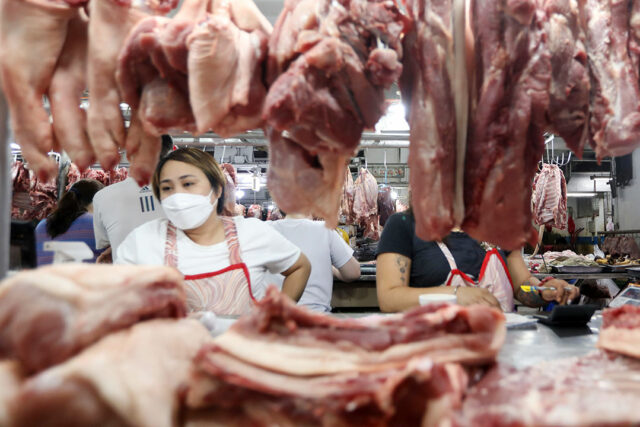
A vendor waits for customers at a public market. — PHILIPPINE STAR/EDD GUMBAN

By Keisha B. Ta-asan, Reporter

INFLATION likely further eased to below the 5% level in July, as base effects and lower power rates may have tempered higher food costs and pump prices, a BusinessWorld poll showed. 

A BusinessWorld poll of 17 analysts yielded a median estimate of 4.9% for July inflation, which would be slower than the 5.4% print seen in June and the 6.4% print in July 2022.

If realized, July would mark the sixth straight month of slowing inflation and the first time that inflation fell below 5% since 4.9% in April 2022.
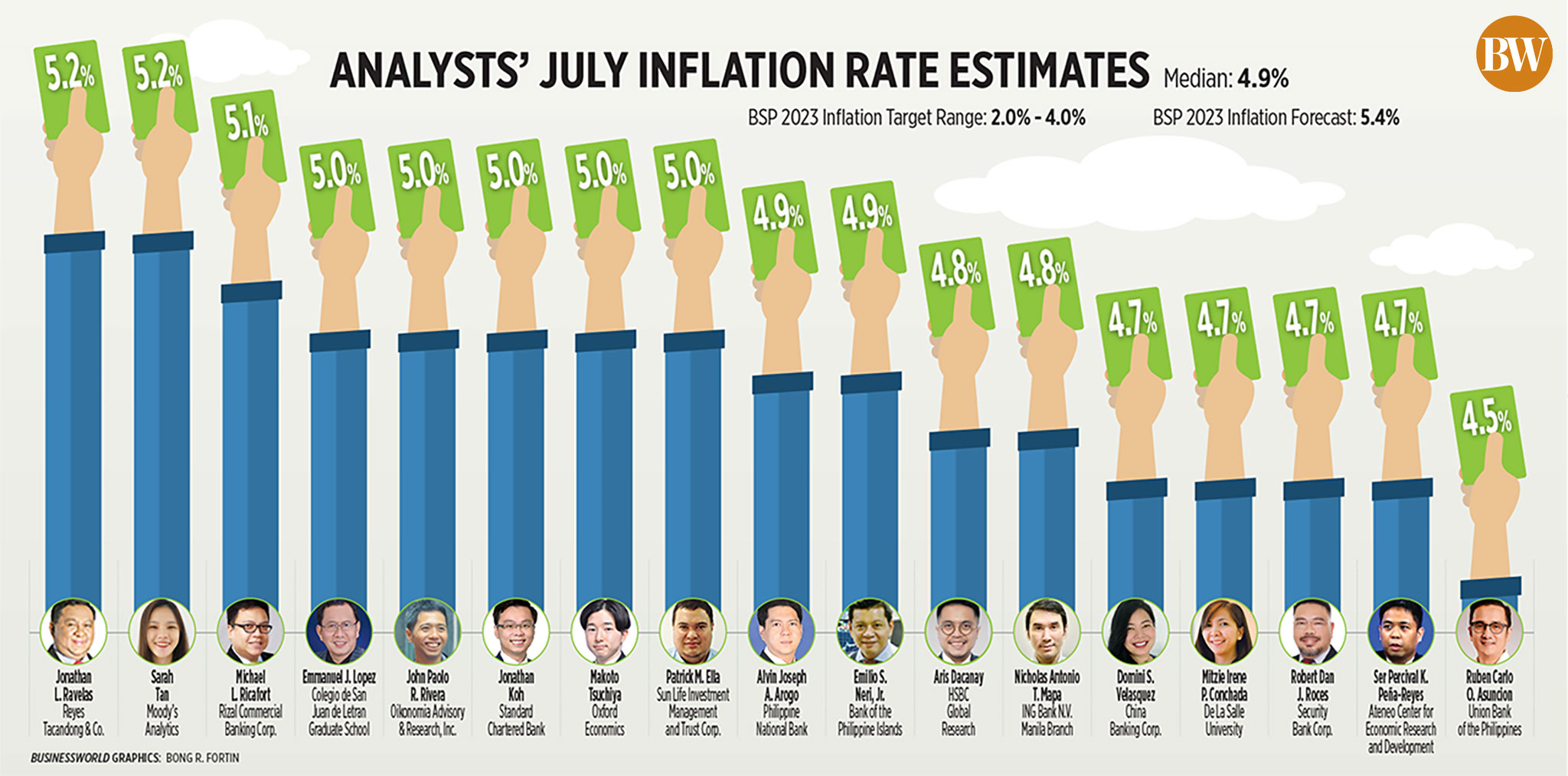
July inflation would also likely exceed the central bank’s annual 2-4% target range for the 16th straight month.

The Bangko Sentral ng Pilipinas (BSP) will release its inflation forecast today (July 31).

The Philippine Statistics Authority is scheduled to release the latest consumer price index data on Aug. 4 (Friday). 

According to analysts, inflation likely decelerated further in July as lower utility rates offset the rising prices of food and oil.

“Electricity rates in all regions fell substantially from the previous month, especially in Mindanao and Batangas. This likely resulted in a negative month-on-month inflation rate for non-food items,” China Banking Corp. Chief Economist Domini S. Velasquez said.   

Residential customers in areas served by Manila Electric Co.  saw lower electricity bills in July after the overall rate went down by P0.72 to P11.18 per kilowatt-hour.   

“Electricity prices decreased during the month while the peso strengthened against the dollar, making imports more affordable,” HSBC Global Research ASEAN economist Aris Dacanay said. 

The peso closed at P54.91 on Friday, strengthening by 0.52% or 29 centavos from its P55.2 finish on June 30.

Ms. Velasquez noted prices of key food items such as rice, fish, fruits, and vegetables may have increased during the month.

“This was likely brought about by the warmer weather in July. Recent typhoons could also negatively impact food prices in the coming months, especially rice and corn in the north due to Typhoon Egay,” she said.

The estimated damage to agriculture brought by Typhoon Egay (international name: Doksuri) was valued at P1.5 billion, the latest data from the National Disaster Risk Reduction and Management Council showed.

According to Security Bank Corp. Chief Economist Robert Dan J. Roces, there may be a 0.8% month-on-month increase in food inflation due to the higher price of rice, fish, and vegetables.

“This suggests that the food sector may continue to experience volatility, which could influence inflation dynamics in the coming months, and indeed still provides significant upside risks,” Mr. Roces said.   

He also noted that weather-related disruptions, supply chain issues, or changes in consumer demand may add to the volatility.

At the same time, Mr. Roces said recent pump price hikes have also added to inflationary pressures in July.

During the month, pump price adjustments stood at a net increase of P2.35 per liter for gasoline, P2.60 per liter for diesel, and P1.80 per liter for kerosene.   

“Fluctuations in energy prices can significantly influence overall inflation, and any developments in the global energy market may impact domestic inflation trends,” Mr. Roces said.

Philippine National Bank economist Alvin Joseph A. Arogo said consumer prices may have increased month on month in July due to the recent wage hike in Metro Manila.

A P40 minimum wage hike in the National Capital Region took effect on July 16. There are also pending wage hike petitions in other regions such as Central Luzon, Calabarzon, Western Visayas and Central Visayas which will likely be resolved by September.

“We think the price pressures from higher wages will be more pronounced in the months ahead,” Mr. Dacanay said.   

He noted India’s recent decision to ban exports of non-basmati white rice is another upside risk to inflation.

The Philippines is one of the world’s biggest rice importers, although it usually buys from Vietnam.

President Ferdinand R. Marcos, Jr. on Saturday said the Philippines should boost rice stocks and may consider a supply deal with India in preparation for the impact of El Niño.

Nicholas Antonio T. Mapa, senior economist at ING Bank N.V. Manila, said the ongoing conflict in Ukraine and the El Niño weather event may lead to more supply chain constraints in the coming months.

Last week, Russia decided to withdraw from a grain agreement that blocks Ukrainian grain exports in the Black Sea.

“The government must ensure timely importation of important food items to keep supply chains well-oiled and functioning efficiently,” Mr. Mapa said.

“Given the immense power at the disposal of the President, who holds the concurrent position of Agriculture secretary, we believe that prices should continue to go down if all measures to ensure food security are carried out effectively and immediately,” he added.   

Mr. Arogo noted that despite the emerging risks, base effects will continue to bring year-on-year inflation towards the 2-4% target range in the fourth quarter this year.

POLICY OUTLOOK
Analysts said that the Monetary Board may extend its policy hold next month, as inflation is on track to hit the target before the year ends.   

The Monetary Board has raised borrowing costs by 425 basis points (bps) from May 2022 to March 2023. This brought the policy rate to 6.25%, a near 16-year high.

“Sticking to this data-driven mantra, monetary policy will be flexible enough to carry out rate hikes when warranted, pause when needed, and cut when necessary. As of now, the bias is still to hike rates, if needed, given that inflation remains above target and growth above 6%,” Mr. Mapa said.

The Philippine economy grew by 6.4% in the first quarter, its slowest in two years.   

“In the coming months, should inflation fall comfortably within target and growth slows considerably, BSP Governor [Eli M.] Remolona indicated that he can talk about rate cuts and consider them to insulate the economy, if need be,” Mr. Mapa added.   

Makoto Tsuchiya, an assistant economist from Oxford Economics, said easing inflation gives the BSP some comfort in pausing at its August meeting despite the latest rate hike by the US Federal Reserve. 

“The peso is unlikely to weaken to the extent seen last year as the domestic economic recovery is more advanced. On top of this, with much lower domestic inflation, the central bank can be more tolerant of currency depreciation,” Mr. Tsuchiya said.   

The US Federal Reserve raised the federal funds rate target range by 25 bps to 5.25-5.5% last week, the highest level in 22 years.   

“If the exchange rate sharply weakens due to the lower BSP-Fed interest rate differential, however, then we believe that BSP will act fast. This can be in the form of a clear advance guidance or even an unscheduled meeting,” Mr. Arogo said.   

Mr. Dacanay noted that the BSP may only cut rates after the US Fed starts its policy easing.

The Monetary Board’s next policy review is scheduled on Aug. 17.

DoF orders agencies to address underspending

PHILIPPINE STAR/RUSSELL PALMA

THE DEPARTMENT of Finance (DoF) ordered government agencies to come up with a “catch-up” plan to address underspending in the first half of the year.

“We talked to agencies, and we asked them to come up with their own catch-up plan. The problem is they are underspending. Their budget has been increased significantly this year (but) they’re still not spending,” Finance Secretary Benjamin E. Diokno told reporters at the DoF office in Pasay City, Friday.

“We are still optimistic they will be able to catch up.”

The National Government’s budget deficit narrowed by 18% to P551.7 billion in the January-to-June period as revenue collections exceeded the target while spending slowed. However, it was 28.49% lower than the P771.5-billion program for the period.

State spending inched up by 0.42% to P2.41 trillion in the first half but missed its P2.58-trillion expenditure program by 6.6%.

“I’m worried we aren’t meeting our expenditure target. I’m not happy with a smaller deficit,” Mr. Diokno added.

This year, the government has set a budget deficit ceiling of P1.499 trillion, equivalent to 6.1% of the gross domestic product.

Mr. Diokno said agencies may have been underspending due to “birth pains” as the Marcos administration has only had one year in office.

“There are adjustments. Let’s call it birth pains. Congress made a lot of changes in the budget, there are new projects introduced in the budget. And since they are new, they may not have feasibility studies and engineering (plans) so they cannot start building,” he said.

“Though our underspending is not as big, unlike other years. This time, it’s just a matter of procurement delays. The weather was cooperating in the first six months,” he added.

Mr. Diokno expressed optimism that government agencies will still be able to catch up with spending in the second half.

Data from the Department of Budget and Management showed that government agencies’ budget utilization rate stood at 98% at the end of the second quarter, slightly slower than the year-ahead pace of 99%.

As of end-June, the newly formed Department of Migrant Workers registered the lowest utilization rate at 44%.

This was followed by the Department of Agriculture (76%), the Office of the Vice-President, the Department of Information and Communications Technology, and the Department of Social Welfare and Development (80%).

REVENUES
Meanwhile, Mr. Diokno said that the government is planning to maintain its full-year revenue program for the year.

“We’re not revising. In fact, for the Bureau of Customs (BoC), we actually adjusted it downward. That’s mainly because oil prices have gone down significantly, and the peso has stabilized. If you look at the peso value of our oil imports, there was a huge decline. So, we adjusted the target of the BoC,” he added.

The government plans to collect P3.729 trillion in revenues this year, equivalent to 15.2% of gross domestic product.

In the first half, revenues rose by 7.68% year on year to P1.86 trillion, exceeding the P1.81-trillion program by 2.72%.

According to the BoC’s Financial Service, the agency’s adjusted collection goal for this year is at P874.166 billion. This is lower than its previous target of P901.3 billion.

The Bureau of Internal Revenue (BIR) raised its revenue collection goal for this year to P2.64 trillion, slightly higher than its previous target of P2.599 trillion.

Mr. Diokno said that the government has been efficient in collecting nontax revenues.

“I think we are really performing very well. Right now, if my recollection is correct, we (have raised) around P90 billion from privatization. During other administrations, that’s what they achieved from their entire term. We are very quick to deal with privatization, that’s why nontax revenues grew much faster than tax revenues, though both are above target,” he added.

Nontax revenues rose by 9.13% to P203.1 billion in the January-to-June period. Revenues from other offices, which include privatization proceeds, fees, and charges, jumped by 34.26% to P110.2 billion, surpassing its P81.7-billion target.

Mr. Diokno also said that the government is also working on reviewing the regulations of its collection agencies to improve the ease of doing business.

“We continue to review our existing regulations for both the BIR and BoC. There is a plan to do e-invoicing for the BoC… so importation will be more efficient. We continue to improve the regulations, simplify requirements,” he said. — Luisa Maria Jacinta C. Jocson

Inflation in ‘right direction,’ but PHL faces persistent upside risks

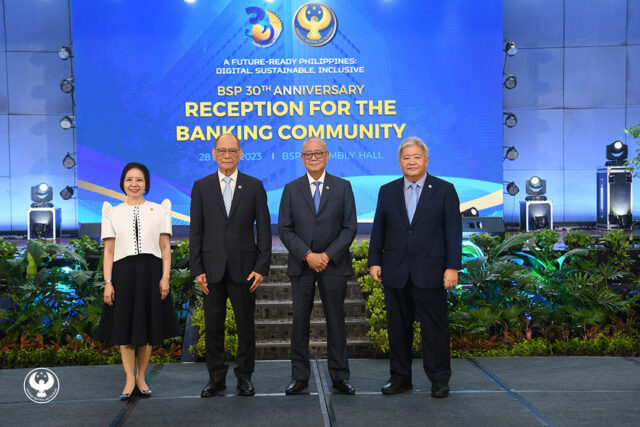
Bangko Sentral ng Pilipinas Governor Eli M. Remolona (third from left) attends the 30th BSP Anniversary Reception for the Banking Community, along with (from left) Monetary Board members Anita Linda R. Aquino, Finance Secretary Benjamin E. Diokno and Bruce J. Tolentino. — BANGKO SENTRAL NG PILIPINAS

THE BANGKO SENTRAL ng Pilipinas (BSP) needs to ensure that the downtrend in inflation is “more permanent,” amid persistent upside risks arising from the El Niño weather event and Russia’s invasion of Ukraine.

“Inflation is in the right direction but we have to be able to set in the measures which will make it long term and sustainable. Right now, we’re lucky that fuel prices are going down. But that’s luck. We need to make it more permanent,” Monetary Board member Bruce J. Tolentino told reporters on the sidelines of the annual reception for the banking community on Friday.

At the same event, BSP Governor Eli M. Remolona said it is too early to “declare victory” against inflation, even if it is on its way to the 2-4% target band.

“Core inflation remains high. There are still upside risks to inflation — for example, risks in the form of El Niño and further supply shocks. We will wait and see. We will analyze the data as they arrive, and that analysis will decide monetary policy down the road,” Mr. Remolona said.

The BSP expects inflation to return to the 2-4% target range by the fourth quarter this year, with full-year inflation hitting 5.4% in 2023. Inflation is expected to decelerate further to 2.9% in 2024.

According to Mr. Tolentino, the blockage of wheat and fertilizer exports due to the ongoing conflict in Ukraine will impact prices of rice and corn globally.

“We’re reacting to international developments particularly to fuel, but if Ukraine gives a kick to food and fuel prices, we have a problem,” he said.

Earlier this month, Russia quit the Black Sea Grain Initiative which allowed Ukraine to export grain to help prevent a global food crisis.

“There’re still long-term underlying productivity issues that we have to resolve, and those long-term underlying productivity issues are all about agriculture,” Mr. Tolentino said, adding the government should consider amending the tariff structure to support price stability.

National Economic and Development Authority Secretary Arsenio M. Balisacan said inflation likely further moderated in July, but cited risks from rising oil prices.

“We are seeing oil prices going up a bit. We’ll see how Russia moves in the Ukrainian exports of grain, but I will say that it will not be as bad in terms of the global reaction of the markets as before, because I suppose that you know, the world learned from those further shocks,” he told reporters on Friday.

Mr. Balisacan also noted the impact of Typhoon Egay, which has caused P1.5 billion in agriculture damage so far.

“That’s really a very serious concern because we never expected this kind of flooding. The assessment is still going on,” he said.

“They’re monitoring the situation, especially the impact on agriculture because it’s flooding in the Ilocos Region. Benguet has also been hit hard and that’s where a lot of vegetables come from. We don’t have much of the data now. Hopefully, it’s not that serious,” he added.

POLICY
Meanwhile, Finance Secretary Benjamin E. Diokno, a member of the Monetary Board, said that the BSP does not have to match the recent rate hike made by the US Federal Reserve.

“I don’t think we have to match, that’s my view. We have to monitor other indicators like inflation and what’s the impact of this recent adjustment on the global economy and the domestic economy,” he said in a press chat on Friday.

The US central bank hiked the federal funds rate target range by 25 basis points (bps) to 5.25-5.5% last week, the highest level in 22 years.

The BSP also raised its key policy rate by 425 bps to 6.25% from May 2022 to March 2023. It will meet again on Aug. 17 to discuss the country’s policy settings.

The interest rate differential between the Fed and the BSP now stands at 75 bps.

“When we meet on Aug. 17, we will look at all this. (We also consider) the impact of the slowdown. We have to think, we might have a recession here. We will look at all the numbers. We are data dependent,” Mr. Diokno said.

Mr. Diokno said that there have been times where the interest rate differential between the Fed and the BSP is narrow. — Keisha B. Ta-asan and Luisa Maria Jacinta C. Jocson

FIRB grants tax incentives to 25 projects

BW FILE PHOTO

THE FISCAL Incentives Review Board (FIRB) has approved the application for tax incentives of 25 projects with a combined investment capital of P287.7 billion in the first year of the Marcos administration, the Department of Finance (DoF) said.

“These are expected to generate around 24,617 jobs in telecommunications, data centers, manufacturing, infrastructure, tourism, hospitals, mass housing, energy, and information technology and business process management (IT-BPM),” Finance Secretary Benjamin E. Diokno said in a press chat in Pasay City on Friday.

Data from the DoF also showed that incentives granted from June 30, 2022 to July 28, 2023 were worth P29.97 billion.

Tax incentives ranged from duty exemptions on importation, value-added tax zero-rating on local purchases, and income tax holidays, among others.

The FIRB granted incentives for two major telecommunication infrastructure projects, one worth P147 billion by Unity Digital Infrastructure, Inc. and another worth P36 billion by LBS Digital Infrastructure Corp.

It also approved incentives for energy projects by Enovate Motors Corp. (P16 billion), Century Summit Carrier, Inc. (P15.8 billion), and Century Peak Energy Corp. (P7.6 billion).

Other projects include data centers by Evolution Data Centres Philippines, Inc. (P9.7 billion) and Digital Edge Philippines, Inc. (P5.4 billion).

The FIRB also approved projects involved in manufacturing, mass housing, health, and tourism.

Meanwhile, Mr. Diokno, who accompanied President Ferdinand R. Marcos, Jr. on a state visit to Malaysia last week, said Malaysian investors and firms are still concerned over the high power costs and difficulty of doing business in the Philippines.

“If you want to set up a power plant, you need at least 65 permits from the National Government to (local government). We have tried to streamline,” he said.

Mr. Diokno also said that investors are awaiting the passage of the Public-Private Partnership (PPP) Act.

“That has passed the House already. We expect that to be passed by the Senate before the end of the year,” he added.

In December, the House of Representatives approved on third and final reading the PPP Act. It aims to create a more enabling environment for PPP partnerships.  L.M.J.C.Jocson

Phinma maps expansion after control over units

PHINMA Corp. plans to step up its expansion plans after acquiring a majority stake in the subsidiaries of its parent firm, an official of the listed holding firm said.

“This was part of our one Phinma objective where we are trying to consolidate the ownership of the operating companies of the group from Phinma, Inc. in our listed entity,” Deputy Group Chief Financial Officer Edmund Alan A. Qua Hiansen told BusinessWorld on the sidelines of a company event last Wednesday.

Mr. Qua Hiansen added that the acquisition would provide the subsidiaries with a platform to raise funds to grow their businesses.

“We are very optimistic about the future of all our core business units,” he said. “The Phinma Group is in a growth trajectory right now. Consolidating the investments is one thing; the next step is to continue our growth.”

In a previous disclosure, the company said it had signed the deed of absolute sale for five of the subsidiaries for a total of P2.34 billion.

The company acquired the 8% additional stake in Phinma Education Holdings, Inc. for P1.06 billion. The education unit currently has about 10 schools within its portfolio. The acquisition resulted in 75.2% ownership of the unit.

Phinma also purchased 36.7% of Phinma Property Holdings Corp. for P588.88 million. It now owns 86.3% of the property development subsidiary.

The company likewise bought shares in Phinma Hospitality, Inc. and Phinma Microtel Hotels for P251.24 million and P21.19 million, respectively. The companies are the management and master franchisor of the group’s Microtel and TRYP hotels.

After the acquisition, Phinma now owns 63.8% of Phinma Hospitality and 51% of Phinma Microtel.

Additionally, the company also acquired 63.47% of ABCIC Property Holdings, Inc. for P409.39 million. The purchase resulted in Phinma owning about 90% of the subsidiary.

Mr. Qua Hiansen said that the company, through its property unit, will venture into township development, starting with around 20 hectares in Western Visayas.

He added that the company is set to invest up to P420 million and will be targeting the low to middle housing market segments.

Phinma intends to put up a hotel in its proposed township projects via the Microtel and TRYP hotel brands, he said, “and if the location is right maybe including the education business as well.”

“We are looking at more townships… but we are really focused on areas outside of Metro Manila and growing urban communities,” he said.

“What we want to do is to provide it where [there] is not enough supply and there is still demand for people who want to live in a township,” he added.

Additionally, Mr. Qua Hiansen said Phinma is eyeing to start development for its insulated panel facility in Pampanga next year.

“We are in discussions with a foreign joint venture partner, who we think is world-class in these facilities so they can share the technical knowledge with us,” he added.

The company said earlier that it plans to spend around P500 million to construct a new facility. It also aims to produce approximately one million square meters of insulated paneling materials every year.

Meanwhile, Mr. Qua Hiansen said that the company is optimistic about the growth outlook of its businesses.

“There are exciting prospects that we continue to evaluate as we make these investments, we believe that they should be value accretive to the group,” he added. — Adrian H. Halili

Chery peaking

PHOTO BY KAP MACEDA AGUILA

New leadership, new direction, new energy vehicles

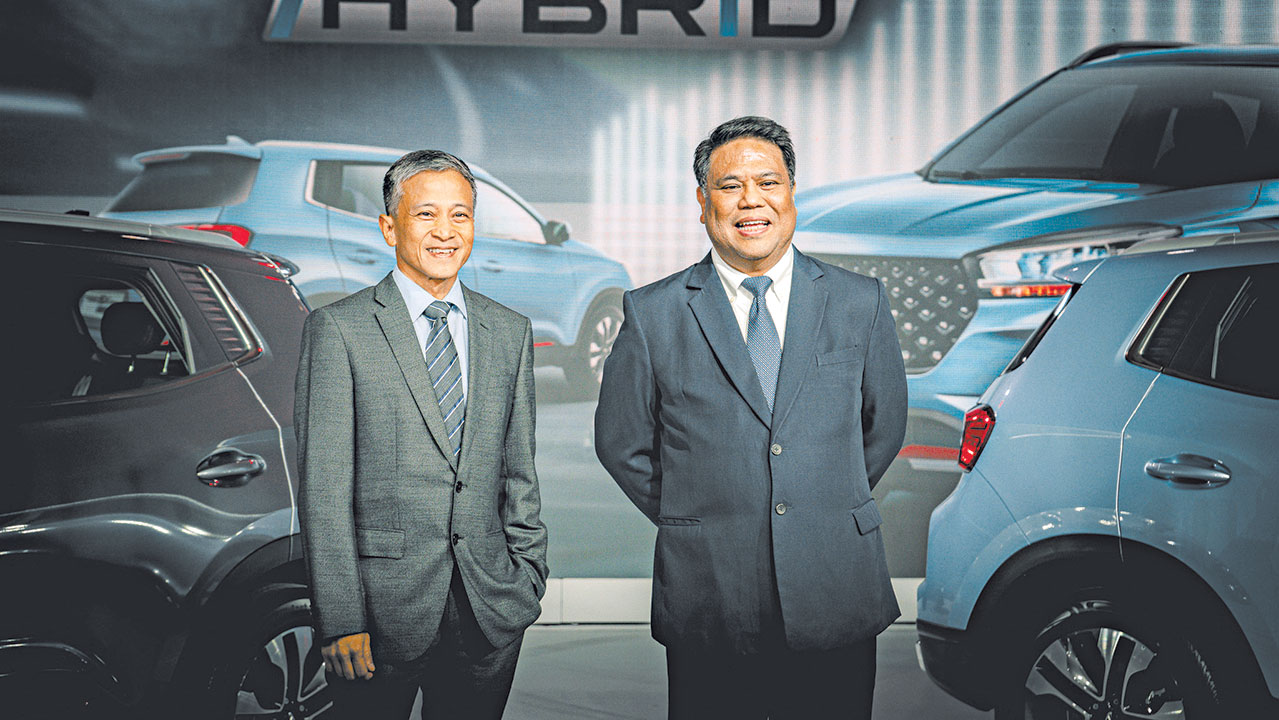
LAST WEEK, the next chapter veritably opened for Chery in the country, as local importer and distributor Chery Auto Philippines formally declared a new direction — underscored by the release of an electrified subcompact crossover and, perhaps, more importantly, the introduction of a new management team headed by a veteran automotive figure who assumes the role of managing director.

In a speech at an event attended by Chery partners, dealers, and members of the media, United Asia Automotive Group, Inc. (UAAGI) Chairman Rommel Sytin said, “Tonight, Chery Auto Philippines begins a new era of change. We are embarking on a serious path in keeping the needs of our past, present, and future customers at the core of everything we do. We are serious about giving our customers a competitive end-to-end Chery ownership experience.”

He noted that the recent all-time record of 382 units sold in a month, achieved just last month (see related story on Page 2/S3) is “solid proof that (Chery is on) the right track to achieve more success.”

Mr. Sytin added that the company is “adding more people to its management team who is seasoned, and with fresh perspectives and innovative strategies.”

Now leading the Chery Auto Philippines charge is Managing Director Froilan Dytianquin. An old hand in the auto industry, with three decades of cumulative experience with Mitsubishi Motors Philippines Corp. and Geely Philippines, he is said to have played a “vital role in bringing the (Geely) brand to top eight in the Chamber of Automotive Manufacturers of the Philippines, Inc.’s (CAMPI) industry sales charts.”

Mr. Dytianquin said during his presentation that he is “thrilled and motivated to propel this promising brand to new heights in the Philippine automotive industry.” Expressing thanks to Mr. Sytin and the directors of UAAGI, the executive appeared bullish over prospects for Chery. He described the brand as a “global powerhouse” which has been China’s number-one exporter of passenger vehicles for two decades. “This year alone Chery exports soared (by) a staggering 170% (and totaled) 394,000 units during the first half of the year. With over 11.2 million happy customers worldwide, the Chery brand experience is cherished by many. Such exponential growth cements Chery as one of the fastest-growing automotive brands globally.”

Chery Auto Philippines, he continued, will be opening more dealerships “to reach out to more Filipinos,” letting them experience what the new tagline, “There’s more to our cars,” is about.

“You will begin to notice changes in the manner of our communication; also how we engage with our customers,” promised Mr. Dytianquin. “We shall also introduce vehicles which have seamless integration of advanced features that cater to the needs of those who crave for cutting-edge technology, while maintaining an affordable price point. This also signals the brand’s focus on developing and introducing new energy vehicles shaping the future of Chery mobility.”

This means the introduction of more electrified vehicles in the market (see our exclusive interview with Mr. Dytianquin below).

The initial offering under the new management team is the Chery 5X Pro, also unveiled in the same event. The compact crossover, priced from P940,000 for a gas-powered variant, significantly banners a hybrid version with a price of P1.14 million. Chery Auto Philippines is also offering as much as P90,000 in savings for early-bird reservations. Chery packages the vehicle its standard 10-year/one-million-km engine warranty, five-year/150,000-km general vehicle warranty, free three years of preventive maintenance service (PMS), and free three years of roadside assistance.

“With its upmarket styling, efficient hybrid drivetrain, and premium features, we expect it to surprise and delight Filipinos who want to get more from their subcompact crossover,” Mr. Dytianquin said in a release.

This joins the recently launched Tiggo 7 Pro Hybrid, Chery’s first mild-hybrid model in the country. The Tiggo 7 Pro Hybrid gets a 48-volt BSG system supplementing a 1.5-liter turbocharged gasoline engine mated to a nine-speed CVT. The vehicle is priced at P1.35 million, while the non-hybrid variant costs P1.25 million.

Again, the tagline “There’s more to our cars” encompasses the whole Chery experience, he insisted. “It represents a profound brand commitment. It signifies our promise to deliver not just innovative and world-class vehicles but an unparalleled ownership experience. From the joy of owning to the fun of driving, all complemented by our unbeatable warranty program — the Chery Premium Preserv and exceptional after-sales support. (It) encapsulates our dedication to providing a holistic and elevated driving experience, surpassing expectations and catering to the diverse needs and desires of our esteemed customers.”

New Wave, Malaysian firm allot $50M for renewables

NEW Wave Strategic Holdings, Inc. (New Wave) said it had partnered with Emissary Capital Partners Sdn. Bhd. for a proposed investment of $50 million to develop the country’s renewable energy sector.

“It is important that the Philippines develops a more mature eco-system with capital providers across various stages of the investment cycle. With Emissary’s entry into the Philippines, we are providing more founders and entrepreneurs access to growth capital as well as a regional network that can help them expand across SEA,” Enrique Y. Gonzalez, director of New Wave, said in a media release.

The proposal involves a plan to invest in the country’s renewable energy sector to generate 1,000 megawatts (MW) of bankable capacity, New Wave said.

New Wave is a subsidiary of investment holding firm IP E-Game Ventures, Inc. while Emissary Capital is an investment firm focusing on Southeast Asia.

The parties said their proposal aims to fund companies in the renewable energy sector, electric vehicle industry, clean energy, and smart grids, while also identifying solar and wind farms in North Luzon as their immediate focus.

“Our value proposition is more than capital. We help businesses scale within the Philippines and can open up regional Southeast Asia access,” Mr. Gonzales said.

The entities said raising capital for renewable energy projects had been a challenge in the energy sector’s growth.

“Equipping developers with an additional war chest with value-added involvement in pre-development work will translate to attractive returns for the funds,” it said.

The parties also expect the installation of about 1,000 MW to help spur more foreign direct investment into the country and support the construction and operation of renewable energy projects.

“Clean energy is both a local and regional commitment amongst ASEAN neighbors. We believe cross-border investment and trade will ultimately benefit the entire region and help ASEAN meet its collective goals. We hope our fund can contribute to this goal as well as generate healthy returns,” said Erman Akinci, a partner at Emissary Capital.

New Wave and Emissary Capital expect their partnership to help advance the government’s target of increasing the share of renewable energy in the country’s power mix.

The government is aiming to increase renewables’ share to 35% by 2030 and 50% by 2040. As of end-2022, renewables accounted for 22% of the Philippine energy mix. — Ashley Erika O. Jose

‘We will capitalize on the major strengths of the brand’

Mr. Dytianquin delivers a presentation shortly after his introduction as Chery Auto Philippines managing director. — PHOTO BY KAP MACEDA AGUILA

We speak with Froilan Dytianquin, newly minted Chery Auto Philippines managing director, on what’s in the cards for the brand

Interview by Kap Maceda Aguila

VELOCITY: With everything we saw in your presentation, it’s obvious that you will be hitting the ground running with Chery. What are the marching orders you received as you assumed the role of managing director? What is the vision for the company and the brand, moving forward? How is this different from the old Chery run?

FROILAN DYTIANQUIN: Chery is basically a good brand. We weren’t able to maximize its strengths when it was relaunched in 2019. My goal is to revive the brand and, coming from another Chinese brand, I guess it’s going to be easy because I can basically duplicate the success story I was part of. The strength for Chery is in the products, based on what I’ve seen in their models. This is something that we will capitalize on through our network. Right now, we’re engaged in getting more dealer investors.

So the growth of the network is one of the key priorities?

Correct, that’s one pillar, and another is basically the marketing. From what I’ve observed, there wasn’t much effort put into aggressive marketing for Chery to highlight the strengths of the brand. So what I’ll do is to capitalize on the major strengths of the brand, of the organization, of the dealership, and the customer journey. As I mentioned, one of the strengths of the brand is that it provides, I believe, one of the best support in terms of warranty. This is top-notch, such as the 10-year engine warranty. I’m sure that most of the Chery owners right now appreciate this support, in addition to the low cost of ownership. We’re providing free three years of periodic maintenance services. When you buy a Chery you don’t have to think about maintenance. We’re trying to synergize all these strengths to be able to send a message to the public. That’s also why we’ve changed the tagline of Chery: There’s more to our cars. It’s about the total ownership experience that you will enjoy when you buy a Chery.

You come from another Chinese brand. With your experience working with Chinese brands — now with Chery — what do you see in the Philippine market that makes us such an attractive prospect for Chinese brands, and more of them are coming in? The other way around, what makes Chinese brands, particularly Chery, attractive to Filipinos? What are you seeing from both market and brand standpoints?

When I was with the other brand, one thing that we had observed is the growing segment of younger buyers — the millennials, the Gen Z. This is where the Chinese brands come in. This young market is pretty much not so brand-loyal, and these buyers rely on their personal judgment. They will not rely on their parents, friends, or relatives to decide for them which car to buy. On their own they do research, go to the dealership, check out specifications, test-drive the car. One thing good for this market is all the technology that Chinese brands provide.

This market is tech-savvy.

Yes, and this is something that we want to maximize — the growing market of young buyers. This is something that Chery and other Chinese brands can capitalize on in the years to come.

What will differentiate Chery from these other Chinese brands then?

I go back to my earlier statement. We’re going to provide a different experience. Every Chinese brand will surely highlight their technology as a value proposition. At the end of the day, okay, you got all that and features that you want, the value for money, but the cost of ownership is something we want to emphasize. At the same, our direction now is to go into new energy vehicles. That’s also something we’re looking forward to. Our future product lineup will be focused on these — mild hybrids, hybrids, plug-in hybrids, or even full electrics. We’re ready for that. When we were talking to new dealer investors, we’re not just selling normal ICE (internal combustion engine) cars but we will have these new energy vehicles as well.

So you will still have pure ICE vehicles, but bring in more of the new energy vehicles?

Yes, more hybrids to complement our ICE choices.

Maynilad sets P5.7-B capex for new water facilities

BW FILE PHOTO

WEST ZONE concessionaire Maynilad Water Services, Inc. is setting aside P5.7 billion as capital expenditure (capex) budget for new water treatment facilities to produce nearly 97 million liters per day.

Ang capex na binudget namin diyan (The capex that we budgeted) to produce close to 97 million liters per day is 5.7 billion [pesos],” Maynilad President and Chief Executive Officer Ramoncito S. Fernandez told reporters in a chance interview last week.

“[The project is in] phases as it is tied with the wastewater treatment plant so what is laid out now that is starting is in Valenzuela, by the end of the year, and then next year would be in Pasay,” he added.

The new facilities are part of the company’s “new water” project that was launched in July last year starting in Parañaque City. The project aims to convert treated used water from sewerage treatment plants into potable water.

In June, Maynilad received a permanent operational permit from the Department of Health for its “new water” treatment plant in Parañaque City.

Asked about the ease in securing a permit for the facilities, he said: “That’s what we believe so because this is first in the Philippines, first in Asia.”

He said at first, the company struggled to convince regulators, but the project was accepted after efforts to gain public acceptance.

Mr. Fernandez said that after proving the project’s safety and “that it can be done scientifically, the adoption of the others should be faster.”

The project seeks to generate additional water supply in response to growing demand.

Meanwhile, Maynilad said over the weekend that it started the pilot use of electric vehicles (EVs) in its operations in transition to “green” transportation to reduce greenhouse gas emissions.

The concessionaire plans to eventually shift 50% of its fleet into EVs or 413 units by 2037.

According to Maynilad, an initial batch of three EVs had been turned over for use this year while another set of 41 units will be made available over the next five years.

The EVs were supplied by eSakay, Inc., a subsidiary of Manila Electric Co.

Maynilad serves Manila, except portions of San Andres and Sta. Ana. It also operates in Quezon City, Makati, Caloocan, Pasay, Parañaque, Las Piñas, Muntinlupa, Valenzuela, Navotas, and Malabon.

It also supplies the cities of Cavite, Bacoor, and Imus, and the towns of Kawit, Noveleta, and Rosario, all in Cavite province.

Metro Pacific Investments Corp., which has a majority stake in Maynilad, is one of three Philippine units of Hong Kong-based First Pacific Co. Ltd., the others being Philex Mining Corp. and PLDT Inc.

Hastings Holdings, Inc., a unit of PLDT Beneficial Trust Fund subsidiary MediaQuest Holdings, Inc., has an interest in BusinessWorld through the Philippine Star Group, which it controls. — Sheldeen Joy Talavera

Reservations open for all-new Toyota Yaris Cross, set for Aug. 4 launch

PHOTO BY KAP MACEDA AGUILA

TOYOTA MOTOR PHILIPPINES (TMP) has just confirmed the buzz. Closely following the recent launch of the second-generation Wigo, it will debut a new nameplate in the local market — the all-new Yaris Cross. Even before its public launch set on Aug. 4 at the amphitheater of Bonifacio High Street in Bonifacio Global City, Taguig, people can already reserve a unit at their Toyota dealership of choice.

The Yaris Cross — specifically its hybrid variant — is touted as a hero model, in line with TMP’s “goal of constantly expanding electrified vehicle options for Filipino customers.” The vehicle is also positioned as Toyota’s “best-packaged electrified vehicle yet,” one that TMP hopes will usher in greater adoption of more sustainable, planet-friendly choices — while fitting people’s “needs, passions, and lifestyle.”

Said TMP First Vice-President for Vehicle Sales Operations Danny Cruz, “We believe that the upcoming introduction of the all-new Yaris Cross will further boost the current evolving era of electrified mobility in the Philippines. The HEV variant of the all-new Yaris Cross is further strengthening our widest lineup of electrified vehicles, and giving our customers an easier route to shift to high-quality and reliable electrified mobility technology.”

The expansion of its electrified vehicle offerings is part of TMP’s so-called “multiple pathway approach” to help achieve carbon neutrality in the mobility sector. The Yaris Cross launch event will also feature other Toyota models with hybrid options — and people can test-drive these.

In terms of size, the Yaris Cross slots in between the smaller Raize and the larger Corolla Cross. The Yaris Cross stretches 4,310mm, is 1,770-mm wide, and stands 1,615-mm tall. It clears the ground by 220mm. According to a reliable source outside of TMP, who made materials available to “Velocity,” there will be a wide variety of colors available as well: Scarlet, Dark Turquoise, Platinum Pearl White, Greenish Gunmetal, Attitude Black, plus three two-tone (with Attitude Black roofing) options in Scarlet, Dark Turquoise, and Platinum Pearl White.

TMP is also highlighting the spacious cargo hold of the Yaris Cross — said to be able to accommodate up to six suitcases, or a stroller, or six five-gallon water bottles, or a folding bicycle.

The all-new Yaris Cross is priced from P1.199 million for the G gas variant while the hybrid variant starts at P1.598 million. “Full features, and specifications will be announced during the unveiling event and will be made available on TMP’s official website, toyota.com.ph,” said the company. — Kap Maceda Aguila

Rates of T-bills, bonds may drop  as market sees slower July CPI

BW FILE PHOTO

RATES of Treasury bills and bonds on offer this week could decline amid expectations that headline inflation eased in July.

The Bureau of the Treasury (BTr) will auction off P15 billion in Treasury bills (T-bills) on Monday, or P5 billion each in 91-, 182- and 364-day papers.

On Tuesday, it will offer P30 billion in reissued 10-year Treasury bonds (T-bonds) with a remaining life of four years and seven months.

T-bill and T-bond rates may track secondary market yields amid an expected easing in June inflation, Rizal Commercial Banking Corp. Chief Economist Michael L. Ricafort said in a Viber message.

At the secondary market on Friday, the 91-, 182-, and 364-day T-bills went down by 10.83 basis points (bps), 2.18 bps, and 2.63 bps week on week to end at 5.6997%, 5.9347%, and 6.1188%, respectively, based on the PHP Bloomberg Valuation (BVAL) Service Reference Rates data published on the Philippine Dealing System’s website.

Meanwhile, the 10-year T-bond went up by 6 bps week on week to 6.3562% on Friday, while the five-year bond, the tenor closest to the remaining life of the papers on offer this week, saw its rate climb by 4.77 bps to 6.2805%.

The Philippine Statistics Authority will release July consumer price index (CPI) data on Friday, Aug. 4.

A BusinessWorld poll of 17 analysts yielded a median estimate of 4.9% for July inflation.

If realized, this would be below the 5.4% in June but would match the 4.9% seen in April last year. It would also be the slowest rise since the 4% seen in March 2022.

Still, this would mark the 16th straight month that the CPI exceeded the central bank’s annual 2-4% target.

A trader added in an e-mail that T-bond yields could range from 6.2% to 6.3% amid stronger US economic growth and after the Bank of Japan’s latest policy move.

The US economy grew faster than expected in the second quarter as a resilient labor market supported consumer spending, while businesses boosted investment in equipment and built more factories, potentially keeping a much-feared recession at bay, Reuters reported.

US gross domestic product (GDP) increased at a 2.4% annualized rate last quarter, the government said in its advance estimate of second-quarter GDP. The economy grew at a 2% pace in the January-March quarter. Economists polled by Reuters had forecast GDP would rise at a 1.8% rate in the April-June period.

Meanwhile, the Bank of Japan (BoJ) heralded the start of a slow shift away from decades of massive monetary stimulus on Friday, allowing the country’s interest rates to rise more freely in line with increasing inflation and economic growth.

In what some analysts said could be a seismic shift for global financial markets, the BoJ made its bond yield control policy more flexible and loosened its defense of a long-term interest rate cap.

The BoJ said it would offer to buy 10-year Japanese government bonds at 1% in fixed-rate operations, instead of the previous rate of 0.5%, signaling that it would now tolerate a rise in the 10-year yield to as much as 1%.

Last week. The BTr raised P15 billion as planned via the T-bills it auctioned off on Tuesday, with total bids reaching P66.695 billion or more than four times the amount on the auction block.

Broken down, the Treasury made a full P5-billion award of the 91-day T-bills as tenders for the tenor reached P29.775 billion. The average rate of the three-month papers went down by 27.3 bps to 5.611%, with accepted rates ranging from 5.608% to 5.618%.

The government also raised P5 billion as planned from the 182-day securities as bids stood at P22.815 billion. The average rate for the six-month T-bill was at 5.823%, falling by 27.2 bps from the previous week’s level, with accepted rates from 5.818% to 5.838%.

Lastly, the BTr borrowed P5 billion as programmed via the 364-day debt papers as demand reached P14.105 billion. The average rate of the one-year T-bill inched down by 4.2 bps to 6.184%. Accepted yields were from 6.1% to 6.275%.

Meanwhile, the reissued 10-year bonds to be offered on Tuesday were last auctioned off on June 6, where the government raised just P16.742 billion out of the P25-billion program. The bonds were awarded at an average rate of 5.805%.

The BTr wants to raise P225 billion from the domestic market this month, or P75 billion via T-bills and P150 billion via T-bonds.

The government borrows from local and foreign sources to help fund its budget deficit, which is capped at 6.1% of gross domestic product this year. — AMCS with Reuters

Going for gold: Versace Home arrives in the Philippines

ROSENTHALUSA-SHOP.COM

ALL the gold and gilding and Italian baroque that Versace brings to mind can now surround your own home. Versace Home, the brand’s furniture and decor line, is now in the Philippines.

The collections were launched on July 28 at BGC’s Metropolitan Museum of Manila. Guests surveyed chairs with Versace’s Medusa logo carved out as a relief from the back of a chair, standing on gray carpets with their tuft showing the Medusa. There was a vanity table with its mirror glazed with another Versace design signature, the Greek meander pattern, and an ottoman shaped like a giant pillow, printed all over with Versace gold motifs. Finally, there were masses and masses of Versace porcelain, made in collaboration with German porcelain manufacturer Rosenthal.

The launch also served to introduce celebrity and haute couture enthusiast Heart Evangelista (a screen name, she is Love Marie Ongpauco-Escudero in real life) as the ambassador of Opulence, the Filipino company which brought Versace Home to the Philippines.

Ms. Escudero said in a speech, “It’s not about the price tag. It’s how it’s made with quality. I feel like at a certain time in our life, we all deserve quality. We work so hard.

“It’s not necessarily about being expensive,” said the actress and socialite. “Luxury is about what I feel in a sense that you’re giving something to yourself, by making you feel good,” she said. “You only live once. So you have to enjoy every moment.”

“Heart embodies opulence,” said Jinky Sy, one-half of the couple (alongside her husband Gerry) who owns Opulence. “We were thinking of who to choose [as their ambassador], but it’s only Heart who can really — she has that aura, that style, that taste. It fits well with the brands we carry.”

Among the brands that are distributed by Opulence are Fornasetti, Versace Home, Misuraemme, Stosa Cucine, Versace by Rosenthal, Swarovski by Rosenthal, Sambonet, Thomas, and Vimar.

Vimar, a line of luxury light switches frequently used in hotels, kicked off the Sy couple’s business. In an interview, they said that the sales of light switches weren’t as fast (they tend to last long after a construction project has been finished), so they moved on to furniture and home decor. As for their affinity for Italian brands, Mr. Sy said, “As you know, Italians are famous for their furniture. When you say design, it’s Italy. I think we’re on the right track.”

The brands have a far-reaching price range: one can have Versace-branded porcelain for P3,000, but then, the carpets jump up to P1.8 million.

“Versace has always been an iconic brand,” said Mrs. Sy. “It has been synonymous with luxury, style, and elegance. When they introduced the home line, we took the opportunity to bring it here.”

Opulence showrooms can be found in Greenhills, The Podium, and in Rockwell. — Joseph L. Garcia

ADVERTISEMENT
ADVERTISEMENT