Home Blog Page 4499

DITO expects 5% revenue contribution from enterprise segment in first year

DITO Telecommunity Corp. expects its enterprise business to contribute 5% to its top line in the first year from its launch and by 18% in the next three years.

“Our outlook moving forward is we want the enterprise segment to be 5% of our revenue contribution up to 18% in the next three years,” Evelyn B Jimenez, chief commercial officer of DITO, said at a media briefing on Thursday.

Ms. Jimenez said a new offering that targets micro, small, and medium enterprises is one of the products the company is looking to launch within this semester.

“In the latter part of this year, we are (also) going to launch a new prepaid portfolio targeting the high-usage segment,” she said.

In 2023, the company launched two businesses: mobile postpaid plans and DITO Home Wifi.

“We have launched two major businesses: mobile postpaid because we are already targeting the higher segment and come July, we launched DITO Home, in which we received close to 30,000 applications in less than a month,” said Ms. Jimenez.

SIM REGISTRATION
Meanwhile, the company said it is confident on the turnout of the SIM (subscriber identity module) registration as it shows that it has about 8 million subscribers.

“The SIM registration is the coming out party of DITO. With nearly 8 million subscribers, you can’t deny that although we are a far third, we are in the running,” said Adel A.Tamano, chief administrative officer of DITO.

At the end of the registration and reactivation period, the National Telecommunications Commission recorded a total of 113.97 million SIM cards registered or 67.83% of the total 168.02 million subscribers.

About 7.74 million out of this are DITO subscribers, which represents 51.72% of its 14.96 million total subscribers.

“What you see is the percentage registered against what we published. What we published is our cumulative activations since we launched in March 2021. But if you talk about our real customer base, who are revenue-generating and active, we are close to 100% registered,” said Ms. Jimenez.

She said this is the reason the company is not worried about those that did not register because the business is protected by the registration of its core base.

“Now we are at around 7.8 million (subscribers), so we are probably looking at around 9 to 10 million (subscribers) by the end of the year,” she added.

Aside from this, Ms. Jimenez said the company is also confident in the growth in its average revenue per unit (ARPU) and daily activations since the SIM registration.

“Our revenue now compared to last year, we are already at 60% growth from last year, so revenue is definitely continuing to increase. Even ARPU is also increasing, now it is 13% increase ever since the SIM registration,” she said.

“Our average daily activations also increased by around 15% after SIM registration. So, things are doing really well for the business,” she added.

At present, the company has an ARPU of P107 for prepaid P107, which it is targeting to increase to P125 towards the end of the year. — Justine Irish D. Tabile

Two measures of global economic and corporate health flash red

LONDON — Two measures of corporate and economic health were flashing red on Friday as shipping group Maersk reported a fall in global demand for sea containers and advertising giant WPP said clients in the US tech sector were slashing their marketing spend.

A.P. Moller-Maersk lowered its estimate for global container trade this year as companies reduce inventories and higher interest rates and recession risks in Europe and the United States drag on global economic growth.

The company, one of the world’s biggest container shippers, said it expects container volumes to fall by as much as 4%. It had previously forecast a decline of no more than 2.5%.

Maersk controls about one-sixth of global container trade, transporting goods for retailers and consumer companies such as Walmart, Nike and Unilever.

WPP, the world’s largest advertising group, warned that US tech clients had pulled back spending in the second quarter, which Chief Executive Mark Read said took the company by surprise.

“Spend will pick up after a period of time, but I think we are nervous for the rest of the year because we can’t get total clarity on when that’s going to happen,” he told Reuters.

The retreat in spending led WPP to follow rival Interpublic — which last month also blamed tech clients cutting marketing budgets — in lowering its growth forecast for this year, to 1.5-3.0% from 3-5%.

That was a stark contrast from February, when WPP, which owns the Ogilvy, Grey and GroupM agencies, reckoned clients would spend on marketing through any downturn to prop up sales and justify price rises.

Analysts said the news reflected caution among companies wrestling with higher borrowing costs and consumers tightening their own budgets amid a cost of living crisis.

Marketing spending is often the first to get cut when companies are worried about a strain on cash.

WAIT AND SEE
“Corporations are in wait-and-see mode when it comes to splashing the cash and handing margin over, at a time when demand is very tough to profile,” said Sophie Lund-Yates, lead equity analyst at Hargreaves Lansdown.

Apple on Thursday warned that its sales would decline for the fourth quarter in a row, although Amazon.com, Inc. was more upbeat, reporting sales growth and profit that beat Wall Street’s expectations.

The signs of economic turbulence will underscore concerns that a bounce in China’s economic activity after Beijing lifted its long COVID lockdowns will prove short-lived. Companies had bet that a Chinese rebound would help offset the impact from slowdowns in the US and European economies.

The scope of stimulus Beijing has offered to revive the economy so far has underwhelmed the market.

Global firms from consumer goods giant Unilever to automaker Nissan 7201.T and machinery maker Caterpillar have warned of slowing earnings there as the world’s second-largest economy loses its post-pandemic spring.

Expectations for second-quarter earnings were already low due in part to China’s weakness. Refinitiv I/B/E/S data show European companies are expected to report their worst quarterly results in years. US results have been better than expected, but as of Friday were still posting a 4.2% year-over-year drop in second-quarter earnings, mostly due to the energy sector.

The International Monetary Fund last week said that it expects global economic growth to slow this year, led by advanced economies even as food prices have come down and the March banking turmoil has been contained.

It expects the global growth to slow to 3% this year and next, from 3.5% last year.

Echoing Maersk, DHL Group, among the world’s biggest shippers, said on Tuesday it saw drops of 16% and 7.1% respectively in air and ocean freight volumes in the first half, particularly on routes between China and its two biggest trading partners, the United States and Europe.

“I don’t know that we’ve ever seen freight demand fall this far so fast and for so long without an accompanying economic recession,” logistics firm Knight-Swift chief David Jackson said in a post-earnings call last month. — Reuters

Palay output growth estimated at 1.6% in three months to June

PRODUCTION of palay, or unmilled rice, in the second quarter was estimated to have risen 1.6% year on year during the second quarter, the Philippine Statistics Authority (PSA) said.

The PSA estimate for palay volume was 4.27 million metric tons (MT), higher than the actual output of 4.20 million MT a year earlier. The estimate was based on the standing crop as of June 1.

The new projection is 0.2% lower than the initial forecast of 4.28 million MT issued on April 1.

In the three months to June, the harvest area for the quarter is estimated to have increased by 0.8% year on year to 961.14 thousand hectares. If realized, yield per hectare will grow 0.7% to 4.44 MT.

“As of June 1, 2023, about 840.51 thousand hectares or 87.4% of the 961.14 thousand hectares updated harvest area of standing crop have been harvested with recorded palay output of 3.76 million metric tons,” the PSA said.

Of the standing palay yet to be harvested, 96.9% were at the maturing stage, while 3.1% were at the reproductive stage.

The PSA also reported that corn production is estimated to have declined 0.5% to 1.48 million MT, based on the standing crop as of June 1.

The new estimate was 0.3% higher than the 1.47 million MT issued on April 1.

The PSA cut its harvest area estimate by 2.6% to 408.89 thousand hectares, while the assumed yield per hectare is estimated to have risen by 2.3% to 3.61 MT.

“As of June 1, 2023, the updated area harvested for corn was 323.92 thousand hectares or 79.2% of the 408.89 thousand hectares updated area of standing crop with reported corn production of 1.25 million metric tons,” the PSA said.

Of the standing crop, 86.5% were at the maturing stage, while 13.5% were at the reproductive stage. — Sheldeen Joy Talavera

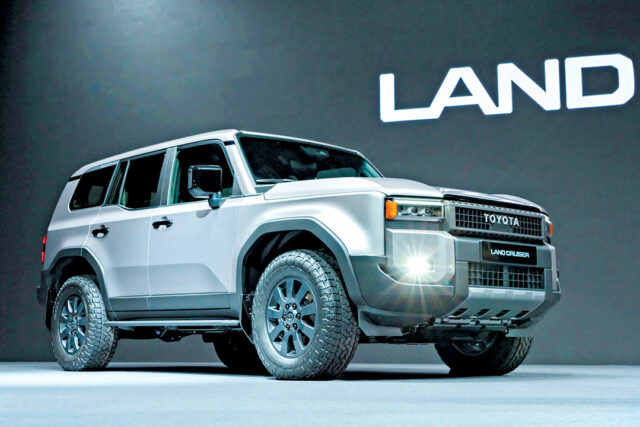
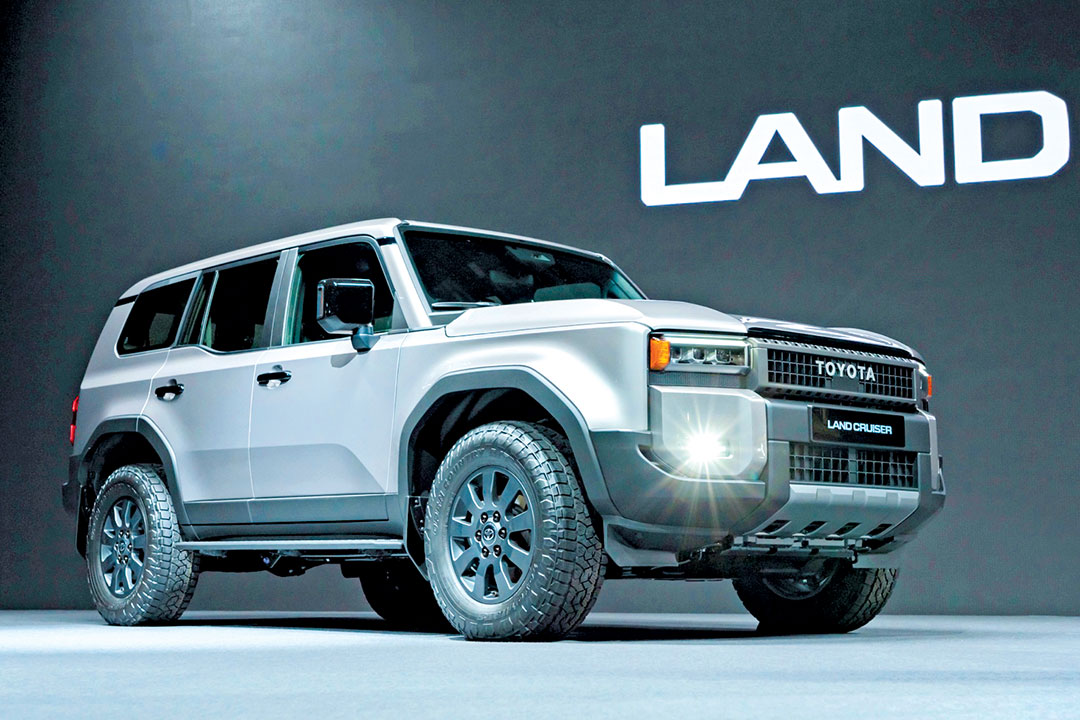
Toyota Land Cruiser 250 presented to the world

Two iterations of the Toyota Land Cruiser 250 — PHOTO FROM TOYOTA MOTOR CORP.

Hybrid powertrain to make debut in iconic model

LAST WEDNESDAY, at exactly 10 a.m. Japan Standard Time, Toyota Motor Corp. (TMC) unveiled the all-new Land Cruiser in an event streamed online via YouTube. This model is affixed with a “250” appendage on its moniker and, hence, shouldn’t be confused with the previously launched (and selling like hotcakes) Land Cruiser 300.

TMC is still officially calling the LC250 a prototype, with a launch “planned for the first half of 2024 in Japan,” according to a company release. TMC Director and Operating Officer Simon Humphries presided over the 20-minute introduction of the LC250 (and Japan-exclusive LC70), noting that the Land Cruiser nameplate is already 72 years old.

It was, he narrated, “the time of Kiichiro Toyoda, founder of Toyota Motor Corp., (when) the company was only 14 years old, a disruptive start-up in the automotive world.” Today, Mr. Humphries continued, the Land Cruiser is sold in 170 countries and regions around the world. “(It) literally put Toyota on the map.” The nameplate has cumulatively sold about 11.3 million units worldwide.

“From prairies to deserts, from the North to the South poles, it is safe to say, Land Cruiser has seen more sides of life than any other automobile in history,” he boasted.

The Land Cruiser has been traditionally divided into three iterations: the station wagon “that always showcases the latest technologies and has evolved into the flagship model” (currently the 300 Series); a heavy-duty version “with outstanding durability and off-road driving performance (the 70 Series),” and a light-duty model “that provides ease of handling and comfort on an off-road base as a lifestyle and practical choice for customers (Prado).”

Enter the 250 Series, which is said to be a result of instructions from former TMC President (now Chairman) Akio Toyoda. “The Land Cruiser should be a car that supports people’s lives and local communities, so the light-duty model must return to the true form that customers are looking for,” he had said to the development team.

The group interpreted the directives as “returning to the origin of the Land Cruiser,” resulting in a “simple and sturdy vehicle that can be trusted by customers to fulfill their lifestyle choices and practical needs.”

Mr. Humphries described the 70 as the “essence” of Land Cruiser, the 300 as its “pinnacle,” and the 250 as its “core.” While sharing a GA-F platform with the 300, it will banner for the first time in an LC a hybrid powertrain (among others) and electric power steering, while improving on a “basic performance as an off-roader.” Versus the current-generation Prado, the LC250 is 100 millimeters longer (at 4,925mm); 95mm wider (at 1,980mm), 20mm taller (at 1,870mm), and with a wheelbase 60mm longer (at 2,850mm).

The executive shared that TMC sought the opinion of Dakar Rally champion Akira Miura in developing more intuitive cockpit controls. “We designed (these) to be easy to identify and operate by feel alone,” said Mr. Humphries.

Meanwhile, the 250’s overhangs have been kept short, “proportions are calculated for maneuverability in extreme environment,” and the vehicle gets a low beltline, slim A-pillars, and an angular construction for better visibility.

Significantly, TMC will be marketing the Land Cruiser 250 to the North American continent (the 300 isn’t). Although it’s too early to tell, there’s a good chance that the Philippines will get that (aforementioned hybrid) variant, powered by a 2.4-liter Hybrid Direct Shift (eight speed) delivering 330ps and 630Nm. Other options include an exclusively ICE (internal combustion engine)-powered trim, one fitted with a 2.8-liter turbo with 48V generator, a diesel, and a 2.7-liter six-cylinder gas grade. — Kap Maceda Aguila

ACEN still looking to pursue net-zero goal

AYALA-LED ACEN Corp. will continue to pursue its net-zero emissions target, even amid the absence of a committed goal in the upcoming edition of the Energy department’s Philippine Energy Plan.

“The decision for ACEN to set a net-zero target and 100% RE (renewable energy) was made independent of the decision of the DoE’s (Department of Energy) on this point. So, it does not really change our particular position — it is a commitment we have made and intend to stand by,” Miguel G. de Jesus, chief operating officer of ACEN, said at the BusinessWorld Insights forum on July 26.

The listed energy company of the Ayala group has committed to fully transition the company’s power generation portfolio to 100% RE by 2025.

ACEN has said it aims to achieve its near-term emission reduction by 2030, deliver its long-term emission reduction targets by 2040, and neutralize residual emissions to achieve net zero by 2050.

The Energy department earlier said that it will not commit to a net-zero emissions target yet because it plans to focus more on increasing the share of RE in the power mix and possibly deploying more emerging clean technologies.

The DoE is set to release its new Philippine Energy Plan within this year, which is expected to include a higher share of renewable energy and a target share of nuclear energy capacity. Currently, the government is aiming to increase the share of RE to 35% by 2030 and 50% by 2040.

Net zero refers to reducing greenhouse gas emissions to as close as zero while also offsetting any remaining greenhouse gases in the atmosphere.

“We have also gone through the process of trying to look for transition mechanisms for some of our thermal assets and we recognize that we are relative newcomers compared to some of the energy players who have larger footprints. In some senses, that makes it a little bit easier for us to pivot,” Mr. De Jesus said.

For its part, the energy company is aiming to grow its RE portfolio to 20 gigawatts by 2030. To date, it has around 4,200 megawatts of attributable capacity spread across the Philippines, Vietnam, Indonesia, India, and Australia.

“We believe in the RE trajectory and are quite committed to ensure that we hit our 2030 target,” he said. — A.E.O. Jose

Audrey Hepburn from the man who knew her best

VIRTUALLY every person on Earth has seen the face of actress Audrey Hepburn at least once. Just like the image of her contemporary Marilyn Monroe in a billowing white dress, Audrey Hepburn’s image in a slinky black Givenchy gown in her role as Holly Golightly in Breakfast at Tiffany’s has been frozen in time to serve as a snapshot of showbiz glamor. This same image of her has been reproduced millions of times on posters, T-shirts, coffee mugs, and masses and masses of kitsch. But beyond that face, and beyond the movie roles that made that face enduringly famous for decades, how many people actually know her?

An exhibit called “Intimate Audrey” seeks to reintroduce her to the world, redirecting the light far from the flashbulbs of Hollywood to the more intimate glow which shone from a singular, extraordinary woman. The 730 square-meter exhibition, featuring photographs, scenes from her films, voice recordings, letters, and sketches from the actress premiered in Belgium (her birthplace) in 2019, then moved to Holland (where she spent World War II). The Manila stop is its first in Asia — thanks to the efforts of FashX, a fashion trade and licensing company in the Philippines, after its founder Carmina Sanchez-Jacob fell in love with the exhibit in Amsterdam. The exhibition runs from Aug. 1 to Oct. 29 in S Maison at Conrad Manila in Pasay City.

No less than her own firstborn, Sean Ferrer (with her first husband, fellow actor Mel Ferrer), took media guests and First Lady Liza Araneta-Marcos around on the last day of July for the exhibit’s opening.

For 30 years, Mr. Ferrer has been curating his mother’s physical memories, and composing them all into an exhibit, covering her childhood, her fame, her family, and her work as an ambassador with the United Nations Children’s Fund (UNICEF). True to her final role as a humanitarian, proceeds from the exhibit will go to children’s charities. Profits will go to EURORDIS — Rare Diseases Europe — as well as other charitable projects, according to the exhibition’s website.

“Obviously, we don’t do this to make her any more famous, because she’s permanently viral. We do this to raise monies for children’s charities and so forth,” said Mr. Ferrer in an interview with BusinessWorld.

EARLY CHILDHOOD
Audrey Hepburn was born on May 4, 1929 as Audrey Kathleen Ruston in Ixelles, one of the municipalities of Brussels. She was the only child from the second marriage of her mother, the Baroness Ella van Heemstra (her mother’s childhood home was Huis Doorn, the estate where the deposed Kaiser Wilhelm II spent his years in exile after World War I) to British subject Joseph Victor Anthony Ruston. The name by which she would be later known came from her father’s impression that he was connected to the aristocratic Hepburn family, transforming his and his daughter’s name to Hepburn-Ruston. Her parents divorced when Audrey was six. She called this “the most traumatic event in my life,” according to Enchantment, Donald Spoto’s biography of the actress.

While there are photographs of a young Audrey and her father in the exhibit, there is also one of an adult Audrey and her father in the 1960s. She had tracked him down in Dublin through the Red Cross. In Audrey Hepburn, An Elegant Spirit, a biography Mr. Ferrer wrote about his mother, he said, “The man she had longed for her entire childhood was in reality an emotional invalid. And so my mother did it: she stepped forward and hugged him, knowing full well that was going to be it. She chose to forgive him, instinctively, in one instant.”

Enrolled at boarding school in England, young Ms. Hepburn was sent back to Arnhem in the Netherlands at the outbreak of World War II in 1939. While first protected from the war’s dangers due to the Van Heemstra family’s status as respected citizens of Arnhem, the war would eventually spare no one. The Dutch famine of 1944-1945, for example, forced Ms. Hepburn and her family to eat bread made from grass, and share broth made from boiling a single potato.

“Don’t discount anything you hear or read about the Nazis. It was worse than you could ever imagine. We saw my relatives put against the wall and shot,” said the actress. “I knew the cold clutch of human terror all through my early teens: I saw it, I felt it, heard it — and it never goes away. You see, it wasn’t just a nightmare: I was there, and it all happened.”

The girl, educated in dance, and with a dream to be a dancer, helped raise funds for the Dutch Resistance movement by giving performances, the audiences forced to be quiet by the fear of arrest: a story she discussed during her screen test for Roman Holiday. “The best audience I ever had made not a single sound at the end of my performance,” the actress later said.

In the exhibit, there is a picture of Ms. Hepburn, taken on her 16th birthday, holding bunches of flowers. The Germans in the Netherlands surrendered to the Allied Forces a day later.

FROM BALLET TO MOVIES
Mother and daughter moved to London after the war to continue Ms. Hepburn’s education in ballet, with Marie Rambert, a collaborator of ballet impresario Sergei Diaghilev, and dancer Vaslav Nijinsky. It was here that she was told that she was too tall and that she had started her ballet training too late, thus limiting a future career as a prima ballerina.

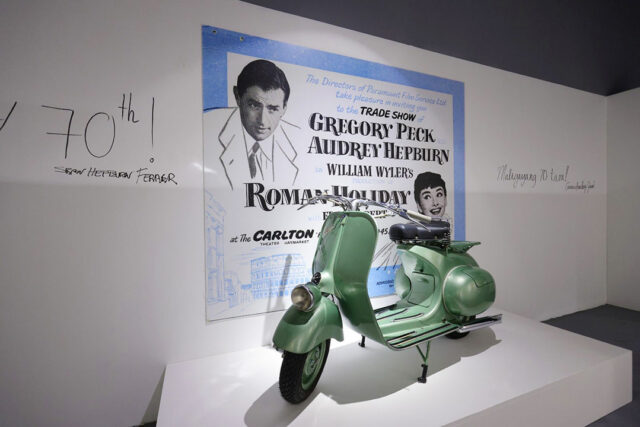
That was when she started acting, taking roles on stage, and then small parts in movies. While shooting another small role in the film Monte Carlo Baby, Ms. Hepburn was discovered by French novelist Collette, who cast her as the lead for her play Gigi. That would lead to her being noticed by Paramount Pictures which chose her to play a princess who spends a madcap day in Rome with a reporter but would have to give up love for duty and return to her royal job in the film Roman Holiday. For that role, she would win her first Oscar at 23. The Vespa scooter from the film can be seen in the exhibit.

“This year is kind of a bittersweet anniversary, because it does mark the 70th birthday of Roman Holiday,” said Mr. Ferrer in a speech. Forty years after the release of Roman Holiday, Audrey died of cancer in 1993.

Other movie roles would follow — in the exhibit, there are stills from Sabrina, Funny Face, Charade; costume swatches on which she made notes, and a whole wall devoted to off-duty pictures with famous friends.

“I think that with each film, it’s hard to say a ‘favorite role,’ because she would kind of do it, and then let it go. But each film represented the beginning of lifelong friendships,” said Mr. Ferrer. “I think that Funny Face had a special place in her heart, because you know, she wanted to be a dancer to begin with. To be able to sort of spread her wings next to Fred Astaire is any woman’s dream come true.” In that movie, Ms. Hepburn played a shy bookstore clerk who becomes a model in Paris, with a solo dance sequence showing the world her love of dance.

FAVORITE ROLE: MOTHER
Her actual favorite role as a mother would also be represented in the exhibit. Special sections are devoted to her marriage to Mel Ferrer — after their divorce, she would marry and divorce once more, to psychiatrist Andrea Dotti, and have another son, Luca; and ended life in the company of fellow actor Robert Wolders — as well as a section with just her son Sean.

There’s her wedding dress by Pierre Balmain, Mr. Ferrer’s christening gown by his mother’s friend, designer Hubert de Givenchy, as well as dozens of photographs documenting a quiet domestic life away from Hollywood.

“I think that if you consider the fact that at the top of her career, she gave up being an actress to become a full-time mother to me because I couldn’t travel anymore, to visit her on the set, that says a lot. She knew that she couldn’t do too many things at once. She gave up her career to be my mom. That’s a huge present,” Mr. Ferrer told BusinessWorld. Ms. Hepburn herself said, “The one thing I dreamed of in my life was to have children of my own. It always boils down to the same thing — not only receiving love but wanting desperately to give it.”

Another cherished role was her work with UNICEF, a decision that goes back full circle to her hardships during the war.

“There’s a big difference between dying of starvation and malnutrition, of course, but I was very, very undernourished. Immediately after the war, an organization, which later became UNICEF, instantly came in with the Red Cross and brought relief for the people in the form of food… I was one of the beneficiaries with the other children. I’ve known about UNICEF all my life,” she said.

A section in the exhibit shows her travels in Ethiopia, Sudan, Guatemala, Honduras, El Salvador, Mexico, Vietnam, Thailand, and Bangladesh, surrounded by the children she helped. In the UNICEF website, she is quoted as saying, “There is a moral obligation for those who have, to give to those who have nothing.” In Enchantment, Donald Spoto quotes her: “Giving is living. If you stop wanting to give, there’s nothing more to live for.”

INNER AND OUTER BEAUTY
It is in these instances that we see a connection between inner and outer beauty, in a world often too eager to appreciate only what can be seen.

Mr. Ferrer told BusinessWorld, in a discussion about his mother’s own beauty: “Without the inner grace and generosity she would have been something else. There is no doubt. I mean, she was not a classic beauty.” Ms. Hepburn herself said, “I never thought of myself as beautiful. I’d like not to be so flat-chested. I’d like not to have such angular shoulders, such big feet, and such a big nose. When you see what is happening in the world, it’s so trivial to talk about looks. Actually, I’m very grateful for what God has given me. And there’s a lot more — so much more — that I must do!”

“She saw herself as a wonderful package of imperfections… I think in her case, the light comes from within,” said Mr. Ferrer.

Hepburn’s face, contrary to her own belief, endures as a symbol of beauty. Mr. De Givenchy once said, “There is not a woman alive who does not dream of looking like Audrey Hepburn.”

“I think it’s not so much about what she looks like,” said Mr. Ferrer on his mother’s enduring legacy. “It’s about what she feels like.

“What she felt like to all those children in Africa — who didn’t know who she was. What she feels like to all the younger generations — a lot of poetic justice there — because it’s the same generations that she fought for as a UNICEF ambassador, who today are carrying her into the future. She’s really become viral also for tweens and teens and kind of has taken the place next to James Dean on that closet door in that teen’s bedroom,” said Hepburn’s son.

“They sense her. Each of them has a little piece of her life. All together, they have a wonderful, kaleidoscopic view of who she was,” he said. “I can only tell you what she said at the end of her life, when I had to tell her myself that we couldn’t get her better.

“She said: ‘How disappointing.’ But at the same time, ‘That’s life. The tall tree has to fall for the sun to shine through, and the little sapling to grow up.’ She saw it as a cycle of life. She was not angry. I think she felt she lived a very fortunate and rich life. I think she was thankful, even though she was taken very young.” — Joseph L. Garcia

Exhibition tickets will be available online via SM Tickets and at all SM Ticket offline locations such as SM Department Stores and SM Cinemas. Exhibition access is priced at ₱850 with a special rate of ₱450 for students, senior citizens, PWDs, national athletes and medal of valor awardees, and allows access for one hour and a half per visit.


World rice price index jumps to near 12-year high in July, says FAO

MUMBAI — The United Nations food agency’s rice price index rose 2.8% in July from a month ago to their highest level in nearly 12 years as prices in key exporting countries jumped on strong demand and India’s move to curb the exports, the agency said on Friday.

The Food and Agriculture Organization’s (FAO) All Rice Price Index, which tracks prices in key exporting countries, averaged 129.7 points in July against 126.2 points for the previous month, the agency said.

The July score was almost 20% higher than the last year’s 108.4 points and the highest since September 2011, it said.

The agency’s overall world food price index also rose in July, rebounding from two-year lows.

India, which accounts for 40% of world rice exports, last month ordered a halt to its largest rice export category to calm domestic prices, which climbed to multi-year highs in recent weeks as erratic weather threatens production.

India, Thailand, Vietnam, Cambodia and Pakistan are among leading exporters of rice. China, Philippines, Benin, Senegal, Nigeria and Malaysia are key importers of the staple. — Reuters

Appellate tax court affirms San Miguel Brewery’s P122-M refund claim

CTA.JUDICIARY.GOV.PH

THE Court of Tax Appeals (CTA) has affirmed its ruling to grant San Miguel Brewery, Inc.’s refund claim worth P122.62 million, representing wrongly paid excise tax on its beer products for the fiscal year 2017.

In a 27-page decision dated Aug. 2 and made public on August 3, the CTA full court said its Third Division did not err when it voided a 2012 Bureau of Internal Revenue (BIR) memo that imposed a 4% annual excise tax above what was mandated under the Tax Code, leading to the court granting the firm’s refund claim.

“The commissioner of internal revenue (CIR) cannot, in exercising such power, issue administrative rulings or circulars inconsistent with the law sought to be applied,” Associate Justice Lanee S. Cui-David said in the ruling, citing the CIR’s authority to interpret provisions of the National Internal Revenue Code.

The tax tribunal said it has jurisdiction to rule on the validity of revenue regulations imposed by the BIR.

“This issue is not novel as it has already been settled in a plethora of cases that the CTA has exclusive jurisdiction to rule on the constitutionality or validity of a tax law and regulation or administrative issuance,” it said.

Under amendments to the Tax Code covering excise taxes on alcohol and tobacco, the excise tax rates on liquor are at P1 per liter if the net retail price per liter of the product is P50.60 or less, and P20 if it is higher than P50.60.

The BIR had imposed excise tax rates per liter of fermented liquors of P15.49 or P20.57 regardless of whether the net retail price per liter of the volume of the liquor product is below or more than P50.60.

Citing provisions of Section 143 of the Tax Code, the CIR argued that the tax court erred when it granted the refund since there was no reclassification of the firm’s San Miguel Light beer product as a variant of an existing product.

The court sided with San Miguel Brewery’s argument that reclassifying San Miguel Light is not an issue in the refund claim, saying the provision had already been repealed by Republic Act No. 10351, or the law on excise tax on alcohol and tobacco products.

Last month, the CTA Special Second Division granted a separate refund claim on overpaid excess taxes worth P146.87 million based on the same voided BIR memo.

Citing the Supreme Court, the tax tribunal said BIR memorandum circulars are considered “general interpretations of tax laws” that could be scrutinized under a court of law.

“The courts will not countenance administrative issuances that override, instead of remaining consistent and in harmony with the law they seek to apply and implement,” the tribunal said. — J.V.D. Ordoñez

BMW XM now here

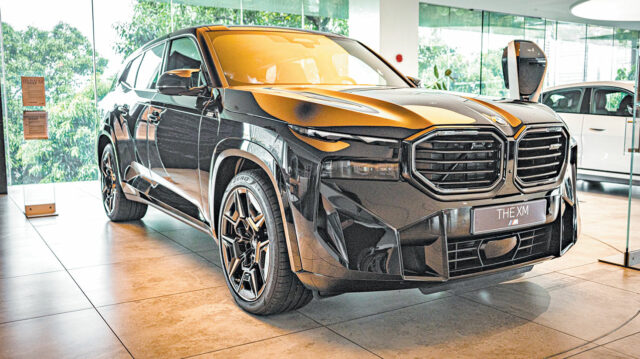
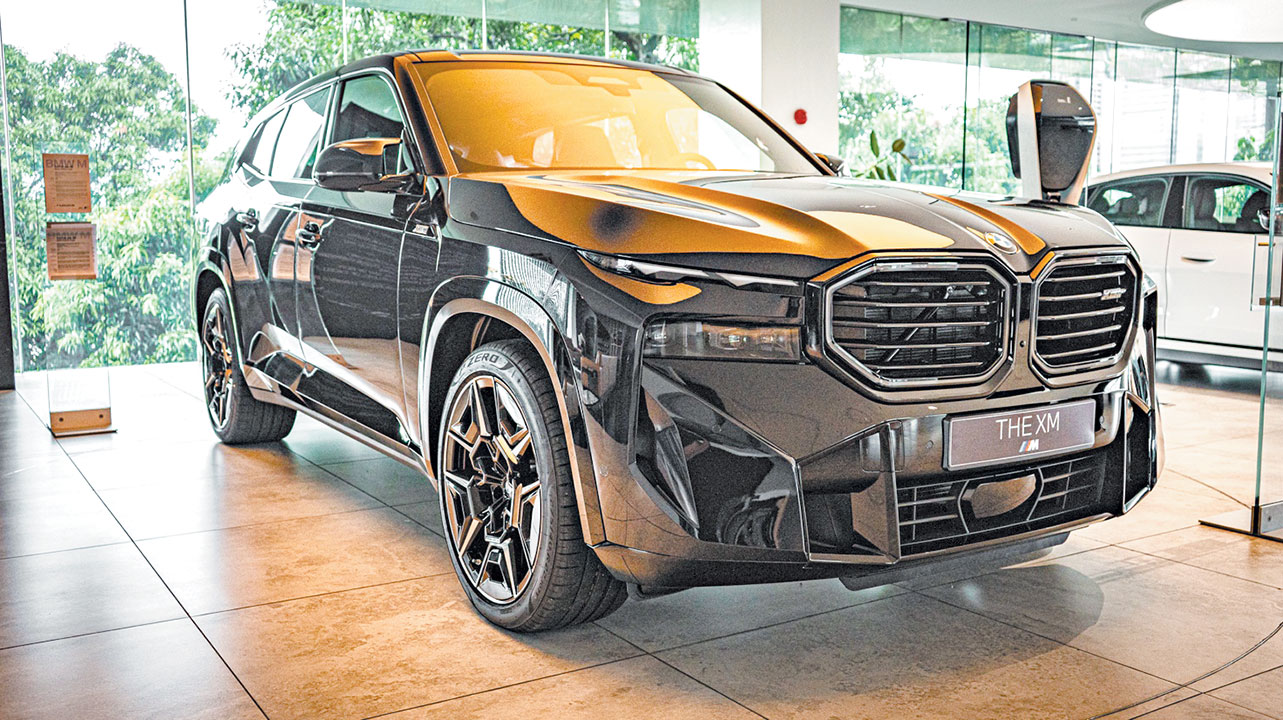
The BMW XM is a plug-in hybrid that offers both high performance and premium appointments. — PHOTO BY KAP MACEDA AGUILA

Brand’s first electrified performance vehicle is priced at P15.89 million

SMC ASIA CAR Distributors Corp., official importer and distributor of BMW in the Philippines, has now made available the BMW XM. Described by company president Spencer Yu as “the epitome of power, luxury, and sustainability in the M car lineup,” the XM is a plug-in hybrid electric model that demonstrates BMW’s “dedication to a greener future.”

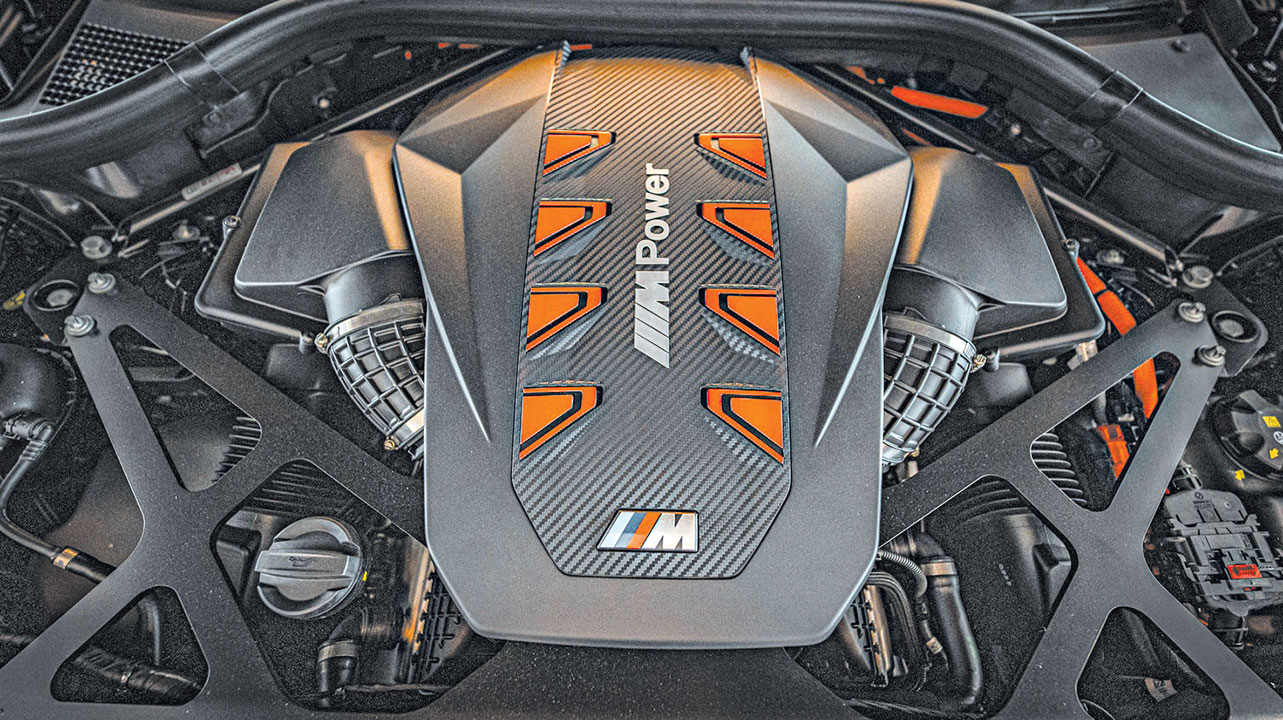
Primarily powering the SUV (or Sport Activity Vehicle in BMW parlance) is a 4.4-liter V8 with M TwinPower Turbo technology delivering 653hp. This is supplemented by an electric drive system churning out 197hp. The motor is integrated into the eight-speed M Steptronic transmission. The M Hybrid drive system produces maximum overall torque of 800Nm, and a pre-gearing stage increases the electric motor’s effective maximum torque to 450Nm at the transmission input.

BMW said that the XM “is defined by an immense build-up of power that begins instantaneously and is sustained throughout the rev range,” enabling the vehicle to sprint from a standstill to 100kph in 4.3 seconds. The exhaust system features electronically controlled, continuously adjustable flaps and hexagonal dual tailpipes arranged one above the other for the first time on a BMW M model. The M Hybrid button on the center console is used to select one of three operating modes, including an Electric setting for cruising with zero local emissions at speeds of up to 140kph and over a maximum distance of 82 to 88 kilometers in the WLTP cycle. It uses a lithium-ion high-voltage battery mounted in the car’s underbody delivering 25.7kWh of usable energy. The Combined Charging Unit in the BMW XM enables AC charging at up to 7.4kW.

The BMW IconicSounds Electric developed in a collaboration between the BMW Group and film score composer Hans Zimmer creates “a suitable backing track for the electric motor’s power delivery,” while the M-specific electric drive sound provides feedback to inputs on the accelerator pedal when driving in the locally emission-free operating mode. If the Sport or Sport Plus setting is selected while the drive system is operating in Hybrid mode, a boost sound will underline the electrical assistance being provided to the combustion engine.

The power generated is channeled to the road via the all-wheel-drive system M xDrive, whose rear-biased setup is particularly noticeable in 4WD Sport mode. Drivers can also select the 4WD Sand mode, designed specifically for driving over dunes and similar surfaces. Operation of the M Sport differential in the rear axle is also fully variable.

Outside, the XM dons the looks of a modern BMW SAV with powerful contours, a dynamically stretched silhouette, M-typical design cues, a reworked interpretation of the front-end look created for BMW’s luxury-segment models, and a host of distinctive accents.

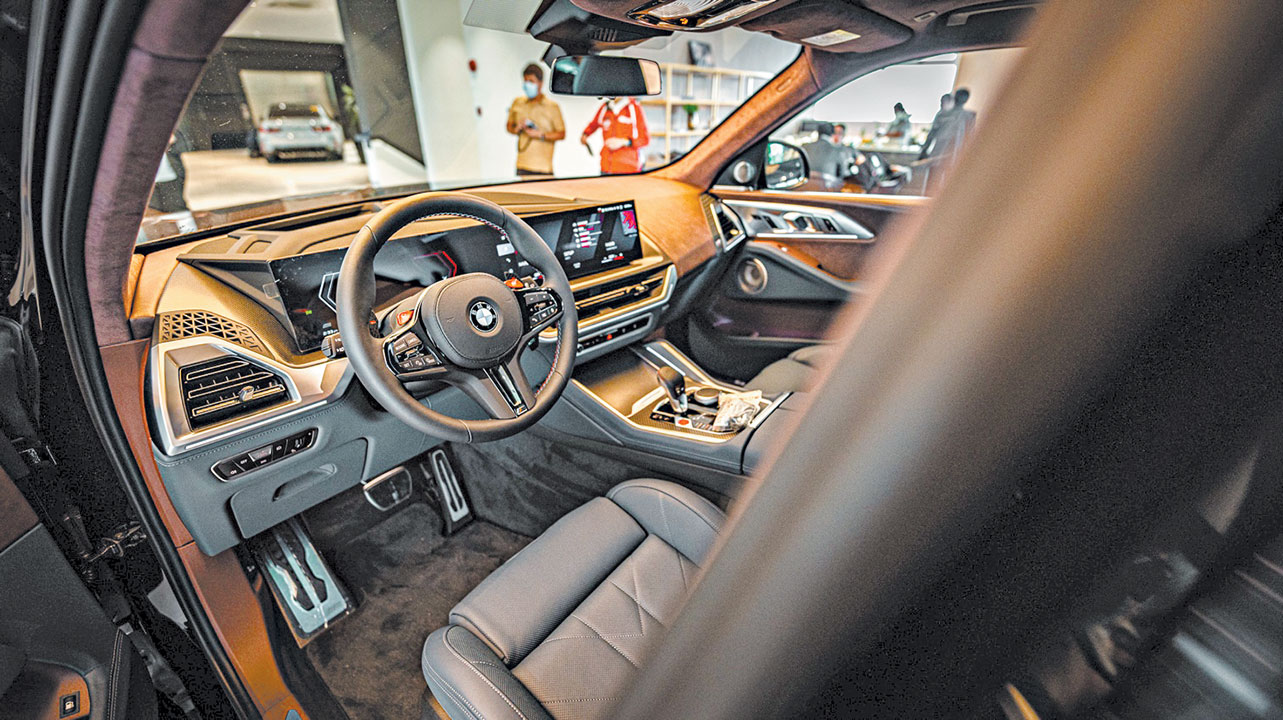
In the cabin, the XM delivers a feeling of space — employing high-quality materials and featuring extravagant design to transform the rear into an “exclusive M Lounge.” The interior is equipped with BMW Leather Merino with extended contents in Deep Lagoon upholstery and carbon fiber interior trim finishers for the upper sections of the instrument panel and door panels. Heated backrests extending well into the sides of the rear compartment and specially designed cushions offer passengers luxurious levels of comfort. The sculptural headliner is unique with its three-dimensional prism structure, photo mount-style border, and 100 LED units for illumination.

The cockpit and front seats are designed entirely around an active driving experience. Standard specification includes M multifunction seats, knee pads and a model-specific M leather steering wheel, along with M-specific graphics including shift lights for the BMW Widescreen Display and BMW Head-Up Display.

The XM has ambient lighting, four-zone automatic climate control, and a Bowers & Wilkins Diamond Surround Sound System. The surround audio system with studio-quality acoustic technologies and 3D audio via speakers in the headliner are installed in the BMW XM with an overall power of 1,475W and over 20 loud speakers dispersed around the vehicle. The Travel and Comfort System are also included as standard features in the first-ever BMW XM.

The BMW XM retails for P15.89 million. Purchase also includes a five-year BMW factory warranty, and a BMW Wallbox Charger which will be installed in the customer’s home free of charge.

Barbie: the movie

What is a movie review on a hyped-up PG-13 rated bio-flick about a child’s doll doing in an opinion column in a business newspaper?

This is just an opinion of a former professor of business administration at the MBA level, whose basic liberal arts education in literature and the arts has acknowledged other perspectives in the conundrum of “Art imitating Life” or “Life imitating Art.” Mainstream and social media are already deluged with reviews and comments for and against the form and substance of the Barbie movie, and conspiracy theories abound on the grand scheme of the marketers of the product riding on the eternal gender equality issues since Adam and Eve in the Garden of Eden.

Barbie: the movie is an interesting marketing case study, as it would be dissected in an MBA class. But more than just for showing marketing strategy as it has used the art form that is the movie, it must be analyzed for its substance — which is the message the movie will convey to its audience at various levels from intuition to enlightened passion for or against the issues raised.

The Barbie movie audience is 66.2% female and 33.8% male, according to thewrap.com. It said 74.6% of viewers are under the age of 29 (Gen Z), while 16.9% are Millennials (30-39 years old) and 8.5% are Gen X (40+ years old). As of Aug. 3, 2023, Barbie has grossed $406.4 million in the United States and Canada, and $429.3 million in other countries and territories, for a worldwide total of $835.7 million, according to Barbie IMDb. It is expected to reach a $1-billion record-breaking box office success and set the record for any film that was not a sequel, remake or superhero property.

The main character in the movie is Barbie, an 11.5” molded plastic toy doll with a stylized adult female body with big pointy breasts, teeny-tiny waist, and overly long shapely legs on tiptoes (for high-heeled shoes).  Barbie’s pretty smiling face crowned with comb-able long fiber-hair perfects what might be the conditioning of a child’s mind of how she should look, when she grows up.

Barbie was created by Ruth Handler in 1959, when she and her husband Elliot decided to expand their little business of making dollhouses on a contract basis. The revolutionary adult Barbie doll concept was modeled on “the German Bild Lilli doll, a risqué gag gift for men based upon a cartoon character featured in the West German newspaper Bild Zeitung, Britannica says. And the Handlers approached the toy company, Mattel, to manufacture Barbie, launched on March 9, 1959.

But marketing the sexy, adult Barbie doll was a problem for Mattel.  “Mothers in a 1958 Mattel-sponsored market study before the doll’s release criticized Barbie for having ‘too much of a figure.’ Mattel circumvented this problem, however, by advertising Barbie directly to children via television. Mattel, in fact, upon sponsoring Walt Disney’s Mickey Mouse Club program in 1955, became the first toy company to broadcast commercials to children.” Britannica adds.

Barbie-scaled peripherals, i.e., clothes, jewelry, cars, fully equipped dollhouses, cars and even backdrop/settings were advertised and sold briskly in the US and international markets (but not manufactured in the US to avoid higher labor costs, according to Britannica). In 1961, Mattel brought out the male Ken, Barbie’s ultimate “accessory” who was not really her boyfriend.   Midge, Barbie’s best friend, came next, and in 1964 Barbie’s little sister, Skipper and other siblings. By 1968 Barbie had “friend” dolls of color and in 1980 Barbie herself had an African-American incarnation, and then came a Latina Barbie.

From the late 1970s through the 1980s the social issues on gender equality rose to fever-pitch, specially because of the global financial and economic crises, and the discriminatory “glass ceiling” for women in the workplace.   Marketers of the Barbie doll jumped into the fray of gender discrimination issues and came up with Barbies costumed for different professions and jobs, from being a utility service person to an astronaut, a wildlife conservationist, a United Sates Air Force pilot, a news anchor and an astrophysicist. To date, Barbie has had over 200 jobs, according to today.com.

“You can be anything you want! No dream’s impossible, because you’re unstoppable,” the official music video of Barbie Magical Dream Camper chants to mesmerize Barbie fans and fans-to-be. And that’s the point of Barbie: the movie.  You, every woman, can be like me, Barbie — you can be anything you want to be.  Watch me!

In the movie, the original blonde, blue-eyed, reed-thin but big boobs Barbie doll wakes up to her usual perfect day in her perfect Barbie Land with perfect girl buddies in varied roles who are perfect personality replicas of her perfect self.  One blight in Barbie Land might be the existence of not-so-perfect males led by the original Ken and Ken replicas in various attires mostly for leisure and play.  Note that not one Ken is marked as a respected professional or a VIP, unlike the Barbies who display empowerment and a take-charge attitude toward what happens next. “Barbie has a great day every day. But Ken only has a great day if Barbie looks at him” — the introductory annotations (voiced by Helen Mirren) say it so clearly in the opening scenes.

Tickly romance is definitely out of the question for Barbie when Ken asks the loaded question, “Can I see you tonight?”  “(No), it is ‘girls’ night (as every night is girls’ night),” Barbie replies flatly. And that’s when Barbie decides to cross over to the real world to test her empowerment and self-sufficiency and sadly learns about defeat and dying.  And she takes to the real world with Ken in tow (she’s driving).

The tragedy for Barbie is finding the role reversal between her and Ken in the real world. Ken is awakened to the power of possession — fancy cars and mammoth vehicles like Hummers, jewelry and land, with his own “Kendom” exclusive only to male friends. His attire to match his vanity for his newfound power is a floor-length pristine white mink coat, same as that worn by Silvester Stallone in the movie Rocky. He maximizes on the “patriarchy” (male dominance) in the real world, where women serve and cater to men’s pleasures.  Barbie is shocked that women willingly accept subservience and would even want to be attractive to men. Or that some women can hate or envy other women.

Ken proposes a “constitution” to take over Barbie Land. Barbie refuses.  She then  meets the pre-adolescent Sasha who used to play with her Barbie doll in her childhood, and Sasha’s mom Gloria, a sympathetic Mattel employee who helps whisk Barbie from the all-male Mattel executives who are chasing her to “put her back in the box” and return her to Barbie Land.

The experience with the real world has shattered Barbie’s self-confidence. “I am not good enough for anything,” she says to the spirit of Barbie Land — Ruth Handler herself, Barbie’s own creator. Gloria echoes the same, speaking as a “human”:  “You can’t be the greatest, and not too great.  Everything is your fault.” Her daughter Sasha, who had openly rebelled against her, at last embraces her in poignant realization and acceptance of her not-so-perfect mother’s perfect love for her.

Barbie decides to return to the real world and become human.  First, she sets up an appointment with a gynecologist.

Critic Peter Debruge in Variety Magazine was candid, praising the humor “for giving permission to challenge what Barbie represents” and lauded Gosling’s physical performance, but concluded that the film is “an intellectual experience, not an emotional one, grounded largely in audience nostalgia.”  The nostalgia that drew the crowds (two-thirds female, three-fourts under 29 years old) validated the winning marketing strategy for Mattel, more than rousing the passion and commitment for the protracted gender equality and nondiscrimination issues.

Katie Pickles of The Conversation observed that Barbie shows how “the matriarchy can be as bad as the patriarchy, with the Kens being the objectified and excluded sex in Barbieland.” Many reactors deplore the male-bashing that portrays a wimpy, jobless Ken in Barbieland and an arrogant and vain (but still jobless) Ken in his Kendom in the real world.

But what upset this writer the most in the Barbie movie is the gray, dreamlike opening scene (ala Stanley Kubrick in “2001”) where little girls are sitting in small chairs on a beach, quietly playing with their infant baby dolls, pretending to feed them and then gently caressing them to sleep.  A towering 10-feet-high Barbie, dressed in her signature striped swimsuit, suddenly appears in their midst, grinning down on them. Instead of being frightened by the Barbie giant, the little girl’s faces grimace into crazed violence as they smash their baby dolls against the rocks.  Enough of mother roles!

The dashing and splintering of the sacred primary role and duty of Woman as giver of life is too painful an exchange for independent self-determination and empowerment that some hard-core feminists might obsess for.  Something is wrong somewhere.

A successful marketing strategy cannot justify a flawed message.


Amelia H. C. Ylagan is a doctor of Business Administration from the University of the Philippines.

ahcylagan@yahoo.com

Upland rice farming touted as hunger prevention program

IRRI

DAVAO CITY — Former Agriculture Secretary Emmanuel F. Piñol said upland rice farming on small plots could serve to mitigate hunger among farmers.

The “Kalahating Ektarya sa Bawat Pamilya (A half hectare for every family)” program (KEBP) will involve both hybrid and inbred rice, and is designed to address a possible downturn in production due to the prevailing El Niño.

Ang focus nito ay may makain ang pamilyang Pilipino in the rural areas kasi sila ang pinaka vulnerable whenever the prices of commodity goes up (The focus is for rural families to have something available to eat because they are the most vulnerable whenever rice prices rise),” he said.

Mr. Piñol, who is also a former chairman of the Mindanao Development Authority, said the recommended hybrid seed variety is the Tatag TH82 (mestizo 51 NSIC 350H) alongside AMO Foliar Fertilizer and chicken manure slurry. The combination has a target yield of at least two metric tons per half hectare, ultimately yielding 1,200 kilos of milled rice or 24 50-kilo sacks of rice.

According to Mr. Piñol, other ways of cushioning the expected rice shortage include the repair and rehabilitation of irrigation systems, especially those used for communal irrigation, and maximum use of high-yielding hybrid and inbred seed to increase production, including the Inbred RC 222 variety.

He urged all companies in the hybrid rice seed industry to conduct an inventory of the seed supply.

He said upland areas benefit from high moisture and regular rainfall even during El Niño events.

Mr. Piñol said the program will engage local government units to use their development and calamity funds to prepare for the impending rice crisis by aiding farm families in planting rice for their own consumption during the crisis and eventually as an eventual component of a broader food security strategy.

The KEBP initially targets North Cotabato’s upland rice areas in Arakan, Antipas, President Roxas, Magpet, Kidapawan, Makilala, Tulunan, M’Lang, Matalam, Aleosan, Midsayap, Libungan, Pigcawayan, Alamada, and Banisilan, where upland rice farming had long been practiced.

“For every farm family in the highlands or in non-irrigated but water supply-accessible areas, seed good for half a hectare will be provided along with the needed inputs for land preparation, fertilization, and plant care,” Mr. Piñol said.

Mr. Piñol created the program in partnership with Seedworks Philippines, a company that is promoting TH82.

According to Remus Morandante, vice-president of Seedworks Philippines, with TH82 farmers can enjoy high yields despite the many biotic and abiotic stresses affecting rice farming.

TH82 has a proven tolerance to intermittent drought and is applicable for direct and dry seeding cultures.

Seedworks, a plant science company, is engaged in the research, production, and marketing of rice, cotton, millet, mustard, and vegetables that grow even in adverse weather and soil conditions. — Maya M. Padillo

Weavers, start your looms

Likhang Habi Fair returns with two flagship weaving competitions

HABI: The Philippine Textile Council launches the sixth edition of the Lourdes Montinola Piña Competition, and the second Eloisa Hizon Gomez Abaca Competition.

A yearly highlight of the Likhang Habi Fair, which will be held October 13-15 at the Glorietta Activity Center in Makati City, the piña (pineapple leaf fibers woven into a translucent fine material used for formalwear) competition is the country’s premier piña weaving contest. Named after local textile champion Lourdes Reyes-Montinola, chair emeritus of the Far Eastern University, the competition invites local artisans from all over the Philippines to join and proudly exhibit their talents in weaving, dyeing, embroidering, and embellishing piña. The competition aims to keep this traditional craft alive, as well further promote appreciation and use of Philippine textiles.

Interested participants should submit a panel of their creation at least two meters long, along with a detailed description of the work, and a photograph of the weaver with their entry. More than 50% of the cloth’s body must be made of piña.

Three major winners will be selected, and two weavers will be granted special awards including the Innovation Award from Len Cabili of Filip+Inna.

Last year’s winning weavers all came from Kalibo, Aklan: Ursulita de la Cruz, whose design “Kahel” featured pure piña liniwan with sinuksok detail in orange, green, and white; Delara Eliserio, a 13-year-old who created a checkered pattern piña design titled “Sorbetes”; Melanie Palmon, who created piña silk with scattered suksuk; Marilyn Almario and her piña linen yarn and silk with a double weave and pocket details; and Rosabelle from Balete, who created piña silk with all-over sinuksok and tablero renggue.

Another highlight of the upcoming Likhang Habi Fair is the Eloisa Hizon Gomez Abaca Weaving competition, which celebrates the well-loved and versatile abaca fiber, globally known as Manila hemp.

The competition, now on its second year, is inspired by its namesake — a prominent Kapampangan who actively encouraged the use of Filipino textiles, and is mother to popular 70s fashion designer-turned-monk Gang Gomez, now known as Dom Martin Gomez, OSB. Last year, the contest attracted 13 entries from South Cotabato, Aklan, Davao, and Bicol — a roster that Habi aims to expand as it renews its call for entries this year.

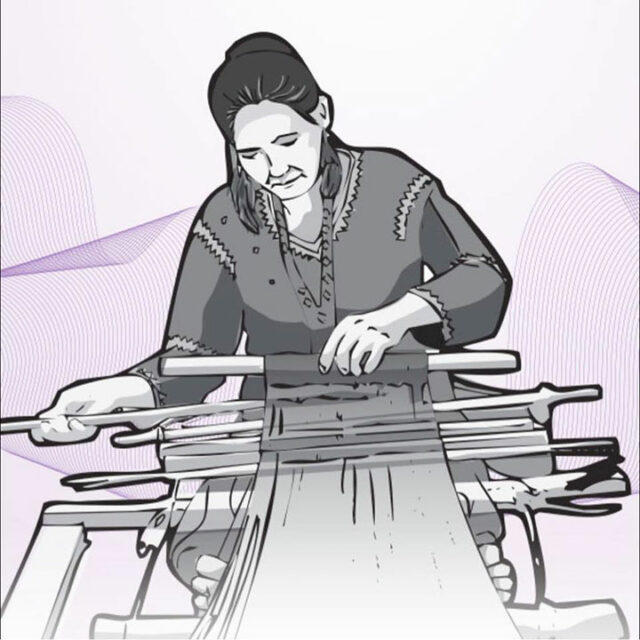
Winners of last year’s Eloisa Hizon Gomez Abaca Weaving Competition include Nening Tuan, whose entry featured a traditional pattern on a cloth made of doun basag (palm leaf) woven  on a backstrap loom with abaca filament, and dyed using T’boli ikat technique; Rolly Arboleda, who won two awards for his pure abaca circular fabric and pure abaca fino barong; Annaliza Angcoy, whose design titled “Hafak Menual” depicted the wings of an eagle, woven on a back strap loom with abaca filament and dyed using the T’boli ikat technique; and Rhoda Rose Monon Dillera, who created an inabal design (inherited from Salinta Monon, Recipient of the Gawad Manlilikha Award in 1998) woven on a backstrap loom with abaca fiber and dyed using the Bagobo Tagabawa ikat technique.

Three awards will be given to participating artisans, who can work either individually or as part of a group.

Interested participants can enter their abaca creations under the following contest categories: Woven – Pure Abaca; Woven – Abaca Blended (at least 50% abaca plus other fibers); and other applications (e.g. macrame, flat, or three-dimensional). Cloth entries should be at least six yards long and 30 to 36 inches wide or the maximum width of a backstrap loom.

Aside from exhibiting their entries, weavers can also sell their creations at the Likhang Habi Fair. Those interested in doing so must indicate their selling price. All entries for both competitions must be submitted to the Habi: Philippine Textile Council Office at 962 May Street, Mandaluyong City.

The deadline for submissions is on September 30, 2023. Interested parties may call Habi: The Philippine Textile Council at 0921-849-6974 or send an e-mail to support@habiphilippinetextilecouncil.com for more information.