Home Blog Page 4482

Jobless rate climbs to 3-month high in June

The unemployment rate rose to a three-month high in June. — PHILIPPINE STAR/EDD GUMBAN

By Abigail Marie P. Yraola, Researcher

THE UNEMPLOYMENT RATE rose to a three-month high in June as the quality of jobs deteriorated, the Philippine Statistics Authority (PSA) reported on Wednesday.

Preliminary estimates of the PSA’s latest Labor Force Survey (LFS) showed the unemployment rate, or the share of the jobless Filipinos to the total labor force, edged up to 4.5% in June from 4.3% in May.

Year on year, the jobless rate was lower than the 6% seen in June 2022.
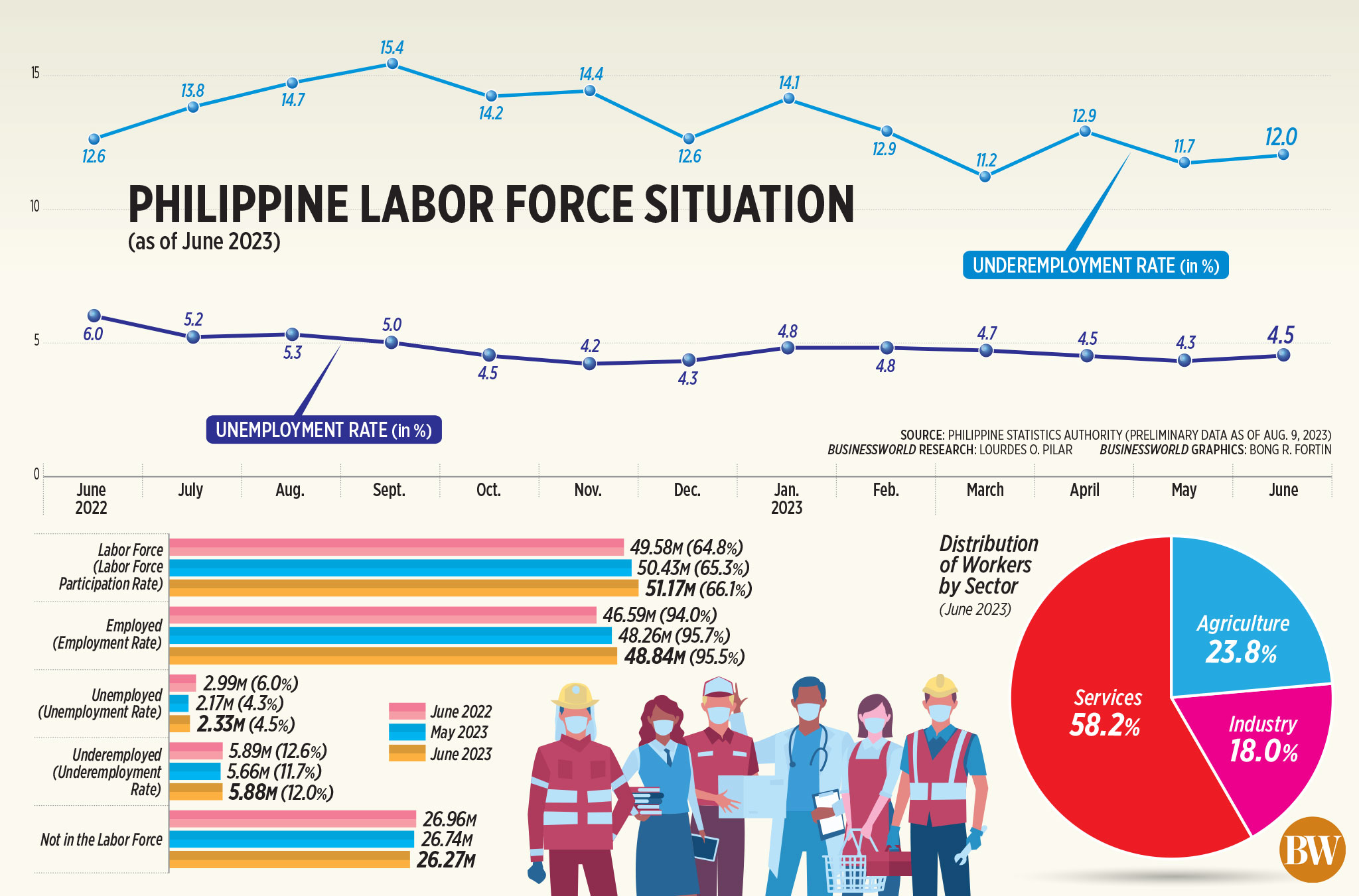
This translated to 2.33 million unemployed Filipinos in June, up by 159,000 from May. However, this was 663,000 lower than the 2.99 million jobless in June 2022.

June’s unemployment rate matched April’s figure and marked the highest unemployment share in three months or since the 4.7% in March 2023.

For the first half, the unemployment rate averaged 4.6%, lower than the 6.1% in the same period a year ago.

At the same time, job quality worsened in June as the underemployment rate went up to 12% from 11.7% in May. However, it was lower than the 12.6% underemployment rate in June 2022.

In June, there were 5.87 million Filipinos who were employed but sought additional work or longer working hours in June, up by 214,000 from 5.66 million underemployed individuals in May.

Year on year, the number of underemployed fell by 13,000.

PSA data showed the June underemployment rate was the highest in two months or since the 12.9% recorded in April.

Year to date, the average underemployment rate was 12.5%.

The employment rate, on the other hand, eased to 95.5% in June from 95.7% in May but higher than the 94% in June last year. The employment rate represents the share of the employed population to the total working force.

This was equivalent to 48.84 million employed Filipinos in June, an increase of 581,000 from the 48.26 million employed individuals in the prior month. Year on year, 2.25 million Filipinos were added to the workforce.

In the first semester, employment averaged 95.4%.

MORE WORKERS
“We can see there was a slight increase in the underemployment rate month on month because there was a big increase in labor force participation,” PSA Undersecretary and National Statistician Claire Dennis S. Mapa said.

The labor force size in June increased by 741,000 month on month to 51.17 million. It also grew by 1.59 million from last year’s 49.58 million.

As a result, the labor force participation rate (LFPR) — the proportion of the working-age population (15 years old and over) that is part of the total labor force — increased to 66.1% in June, higher than the 65.3% in the previous month and the 64.8% in June last year.

This marked the highest LFPR in four months or since February when it stood at 66.6%. Year to date, the average LFPR was 65.6%.

As the LFPR goes up, Mr. Mapa said the number of unemployed and underemployed also increases since not all workers will be hired on a full-time basis.

He also noted some workers may remain unemployed not because of the lack of job opportunities but because of the job-skill mismatch.

New entrants to the workforce reached 543,000 in June, an addition of 99,000 from the month prior but 437,000 fewer than 980,000 seen in June 2022.

“As the number of young workers continues to expand, the Marcos administration is exerting efforts to focus on training and upskilling to improve their employability for high-quality and high-paying jobs,” said National Economic and Development Authority Secretary Arsenio M. Balisacan in a statement.

Robert Dan J. Roces, chief economist at Security Bank Corp., said the June data suggest the labor market is still recovering.

“The uptick in underemployment and unemployment suggests potential challenges ahead,” he said in an e-mail.

By sector, the services remained the top employer in June with an employment rate of 58.2%, followed by agriculture at 23.8% and industry at 18%.

On a monthly basis, higher employment was observed in construction (up 488,000); agriculture and forestry (up 469,000); administrative and support service activities (up 308,000); public administration and defense; compulsory social security (up 128,000); and accommodation and food service activities (up 104,000).

Month-on-month job losses, on the other hand, were noted in fishing and aquaculture (down 575,000); transportation and storage (down 205,000); arts, entertainment and recreation (down 124,000); real estate activities (down 99,000) and professional, scientific and technical activities (down 97,000).

Wage and salary workers still had the largest share of the labor force with 61.5% in June.

In June, an employed Filipino worked an average of 40 hours per week, slightly lower than the 40.3 hours in June 2022. However, this was higher than the 39.3 hours per week in the prior month.

“While the overall trajectory seems positive, careful monitoring is crucial to address potential structural issues in the economy,” Mr. Roces said.

Capital Economics’ Emerging Asia economist Shivaan Tandon said he expects the labor market to soften in the next few quarters as domestic and foreign demand weakens.

Julius H. Cainglet, vice-president for Research, Advocacy and Partnerships at the Federation of Free Workers, said the unemployment and underemployment numbers will surely increase as the fresh graduates enter the labor force.

“Workers have yet to feel the impact of what the government has described as foreign investments that would create millions of jobs,” Mr. Cainglet said in an e-mail.

He noted the delay in the release of new wage orders in some regions will likely worsen underemployment as workers cope to make ends meet.

“With less employment available, coupled with the increase in fuel prices and global uncertainty brought about by the Russia-Ukraine war that has yet to end, (job) growth will be expected to slow down,” Mr. Cainglet said.

The latest LFS was conducted from June 8 to 28, with a total of 11,028 sample households.
August power rates down on lower generation charge

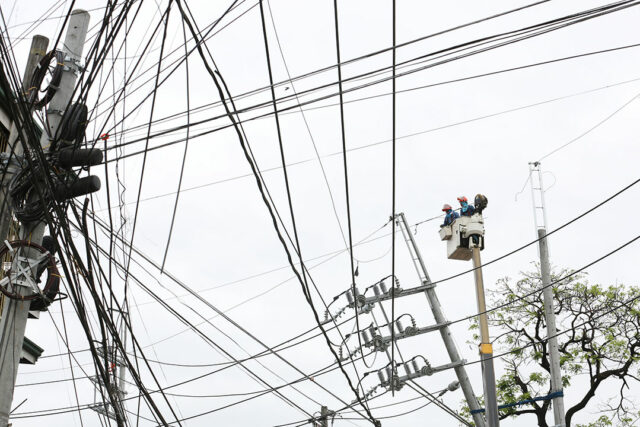
Typical households in areas covered by Manila Electric Co. will pay lower power bills in August. — PHILIPPINE STAR/MICHAEL VARCAS

HOUSEHOLDS can expect a reduction in the cost of electricity this month as Manila Electric Co. (Meralco) said it will lower rates by P0.29 per kilowatt-hour (kWh) as the generation charge fell for a third straight month.

This brings the overall rate for a residential household to P10.90 per kWh in August from P11.19 per kWh in July, Meralco said in a statement.

Households with a 200-kWh consumption will see their monthly bills reduced by around P58.

Households consuming 300 kWh, 400 kWh, and 500 kWh will see a decrease of P87, P116, and P145, respectively, in their monthly bills.

With the latest adjustment, total reduction in power rates for the last two months stood at P1.01 per kWh, Joe R. Zaldarriaga, Meralco spokesperson and vice-president for corporate communications, said in a virtual briefing.

Meralco said the rate cut is mainly due to the P0.21 reduction in generation charge to P6.39 per kWh in August, from P6.61 per kWh in July.

Mr. Zaldarriaga said other generation charge components also went down, offsetting the slight increase in charges from independent power producers.

Charges from the Wholesale Electricity Spot Market  fell by P1.29 to P6.99 per kWh, while charges from power supply agreements slipped by P0.17 to P5.96 per kWh.

The average demand in the Luzon grid declined by over 200 megawatts (MW) as the rainy season started. “The decrease in spot market prices also reduced the imposition of the secondary price cap to 2.41% of the time in the July supply month from 9.21% in the previous month,” Meralco said.

Lawrence S. Fernandez, vice-president and head of utility economics of Meralco, said a decrease in the price of Malampaya natural gas also helped bring down power rates for the month. 

Meralco’s major power suppliers include three power plants of First Gen Corp., that use Malampaya gas as fuel. These power plants have a combined 1,900 MW of baseload supply to Meralco.

The Malampaya fuel price adjusts every quarter based on oil prices and other fuels in the past six months.

Dubai crude oil price, which is the benchmark used in the Philippines, fell to around $79.08 per barrel in the second quarter from $82.58 per barrel in the first quarter.

“For the first half of 2023, there was a reduction in global Dubai crude oil prices compared to the prior six months. This was reflected starting July in the fuels of the power plants and is now being reflected in August generation charge. They supply almost 40% of Meralco’s requirements,” Mr. Fernandez said.

Meralco also noted the peso appreciation, which affected dollar-denominated costs, contributed to lower rates for the month.

Transmission and other charges, which include taxes and subsidies, reported a net reduction of P0.077, Meralco said.

The collection of the feed-in-tariff allowance (FIT-All) stood at a rate of P0.036 per kWh. The collection of FIT-All, however, will only remain suspended until August.

FIT-All is a uniform charge levied on all on-grid electricity customers, calculated and set annually. The funds these payments go into support the development and promotion of renewable energy.

Meanwhile, Meralco urged all qualified consumers to register under the lifeline rate program, warning that discounts will no longer be provided to unregistered consumers starting September.

Maita Basa-David, Meralco North Business Area Head, said Meralco has only received 3,259 applications so far, of which 2,061 were approved.

Under Meralco’s franchise area, there are a total of 450,607 beneficiaries of Pantawid Pamilyang Pilipino Program (4Ps) and other marginalized households qualified to avail of the subsidy.

The lifeline rate is a subsidy provided to customers with a monthly power consumption of 100 kWh or less. Under the revised rules, customers living in condominiums, subdivisions, and those with net-metering services are no longer qualified for the lifeline rate despite having lower consumption.

Meralco’s controlling stakeholder, Beacon Electric Asset Holdings, Inc., is partly owned by PLDT Inc.

Hastings Holdings, Inc., a unit of PLDT Beneficial Trust Fund subsidiary MediaQuest Holdings, Inc., has a majority stake in BusinessWorld through the Philippine Star Group, which it controls. — Ashley Erika O. Jose

PSA keeps 1st quarter GDP growth unchanged at 6.4%

The Philippine economy grew by 6.4% in the first quarter. — PHILIPPINE STAR/EDD GUMBAN

THE PHILIPPINE Statistics Authority (PSA) said on Wednesday it kept the gross domestic product (GDP) annual growth rate for the first quarter unchanged at 6.4%.

This came ahead of the release of the second-quarter GDP data today (Aug. 10).

A BusinessWorld poll of 21 economists conducted last week yielded a median estimate of 6% GDP growth for the April-to-June period. If realized, this would be slower than the 6.4% growth in the first quarter and the 7.5% expansion in the same period in 2022.

Meanwhile, the net primary income from the rest of the world was revised upwards to 82.4% from 81.2% previously. This brought the gross national income in the first quarter to 10%, from the 9.9% initially reported.

The PSA noted the major upward revisions in the industry side: accommodation and food service activities (27.8% from 26.9% initially); education (6.6% from 5.8%); and construction (11.1% from 10.8%).

It also raised growth rates in other services (37% from 36.5%); electricity, steam, water, and waste (7.21% from 6.8%); transportation and storage (14.6% from 14.3%); human health and social work activities (7.7% from 7.5%); and professional and business services (7.8% from 7.7%).

On the expenditure side, the PSA upwardly revised private consumption growth to 6.4% in the first quarter from the 6.3% initially reported.

Government spending growth was kept at 6.2%.

Gross capital formation was also revised upwards to 12.6% from 12.2%.

The growth of exports of goods and services was upgraded to 1% from 0.4%, while imports of goods and services were revised to 4.7% from 4.2% previously.

National account revisions are based on approved revision policy, which is consistent with international standard practices, the PSA said. — Andrea C. Abestano

Strong consumer confidence propels SMIC’s income to P36.5B — CEO

SM INVESTMENTS Corp. (SMIC) reported on Wednesday a consolidated net income of P36.5 billion for the first half, reflecting a 32% increase from P27.7 billion in the same period last year.

The results were “driven by solid consumer sentiment on the back of a positive economic environment,” SMCI President and Chief Executive Officer (CEO) Frederic C. DyBuncio said in a statement.

“Our performance was driven by fundamental demand, without the added benefit of post-pandemic ‘revenge spending’ that contributed to last year’s results,” he added.

He noted that the robust consumer confidence was also tied to low unemployment and better inflation environment, setting a strong base for the rest of the year.

The company’s consolidated revenues increased by 18% to P286.3 billion from P242.6 billion in the previous year.

The company’s total net earnings for the six-month period came from retail, accounting for 17%; property, accounting for 26%; banking, which made up the bulk at 47%; and portfolio investments, contributing 10%.

SM Retail, Inc. recorded a 21% increase in net income for the period, amounting to P8.4 billion from P7 billion, with revenues also rising by 15% to P188.9 billion from P164.3 billion.

These gains were attributed to increased shopping activity, buoyed by improved employment conditions.

“Consumer spending was notably strong in discretionary categories such as fashion, dining out, and entertainment, reflecting increased spending power on lifestyle and experiences, underpinned by stronger consumer confidence,” Mr. DyBuncio said.

Revenues from department stores grew by 27%, specialty retail also increased by 18%, and its food retail segment grew by 10%, boosted by Alfamart reporting a 26% increase in revenue.

As of June 2023, Alfamart had a total of 1,528 stores, while SM Retail and its affiliates added 174 stores, bringing the total retail network to 3,677 stores.

SM Prime Holdings, Inc. reported a consolidated net income of P19.4 billion for the first half, marking a 37.6% increase from P14.1 billion.

This growth was driven by a 29% increase in revenues, reaching P31.2 billion from P22.5 billion last year.

The company’s banking segment, BDO Unibank, Inc., saw a net profit increase to P35.2 billion in the first half.

Net interest income advanced to P89.5 billion, supported by an 8% rise in gross customer loans to P2.7 trillion, while deposit liabilities increased by 12% to P3.3 trillion.

Meanwhile, China Banking Corp. reported a net income of P10.8 billion, marking a 7% improvement compared to the previous year. Its net interest income increased by 16% to P25.5 billion, as its overall income countered the rise in interest expenses.

The company’s portfolio investment contributed 10% to its consolidated net income for the period.

SMIC shares closed 0.56% higher at P900 apiece on Wednesday. — Adrian H. Halili

Megawide’s property arm secures P3-B loan for QC project

MEGAWIDE.COM.PH

MEGAWIDE CONSTRUCTION Corp.’s property unit, PH1 World Developers, Inc., has secured a P3-billion development loan from BDO Unibank, Inc. for its vertical project in Quezon City, its president said on Wednesday.

PH1 World Developers intends to use the loan proceeds for its 45-storey development called My Enso Lofts, according to the company.

“The transaction marks a significant milestone for PH1, giving a seal of approval on the My Enso Lofts’ prospects and establishes our company’s credit worthiness as a legitimate player in the industry,” said PH1 President Ma. Gilda G. Alcantara in a press release.

My Enso Lofts was launched in November 2020 and is expected to be completed by 2026. It will follow the maiden development of PH1 in Taytay, Rizal which is said to be currently at the tail end of turning over.

“PH1 has shown its ability to deliver on its commitments, followed by a healthy take-up of newly launched projects,” said Cecile Tan, lead co-head of institutional banking group at BDO Unibank.

“The company’s rich pipeline can potentially anchor a stronger and longer-term business relationship between our organizations that we can further build on,” she said.

PH1’s other projects include the recently launched Modan Lofts Ortigas Hills, along with projects in Pasig City and Pampanga.

The company also plans to launch a horizontal development in Bulacan through Northscapes San Jose Del Monte, which will mark its first venture into horizontal projects.

Aiming to prioritize energy efficiency, Northscapes will incorporate solar panels, tinted windows, insulated walls, e-shuttles, and solar-powered street lights.

Last month, Megawide announced its intention to acquire the 100% outstanding capital stock of PH1 from Citicore Holdings Investments, Inc. for P5.2 billion. — Justine Irish D. Tabile

CTA affirms denial of Carmen Copper’s VAT refund claim

CTA.JUDICIARY.GOV.PH

THE COURT of Tax Appeals (CTA) has upheld its decision to reject Carmen Copper Corp.’s tax refund claim of P11.4 million, which was said to represent the excessive value-added tax (VAT) on the company’s purchases of goods, services, and imports for the year 2015.

In a 19-page decision dated Aug. 2, the CTA full court said the firm failed to prove its entitlement to the amount and that the amount could be traced to zero-rated sales.

“Petitioner (Carmen Copper) was not able to prove that it is entitled to a refund in cash in the amount of P11,393,494.01, representing its excess and unutilized input VAT on purchases of goods and services, and importation of goods, for the first quarter of 2015,” the tax tribunal said.

The court also noted that its Second Division did not misuse its discretion in rejecting the company’s refund claim.

In 2017, former Assistant Revenue Commissioner Teresita M. Angeles partially granted Carmen Copper’s claim in the amount of P48.78 million of its initial P60.17 million claim for 2015.

Under the country’s tax code, zero-rated sales are transactions made by VAT-registered taxpayers that do not translate to any output tax.

If a sale is subject to 0% VAT, the term “zero-rated sale” must also be written on the company’s official invoices. — John Victor D. Ordoñez

San Francisco-Manila route sparks optimism for United Airlines

IMAGE VIA UNITED AIRLINES

UNITED AIRLINES is hopeful about travel demand in the Asia-Pacific region due to the expected interest in its San Francisco-Manila route, a company official said on Wednesday.

“We are very confident that this flight will perform exceptionally well,” said Walter Dias, United Airlines’ regional director for Greater China, Korea, and Southeast Asia sales, during a briefing.

“Our forecasts are grounded in the current economic conditions and observed travel trends within the region.”

Last month, the company unveiled plans to launch daily nonstop direct service between San Francisco and Manila, set to commence on Oct. 30.

The Manila-San Francisco flight will depart daily at 9:55 a.m. and arrive at 7:20 a.m., using a Boeing 777-300ER, the airline’s largest aircraft.

“This route has been a dream of mine for over 20 years. I’ve always envisioned a trans-continental flight connecting the US mainland to Manila,” said Mr. Dias.

He said that the new route would benefit the Philippines, as the San Francisco hub is anticipated to generate significant traffic to the country.

“The San Francisco hub stands as the largest US gateway into Asia. We facilitate over 200 flights daily to and from San Francisco, connecting to approximately 29 Asia-Pacific destinations,” he added.

The new route supplements the airline’s existing nonstop service to Manila from Guam and Palau, both of which, according to the airline, have seen strong demand.

“We’re very pleased with our load factor. Some days, it even surpasses our expectations,” United Airlines Country Manager for Sales-Philippines Pam C. Navarro said.

The San Francisco-Manila route is just one of the 15 planned Asia-Pacific destinations for the airline. The roster includes direct flights to New Zealand, Australia, Japan, South Korea, Tahiti, Singapore, Shanghai, Hong Kong, and Taipei.

For the upcoming winter period, United Airlines foresees its Asia-Pacific capacity being 50% larger than the combined capacity of the two other major US carriers in the region.

By 2032, the airline expects to receive delivery of 700 new narrow and wide-body aircraft, building upon its fleet of 770 aircraft at the end of 2022.

“Over the next eight or nine years, approximately 700 new aircraft will be integrated into our fleet. This is an exciting development,” said Mr. Dias. — Justine Irish D. Tabile

Makati Shangri-La reopens (and will be releasing their own gin)

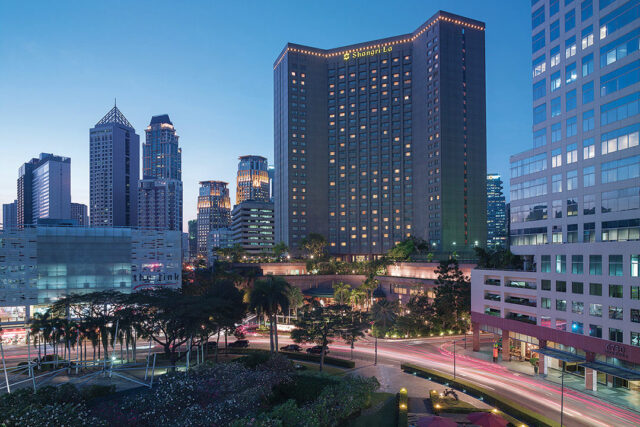
THE MAKATI SHANGRI-LA at dusk

THE LIGHTS are on again at the Makati Shangri-La.

Last week, we saw every foot of the hotel’s grand chandelier had been lit as we walked up the stairs towards the reopened Sage restaurant for lunch. The hotel officially opened to guests again on Aug. 8.

Its temporary closure had been announced early in 2021, in the middle of the COVID-19 pandemic. In a previous BusinessWorld story, management of the three-decade old Makati landmark said that “the closure decision was made after low business levels and a prolonged recovery timeline.”

“It was always our intention to open the doors of Makati Shangri-La again,” explained John Rice, Vice-President for Operations for Shangri-La Group Philippines, during an interview with BusinessWorld. “We never actually closed, we just suspended operations for a period of time, until the economy improved and until we felt that the demand was there,” he explained.

“It was a difficult decision,” he admitted. “It wasn’t a situation where we closed at all. We just stopped… until we could get to a situation where economic conditions improved and the demand was there, and we could reopen for business.”

In the interim, he said that they had kept on a core team of people on the property. “It’s been incredibly well-maintained,” said Mr. Rice.

“Makati Shangri-La, Manila is an iconic landmark that has long been woven into the rich history of Makati City. For the past three decades, the hotel has provided a tranquil sanctuary within the city’s bustling business district,” said Udo Wittich, hotel manager at the Makati Shangri-La, Manila. “The reopening symbolizes a fresh beginning for Makati Shangri-La, Manila. It presents us a unique opportunity to provide guests with refreshed experiences and colorful joys of life that span our accommodations, dining destinations, and even in the ways we work with our community.”

RESTAURANTS ARE OPEN FOR BUSINESS
As of Friday, reopened dining outlets include Sage, Shang Palace, and the Lobby Lounge. The Japanese outlet Inagiku will also reopened soon. Other dining establishments such as the Circles Event Café and Sage Bar are slated to reopen in the coming months.

The hotel’s banquet operations are in full swing, as are its function rooms (the ballroom will actually play host to a party quite soon). Mr. Rice said that they will “progressively reopen other outlets as we move further into the year.”

The rooms will also be progressively released — with a refreshed look — as well as a new category called Horizon Business, which will feature ergonomic furniture and state-of-the-art IT equipment for business travelers. Each Horizon Club Business Room comes equipped with a range of remote work-friendly amenities such as an Omnidesk adjustable standing table paired with an ergonomic chair, and fuss-free modern electronics featuring dual-screen 4K monitors, a speakerphone, mobile stands, and fast-charging cable adaptors. The business traveler-centric design offers a conducive and distraction-free environment for work, ensuring elevated productivity.

Other hotel amenities — like the Health Club, the outdoor pool, children’s pool, and tennis courts — will gradually open. The hotel spa will reopen in the first quarter of 2024.

Udo Wittich, the Makati Shangri-La’s hotel manager, also announced changes such as adopting more environment- friendly measures at the hotel. These include four new parking slots with electric car-charging capabilities, and a reduction in the use of single-use plastics. This measure includes changing keycards and pens to wood from plastic, and replacing single-use toiletries with refillable options.

They are also planning on opening a rooftop herb garden, and a greenhouse by the first quarter of next year — which will help when they release their own gin (Mr. Rice said that the gin was being bottled as we spoke).

“A few other initiatives will come up as soon as we reach the end of the year,” said Mr. Wittich. Joseph L. Garcia

For room reservations, e-mail reservations.makati@shangri-la.com. For dining reservations, e-mail dining.makati@shangri-la.com or call 8813-8888.

DMCI Holdings Q2 income falls 9% to P8.24 billion

DMCI HOMES

DMCI HOLDINGS, Inc. on Wednesday reported a 9% decline in attributable net income for the second quarter (Q2) to P8.24 billion, down from P9 billion last year.

This decrease was attributed to reduced contributions from the company’s coal, nickel, and construction businesses, DMCI said in a statement.

“Our bottom line was supported by the strong recovery of our power and water businesses,” DMCI Chairman and President Isidro A. Consunji said.

“Despite double-digit drops in coal and nickel prices, as well as decreasing construction volumes, we achieved our second-highest Q2 performance ever,” Mr. Consunji added.

The company’s total revenue slipped by about 2% to P36.96 billion from P37.7 billion last year, with higher electricity sales offsetting the impact of weaker commodity prices and fewer construction achievements.

The major contributors during the three-month period were Semirara Mining and Power Corp. (SMPC), DMCI Project Developers, Inc. (DMCI Homes), and Maynilad, accounting for 92% of total core income.

Contributions from Semirara Mining and Power to the company’s net income declined by 5% to P5.8 billion from P6.1 billion, primarily due to weaker coal selling prices. 

However, this was largely offset by higher coal shipments, power generation, electricity sales, and average selling prices.

SMPC reported a 5% decrease in net income to P10.19 billion from P10.78 billion due to reduced domestic coal sales.

DMCI’s residential unit, DMCI Project Developers Inc. (DMCI Homes), saw an 8% increase in contributions to P1.4 billion from P1.3 billion the previous year, driven by higher finance and other income. Net income also increased by 6% to P1.41 billion from P1.32 billion.

DMCI affiliate Maynilad contributed P474 million, marking a 21% increase from P393 million, due to improved billed volume, customer mix, and average effective tariff.

The affiliate’s net income grew by 34% to P2.18 billion from P1.63 billion the previous year.

DMCI Mining Corp. contributed P250 million to the company’s bottom line for the period, reflecting a 51% decline from the P510 million in the previous year.

This decline was mainly due to lower selling prices and foreign exchange gains, coupled with higher costs. Net income decreased to P708 million from P1.09 billion the previous year.

DMCI Power Corp.’s net income contribution for the quarter increased by 13% to P231 million from P205 million, supported by higher electricity sales and lower fuel costs.

Net income also jumped by 12% to P231 million from P205 million the prior year.

Furthermore, due to slower construction progress, fewer projects, and delays in major projects, D.M. Consunji, Inc.’s contributions dropped by 73% to P139 million from P516 million last year.

D.M. Consunji’s net income for the quarter decreased to P216 million from P650 million in the same period last year.

DMCI Holdings shares closed 1.05% higher at P9.60 apiece on Wednesday. — Adrian H. Halili

Italian dining: More than tomatoes and cheese

IT’S A COMMON misconception that Italian cuisine is just tomatoes and cheese on something. The varied terrains and cultures of each Italian region provide many ingredients and techniques that make for various dishes, each town boasting a different recipe than the next, oftentimes, for the same thing.

Up north for example, closer to Switzerland, we get dishes rich in dairy and of a heavier texture, due to the need for sustenance in harsher climates. Down south, we get the lighter dishes with sunnier produce (such as tomatoes); and it is this cuisine that has become evocative of Italian cuisine due to the number of their citizens migrating to America. The modification of Italian cuisine to become more suited to new American environments is a different story all together.

But going back to Italy, all roads lead to Rome, and this is where Conrad Manila’s final guest chef for its Legendary Chefs series, Valerio Pierantonelli, comes from. His dishes will be served at the buffet at Conrad Manila’s Brasserie on 3.

For lunch earlier this week, Mr. Pierantonelli served Insalata di Polpo e Patate (Octopus salad with yellow potatoes and basil), Asparagi al Tartufo e funghi (Poached asparagus marinated with mushroom and truffle paste), a mushroom soup with a truffle paste, and a gnocchi of yellow potatoes roasted with gorgonzola. Taken collectively, these dishes had a homey, comforting quality. Next came a porchetta (pork belly), noisly crunchy; and a delicate sea bass with a sauce made from a seafood stock stewed for four hours. There was of course, an osso buco, a stew made from beef shanks that hit the spot. A piece de resistance was a risotto, colored pink from beetroot, mixed with chopped asparagus and dusted with olive powder. This had the right balance between comfort and luxury.

Debunking the misconception that it’s all tomatoes and cheese up in Italy, Mr. Pierantonelli said, “There are so many things. People outside the world know only the things that are the most common. But I think, if you actually travel all over Italy, there are so many things that not even Italians know.”

He makes an example of the dishes from his native Rome, the country’s capital. “It’s very heavy. There is a lot of strong flavor,” he said. “Even in Italy, when they go to Rome, they that they’re going to eat a lot.”

His own personal touch meanwhile, can be seen in the pizza sauce. Made of crushed tomatoes and a basil infusion, it’s cooked right on the crust as the pizza is baked, resulting in a richer, more expressive flavor.

NONNA’S FAVORITES
It’s not extraordinary for Mr. Pierantonelli’s food to have an element of down-to-earth domesticity, despite his work at Conrad Singapore Orchard’s Italian restaurant, Basilico. After all, he did receive his first education in cooking from both his grandmothers — nonnas — legendary fixtures in Italian cuisine. “I started very young with both my grandmothers,” he said. He said that he had been an energetic baby, so his grandmothers would give him pieces of dough to knead to keep him busy. During Carnevale, when children would dress up in all sorts of costumes, he would choose to wear a chef’s costume. “That’s how I started to love the food.”

Nonnas are the enduring figureheads of Italian cuisine (as opposed to the temperamental chef, as French cuisine is usually represented in the media). “I think it’s good, because even myself, that’s how I learned to cook. Like I said before, the kitchen is love for me.

“More than a grandmother, who else can give you so much love?”

Mr. Pierantonelli’s dishes will be available at Brasserie on 3 until Aug. 15. Prices range from P1,799 to P3,500. —  JL Garcia

For reservations and inquiries, contact Conrad Manila’s dining reservations at 8833-9999, 0917-650-3591 or e-mail MNLMB.FB@conradhotels.com. Prices range from P1799 to P3500.

Phinma’s profits drop to P208.76M on lower construction, property income

PHINMA CORP. said on Wednesday that its attributable net income declined to P208.76 million for the first half despite recording higher revenues from most of its business segments.

The company posted an attributable net income of P406.83 million in the same period last year.

Phinma’s consolidated top line reached P8.89 billion for the first six months of the year, an increase of 3% from last year, the company said in a regulatory filing.

Its education unit, Phinma Education Holdings, Inc., registered a 52% growth in its top line, driven by a 30% increase in enrollment during the second semester of the school year 2022-2023, 

Phinma Education saw consolidated net income three times higher at P307.47 million for the first half of the year, up from P96.88 million in the same period last year.

Its construction materials business, comprised of Union Galvasteel Corp., Philcement Corp., and Phinma Solar Corp., recorded a combined revenue of P6.59 billion for the first six months.

However, the three companies saw a decline in their combined net income, reaching P262.01 million, attributed to softness in construction demand and delayed government infrastructure spending.

“Construction materials group focused on improving operational efficiencies, expanding its distribution network and developing new markets to support future sales growth especially as government infrastructure spending is expected to accelerate in the second half,” the company said.

At the company’s board meeting on Tuesday, they approved the additional investment of P114 million to Philcement, which it said will fund the expansion and improve operational efficiencies in Visayas and Mindanao.

The board also approved a P170 million investment in Galvasteel to fund projects in Phinma Solar including the installation of 9.39-megawatt alternate current of solar rooftops.

Meanwhile, Phinma’s property unit booked a net loss of P83.95 million due to the acceleration of cancellation of sales amounting to P149.5 million.

“The bulk of which has been resold and are expected to be booked during the second half of the year,” the company said.

At the same meeting on Tuesday, the company’s board of directors also approved the incorporation of a new hospitality management company, which will be a wholly owned subsidiary of Phinma. — Justine Irish D. Tabile

Yields on term deposits rise amid growing inflation risks

BW FILE PHOTO

YIELDS on the term deposits auctioned off by the Bangko Sentral ng Pilipinas (BSP) edged higher on Wednesday as global crude oil prices rose and the peso depreciated to a two-month low against the dollar, which could affect inflation.

Demand for papers under the BSP’s term deposit facility (TDF) totaled P297.282 billion on Wednesday, lower than the P300 billion on the auction block. However, this is higher than the P280.088 billion in bids logged last week for the P280-billion offer.

Broken down, the seven-day deposits attracted tenders amounting to P167.147 billion, above the P160-billion offering and the P151.358 billion in bids recorded the prior week for a P150-billion offer.

Rates for the one-week papers ranged from 6.57% to 6.61%, slightly narrower than the 6.559% to 6.61% range logged in the previous week. This brought the average rate for the tenor to 6.5932%, inching up by 0.44 basis point (bp) from the 6.5888% seen on Aug. 2.

For the 14-day deposits, tenders hit P130.135 billion, below the P140-billion offering but slightly above the P128.730 billion in bids seen last week for the P130 billion on the auction block.

Accepted yields were from 6.5% to 6.62%, unchanged from the previous week. Still, the average rate of the two-week deposits went up by 0.71 bp to 6.5974% from the 6.5903% logged a week ago.

The central bank has not auctioned off 28-day term deposits for more than two years to give way to its weekly offering of securities with the same tenor.

The term deposits and the 28-day bills are used by the BSP to mop up excess liquidity in the financial system and to better guide market rates.

TDF yields were higher week on week after global crude oil prices went up, which could affect inflation, Rizal Commercial Banking Corp. Chief Economist Michael L. Ricafort said in a Viber message.

Brent crude futures and US West Texas Intermediate (WTI) gained nearly $1 on Tuesday. Brent crude futures gained 83 cents to $86.17 a barrel while US WTI crude rose 98 cents to $82.92, Reuters reported.

Yields went up amid the peso’s depreciation against the greenback, which could also lead to higher import prices and inflation, Mr. Ricafort added.

The peso weakened to a two-month low against the dollar on Tuesday due to hawkish remarks from a US Federal Reserve official.

The local currency closed at P56.24 versus the dollar on Tuesday, weakening by 22 centavos from Monday’s P56.02 finish, data from the Bankers Association of the Philippines’ website showed.

This was the peso’s weakest close in over two months or since its P56.26-per-dollar close on June 1.

Additional interest rate hikes will likely be needed in order to lower inflation to the Fed’s 2% target, Fed Governor Michelle Bowman said on Monday.

The Fed raised borrowing costs by 25 bps last month, bringing its target interest rate to a range between 5.25% and 5.5%.

The US central bank has hiked rates by a cumulative 525 bps since it began its tightening cycle in March last year.

The Federal Open Market Committee will hold its next policy meeting on Sept. 19-20.

Meanwhile, the BSP expects inflation to return to its 2-4% annual target before the year ends.

Headline inflation slowed to 4.7% in July from the 5.4% in June, its sixth straight month of decline.

From January to July, inflation averaged 6.8%, still higher than the 5.4% forecast of the central bank. — K.B. Ta-asan with Reuters

ADVERTISEMENT
ADVERTISEMENT