Home Blog Page 4481

Maui wildfires kill six as ‘apocalypse’ strikes Hawaiian paradise
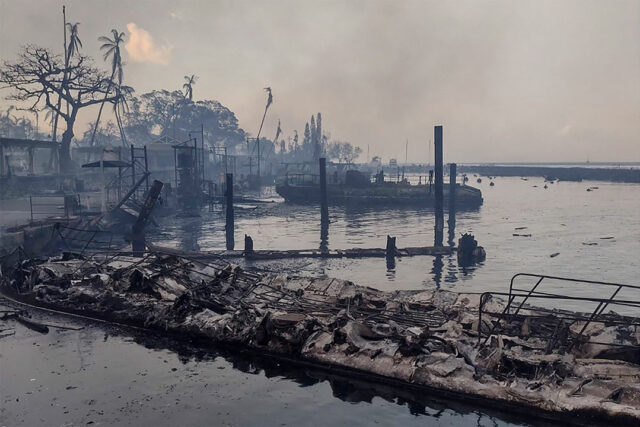
A CHARRED BOAT lies in the scorched waterfront after wildfires fanned by the winds of a distant hurricane devastated Maui’s city of Lahaina, Hawaii, US, Aug. 9. — MASON JARVI/HANDOUT VIA REUTERS

KAHULUI — Wildfires fanned by winds of a distant hurricane killed at least six people and devastated much of the resort city Lahaina on Hawaii’s Maui island on Wednesday, forcing thousands to evacuate as some fled into the ocean to escape the smoke and flames.

Multiple neighborhoods were burnt to the ground as the western side of the island was nearly cut off with only one highway open as officials told of widespread devastation to Lahaina, its harbor and surrounding areas.

Some 271 structures were damaged or destroyed, the Honolulu Star-Advertiser reported, citing official reports from flyovers conducted by the US Civil Air Patrol and the Maui Fire Department.

“We just had the worst disaster I’ve ever seen. All of Lahaina is burnt to a crisp. It’s like an apocalypse,” said Lahaina resident Mason Jarvi, who escaped from the city.

Mr. Jarvi showed Reuters pictures he took of the ashen-colored destruction along the Lahaina waterfront. Wearing shorts, he also showed blisters on his thigh that he said he suffered when riding through flames on his electric bike to save his dog.

Aerial video showed pillars of smoke rising from block after block of Lahaina, the largest tourist destination on Maui and home to multiple large hotels.

“It’s like an area was bombed. It’s like a war zone,” said helicopter pilot Richard Olsten, according to Hawaii News Now.

With firefighters battling three major blazes, western Maui was closed to all but emergency workers and evacuees.

The fires, which started Tuesday night, also scorched parts of the Big Island of Hawaii. The state said thousands of acres burned.

At least 4,000 tourists were trying to leave western Maui, said Ed Sniffen of the Hawaii Department of Transportation. Though at least 16 roads were closed, the Maui airport was operating fully and airlines were dropping fares and offering waivers to get people off the island, Mr. Sniffen said. 

Panicked evacuees posted images on social media showing clouds of smoke billowing over once-idyllic beaches and palm trees.

“I was the last one off the dock when the firestorm came through the banyan trees and took everything with it. And I just ran out and helped everyone I could along the way,” said Dustin Johnson, who was in Lahaina Harbor working for a charter boat company that offers two-hour tours. He spoke from Kahului Airport, normally a 25-minute drive east of Lahaina

Some people were forced to jump into the Pacific Ocean to escape the smoke and fire conditions, prompting the US Coast Guard to rescue them, according to a Maui County press release.

Officials said they were looking into witness reports of people being trapped in their cars.

“Local people have lost everything. They’ve lost their house. They’ve lost their animals. It’s devastating,” said Jimmy Tokioka, director of the state Department of Business, Economic Development and Tourism.

At least 20 people suffered serious burns and were airlifted to Oahu, Hawaii News Now reported, citing officials.

Evacuation efforts were complicated by power outages and disruption to cell phone service, as communication with the west side of Maui was only available via satellite, Lieutenant Governor Sylvia Luke said.

“We have shelters that are overrun. We have resources that are being taxed,” Ms. Luke said.

The situation in Hawaii recalled scenes of devastation elsewhere in the world this summer, as wildfires caused by record-setting heat forced the evacuation of tens of thousands of people in Greece, Spain, Portugal, and other parts of Europe, and western Canada suffered unusually severe fires.

Human-caused climate change, driven by fossil fuel use, is increasing the frequency and intensity of such extreme weather events, scientists say, having long warned that government officials must slash emissions to prevent climate catastrophe.

The White House issued a message of condolence from President Joseph R. Biden, who praised the work of firefighters and ordered “all available Federal assets on the Islands to help with response.”

The National Guard, US Navy, Marines and Coast Guard were mobilized, while the US Department of Transportation aided evacuation efforts, Mr. Biden said.

Deanne Criswell, administrator of the Federal Emergency Management Agency, said US assistance had already been authorized.

The cause in Maui had yet to be determined but the National Weather Service said the fires were fueled by a mix of dry vegetation, strong winds, and low humidity.

Officials said the winds from Hurricane Dora fanned the flames across the state. The storm was about 860 miles (1,380 km) southwest of Honolulu as of 11 a.m. local time (2100 GMT), the National Hurricane Center said. — Reuters


Biden unlikely to attend ASEAN summits in September

US PRESIDENT JOE BIDEN

WASHINGTON/JAKARTA — US President Joseph R. Biden is unlikely to attend summits with Southeast Asian leaders in Jakarta next month, multiple sources told Reuters, an absence that would raise questions about US commitment to a region vital in its efforts to push back against China’s expanding influence.

Mr. Biden is due to attend a Sept. 9-10 Group of 20 (G20) summit in India and said on Tuesday he plans to visit an important emerging Southeast Asian partner Vietnam “shortly” to upgrade ties, but his presence at the Sept. 4-7 summits of the 10-nation Association of Southeast Asian Nations (ASEAN) is in significant doubt.

One source close to the matter said Mr. Biden would not go to Indonesia, and another cited a Washington-based ambassador from an ASEAN member as saying that Indonesia had been informed on Monday that Mr. Biden would not be going. Other sources cited White House officials as saying that Mr. Biden’s attendance was “unlikely.”

Asked if it was correct that Mr. Biden would not be going to Indonesia, a senior White House official told Reuters on Tuesday: “We’re still working on it … we’ll probably have more to say about it soon.”

White House spokespersons did not immediately respond to a request for comment. Sources said Mr. Biden’s schedule for Asia is not official until it has been announced and could change.

Several ASEAN diplomats said it would be a significant disappointment if Mr. Biden did not go to Jakarta, given the public emphasis his administration puts on the importance of ties with the region.

One senior diplomat referred to Indonesia having scheduled the ASEAN summits, which are normally held in November, for September, specifically to make is possible for Mr. Biden to attend and then go on to the G20.

Sources said Mr. Biden was expected to send Vice President Kamala Harris in his place. Ms. Harris, the first Asian American vice president, has conducted diplomacy in the region before.

DISAPPOINTMENT IN REGION
Mr. Biden already caused disappointment in the region when he canceled what would have been the first visit by a serving US president to Papua New Guinea in May and a subsequent planned visit to Australia because he was working to close a deal with lawmakers to resolve the US debt ceiling crisis.

In an address to an ASEAN-related event in Washington on Tuesday evening, Mr. Biden’s deputy national security adviser Jonathan Finer hailed the US-ASEAN relationship and said that “ASEAN centrality” was at the heart of the administration’s strategy for the Indo-Pacific region.

Policy analysts said another no-show by Mr. Biden, who attended ASEAN meetings in Cambodia in November, would call that characterization into question.

“It will be viewed as another letdown by the region,” said Murray Hiebert, a senior associate with the Southeast Asia program at Washington’s Center for Strategic and International Studies.

“Southeast Asia has been impressed that Washington under Biden has stepped up engagement with the region,” Hiebert said.

“For him to skip the summit when he will already be nearby attending a summit in India, and likely making an official visit to Vietnam, will prompt many in the region to wonder whether the US is again slipping back to its episodic and half-hearted engagement with the region.”

Ted Osius, a former US ambassador to Vietnam who heads the US-ASEAN Business Council, said there would likely be some disappointment if Mr. Biden was unable to go to Jakarta, although he stressed the “dramatic” increase in US government-to-government engagement with ASEAN under Mr. Biden, a Democrat.

ASEAN members were unhappy when Mr. Biden’s Republican predecessor Donald Trump skipped regional summits for three consecutive years, something policy experts saw as playing into China’s expansion of its influence in the region.

Mr. Trump’s predecessor Barack Obama attended every US-ASEAN and East Asia summit from 2011, apart from 2013, when he canceled due to a government shutdown at home. — Reuters

With Eris on the rise, US CDC sees no major shift in COVID variants

CURRENTLY spreading COVID-19 variants such as EG.5, or Eris, do not represent a major shift and updated vaccines in September will offer protection, the director of the US Centers for Disease Control and Prevention (CDC) said on Wednesday.

“Right now, what we’re seeing with the changes in the viruses, they’re still susceptible to our vaccine, they’re still susceptible to our medicines, they’re still picked up by the tests,” Director Dr. Mandy Cohen said in an interview on former Biden administration adviser Andy Slavitt’s “In the Bubble” podcast. “We’re seeing small changes that are what I would call subtypes of what we’ve seen before.”

Updated vaccines should be available by mid- to late September, she said.

COVID-19 vaccine manufacturers have created new versions of their vaccine, which were updated to target the so-called XBB.1.5 subvariant that was dominant earlier this year in order to more closely resemble the circulating virus.

“We anticipate that they are going to be available for most folks by the third or fourth week of September,” Ms. Cohen said. The vaccines still need to be authorized by the US Food and Drug Administration and the CDC needs to make its recommendations, she said.

“We are likely to see this as a recommendation as an annual COVID shot just like we have an annual flu shot,” she said.

Pfizer PFE.N/BioNTech SE, Moderna and Novavax have all said they expect to have supplies of the updated vaccine ready for the roll out this autumn.

On Wednesday, the World Health Organization classified the EG.5 coronavirus strain, circulating in the United States and China, as a “variant of interest” but said it did not seem to pose more of a threat to public health than other variants. Eris is the fasting-growing COVID-19 subvariant in the US, estimated to be responsible for around 17% of current COVID cases, according to the CDC. — Reuters

North Korea’s Kim calls for war preparations

KCNA VIA REUTERS

SEOUL — North Korean leader Kim Jong Un replaced the military’s top general and called for more preparations for the possibility of war, a boost in weapons production, and expansion of military drills, state media KCNA reported on Thursday.

Mr. Kim made the comments at a meeting of the Central Military Commission which discussed plans for countermeasures to deter North Korea’s enemies, which it did not name, the report said.

The country’s top general, Chief of the General Staff Pak Su Il was “dismissed,” KCNA reported, without elaborating. He had served in his role for about seven months.

Mr. Pak was replaced by General Ri Yong Gil, who previously served as the country’s defense minister, as well as the top commander of its conventional troops.

Mr. Ri also previously served as the army chief of staff. When he was replaced in 2016 his sacking and subsequent absence from official events sparked reports in South Korea that he had been executed. He reappeared a few months later, when he was named to another senior post.

Mr. Kim also set a target for the expansion of weapons production capacity, the report said, without providing details. Last week he visited weapons factories where he called for more missile engines, artillery and other weapons to be built.

Photos released by KCNA showed Mr. Kim pointing at Seoul and areas surrounding the South Korean capital on a map.

The United States has accused North Korea of providing arms to Russia for its war in Ukraine, including artillery shells, rockets and missiles. Russia and North Korea have denied those claims.

Mr. Kim also called for the military to conduct drills with the country’s latest weapons and equipment to keep its forces ready for combat, the report said.

North Korea is set to stage a militia parade on Sept. 9, marking the 75th anniversary of the Day of the Foundation of the Republic. North Korea has a number of paramilitary groups it uses to bolster its military forces.

The US and South Korea are scheduled to hold military drills between Aug. 21 and 24, which the North sees as a threat to its security. — Reuters

Biden orders ban on certain US tech investments in China

OFFICIAL WHITE HOUSE PHOTO BY ADAM SCHULTZ

NEW YORK/WASHINGTON – President Joe Biden on Wednesday signed an executive order that will prohibit some new U.S. investment in China in sensitive technologies like computer chips and require government notification in other tech sectors.

The long-awaited order authorizes the U.S. Treasury secretary to prohibit or restrict U.S. investments in Chinese entities in three sectors: semiconductors and microelectronics, quantum information technologies and certain artificial intelligence systems.

The administration said the restrictions would apply to “narrow subsets” of the three areas but did not give specifics. The proposal is open for public input.

The order is aimed at preventing American capital and expertise from helping China develop technologies that could support its military modernization and undermine U.S. national security. The measure targets private equity, venture capital, joint ventures and greenfield investments.

Biden, a Democrat, said in a letter to Congress he was declaring a national emergency to deal with the threat of advancement by countries like China “in sensitive technologies and products critical to the military, intelligence, surveillance or cyber-enabled capabilities.”

China said on Thursday it is “gravely concerned” about the order and that it reserves the right to take measures.

The order affects normal operation and decision-making of enterprises, and undermines the international economic and trade order, a statement from the Chinese Commerce Ministry read.

The ministry also said it hopes the U.S. will respect laws of the market economy and the principle of fair competition, and refrain from “artificially hindering global economic and trade exchanges and cooperation, or set up obstacles for the recovery of the world economy”.

The Chinese foreign ministry said the country was “strongly dissatisfied” with and “resolutely opposes the U.S.’s insistence on introducing investment restrictions on China”, having also lodged solemn representations with the U.S.

China urged the U.S. to fulfill Biden’s promise of no intention to decouple from China or obstruct China’s economic development, the ministry said in a statement.

SEMICONDUCTORS A PRIORITY

The proposal focuses on investments in Chinese companies developing software to design computer chips and tools to manufacture them. The U.S., Japan and the Netherlands dominate those fields, and the Chinese government has been working to build homegrown alternatives.

The White House said Biden consulted allies on the plan and incorporated feedback from Group of Seven nations.

“For too long, American money has helped fuel the Chinese military’s rise,” said Senate Democratic Leader Chuck Schumer. “Today the United States is taking a strategic first step to ensure American investment does not go to fund Chinese military advancement.”

The regulations will only affect future investments, not existing ones, Treasury said, but it may ask for disclosure of prior transactions.

The move could fuel tensions between the world’s two largest economies. The Chinese embassy in Washington said it was “very disappointed” by the measure.

U.S. officials insisted the prohibitions were intended to address “the most acute” national security risks and not to separate the two countries’ highly interdependent economies.

Republicans said the order was rife with loopholes, such as only applying to future investment, and was not aggressive enough.

SOME EXEMPTIONS EXPECTED

The order will prohibit some deals and require investors to notify the government of their plans on others.

The Treasury said it anticipates exempting “certain transactions, including potentially those in publicly traded instruments and intracompany transfers from U.S. parents to subsidiaries.”

The Chinese tech industry, once a magnet for U.S. venture capital, has already seen a drastic decline in U.S. investment amid intensifying geopolitical tension.

Last year, total U.S.-based venture-capital investment in China plummeted to $9.7 billion from $32.9 billion in 2021, according to PitchBook data. This year so far, U.S. V.C. investors only put $1.2 billion into Chinese tech startups.

The measure is expected to be implemented next year, a person briefed on the order said, after multiple rounds of public comment, including an initial 45-day comment period.

REPUBLICAN SEES MANY LOOPHOLES

Republican Senator Marco Rubio said the Biden administration’ plan was “almost laughable.”

“It is riddled with loopholes, explicitly ignores the dual-use nature of important technologies, and fails to include industries China’s government deems critical,” he said.

A spokesman for the Chinese embassy in Washington said the White House had not heeded “China’s repeated expression of deep concerns” about the plan.

The spokesman said more than 70,000 U.S. companies do business in China. The restrictions will hurt both Chinese and American businesses, interfere with normal cooperation and reduce investor confidence in the U.S., he said.

The Semiconductor Industry Association said it hopes the order will enable “U.S. chip firms to compete on a level-playing field and access key global markets, including China.”

Emily Benson of the Center for Strategic and International Studies (CSIS), a bipartisan policy research organization, said key questions are how the plan affects U.S. allies and how China responds. — Reuters

Kellogg’s ‘woke’ workplace diversity programs are illegal, group claims

UNPLASH

A conservative legal group on Wednesday urged a United States anti-discrimination agency to investigate Kellogg Co over workplace diversity policies that it says are unlawful, and accused the cereal maker of sexualizing its products.

This is the second complaint filed this week against a company by America First Legal, a nonprofit run by Stephen Miller, who was an adviser to former President Donald Trump.

America First in a letter to the U.S. Equal Employment Opportunity Commission (EEOC) said Kellogg’s hiring, training and promotion practices are designed to achieve a balance based on race and sex that violates the federal law banning workplace bias.

It also criticized marketing campaigns including boxes of Cheez-It crackers featuring drag queen RuPaul and cereal boxes celebrating LGBTQ Pride Month.

“Management has discarded the company’s long-held family friendly marketing approach to politicize and sexualize its products,” the group said.

The EEOC can sue companies if it finds that their employment practices amount to illegal discrimination.

Kellogg did not immediately respond to a request for comment.

Many legal experts expect an uptick in legal challenges to corporate diversity programs in the wake of a June U.S. Supreme Court ruling barring race-conscious admissions policies in higher education.

America First in the letter said Kellogg, for example, has said it wants to have “25% underrepresented talent at the management level” by 2025 and runs fellowship programs that are only open to racial minorities.

“Kellogg’s employment practices are unlawfully based on ‘equity,’ which is a euphemism for illegal discrimination,” Reed Rubenstein, a lawyer with the group, wrote in the letter.

America First said it also had sent a letter to Kellogg’s board of directors on Wednesday threatening shareholder litigation if the company maintains the allegedly illegal policies.

The nonprofit on Tuesday sued Target Corp on behalf of an investor, saying the retailer failed to anticipate customer backlash over LGBTQ-themed merchandise that hurt its stock value.

The complaints are part of a campaign conservative legal groups and Republican legislators are waging against corporations that have enacted so-called woke policies on social issues such as race, gender and diversity. — Reuters

Malaysia blocks live cattle imports from Australia after skin disease scare

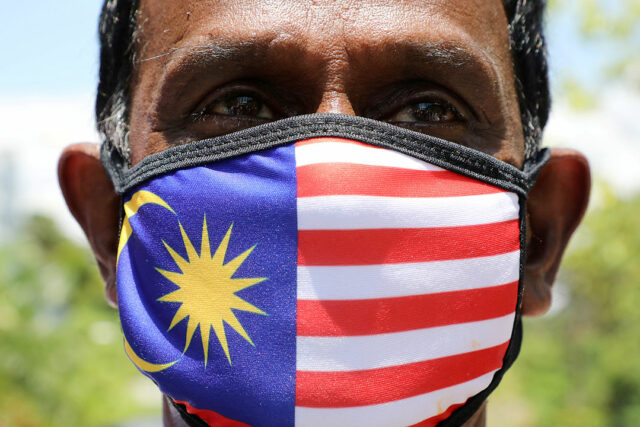
A MAN wears a mask with Malaysia’s flag outside the National Palace, Kuala Lumpur, Malaysia, Feb. 26, 2020. — REUTERS

SYDNEY – Malaysia has temporarily suspended live cattle and buffalo imports from Australia, the Australian government said, days after Indonesia paused some imports after lumpy skin disease (LSD) was detected in a small number of cattle after arrival.

Australia was urgently engaging with its Malaysian counterparts to lift the curbs while confirming the country remained free from the disease, Australia’s chief veterinary officer, Mark Schipp, said on Wednesday.

“We understand this decision was based on Indonesia’s advice that they will not accept cattle from four specific export establishments following detection of LSD in exported Australian cattle after they had arrived and spent time in Indonesia,” Schipp said in a statement.

Indonesia, the largest market for Australian live cattle exports, last week placed some restrictions even as officials sought to allay fears by conducting rapid diagnostic testing.

Schipp said his department was working to finalize the investigation into the health status of the impacted cattle. Australia is free of LSD and cattle exports to Indonesia continue from other facilities.

LSD, which causes blisters and reduces milk production, is a highly infectious viral disease affecting cattle and buffalo that is transmitted by insect bites. It poses no risk to humans.

Australia did not specify the number of shipments that will be impacted by Malaysia’s decision. — Reuters

Nicaragua freezes bank accounts of top university led by Jesuits – source

Nicaraguan authorities froze the bank accounts of the country’s top private university, a source from the institution told Reuters, marking the latest move against a Catholic-led institution in an ongoing crackdown by the government.

The Jesuit-run Central American University (UCA) is the alma mater of many youth leaders who protested the government of President Daniel Ortega in 2018, which were initially triggered by old-age pension cuts.

The protests turned violent, and rights groups blamed Ortega’s police and other government-affiliated security forces for killing more than 300 civilians.

“I can tell you that the accounts are frozen. We are trying to find out what is going on but we don’t want to cause alarm,” said a university official who requested anonymity to speak candidly.

Earlier on Wednesday, digital news outlet Divergentes reported that UCA officials sent an email to staff and students advising that they were not receiving any payments due to reasons beyond their control.

The government did not immediately reply to a request for comment.

In May, authorities also froze bank accounts belonging to Catholic parishes across the country as prosecutors launched what they called a money laundering investigation. Officials have also arrested and jailed priests including Bishop Rolando Alvarez, a major Ortega critic.

Catholic church leaders had acted as mediators in the aftermath of the 2018 protests.

Founded in 1960, UCA graduates include many from Nicaragua’s political and business class, including Ortega who began law studies there in 1962 before leaving to join the Sandinista rebel movement. Three of his sons later studied there.

The university had already been singled out for budget cuts and its leaders targeted, including UCA rector and Jesuit priest Jose Idiaquez who last year was barred from returning to Nicaragua after traveling to Mexico. — Reuters

BSP sees ‘prudent pause’ in tightening amid easing inflation

REUTERS

MANILA – A series of interest rate hikes by the Bangko Sentral ng Pilipinas (BSP) should bring inflation back to within target in the fourth quarter, giving monetary authorities “the cause for a prudent pause” in its tightening cycle, its governor said on Thursday.

Future monetary policy actions will continue to be data-dependent and guided by evolving domestic developments, Bangko Sentral ng Pilipinas Governor Eli M. Remolona told lawmakers ahead of a rate-setting meeting on Aug. 17.

The central bank is not yet sure whether to raise interest rates or even to cut amid mixed data, Mr. Remolona said. “But for now, we are at a pause and reassessing the situation”.

Year-to-date inflation was at 6.8%, a key factor in dampened consumer spending, well beyond the central bank’s 2% to 4% target for the year. — Reuters

Philippine economy grows 4.3% in second quarter as spending slows

Condominium buildings are seen in Manila amid dark rain clouds, April 14, 2023. — PHILIPPINE STAR/MIGUEL DE GUZMAN

MANILA – The Philippine economy slowed for a third straight quarter in April-June from last year, the statistics agency said on Thursday, dragged down by higher commodity prices and slower government and consumer spending.

Gross domestic product (GDP) in the June quarter rose 4.3%, losing further momentum after the previous quarter’s 6.4%, which was slower than the December quarter’s 7.1%.

On a quarter-on-quarter basis, the economy contracted 0.9% in the second quarter, weaker than the 1.1% expansion in the March quarter and missing a 0.5% growth forecast of economists.

The country’s economic ministers said the weaker performance was due to higher prices of farm goods deterring consumer spending, plus a contraction in government spending compared to the same period a year earlier, when an election was held.

“For the second quarter, the moderate economic expansion was driven by increases in tourism-related spending and commercial investments, but was tempered by high commodity prices, the lagged effects of interest rate hikes, the contraction in government spending, and slower global economic growth,” they said in a statement.

The slower than expected growth in the second quarter will weigh on the policy review of the central bank, which will meet on Aug. 17 to decide whether to resume raising rates or extend its rate hike pause.

The ministers said an improving inflation outlook boded well for an easing of interest rates, and government spending would accelerate in the coming quarters and they aimed to ensure overall price stability amid upside risks.

Growth in the June quarter brought first half expansion to 5.3%, below the government’s 6.0%-7.0% target for the year. Even so, Economic Planning Secretary Arsenio M. Balisacan said the full-year target was still attainable.

“We firmly believe that the prospects of the Philippine economy remain strong and positive,” the economic ministers said in a statement read by Mr. Balisacan at a press conference.

ING Economist Nicholas T. Mapa said the central bank, which will meet on Aug. 17 to review policy, “will need to consider a pause” to support growth.

The BSP has kept interest rates steady PHCBIR=ECI at 6.25% at its last two meetings after nine rate hikes totaling 425 basis points in efforts to bring inflation back to within the 2%-4% target band. — Reuters

E-Commerce Customer Support Philippines: Cynergy BPO — Outsourcing — The Game-Changer

The digital revolution has transformed the way businesses operate, creating opportunities that were unthinkable a few decades ago. In this vibrant, complex ecosystem, e-commerce stands out as one of the most significant disruptors. And within this digital marketplace, customer support emerges as the cornerstone of business success. One company at the helm of this transformative shift is Cynergy BPO, an advisory firm that facilitates strategic partnerships between global e-commerce players and industry-leading business process outsourcing (BPO) providers in the Philippines and around the world.

“E-commerce has democratized the global marketplace. In such a diverse, dynamic arena, the one element that can truly differentiate a brand is its customer support,” says John Maczynski, CEO of Cynergy BPO. “Our role is to help e-commerce firms find industry-leading outsourcing partners who can deliver on this crucial element of business.”

The fast-paced nature of e-commerce demands a 24/7 customer support system, something that in-house teams may struggle to provide. In addition, issues like linguistic diversity, managing volumes during peak seasons, and providing technical support are areas where businesses may falter. This is where outsourcing customer support can be a game-changer.

The Philippines, with its rich pool of tech-savvy, customer-focused talent and advantageous time zone, is ideally positioned to cater to the global demand for high-quality e-commerce customer support.

Ralf Ellspermann, CSO at Cynergy BPO, emphasizes this point. “The Philippines not only has the infrastructure and talent but also the customer-centric culture that makes it a top choice for outsourcing e-commerce customer support.”

Outsourcing, however, isn’t just about offloading tasks. It’s about creating strategic partnerships that foster growth, innovation, and a customer-centric ethos. By connecting e-commerce firms with the right BPO partners, Cynergy BPO ensures the delivery of superior customer support services out of the Philippines, handling everything from order inquiries and technical issues to returns, refunds, and complaints.

But the true game-changing potential of outsourcing goes beyond customer support. With the right BPO partner, e-commerce businesses can access a suite of services such as data analytics, market research, social media management, and more, each designed to enhance the customer journey and business operations.

Furthermore, outsourcing to a country like the Philippines, known for its high English proficiency and culturally adaptive workforce, enables companies to offer a truly global service. “With our Philippine partners, we ensure that businesses can cater to a diverse customer base, providing customer support in multiple languages, thereby fostering customer loyalty and business growth,” Mr. Ellspermann adds.

Cynergy BPO stands at the intersection of technology, customer service, and strategic outsourcing, enabling e-commerce firms to navigate the complex world of customer support. With its focus on creating strategic alliances, leveraging the power of technology, and fostering a customer-centric ethos, Cynergy BPO is reshaping the face of e-commerce customer support.

In an industry where the customer is king, and their satisfaction is paramount, outsourcing customer support to the Philippines can indeed be a game-changer. As MR. Maczynski puts it, “In the end, it’s about delivering value — to our clients, their customers, and our BPO partners. And that’s the real game-changer in e-commerce.”


Spotlight is BusinessWorld’s sponsored section that allows advertisers to amplify their brand and connect with BusinessWorld’s audience by enabling them to publish their stories directly on the BusinessWorld website. For more information, send an email to online@bworldonline.com.

Join us on Viber at https://bit.ly/3hv6bLA to get more updates and subscribe to BusinessWorld’s titles and get exclusive content through www.bworld-x.com.

Globe user experience seen boosted by heavy investment in mobile network

BW FILE PHOTO

INCREASED investment by Globe Telecom, Inc. in its mobile and fixed networks led to a major improvement in the user experience of the company’s customer base, OpenSignal said in a report.

“During 2022, Globe improved its mobile network experience at the same time as it has focused on increased network investment. As a result, Globe has overtaken Smart to become the current most awarded in the Philippines,” OpenSignal said.

In the report, OpenSignal said Globe users were observed to have spent more time with active connections, and reported an improved video experience relative to customers of Smart Communications, Inc. and DITO Telecommunity Corp.

Last year, Globe invested P101.4 billion in its network and exceeded its rollout targets with 2,267 new 5G sites and more than 13,600 mobile sites upgraded to 4G.

OpenSignal said both Globe and Smart saw a large rise in mobile traffic in 2022 with year-on-year growth of 25% and 30%, respectively.

“With greater network usage, operators need to invest more to avoid increased congestion. If they don’t, then users’ network experience will suffer, and they will risk increased churn,” OpenSignal said.

It said the two most important metrics in the Philippines for user experience are perceived video quality and time with no signal.

Globe has the highest percentage of users at 88.3% experiencing less than 1% of their time with no signal.

In terms of video quality, an industry-leading 6.5% of Smart users reported excellent video experience. Globe topped the other categories with 41.2% of its users reporting very good video experience, while only 15.9% of its users reported poor video experience.

“This distribution indicates users on Globe will likely enjoy a more consistent video experience than users on Smart’s or DITO’s network,” OpenSignal said.

Meanwhile, it said DITO and Smart are playing catch up in terms of 4G signal strength as Globe users were found to be consistently spending less time with a poor network. — Justine Irish D. Tabile

ADVERTISEMENT
ADVERTISEMENT