Home Blog Page 4451

Fuel surcharge for airlines to rise in September

Image by Andy Choinski from Pixabay

The Civil Aeronautics Board (CAB) has raised the passenger and cargo fuel surcharge rate for September, after keeping it at level 4 for three consecutive months or from June to August.

In an advisory posted on Wednesday, the CAB announced that the applicable fuel surcharge for domestic and international flights was raised by two levels or to Level 6.

Under level 6, passengers will have to pay a fuel surcharge of between P185 and P665 for domestic flights, and between P610.37 and P4,538.40 for international flights.

At the current level 4, CAB permits a fuel surcharge per passenger of between P117 to P342 for domestic flights and from P385.70 to P2,867.82 for international flights.

CAB Officer-in-Charge Maria Elben SL. Moro said that the applicable conversion for the Sept. 1-30 period is P54.97 per US dollar.

The fuel surcharge level set for September is the first rise since CAB started reducing rates in April.

Airline fuel surcharge is an optional fee imposed by airlines to recover fuel costs. It is evaluated based on a one-month average of jet fuel MOPS (Mean of Platts Singapore) prices. — Justine Irish D. Tabile

ISOG champions public sector cybersecurity, digital transformation at 2nd I AM SECURE 2023 Forum

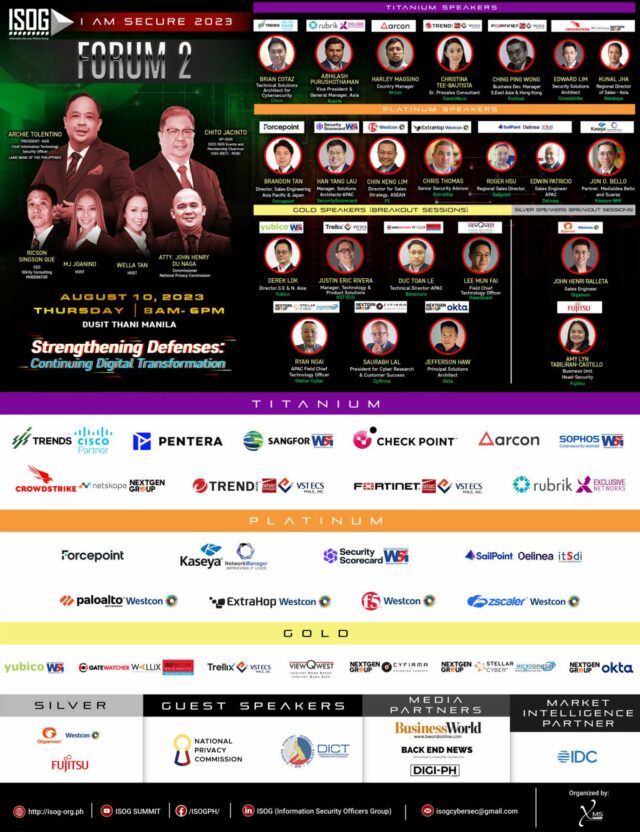
The Information Security Officers Group (ISOG) continued its cybersecurity campaign this year with the second forum of I AM SECURE 2023. With the theme Strengthening Defenses: Continuing Digital Transformation, the forum was held on Aug. 10, 2023, at the Dusit Thani Hotel.

While the first forum held in June focused on banking and finance industries, the second forum revolved around equipping and establishing the cyber defenses of the government and public sector in the age of digital transformation.

“As our government implements plans and strategies to reinforce the Philippines’ defenses in the digital realm, it needs the support of information security professionals throughout the country.  With a huge responsibility on our shoulders, we have to ensure that we are equipped for the battle. The constant need to keep our guard up is the very reason that we are dedicating our time to this forum and other activities organized by ISOG,” said ISOG President Archie Tolentino  in his opening remarks.

The forum brought together hundreds of participants, consisting of local and international decision-makers, C-suite executives, and cybersecurity experts. The delegates learned about empowering data privacy in the Philippines from keynote speaker, Atty. John Henry D. Naga,  Commissioner of National Privacy Commission. Moreover, guest speaker,  Vazir Joshua Querol, Project Director for Services of the Department of Information and Communications Technology’s National Government Data Center Project, shared updates on current projects that aims to Strengthen the Digital Transformation Journey.

The plenary session featured a dynamic lineup of informative and engaging presentations by global thought leaders and industry experts from the Titanium and Platinum sponsors. The roster of speakers included Brian Cotaz, Technical Solutions Architect for Cybersecurity at Cisco (through Trends); Abhilash Purushothaman, VP and General Manager, Asia at Rubrik (through Exclusive Networks); Christina Tee- Bautista, Senior Pre-sales Consultant at Trend Micro (through Netsec and VST-ECS); Ching Ping Wong, Business Development Manager, SEA and HK at Fortinet (through Netsec & VST-ECS); Harley Magsino,  Country Manager at Arcon; Edward Lim, Security Solutions Architect at Crowdstrike and Kunal Jha,  Regional Director of Sales – Asia, at Netskope (through Nextgen); Brandon Tan, Director, Sales Engineering Asia Pacific & Japan, Forcepoint; Han Yang Lau Manager, Solutions Architects, APAC at SecurityScorecard (through WSI); Chin Keng Lim, Director for Sales Strategy, ASEAN at F5 (through Westcon); Chris Thomas, Senior Security Advisor at ExtraHop (through Westcon); Roger Hsu, Regional Sales Director at Sailpoint; and Edwin Patricio, APAC Sales Engineer at Delinea (through ITSD, and Atty. John O Bello, Medialdea, Bello and Suarez  (represented Kaseya and NMI).

One of the highlights of the forum was the panel discussion among some of the plenary speakers representing the Titanium and Platinum Sponsors. Moderated by Ricson Singson Que, President of SQrity Consulting, the panel discussion entitled entitled Implications of Artificial Intelligence (AI) in Today’s Digital Transformation Efforts  allowed the forum participants to learn from the panelists’ take on how AI can help organizations accelerate their digital transformation journey.

In the afternoon, participants attended a breakout session featuring presentations by speakers from the Gold and Silver sponsors including Derek Lok, Director, South East and North Asia at Yubico(through WSI); Justin Eric Rivera, Manager, Technology & Product Solutions at Trellix (representing VST-ECS); Duc Toan Lee, Technical Director at Bizsecure (with Gatewatcher and Wallix), Ryan Ngai, APAC Field Chief Technology Officer at Stellar Cyber, with Microgenesis (through Nextgen); Lee Mun Fai,  Field Chief Technology Officer at ViewQwest; Saurabh Lal,  President for Cyber Research & Customer Success at Cyfirma (through Nextgen); Jefferson Haw Principal Solutions Architect at  Okta (through Nextgen); John Henri Ralleta, Sales Engineer at  Gigamon (through Westcon); and Amy Lyn Tabiliran-Castillo, Business Unit Head-Security at Fujitsu.

The forum also provided an avenue for participants to interact with each other through the speed networking session, a series of brief one-on-one information exchanges.

“Attending this forum is one of our ways to sharpen our expertise, equipping us with up-to-date knowledge and skillset essential to ensuring cybersecurity. ISOG commits to providing everyone in our industry with opportunities to advance their proficiency and connect with other professionals,” ISOG Vice President and 2023 Events and Membership Chairman Chito Jacinto said.

ISOG is set to hold the ISOG Conference, in celebration of cybersecurity month, on October 26 at Shangri-la at the Fort.  The organization is also looking forward to its annual donation drive and corporate social responsibility project in December.

Organized by XMS, the second forum of the I AM SECURE 2023 was supported by media partners, DIGI.PH, Backend News, BusinessWorld, and Market Intelligence Partner, IDC.

ISOG is a leading professional information security organization that provides a platform for companies to the country’s cybersecurity community by strengthening information technology through education and awareness programs. Promoting fellowship among information security leaders to achieve sustainable info. security environment.

For more details about ISOG and its campaigns, visit ISOG’s official website at www.isog-org.ph and socials at LinkedIn: ISOG (Information Security Officers Group), Facebook: ISOGPH, YouTube Channel: ISOG SUMMIT.


Spotlight is BusinessWorld’s sponsored section that allows advertisers to amplify their brand and connect with BusinessWorld’s audience by enabling them to publish their stories directly on the BusinessWorld website. For more information, send an email to online@bworldonline.com.

Join us on Viber at https://bit.ly/3hv6bLA to get more updates and subscribe to BusinessWorld’s titles and get exclusive content through www.bworld-x.com.

Meet Raging Bull Chophouse’s burger sibling

RBB KICKASS

CITED in Asia’s 50 Best Discovery List, the Raging Bull Chophouse and Bar at Shangri-La The Fort knows its steaks. You should meet their burgers.

A sister brand, Raging Bull Burgers, opened its doors at Shangri-La Plaza on Aug. 10 for a tasting (but has been open since July).

We met two of their burgers recently, namely, the Kickass (the names might be PG-13; beers brewed exclusively by Nipa Brewery for them are also available), made with 1/3 lb. Angus beef patty, iceberg lettuce, tomato, dill pickles, and Raging Bull sauce; and the Raging Wagyu, 1/3 lb. Australian Wagyu beef patty, braised onions, chili chutney, lettuce, tomato, and dill pickle. Both burgers were especially satisfying, especially with their quality and that price — at about P350, while premium burgers in the city can clock up to P450 or higher.

While the beef is imported, sustainable diners can sigh a bit easier: most of the ingredients used in the store are sourced from local farmers, while the utensils are made biodegradable cornstarch.

Other items in the menu include The Mighty Beast (US Angus beef patty,  griddle maple bacon, aged cheddar, spicy beer mustard sauce, lettuce, tomato, and dill pickle toppings), Kickin’ Chicken (grilled chicken, smoky bacon, iceberg lettuce, tomato, dill pickle, and Raging Bull homemade BBQ sauce), Naked Fish (fried grouper fillet, criolla and romaine lettuce, and tartar sauce), and a vegan option, The Clean Slate (squash patty, iceberg lettuce, cauliflower parsley tabbouleh, and a vegan BBQ sauce). All of these are topped off with a bun (also locally sourced) made from corn, which, while giving the burger a sweetish note, is also firmer — which keeps the burger more intact as you hold it between your hands.

The patties are made from choice cuts of brisket, rump, and wagyu; a callback to the fancier steakhouse with which the burger joint shares its name. Soh Rosario, Director of Marketing Communications at Shangri-La The Fort outlined the close relationship within the brands during the launch. “It’s on the premium side. When you say Raging Bull, consumers can be assured that it’s premium quality beef.” He adds, “It’s the Shangri-La brand. Five-star quality.”

Raging Bull Burgers is located at the ground floor of the North Wing of Shangri-La Plaza Mall in Mandaluyong. — Joseph L. Garcia

Repower Energy expects to maintain growth momentum

Repower Energy Development Corp. is optimistic that it would further grow its earnings for the rest of the year, mainly driven by the commissioning of its hydropower plant.

In a stock exchange disclosure on Wednesday, the company reported an attributable net income of P40.40 million for the second quarter, a reversal of the P12.39-million net loss incurred in the same period last year.

“The third and fourth quarters of 2023 is expected to likewise grow further with the commissioning of the Tibag 5.8-megawatt (MW) plant last June and the Lower Labayat presently undergoing testing and commissioning,” it said.

For the April-to-June period, Repower Energy saw its gross revenues increase by 48.6% to P105.35 million from the P70.91 million reported a year ago.

For the first semester, its attributable net income reached P88.65 million, reversing the P28.78-million net loss a year ago.

Repower Energy’s net income for the period climbed more than threefold to P95.70 million from P27.32 million previously, which is mainly due to the contribution of its two power plants, the Tibag and the Lower Labayat hydroelectric facilities.

For the first half, Repower Energy’s gross revenues jumped 64.5% to P226.31 million from P137.57 million in the corresponding period a year ago.

Repower Energy, a subsidiary of Pure Energy Holdings Corp., has set a target of expanding its installed capacity by 1 gigawatt in the next five years, with its main focus on hydropower plants.

It debuted on the Philippine Stock Exchange last July 24 where it raised P1.15 billion to fund the expansion of its renewable energy portfolio. — Ashley Erika O. Jose

Taste of high-altitude wines

WHEN I first encountered Bodega Colomé wines around eight years ago, either in VinExpo Asia Hong Kong or ProWein Germany (not sure which one), I was immediately captivated by their wines during my tastings of their verticals of Malbec. After all, Malbec is Argentina’s proudest and most famous wine varietal. Back then, I only recalled three levels of Malbec from Colomé, and they were all color-coded: Red-label for Estate Malbec, Blue-label for the Authentico Malbec, and Black-label for their top-of-the-line Reserva Malbec.

Colomé back then also had the distinction of being the highest vineyard on earth according to the Guiness Book of World Records, which stood then at 3,111 meters or 10,200 feet above sea level in Salta region. Imagine this — an elevation of over 3,000 meters is close to that of our own Mount Apo, the highest mountain and volcano in the country, which takes hikers two to four days to reach the summit. This record was shattered recently by a vineyard in Cai Na Xiang, Qushui, Lhasa County, Tibet, China that is situated at an altitude of 3,563 meters.

However, Bodega Colomé as a winery and vineyard owner, still owns some of the world’s highest altitude vineyards, ranging from a low of 2,300 meters to a high of 3,111 meters. In comparison, France’s Bordeaux vineyards are just around 40 meters above sea level, while the renowned Napa Valley in California has its highest altitude vineyards in their subregion of Atlas Peak, and those vineyards can only go as high as 800 meters.

Obviously, this means that lower altitude vineyards can still make amazing wines, as elevation is just one of several factors affecting vineyard conditions. So then, what are the qualities of high-altitude wines?

BENEFITS OF HIGH-ALTITUDE VINEYARDS
First, oenologists agree that altitude is relative and has more of an impact on vineyards in areas with tropical and subtropical climates of very hot and humid summers, rather than those in areas with a temperate climate of moderate summers like the ones in Europe and North America. High altitude cools down the vines in areas with temperatures that may otherwise scorch the berries, especially in the light of global warming.

A higher altitude also means a wider difference between day and night temperatures that ultimately preserves acidity and contributes to freshness.

Also, a high altitude gives the vines more direct contact with the sun, making grapes reach their ultimate physiological ripeness with positive effects on thicker skins, more color, and likely, more flavor depth.

MORE ABOUT BODEGA COLOMÉ
Bodega Colomé was founded in 1831, almost 200 years ago, and is in fact the oldest continuously operating winery in all of Argentina. Since 2001, the winery has been under the control and management of businessman Donald Hess, and at present, it is under the auspices of the second generation, Larissa and Christoph Ehrbar.

Bodega Colomé is a pioneer in making the best high-altitude wines in the world.

Bodega Colomé is based in Calchaquí Valley in the Salta region, home to Argentina’s highest vineyards. This year, Bodega Colomé ranked No. 24 out of the Top 100 in the World’s Best Vineyards list.

While you can already purchase Colomé Estate Malbec or Colomé Authentico Malbec at your favorite online wine shops, there are three other specific high-altitude Malbec wines that are missing from the Bodega Colomé portfolio in the Philippines.

These missing Malbecs are actually Colomé’s finest wines that came to being relatively recently. I was very fortunate to preview and taste these top-tired premium Malbec wines — all from Colomé’s highest vineyards, and all boasting of great critical reviews. These wines are not yet available in the Philippines but will most likely be released here come early 2024. 

Below I share my tasting notes from when I tasted them for the first time.

MY CUSTOMARY TASTING NOTES:
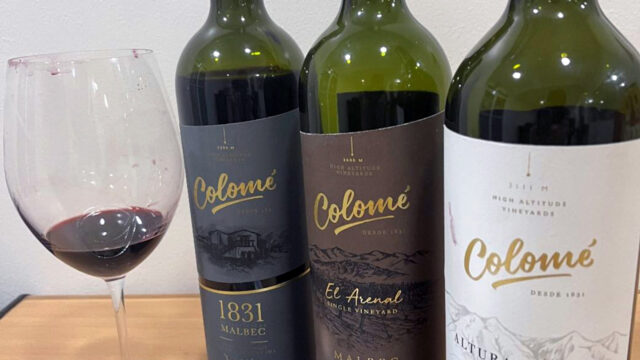
Colomé Altura Maxima Malbec 2018, Salta Argentina — “altura maxima” means highest altitude and this wine comes from vineyards with elevation at 3,111 meters (10,200+ feet) above sea level, still the second highest vineyard after the one in Tibet. Only 7,000 bottles are produced for this specific wine annually.

“Wine has brilliant brooding deep violet color, nose of freshly picked berries, figs, buttered-toast bread, full-bodied, mocha-taste, with nice BBQ charred flavors, long with butter-scotch lingering finish.”

Estimated retail price: P8,000

Colomé El Arenal Single Vineyard Malbec 2021, Salta Argentina — from the estate’s El Arenal vineyard with elevation at 2,600 meters (8,500+ feet) above sea level.

“Wine has bright dark ruby color, aromatic, coffee-latte nose, intense flavors, more on tangier fruits like raspberry, rich and velvety texture, tannin are coffee-bean like, with lingering dark chocolate-bitter finish.”

Estimated retail price: P3,300

Colomé 1831 Oldest Vines Malbec 2019, Salta Argentina — named after the founding year of the winery. This wine comes from the oldest vineyards of the winery, with many over 100 years old, and grown at an elevation of 2,300 meters (7,500+ feet) above sea level.

“The wine has dark ruby color, more delicate flavors, cinnamon pie, juicy, minty, silky, long raisiney finish.”

Estimated retail price: P4,200

After tasting these Colomé wines, I am now a true believer of high-altitude wines, but don’t take my word for it, try them as soon as they are available on the market. And if you want to try the existing Colomé range from the Estate — the Authentico to their white wine Torrentes — look for them at your favorite online stores, or e-mail Golden Wines, Inc. at info@goldenwines.com.

The author is the first Filipino member of both the Bordeaux-based Federation Internationale des Journalists et Ecrivains du Vin et des Spiritueux (FIJEV) and the UK-based Circle of Wine Writers (CWW). For comments, inquiries, wine event coverage, wine consultancy, and other wine related concerns,e-mail the author at wineprotege@gmail.com, or check his wine training website at https://thewinetrainingcamp.wordpress.com/services


Changing the way we drive

TIM-FOSTER-TW-UNSPLASH

I have been writing about the electric vehicle (EV) industry for some time now, tackling various issues and concerns regarding the Philippines’ phased transition to EV from gas- and diesel-powered motor vehicles. But truth be told, I have not actually driven an EV myself until a few weeks ago when Audi Philippines introduced the new Audi Q8 E-Tron.

My thanks to former BusinessWorld colleague Brian Afuang for the invitation to view up close and personally try out the new fully electric Audi Q8. It has been around 20 years since I gave up my weekly motoring column, and the Audi event was a great opportunity to reconnect with old friends and other motoring journalists.

More importantly, the event gave me a new perspective on EVs. You see, I am late in the game when it comes to driving electric, or hybrids for that matter. I have never owned such vehicles, and to be honest, up until recently remained unconvinced of the urgency to shift to hybrid or EV. Heck, I still own a gas-guzzling 1975 Range Rover classic with a V-8 engine.

But driving the Audi Q8 E-Tron even for just a short time made me realize how extensively technology has been changing the motoring industry. And it is not just the internal combustion engine that is being replaced. Most everything else connected to “old school” motoring seems to be on the way out with all the “computers” now in our cars.

Despite my background in electronics, having gone to a technical high school, I have always been averse to more electronics in cars. Thus, my natural liking for motor vehicles with limited electronics, for old-school technology. To date, all the cars I own use either gas or diesel fuel, are rear-wheel drives, and have ladder frame chassis — all old-school tech.

I entered this era of EVs with much skepticism. I doubted the range and lifespan of EV batteries; EVs’ ability to survive the heat of our summers and our typhoons and floods; and the local motoring industry’s capability to deal with EV repair and maintenance issues. I also questioned the economics of purchasing an EV relative to fluctuations in fuel prices and the limited number of charging stations.

All told, my sense of things told me not to put my hard-earned money on any EV just yet, especially given the premium on its sticker price compared to gas- or diesel-powered cars. And not until more charging stations are put up inside and outside of Metro Manila. Even hybrids, given their price premium over ordinary vehicles, I felt were still not very accessible to many of us. I will make the jump perhaps when EV prices come down — or when gas or diesel cars are no longer sold.

The Audi Q8 E-Tron, obviously, is only for the wealthy few who can afford its price tag of P6.25 million for the base variant and P7.25 million for the top-of-the-line variant Q8 E-Tron 55 Quattro. It is, obviously, not the every-man EV. It has a claimed range of up to 600 kilometers and can wade in about half-meter of flood water. These two features are the game-changers that tempered my skepticism. My Audi Q8 E-Tron experience revealed a realm of possibilities.

In so short a time, the EV industry has gone a long way in producing better-built cars. And with continuous investments in research and development, technology changes so fast that upgrades now come in shorter cycle times. So, if an Audi Q8 E-Tron can have a claimed range of 600 kilometers today, which was unheard of a couple of years back, then I am sure by next year even more EVs will start trumpeting longer ranges as well. And I would not be surprised if Audi, by 2024, retails EVs with ranges over 600 kilometers.

The Ford Mustang Mach-E has a claimed range of 372 miles (595 kilometers) while the BMW iX has a claimed range of 380 miles (608 kilometers). The newer Tesla Model 3 claims a range of 389 miles (622 kilometers). By next year, with newer battery technologies, many models will probably be looking at ranges of 700-800 kilometers, thus mitigating the urgency of making more “charging” stops or needing to access more charging stations. A game changer.

Upgrades and development with respect to weather and the elements are also surely forthcoming. I have always doubted if EVs could wade in floodwater, even the shallow ones. After all, one would generally assume that “electric” cars will not do well in “wet” environments. But lo and behold, the Audi Q8 E-Tron can wade through 500 mm of water. Like many others, I also dipped the car in the big tub of water and came out unscathed. Again, in just a short time from now, I am certain Audi and other EV makers will be going for even deeper wading depth. More important, EVs are proving to be real all-weather vehicles.

But the greater revelation for me is how driving an EV was like not driving at all. I did not feel any strong engine vibration, or heard much noise from the engine compartment as I drove around the track. There was no engine revolution or automatic shifting to “feel.” Initially, I found this disconcerting. But, after a while, I began to appreciate the quiet engine and the silent drive. And I am certain, after such an experience, many motorists will start turning to EVs as well.

And this now prompts me to believe that with the market putting a greater premium on comfort and convenience, and fuel “savings,” EVs might just turn the corner sooner than later and become the initial choice for new car buyers. Better range, and ability to navigate wet environments, are big pluses. And with EVs now coming in various configurations, customers have a greater variety to choose from.

During my time in the Audi Q8 E-Tron, I did not dare touch any of the buttons or switches, for fear of disrupting any of the “settings.” For the car, in the truest sense, was being run by a network of small computers — by artificial intelligence — that worked with each other to control all the moving parts and components to ensure the optimum configuration for the drive. All I did was gently step on pedals, steer the wheel, and enjoy my first EV experience.


Marvin Tort is a former managing editor of BusinessWorld, and a former chairman of the Philippine Press Council

matort@yahoo.com

ICTSI’s Hong Kong, Taiwan service from Mindanao resumes

A unit of International Container Terminal Services, Inc. (ICTSI) on Wednesday announced the resumption of its Mindanao-Hong Kong-Taiwan service to meet increased market demand in the region.

In a press release, ICTSI said that Mindanao Container Terminal (MCT) at its container handling facility in Cagayan de Oro is receiving calls from Wan Hai Lines for its Mindanao-Hong Kong-Taiwan service beginning Aug. 3.

“The return of the service is a significant development in our efforts to strengthen regional trade connectivity and support the growing Mindanao economy,” said Aurelio Garcia, chief executive officer of MCT.

“We are thrilled to re-establish this crucial link that makes international trade more efficient and accessible to businesses in Mindanao,” he said.

ICTSI said the return of the service rotation at MCT was due to the increasing market demand and economic activity in Mindanao, which saw an 18% increase in export volume.

During the first call on Aug. 3, MCT handled a total of 237 containers filled with commodities, including coconut byproducts, falcata lumber, and wastepaper.

“MCT looks ahead to a fruitful collaboration with Wan Hai and the mutual benefits that the reinstated service will bring to the region’s economy,” MCT said.

MCT is a subsidiary of ICTSI that operates the container terminal at the PHIVIDEC Industrial Estate in Tagoloan, Misamis Oriental.

At the stock exchange on Wednesday, shares in ICTSI closed 3.01% or P6.2 higher to P212 apiece. — Justine Irish D. Tabile

Another healthy food option arrives in PHL

3 – Shibuya Nights (Php 375): Embark on an Asian-inspired journey with green soba, baked salmon, grilled mushrooms, and a soft-boiled egg. Oriental cabbage salad and furikake come alive with the pairing of Avocado Edamame Dip & Beetroot Miso.

THE SALADSTOP Group is giving a new healthy choice for Manila diners with the opening of another brand in the Philippines called HeyBo.

According to a release, the name is a portmanteau of “hey,” and a truncation of “bowl.” HeyBo specializes in warm grain bowls “with a focus on the use of local flavors.” During the opening at Central Square BGC, Taguig — the first international and flagship outlet of HeyBo — on Aug. 11, guests were treated to the new brand’s bowls.

Kampong Table is a bowl of mixed grains, roasted lemongrass chicken, crispy tempeh, soft-boiled egg, oriental cabbage salad, and a lime wedge, served with white bean and cauliflower dip and green chutney. Muscle Beach is composed of tri-color quinoa, sous-vide chicken breast, charred carrots, broccoli, creamy avocado, and mixed seeds, with a beetroot chipotle dip and yuzu soy.  Shibuya Nights is an Asian-inspired bowl with green soba, baked salmon, grilled mushrooms, soft-boiled egg, oriental cabbage salad, and furikake, with avocado edamame dip and beetroot miso. Sunday Roast is a hearty mix of tri-color quinoa, char-grilled steak, a roasted pumpkin wedge, charred corn, tomato salad, and garlic breadcrumbs, with beetroot chipotle dip and balsamic butter.

For vegetarian options, there’s El Patron, with mixed grains, a vegan Mexican patty, sautéed capsicum, spiced black beans, a tomato salad, and tortilla chips, with an avocado edamame dip and smoky sriracha, while Spice Trade is a savory mix of cauliflower lentil rice falafels, spiced chickpeas, fried eggplant, carrot salad, and Murukku chips, with red pepper dip and tzatziki.

HeyBo also has flavors unique to the country, carefully created to satisfy local cravings. Humba Wamba has garlic black rice, braised pork humba, charred corn, fried eggplant, winged bean salad, and spiced peanuts, with a white bean and cauliflower dip and pineapple tamarind. Off The Hook is a harmony of garlic black rice, halibut adobo, Thai basil tofu, charred corn, and coconut lime spice, with red pepper dip and a moringa vinaigrette.

FILLING A NICHE
SaladStop first arrived in the Philippines in 2014, having been established in 2009 in Singapore then spreading into key markets in Asia. Adrien Desbaillets, Chief Executive Officer and Co-Founder, noted that the arrival of another brand was simply interrupted by the pandemic. Another brand, an outlet selling rice rolls called Wooshi, may also be seen in the Philippines quite soon.

“We’re looking into opening that in the Philippines as well,” said Mr. Desbaillets in an interview with BusinessWorld. “SaladStop was a brand that we knew the niche we would fill,” he said. “HeyBo is in a way, easier to launch because we understand the market so much better.”

Opening another brand focused on healthy eating is also a reflection on how well the Philippines is providing more options for health-conscious consumers. With SaladStop, he said, “We’re going into areas of Manila and in the outskirts that a few years ago we would have probably found to be a little bit difficult. Now, I guess, the healthy food segment has grown so much.”

Mr. Desbaillets pointed out that most of the ingredients they use are sourced from local farmers, and their utensils are made from biodegradable materials. Sustainability is one of the pillars holding up the company, considering they just opened a carbon net-zero store in Singapore. “It’s just the impact that we do. It’s part of our DNA. It’s how some are built, what we as people within the company are strong believers in: trying to… change the conversations around sustainability and do it in a very authentic way.”

That’s nice — but does morality make the food taste better? “Yeah. Local is better. Simple,” he said. He elaborates: “It’s a belief in terms of how we develop our menu. We know that we can work with local farms and it takes 24 hours for a product to reach the store. It’s just going to taste fresher.”

In the Philippines, HeyBo and SaladStop are both licensed by the SSI Group, Inc. — Joseph L. Garcia

Corporate failure is a valuable asset that’s hard to protect

CHARLESDELUVIO-UNSPLASH

THE fraction of enterprise value of large US companies represented by tangible assets — things like real estate and inventory — has fallen from 50% to 20% over the past 15 years. Moreover, only about 25% of enterprise value is in identifiable intangible assets such as patents, copyrights, trademarks, customer lists, and data files. The remaining 55% is in assets too intangible to even identify clearly — things like technical knowledge, corporate culture, going-concern value, and customer relationships.

A recent article in Business Law Today calls attention to something less tangible still — the economics of negative information assets. How do you assess and safeguard corporate know-how about products that didn’t work, dead-end research or failed experiments at a time of heightened staff mobility?

For companies with little in the way of tangible assets or recurring revenue — ones valued primarily on expected future products and services — gauging the worth of what a company knows is key, and much of that knowledge is about approaches that don’t work. Moreover, that knowledge only has value if the company can protect it.

Just as normal matter exists in a sea of dark matter and dark energy that make up 95% of the universe, positive business information (such as product specifications) exists in a much larger sea of negative information (such as ideas that don’t work). Advertisers work to create brand names — positive information assets — but also to warn against an innumerable list of dangers from head (dandruff) to toe (athlete’s foot), or make “where’s the beef” criticism of competitors’ products. Such negative information assets increase the value of a product by making the alternative seem worse. Employee handbooks list a few positive admonitions, and much longer lists of what not to do.

Not only are intangible assets — especially negative information assets — growing rapidly in economic value, they are also getting harder to protect. Employee mobility has grown since 2008, especially in technology fields; and the government is working to increase it further with Federal Trade Commission efforts to ban non-compete clauses and the proposed Workforce Mobility Act of 2023. Courts are getting more reluctant to grant patents and other intellectual protection, especially on software. Work-from-home means information spills out to uncontrolled locations, and of course the internet makes transmitting information far easier than in the past.

From an investors’ perspective, this means that only about 20% of what you pay for an average stock covers assets that can be easily insured and protected against theft or damage; and that creditors can seize and sell in a bankruptcy with some hope of recovery. Stock investors are hoping for future cash flows to be generated mostly by intangible assets, in many cases assets that cannot even be identified clearly and may be negative. Creditors can look to only a small portion of enterprise value to secure loans.

At least with positive information there is some hope of tracking down theft and suing for recovery. If an employee goes to a competitor who soon launches a product similar to yours, you will notice. You can demonstrate the similarities in court, and perhaps refer to patent or other protection.

But what if an employee goes to a competitor and designs a different product from yours, and the research effort is sped up because your former employee learned on your dime what dead ends to avoid? What will you point to in court to prove the theft? What kind of patents protect failed ideas?

Most of my professional experience is in finance. A hedge fund employee who copies her former employer’s strategy can be identified. But behind every implemented strategy are hundreds or thousands of alternatives that were tested and rejected. An employee who knows those results can find a good new strategy much faster than a researcher starting from scratch.

One prominent example of this is the high-profile lawsuit by Alphabet, Inc.’s Waymo alleging that its former engineer Anthony Levandowski took to Uber Technologies, Inc. information about dead-end designs and approaches unsuited to market that saved Uber substantial time and money, and were critical to its efforts to develop self-driving cars.

Moving from an investor’s to a social perspective, intellectual protection and trade secret law attempts to balance the social good of encouraging research and development, with the other social good of competition. Patents force applicants to reveal their secrets in return for 20 years of protection. Companies are allowed to take some measures to protect trade secrets, but not to prevent former employees from making a living in their fields.

Negative information does not fit into either model. You can’t force former employees to remake mistakes they identified while working for you. You can’t get a patent on a failed idea, one that forces other people to pay you money to avoid the failure. From a social standpoint these don’t balance any considerations, they just impose perverse costs.

There is a related issue in academic research — it’s rare to publish negative results. A vast amount of negative information knowledge is systematically excluded from the literature in many fields.

If the trend toward increasing negative information asset value and decreasing ability to protect it continues, it should lead to fragmentation in research. If every company pursues one idea and liquidates if its idea fails, negative information becomes public, and no entity has to protect it. Negative information assets are a problem only for large companies that survive the failure of many research paths, and thereby accumulate large negative information assets that cannot be insured or protected.

One solution for a large company is to put researchers in siloes, so individual employees have knowledge of at most one dead-end. But this eliminates valuable cross-fertilization of research and gets in the way of rational employee development. Many hedge funds do this, but it is a problematic solution in fields like information and medical technology where the scientific culture is more open, and there is more communication between academic and for-profit activities and more diverse specialists are needed for projects.

I don’t know how this will play out, but I think it represents one of the biggest challenges to big tech company valuations. With increasing employee mobility and weakening non-compete protections, big tech is losing the ability to protect its fastest-growing type of asset. I can’t see any good solution — either in research strategy or law — but it’s something investors should consider seriously.

BLOOMBERG OPINION

PAL ties up with low-carbon energy services provider

PHILIPPINE STAR/EDD GUMBAN

Flag carrier Philippine Airlines (PAL) has signed a memorandum of understanding (MoU) with ENGIE, a global low-carbon energy services provider, to manage its energy resources.

“Having ENGIE as a key partner helps us manage our resources more efficiently and work towards a more sustainable world in air travel, for the benefit of our economy and the traveling public,” said Stanley K. Ng, president and chief operating officer of PAL, in a statement on Wednesday.

Under the MoU, ENGIE Services (Philippines) and ENGIE Global Energy Management & Sales (GEMS) APAC will be helping PAL in four key areas: energy risk management services, carbon credits procurement and supply, decarbonization strategies, and decarbonization projects.

“ENGIE is proud to partner with PAL on their decarbonization journey. Together, we will explore ways to reduce their environmental impact and foster a greener, more environmentally conscious future for the aviation sector, in the Philippines and beyond,” said Thomas Baudlot, country head at ENGIE South East Asia.

Specifically, ENGIE will be assisting the airline in the procurement and in supplying carbon credits that will enable it to offset its carbon emissions as well as in developing and implementing sustainability-related projects including exploration of sustainable aviation fuel.

PAL currently operates flights to 33 destinations in the Philippines and 39 destinations in Asia, North America, Australia and the Middle East through hubs in Manila, Cebu, Clark, and Davao.

On Tuesday, the airline announced the resumption of its Manila-Tuguegarao daily flight services starting Oct. 29.

The resumed route, which the airline previously operated from October 2014 to June 2019, will be operated with 180-seater Airbus A320 aircraft. — Justine Irish D. Tabile

TDF yields inch up before BSP meeting

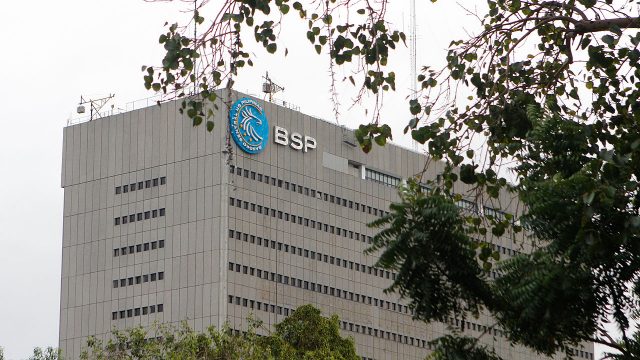
YIELDS on the term deposits auctioned off by the Bangko Sentral ng Pilipinas (BSP) inched higher on Wednesday ahead of its policy meeting on Thursday.

Demand for papers under the BSP’s term deposit facility (TDF) totaled P319.002 billion on Wednesday, higher than the P300 billion on the auction block and the P297.282 billion in bids logged last week.

Broken down, the seven-day deposits attracted tenders amounting to P179.011 billion, higher than the P170-billion offering as well as the P167.147 billion in bids recorded the prior week for a P160-billion offer.

Rates for the one-week papers ranged from 6.57% to 6.61%, unchanged from the previous week. This brought the average rate for the tenor to 6.5956%, inching up by 0.24 basis point (bp) from the 6.5932% seen on Aug. 9.

For the 14-day deposits, tenders hit P139.991 billion, going above the P130-billion offering and the P30.135 billion in bids last week for the P140 billion on the auction block.

Accepted yields were from 6.55% to 6.52%, steady from the previous week. This brought the average rate of the two-week deposits to 6.5998%, up by 0.24 bp from the 6.5974% logged a week ago.

The central bank has not auctioned off 28-day term deposits for more than two years to give way to its weekly offering of securities with the same tenor.

The term deposits and the 28-day bills are used by the BSP to mop up excess liquidity in the financial system and to better guide market rates.

TDF yields were higher on Wednesday amid expectations of a 25-bp rate hike from the BSP this week, Rizal Commercial Banking Corp. Chief Economist Michael L. Ricafort said in a Viber message.

According to Mr. Ricafort, there is a good chance the BSP will resume its policy tightening to mirror the latest move of the US Federal Reserve and help stabilize the peso.

A BusinessWorld poll last week showed 13 of 15 analysts predict the Monetary Board will extend its pause at its Aug. 17 meeting.

On the other hand, two economists expect the BSP to hike borrowing costs by 25 bps to match the move of the US Federal Reserve last month. If realized, this would bring the key rate to 6.5%.

The Monetary Board has raised policy rates by 425 bps from May 2022 to March 2022. Meanwhile, the US Federal Reserve raised the federal funds rate target by 25 bps to 5.25-5.5%, the highest level in more than two decades.

On Wednesday, the local currency closed at P56.515 per dollar, appreciating by 32.50 centavos from its previous finish of P56.84 against the greenback. Year to date, the peso has depreciated by 1.3% or 76 centavos from its P55.755 close on Dec. 29.

After Thursday’s review, the BSP’s other policy-setting meetings for the year will be held on Sept. 21, Nov. 16, and Dec. 14. — Keisha B. Ta-asan

To bring back the office, bring back lunch

IT HAS been nearly two years since corporate America reopened, and employers are still struggling to get people back into the office. Just ask Jamie Dimon, Chief Executive Officer of JP Morgan Chase, who has been pushing for in-office-work, yet 30% of his workers remain hybrid and he continues to face pushback.

So allow me to make a modest proposal. This fall, to get people back to the office, US employers need to do something radical, something bold, something (gasp) very French: They need to buy their employees lunch — a proper lunch, in a restaurant.

There are no sad desk salads in France. Eating in the workplace is prohibited. Since 1962, French employees have received meal vouchers as part of their compensation. The vouchers used to be paper tickets, but now they are usually loaded on to a plastic card, which can be used to buy lunch at local restaurants. Both employers and employees contribute to the card — the former tax-free — with employers paying 50% to 60% of the lunch’s value.

The voucher can be used for a meal up to 19 euros, though that limit was doubled during the pandemic to help struggling restaurants. The number of meals an employee gets each month depends on the number of days he or she works; one meal voucher can be provided for each full workday, provided the meal occurs during the workday.

Like most efficiency-focused Americans, I always looked upon this system with a mixture of amusement and horror. I saw it as the sort of thing that can only happen in France. A law against eating at your desk? Talk about uncivilized. I prefer a quick lunch, thank you, so I can finish work and get home sooner. And as nice as a free lunch sounds, benefits are never really free; they usually mean a lower salary. Once again, thank you but I’d prefer the cash.

But I am rethinking my aversion to the French lunch voucher system because I fear the US workplace is stuck in what we economists call a sub-optimal equilibrium. Working together, in person, is important for training and workplace culture — especially for younger workers who require mentoring. Over time, working from home even a few days a week can mean lower productivity and less engagement with work.

I also worry about what working from home does to a society that is increasingly isolated and lonely. Not to mention all the struggling businesses in America’s downtowns. Foot traffic in downtown San Francisco is at only 32% of its 2019 level. New York is at 67%. Office vacancies remain elevated. Despite pleas and even threats from their bosses — many of whom are also WFH, at least part of the time — or free food in the office pantry, not enough people are going back.

So what if there were such a thing as a free lunch — not metaphorical but actual?  A lunch that lasts an hour (maybe more) may be just the incentive you need. Especially at a nice restaurant in the middle of the day. It makes you feel so sophisticated. More important, it will involve making plans to get you out of the house. And while you shouldn’t be required to eat with your colleagues, maybe you will want to, which will improve morale and help restore the connections lost in the years of working from home. Perhaps you will even invite your junior coworkers.

True, there may be some productivity losses. Some people will take lunch breaks that are too long, especially if wine is involved. But working from home indefinitely might mean even more lost productivity. And any losses from lunch should be measured against the economic boost it would provide the restaurant sector.

The voucher system should be a little different than it is in France. Employee contributions to the voucher should be optional. And the vouchers should only be used in restaurants located in business districts, or near the workplace, for a sit-down meal. The tax incentive would be a nice bonus, but it’s not necessary, especially with growing public debt. Instead, participating restaurants may offer discounts or voucher-lunch specials if they want the business.

I realize this is all getting expensive. So employers needn’t offer a free lunch for every day worked. This is America, after all. It is your right as a citizen to eat at your desk. — Bloomberg Opinion

ADVERTISEMENT
ADVERTISEMENT