Home Blog Page 4447

Immigration training, not stricter travel guidelines, to stop trafficking — analyst

By Beatriz Marie D. Cruz, Reporter

ARRESTING incidents of human trafficking in the country requires capacitating Bureau of Immigration (BI) officers to detect fraud more than imposing stricter regulations on travelers, a congressman-turned-convenor of a think tank said on Monday.

“If government is concerned in the rise in human trafficking cases through international borders, the remedy is not to impose more regulations to entire classes of Filipino travelers,” Infrawatch convenor Terry L. Ridon said in a Viber chat with reporters.

Mr. Ridon’s comments come on the heels of the Inter-Agency Council Against Trafficking’s (IACAT) updated guidelines for Filipinos traveling abroad, which were released last week.

Basic travel documents now include a passport that is valid for at least six months from the date of departure, a valid visa, a boarding pass, and a confirmed return or roundtrip ticket.

Self-funded tourists are required to show proof of employment and financial capacity, while travels sponsored by entities abroad should include affidavits of support.

Overseas Filipino Workers (OFWs) should also present their overseas employment certificate (OEC) or any other equivalent documents of the sponsor. Minors will also need travel clearance from the Department of Social Welfare and Development.

Mr. Ridon said the additional documents increase the burden on peoples’ right to travel. “Issued visas [which have already shown to their embassies and consulates,] should constitute presumptive proof of a traveler’s financial capacity to travel and willingness to return to the country,” Mr. Ridon noted.

Instead of making regulations tougher for Filipinos to travel out of the country, he said the government must focus on training immigration officers on how to detect new forms of trafficking, expand their experience through their day-to-day work, and increase the number of personnel assigned at the country’s borders.

Senator Ana Theresia “Risa” N. Hontiveros-Baraquel called to further study whether the additional travel documents are necessary and practical.

“We shouldn’t turn a blind eye to warnings that some of the requirements would only promote delays and are prone to exploitation by corrupt immigration officers,” Ms. Hontiveros-Baraquel said in a statement.

Justice spokesman Jose Dominic F. Clavano IV last week said the guidelines are part of the government’s efforts to “streamline and organize existing [travel] requirements.”

SC faults PAGCOR funding

PHILSTAR FILE PHOTO

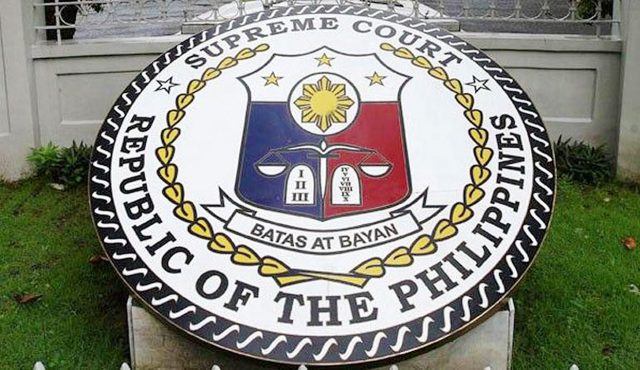
THE SUPREME COURT (SC) has upheld a Commission on Audit (CoA) ruling that disallowed financial assistance paid by former high-ranking officials of the Philippine Amusement and Gaming Corp. (PAGCOR) worth P2 million for a flood control project in a subdivision in Laguna. 

In a 24-page decision dated Aug. 18 and made public last Thursday, SC said the disallowance was proper since state funds could not be used for private projects, in this case, the Pleasant Village Homeowners Association’s (PVHA) flood control project. 

Although it was established that PAGCOR is allowed to fund infrastructure and sociocivic projects, it must be public in nature and not as an “incidental advantage to the public or to the state” that results from the promotion of the interests of a private entity. 

“The provision is clear and absolute in requiring government funds to be spent or used solely for public purposes,” Associate Justice Ramon Paul L. Hernando wrote in the ruling, citing the Government Auditing Code. — John Victor D. Ordoñez

Veterans’ disability pension hiked 

PHILSTAR FILE PHOTO

SENATE President Juan Miguel F. Zubiri on Monday said a newly signed law that increases the pension of veterans with disabilities is a long overdue improvement to the previous benefits set 30 years ago. 

Following President Ferdinand R. Marcos, Jr.’s signing of the measure into law last Aug. 24, pension rates have been increased depending on the veteran’s disability rating. 

From the previous P1,000 received by a veteran with the lowest disability rating at 10%-30%, it will now be P4,500. The pay increases on scale up to P10,000 for those whose disability rating is the highest at 91% – 100%. 

Moreover, the new law automatically qualifies a veteran who turns 70 years old to a disability pension of P1,700. — John Victor D. Ordoñez

Luzon-Visayas bridge sought 

A CONGRESSMAN on Monday called on the country’s economic managers to include a proposed bridge connecting Luzon and Visayas under the government’s Mega Bridge Master Plan Project.  

“We are calling on the government’s economic planners to include the Sorsogon-Northern Samar Bridge in the Mega Bridge Program,” Minority Leader Marcelino C. Libanan said in a statement. “The bridge will solve the recurring problem of seaport congestion and thousands of passengers getting stranded during weather disturbances,” he said.  

The Luzon-Visayas crossing bridge, which will connect seaports located in the municipality of Matnog in Sorsogon in Luzon and the municipality of Allen in Northern Samar in Visayas, could help enterprises transport their goods across islands and even save one-and-a-half hours of travel time, said Mr. Libanan.  

A 2019 study commissioned by the National Economic and Development Authority (NEDA) said construction of the bridge will take six years and costing around P284 billion. — Beatriz Marie D. Cruz

Probe on teen’s killing sought 

A MINORITY lawmaker has urged the administration of President Ferdinand R. Marcos, Jr. to look into the recent killings of minors that were allegedly committed by police and called for reforming the country’s police system. 

“We demand a thorough and impartial investigation into this incident,” said Deputy Minority Leader and party-list Rep. France L. Castro in reference to the killing of a 15-year-old boy during an “anti-criminality” inspection in Rizal province last Aug. 20. 

“We are deeply disturbed and saddened by the senseless killing of John Frances Ompad. This is another case of police brutality that highlights the dire situation of human rights in our nation. It is unacceptable,” Ms. Castro added. 

This was preceded by an incident of mistaken identity when Navotas City cops gunned down a 17-year-old boy last Aug. 2. The lawmaker said these tragic incidents underscore the urgent need for police accountability and the demand to put an end to the culture of impunity in the country. — Beatriz Marie D. Cruz

21 Moro clan wars settled 

COTABATO CITY — Central Mindanao has settled 21 blood clan wars in predominantly Moro towns in Region 12, paving the way for an improved investment climate which, for decades, had been stunted by armed conflicts.   

The latest rido or deep-seated hostility that raged for two years and exacted fatalities on both sides was settled last weekend between two rival blocs in the Moro Islamic Liberation Front (MILF) in the adjoining towns of Pikit, Cotabato and Pagalungan, Maguindanao del Sur.
On Monday, Ronald Halid D. Torres, chairman of the Bangsamoro Business Council, noted how mediators from various sectors were involved in settling these conflicts across 63 Bangsamoro barangays in the region known as the Special Geographic Area-Bangsamoro Autonomous Region in Muslim Mindanao (SGA-BARMM). 

Mr. Torres expressed optimism that the development ushers in a favorable business climate, where there exists ease in attracting investors from outside the region to put up capital intensive agricultural projects in so-called SGA areas, which are suitable for large-scale propagation of Cavendish banana, palm oil, and short-term crops such as cassava, soybeans and hybrid corn. 

Dr. Kadil M. Sinolinding, a member of the 80-seat Bangsamoro parliament, said one factor that hastened the resolution of clan wars is the construction in recent months of public markets, barangay halls, municipal government buildings and police stations as part of management and peace-building initiatives. — John Felix M. Unson

Philippine typhoon Goring weakens as it nears Taiwan

Tropical storm Saola (local name: Goring) headed towards Taiwan on Monday while bringing heavy rain to the northern Philippines, cutting power to some towns and forcing the evacuation of nearly 2,000 people, authorities said.

With Saola forecast to make landfall over southern Taiwan late on Wednesday or early on Thursday, the typhoon’s maximum winds eased to 155 kilometers per hour (96 miles per hour), with gusts of up to 190 kph (118 mph), the weather agency said.

The seventh tropical storm in the Philippines this year, Saola had sustained winds of 185 kph (115 mph) and gusts of up to 230 kph (143 mph) on Sunday evening.

Besides the wind, rain and power cuts, it forced nearly 2,000 people to seek shelter in evacuation centers, the disaster agency said.

“Flooding and rain-induced landslides are still expected, especially in areas that are highly or very highly susceptible to these hazards,” the weather bureau said in an advisory.

The provinces of the northern Philippines are among the country’s biggest producers of rice, corn, and vegetables.

An archipelago of more than 7,600 islands, the Philippines sees an average of 20 tropical storms a year, though few make landfall there. — Reuters

Foxconn billionaire Terry Gou to run for president in Taiwan

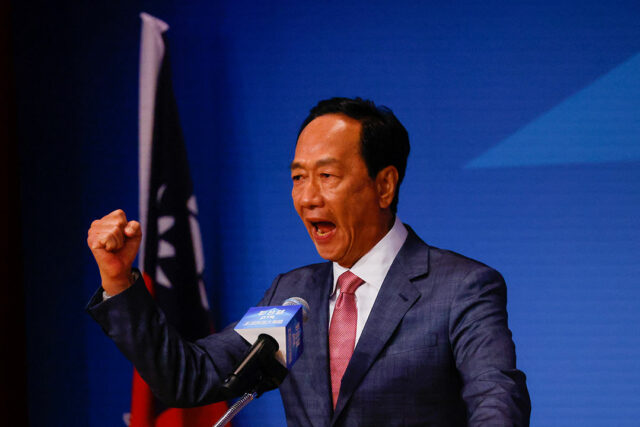
Terry Gou, Foxconn founder announces bid for Taiwan presidency during a press event in Taipei, Taiwan Aug. 28, 2023. — REUTERS/ANN WANG

TAIPEI — Terry Gou, the billionaire founder of major Apple, Inc. supplier Foxconn, said on Monday he was entering the race to be Taiwan’s next president as an independent candidate in 2024 elections.

Mr. Gou stepped down as Foxconn chief in 2019 and made a presidential bid that year, but dropped out after he failed to win the nomination for Taiwan’s main opposition party, the Kuomintang KMT, which traditionally favors close ties with China.

He made a second bid to be the KMT’s candidate for the presidential election to be held in January earlier this year, but the party chose instead Hou Yu-ih, the mayor of New Taipei City.

Gou has spent the past few weeks touring Taiwan and holding campaign-like rallies, fuelling speculation he was planning to run as an independent.

“Under the rule of the Democratic Progressive Party in the past seven years or so, internationally, they lead Taiwan towards the danger of war. Domestically, their policies are filled with mistakes,” Mr. Gou said, adding “the era of entrepreneur’s rule” has begun.

“Give me four years and I promise that I will bring 50 years of peace to the Taiwan Strait and build the deepest foundation for mutual trust across the strait,” he said in a plea to Taiwan voters.

“Taiwan must not become Ukraine and I will not let Taiwan become the next Ukraine.”

Mr. Gou’s main theme in his pre-campaign events has been that the only way to avoid war with China, which claims Taiwan as its own territory, is to get the DPP out of office.

Mr. Gou must gather close to 300,000 voter signatures by November 2 to be qualified as an independent candidate, according to elections regulations. The Central Election Commission will review the signatures and announce the results by November 14.

Taiwan Vice President William Lai, the presidential candidate for the ruling Democratic Progressive Party (DPP), is the favorite to win the election as he leads the polls.

Former Taipei mayor Ko Wen-je of the small Taiwan People’s Party has generally been running second in the polls, with Mr. Hou a distant third.

In a call for “unity,” Mr. Gou on Monday urged Mr. Ko and Mr. Hou to sit down with him and discuss plans to join forces in order to win the election against the DPP.

The KMT expressed “extreme regret” on Mr. Gou’s bid and urged Mr. Gou to support the party’s candidate, Mr. Hou.

China has a particular dislike of Mr. Lai for comments he has previously made about being a “worker” for Taiwan independence, a red line for Beijing.

The DPP champions Taiwan’s separate identity from China, but the government it leads has repeatedly offered talks with China that have been rebuffed.

The run up to the election is taking place at a time of increased tensions between Taipei and Beijing, as China stages regular military exercises near the island to assert its sovereignty claims.

When asked about the issue of conflict of interest with Gou being a major shareholder of Foxconn, which has massive investment in China, Mr. Gou said he’s willing to “sacrifice” his personal assets in China in the event of a Chinese attack.

“I have never been under the control of the People’s Republic of China,” he said. “I don’t follow their instructions.” — Reuters

Jakarta launches its first LRT, hopes to ease traffic

EN.WIKIPEDIA.ORG

JAKARTA — Indonesian President Joko Widodo on Monday launched the first elevated rail line for Greater Jakarta, hailing the $2.13 billion project as a step towards easing the capital’s chronic road congestion and worsening air pollution.

The driverless, 41.2 km (25.6 miles) Light Rail Transit (LRT) system connects central Jakarta and its satellites cities in West Java, Bekasi and Depok.

People in Greater Jakarta commonly use a 418 km (260 mile) Commuter Line which serves around 1.2 million passengers per day.

Jakarta has been ranked among the world’s most polluted cities since May and earlier this month topped the charts compiled by Swiss air quality technology company IQAir.

The president blamed the pollution on excessive road traffic and industries using coal and said nearly 1 million vehicles enter Jakarta each day.

“Jakarta is always on the top 10 of list of cities with the worst traffic jams,” he said. “Traffic jams and pollution always exist in Jakarta.”

The capital, which has a population of more than 10 million, is also served by an existing, 16 km long underground mass rapid transport (MRT) line that connects the southern areas to downtown Jakarta.

Indonesia has started building a new city on Borneo island called Nusantara to replace the congested Jakarta as capital of Southeast Asia’s biggest economy. The project, which has no timeframe for completion, is a key part of the president’s legacy as he prepares to leave office next year. — Reuters

Pope Francis to fly across world to visit Mongolia’s tiny Catholic flock

ANNETT KLINGNER-PIXABAY

VATICAN CITY/ULAANBAATAR — Mongolia’s Catholics — all 1,450 of them – could be squeezed standing into St. Peter’s Basilica dozens of times over and their number is smaller than the congregation of a small parish in some small towns.

So why is Pope Francis, 86 and in need of a wheelchair, traveling 8,278 kilometers to visit them this week?

Essentially, to paraphrase British climber George Mallory’s response in the 1920s as to why he wanted to climb Mt. Everest, because the Catholics are there.

“I can’t even fathom this,” said Arvanai Hashdorj, 19, a university student who attended Mass on Sunday at the Cathedral of Saints Peter and Paul in the Mongolian capital Ulaanbaatar on Sunday. “So I am very grateful”.

Mr. Hashdorj told Reuters he had recently returned from the Catholic Church’s World Youth Day gathering in Lisbon, where young people from countries with millions of Catholics noted in conversations with him that the pope had not yet visited their countries.

Visiting places where Catholics are a minority is part of Francis’ policy of drawing attention to people and problems in what he has called the peripheries of society and of the world.

He still has not visited most of the capitals of Western Europe.

Pope Francis, who will be attending an inter-religious service in Mongolia, said at his weekly noon address on Sunday that he would be visiting “a Church that is small in numbers but vivacious in faith”.

Last year, Francis named Archbishop Giorgio Marengo, an Italian, the first cardinal to be based in Mongolia, where he is the Catholic Church’s administrator.

“The originality of this trip is related to the originality of the country sparsely populated and with such a small Catholic community,” Marengo said last month in Rome.

“This shows how for him (the pope), every single member of the faithful is important,” said Mr. Marengo, who has been a missionary in Mongolia for more than 20 years.

Mongolia has nine parishes, compared to 25,500 in Italy. The smallest one, hundreds of miles from the capital, has only between 30-40 members.

Still, the visit will show how far it has come since locals watched “these funny foreigners praying,” Mr. Marengo said.

‘GREAT RELIGIOUS TRADITION’
Francis said on Sunday that he felt honoured to visit “a noble and wise people” with a “great religious tradition”.

About 60% of Mongolians identify as religious. Among those, 87.1% are Buddhist, 5.4% Muslim, 4.2% Shamanist, 2.2% Christian and 1.1% followers of other religions, according to the US State Department.

There are only two native Mongolian Catholic priests.

“I wanted to show the world that there is a Catholic Church (in Mongolia) and it’s beautiful,” said one of them, Father Peter Sanjaajav, after saying Mass at the Cathedral the pope will visit on Saturday as part of the Aug. 31-Sept 4 trip.

The country of about 3.3 million people is strategically significant for the Roman Catholic Church because of its proximity to China, where the Vatican is trying to improve the situation of Catholics amid sometimes scratchy relations with the communist government.

Mongolia was part of China until 1921 and still has close ties with Beijing. Diplomats say it could be used as an intermediary with China.

It was not clear if any Catholics from China would be allowed to cross the border to see the pope.

China is by far Mongolia’s biggest export market, buying most of its coal, copper and cashmere, and Ulaanbaatar also relies on China’s rail network to deliver its goods to third countries.

Mongolia has seen a revival of Tibetan Buddhism since the collapse of the Soviet-backed Communist government in 1990, and the Dalai Lama is regarded as its main spiritual leader.

However, China has repeatedly put pressure on Mongolia not to allow the 88-year old exiled Tibetan leader to visit, branding him a dangerous separatist. — Reuters

Argentina offers financial aid to crisis-hit workers and pensioners

STOCK PHOTO | Image by Herbert Brant from Pixabay

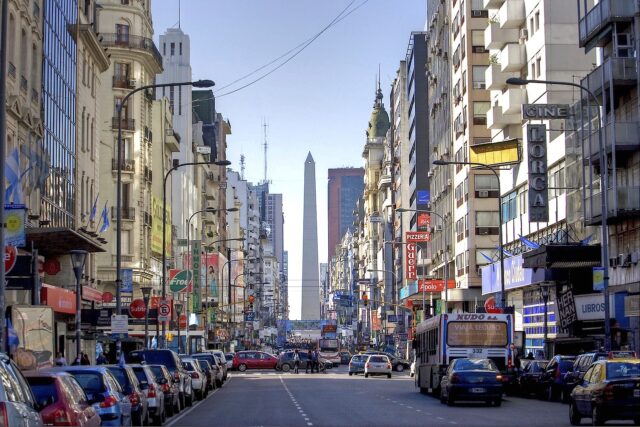
 – Argentina‘s economy ministry on Sunday announced a series of benefits for workers and pensioners intended to soften the blow of a severe economic crisis which has seen inflation spiral and the government devalue the country’s currency.

The government will give nearly 7.5 million pensioners a package of 37,000 pesos (around $105 at the current official exchange rate) over the next three months, Economy Minister Sergio Massa said in part of a series of messages on his Instagram account.

Mr. Massa, who is also the ruling party’s presidential candidate for the Oct. 22 elections, will face ultra-libertarian outsider Javier Milei whose support from disillusioned voters propelled him to victory in a primary vote this month.

Mr. Massa said workers will receive 400 billion pesos in loans, while self-employed workers will be offered six months of tax relief and those on food benefits will receive additional stipends.

He also announced a suspension of export taxes for some industrialized regional goods such as wine, rice and tobacco, as well as funding for fertilizers to help farmers whose last harvest suffered from a historic drought.

The government, helped by bank financing, will also offer $770 million in funding to help boost export sales and companies have been ordered to provide bonuses to some 5.5 million workers who earn below 400,000 pesos per month, Mr. Massa said, equivalent to $1,140 at the official rate but roughly $500 at the informal parallel exchange rate.

“The goal is that every economic sector receives some state support,” Mr. Massa said.

The move comes two weeks after the government devalued the peso by nearly 20%, accelerating annual inflation which already was hovering around 115% as Argentines saw their purchasing power dwindle further.

Mr. Massa said the devaluation resulted from a request from the International Monetary Fund as it renegotiates a $44 billion loan program with the South American government.

Polls for the October elections have narrowed giving an equal share of the vote to Mr. Massa, opposition candidate and former security minister Patricia Bullrich and Milei, who has pledged to dollarize the economy and shut the central bank.

Experts believe the vote could pass to a run-off in November. Meanwhile, tensions have risen and series of lootings have taken place across the country. – Reuters

Adani’s bid to remake Mumbai slum spurs residents’ doubts, favouritism claims

STOCK PHOTO | Image by A MH from Pixabay

 – Indian billionaire Gautam Adani’s plan to rehouse a million people living in one of Asia’s biggest slums is fueling worries among residents about his capacity to deliver amid high-profile financial setbacks and allegations that Prime Minister Narendra Modi’s allies afforded him favorable treatment.

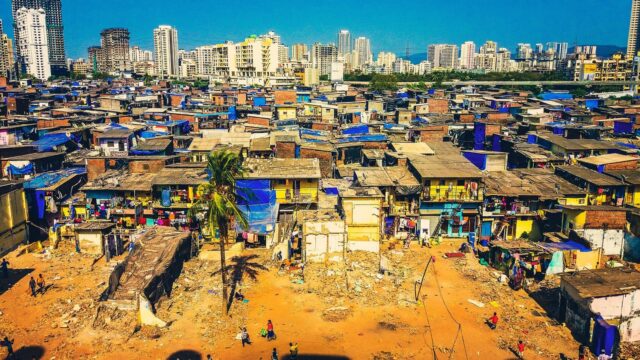
The Dharavi slum, about three-quarters the size of New York’s Central Park, featured in Danny Boyle’s Oscar-winning 2008 movie “Slumdog Millionaire”. Its open sewers and shared toilets, close to Mumbai‘s international airport and high-rises housing foreign companies, stand in contrast to India’s development boom.

Adani is at the helm of plans to redevelop Dharavi after the Maharashtra state government in July approved his $614 million contract bid to overhaul the slum, which is known for producing leather goods, following years of failed attempts.

Adani Group aims to demolish what it describes in legal documents as an area of “unhygienic, deplorable” conditions and build new towers on state-owned land to accommodate residents and their businesses. Consultancy Liases Foras estimates Adani may invest up to $12 billion on remaking Dharavi and in return get development rights that could yield revenue of up to $24 billion.

Only those who already lived in Dharavi before 2000, mostly ground-floor residents, will get free homes within the redevelopment. About 700,000 inhabitants of mezzanine and upper floors are considered ineligible by the government and will be offered units up to 10 kilometers away, which they say could require them to pay upfront costs or higher rents.

The overhaul, poised to start around September, comes at a tumultuous time for Adani. The tycoon was the world’s third-richest person until January, when – despite his denials – allegations by US short seller Hindenburg of improper dealings wiped $150 billion off his group’s market valuations.

In interviews with Reuters, some Dharavi residents cited the billionaire’s financial troubles as contributing to their concerns.

A fresh threat to Adani’s plans is a legal challenge from rival bidder SecLink Technologies Corporation. The Dubai-based consortium, which says it is backed by Bahrain’s royal family, alleges Maharashtra improperly cancelled an original 2018 tender, for which SecLink bid highest, and restarted the process with new terms in 2022 so that Adani could win, according to court papers reviewed by Reuters.

The current state government, ruled by Modi’s Bharatiya Janata Party (BJP) and its allies, is contesting the case. Last month, a Mumbai court allowed SecLink to add Adani to its lawsuit, forcing the conglomerate to defend its position before judges.

In an 809-page filing last month challenging Adani and the state, reported by Reuters for the first timethe eight-member consortium said Maharashtra’s modified bidding process was “politically motivated” and “tailor made to suit” Adani Group.

Those changes, according to SecLink, included doubling a bidder’s required net worth to $2.4 billion and capping consortium members at two instead of eight previously.

Adani, in a non-public submission to judges before an Aug. 31 hearing, denied SecLink’s allegations and argued the case should be thrown out in the interest of development.

Maharashtra said in a submission that SecLink’s claims were “baseless” and that officials had followed “proper process” in cancelling the earlier tender, according to a Reuters review of non-public filings related to the case. It said it restarted the process because it added another land parcel to the project after the 2018 tender had closed.

Adani Group, SecLink, Maharashtra’s Chief Minister Eknath Shinde and Modi’s office did not respond to questions from Reuters for this report.


HINDENBURG FALLOUT

Modi and Adani both hail from the western state of Gujarat. Their opponents and critics often allege the meteoric rise of Adani’s ports-to-energy empire was partly due to his close relations with, and favorable treatment by, administrations run by Modi’s BJP and its allies. The duo have repeatedly denied impropriety.

The opposition Congress party has seized on the Dharavi dispute to put pressure on Modi and the BJP ahead of 2024 national elections, accusing Maharashtra’s government of handing Adani an advantage.

“The fact that it is associated with Adani will automatically result in snowballing into a political controversy,” said Sandeep Shastri, director of academics at India’s NITTE Education Trust.

Hindenburg’s report and ensuing regulatory scrutiny of Adani have sowed mistrust among some in Dharavi, according to representatives of thousands of local families, and 25 other residents and business owners interviewed by Reuters.

“People have doubts regarding Adani’s image after the Hindenburg incident. There are issues of trustworthiness,” said Rajendra Korde, president of Dharavi Redevelopment Committee, which is calling for public consultation.

In early August, about 300 opposition supporters and residents gathered in Dharavi to object to Adani’s involvement. Some bore banners showing Adani’s face with a red cross, shouting, “Remove Adani, Save Dharavi”.

Many told Reuters they were troubled by Adani Group’s financial setbacks, including the collapse in its valuations.

“If something like that happens again, and if he is not able to complete the project, where will people like us go,” said Radha Pawar, a 50-year-old airport cleaner.


‘COLOSSAL’ CHALLENGE

Adani, 61, in a July video address said the group had raised funds since Hindenburg’s report and that investors supported its governance and capital allocation practices.

Still, in a blog post last month, Adani acknowledged that rebuilding Dharavi presented “colossal” challenges – though he hoped the area in future would produce “millionaires without the slumdog prefix”.

Under the plan, the tycoon will need to create larger apartments of 300-350 square feet, with the state recommending fittings of foreign glass brands like France’s Saint-Gobain.

SVR Srinivas, who heads the Dharavi Redevelopment Authority, said efforts would be made to minimize disruption.

But residents remain jittery.

Mohammad Hasmat Ullah has lived in Dharavi since 1995 but runs an embroidery business from a rented upper floormaking his place ineligible for a free replacement. He earns $145 a month to support his family, including seven children.

“We are worried that Adani will throw us out of here,” said Ullah, 44, sitting inside his workshop accessed by a narrow, steep staircase.

“If Adani gives us a place to work and stay, it’s good. Otherwise, we will be forced to go back to our village.” – Reuters


ADVERTISEMENT
ADVERTISEMENT