
How PSEi member stocks performed — August 25, 2023
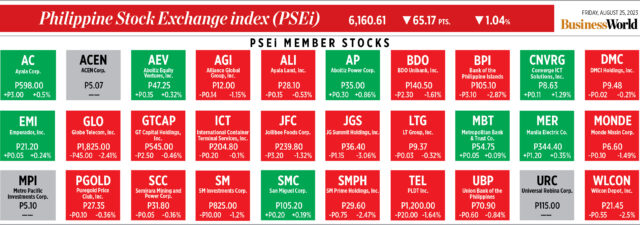
Here’s a quick glance at how PSEi stocks fared on Friday, August 25, 2023.


Here’s a quick glance at how PSEi stocks fared on Friday, August 25, 2023.
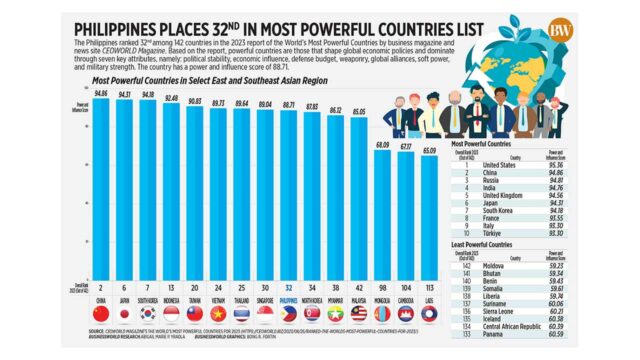
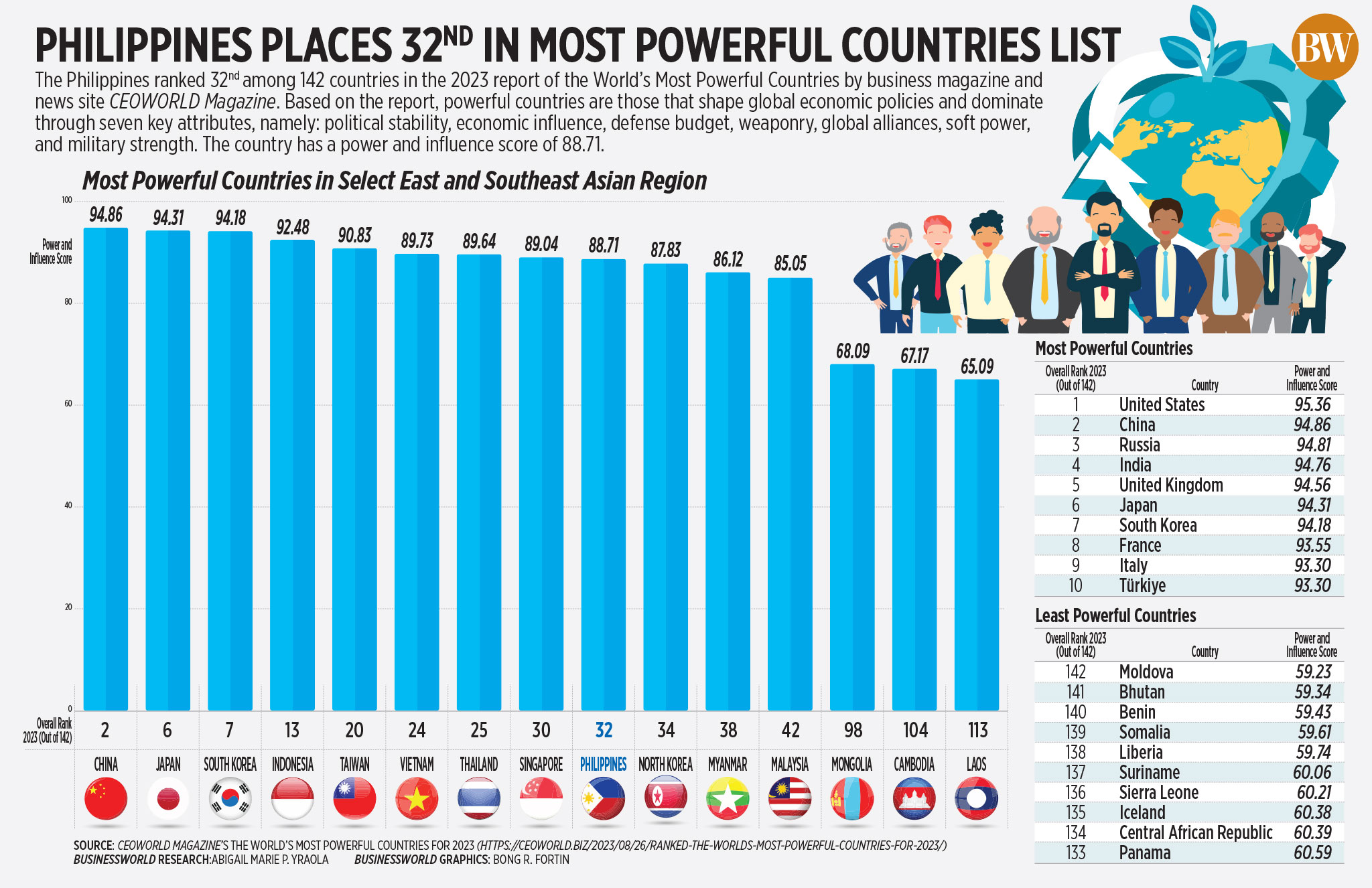
The Philippines ranked 32nd among 142 countries in the 2023 report of the World’s Most Powerful Countries by business magazine and news site CEOWORLD Magazine. Based on the report, powerful countries are those that shape global economic policies and dominate through seven key attributes, namely: political stability, economic influence, defense budget, weaponry, global alliances, soft power, and military strength. The country has a power and influence score of 88.71.

THE PESO could trade sideways against the dollar this week ahead of the release of US gross domestic product (GDP) data for the second quarter and the US Federal Reserve’s preferred inflation gauge.
The local unit closed at P56.57 versus the dollar on Friday, strengthening by 19 centavos from Thursday’s P56.76 finish, data from the Bankers Association of the Philippines’ website showed.
Week on week, however, the peso dropped by 39 centavos from its P56.18 close on Aug. 18.
The local unit opened Friday’s session at P56.80 per dollar. Its weakest showing was at P56.84, while its intraday best was at P56.48 against the greenback.
Dollars traded rose to $1.32 billion on Friday from the $1.13 million on Thursday.
The peso rose against the dollar on Friday as the market awaited signals from Fed Chair Jerome H. Powell’s speech at the Kansas City Jackson Hole Economic Policy Symposium over the weekend, Rizal Commercial Banking Corp. Chief Economist Michael L. Ricafort said in a Viber message.
The Federal Reserve may need to raise interest rates further to cool still-too-high inflation, Mr. Powell said on Friday, promising to move with care at upcoming meetings as he noted both progress made on easing price pressures as well as risks from the surprising strength of the US economy, Reuters reported.
While not as hawkish a message as he delivered this time a year ago at the annual Jackson Hole Economic Policy Symposium, Mr. Powell’s remarks still delivered a punch, with investors now seeing one more rate hike by yearend more likely than not.
But with “signs that the economy may not be cooling as expected,” including “especially robust” consumer spending and a “possibly rebounding” housing sector, Mr. Powell said that above-trend growth “could put further progress on inflation at risk and could warrant further tightening of monetary policy.”
The Fed raised interest rates by 25 basis points (bps) last month, bringing its benchmark overnight rate to a range between 5.25% and 5.5%. It has hiked rates by a cumulative 525 bps since it began its tightening cycle in March last year.
The Federal Open Market Committee will next meet on Sept. 19-20 to review policy.
For this week, Mr. Ricafort said the peso could trade sideways ahead of the release of the US personal consumption expenditures price index and second-quarter GDP growth data.
Mr. Ricafort sees the peso trading between P56.30 and P56.80 per dollar this week. — A.M.C. Sy with Reuters
STOCKS declined on Friday on profit taking as the market awaited US Federal Reserve Chair Jerome H. Powell’s speech at the annual economic policy meeting in Jackson Hole symposium later that day.
The Philippine Stock Exchange index (PSEi) went down by 65.17 points or 1.04% to close at 6,160.61 on Friday, while the broader all shares dropped by 25.17 points or 0.75% to end 3,332.40.
Week on week, the PSEi likewise fell by 129.66 points or 2.06% from its close of 6,290.27 on Aug. 18.
“Nerves were rattled ahead of Powell’s speech at the Fed’s annual retreat for global central bankers — including the Bank of Japan’s Kazuo Ueda and European Central Bank’s Christine Lagarde — encouraging market participants to cash in from Thursday’s gain,” Globalinks Securities and Stocks, Inc. Head of Sales Trading Toby Allan C. Arce said in a Viber message.
“Cautious investors sold… and waited for the discussion at Jackson Hole. Overall, the market is trading at oversold levels — that’s why we experienced a rally on Thursday,” Mercantile Securities Corp. Head Trader Jeff Radley C. See likewise said in a Viber message.
The Federal Reserve may need to raise interest rates further to cool still-too-high inflation, Fed Chair Jerome Powell said on Friday, promising to move with care at upcoming meetings as he noted both progress made on easing price pressures as well as risks from the surprising strength of the US economy, Reuters reported.
While not as hawkish a message as he delivered this time a year ago at the annual Jackson Hole Economic Policy Symposium, Mr. Powell’s remarks still delivered a punch, with investors now seeing one more rate hike by year-end more likely than not.
The Fed has raised rates by 5.25 percentage points since March 2022, and inflation by the Fed’s preferred gauge has moved down to 3.3% from its peak of 7% last summer. Although the decline was a “welcome development,” Mr. Powell said, inflation “remains too high.”
Back home, all sectoral indices declined on Friday. Financials went down by 28.99 points or 1.56% to 1,829.46; property fell by 38.67 points or 1.48% to 2,559.82; services slumped by 12.56 points or 0.82% to 1,506.79; holding firms dropped by 42.75 points or 0.72% to 5,840.88; industrials declined by 23.52 points or 0.27% to 8,700.60; and mining and oil lost 3.05 points or 0.03% to end at 9,930.33.
Value turnover went up to P3.57 billion on Friday with 340.80 million shares changing hands from the P3.31 billion with 415.26 million issues seen on Thursday.
Decliners outnumbered advancers, 101 versus 66, while 43 names closed unchanged.
Net foreign selling rose to P657.76 million on Friday from P263.91 million on Thursday. — Sheldeen Joy Talavera with Reuters
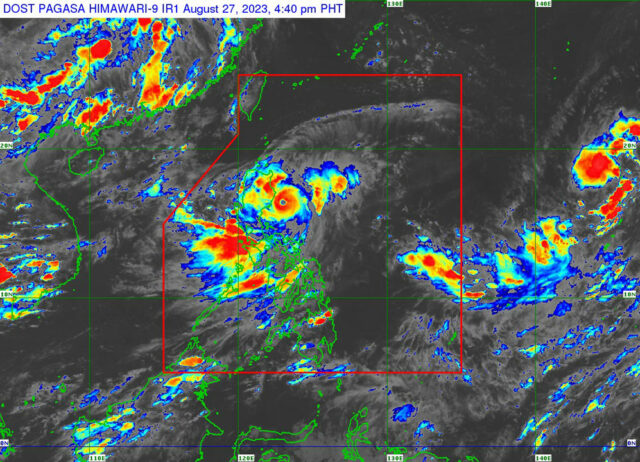
TROPICAL CYCLONE Goring (international name: Saola) on Sunday intensified into a super typhoon, prompting the state weather bureau to raise storm signals over parts of the main Philippine island of Luzon.
In a 2 p.m. bulletin, the Philippine Atmospheric, Geophysical and Astronomical Services Administration (PAGASA) said Goring was seen 90 kilometers east-northeast of Casiguran, Aurora province.
It was moving southward with maximum sustained winds of 185 kilometers per hour (kph)and gusts of up to 230 kph.
PAGASA hoisted tropical cyclone wind signals over various parts of Luzon due to typhoon-level winds.
Signal No. 3 was raised over the eastern portions of Isabela, specifically Divilacan, Palanan, Dinapigue, Ilagan City and San Mariano.
“Moderate to significant impacts from storm-force winds are possible within any of the areas where Wind Signal No.3 is hoisted,” it said.
Signal No. 2 was raised over the easter portion of mainland Cagayan, the northern and central parts of Isabela, the extreme northern portion of Aurora and the eastern portion of Quirino province.
Batanes, the rest of Cagayan including Babuyan Islands, the rest of Aurora, the rest of Quirino, the rest of Isabela, Apayao, Nueva Vizcaya, Ifugao, Mountain Province, Kalinga, Abra, the eastern portion of Ilocos Norte, Polillo Islands, the eastern part of Benguet, the eastern portion of Nueva Ecija and Calaguas Islands were all under Signal No. 1.
The Philippines lies along the typhoon belt in the Pacific and experiences about 20 storms each year. It also lies in the so-called Pacific Ring of Fire, a belt of volcanoes around the Pacific Ocean where most of the world’s earthquakes strike.
The country constantly experiences unavoidable losses and damage equivalent to 0.5% of its annual economic output mainly due to an increasingly unpredictable climate, according to the Finance department.
PAGASA said the southwest monsoon, which was enhanced by Goring, would bring occasional or monsoon rains over the western portions of central Luzon, southern Luzon and the Visayas in the next three days.
It added that a gale warning was in effect for the northern and eastern coastal areas of Luzon.
“Disruption in civilian maritime activities is expected over these areas due to hazardous sea conditions,” the agency said.
The super typhoon will move in a lopping motion and by Aug. 28, the storm will turn northeastward and northward before shifting northwestward on Tuesday.
“Goring is forecast to remain at super typhoon category until it makes landfall over southern Taiwan,” the weather bureau said.
“It is likely that Goring will emerge over the Taiwan Strait and exit the Philippine area of responsibility on Friday as a severe tropical storm or a typhoon in its lowest limit,” it added.
Meanwhile, about 1,473 people from 448 families fled their homes and took refuge on safer grounds in Cagayan province, the Provincial Disaster Risk Reduction and Management Council said.
At least 388 people from 141 families were brought to evacuation centers while the rest took refuge in their relatives’ homes.
Some road systems in the province were impassable due to floods after two days of nonstop rains. Abariongan Ruar-Abariongan Uneg road, Tammuco-Balagan-Abaruangan Ruar road and Tamban Bridge in Sto. Niño town were closed.
PAGASA said the forecast rainfall would be generally higher in elevated or mountainous areas. Under these conditions, flooding and rain-induced landslides are possible especially in areas that are highly susceptible to these hazards.
“The public and disaster risk reduction and management offices concerned are advised to take all necessary measures to protect life and property,” it said. “Persons living in areas identified to be highly or very highly susceptible to these hazards are advised to follow evacuation and other instructions from local officials.” — Adrian H. Halili and Artemio A. Dumlao

A CONGRESSMAN on Sunday urged the Philippine Coast Guard (PCG) and Maritime Industry Authority (Marina) to supervise the training and appointment of safety officers in coastal towns, cities and ports amid accidents in Philippine waters.
“The purpose is to improve maritime safety compliance at the ports and coasts and points in between,” Quezon Rep. Wilfrido Mark M. Enverga said in a statement. “Maritime regulation and enforcement happen to be the jurisdiction of Marina and the Philippine Coast Guard, but they do not have enough people on the ground.”
He said the agencies should coordinate with local government units to ensure proper training and deployment of personnel.
“The PCG could deploy coast guard auxiliary officers in the different ports of Polillo, Quezon, Binangonan and Talim Island in Rizal,” Mr. Enverga said.
The Technical Education and Skills Development Authority (TESDA) and Maritime Training Council should also produce competency standards, free training and certification courses to enhance the skills of local marines, he added.
He noted that courses in aquaculture, fishing and lifeguard services should be taught to motorized banca operators to upgrade their livelihood and survival abilities.
Technical and educational vocation courses on boat building, sea freight transport, navigational watch and engineering watch and submerged arc welding should be taught, he added.
The Small Business Corp. (SBC) could also extend financial assistance to small boat owners, Mr. Enverga said.
The congressman said the skill enhancement of local boat owners and the appointment of maritime safety officers would lessen accidents at sea involving passenger bancas and small motorboats.
The Philippine Coast Guard on Aug. 3 rescued 67 people after a motor banca sank near Polillo in Quezon, while a motorized boat carrying 33 people capsized in waters near Northern Samar.
A small passenger boat in Binangonan, Rizal also capsized due to Super Typhoon Doksuri or Egay. — Beatriz Marie D. Cruz

By Kyle Aristophere T. Atienza, Reporter
THE PHILIPPINES should start looking at how the bloc of emerging economies that seek to reshape the global order could affect its national security in the future, geopolitical analysts said at the weekend.
Expansion was a key point during the recent summit of the BRICS alliance, which is seen countering the West-dominated world order.
The BRICS, which is composed of Brazil, Russia, India, China and South Africa, recently invited six countries to join its fold — Iran, Saudi Arabia and the United Arab Emirates, the world’s biggest oil producers, as well as Egypt, Argentina and Ethiopia.
“Certainly, one of the goals of the BRICS is to weaken the petro-dollar as the world’s currency and perhaps nominate the China-led yuan currency in the near future,” said Chester B. Cabalza, founder of Manila-based International Development and Security Cooperation.
“The possibility of bandwagoning with the BRICS will all matter with our national interests since the members will be the future economic leaders of the world based on global economic foresights,” he said in a Facebook Messenger chat.
The Philippines should consider its “political and security dynamics” with China, the de facto leader of the BRICS that could act more aggressively in the South China Sea, Mr. Cabalza said.
Tensions between the Philippines and China have worsened after the Chinese Coast Guard fired water cannons to block Manila’s resupply mission to Second Thomas Shoal on Aug. 5.
Mr. Cabalza noted that India, one of the world’s fastest-growing economies and the most populous country in the grouping, recently expressed support for a 2016 arbitral ruling that voided China’s claim to more than 80% of the South China Sea.
Experts have said India, which has improved ties with the United States amid China’s growing influence in the Indo-Pacific region, might soon be forced to choose between the West and BRICS.
India and China have competing visions for the BRICS, which is being shaped by China and Russia to become an openly anti-western platform.
“Certain members continue to attempt to make use of their membership to shift the direction of BRICS into a rival bloc,” said Don Mclain Gill, who teaches foreign relations at De La Salle University in Manila.
He was referring to China and Russia, whose tensions with the US and other western countries have escalated after Russia invaded Ukraine in February last year.
Iran, whose hardline religious and military leaders have maintained an anti-western stance, is among the six countries that are poised to join the grouping, with Iranian President Ebrahim Raisi’s political deputy calling the move a “strategic victory for Iran’s foreign policy.”
“But the rest of the BRICS members are neither anti-west, nor interested in challenging the West,” Mr. Gill said, noting that Saudi Arabia, the UAE and Egypt are major defense partners of the US and benefit from US security provisions.
‘HEDGING’
“India, Brazil and South Africa have made it clear that development and expansion of BRICS would always be centered on the interests of the global south,” he said.
In a note, Dutch multinational banking corporation ING Group said the possible membership of Saudi Arabia in BRICS adds “fresh impetus to the de-dollarization debate, which is a potential challenge to the dominance of the US dollar in global trade.”
But it said the grouping’s tense relations with the West “raised doubts about whether Saudi Arabia would formalize political and economic ties with the BRICS.”
The admission of Saudi Arabia to the BRICS grouping will “inevitably focus debate on the use of nondollar currencies in trade,” it said, noting the “ambitions of BRICS to de-dollarize.”
“There certainly will be increased speculation that this latest move could see Saudi Arabia increasingly switching to nondollar-denominated currencies for oil trade.”
The six new candidates are poised to become members on Jan. 1, 2024, South African President Cyril Ramaphosa said on the last day of a three-day summit in Johannesburg.
BRICS, a consensus-based organization, was formed by Brazil, Russia, China and India in 2009 and included South Africa in its only previous expansion in 2010.
Mr. Gill said the BRICS, which account for a quarter of the global economy, should be looked at more positively by developing countries and middle powers such as the Philippines “given that [it provides] a voice for the global south.”
“However, Manila will have to navigate carefully and selectively given the fact that some members may weaponize such institutions, thus deviating from its intended purpose,” he said.
“At the end of the day, Philippine foreign policy should always reflect the country’s national interest, sovereignty and sovereign rights rather than indulging in any sort of rigid bloc politics.”
Aaron Jed Rabena, a research fellow at the Asia-Pacific Pathways to Progress, said the Philippines is increasing engagements with western allies like India and Japan, “and it should do the same with Middle Eastern, Latin American and even African countries.”
“The Philippines should maintain relations with all developed and emerging powers alike as opportunities and risks abound in both,” he said via Messenger chat. “This is part of hedging and of having a balanced and diversified foreign policy.”

By John Victor D. Ordoñez, Reporter
CONGRESS should pass proposed measures ensuring that workers in the gig economy are afforded their basic rights as employees, labor groups said.
The Federation of Free Workers (FFW) is pushing for the Senate to approve Senate Bill No. 1373, which aims to recognize gig workers on online platforms as regular employees, ensuring they receive the same protections under Philippine law.
A gig economy refers to a free market system in which temporary positions are common and organizations hire independent workers for short-term commitments or gigs.
“Legislation in this sphere should likewise harmonize with the game-changing Lazada ruling,” FFW President Jose “Sonny” G. Matula said in a Viber message, citing a recent Supreme Court ruling.
This ruling, made public last Jan. 19, ordered Lazada E-Services Philippines, Inc. to pay riders it had illegally dismissed full back wages from the time of dismissal up to the time of actual reinstatement.
It reversed the decisions of the National Labor Relations Commission (NLRC) and the Court of Appeals, which ruled that there was no employer-employee relationship between the riders and Lazada.
“We firmly believe that the freelance bill could go a long way in protecting our gig riders, in particular, should it incorporate our proposals for a charter of rights,” Sentro ng mga Nagkakaisa at Progresibong Manggagawa Secretary-General Josua T. Mata said in a Viber message.
“Essentially, that means that all gig riders, irrespective of their employment status, should enjoy the same rights and benefits that regular employees have, including the right to join or form unions,” Mr. Mata said.
Recently, Labor Undersecretary Benedicto R. Bitonio, Jr. told a House of Representatives committee hearing that the Department of Labor and Employment (DoLE) supports a proposed law protecting the rights and welfare of freelance workers, referring to House Bill No. 6718.
The bill, titled the Freelance Workers Protect Act, aims to provide safeguards for the welfare of freelance workers.

PRESIDENTIAL Assistant for Eastern Mindanao Secretary Leo Tereso A. Magno has initiated engagements with local government units (LGUs) in Central Mindanao for inclusion in President Ferdinand R. Marcos Jr.’s “Pambansang Pabahay Para sa Pilipino Program” or “4PH.”
A flagship program of the President, the 4PH was launched last September with the aim of providing affordable housing to homeless Filipinos. The target is to build a million housing units annually for a total of 6.5 million houses for the homeless by 2028.
Mr. Magno solicited local government unit (LGU) support for the project by meeting with local officials, among them Davao City Mayor Sebastian Z. Duterte and General Santos City Mayor Lorelie G. Pacquiao.
As concurrent Cabinet Officer for Regional Development and Security (CORDS) for Region 11, Mr. Magno also met with security officers to further intensify the government’s fight against terrorism and insurgency. He vowed to raise the region’s concerns with the Office of the President, the Cabinet, other departments, and other concerned government agencies. — Maya M. Padillo

THE COURT of Tax Appeals (CTA) has denied FCF Minerals Corporation’s claim for a refund of P7.01 million, the amount it claimed to have mistakenly paid for a documentary stamp tax (DST) in 2017.
In a 20-page decision made public on Aug. 15, the tribunal said that while mining firms are exempt from DST, the firm gave up this right when it agreed to an amendment to its existing financial assistance deal with the government.
“The parties to the Amendment Deed explicitly agreed that the ‘Borrower’ shall pay the DST on the transaction,” stated the ruling made by Associate Justice Maria Rowena Modesto-San Pedro. “Evidently, petitioner (FCF Minerals) waived the exception it enjoyed by virtue of this provision.”
In 2009, the firm entered into a financial or technical assistance agreement with the government, agreeing to assist the latter in the large-scale exploration and development of minerals.
Seven years later, FCF Minerals together with Metals Exploration PLC and Metals Exploration Pte, Ltd. agreed to an amendment deed to the contract, covering a loan commitment of $28,160,000.
Under the amendment, the borrowing party, in this case FCF Minerals, must pay any DST in relation to the loan. — John Victor D. Ordoñez
BAGUIO CITY — Fears of adverse effects on water sources, small-scale mining activities, livelihood, and the safety of people and properties are issues that continued to set back the Application for Production Sharing Agreement (APSA 103) by mining firm Itogon-Suyoc Resources, Inc. (ISRI) in Itogon, Benguet.
At last week’s scheduled signing of the memorandum of agreement (MoA), indigenous peoples (IPs) of Dalicno, Simpa and Lolita in Barangay Ampucao, Itogon, once again rejected the document, claiming no adequate consultations have merited their approval.
An earlier petition to the National Commission on Indigenous Peoples (NCIP) and the Itogon Indigenous Peoples Organization (IIPO) insisted that sitios are part of the areas inside the ancestral domain of Itogon which are covered by the APSA 103 of ISRI.
But former Itogon Indigenous Peoples Mandatory Representative (IPMR) Romeo Pocding, now a council of elders of the IIPO, claimed that ample consultations were conducted with affected residents about APSA 103 and that the process of getting their consent was done all above board.
The conduct of an FPIC (Free and Prior Informed Consent) with the physical presence of the IPs of the community affected by the ISRI project is required, under the NCIP rules, prior to the issuance of a certification. — Artemio A. Dumlao
ABOUT 83% of Filipinos believe that unlicensed nurses should be employed in healthcare facilities but with the guidance and supervision of licensed nurses, a new poll revealed.
The poll, conducted by research and intelligence agency Capstone-Intel Corp. on Aug. 1-10, brings to light the sentiments of Filipinos as the Department of Health (DoH) revealed plans to hire 4,500 unlicensed nurses to fill the manpower void in the healthcare sector.
The poll revealed that only 13% of the 1,205 respondents believe that unlicensed graduates should only be allowed to work after passing the board exam, while 4% are undecided on whether or not they should work in a healthcare setting.
The agency said that the minority opposing the employment of unlicensed nurses were likely concerned about “patient safety, qualifications without the exam, or implications for the nursing profession.”
Meanwhile, the same poll showed that 69% of the respondents believe that unlicensed nurses
“can provide quality healthcare services” as against 16% who believed otherwise. Some 15% of those polled were “not sure” with the premise.
Also, 83% of the respondents said allowing nursing graduates to work as healthcare associates under the supervision of licensed nurses would improve their chances of passing the board exam. Only 12% said they felt graduates should instead study in review centers to boost their passing chances, while 5% were not sure if supervised work would help improve board exam outcomes.
About 40% to 50% of nurses in private hospitals have quit in the past two years due to dissatisfaction with salaries, the Private Hospitals Association of the Philippines, Inc. has said. — Kyle Aristophere T. Atienza
