Home Blog Page 4436

Quezon City government awards P5 million worth of financial grant to StartUp QC finalists
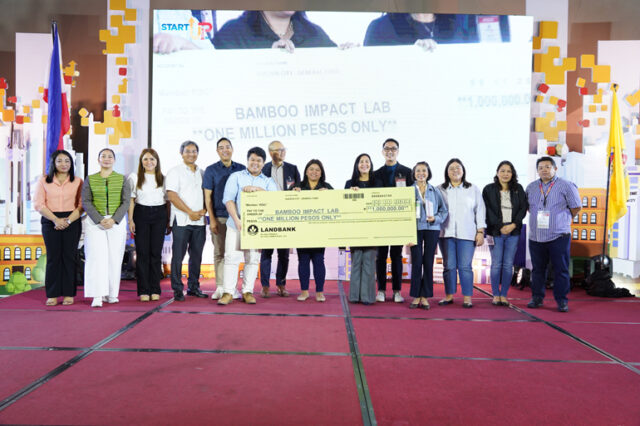
Bamboo Impact Lab, one of the finalists of StartUp QC’s first cohort, receives a financial grant from the Quezon City government.

The Quezon City government awarded financial grants amounting to P1 million to each of the five startup finalists under the first cohort of StartUp QC, the city’s very own startup program.

The finalists include Bamboo Impact Lab, a company that produces high-quality bamboo-derived products; EdukSine Production Corp., an online platform that provides socially relevant, Filipino independent films; and ITOOH Homestyle, the first tech-enabled marketplace for quality-vetted home and office furniture largely crafted by local craftsmen.

Also receiving grants are Indigo Artificial Intelligence Research, Inc., a venture between engineers and professors that provide general-purpose AI capabilities such as multilingual AI engines that can understand local languages, dialects, and its colloquial variants; and Wika which is an accessibility service provider that offers an array of tech-enabled solutions, such as provision of sign language, captions, and audio descriptions for the deaf and visually impaired.

The grants were awarded during StartUp QC’s Demo Day held last Aug. 11, which gave the finalists a stage to pitch their startups.

“Our five pioneering startups have been immersed in various coaching and mentoring sessions meticulously tailored to address their unique requirements. In their journey, we’ve had the privilege of observing firsthand their unwavering determination, commitment, and eagerness to acquire knowledge and evolve,” Juan Manuel J. Gatmaitan, head of the Quezon City Local Economic and Investment Promotions Office, said during the Demo Day.

Launched last October 2022, StartUp QC is an initiative led by the Quezon City government to support existing early-stage startups through various training and mentoring sessions, industry exposure and networking events.

The companies under the cohort have received various business and technical trainings in partnership with the Department of Information and Communications Technology, the Department of Trade and Industry, Quezon City University, Ateneo De Manila University, Miriam College, Thames International, Technological Institute of the Philippines, University of the Philippines, Diliman, and tech innovation hub Launchgarage.

“The city’s support does not end here. In addition to the learning, engagement, and development sessions, we have numerous exciting opportunities planned for our cohort,” Mr. Gatmaitan said. “Each participant will embark on the product development phase of our program. This phase takes their journey to the next level by offering venture acceleration assistance where we will continue to offer the necessary support to each startup and clients eagerly awaiting your presentations.”

Quezon City Mayor Maria Josefina “Joy” G. Belmonte stressed the significance of a city being both innovative and supportive of businesses, stating that local governments should create an inclusive environment that promotes growth and progress for all types of businesses.

“It’s in the interest of all sectors to have a city where anyone would be confident to launch their businesses however novel their idea is. Such endeavors would eventually generate jobs, push the economy to its maximum potential, and help every citizen live the life they aspire to have,” Ms. Belmonte said in a statement.

“The city, together with its partners, are ready to collaborate with these startups and introduce their ideas to the market. Their success will redound to the growth of the community and the city,” she added.

Also present during the Demo Day, Ed Rollan, chief executive officer of Growsari, imparted words of encouragement to the finalists.

“Don’t stop yourselves from thinking big. In every pain point, there’s always a big idea waiting to be unlocked, but always go for the biggest idea that you can think about,” Mr. Rollan shared.

“I’ve also learned in my seven years of doing startups that 90% of the success is actually reliant on our ability to execute, not on our ability to write slides and strategies. So, I encourage all of you to test new things. Learn and just do it; and [when] the learning comes, adjust [and be] agile enough to evolve,” he added.

Ongoing competitions

The Quezon City government is currently accepting applications for the second round of the Startup QC Program until Aug. 30 at 5 p.m. Interested applicants may sign up at https://qceservices.quezoncity.gov.ph/.

Moreover, students in the city are also invited to take part in the Startup QC Student Business Plan Competition.

Launched earlier in July, the program is open to all students of legal age residing in Quezon City, who are enrolled at any school, college, or university in the Philippines.

Applicants are encouraged to submit imaginative business ideas that are focused on high development impact sectors such as agriculture technology (agritech), education technology (edtech), environment technology (greentech or cleantech), health technology (healthtech) and government technology (govtech).

Student applicants who will qualify for this competition will undergo cadetship training sessions on topics such as design thinking, cultivating an entrepreneurial mindset, and creating a pitch deck.

After the cadetship, student finalists will have to pitch their business idea to a panel of judges for a chance to win up to P100,000.

Deadline of applications for this competition is on Sept. 14 at 5 p.m. Interested applicants may sign up also at https://qceservices.quezoncity.gov.ph/.

BoP deficit narrows to $53M in July

By Keisha B. Ta-asan, Reporter

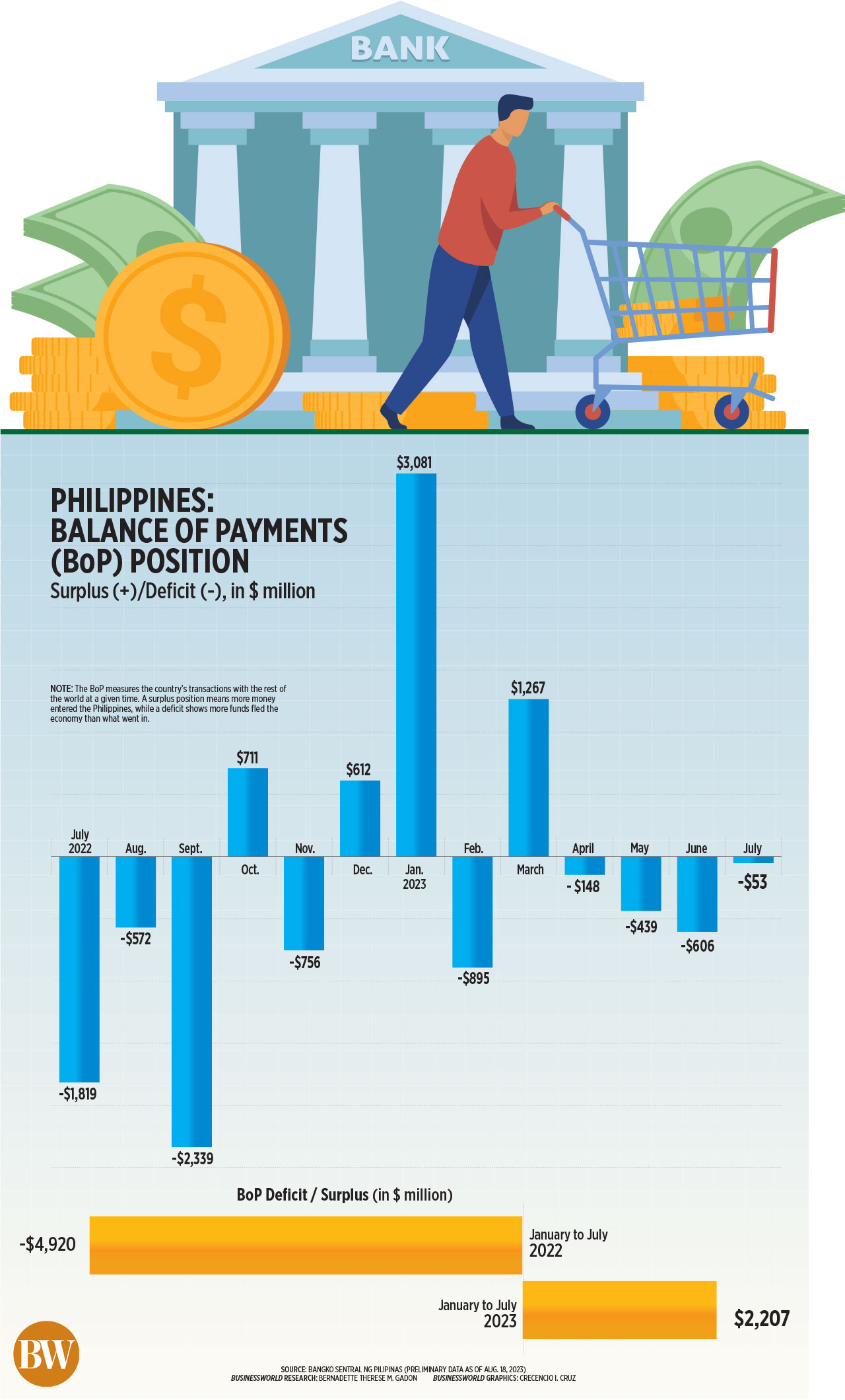
THE OVERALL balance of payments (BoP) deficit sharply narrowed to $53 million in July, as more dollars flowed out of the country to pay for the government’s foreign debt.

The BoP shortfall in July was significantly smaller than the $1.8-billion gap in the same month a year ago and $606 million in June, data released by the Bangko Sentral ng Pilipinas (BSP) late on Friday showed.

This is the narrowest BoP deficit in three months or since the $148-million gap in April.

July also marked the fourth straight month the BoP position was in a deficit.

“The BoP deficit in July 2023 reflected net outflows arising mainly from the National Government’s (NG) payments of its foreign currency debt obligations,” the BSP said in a statement.

The BoP measures the country’s transactions with the rest of the world at a given time. A deficit means more funds fled the economy than what went in, while a surplus shows that more money entered the Philippines.

In the first seven months of the year, the BoP position swung to a surplus of $2.21 billion, from the $4.92-billion deficit in the same period in 2022.

“Based on preliminary data, this development reflected mainly the improvement in the balance of trade and the sustained inflows from personal remittances, net foreign borrowings by the NG, trade in services, and foreign direct investments,” the BSP said. 

Rizal Commercial Banking Corp. Chief Economist Michael L. Ricafort said the smaller BoP deficit in July is likely due to the narrowing of the country’s trade deficit.

The trade deficit for January-June reached $27.96 billion, slightly narrowing from the $29.8-billion deficit posted in the same period last year.

Mr. Ricafort said the narrower BoP deficit was also due to the continued growth in dollar inflows from remittances, business process outsourcing revenues, foreign tourism receipts, profit from Philippine Offshore Gaming Operators (POGO) firms and foreign investments.

The central bank also noted the BoP position reflects the final gross international reserves (GIR) level of $100 billion as of end-July, 0.6% higher than the $99.4 billion as of end-June.

The GIR level reflects a more than adequate liquidity buffer equal to 7.4 months’ worth of imports of goods and payments of services and primary income.

“Specifically, it ensures availability of foreign exchange to meet balance of payments financing needs, such as for payment of imports and debt service, in extreme conditions when there are no export earnings or foreign loans,” the BSP said.

The GIR can also cover up to 5.9 times the country’s short-term external debt based on original maturity and 4.1 times based on residual maturity.

Further growth in dollar inflows and continued narrowing of the country’s trade deficit will support the BoP position of the Philippines moving forward, Mr. Ricafort said.

The planned retail dollar bond offering by the National Government as well as its debut of about $1-billion Islamic bonds this year will boost the dollar reserves, he said.

The government is eyeing to launch a retail dollar bond offering in the third quarter, with an offer size of around $2 billion. The last retail dollar bond sale was in 2021, when the Philippines raised almost $1.6 billion or P80.91 billion.

Earlier in June, the central bank revised its BoP deficit forecast to $1.2 billion or equivalent to -0.3% of gross domestic product (GDP), down from the $1.6-billion (-1.3% of GDP) forecast in March.

The BSP also projected a narrower current account deficit at $15.1 billion (-3.4% of GDP) this year from $17.1 billion (-4% of GDP) previously.

The country’s GIR is expected to hit $100 billion by end-2022 and $102 billion by end-2023.

Economists cut inflation forecasts for 2024, 2025

Rising pump prices may also put pressure on inflation, the central bank said. — PHILIPPINE STAR/MIGUEL DE GUZMAN

PRIVATE SECTOR economists kept their inflation outlook for this year but cut their forecasts for 2024 and 2025, the Bangko Sentral ng Pilipinas (BSP) said.

However, analysts said the threat of El Niño, the impact of trade restrictions on food items, oil production cuts, and hikes on transport fare and wages pose risks to the inflation outlook.

Based on the results of the BSP’s survey of private economists in August, analysts’ average inflation forecast for 2023 was at 5.5%, unchanged from the July survey.

For 2024, the analysts’ mean inflation forecast was trimmed to 3.5%, from 3.6% previously, while the projection for 2025 was also cut to 3.4% from 3.6%.

“Analysts expect inflation to continue easing in the near term owing largely to negative base effects,” the BSP said. “Risks to the inflation outlook, however, remain tilted to the upside due mainly to supply disruptions, particularly the potential adverse impact of El Niño.”

On Thursday, the BSP raised its average inflation forecast for 2023 to 5.6% (from 5.4% previously) and 3.3% (from 2.9%) for 2024, respectively. It also hiked its 2025 inflation forecast to 3.4% from 3.2%.

According to the central bank, analysts cited the higher prices of basic commodity items and services due to weather disturbances and the El Niño phenomenon as a key upside risk to inflation.

The El Niño weather event will likely persist in the Philippines until the second quarter next year, based on the latest advisory from the state weather agency.

This increases the chance of below-normal rainfall conditions, which could lead to dry spells and droughts in some areas of the country and in turn, dampen water resources and agricultural productivity.

“Electricity rates could rise in the fourth quarter of 2023 to second quarter of 2024 owing mainly to the warm and dry weather condition associated with El Niño,” the BSP said.

“A substantial increase in demand for power which could not be supported by power supply reserves could lead to a declaration of yellow or red alerts in the transmission grids, resulting in higher generation charges from the Wholesale Electricity Spot Market (WESM) and independent power producers (IPPs),” it added.

Local distribution utilities may also have to tap more expensive power generation sources as an alternative to hydropower plants, the BSP said.

The impact of trade restrictions on food items as well as oil production cuts by the Organization of the Petroleum Exporting Countries and its allies may also affect inflation in the Philippines.

India’s decision to restrict rice exports of non-basmati and broken white grain has pushed global rice prices higher.

The BSP said second-round effects from higher transport fares and wage hikes may also put pressure on inflation.

Transport groups are requesting for a P2 increase in public transport services nationwide, while a P40 wage hike in the National Capital Region (NCR) took effect on July 16. Pending wage hike petitions for various provinces in the country will likely be decided on by September.

“The main downside risk cited by a few analysts include the lagged effect of the BSP’s successive monetary policy tightening, which is expected to temper inflation,” the central bank said.

The BSP kept benchmark interest rates steady for a third straight meeting last week, but signaled it is prepared to resume tightening if needed amid risks to inflation.

The Monetary Board left its overnight reverse repurchase rate unchanged at a near 16-year high of 6.25%. Interest rates on the overnight deposit and lending facilities were maintained at 5.75% and 6.75%, respectively.

The BSP has raised borrowing costs by 425 basis points (bps) from May 2022 to March 2023 to tame inflation.

The central bank also said most analysts forecast the BSP to extend its policy pause for the rest of the year.

“However, some analysts are looking at one last rate increase by 25 bps in the third quarter and a possible reversal by 25 bps in the fourth quarter,” it said.

For 2024, all analysts expect the BSP to cut the key policy rate by a range of 50 bps to 225 bps. They also anticipate further cuts of 25 bps to 200 bps in 2025.

Meanwhile, all economists expect full-year inflation in 2023 to breach the 2-4% target. For 2024 and 2025, most analysts see inflation decelerating within the target range.

Analysts assigned a narrow 1.7% probability (from 2.8% a month ago) that inflation this year will settle within the target range, while there is a 98.3% chance (from 97.2%) it will exceed 2-4%.

The likelihood of inflation falling within the target band next year increased to 80.5% (from 76.7%), while the probability of inflation settling within 2-4% in 2025 is at 77.5% (from 71.6% previously).

There were 26 respondents in the BSP’s survey of private sector economists, which was conducted from Aug. 5 to Aug. 9. — Keisha B. Ta-asan

Infrastructure spending exceeds target in first half

PHILIPPINE STAR/ MICHAEL VARCAS

THE NATIONAL GOVERNMENT exceeded its target spending for infrastructure by 5% in the first half, data from the Department of Budget and Management (DBM) showed.

According to data from the DBM, infrastructure expenditures reached P507.2 billion in the January-to-June period, surpassing the P483.1-billion infrastructure spending program for the period by 5%.

Infrastructure spending jumped by 7.8% in the first half from P470.5 billion in the same period in 2022.

The National Government disbursed P608.7 billion for actual infrastructure projects in the first six months, 2.6% up from P593.2 billion in 2022.

However, the disbursement for infrastructure projects missed the P618.1-billion target for the period by 1.5%.

The government plans to spend 5.3% of the gross domestic product (GDP) or about P1.29 trillion on infrastructure this year.

“The continued growth in infrastructure spending would remain to be a bright spot in the economy, as it remains high at 5%-6% of GDP, compared with 2% or even less than 2% of GDP 10-20 years ago,” Rizal Commercial Banking Corp. Chief Economist Michael L. Ricafort said in a Viber message.

Infrastructure spending growth also offset the low budget utilization of some government agencies in the second quarter, Mr. Ricafort added.

China Banking Corp. Chief Economist Domini S. Velasquez said higher infrastructure spending may help lift economic growth.

“Given the effect of underspending to Q2 GDP, the government will likely be more focused on spending this year’s entire budget in a timely manner,” she said in a Viber message. Mr. Ricafort expects the rate of infrastructure spending growth to remain in high single digits, and faster than GDP growth in recent years.

Infrastructure activities may also benefit from the El Niño weather pattern in the next few months.

“Drier weather is positive for infrastructure activities,” Ms. Velasquez said.

Infrastructure spending is expected to be maintained at 5-6% of GDP until 2028. — Aaron Michael C. Sy

DBM chief says Q2 GDP growth would have been higher if not for gov’t underspending

PHILIPPINE STAR/WALTER BOLLOZOS

THE PHILIPPINE ECONOMY would have expanded by 5.3% in the second quarter if the government was able to address underspending by key agencies.

The Department of Budget and Management (DBM) Secretary Amenah F. Pangandaman said the government was not able to spend P170 billion in the first semester, which led to a slower-than-expected gross domestic product (GDP) growth in the second quarter. 

“Our study showed that if we only spent at least P65 billion of the P170-billion gap, our GDP would have been 5.3%. So, sayang (what a waste),” Ms. Pangandaman said at an event hosted by the University of the Philippines School of Economics on Saturday.

The Philippine economy grew by 4.3% in the second quarter, the slowest in two years. This was weaker than the 6.4% growth in the first quarter and 7.5% in the same period last year.

For the first half, GDP growth averaged 5.3%, lower than the government’s 6-7% target.

The disappointing second-quarter growth was mainly attributed to weaker consumption and a decline in government spending. Government spending contracted by 7.1% in April to June, a reversal of the 6.2% growth in the first quarter and 10.9% a year ago.

Finance Secretary Benjamin E. Diokno partially attributed the underspending to the over P100 billion in government-issued checks that were not released in the first half.

Ms. Pangandaman earlier said there are P124.1 billion worth of government-issued checks which are currently held by banks. This prevents the funding of social programs that should have been implemented.

According to Mr. Diokno, during his time as a Budget secretary, government units tend to accept projects that are not ready for implementation.

“You have to be very strict. Do not accept projects that have no studies…Do not ask for more than what you can chew. If you will not be able to spend the budget, that is unfair to other departments that can spend the money,” he told reporters on Friday.

In coming up with the proposed 2024 national budget, Ms. Pangandaman said the DBM considered the past spending performance of agencies.

“Even if you want (a budget that is) as high as P100 billion for a certain project, but you won’t be able to spend it, it will be part of our formula,” she said.   

Still, Mr. Diokno said he is optimistic the economy will expand in the second half as easing inflation may boost household consumption and face-to-face schooling lifts economic activity.

He noted that government spending usually catches up in the second half.

Meanwhile, the DBM is pushing for amendments to the procurement laws to speed up government spending.

“I know that the current government procurement process is difficult, so we will reform that, and we will present it to the President next week,” Ms. Pangandaman said.

Ms. Pangandaman earlier said the Government Procurement Policy Board is working on simplifying the law’s implementing rules and regulations to address bottlenecks.

The DBM is also working on building the capacity of local government units (LGUs) amid the implementation of the Supreme Court’s Mandanas-Garcia ruling.

“We have to recognize that the capacity per LGU (is different),” Ms. Pangandaman said. “There are LGUs, especially those who are progressive, who can really create and implement projects that are highly impact and highly technical, but there are some who don’t have enough capacity.”

She said the National Economic and Development Authority (NEDA) will soon release a study that would identify which projects and programs would be better handled by the National Government or LGUs.

“Hopefully we’ll have the study soon so we will be able to identify which projects and programs can be delivered more efficiently by the National Government and what programs can be delivered by our LGUs,” she said.

The government is currently working on devolving national government functions and programs to LGUs to give them the capacity to govern.

Under the Supreme Court’s Mandanas-Garcia ruling, LGUs were granted a larger share of national taxes to support them in the devolution. — Keisha B. Ta-asan with inputs from AMCS

Discounted sale of DITO shares raises financial health concerns

By Justine Irish D. Tabile, Reporter

THE SALE by DITO CME Holdings Corp. of 2.2 billion shares to “unrelated third-party” investors bring funds to the Dennis A. Uy-led telecommunications company but raises concerns about its financial health, analysts said.

“The share issuances will provide DITO with fresh funds to support the network rollout of its flagship subsidiary, DITO Telecommunity Corp.,” China Bank Capital Corp. Managing Director Juan Paolo E. Colet said in a Viber message.

However, Mr. Colet said the fresh funds would hardly improve the company’s equity deficit, which exceeded P21 billion in the previous quarter, increasing the likelihood of more capital-raising activities.

Toby Allan C. Arce, head of sales trading at Globalinks Securities and Stocks, Inc., said the issuance is a sign of a “significant development” for the company.

“By selling 10% of its shares, DITO is effectively diluting the ownership of its existing shareholders by 10%. This means that each existing shareholder will own a smaller percentage of the company,” Mr. Arce said.

In separate disclosures on Aug. 16 and 17, DITO reported that it had entered into subscription agreements with unrelated third-party subscribers for 1.59 billion and 610 million common shares, respectively, at par value.

However, since the sale was at a very steep discount compared with its price of as high as P2.40 per share last week after the disclosures, analysts said the move could raise concerns about the company’s financial health.

“Investors may question why the company is selling shares at a discount, and whether this is a sign that the company is in financial trouble,” said Mr. Arce.

“If management thinks a peso per share is a fair price for an arm’s length transaction, then this implies that the market is significantly overvaluing the company,” Mr. Colet said.

He added that the recent transactions are in contrast to the private share placement to Loden Infra Technologies Ltd. on Aug. 2021 for P8 per share.

“Although that was a smaller deal, some public investors may worry that the deep discount given to the latest share issuances reflects a fundamental change in the company’s prospects,” he said.

Last Thursday, DITO disclosed that it had completed the applicable requirements for the listing of 35 million shares for a total price consideration of P280 million from Loden Infra. It added that the number of DITO’s listed common shares will be adjusted on the listing date or Aug. 22, 2023.

However, Mr. Arce said that the share placement of Loden Infra implies that the company believes in the long-term prospects of DITO.

With the sale of 2.2 billion shares, analysts expect DITO’s public float to increase as they are said to have been sold to unrelated parties.

“The placements to what the company has described as unrelated third parties will increase the public float, assuming they do not own at least 10% of the outstanding shares and are nonstrategic investors in DITO,” said Mr. Colet.

Mr. Arce said that issues could also be raised from the entry of a new shareholder as its management may have a different vision for the company.

“This could lead to changes in the company’s management team, as well as its strategic direction,” he said.

The company did not disclose the third parties to which the 2.2 billion total shares were issued even if the first sale, which constituted 1.59 billion shares, represented 10.18% of the total number of issued and outstanding shares of DITO after the issuance, which was 15.63 billion.

“A holder of at least 5% of a company’s outstanding shares is required to disclose such ownership,” said Mr. Colet.

“Thus, at the very least, we should expect a disclosure of the subscriber to the 1.59 billion shares,” he added.

At the stock exchange on Friday, shares in DITO declined by five centavos or 2.08% to P2.35 apiece.

MGen allots P18B for renewables

MANILA ELECTRIC CO. (Meralco) through its power generation arm Meralco PowerGen Corp. (MGen) is allocating P18 billion for renewable energy expansion, the power distributor unit said on Sunday.

“We will continue to work with the energy industry, government, and other pertinent stakeholders to help further accelerate the country’s energy transition as we aggressively pursue more renewable energy projects,” Jaime T. Azurin, president and chief executive officer of MGen, said in a statement.

The investment will help fast-track Meralco’s long-term sustainability aspiration to transition to clean energy, MGen said.

It will cover about 2 gigawatts (GW) of gross renewable energy capacity from solar and wind, the company said, adding that it intends to build the renewable energy capacity by 2030 along with its partners.

MGen said its renewable energy unit MGen Renewable Energy, Inc. (MGreen) will hasten its target of about 1,500 MW or 1.5 GW of renewable energy capacity with investments in additional and larger renewables projects like battery energy storage systems.

Mr. Azurin said more projects using renewable energy are under development and assessment.

“This is in line with Meralco’s long-term sustainability strategy to embark on a just, affordable, and orderly transition to clean energy,” he said.

The aspiration of the Meralco group includes a target of reducing its direct emissions by about 20% by 2030 as MGen strives to fully phase out coal by 2050.

To date, MGreen’s portfolio includes the 55-MW-alternating current (MWac) BulacanSol solar plant in San Miguel, Bulacan in partnership with Powersource Energy Holdings Corp.; and the 68-MWac solar farm in Ilocos Norte of Nuevo Solar Energy Corp., a joint venture between MGreen and Vena Energy.

MGreen’s renewable energy portfolio also includes the 75-MWac solar farm of PH Renewables, Inc. (PHRI) with Mitsui & Co.’s Mit-Renewables Power Corp. in Baras, Rizal.

The renewable energy unit of MGen said PHRI had just completed commissioning tests for the first phase of its project, which involves 67.5-MWac energy capacity.

The first phase is expected to commence operations by this month, while the second phase is expected to be operational by at least the first semester of 2024.

Two solar projects — the 49-MWac solar plant in Cordon, Isabela, and the 18.75-MWac solar plant in Bongabon, Nueva Ecija — are among the winning bidders in the second round of the government’s green energy auction program, which provides an additional market for RE through competitive electronic bidding of RE capacities.

Meralco’s controlling stakeholder, Beacon Electric Asset Holdings, Inc., is partly owned by PLDT Inc.

Hastings Holdings, Inc., a unit of PLDT Beneficial Trust Fund subsidiary MediaQuest Holdings, Inc., has an interest in BusinessWorld through the Philippine Star Group, which it controls. — Ashley Erika O. Jose

JG Summit expects sustained growth for 2nd half

JG SUMMIT Holdings, Inc. expects to sustain its growth for the second half of the year due to the country’s continuing economic recovery, its top official said in a corporate event on Thursday.

“We expect the second half to continue to be positive relative to the previous year,” JG Summit President and Chief Executive Officer Lance Y. Gokongwei told BusinessWorld.

Mr. Gokongwei added that the company’s core businesses would mainly benefit from confidence among consumers as they return to malls, travel, and retail shopping.

“It’s [the] economic growth in the country and we’re benefiting again from people going back to being more mobile,” he added.

His optimism comes after the company reported an attributable net income of P10.38 billion in the first half of the year, a reversal of the P2.75 billion net loss the prior year.

JG Summit’s consolidated revenues for the six-month period went up by 11.8% to P163.39 billion from P146.14 billion in the same period last year.

The company’s budget carrier Cebu Pacific is also expecting continued passenger growth for the latter half of the year as the demand for travel increases.

“People are more confident [with travel],” Mr. Gokongwei said, adding that the airline is restoring more flights, particularly for international destinations, while bringing in additional aircraft. 

“So that [bodes] well for the future in terms of growth,” he said.

“The dark cloud now is oil prices are rising so that may affect our cost structure, but overall, we are seeing some return to travel,” he said.

Cebu Air, Inc., the listed company that operates the airline, saw a reversal of its net loss during the first semester, reporting an attributable net income of P3.75 billion, a turnaround from the P9.5 billion the prior year.

Its revenues more than doubled during the period to P43.55 billion from P20.68 billion the prior year, driven by a significant increase in passenger volume and flight activity.

Meanwhile, Mr. Gokongwei said that the group would look into the effects of the proposed “junk food” tax on the company’s food and beverage unit Universal Robina Corp.

“We have to see first what the law says. First, I think it is inflationary, and second, it can be anti-poor,” he said, citing the proportion of lower-income people who allocate a larger part of their basket for food compared with wealthier people.

“I think it’s very difficult to define what’s junk food so I think it could create potential imbalances. But, I don’t think it’s the best way to collect taxes,” he added.

Finance Secretary Benjamin E. Diokno said earlier that the government is pushing for taxes on junk food and sweetened beverages to address “diabetes, obesity, and noncommunicable diseases related to poor diet,” as well as raise P76 billion in additional revenues in the first year of implementation.

On Friday, JG Summit shares fell by 2.93% or P1.15 to P38.05 apiece. — Adrian H. Halili

Davao Light sets aside P2.4-B capex for next year

BW FILE PHOTO/

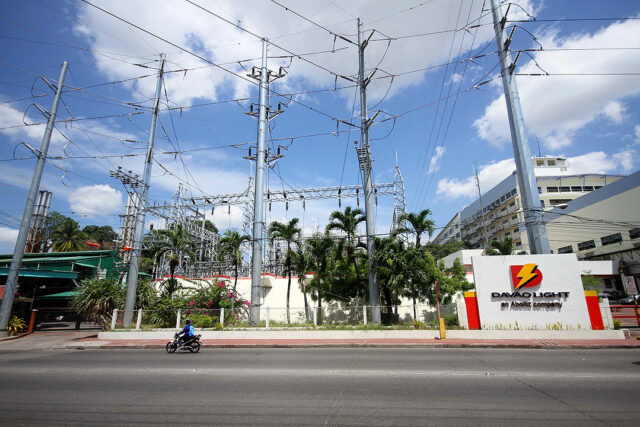
DAVAO Light and Power Co., Inc., a subsidiary of Aboitiz Power Corp., is setting aside about P2.4 billion for next year’s capital expenditure (capex), the company’s top official said.

Rodger S. Velasco, president and chief operating officer of Davao Light, told reporters in Davao City last week that the capex will be funded by both internally generated funds and debt.

For 2023, the company allocated around P2.4 billion for capital investment, he said.

Of this year’s capex, between P200 million and P250 million was earmarked for underground cabling while the rest is for expansion and new substations.

The electricity distribution utility has also set a target to complete its underground cabling project in Davao City by 2029.

It said the project started through separate city ordinances issued in 2014 and 2017 mandating the transfer of electric power and telecommunication wires and cables underground from overhead.

The company said that the recent city ordinance further expanded the target locations covered in the project to include the areas of C.M. Recto, R. Magsaysay Ave., and the streets of San Pedro, C. Bangoy Sr., Bonifacio, Pelayo, and E. Quirino in Davao City. The project is expected to be completed by 2029.

Prince Rainier Yamyamin, who is Davao Light’s lines and substation design engineer, said that to date, the project is 25% complete, representing two kilometers of the 7.5 kilometers covered under the underground cabling project.

Davao Light serves Davao City, portions of Panabo City, and the municipalities of Carmen, Braulio E. Dujali, and Santo Tomas in Davao del Norte.

To date, it has served a combined customer count of about 476,428 customers with a peak demand of nearly 500 megawatts.

As of May, Davao Light said its demand growth resulted in a total of 1.13 million megawatt-hours, further increasing its energy sales by 4.29% and demand by 4.2% in 2023. — Ashley Erika O. Jose

Bayo looks to the future

AT THE opening of Bayo’s multibrand store in Glorietta on Aug. 8, the brand showed off three of its brands, namely Bayo itself, Viseversa, and Tela. Tela, founded by the Bayo Group co-CEO Anna Lagon’s daughter Alyssa, seems to be its response to the future.

The younger Ms. Lagon toured us around the store, showing off their mannequins covered in abaca. According to her, the mannequins were old, but by rewrapping them in a new, sustainable material, they’re being given new life. This is all part of their Journey to Zero initiative, which sees hangers made of cornstarch, water-based printing on their clothes, and recycling textile cut-offs.

Ms. Lagon told us why their brand decided to open a store with all three brands inside: “During the pandemic, we noticed that the consumer wanted convenience. One perfect way was to have all the brands in one space. I’d notice that when people go to the malls, (they’re) usually with family.” The family can thus take its pick from all three brands: Viseversa has clothes meant for older women, Bayo has clothes for those in their thirties, while Tela caters to Ms. Lagon’s own teen to early-20’s age bracket.

“I couldn’t find any local clothes that fit my aesthetic,” she said. “I felt like there’s a big gap, also in terms of sustainability. Tela fills in that gap.” Tela’s clothes are made from recycled and natural materials, and the clothes on view at the store were printed with a pattern like splashes of watercolor.

She pointed out that while Bayo did have a younger line a few years back called Love by Bayo, “I felt like it’s better to create a brand that’s separate. Some people don’t like wearing the same clothes as their mom’s. Important pa rin iyong brand differentiation (Brand differentiation is still important).”

Bayo was founded in the 1990s by sisters Corazon Bitong and Lynn Agustin, but was acquired in 2014 by clothing manufacturers Anna and Leo Lagon. In the span of time since it began, local brands have come and gone, but Bayo still stands. On that note, it also faces a new landscape that sees more and more affordable global brands filling the country’s retail spaces. Ms. Lagon told us their secrets for staying in the game. “Constantly innovating and always putting the consumer at the forefront; also trying to see what they need, and addressing it.”

As for staying relevant as a local business in a market saturated with foreign brands, she said, “Our pieces aren’t similar to the global brands. You could see weaves here that aren’t available in the other brands.” She pointed out pieces made in partnership with communities in Aklan, Argao, and Bulacan. “We have the manufacturing capability. It’s easy for us to produce clothes that really cater to the Philippine market.”

She takes pride that all their clothes are produced 100% locally. “We do everything in-house,” she said. “To control the cost, to make sure that the people behind the scenes are well-taken care of.

“We control the wages, benefits, and we can control the environment where they work in,” she said, citing the Rana Plaza collapse in Bangladesh that killed more than 1,000 clothing factory workers. The 2013 incident displayed the uglier side of fashion, considering that the workers there were making clothes for foreign brands. “It’s important for us to support local and support the livelihood here,” she said.

Ms. Lagon had a quick answer when asked why all these measures are important for the company. “Fashion is one of the largest contributors in terms of harmful effects in the (environment). Bayo, as one of the leading brands [locally], it’s important that we start the movement that we give consumers better alternatives.”

But it’s important for her, personally, too. “I’m the future generation. I’m going to live in the world for more years.

“I want to live in a world that’s better.”

Bayo Group’s multi-brand store featuring Bayo, tela, and Viseversa is now open at the ground level of Glorietta. One can also shop online at www.styleshops.com.ph and www.telamnl.com.Joseph L. Garcia

SEC to impose new fines, penalties on erring firms

THE SECURITIES and Exchange Commission (SEC) is urging corporations and associations to avail of its amnesty program as it is set to implement a new set of fines for late or non-filing of disclosure requirements.

“We reiterate our reminder to all corporations that starting a business does not end with registration with the SEC. This is just the first step — they must faithfully comply with reportorial requirements thereafter to ensure their continuity and sustainability,” SEC Chairman Emilio B. Aquino said in a statement over the weekend.

The commission said that about 40,000 firms have filed amnesty applications, which are a waiver or reduction of fees, allowing them to fully comply with reportorial requirements.

“The SEC Amnesty Program is a chance for corporations and associations to get a fresh start in their compliance with reportorial requirements, so they continue to enjoy the benefits and privileges of being a registered corporation,” Mr. Aquino added.

The regulator said that the deadline for the submission of amnesty application is set on Sept. 30, a further extension of the SEC’s earlier memorandum with an initial deadline of June 30.

“Corporations that are able to submit their correct reportorial requirements, including those reverted for compliance… will be considered to have undergone the complete amnesty process and are entitled to receive a Confirmation of Payment,” the SEC said.

The commission added that by Oct. 1, higher fines and penalties will be imposed on firms that have not yet submitted their financial reports.

It said earlier that penalties for corporations that filed their reportorial requirement late could range from P5,000 to P27,000 with an additional fine of up to P1,000 per month depending on their retained earnings.

Penalties for non-filing of reports could range from P10,000 to P18,000. A monthly fine of P1,000 will also be imposed.

Additionally, the regulator said that it would now begin to strictly impose fines for noncompliance with Memorandum Circular No. 28, which requires companies to disclose their official and alternate e-mail addresses and mobile phone numbers.

The SEC said it might place a company under delinquent status after three — consecutive or intermittent — failures to submit reportorial requirements within five years.

“The commission can also revoke a corporation’s registration should it incur a fourth offence and it has been given reasonable notice regarding its delinquent status,” it added. — Adrian H. Halili

From Spongebob Squarepants to EXO’s Chanyeol: Inside Ever Bilena’s back-to-back August launches

By Zsarlene B. Chua

AUGUST is shaping up to become one of Ever Bilena Cosmetics’ busiest months as the local beauty brand has given its fans not one but two launches across its Ever Bilena and Careline brands — from an exciting collaboration with a beloved animated series, to naming its first international male ambassador, here’s what Ever Bilena has prepared for this month.

CARELINE X SPONGEBOB COLLECTION
“Oh, who lives in a pineapple under the sea?” For over 20 years, Spongebob and his ragtag group of marine friends (if you can count a squirrel a marine animal) have regaled multiple generations with their hilarious hijinks and antics. And now, the fifth-longest-running American animated series collaborated with Careline in bringing a new collection of cosmetics featuring the beloved Bikini Bottom residents.

“We work[ed] closely with Viacom and Paramount Global to ensure the makeup collaboration accurately represents the quality, the personality, the colors, and aesthetic, essentially everything the Spongebob is known and adored for,” Denice Sy, chief sales and marketing officer of Ever Bilena Cosmetics, said in a press release.

The collection, which Ms. Sy said was a year in the making, was the first time Spongebob Squarepants collaborated with a Filipino brand.

Careline may be Ever Bilena’s cosmetics line that promises clean, vegan beauty and targets the younger generations (Gen Z), but as a millennial who grew up with Spongebob on Nickelodeon, I also enjoyed this collection very much.

The six-piece collection features Oh My Blush Liquid Blush (P325/9.5ml) in four shades — Girly Girl (a blue-red shade for those with deeper, cooler skin tones), Red Ahoy (a brick-red shade for those with deeper, warmer skin tones), Shell Pink (a mauve pink shade for those with fairer, warmer tones), and Pink Patricia (a bubblegum pink shade for those with fairer, cooler tones).

Each shade promises incredible mileage such that “one dot goes a long way” and staying power that will stay “one eternity later” (a Spongebob meme). It also contains Hyaluronic Acid and Vitamin E for a little boost of skincare.

Quick review: While this writer hasn’t had the chance to truly put the blushes through their paces, the few days I have been using this proved that the product does go a long way and less IS more when applying — one to two dots is often more than enough. Pigmentation and pay off are great as it managed to stay on during an entire work-from-home day (haven’t been able to use it when I go outside) with very minimal fading.It also does not apply streaky and patchy and gives you enough time to blend it in before it sets.

Another plus is the packaging is incredibly cute (each bottle          features a Spongebob character) and feels premium! Definitely a must-buy.

Aside from the liquid blush, the collection also includes Contour Y’all Liquid Contour (P325/9.5 ml) and the Shimmery Splash Liquid Highlighter (P325/9.5ml).

The Liquid Contour only comes in one shade, a medium-brown shade that will work for those with fairer, cool-toned skin — hopefully, Careline comes out with more shades so more Filipinos can enjoy the liquid contour. Its formula contains Hyaluronic Acid, Shea Butter, and Glycerin for extra hydration and moisturization.

Finally, the Shimmery Splash Liquid Highlighter, which Ms. Sy told this writer in a Viber message is her personal favorite, is a silvery-pink highlighter that provides a pearly glow. It also contains Hyaluronic Acid and Castor Seed Oil for that extra skincare oomph.

All in all, this new Careline line is a fun addition to its product line and perfectly combines childhood nostalgia with great skin-caring makeup products.

EXO CHANYEOL NAMED THE NEW EVER BILENA AMBASSADOR
Korean K-Pop superstar Park Chan-yeol of EXO is Ever Bilena’s newest ambassador and the brand’s first-ever male and first international brand ambassador. With him being the newest face of Ever Bilena, the brand is said to be doubling down on its “For Every Beauty” tagline that maintains that beauty is for everyone, and on its “continuous push to produce top-tier product innovations.”

The multihyphenate and multitalented idol is not only a singer and a rapper, but also a guitarist, an actor, a cook, and a philanthropist. Added to his world-class appeal, this makes him “a great representative for Ever Bilena. [As] His heart and positive personality are both aspirational and relatable to Ever Bilena users,” said Ms. Sy in a separate press release.

Park fronts the Every Bilena EB Plus collection that includes EB Plus Shape & Set Brow Duo (P275), EB Plus Fearless Serum Skin Foundation (P325), EB Plus Two-Way Cake Serum Foundation (P250), and the brand’s newest drop, the EB Plus Serum Tinted Lip Balm (P245).

The Spongebob x Careline collection is now available online at Careline’s official Shopee, Lazada and Tiktok shops. It is also available in physical stores at SM Beauty  at SM Department Stores, Robinsons Department Stores, and Watsons Mall Stores.

Shop for the EB Plus collection at all Watsons, SM Beauty at SM Department Stores, Robinsons Department Stores, The Landmark, W Department Store, and other premiere department stores nationwide and at Ever Bilena’s flagship stores in Shopee, Tiktok, and Lazada.


Zsarlene Chua is a former BusinessWorld reporter who is now a fledgling PR girl. She’s all about skincare, makeup, and video games. None of these products recommended are the writer’s clients. These are all independently reviewed and acquired products.