Home Blog Page 4432

ICTSI adds cranes in Australia

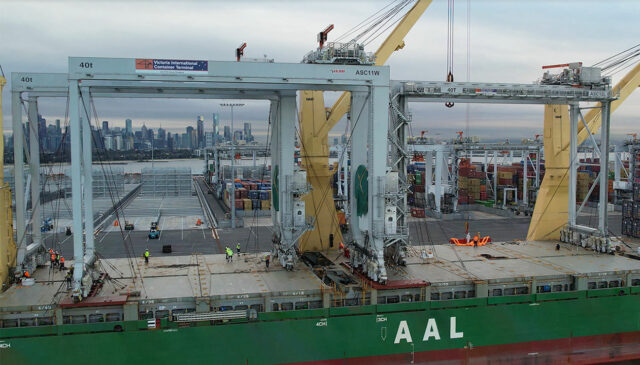
INTERNATIONAL CONTAINER Terminal Services, Inc. (ICTSI) has added six new automated stacking cranes at its port in Australia to achieve a fully automated container terminal.

In a press release, ICTSI said that the purchase of the additional stacking cranes for Victoria International Container Terminal (VICT) will increase its terminal yard and reefer capacity by 30% and 43%, respectively.

VICT’s new equipment is part of an ongoing expansion project, which includes 15 additional truck grids that will increase the terminal’s slot availability by 30%.

The container terminal in Melbourne is also set to acquire two larger ship-to-shore cranes, which will bring the total number to seven.

“The new cranes will have an outreach of 22 containers to enable the handling of up to 14,000-twenty-foot-equivalent-units (TEUs) capacity Neo-Panamax ships,” the company said.

Under the expansion project, VICT’s quay line, or the area where boats are tied up for loading and unloading, will be extended by 71 meters, which will allow two 336-meter-long vessels to berth simultaneously.

On Aug. 3, 2021, the Port of Melbourne committed to carrying out the berth extension, which commenced in March last year and is expected to be completed by the end of 2023.

The container terminal’s expansion, which is expected to raise VICT’s annual throughput capacity by 250,000 TEUs to 1.25 million TEUs, is scheduled to be completed and operational at the beginning of 2024.

A subsidiary of ICTSI, VICT started its operations in Australia’s fully-automated container terminal in 2017.

In the second quarter, ICTSI saw an increase in volume from its Asia operations by 17.2% to 1.61 million TEUs from 1.38 million TEUs in the same period last year.

Its operations in Asia cover its terminals in the Philippines, China, Indonesia, and Papua Guinea. — Justine Irish D. Tabile

Alas, Trump is still eligible to run for office

A LAW REVIEW article claiming that Donald Trump is automatically disqualified from holding elected office is getting attention in large part because it was written by two conservative, originalist law professors, William Baude and Michael Stokes Paulsen. Baude and Paulsen argue that Trump should be excluded from ballots for giving aid to an “insurrection or rebellion” in violation of Section 3 of the 14th Amendment.

There are two problems with the notion that Trump can and should be kept off the ballot by state election authorities.

First, although Baude and Paulsen’s originalism is honest and conscientious, originalists outside academia typically won’t apply their originalism if it leads to a result at odds with their conservatism. Second, there is precedent that contradicts their argument — precedent the scholars dismiss because they say it contradicts the original meaning of Section 3.

To condense their main points, when the 14th Amendment was drafted after the Civil War, the original meaning of Section 3 was that anyone who previously held public office and then rebelled against the US government should be automatically barred from office unless two-thirds of Congress made an exception. This constitutional provision is law and requires no further action by Congress to implement it, the article says. Courts can and should apply it, but we don’t need to wait for them to do so. Any government official, state or federal, whose duty it is to apply the Constitution must obey Section 3. It follows, the authors say, that the state officials who set the ballots for the primaries and general elections should exclude Trump. If he wants to fight that in court, he can. But there’s no need for the officials to wait for a judicial determination.

To state this argument is to see why it won’t be followed by state officials. Was the Jan. 6 attack on the Capitol an “insurrection”? Did Trump participate or give aid and comfort to the “enemies” of the Constitution under Section 3? These are contentious questions of constitutional interpretation.

True, all state and federal officials are sworn to uphold the Constitution. But today we are accustomed to having the Judiciary, and ultimately the Supreme Court, resolve tough constitutional questions.

A state election official who blocked Trump from the ballot would understandably feel an enormous amount of trepidation about making such an epochal decision absent judicial guidance. And even if local officials were prepared to bar Trump, they would be ill advised to do so as a matter of constitutional law.

The Supreme Court as a whole has never directly interpreted Section 3. But in 1869, the chief justice of the United States, Salmon P. Chase, issued a circuit court opinion in Griffin’s Case interpreting Section 3. (At the time, it was normal for Supreme Court justices also to work as circuit court judges.) In it, Chase held that Section 3 was not automatically enforceable — what lawyers call “self-enforcing” — but rather could only go into effect if Congress passed a law directing its implementation. Such legislation is not in existence today.

A circuit court decision, even one written by a sitting chief justice, doesn’t formally bind the Judiciary or even the other courts of appeal. Nevertheless, the opinion is overwhelmingly the most important precedent interpreting Section 3. It has not been seriously questioned by the Supreme Court or the other courts of appeal since it was set down more than 150 years ago. Because it is still on the books, ignoring it would be an act of legal irresponsibility.

To be sure, Chase’s logic in Griffin’s Case is a bit tortured, as Baude and Paulsen’s article shows over some 20 pages. Chase was clearly trying to achieve a near-term legal objective (upholding convictions by judges who had once been associated with the Confederacy and might have been disqualified by Section 3). He also likely had a longer-term political objective, namely giving a majority in Congress the ability to decide whether Section 3 would be applied, rather than requiring two-thirds of Congress to lift the bar on office.

But nearly every important judicial opinion reflects legal and political judgments. The whole idea of precedent is that it stays in place until the courts reject it.

Originalists don’t like that. In fact, they don’t like precedent much at all, because they think a law’s original meaning has more validity than later judges’ interpretation. That’s one of the things that’s wrong with originalism. Although theoretically designed to constrain courts, originalism in fact invites judges — and others — to disrupt long-established law in favor of their preferred policy positions, dressed up as original meaning. Think of Dobbs v. Jackson, where originalists could say that the right to choose wasn’t in the original meaning of the due process clause, despite a half-century of precedent ruling otherwise.

The takeaway is that the scholars’ article helps show what’s wrong with originalism, in both theory and practice. Donald Trump is manifestly unfit to be president. But it’s up to voters to block him. Magic words from the past won’t save us.

BLOOMBERG OPINION

Britney Spears’ husband seeks divorce

SAM ASGHARI, the husband of pop superstar Britney Spears, is seeking to divorce the singer he married last year after she was released from a legal conservatorship.
The 29-year-old Mr. Asghari cited “irreconcilable differences” in a filing in Los Angeles Superior Court on Wednesday. He is seeking spousal support and payment of legal fees by Ms. Spears.

In a statement on Instagram, Mr. Asghari said he and Ms. Spears “have decided to end our journey together.”

“We will hold onto the love and respect we have for each other and I wish her the best always,” Mr. Asghari added. “Shit happens. Asking for privacy seems ridiculous so I will just ask for everyone including media to be kind and thoughtful.”

Representatives for Ms. Spears did not immediately respond to requests for comment.
Mr. Asghari and Ms. Spears, 41, wed 14 months ago in June 2022 after dating for nearly six years.

The wedding took place months after a judge ended a conservatorship that had controlled the singer’s personal life and finances for 13 years. During court proceedings, Ms. Spears said she longed to get married and start a new family without any restrictions.

The conservatorship had been set up and overseen by the singer’s father, Jamie Spears, after she had a public breakdown in 2007 and was hospitalized for undisclosed mental health issues.

The marriage is the third for Ms. Spears, and the first for Mr. Asghari. She married Jason Alexander, a childhood friend, in a surprise ceremony in Las Vegas in 2004 but the marriage was annulled shortly after. Nine months later, she married dancer Kevin Federline, with whom she had two children. That marriage ended in divorce in 2007.

The Grammy-winning Ms. Spears is known for pop music hits such as “Baby One More Time,” “Oops! … I Did It Again” and “Stronger.”

Iranian-born Mr. Asghari is a personal trainer and actor who has appeared on the Showtime series Black Monday. — Reuters

PHL should tap municipal bonds to expand its financing options

BW FILE PHOTO

DEVELOPING COUNTRIES like the Philippines should promote the use of municipal bonds to expand and decentralize financing options, the Asian Development Bank (ADB) said.

“While it is unlikely that any of the target developing member countries will develop an active municipal bond market, with municipal bonds as a core investment in the portfolios of domestic institutional investors, it is feasible to envisage greater issuance within all four countries (India, Vietnam, the Philippines, and Indonesia),” the ADB said in a report.

The ADB said there is still a “very limited” history of municipal bond issuances in the Philippines.

It said decentralization remains a “work in progress” in the country.

“The Local Government Code provides an adequate legal framework for the activities of local government units (LGUs), including for the issuance and servicing of debt for infrastructure projects,” it said.

“Some regulatory issues, such as the possibility of annual appropriations risk for the payment of debt service, and the possibility under certain circumstances for an LGU to assign an intercept of shared tax revenues for the repayment of debt, require further clarification,” it added.

According to the ADB, LGU debt accounts for just 1.3% of outstanding public sector debt, indicating “low relative participation compared with the central government in the financing of infrastructure projects.”

Data from the multilateral lender showed the Philippine domestic bond market has around P10.427 trillion in capitalization.

“The Philippine domestic bond market is relatively small and shallow, but it is growing. The bond market is dominated by government bonds that constitute 82% of all bonds outstanding,” it said.

“Should municipalities return to the bond market, the Securities and Exchange Commission provides a robust regulatory framework for bonds, although this does not include guidelines for the issuance and listing of municipal bonds, as are present in some Asian developing member countries, such as India and Indonesia,” it added.

The report also included recommendations such as debt structuring, particularly in broadening municipal debt security, diversifying tenors, and creating pooled finance vehicles.

The multilateral lender also recommended the redirection of government-owned financial institution lending to municipalities.

“These recommendations pertain to redirecting the lending activities of government-owned financial institutions, which in many target DMCs dominate municipal finance because of their low cost of capital and strong relationships with the local government sector,” it added.

Institutional capacity building is also key to helping municipalities enter the bond market. It cited the promotion of municipal ratings, the production of independent financial audits, and benchmarking exercises, among other measures. — Luisa Maria Jacinta C. Jocson

McDonald’s Philippines aims to have 130 Green & Good stores by yearend

MCDONALD’s Philippines is aiming to end the year with a total of 130 Green & Good stores, from the current 25.

“With more than 700 stores nationwide, McDonald’s Philippines carries a strong commitment to environmental responsibility.  We will continue to find solutions to make our operations more efficient and better for the planet. With the results of our Green & Good initiatives so far, we believe that it is possible to grow sustainably. Our stakeholders can look forward to enjoying more McDonald’s stores that are Green & Good in the future,” Kenneth S. Yang, McDonald’s Philippines president and CEO, said in a statement.

The first Green & Good store is the McDonald’s branch along UN Del Pilar Avenue in Manila City which opened in 2020.

There are 25 Green & Good stores with solar-powered rooftops are able to save a total of 546,000 kWh, which McDonald’s said cuts its electricity consumption by as much as 36% versus stores that do not use solar power.

With its first six flagship Green & Good stores, McDonald’s said it was able to realize an annual reduction of 52,500 kg of carbon dioxide (CO2e) and 102,000 (H2O) liters of water reduction for each store.

McDonald’s also uses rainwater harvesting tanks collecting run-off to decrease water consumption, as well as inverter air-conditioning technology, LED lights and photo and motion sensors inside its stores.

McDonald’s said it now uses 60% paper- or fiber-based packaging and strawless lids for cold beverages, which have reduced  plastic waste by 273 metric tons.

McDonald’s stores also have Bike and Dine areas, and have e-charging stations for two-wheeled electric vehicles.

San Miguel prepares to train new engineers for MRT-7 operations

SAN MIGUEL Corp. (SMC) on Monday is set to train about 115 recently graduated engineers to helm the Metro Rail Transit Line 7 (MRT-7) project.

“MRT-7 promises to be a game-changer for the Philippine transportation landscape, and we are confident our young professionals will set new benchmarks in efficiency, safety, and service excellence,” San Miguel President and Chief Executive Officer Ramon S. Ang said in a statement.

The company said the engineers will undergo extensive training for the commercial operation of MRT-7 by 2025.

It added that the new graduates have started their training in the country, while 40 engineers were sent to Korea for training under Korea Railroad Corp. or Korail.

The company said the remaining cadets are undergoing mandatory fundamental training courses under the Philippine Railway Institute.

San Miguel has partnered with the Korean railway operator and the Philippine Railway Institute for industry-level insights and understanding in train operations and railway maintenance.

“Investing in the growth, development and well-being of young local talents is part of our commitment to nation-building and ensuring our country’s long-term success and prosperity,” Mr Ang said.

“We want to be able to provide them with the tools they need to enhance their competencies, prepare them for when the MRT-7 starts operating and eventually make meaningful contributions to the wider community,” he added.

The company, through its infrastructure unit, SMC Infrastructure, recently acquired a P100-billion loan to hasten the project completion by 2025. 

The load was between the company and a consortium of local entities, namely: BDO Unibank, Inc., Philippine National Bank, Bank of Commerce, Security Bank Corp., and the Government Service Insurance System.

The MRT-7 project is a 23-kilometer elevated railway line with 14 stations.

It will run from Quezon City to San Jose del Monte, Bulacan, and is expected to carry 300,000 passengers daily in its first year, and up to 850,000 passengers a day in its 12th year. — Adrian H. Halili

Financing growth

(1st of a series)

This column will produce a new series on Financing Growth. The take-off point is the successful UP School of Economics program in development economics alumni association homecoming lecture last Saturday titled “A Conversation with finance and budget secretaries on financing sustained economic growth.”

Finance Secretary Benjamin E. Diokno and Budget Secretary Amenah F. Pangandaman discussed the recent and medium-term economic performance and targets of the economic team and Marcos administration.

GDP GROWTH IN Q2 2023
Of the top 50 largest economies in the world in GDP size in 2022, 32 have reported their second-quarter 2023 GDP data. The top three fastest-growing in the first half or average for Q1 and Q2 2023 were the United Arab Emirates (UAE), Philippines and China. But UAE and China have fast growth in 2023 on low base or low growth in Q1 and Q2 of 2022, whereas the Philippines has fast growth in 2023 on high base or high growth in 2022. So it would appear that of these 32 major economies in the world, the Philippines has the most dynamic and resilient growth.

And of these 32 economies, 11 have low H1 growth of below 2%, while seven have contractions of 0.1% to 1% including Germany — the largest economy in Europe — Sweden, Poland and Taiwan. I added four countries with modest or high growth in Q1 but no Q2 data yet (Table 1).
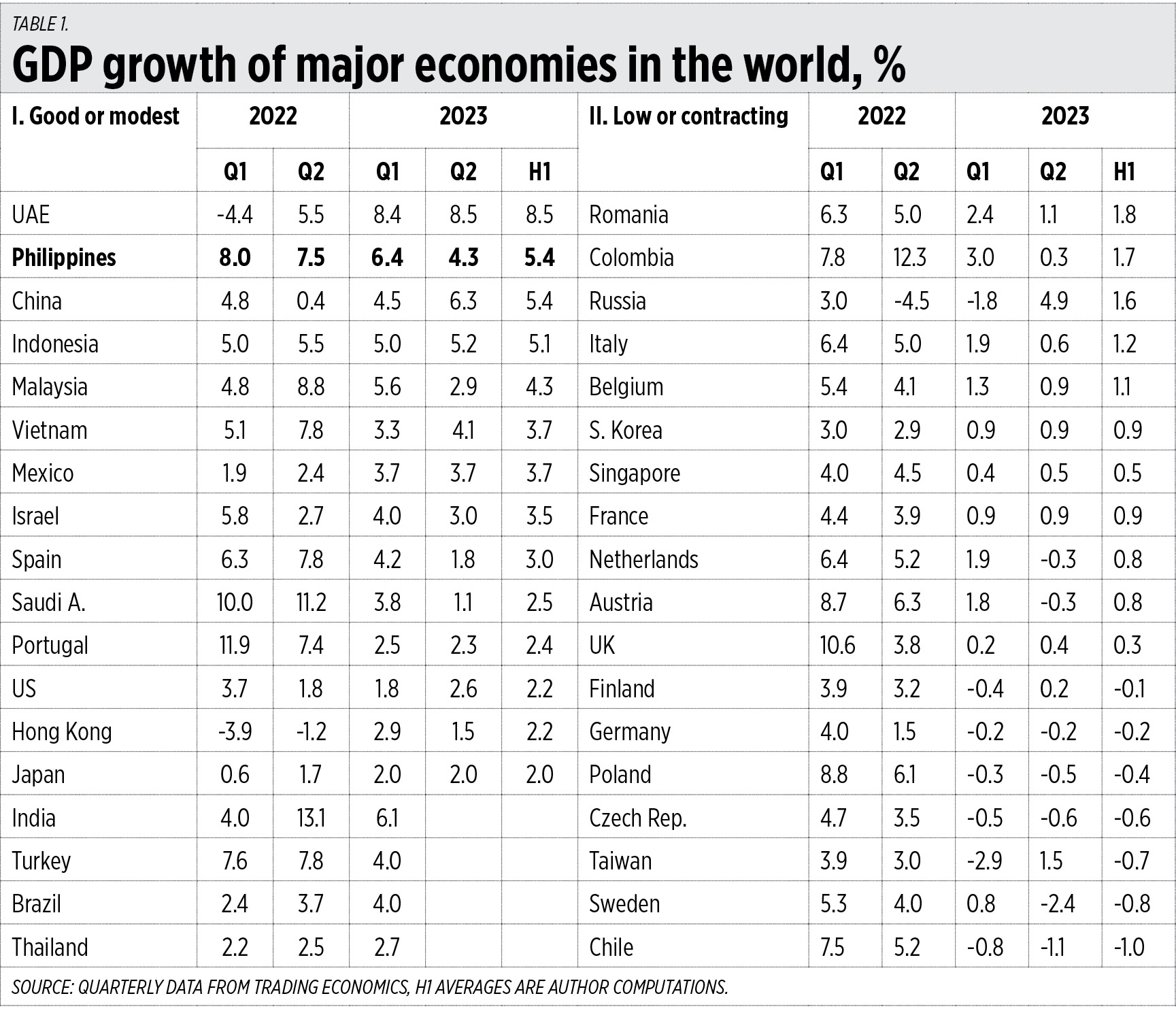
The global and regional economic environment in 2023 is worse than in 2022. A growth of 3% or higher now looks fast already. The Philippines growing at 5.4% in H1 was already an outstanding performance.

BIG INFRASTRUCTURE
Secretary Diokno and Secretary Pangandaman discussed an optimistic short- to medium-term economic and fiscal outlook. Below are four sets of data presented by the two secretaries, among the many data they discussed and for brevity, I compressed these sub-tables into one.

Sub-table I shows the growth target of the Development Budget Coordination Committee (DBCC), and projections by the ASEAN+3 Macroeconomic Research Office and the three multilaterals — ADB, IMF and WB. The four institutions’ projections for 2023 are within the DBCC target, but for 2024, the three multilaterals have lower projections than DBCC but still high — 5.5% or higher.

Sub-table II shows that all the five credit rating companies either upgraded or affirmed and sustained their previous ratings for the Philippines since President Ferdinand R. Marcos, Jr. assumed power in July 2022. The most recent were made by Fitch, from BBB- to BBB stable in May, and by R&I, from BBB+ stable to BBB+ positive early this month. The next goal is to move from BBB+ to A and I think that is highly possible.

Sub-table III shows the medium-term fiscal projections like reducing the public debt/GDP ratio, deficit/GDP ratio and keeping the infrastructure spending/GDP ratio between 5-6% yearly. I also think these are doable, although I wish that deficit/GDP ratio was below 3% by 2028.

Sub-table IV shows an ambitious infrastructure program of P1.3 trillion until 2028, led by more roads and bridges. Both secretaries highlighted two main sources of funding other than the budget and new borrowings from multilaterals — more public private partnerships (PPP) and the Maharlika Fund (Table 2).

BusinessWorld reporter Keisha B. Ta-asan was at the lecture and she wrote two stories, “Diokno: Tuition-free college education unsustainable” (Aug. 20), “DBM chief says Q2 GDP growth would have been higher if not for gov’t underspending” (Aug. 21). Good to see you there, Keisha.

PDE ALUMNI HOMECOMING
Even if it was a Saturday afternoon of a long weekend, the UPSE auditorium was full during the lecture by the two secretaries. The bulk of the audience came from PDE alumni batches of the 1970s and 2010s.

After the lectures and open forum with the two secretaries, dinner was served courtesy of the Philippine Center for Economic Development of UPSE. Then came the PDE homecoming program. Mai Valera-Co, president of batch 46th, and I were the co-MCs. There were lots of fun games, raffle prizes and giveaways to all alumni who came, plus food and beer. Our batch also gave an entertainment number — economic carols composed and sang in December 1997.

For that very successful event, the two secretaries’ lecture and PDE homecoming, I want to thank the following.

Our corporate sponsors who gave donations in kind, in alphabetical order: Alas Oplas & Co. CPAs., Astoria Hotels and Resorts, Gallerie Joaquin, iOptions Ventures Corp., Japan Tobacco, Inc., Manila Electric Co., Nestlé Philippines, Philip Morris Fortune Tobacco Corp., Robinsons Retail and San Miguel Corp.

Friends who represent the companies above: Marycris (also my sister), Jeffrey, Jack, Pidro, Robert, Joe, Arlene, Noel, Robina and Ferdie. Thank you guys, more blessings to your companies.

Of those 10 corporations, only iOptions Ventures is province-based, in Palawan. Pidro was my dormmate at the UP Narra dormitory in the 1980s, a very kind man and he formed the Palawenyo Savers, the CSR arm of iOptions that provide scholarships and nurture rural-based entrepreneurship like developing small organic farm systems, biochar production including carbonized rice hull and liquid smoke.

For the organizing team, special thanks to UPSE Dean Joy Abrenica (also our teacher in PDE in 1997-1998), Rose San Pascual, Chelle Magboo, many other staff of UPSE, my co-MC Mai Valera-Co, PDE Alumni Association convenor Monching Bacani and most importantly, former UPSE faculty and PDE Director Ruping Alonzo (RIP) who is well-loved and remembered by so many PDE graduates from various batches.

Thank you all. Fantastic lectures and homecoming. We will do it again next year.


Bienvenido S. Oplas, Jr. is the president of Bienvenido S. Oplas, Jr. Research Consultancy Services, and Minimal Government Thinkers.

minimalgovernment@gmail.com

Susan Sarandon sues over ‘extensive problems’ at Vermont home

THE OSCAR-WINNING actress Susan Sarandon has taken a construction firm to court over what she calls “extensive problems” at a $2-million home she built in Vermont and where she planned to spend her retirement.

Buckled siding, missing insulation, mold and an unfinished primary bedroom ceiling are among 47 issues found by engineers, contractors and Ms. Sarandon’s staff, according to a lawsuit filed against DeGrenier Contracting and Property Management on Thursday in the federal court in Springfield, Massachusetts.

Ms. Sarandon, 76, built the environmentally sustainable home on 45 wooded and meadowed acres in Stamford, Vermont, located near the Massachusetts border, that she bought in 2018 through the limited liability company The Right to Bear Farms, which filed the lawsuit.

Known for her political activism, Ms. Sarandon said she had a “clear vision” for a home that would be “entirely off-the-grid,” with solar power, well water and geothermal energy, “in light of increasing global environmental instability.”

But she said the Clarksburg, Massachusetts-based construction management firm’s owner misrepresented his qualifications, inflated invoices, charged for construction he never did, and did essentially nothing to justify being paid nearly $140,000 to act as the property’s caretaker under an agreement struck after the house was built.

The firm’s owner declined to comment. The lawsuit seeks unspecified damages based on claims of breach of contract, unjust enrichment and fraudulent misrepresentation.

Ms. Sarandon won the best actress Oscar for the 1995 movie Dead Man Walking. She stars as the main villain in the superhero film Blue Beetle, which hit theaters on Friday. — Reuters

SMIC wins Stevie Award

SM INVESTMENTS Corp. (SMIC) recently received another international business award.

In a statement, SMIC said it was given the Stevie Award as the bronze winner for the best annual report — privately-owned companies category in the 20th Annual International Business Awards.

“We are pleased to receive this award for our 2022 Integrated Report that reflects how we continue to serve communities. We are mindful that with transparent reporting, we can demonstrate that our business performance and sustainability efforts continue to create value for all our stakeholders,” Frederic C. DyBuncio, SMIC president and chief executive officer, said in a statement.

The International Business Awards are the world’s premier business awards program.

“The report encompasses a good survey and gives a great overview on the Philippine economy,” the judges said.

SMIC is a leading Philippine conglomerate with businesses in retail, banking, and property.

Bank margins may narrow

THE NET interest margins (NIM) of banks could narrow as loan demand is expected to remain tepid and with the Bangko Sentral ng Pilipinas (BSP) seen to cut rates next year.

“Even with rate cuts, borrowers’ appetite to take up loans are likely to stay muted for longer. That will put pressure on the NIM of banks,” Moody’s Analytics Economist Sarah Tan said in an e-mail.

Ms. Tan said while loan demand might increase if the central bank cuts rates, this will not be enough to boost margins.

Moody’s Analytics expects the BSP to begin its policy easing by the first quarter of next year.

The BSP last week kept its benchmark interest rates steady for a third straight meeting, but signaled that it is prepared to resume tightening if needed amid risks to inflation.

The central bank left its overnight reverse repurchase rate unchanged at 6.25%. Interest rates on the overnight deposit and lending facilities were maintained at 5.75% and 6.75%, respectively.

The BSP has raised borrowing costs by 425 basis points from May 2022 to March 2023 to tame inflation.

Banks could mitigate the impact of lower borrowing costs on their margins through the dynamic pricing of loans and other instruments, Rizal Commercial Banking Corp. Chief Economist Michael L. Ricafort said in a Viber message.

He added that lower rates could result in an at least 10% increase in loan disbursement.

Latest data from the BSP showed that outstanding loans by big banks, net of reverse repurchase placements with the central bank, expanded by 9.4% to P10.9 trillion in May from P9.97 trillion a year ago.

This was slower than the 9.7% expansion in April, and was the slowest credit growth in 15 months or since the 8.9% print in March 2022.

Month on month, bank lending grew by 0.7% in May.

University of the Philippines Los Baños senior lecturer Enrico P. Villanueva said in a social media message that retail-dominant banks will see a “lower and slower” impact from the expected policy easing.

“Rate cuts in general encourage more lending, so there is still a positive effect on loan growth. Net interest margin will just not be a high as before, he said.

Meanwhile, Fitch Asia-Pacific Financial Institutions Director Tamma Febrian said in an e-mail that banks will likely be able to maintain their profitability even if the BSP cuts rates, as they have in earlier monetary easing cycles, like in 2020.

“Lower yields on loans will be partly mitigated by their growing share of higher-yielding consumer loans, corresponding but delayed decline in funding costs and higher balance-sheet leverage,” Mr. Febrian said.

Profits will also be boosted by an increase in loan demand amid lower interest rates, especially for longer-dated corporate loans and residential mortgages, Mr. Febrian said.

“On the other hand, rates on credit card receivables are less influenced by policy rates and their growth are likely to be influenced more by consumer spending than interest rates,” he added. — A.M.C. Sy

IPOPHL says ‘Eat Bulaga’ trademark renewal ‘separate’ from cancellation case

THE Intellectual Property Office of the Philippines (IPOPHL) clarified that the registration renewal of the “Eat Bulaga” trademark is separate from a pending trademark cancellation case, amid the ongoing legal dispute for its use. 

“As the renewal requests and other pending applications at the Bureau of Trademarks (BoT) are separate from the trademark cancellation case at the Bureau of Legal Affairs (BLA), they do not affect the BLA’s disposition of the merits of the trademark cancellation case,” the IPOPHL said in a statement on Monday. 

“The renewal process strictly observes an ex-parte nature prescribed by Republic Act 8293 or the Intellectual Property Code. Under the law, requests for renewal should be granted primarily if the registrant can prove the actual and continuous use of the mark,” it added. 

The IPOPHL issued the statement in response to queries on the renewal of the “Eat Bulaga” trademark of Television and Production Exponents, Inc. (TAPE), which was approved in June. 

“The IPOPHL confirms the approval on June 14, 2023 of the request to extend the term of registration over EAT BULAGA AND EB covered by TM Reg. No. 42011005951, for Nice Classes 16, 18, 21 and 25 for another 10 years,” it said. 

Recently, TAPE confirmed that it had received the certificate of renewal of registration for the trademark. 

The IPOPHL issued the certificate amid the pending petition by Vicente “Tito” Sotto III, his brother Marvic Valentin “Vic” Sotto, and Jose Maria “Joey” de Leon, or better known as TVJ, to cancel TAPE’s trademark registration. 

TVJ parted ways with TAPE, which produces “Eat Bulaga” for GMA Network, on May 31, and started hosting E.A.T. in TV5 channel on July 1. 

The trio previously filed charges against TAPE and GMA in June, citing the alleged copyright infringement and unfair competition complaints. They also filed a petition for the issuance of a writ of preliminary injunction to halt TAPE and GMA from using the name, logo and other devices. — Revin Mikhael D. Ochave

India’s trade policy is working great — for Vietnam

ANNIE SPRATT-UNSPLASH

THE printed circuit board assembly, the camera module, the touch-screen display and the glass cover.

Together, they account for three-fourths of the bill-of-materials cost of a smartphone. Vietnam, the world’s second-biggest exporter of handsets after China, sources these and most other components at zero tariffs from free-trade partners. But India, which has few such accords of its own but is still keen to emulate the manufacturing powerhouse in its neighborhood, has customs duties as high as 22%.

The result? Making mobile phones in the world’s most-populous nation now comes embedded with a cost disadvantage of 4%, says the 2023 edition of a comparative study of tariffs by India Cellular & Electronics Association (ICEA), an industry body.

This extra burden is something India has deliberately imposed on assemblers even as it began remunerating them for its many existing cost disabilities, especially poor infrastructure and red tape. The so-called production-linked incentives, or PLI, promise to pay firms as much as 4% to 6% of their incremental sales for five years.

One way to think about this is that India is first damaging its competitiveness, and then compensating firms to set up factories in the country. Another perspective is that the handouts are being “supported through indirect revenue from increased indirect taxes from the same sector,” as the ICEA report says.

Policymakers are convinced that their strategy is a masterstroke. The PLI program, which kicked in for mobile phones in October 2020, is being touted as a success. Annual production has surged by more than 60% to $42 billion. Of this, $11 billion is exported, compared with virtually nothing when Prime Minister Narendra Modi came to power in 2014. From being a net importer, India has become a net exporter of handheld devices.

Elsewhere in Asia, the contest is about semiconductors, the high-value heart of communication, transportation, artificial intelligence, and a lot else besides. From Thailand to Singapore and Malaysia, several countries are now in the fray to shift the locus of front-end chip manufacturing from East to Southeast and South Asia. India is trying to step on that ladder via packaging and testing. While those plans are yet to bear fruit, cheap labor has already made the nation an upcoming rival to Vietnam in a low-value-added activity like assembling electronics parts.

The pandemic and President Xi Jinping’s souring relations with the West have changed the thinking of multinationals. A Foxconn Technology Group plant in the southern Indian state of Tamil Nadu is preparing to deliver iPhone 15s only weeks after they start shipping from factories in China, Bloomberg News reported on Wednesday. The likes of Apple, Inc. are reluctant to rely too heavily on the People’s Republic to feed global demand. Their quest for a China+1 strategy has presented India with a once-in-a-generation chance to storm the supply chain. Vietnam’s phone exports last year were six times the South Asian nation’s thanks to Samsung Electronics Co. It is this gap that New Delhi wants to close. However, conflating correlation with causation could jeopardize this goal.

Just because an apparent change in the country’s fortunes has occurred despite a lurch toward protectionism, government ministers are angrily dismissing critics who dare to question the wisdom of the tariff-subsidy combo. The official view is that as long as exporters can claim back the duties on imported components, they won’t grumble about India’s cost disadvantage against Vietnam — not when they’re being paid generous PLI incentives.

Following up on this thinking, the Modi government in 2018 announced a “calibrated departure” from more than two decades of greater trade openness, and raised import duties on mobile phones to 20% from 15%. That project has continued unabated. In 2020, the duty on printed circuit board assembly and display was raised by 11 percentage points. This year’s government budget cut the duty on camera lenses to zero.

That hasn’t made much difference. As the ICEA study shows, the accumulated increase from three years of changes still works out to nearly 5.6% of the bill of materials, or 3.6% of a phone’s total cost. Add the impact from the rupee’s 11% slide against the dollar since the start of last year — double the decline in the Vietnamese dong — and Indian-made phones would be uncompetitive by more than 4%, the ICEA says.

This cost may not be showing up in export performance because it is being borne by India’s 1.4 billion consumers. Costlier imports are hurting local demand amid high inflation. Component manufacturers have no incentive to become globally competitive if they can hawk whatever they make in their home market at an inflated price, shielded by tariffs.

Exporters, meanwhile, have every reason to keep importing components — and claim duty drawbacks. Self-reliance, the slogan under which the program is being sold to the public, may be an illusion. Raghuram Rajan, a University of Chicago economist and a former governor of the Indian central bank, has shown that after adding major parts that go into phones, the country may have become a bigger net importer than before.

The PLI incentives are on incremental production, but the tariffs are on total costs. When the handouts eventually end, the elevated duties would bite. India’s own history is littered with cautionary tales of excessive state control. Erecting protectionist walls didn’t work in the past. High tariffs and a newly imposed license requirement on imported computers, laptops and tablets — a measure that smacks of bureaucratic desperation, as my colleague Tim Culpan has written — may not help make India the next factory to the world even now.

BLOOMBERG OPINION