Home Blog Page 4422

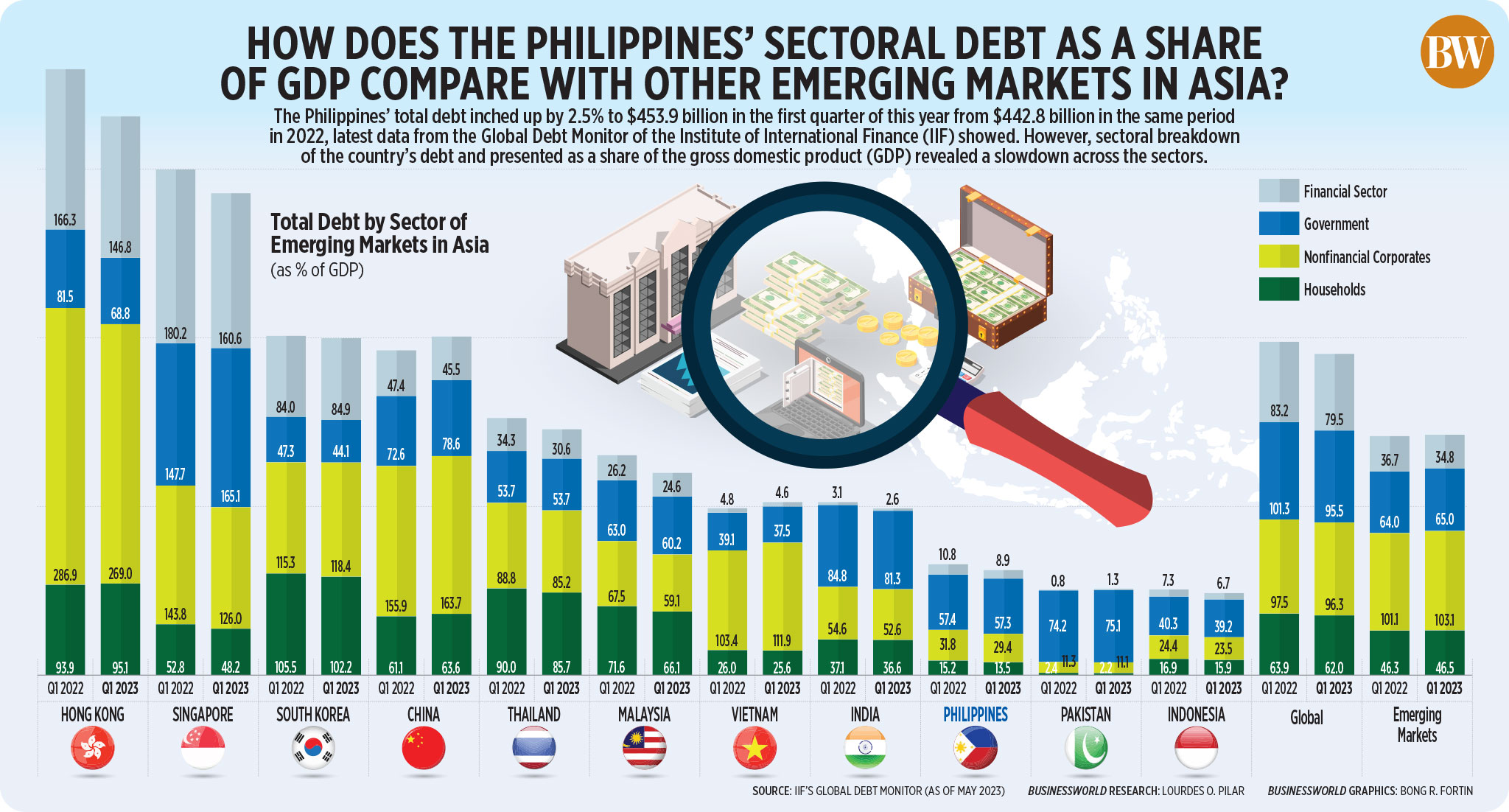
How does the Philippines’ sectoral debt as a share of GDP compare with other emerging markets in Asia?

The Philippines’ total debt inched up by 2.5% to $453.9 billion in the first quarter of this year from $442.8 billion in the same period in 2022, latest data from the Global Debt Monitor of the Institute of International Finance (IIF) showed. However, sectoral breakdown of the country’s debt and presented as a share of the gross domestic product (GDP) revealed a slowdown across the sectors.


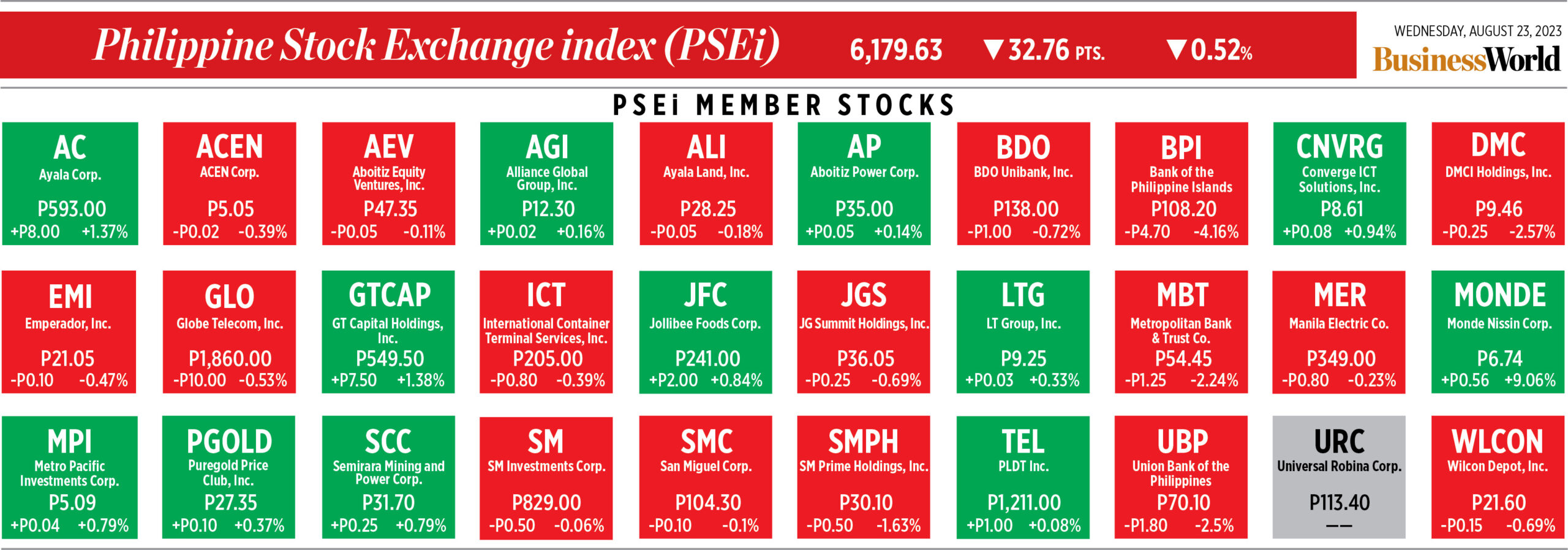
How PSEi member stocks performed — August 23, 2023

Here’s a quick glance at how PSEi stocks fared on Wednesday, August 23, 2023.


Peso declines vs dollar

BW FILE PHOTO

THE PESO declined further against the dollar on Wednesday after S&P Global Ratings downgraded several US lenders.

The local currency closed at P56.73 versus the dollar on Wednesday, weakening by 35 centavos from Tuesday’s P56.38 finish, data from the Bankers Association of the Philippines’ website showed.

The local unit opened Wednesday’s session at P56.32 per dollar. Its intraday best was at P56.30, while its weakest showing was at P56.75 against the greenback.

Dollars traded rose to $1.56 billion on Wednesday from the $1.44 billion on Tuesday.

“The peso weakened from market caution after S&P recently downgraded the credit ratings of various small- and medium-sized banks,” a trader said in an e-mail.

Shares of several US banks fell on Tuesday, the day after ratings agency S&P Global followed Moody’s in cutting its credit ratings on some regional lenders with high commercial real estate (CRE) exposure, Reuters reported.

S&P’s action will make borrowing more costly for a banking sector aiming to recover from a crisis earlier this year, when three regional lenders failed, prompting broader industry turmoil.

S&P on Monday cut ratings on Associated Banc-Corp and Valley National Bancorp on funding risks and higher reliance on brokered deposits.

It also downgraded UMB Financial Corp. and Comerica Bank citing deposit outflows and higher interest rates. The rating agency also cut KeyCorp’s ratings on the back of constrained profitability.

S&P also lowered its outlook for S&T Bank and River City Bank to “negative” from “stable,” citing higher CRE exposure.

The peso weakened ahead of US Federal Reserve Chair Jerome H. Powell’s speech on Friday, Rizal Commercial Banking Corp. Chief Economist Michael L. Ricafort said in a Viber message.

Mr. Powell is scheduled to deliver a speech on the economic outlook at the Kansas City Jackson Hole Economic Policy Symposium this weekend.

For Thursday, the trader said the peso could depreciate further against the dollar due to potentially strong US manufacturing, services and Purchasing Managers’ Index reports overnight.

The trader sees the peso moving between P56.65 and P56.85 per dollar on Thursday, while Mr. Ricafort expects it to range from P56.60 to P56.85. — AMCS with Reuters

PHL shares fall on BSP chief’s hawkish comments

REUTERS

PHILIPPINE STOCKS declined further on Wednesday due to hawkish comments from the Bangko Sentral ng Pilipinas (BSP) chief.

The Philippine Stock Exchange index (PSEi) fell by 32.76 points or 0.52% to 6,179.63 on Wednesday, while the broader all shares index went down by 13.32 points or 0.4% to 3,339.63.

“Shares on the Philippine Stock Exchange held a tight range before dropping at the close as Philippine central bank Governor Eli Remolona doubled down on his hawkish rhetoric as inflation remains a worry, while still gloomy factory readings from Japan left sentiment fragile,” China Bank Capital Corp. Managing Director Juan Paolo E. Colet said in a Viber message.

“While Remolona extended the pause for a third straight meeting in his first rate decision as governor last week, he kept the door ajar for further monetary tightening as higher fuel and rice prices along with a weaker currency threaten to reignite inflation,” Mr. Colet added.

BSP Governor Eli M. Remolona, Jr. on Tuesday said the central bank’s stance remains hawkish and rate cuts are not on its radar as inflation is still elevated.

The Monetary Board last week kept benchmark interest rates steady for a third straight meeting, but said it is prepared to resume tightening if needed amid risks to inflation.

The BSP left its overnight reverse repurchase rate unchanged at a near 16-year high of 6.25%. Interest rates on the overnight deposit and lending facilities were maintained at 5.75% and 6.75%, respectively.

The central bank raised borrowing costs by 425 basis points from May 2022 to March 2023 to tame inflation.

The BSP will hold its next policy meeting on Sept. 21.

“The local bourse extended its decline… as the sentiment was further dragged by the expectation of the Bangko Sentral ng Pilipinas that our country may miss the economic growth target of 6-7% due to the ongoing economic headwinds coupled with the impact of its monetary tightening,” Philstocks Financial, Inc. Research Analyst Claire T. Alviar added in a Viber message.

The central bank said in its August monetary policy report that the Philippines may not be able to hit the government’s economic growth targets for 2023, 2024, and 2025.

Sectoral indices were split on Wednesday. Industrials climbed by 49.77 points or 0.57% to 8,714.78; holding firms went up by 7.87 points or 0.13% to 5,840.53; and mining and oil increased by 39.37 points or 0.4% to 9,849.01.

Meanwhile, financials dropped by 39.81 points or 2.12% to 1,830.66; property declined by 22.80 points or 0.87% to 2,586.12; and services went down by 2.58 points or 0.17% to 1,514.86.

Value turnover dropped P3.62 billion on Wednesday with 347.47 million shares changing hands from the P4.79 billion with 391.66 million shares seen on Tuesday.

Decliners outnumbered advancers, 107 versus 64, while 46 names closed unchanged.

Net foreign selling increased to P508.57 million on Wednesday from the P264.81 million on Tuesday. — S.J. Talavera

Inflation remains risk to PHL’s growth targets, Balisacan says

PHILSTAR FILE PHOTO/PCC FB PAGE

THE GOVERNMENT needs to address elevated inflation to achieve its 6-7% growth target for this year, National Economic and Development Authority (NEDA) Secretary Arsenio M. Balisacan said, noting that domestic demand is being dampened by high prices. 

Mr. Balisacan also expressed support for extending the reduced tariffs for pork, rice, corn, and coal to keep inflation contained.

“Inflation has always been a major concern because when high inflation persists, that discourages or depresses domestic demand,” he said at a Palace briefing.

If the government succeeds in bringing down inflation, “that will be a big boost to our domestic demand and to our growth,” he added.

Gross domestic product rose 4.3% year on year in the three months to June, the weakest reading in over two years, according to the Philippine Statistics Authority. It was weaker than the 6.4% growth posted in the first quarter and the 7.5% from a year earlier.

In his monetary policy report for August, Bangko Sentral ng Pilipinas Governor Eli M. Remolona, Jr. said growth could settle below the 6-7% target in 2023 and below the 6.5-8.0% target for 2024 and 2025 due to economic headwinds as well as the impact of cumulative monetary policy adjustments.

The economic growth target for this year remains achievable, but inflation, which could increase due to rising prices of food and oil, remains a risk, Mr. Balisacan said.

“The downside risk is inflation, especially that oil prices are (rising) again,” he said. “For staples like rice, prices on the global market are also rising.”

The government needs to ensure that it is “in good command of our policy tools,” he added. “For example, looking at enhancing the availability of (commodities) so that we can prevent untoward increases or upward pressure in prices in the near term.”

Inflation slowed for a sixth consecutive month to 4.7% in July, but economists said rising prices of oil and rice and other food items might affect the trajectory of the price index.

The central bank still expects inflation to come in within the 2-4% target range by the fourth quarter.

“And as we have seen, we have made significant progress since January in slowing down inflation,” Mr. Balisacan said, “and we would want to continue moving in that direction.”

The government’s chief economic planner also said improving business conditions and boosting the quality of jobs in the country are also necessary if growth targets are to be met.

“We are keeping watch on agencies and putting pressure on each other to ensure that we are making progress in easing business conditions,” he said. “This we have to address.”

“Remember that our goal, first and foremost, is massive investment to improve the quality of jobs,” he said, “because as an economist looking at the problem, it’s not so much anymore the jobs per se that are the problem, but the quality of the jobs.”

In July, Ibon Foundation Executive Director Sonny Africa said that of the 1.7 million jobs created since President Ferdinand R. Marcos, Jr. took office in June 2022, “1.4 million are part-time jobs.”

Mr. Balisacan said there is a need to extend the executive order that reduced tariffs on key commodities, which is set to expire in December.

He said it is “probably not the right time” to allow tariffs to revert to their former levels.

“We will have to review if the circumstances today still warrant further extending those tariff rates,” he said. “And given the situation now, as we actually see it, the world prices of rice have been rising.”

Mr. Balisacan also cited the impact of typhoons on agriculture, saying, “We have to be careful about reversing the gains.”

“The tariff reductions have been in place for almost two years now, but retail prices have not gone down proportionately,” Federation of Free Farmers National Director Raul Q. Montemayor said in a Viber message.

“It is the traders who benefit with little gain for consumers and large losses for producers.”

Mr. Montemayor also cited billions worth of foregone government revenue in the form of lower tariff collections.

“We are becoming even more dependent on imports for our basic needs,” he said. “The proposal is also a direct contradiction of the assurances given during the hearings on the Regional Comprehensive Economic Partnership (RCEP) that they will not touch the tariffs on sensitive products.”

Meanwhile, Mr. Balisacan said bringing the price of rice down to P20 per kilo — a campaign promise of Mr. Marcos — is impossible without boosting farm productivity.

“What drives low prices are increases in productivity,” he said.

Mr. Balisacan said the government and the private sector need to invest in irrigation, logistics, and other means of enhancing yields in the face of the changing climate. “Unfortunately, those cannot be done overnight,” he added.

“Prices need not be this high as you can see in other countries. Look at Thailand, Indonesia, (and) Vietnam, their prices are much lower than ours because their productivity is high,” he said. “We have neglected agriculture for decades and that’s what we are trying now to reverse.”

Mr. Balisacan said farmers will suffer if the government reduces rice prices to P20 per kilo without a corresponding boost in farm productivity.

“We should be very careful,” he said, noting that the government should look at rice market conditions as comprehensively as possible. — Kyle Aristophere T. Atienza


PEZA sees amendments validating perks won by pre-CREATE locators

By Justine Irish D. Tabile, Reporter

PHILIPPINE Economic Zone Authority (PEZA) Director General Tereso O. Panga said amendments being proposed for the Corporate Recovery and Tax Incentives for Enterprises (CREATE) implementing rules are expected to strengthen the argument for the validity of incentives granted to locators before CREATE came into force.

“There’s not much value to us on the recent amendment introduced by the Fiscal Incentives Review Board because it caters more to domestic-market-oriented companies that are located in the economic zones (ecozones),” Mr. Panga told reporters on the sidelines of the Philippine Die and Mold Machineries & Equipment trade show.

“Nonetheless, we support that. We support it because of that provision on the sunset period (for incentives) so that anything that we have already extended to our locators prior to CREATE should be honored by the government,” he said.

The departments of Finance and Trade and Industry recently approved the amendment of Rule 18 Section 5 of the CREATE implementing rules and regulations (IRR), which concerns value-added tax (VAT) rules for both domestic market enterprises (DMEs) and registered export enterprises (REEs).

Under the amendment, transitory registered DMEs within an ecozone availing of the 5% gross income tax regime may now register as VAT taxpayers.

Meanwhile, transitory REEs with expired income tax-based incentives can continue to enjoy VAT zero-rating on local purchases until the electronic sales reporting system is fully operational or until the expiration of the 10-year transitory period.

“We cater predominantly to export-oriented companies so, right now, their purchases from the local market are entitled to VAT zero-rating already,” he said.

When asked if the agency has submitted a proposal for more amendments, Mr. Panga said that PEZA has submitted its input.

“It is being worked out with the Office of the President,” Mr. Panga added.

The provision PEZA is most interested in is the sunset provision that the pre-CREATE locators signed up for, which “must be kept whole (as per) the registration agreements with PEZA,” Mr. Panga said.

He said that would allow pre-CREATE locators to enjoy incentives already granted to them by virtue of their registration agreements with investment promotions agencies (IPAs).

Mr. Panga added that PEZA is also looking at the possible extension of the sunset period for incentives, which the agency has not submitted a proposal for as yet.

Under Rule 3 of the IRR, export enterprises may be granted four to seven years of income tax holidays (ITH) and a special corporate income tax rate or enhanced deductions for another 10 years.

Meanwhile, a sunset period was also imposed on non-income-related tax incentives of current RBEs for 10 years counting from the effectivity of CREATE. The provision applies to RBEs granted a 5% gross income tax rate. For those RBEs entitled only to an ITH, the sunset period applies when the ITH expires.

Separately, Mr. Panga said in a Facebook post separate customs territory (SCT) status should remain for the ecozones despite the conflicting provisions of the CREATE IRR and Bureau of Internal Revenue’s (BIR) Revenue Memorandum Circular (RMC) No. 24-2022.

“This long-standing rule on SCT placing the ecozones under the IPAs’ supervision and the grant of zero VAT-rating and VAT exemption incentives have been the selling point of PEZA and other freeport authorities in attracting investors to locate in the ecozones,” he said.

“Any attempt to remove these unique incentives and features of the ecozones will surely impact PEZA as an investment promotion agency and the country’s competitiveness as an investment destination,” he added.

SCT treatment grants locators VAT exemptions by virtue of the cross-border doctrine (CBD) and destination principle in taxation.

The provisions of the CREATE IRR and BIR RMC conflict with the treatment of SCT in the CREATE Law, Mr. Panga said.

“Since the SCT provision was retained in the CREATE, the CBD and destination principle in taxation are no doubt valid and enforceable for qualified transactions of ecozone RBEs,” he added.

SCT status for ecozones allows PEZA to exercise exclusive jurisdiction over the ecozones and make them more decentralized, self-reliant and self-sustaining with minimum government intervention.

“The retention in the CREATE of the original PEZA law provision recognizing the ecozones as SCTs is most crucial to PEZA’s attraction and facilitation of investments,” Mr. Panga said.

“As a result, locators get to enjoy additional incentives on top of their income tax holiday and special tax rates such as tax and duty-free importation, zero-VAT rating on local purchases, and VAT exemption on inter-zone sales or constructive exportations,” he said.

Chicken, hog output rise in Q2; farmgate prices decline

PHILSTAR FILE PHOTO

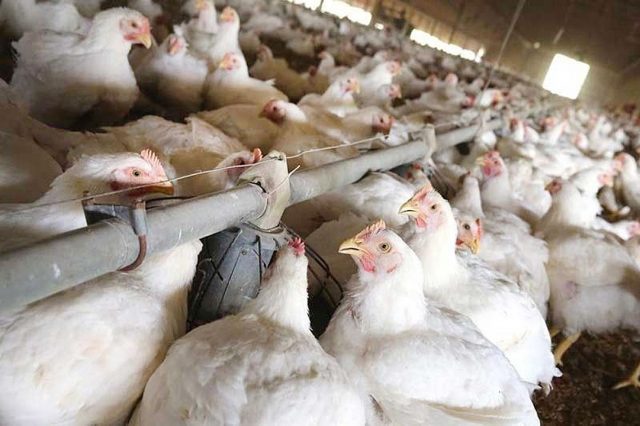
CHICKEN and hog output rose in the second quarter, accompanied by declining farmgate prices, the Philippine Statistics Authority (PSA) said.

Production of chicken during the three-month period rose 3.3% year on year to 477.76 thousand metric tons (MT) on a liveweight basis.

Central Luzon was the top producer at 154.12 thousand MT, followed by Calabarzon (93.90 thousand), Northern Mindanao (39.08 thousand), Western Visayas (32.22 thousand), and Central Visayas (29.67 thousand).

The five regions accounted for 73% of national production for the period.

As of June 30, the PSA estimates the national chicken inventory at 200.21 million birds, up 2.8% from a year earlier.

Of the total broiler chicken inventory, native/improved chicken accounted for 43.3%, followed by broiler chicken with a 34.5% share, and layer chicken with 22.2%, the PSA said.

In the three months to June, the farmgate price of chicken averaged P134.13 per kilogram, down 2.4% from a year earlier.

The PSA also reported a 1% year on year rise in hog production during the quarter to 422.72 thousand MT.

The top producer during the period was Central Visayas with 54.44 thousand MT, followed by Calabarzon (53.84 thousand), Northern Mindanao (50.98 thousand), Central Luzon (42.35 thousand), and Western Visayas (42.03 thousand).

These regions accounted for 57.6% of the country’s total hog production during the period, the PSA said.

As of June 30, the national hog inventory was up 1.4% year on year at 10.07 million head.

About 67.5% of the swine population is grown by smallhold farms, while the remaining 29.2% and 3.2% are grown by commercial and semi-commercial farms, respectively, the PSA said.

The average farmgate price of slaughtered hogs declined 5.1% to P169.73 per kilogram.

Meanwhile, the production of chicken egg and cattle for the April to June period, fell by 2.1% and 1%, respectively.

Chicken egg production dropped to 81.74 thousand MT from 185.58 thousand a year earlier.

Calabarzon remained the top producer of eggs with 59.86 thousand MT during the period, followed by Central Luzon (33.34 thousand), Central Visayas (19.97 thousand), Northern Mindanao (15.94 thousand), and Western Visayas (9.71 thousand), These top producers accounted for 76.4% of the national total.

As of June 20, the layer chicken flock declined 1.4% year on year to 66.96 million birds.

Cattle production edged lower to 60.95 thousand MT from 61.54 thousand a year earlier.

The top five producers of cattle for the period were Northern Mindanao with 9.56 thousand MT, Calabarzon with 8.24 thousand, Bicol with 6.28 thousand, Ilocos with 5.76 thousand, and Central Visayas with 5.76 thousand.

These regions accounted for 57.5% of the national cattle output for the quarter. 

Cattle inventory for the period was 2.58 million head, up from 2.57 million a year earlier.

About 81.4% of the cattle population during the period was grown on smallhold farms, while the remaining 14.9% and 3.7% were held by semi-commercial and commercial farms, respectively. — Adrian H. Halili

eGovPay improvements to be co-developed by LANDBANK, DICT, Treasury bureau

BW FILE PHOTO

LAND BANK of the Philippines (LANDBANK) said it has entered into a partnership with the Department of Information and Communications Technology (DICT) and the Bureau of the Treasury (BTr) to further develop the electronic Government Payment (eGovPay) platform.

LANDBANK will be the depository and financial settlement bank for eGovPay, the bank said in a statement on Wednesday.

The DICT will be the user and application administrator to onboard Payment Service Providers and government institutions planning to enroll in eGovPay.

The BTr will ensure the compliance of LANDBANK and DICT-covered agencies with the Treasury Single Account Framework.

The parties signed a memorandum of agreement on Aug. 15, with National Treasurer Rosalia V. De Leon, Information and Communications Technology Undersecretary David L. Almirol, Jr., and LANDBANK President and Chief Executive Officer Lynette V. Ortiz representing their respective organizations.

eGovPay simplifies payment acceptance for government agencies, enhances the government’s data management and reporting processes, reduces manual operations, and improves the reconciliation process.

President Ferdinand R. Marcos, Jr. is pushing government agencies to digitize public services.

“eGovPay will also support the Adoption of Digital Payments for Government Disbursement and Collections pursuant to Executive Order (EO) No. 170, and Republic Act No. 11032 which promotes the Ease of Doing Business and Efficient Delivery of Government Services,” LANDBANK said. — Aaron Michael C. Sy

DBM releases formula for granting gov’t performance-based bonuses 

BW FILE PHOTO

THE Department of Budget and Management (DBM) said performance-based bonuses (PBB) for government workers will continue to be based in part on user satisfaction with the public services offered by each agency.

“The FY 2023 PBB shall continue to measure and evaluate the agency performance highlighting the public’s satisfaction with the quality of public service delivery, utilization of resources, and reinforced agency stewardship,” the DBM said in a memorandum circular.

The DBM said agencies will be able to self-assess their overall performance in the process of setting the PBB, but will be supplied a scoring system tied to the level of incentives to be earned.

To be eligible for PBBs, each agency will need to meet criteria for performance results, process results, financial results, and citizen/client satisfaction results.

“The agency must also attain a total score of at least 70 points, and achieve at least a rating of 4 for at least three of the four dimensions of accountability based on the PBB scoring system,” it added.

“The FY 2023 PBB will contribute to raising the productivity, performance, transparency, and accountability of government agencies and employees, using the enhanced results-based performance management system and the simplified performance-based incentive system,” the DBM said.

The bonus covers all departments, bureaus, offices, and other agencies of the National Government, including Constitutional Commissions, Other Executive Offices, Congress, the Judiciary, State Universities and Colleges, Government-Owned or -Controlled Corporations, Local Water Districts, and Local Government Units.

Any government agency, which after due process has been determined to have committed an illegal act, will be disqualified from the PBB in the succeeding year of implementation. — Luisa Maria Jacinta C. Jocson 

JICA to provide technical assistance for Customs modernization

THE Japan International Cooperation Agency (JICA) has committed to support the Bureau of Customs’ (BoC) modernization efforts through technical assistance.

“The BoC positively anticipates that the newly designated JICA Customs expert will provide needed timely and strategic technical assistance and capacity-building support to further improve customs processes and good governance,” The BoC said in a statement on Wednesday.

“Through proactive sharing of best practices, JICA can effectively guide the BoC in its pursuit of becoming a credible and modernized customs service.

It said it is looking forward to the re-establishment of a Customs laboratory.

The Customs laboratory aims to help resolve instances of technical smuggling, by providing chemical analyses of shipments seeking to evade tariff classification by being declared as something other than the taxable item.

The National Economic and Development Authority recently blamed the delay in Customs modernization on procurement issues. — Luisa Maria Jacinta C. Jocson

Rice inventory declines 17.5% in May

Workers load sacks of flour in a delivery truck in Manila, July 11, 2022. — PHILIPPINE STAR/ MIGUEL DE GUZMAN

THE inventory of rice declined 17.5% at the start of May, the Philippine Statistics Authority (PSA) said.

In a report, the PSA said that the rice inventory during the period was 1.88 million metric tons (MT), with holdings of households, commercial warehouses and the National Food Authority (NFA) all declining.

Rice held by households, which accounted for 52.8% of the total, fell 19.9% year on year to 993.97 thousand MT; while commercial warehouses held 787.97 thousand MT, 10.6% lower from a year earlier. Commercial stocks accounted for 41.9% of the national inventory.

Stocks held by depositories of the NFA, accounted for 5.3% of overall rice inventory. They fell 37% to 100.12 thousand MT during the period.

In a statement, the Samahang Industriya ng Agrikultura (SINAG), said the NFA needs to use its funding to buy more rice from farmers.

SINAG Chairman Rosendo O. So said that the NFA used its P8.5-billion budget, “it could have procured… 290.8 thousand MT of rice, equivalent to 5.8 million bags,” he said.

The NFA had reported that its rice stocks dropped to the equivalent of 1.56 days’ demand, well below its nine-day target inventory level. The NFA said high prices kept it from buying more.

According to the NFA, daily national consumption is 679,670 bags or 33.93 thousand MT.

Month on month, rice stocks rose 2.1%.

“Increases in the rice inventory were noted in both the commercial sector and NFA depositories at 8.1% and 1.1%, respectively; (while) rice in household decreased by 2.1%,” the PSA said.

Meanwhile, the PSA said the corn inventory decreased to 668.70 thousand MT during the period, down 14.2% from a year earlier.

Corn held by commercial establishments was 584.98 thousand MT, equivalent to 87.5% of the national inventory. Commercial holdings were down 13% year on year.

Corn held by households declined 22% year on year to 83.72 thousand MT. This segment accounted for 12.5% of the national total.

Compared to a month earlier, the national corn inventory rose 34.6%. Household stocks dropped 18.6% from April, while commercial inventory rose 48.5%. — Adrian H. Halili

Well-milled rice prices average P45.56/kg in early July

PHILIPPINE STAR/ MICHAEL VARCAS

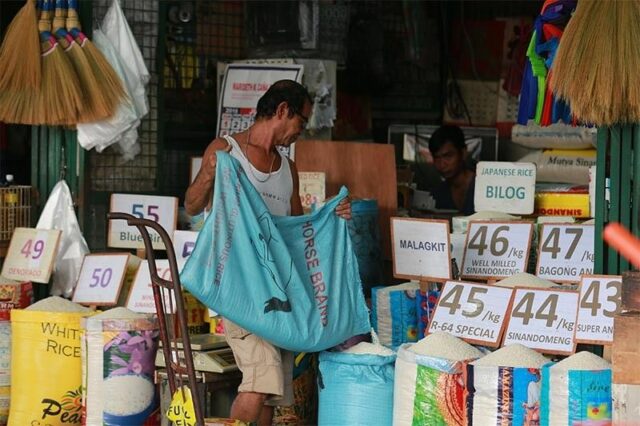
THE national average retail price for well-milled rice in early July was P45.56 per kilogram (kg), the Philippine Statistics Authority (PSA) said.

Prices rose 0.4% for the July 1-5 period, which the PSA refers to as the first phase of July, compared with prices between June 15 and 17, or the second phase of June.

The PSA said the highest retail prices were recorded in Central Visayas P48.25 per kg.

On the low end of the scale was rice from the Ilocos Region, which fetched P41.88 per kg during the period.

The PSA said that the average price for a kilogram of galunggong (round scad) was P197.85 per kg.

The highest average prices were reported in Calabarzon (Cavite, Laguna, Batangas, Rizal, Quezon) at P259.20 per kg. Zamboanga Peninsula returned the lowest price at P129 per kg.

The PSA said that the average price of medium-sized chicken eggs fell 1.4% to P8.44 per piece from P8.56 reported in the second phase of June.

The highest average price was reported in Eastern Visayas at P9.49 and the lowest was in Soccsksargen at P7.27.

The PSA said that the average price of red onion was P206.59 per kg, up 2% from the second phase of June.

The region with the highest-priced red onions was Mimaropa (Mindoro, Marinduque, Romblon, Palawan) with P242.23 per kg; while prices were lowest in the Ilocos Region at P167.5 per kg.

The average prices of carrots and brown sugar rose 24.2% to P131.65 per kg and 0.2% to P83.32 per kg, respectively.

On the other hand, the average price for calamansi, or native lemon, fell 4.9% to P88.13 per kg. — Adrian H. Halili

ADVERTISEMENT
ADVERTISEMENT