Home Blog Page 4416

P150 wage hike to lift pay above ‘poverty’ level

By John Victor D. Ordoñez, Reporter

THE proposed P150 legislated wage hike will raise worker pay beyond their current “poverty” levels and unleash consumer spending power, the Trade Union Congress of the Philippines (TUCP) said.

“Purchasing power continues to erode (due to) rising prices of rice and oil. (It is these prices) that are fueling renewed concerns about inflation — and not (raising) workers’ poverty wages,” Carlos Miguel S. Oñate, legislative officer of the TUCP, told BusinessWorld in an e-mail.

“We push for the P150 wage hike not only to cushion the impact of inflation on working families but to revitalize our consumption-driven economy and drive wage-led growth as a more inclusive and equitable strategy of economic recovery and development,” he added.

Finance Secretary Benjamin E. Diokno and National Economic and Development Authority Secretary Arsenio M. Balisacan have warned that proposals to legislate a P150 wage hike would stoke inflation.

Mr. Balisacan told a Senate hearing this month that the government should focus on improving job quality before implementing another wage hike.

“We understand what the problems are: high cost of energy, poor infrastructure, and high cost of doing business. We’re trying to address those,” he said.

“But, if we address the problem of low incomes now by raising wages, (the economy will slow down).”

The jobless rate in June fell to 4.5% from 6% a year earlier. The unemployment rate averaged 4.6% in the first half.

Legislators are proposing across-the-board minimum wage increases for workers in the private sector and agriculture industry to help them deal with the rising cost of living.

In March, Senate President Juan Miguel F. Zubiri filed a bill seeking to increase the minimum wage for such workers by P150.

At the House of Representatives, the Makabayan coalition proposed a wage hike of P750 for all private-sector workers, including those working in special economic zones, freeports and in agriculture.

BMI Country Risk and Industry Research said in an Aug. 11 report that elevated inflation, high borrowing costs and an uptick in jobless rates are risks to the consumer spending outlook in the near term.

BMI sees consumer spending expanding 5.5% this year, and projected that inflation will likely remain above the Bangko Sentral ng Pilipinas’ 2-4% target range, averaging 5.7% this year.

Headline inflation slowed for a sixth straight month to 4.7% in July from 5.4% in June. It marked the 16th straight month of inflation exceeding the 2-4% target band.

The National Capital Region Tripartite Wages and Productivity Board approved a P40 hike on June 29, bringing the daily minimum wage to P610 for workers outside agriculture.

Wages are typically raised by region, in consideration of the highly localized nature of the cost of living. The proposal to legislate a wage hike would represent an extraordinary bypassing of the wage-setting mechanism.

Michael L. Ricafort,  Rizal Commercial Banking Corp. chief economist, said minimum wage proposals should be coursed through the regional wage-setting system, which he said have tended to produce “acceptable and predictable” increases.

“This (legislated wage increase) would result in higher inflation due to second-round effects of higher prices of other affected goods and services,” he said in a Viber message.

Every wage order approved by a Regional Tripartite Wages and Productivity Board must be approved by the Labor secretary. Wage boards can only act on wage petitions a year after a region’s last wage order.

Labor groups have cited the need to review the wage-setting process since many workers still live in poverty even after the recent P40 wage hike.

Labor Secretary Bienvenido E. Laguesma has said his department will defer Congress should it decide to intervene with a wage hike law.

The Employers Confederation of the Philippines has said a legislated wage hike should also consider workers in less formal employment, noting that private sector workers only make up 16% of the workforce.

“Workers cannot remain the whipping boys with stagnant wages while we take our sweet time in formulating, implementing, and evaluating long-pending reforms,” Mr. Oñate said.


End-July transactions made via InstaPay, PESONet climb further

FREEPIK

TRANSACTIONS made through InstaPay and PESONet continued to grow as of end-July from a year earlier as strong economic activity boosted payments, data from the Bangko Sentral ng Pilipinas (BSP) showed.

The combined value of transactions done through the BSP’s automated clearing houses InstaPay and PESONet rose by 30.7% to P7.02 trillion as of July from P5.37 trillion in the same period last year.

In terms of volume, transactions made via the clearing houses grew by 37% to 477 million as of end-July from 348 million in the comparable year-ago period.

“The sustained strong year-on-year growth in InstaPay and PESONet transactions may reflect increased business and economic activities,” Rizal Commercial Banking Corp. Chief Economist Michael L. Ricafort said.

The accelerated adoption of digital fund transfers as a good alternative to check payments also contributed to the double-digit growth in InstaPay and PESONet transactions, Mr. Ricafort said.

Increasing online transactions and e-commerce also led to greater demand for digital payments, he said.

Broken down, the value of PESONet transactions increased by 25.1% to P4.33 trillion as of end-July from P3.46 trillion a year prior.

The volume of transactions that went through the payment gateway stood at 52.43 million, 9.2% higher than the 47.99 million seen as of July 2022.

Meanwhile, the value of transactions done through InstaPay surged by 40.8% year on year to P2.69 trillion as of July from P1.91 trillion a year prior.

The volume of InstaPay transactions grew by 41.6% to 425.07 million from 300.18 million at end-July 2022.

“Continued double-digit growth for InstaPay and PESONet transactions could still continue for the coming months amid continued recovery of many businesses/industries,” Mr. Ricafort added.

PESONet and InstaPay are automated clearing houses launched under the BSP’s National Retail Payment System (NRPS) that was rolled out in December 2015 to promote a safe, efficient, affordable, inclusive and reliable retail payment system.

Operated by the Philippine Clearing House Corp. (PCHC), PESONet enables high-value transactions and is considered as an electronic alternative to the paper-based check system and recurring payments.

Meanwhile, InstaPay is a real-time, low-value electronic fund transfer facility for transactions up to P50,000 and is handled by BancNet, Inc.

Earlier this month, PCHC and BancNet announced that their proposed merger has been approved by their respective shareholders, with 86.67% of BancNet shares being voted in favor of the merger and 78.57% of PCHC shares being voted in favor of the merger.

“The merger of BancNet and PCHC will create a stronger, more resilient organization that will be better able to provide safe, reliable, and efficient payment services for the benefit of consumers. This will be achieved through the consolidation of their financial technology, talent, and other resources,” BancNet earlier said.

The proposed merger was initiated by the Bankers Association of the Philippines and now awaits approval from the BSP, the Securities and Exchange Commission and the Philippine Competition Commission.

Under its Digital Payments Transformation Roadmap, the BSP wants 50% of total retail transactions done online and to bring 70% of Filipino adults into the financial system by the end of this year.

The share of digital payments in total retail transactions increased to 42.1% in 2022 from 30.3% in 2021.

The BSP’s NRPS promotes the interoperability of the payment system to enable consumers to transfer funds from one account to another, even if the second account is with another financial institution. — K.B. Ta-asan

GCash waives QR fees for micro-merchants until year-end

FINANCIAL super app GCash has waived the QR Ph transaction fees for micro-merchants until end-2023 to help boost the income of small businesses using the scan-to-pay service.

Aside from the waived QR transaction fees, GCash said micro-merchants will also have an increased wallet limit of up to P500,000 per month while the 1.5% transaction fee is waived for up to P100,000 in gross sales

“For GCash, making this service free means micro-entrepreneurs can earn a little extra for their families through safe cashless transactions. We are committed to working with our micro-entrepreneurs to achieve their business goals in the digital economy,” G-Xchange President and Chief Executive Officer Oscar A. Reyes, Jr. said in a statement on Aug. 23. 

G-Xchange is the mobile wallet operator of GCash.

According to GCash, micro-merchants are classified as small-scale businesses such as sari-sari store owners, public market vendors, and online sellers. 

“Making use of our scan-to-pay enables faster tracking of payments received for merchants without imposing any additional cost, even for their customers,” GCash said.

GCash claims that electronic wallets and other payment platforms impose fees of up to 2% for using cashless transaction services such as QR-based and card payments.

“We are one with the Bangko Sentral ng Pilipinas, in its goal of bringing more micro-merchants into the digital economy. Together with our partners, we will equip micro, small, and medium enterprises with the right tools and products so they can grow their businesses safely and conveniently,” Mr. Reyes said. 

As of writing, GCash has empowered 845,000 small-scale community merchants with various digital financial solutions. 

GCash is a wholly owned subsidiary of Mynt or Globe Fintech Innovations, Inc., which is a part of the Globe Telecom, Inc. group. — Revin Mikhael D. Ochave

Netflix signups remain high, fueled by password-sharing crackdown

DAWID ŁABNO-UNSPLASH

SIGNUPS for Netflix in the United States remain elevated despite a fall from June’s record high after the video-streaming pioneer’s crackdown on shared passwords came into effect in May, according to data from research firm Antenna.

“Love is sharing a password,” Netflix had posted on X — then known as Twitter — in 2017, but its global crackdown on password-sharing hinted at its strategy to open new revenue streams in a saturating, competitive market.

Attracting new subscribers and retaining old ones has become a tough task in the last few years as customers now have a surfeit of options — Walt Disney’s streaming service, Amazon.com’s Amazon Prime Video, and Warner Bros Discovery’s Max, among others.

Wall Street had raised concerns that password-sharing could mute subscriber growth. However, Netflix’s crackdown managed to reinvigorate its user additions.

The video-streaming company’s gross subscriber additions fell by 25.7% in July over the prior month, after signups more than doubled in June, Antenna said. But its 2.6 million gross additions in July were overall elevated when compared to the normal, it added.

Netflix had said last year it was going to limit account-sharing and was testing various approaches in some markets.

The company estimated that more than 100 million households had shared their log-in credentials with friends and family outside their homes. This has led analysts to expect that about 50 million users will ultimately create their own accounts.

Around 23% of users who signed up in July chose the cheaper ad-supported Netflix plan — the highest since the plan was launched in November — an increase of four percentage points from a month earlier, Antenna said.

The research firm sources its streaming data from transaction records such as online purchase receipts and banking information. — Reuters

The boringly dull self-centeredness of woke laziness

PVPRODUCTIONS-FREEPIK

“He doesn’t need help. He needs hindrances,” says John Malkovich, playing Valmont in Dangerous Liaisons. Said of someone who needed to try harder, it’s frankly the best remedy for today’s youth whose mantra apparently is “I can’t even.”

It seems like everything stresses them out and gives them anxiety: study, work, interacting with family, Christmas, answering the phone, punctuation. Everything is a mental health issue.

Of course it’s idiotic, but when one has adults — be it media, guidance counselors, HR, parents — irresponsibly giving validation to that idiocy, it just makes it all worse.

Take “bed rotting,” which “involves staying in bed for extended periods — not to sleep, but to do passive activities like eating snacks, watching TV, and scrolling through devices. This trend is most popular with members of Generation Z who may feel burnt out from work, school, family demands, or social engagements.” (“What Is ‘Bed Rotting’? Gen Z’s Newest Self-Care Trend, Explained”; Health.com, July 2023)

Or “depression rooms,” which is a TikTok trend (of course) where young people show off their unmade and dirty rooms because apparently, they’re “sad.”

The problem with all this is that they’re just young kids being lazy, and not only lazy but self-centeredly calling attention to their laziness. And culture being what it is now, anything self-centered is celebrated.

Unfortunately, for those kids, reality always demands a price to be paid: “Bed rotting could start off as self-care to rest but then turn into fewer productive or enjoyable activities, more time on social media, more sleep issues, more social isolation, and lead to more depression,” says Ohio State University’s Dr. Nichole Hollingshead. Furthermore, “spending too much time in bed can disrupt mood, increase stress levels, and interfere with healthy sleep patterns.” It can also “lead to more serious health issues. Patients who consistently sleep longer than eight hours daily may be at increased risk of mortality compared with those who sleep just an hour less each day. Research has also shown an association between long sleep hours and incident diabetes mellitus, cardiovascular disease, stroke, coronary heart disease, and obesity. (“The dangers of ‘bed rotting’: Why spending days in bed is not a healthy way to relax”; MDLinx, July 2023)

As for depression rooms, it’s no surprise that self-centeredly calling attention to it rather than engaging in more positive activities makes it all the worse: Studies suggest that feeling surrounded by chaos can affect mental health. Studies have been consistent in pointing out that cluttered rooms “harms overall well-being” and that “high levels of household disorganization in families led to poor cognitive, behavioral, and communication outcomes among adults and children.” Finally, lower “levels of life satisfaction” (“The Link Between Messy Rooms and Depression”; PsychCentral, May 2022).

Unfortunately, these annoying bits of narcissism haven’t stopped in homes but have gone out to infect even the work environment. Thus, Business Insider (“Top 10 workplace trends on TikTok this year: quiet quitting, bare minimum Mondays, and more”) listed supposed “new” work trends, which are actually just repackaged forms of laziness.

Some nauseating examples: “bare minimum Mondays,” which “refers to taking it easy as you start out the work week,” supposedly to “beat the Sunday scaries, avoid burnout, and establish stronger work-life balance” and include “mornings devoted to self-care and creative work, followed by work condensed into several hours in the afternoon.”

There’s also “acting your wage,” which is “doing your job as written and nothing more — essentially putting in work commensurate with what you’re paid.” And more famously, “quiet quitting,” which involves “dialing it back at work and just doing what’s expected of you — or often, even less.”

Now, if you’re a sane employer who happens to frown on such moronic practices, then prepare to see your workers do “rage applying,” whereby employees fire off “job applications after feeling fed up or overlooked in their current roles” or simply just “underappreciated.”

What’s up with all this? Ross Douthat, a New York Times columnist that writes with “nuance” and “context” (traits which apparently should make liberals have to accept his word), blames the current malaise (or as he calls it, the “culture of narcissism”) on a social media that “entered into a world that was experiencing the triumph of a certain kind of social liberalism, which the new tech subjected to a stress test that it has conspicuously failed” (italics gladly supplied).

Social liberalism here was meant by Douthat as “the more individualistic liberalism that emerged in the 1960s and experienced a second takeoff across the first decade of the 2000s. Its defining features were rapid secularization (the decline of Christian identification accelerated from the 1990s onward) and increasing social and sexual permissiveness — extending beyond support for same-sex marriage to beliefs about premarital sex, divorce, out-of-wedlock childbearing, marijuana use and more” (“The smartphone and the sources of teen despair,” New York Times, Feb. 22, 2023).

We really need ROTC and mandatory military service now.

Anything’s better than this Barbie world.


Jemy Gatdula is a senior fellow of the Philippine Council for Foreign Relations and a Philippine Judicial Academy law lecturer for constitutional philosophy and jurisprudence

https://www.facebook.com/jigatdula/

Twitter  @jemygatdula

Qualities of an excellent training manager

I interviewed a candidate for the job of a training manager. I asked him: “On your first day, what would you consider your number one task?” He said he will review our training calendar and immediately implement the first program on the list. I thought he should have had a better answer. Please advise. — Moon River.

Job interviews are intended to discover the right person for the job. However, it should not be the only basis for selection. Don’t be turned off by one answer. Instead, give him the chance to prove his worth in other things, like answering at least five more questions:

When do you stop employee training?

If a company president doesn’t believe in employee training, then what can you do?

Which is more important — completing a training program perfectly at a high price or imperfectly at zero cost due to budgetary constraints?

What gives you joy when you’re handling a training program?

Aside from training, how do you propose to improve employee performance?

Reviewing a company’s training calendar on the first day of work is not exactly bad. It becomes bad only when it is scrapped without reason, in the absence of a training needs analysis. But then, what’s the correct answer? Aside from onboarding, what should be done by a newly-hired training manager on the first day at work?

My best answer is to meet and greet the training staff after reviewing their 201 folders. Spend some time with the direct reports to understand their situation. After all, you can’t solve a problem without knowing about all the possible resources within your control. Explore and understand all current tasks of the training department.

Find out the importance of training programs in order of priority. Ask their opinion about things pertaining to the department’s objectives. Along the way, ask the five questions that I listed earlier. That way, you’ll get a picture of their challenges and opportunities.

QUALITIES
It’s not enough to limit yourself to asking the most difficult job interview questions. You have to dig deep by defining the desired qualities and characteristics of an excellent training manager and how that person can effectively manage an organization’s employee training and development needs.

This includes all possible skills that are critical for job performance. For this reason, every organization needs an “excellent” training manager who must understand the following:

One, the specific needs of the business. This is often discerned by reconciling the company’s vision, mission and values with the objectives of every training program created and developed by internal stakeholders. This means closely scrutinizing or even rejecting off-the-shelf programs offered by external training providers.

The exception to this is when an organization does not have an internal expert who can develop and deliver such specialized training programs. Another issue is when internal trainers act in a bookish manner, unlike real practitioners, who can help you manage difficult questions by drawing on their experience.

Two, an idea of the difference between process and result. Many times, process orientation must come ahead of results orientation. In lean thinking, if you’re focused on using only the best training process, you’ll come out with the best result, free from waste and defects.

This includes conducting a training needs analysis, recommending the best training solution for poor work performance and measuring the outcome of every training program. This should include finding out how participants implemented the key learnings in their jobs.

Three, the need to go beyond classroom training. Today, almost all training programs can be done online. Many of them are free. They’re also convenient to users who can take them at their own pace, even outside of office hours. There are also many training interventions to help improve employee performance.

They include job cross-postings, immersion programs, special projects, case studies, coaching by internal experts or mentoring by outsiders or volunteers like retired professionals in the same field. In my case, I’ve been a beneficiary of many short-term Japan-sponsored management programs that are free of charge.

Last, the importance of leading by example. An excellent training manager walks the talk. A manager who conducts a leadership program and is revered for leading talent to greater heights would be highly desirable. One of the non-negotiables in a training manager is skill in both oral and written communication, which can be harnessed to persuade the reluctant.

This typically means having flair in delivering presentations, though there is no substitute for knowing the subject matter by heart, to the point where the bulk of the presentation will involve the training manager expounding at length on slides that could contain only two or three words.

As job responsibilities change, the job of a training manager must be redesigned or reengineered so the incumbent can go beyond the confines of employee development and treat it as the continuing process of avoiding obsolescence.


Bring Rey Elbo’s leadership program called “Superior Subordinate Supervision” to your management team. Or chat your workplace questions with him on Facebook, LinkedIn, X (Twitter) or e-mail elbonomics@gmail.com

The adequacy of proportional regulation

The concept of proportionality in legal systems stems from the need to limit public intervention in the form of rules, sanctions, and oversight to what is needed to achieve the desired policy objectives. For banking, the principle of proportionality means that regulatory requirements must consider not just the size and scale of a bank’s operations, but also an institution’s complexity and risk profile. 

Financial sector policy objectives include financial stability, market integrity and consumer protection.  Proportionality aims at avoiding policies that could distort the financial services market by unduly constraining its development, curbing competition, or limiting the diversity of market participants.  A uniform system may lead to unjustifiable resource burden not just on banks but on the regulators themselves.

A proportionate approach aims to avoid excessive compliance costs or regulatory burden for smaller and non-complex banks that could unduly dampen their competitive positions without a clear prudential justification (Lautenschlager (2017)).

The Bangko Sentral ng Pilipinas (BSP) reported to the World Bank how proportionality is being applied in its supervisory work commensurate with the financial institution’s risk profile and systemic importance.  Simple standards are being applied without compromising regulatory objectives.

The BSP segments banks according to business model and risk profile as either simple or complex.  Universal and commercial banks (U/KBs) are automatically classified as complex.  Thrift banks (TBs) as well as rural and cooperative banks (RCBs) can be considered complex if at least three of the following characteristics exist:  (a) total assets of at least P6 billion, (b) extensive branch network, (c)  non-traditional financial products and services, (d) use of non-conventional business model and (e) with a  business strategy  characterized by aggressive risk appetite and increasing risk exposure.

Corporate governance is calibrated in terms of board of directors composition The management structure of key risk areas such as internal audit, compliance risk, risk governance, operational risk, security risk and business continuity is flexible. Concurrency for certain positions is allowed in simple banks, provided that a designated officer is qualified, and the Board of Directors is more active in these areas.  The risk management guidelines are appropriately modified on the key risk areas:  credit risk, liquidity risk, operational risk, information technology and stress testing.

The BSP has adopted a segmented Basel regulatory framework and differentiated liquidity metrics to support proportionality in banking regulations.  These moves are meant to: promote continuing soundness and stability of the banking system; ensure convergence of regulatory and business objective; allocate supervisory resources efficiently; and lead to broad-based inclusive growth and innovation.

The conceptual framework for proportionality provides clear justification to how our BSP has proceeded for which it deserves applause.  Similarly, however, given the characteristics of the Philippine banking industry, is the simple dichotomy between simple and complex sufficient? 

The Philippine banking sector is dominated by several large domestic banks.  Forty-six U/KBs hold over 94% of bank assets, of which 60% are held by the top five banks (all domestic).  Foreign bank subsidiaries and branches hold seven percent of bank assets.  There are about 500 small TBs and RCBs.

In a paper by the Financial Stability Institute, it noted the need to achieve a common understanding of the pros and cons of the varied proportionality approaches that have been adopted by different jurisdictions. “Against this background, considerations could be given to adopting a categorization (or tiering) approach where banks are grouped into several classes (defined by various criteria); and these categories are used as basis for differentiating requirements.”

To be fair, the tiering challenge will deserve further study especially given the diversity of banking sizes at the smaller category — RBs from as low as P50 million capitalization to P200 million and TB’s from P500 million to P2 billion.  The lower capitalization is quite far from the P6 billion threshold set for complex banks. The concept of proportionality must be well communicated to the assigned banking examiners.

The proportionality debate is not complete without recognizing the social role that small institutions play in facilitating access to credit and financial services by households and small firms, especially in a country with still so many unbanked areas. Excessive burdensome regulation for small banks may damage their competitiveness and undermines the level playing field.

In its 2022 Country Report, the IMF reported that access to finance in the Philippines is significantly lower than comparator systems, with only a third of adults having formal accounts. Digital payments are used much less.  Informal financing among family members is more significant to households than retail banks loans. There are barriers to establishing IT and communication infrastructure for the archipelago of over 7,000 islands.

In devising the proportionality concept, the balance between keeping the regulatory burden to a minimum and ensuring compliance with prudential standards is a delicate one. But in this writer’s view, the bigger banks have a natural aversion to MSME clients and the marginalization of empowered smaller banks catering to the small business category can have negative consequences.  Smaller community banks in a brick and mortar setting still play a critical role and hopefully will be subjected to resource-friendly and cost-efficient regulatory standards.


Benel D. Lagua was previously EVP and chief development officer at the Development Bank of the Philippines.  He is an active FINEX member and an advocate of risk-based lending for SMEs. Today, he is independent director in progressive banks and in some NGOs.

Globe cited anew in global index series for ESG practices across its operations

GLOBE TELECOM, Inc. has been included for the eighth-straight year in the global FTSE4Good Index Series for its efforts to implement environmental, social, and governance (ESG) practices across its operations.

In a statement on Wednesday, the telecommunications firm said that businesses included in the index meet various ESG criteria and are evaluated based on their performance in areas such as corporate governance, health and safety, anti-corruption, and climate change. 

The FTSE4Good Index Series, created by global index and data provider FTSE Russell, is used by a wide variety of market participants to create and assess responsible investment funds and other products. 

“Globe’s inclusion in the FTSE4Good Index Series for the eighth consecutive year is more than a recognition, it’s a testament to our enduring commitment to sustainability,” said Globe’s Chief Sustainability and Corporate Communications Officer Maria Yolanda C. Crisanto.

According to Globe, it has taken a stronger position on human rights, diversity, equity, inclusion, and sustainable supply chain this year with its policies.

The company’s human rights policy commitment reinforced its code of conduct to ensure that employees and its stakeholders are treated with dignity and respect. 

“In support of the United Nations General Assembly’s Resolution that access to a clean, healthy, and sustainable environment is a universal human right, this policy commitment reasserts its aim to reach net zero GHG (greenhouse gas) emissions by 2050, take the lead in circularity, among others. The policy also encompasses freedom of expression, digital inclusion, privacy, and children’s rights,” Globe said.

Globe added that its diversity, equity, and inclusion commitment guarantees an embracing workplace. It also continues the commitment to provide equal opportunities and foster a collaborative environment.

“This policy commitment extends to customers, focusing on respect, dignity, and making products and services accessible to a diverse customer base,” it said. 

Meanwhile, Globe said that its updated supplier code of ethics expects suppliers to meet global standards such as the UN Global Compact and Universal Declaration of Human Rights, while the company’s Sustainable Supply Chain Policy commitment focuses on evaluating their sustainability practices before contract awarding as part of its due diligence on suppliers. 

“Aligning our business goals with ESG practices is not just good for the planet but also essential for our future growth. Globe is more determined than ever to continue on this journey, knowing that our actions today shape the world of tomorrow,” Ms. Crisanto said. — Revin Mikhael D. Ochave

Microsoft, Activision to sell streaming rights to secure biggest video gaming deal

LONDON — Call of Duty maker Activision Blizzard will sell its streaming rights to Ubisoft Entertainment in a fresh attempt to win approval from Britain’s anti-trust regulator for its $69 billion sale to Microsoft.

Microsoft announced the biggest gaming deal in history in early 2022, but the acquisition was blocked by Britain’s competition regulator, which was concerned the US computing giant would gain too much control of the nascent cloud gaming market.

After months of back and forth, the Competition and Markets Authority (CMA) said on Tuesday it had stuck to its original decision to veto the deal, forcing Microsoft to come forward with new terms.

Under the restructured deal, Microsoft will not be able to release Activision games like Overwatch and Diablo exclusively on its own cloud streaming service — Xbox Cloud Gaming — or to exclusively control the licensing terms for rival services.

Instead, French gaming rival Ubisoft will acquire the cloud streaming rights for Activision’s existing PC and console games, and any new games released by Activision in the next 15 years.

That will apply globally but not in Europe, where Brussels had already accepted the original deal. In Europe, Ubisoft will get a non-exclusive license for Activision’s rights to enable it to offer those games in that region too.

Microsoft would need to license the rights to Activision’s games from Ubisoft for its own Xbox cloud platform outside the European Economic Area, the CMA said.

European Union (EU) antitrust regulators are examining whether Microsoft’s proposal to gain UK approval would affect its concessions to the European Commission, a spokesperson said.

Tom Smith, a partner at law firm Geradin Partners and previously legal director at the CMA, said it now looked like the deal would go through. “The process has been torturous, and there’s still possibly scope for the wheels to come off, but we shouldn’t expect Big Tech deals to sail through nowadays,” he told Reuters.

Microsoft said on Tuesday it believed its new proposal was “substantially different” and it expected it to be reviewed by the CMA by Oct. 18.

The CMA said it would examine the new deal under its usual system, with a Phase 1 process ending on Oct. 18. If it still has concerns about the impact on competition, the CMA could open a much longer Phase 2 examination.

The two American companies have already extended the deal deadline — pushing it back by three months to Oct. 18 — after the regulatory process took longer than expected.

Alex Haffner, competition partner at UK law firm Fladgate, said he did not believe Microsoft would have taken this new step if it did not believe it would be able to get the new deal past the British regulator by Oct. 18.

EFFECTIVE COMPETITION
CMA Chief Executive Sarah Cardell said the UK regulator would now look closely at the new deal, including seeking the thoughts of third parties.

“Our goal has not changed — any future decision on this new deal will ensure that the growing cloud gaming market continues to benefit from open and effective competition driving innovation and choice,” she said in a statement.

The CMA will argue that the major concession by Microsoft shows the success of its tough approach to tech deals since it became a standalone regulator following Britain’s departure from the European Union.

Competition lawyers have argued, however, that the divergence with Brussels and the back-and-forth over the deal have introduced huge uncertainty to the regulatory landscape.

The Federal Trade Commission in the United States also opposed the deal, but it has failed in its bids to block it. The European Union, however, waved it through after accepting Microsoft’s commitments to license Activision’s games to other platforms.

The CMA first said it would block the deal in April and was preparing to go to court to defend its case.

However, it took the rare step of reopening its investigation in July after Microsoft said commitments accepted by the European Union and a new agreement with Sony constituted a material change.

The CMA said on Tuesday that, having reviewed those changes, it still did not accept them and would block the original deal, forcing the US giant to come back with its new terms.

Microsoft said Ubisoft would acquire the rights through a one-off payment and a market-based wholesale pricing mechanism, including an option that supports pricing based on usage. — Reuters

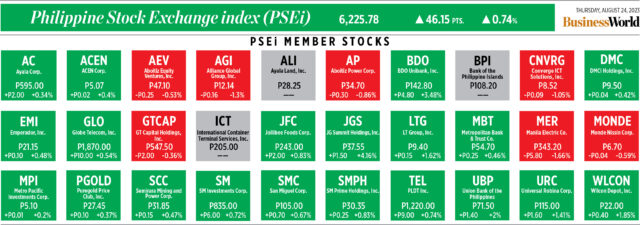
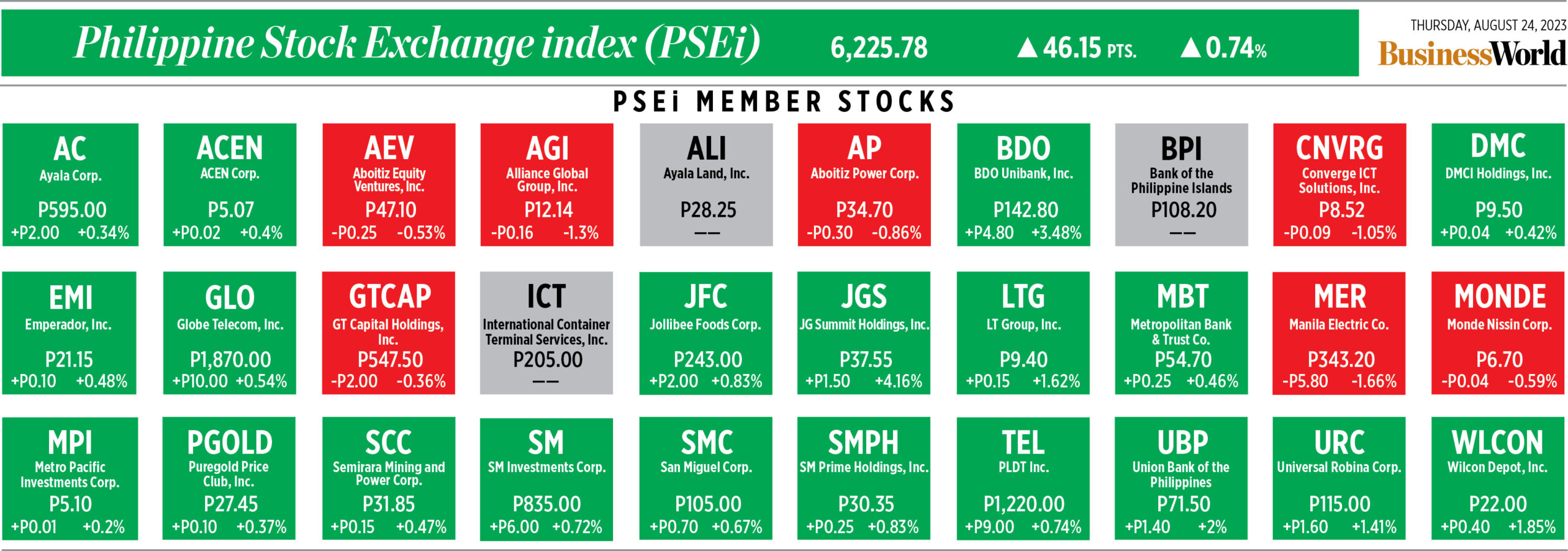
How PSEi member stocks performed — August 24, 2023

Here’s a quick glance at how PSEi stocks fared on Thursday, August 24, 2023.


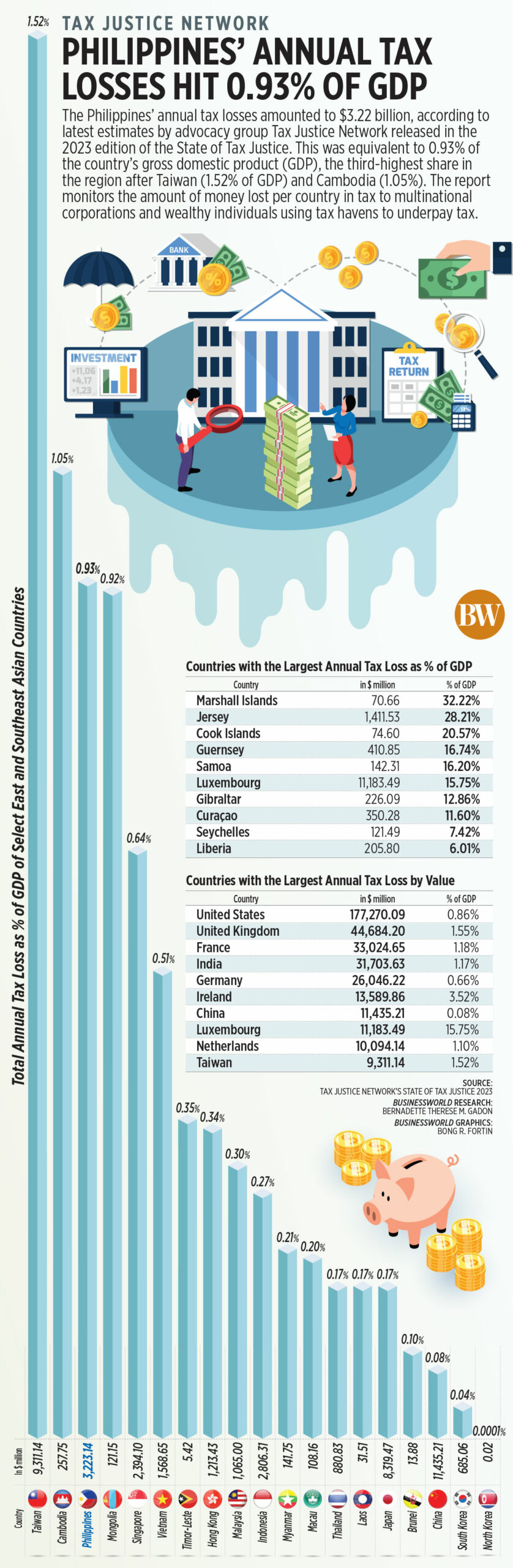
Tax Justice Network: Philippines’ annual tax losses hit 0.93% of GDP

The Philippines’ annual tax losses amounted to $3.22 billion, according to latest estimates by advocacy group Tax Justice Network released in the 2023 edition of the State of Tax Justice. This was equivalent to 0.93% of the country’s gross domestic product (GDP), the third-highest share in the region after Taiwan (1.52% of GDP) and Cambodia (1.05%). The report monitors the amount of money lost per country in tax to multinational corporations and wealthy individuals using tax havens to underpay tax.

PSEi tracks rise on Wall Street, Asian bourses

PHILIPPINE STOCKS rebounded on Thursday to track the increase on Wall Street and in Asian shares amid improving market sentiment globally.

The Philippine Stock Exchange index (PSEi) rose by 46.15 points or 0.74% to close at 6,225.78 on Thursday, while the broader all shares index climbed by 17.94 points or 0.53% to end at 3,357.57.

“After four straight sessions in negative territory, the market finally traded higher to close above 6,200. The index tracked the positive performance of US and Asian markets, with sentiment lifted by easing US Treasury yields and indications of softening US private sector business activity,” China Bank Capital Corp. Managing Director Juan Paolo E. Colet said in a Viber message.

Asian shares rallied on Thursday after blockbuster results from tech darling Nvidia boosted Wall Street and a retreat in US bond yields eased pressure on borrowing costs globally, Reuters reported.

A round of soft manufacturing surveys had also revived hopes central banks were done tightening, though that might change depending on what clues about interest rates US Federal Reserve Chairman Jerome H. Powell gives at an annual central bank summit in Jackson Hole, Wyoming, on Friday.

MSCI’s broadest index of Asia-Pacific shares outside Japan was up 1.7%, also lifted by Nvidia’s bullish outlook.

On Wednesday, US stocks ended sharply higher across the board as shares of Nvidia jumped nearly 10% in trading after the bell, hitting an all-time high after it forecast third-quarter revenue well above Wall Street targets.

On Wall Street, the Dow Jones Industrial Average rose 0.54%, the S&P 500 gained 1.1% and the Nasdaq Composite added 1.59%.

In US Treasuries, the yield on benchmark 10-year Treasury notes reached 4.2076% compared with its US close of 4.198% on Wednesday when it eased from near 16-year highs after weak business activity data from the United States and the euro zone.

Local stocks rose following a decline in global oil prices, Rizal Commercial Banking Corp. Chief Economist Michael L. Ricafort added in a Viber message.

US crude dipped 0.06% to $78.84 a barrel. Brent crude fell to $83.2 per barrel.

All sectoral indices rose on Thursday. Financials climbed by 27.79 points or 1.51% to 1,858.45; mining and oil went up by 84.37 points or 0.85% to 9,933.38; holding firms increased by 43.10 points or 0.73% to 5,883.63; property rose by 12.37 points or 0.47% to 2,598.49; services added 4.49 points or 0.29% to end at 1,519.35; and industrials inched up by 9.34 points or 0.1% to 8,724.12.

Value turnover dropped to P3.31 billion on Thursday with 415.26 million shares changing hands from the P3.62 billion with 347.47 million issues seen on Wednesday.

Advancers outnumbered decliners, 102 versus 60, while 47 names closed unchanged.

Net foreign selling went down to P263.91 million on Thursday from P508.57 million on Wednesday.SJT with Reuters

ADVERTISEMENT
ADVERTISEMENT