Home Blog Page 44

Israeli strikes pummel Lebanon, killing 250 in deadliest day of war
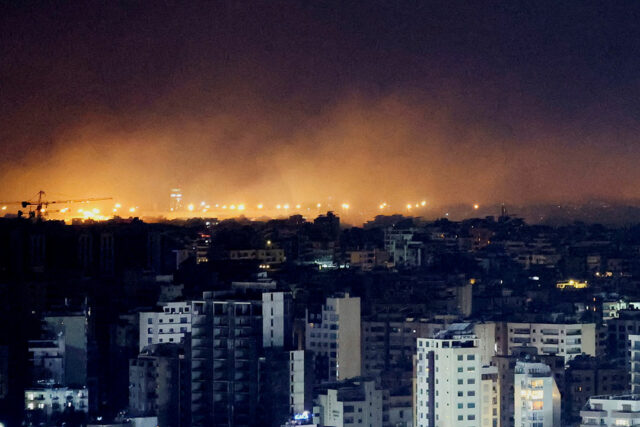
SMOKE rises over Beirut’s southern suburbs after a strike, amid ongoing hostilities between Hezbollah and Israeli forces, as seen from Sin El Fil, Lebanon, Oct. 1, 2024. — REUTERS

BEIRUT/TEL AVIV — Israel carried out its heaviest strikes on Lebanon since the conflict with Hezbollah broke out last month, killing more than 250 people on Wednesday, as the Iran-aligned group resumed rocket attacks on northern Israel after a brief pause under the two-week US-Iran ceasefire.

The strikes raised questions about regional truce efforts, with Iranian President Masoud Pezeshkian saying a ceasefire in Lebanon was an essential condition of his country’s agreement with the US.

On Wednesday afternoon, at least five consecutive strikes rocked the capital Beirut, sending columns of smoke into the sky as Israel’s military said it had launched the largest coordinated strike of the war. More than 100 Hezbollah command centers and military sites were targeted in Beirut, the Bekaa Valley and southern Lebanon within ten minutes, it said.

A total of 254 people were killed and over 1,100 wounded across Lebanon, the country’s civil defense service said. The highest toll was in Beirut, where 91 people were killed. The health ministry gave a toll of 182 dead across the country and said it was not a final figure.

Hezbollah said early on Thursday it fired rockets at the small kibbutz of Manara, citing what it described as Israel’s ceasefire violations.

“This response will continue until the Israeli-American aggression against our country and our people ceases,” the group said in a statement.

It was the deadliest day of the war that erupted on March 2, when Hezbollah fired into Israel in support of Tehran after the US-Israeli attack on Iran two days earlier. Israel launched a fully fledged air and ground campaign in response.

Reuters reporters saw civil defense workers guiding an older woman onto a crane to evacuate her from a building in a western part of Beirut. Half of the building had been sheared off in an Israeli strike, leaving residents on the upper floors trapped.

Earlier, Reuters reporters saw people on motorcycles picking up the wounded and transporting them to hospitals because there were not enough ambulances to get to them in time. One of Beirut’s biggest medical facilities said it needed donations of all blood types.

“The scale of the killing and destruction in Lebanon today is nothing short of horrific,” said UN Human Rights Chief Volker Tьrk. “Such carnage, within hours of agreeing to a ceasefire with Iran, defies belief.”

Late on Wednesday evening, a strike hit Beirut’s southern suburbs, according to a Reuters live broadcast.

ISRAEL, US SAY LEBANON NOT INCLUDED IN TRUCE
In a televised address on Wednesday evening, Israeli Prime Minister Benjamin Netanyahu said Lebanon was not part of the ceasefire with Iran and the Israeli military was continuing to strike Hezbollah with force.

White House press secretary Karoline Leavitt and Vice President JD Vance also said on Wednesday that Lebanon was not included in the truce.

“I think this comes from a legitimate misunderstanding. I think the Iranians thought that the ceasefire included Lebanon, and it just didn’t,” Mr. Vance told reporters in Budapest.

Earlier, Pakistani Prime Minister Shehbaz Sharif, a key intermediary in the US-Iran ceasefire talks, had said the truce would include Lebanon.

In a statement, Hezbollah condemned what it called Israel’s “barbaric aggression” and said the attacks underscored its right to respond.

Hezbollah had stopped attacking Israeli targets early on Wednesday, three Lebanese sources close to the group told Reuters.

“Hezbollah was informed that it is part of the ceasefire – so we abided by it, but Israel as usual has violated it and committed massacres all across Lebanon,” senior Hezbollah lawmaker Ibrahim al-Moussawi told Reuters.

Another Hezbollah lawmaker, Hassan Fadlallah, told Reuters there would be “repercussions for the entire agreement” if Israel’s attacks continued.

Iran’s Revolutionary Guards warned the US and Israel it would deliver a “regret-inducing response” if attacks on Lebanon did not stop.

Lebanese President Joseph Aoun condemned Wednesday’s strikes and said French President Emmanuel Macron had told him he was ready to make a diplomatic push for Lebanon to be included in any ceasefire.

A senior Lebanese official had earlier told Reuters that Lebanon had not taken part in correspondence leading up to the ceasefire.

‘I’M LIVING A NIGHTMARE’
Most of Wednesday’s strikes were in civilian-populated areas, Israel’s military said. Hours before the attacks, the military had issued warnings for some areas of southern Beirut and southern Lebanon. No such warning was given for central Beirut, which was also hit.

Following the strikes, Israeli military spokesperson Avichay Adraee said on X that Hezbollah had moved out of its traditional Shi’ite stronghold in southern Beirut’s Dahiyeh neighborhood to religiously mixed areas elsewhere.

He said Israel’s military would pursue Hezbollah wherever it was.

The Israeli military said it attacked a Hezbollah commander in Beirut, without providing further details.

In a western neighborhood of Beirut that was hit by a strike, Naim Chebbo, 51, swept up shards of glass that had been blown out of the window frames by the force of the blast.

“Tonight I’m not going to sleep because I’m going to be afraid that it’s happening again. I’m living a nightmare,” he told Reuters.

‘LEBANON CAN’T TAKE IT ANYMORE’
Israel also struck the last remaining bridge linking southern Lebanon to the rest of the country on Wednesday, a senior Lebanese security source said. The bridge ran over the Litani River, which runs about 30 kilometers (20 miles) north of the border with Israel.

An Israeli military spokesperson said the area south of the Litani was “disconnected from Lebanon.”

Israel has said it intends to occupy the area as a “buffer zone.” It has struck hospitals and power stations there, and thousands of Lebanese civilians still living there say they have been struggling with a shortage of food and medicine.

Israel has issued evacuation orders covering around 15% of Lebanese territory, mostly in the south and in suburbs south of Beirut. More than 1.2 million people have been displaced.

Many had hoped a ceasefire could allow them to return. Outside a school sheltering displaced people in the southern Lebanese city of Sidon, people had piled their pillows and blankets onto cars, thinking they could return home.

Before Wednesday’s attacks, more than 1,500 had been killed in Israel’s air and ground campaign across Lebanon, including more than 130 children.

“Hopefully a ceasefire will be reached,” said Ahmed Harm, a 54-year-old man displaced from Beirut’s southern suburbs. “Lebanon can’t take it anymore.” — Reuters

NASA Artemis II astronauts to speak from deep space after record-setting flyby

Artemis II Pilot Victor Glover, Commander Reid Wiseman, and Mission Specialist Jeremy Hansen prepare for their journey around the far side of the Moon by configuring their camera equipment shortly before beginning their lunar flyby observations. — NASA

HOUSTON — Four astronauts traveling back from the far side of the moon on NASA’s Artemis II mission will speak with reporters in their first press conference from space on Wednesday.

The Artemis II crew, flying in their Orion capsule since launching from Florida last week, reached the moon earlier this week while cruising along a path that took them past the shadowed, lunar far side and then on to become the farthest-flying humans in history.

“Orion systems are operating nominally, remain healthy, and we are just trekking our way home from the moon,” Orion deputy program manager Debbie Korth told reporters on Wednesday.

NASA astronauts Reid Wiseman, Victor Glover and Christina Koch and Canadian astronaut Jeremy Hansen are the first wave of astronauts in a multibillion-dollar series of missions under the Artemis program that aims to return humans to the moon’s surface by 2028 before China, and establish a long-term US presence over the next decade, building a moon base for potential future missions to Mars.

Back on Earth, dozens of lunar scientists have been packed in rooms adjacent to NASA’s Mission Control Center in Houston this week, scribbling down notes and debating a steady stream of both real-time and recorded audio from the Artemis II astronaut crew in their Orion spacecraft.

The crew is due to return to Earth on Friday around 8 p.m. ET (0000 GMT Saturday), splashing down off the coast of San Diego, California to cap their nearly 10-day mission. They will reach peak speeds of up to 38,365 kilometers per hour (23,839 mph)  as they plunge into Earth’s atmosphere.

The four astronauts on Monday had reached a record-breaking distance from Earth of roughly 405,554 kilometers (252,000 miles), surpassing by some 6437 kilometers (4,000 miles) the previous record held by the Apollo 13 crew for 56 years.

The astronauts broke that record amid a six-hour lunar flyby in which they surveyed the lunar surface from roughly 6437 kilometers (4,000 miles) above.

Advances in lunar science have typically relied on lunar-orbiting satellites and Earth-based observations. But the crew’s six-hour lunar flyby provided a real-time stream of scientific collections from human eyes, allowing rare back-and-forth discussions between teams on the ground and their fellow scientists over 405,554 kilometers (252,000 miles) away in deep space.

Scientists see NASA’s Artemis II mission as an important early step in unlocking mysteries about the solar system’s formation. The moon, Artemis II mission specialist Ms. Koch said before launching to space last week, is a “witness plate” to the formation of our solar system. — Reuters

Filipinos split on anti-political dynasty push, says WR Numero

AN ICE CREAM VENDOR passes by a wall covered in campaign posters in Quezon City. — PHILIPPINE STAR/MIGUEL DE GUZMAN

Filipinos are split over proposed measures banning political dynasties currently moving through Congress, according to a recent WR Numero survey. A political expert said the result may reflect the public’s general distrust of lawmakers in passing measures genuinely aimed at curbing dynasties.

The survey, released on Tuesday, found that 44% of respondents objected to the push for an anti-dynasty bill, with 6.1% strongly disagreeing and 37.9% disagreeing.

In contrast, 38% of respondents expressed support for the proposed measures, with 5.6% strongly agreeing and 32.1% agreeing. The remaining respondents said they were unsure (15%), and 3% said they had never heard about the issue.

Both the Senate and the House of Representatives have active versions of the long‑awaited Anti-Political Dynasty Bill, aimed at defining and regulating the proliferation of political dynasties in the country—a mandate long envisioned by the 1987 Constitution.

The Senate version features broader provisions that seek to bar overlapping terms in national and local offices and prohibit relatives from occupying positions across party-list groups and elective posts.

It also prevents immediate succession by disallowing a spouse or family member from taking over immediately after an incumbent’s term.

Meanwhile, the House advanced its own version, House Bill No. 6771, principally authored by House Speaker Faustino “Bojie” G. Dy III and Majority Leader Ferdinand Alexander “Sandro” A. Marcos III. The measure bans political dynasties within the second degree of consanguinity or affinity.

The house version faced backlash from other lawmakers and advocates because the bill still allows relatives to succeed one another, rotate offices, or hold positions in different localities.

A staunch critic of the House’s version, Caloocan City 2nd District Representative Edgar ‘Egay’ R. Erice, said in various statements that it may actually legalize political dynasties instead.

The conflicting views about the passage of an anti-political dynasty law, reflected in the survey, may explain the public’s general distrust of lawmakers, Michael Henry Ll. Yusingco, a senior research fellow at the Ateneo de Manila University Policy Center, said.

“People see lawmakers only working for their own personal agenda. People can’t trust lawmakers to work for the public interest,” Mr. Yusingco said via Messenger.

“Hence, some might not be convinced about the genuineness of the push for the enactment of the anti-dynasty law. It’s possible they’d rather see the indictment and conviction of those involved in the flood control corruption scheme first,” he added.

Mr. Yusingco also described the House bill as a “farce,” noting it still allows multiple members of a family to run for different offices.

“Which means it still allows multiple members of a family to hold different elected offices—the very definition of a fat political dynasty that the Constitution mandates to be prohibited,” he said.

The anti-political dynasty bill has long been pushed in previous Congresses but has repeatedly failed due to lack of support from a legislature dominated by political families.

According to a report by the Philippine Center for Investigative Journalism, eight out of 10 lawmakers belong to political dynasties.

The WR Numero survey also asked respondents to choose among pre-determined reasons why political dynasties should not be limited.

The highest proportion, 46%, said combating corruption should be prioritized first.

Not far behind, 43% said voters have the right to choose candidates even if they are from the same family.

Meanwhile, 24% said the proven leadership experience of a family is significant, and 20% said political dynasties are already part of the country’s political culture and tradition.

Fourteen percent said government improvement is not guaranteed even if the measure is enacted, and 9% were unsure.

Regarding reasons to limit political dynasties, 43% of respondents said it prevents monopolies of power by families, and 38% said it makes electoral competition fairer.

Also, 35% percent said it would lessen corruption in government, while 27% said it would allow more options for new leaders.

Fifteen percent said leaders outside political dynasties would have a chance, 14% said it would fulfill the constitutional provision on limiting political dynasties, and 6% were uncertain.

The survey also asked respondents about the degree to which political dynasties should be limited. The largest group (31%) said it should be prohibited for parents, spouses, and children.

Twenty percent said it should extend to cousins, and another 20% were unsure. Fifteen percent wanted it banned up to great-grandparents, uncles or aunts, and nephews or nieces.

Fourteen percent said it should include siblings, grandparents, grandchildren, in-laws, and parents-in-law.

VP DUTERTE REMAINS TOP BET FOR 2028 ELECTIONS
The WR Numero survey also asked respondents about voter preference for the 2028 election. Philippine Vice President Sara Duterte-Carpio remains the top choice of Filipino voters, while the vice presidential race is a tightly contested battle among three candidates.

The survey showed that more than one-third of Filipino voters, or 35.9%, said they would vote for the VP in the election two years from now, marking a slight increase of three percentage points from November 2025.

WR Numero said that Ms. Duterte, the first to declare her candidacy for president in February, continues to lead the 2028 contenders but has yet to see a post-announcement surge.

Although the firm said declarations of candidacy typically do not trigger a breakout surge.

Mr. Yusingco said the vice president remains the front-runner for several reasons. Her surname carries the legacy of her father, one of the country’s most popular presidents.

Her current position as vice president also gives the impression that she is ready to assume the presidency, or there may simply be no strong competition at present.

However, he noted that Ms. Duterte’s support has remained largely unchanged since her announcement

“This is significant because it means she hasn’t gained others to her side. Her base is solid, but it can also mean this is as good as it gets for her,” Mr. Yusingco said.

Trailing the vice president in the survey are two viable non-Duterte-allied contenders: Rafael “Raffy” T. Tulfo and former Vice President and current Naga City Mayor Maria Leonor “Leni” G. Robredo. Senator Tulfo recorded a pre-election preference of 18.5%, up five percentage points from November, while Mayor Robredo is close behind at 15.7%, posting a three-point increase.

However, WR Numero said public resistance to a potential “UniPink” coalition—a partnership between Mr. Marcos and opposition factions, such as those aligned with Ms. Robredo—“constrains future alignment scenarios.”

Other candidates include Senator Christopher Lawrence T. Go at 3.6%, a slight decline of 0.4 percentage points; Senator Paolo Benigno “Bam” A. Aquino IV at 3.2%, up one point; and Senator Francis “Kiko” N. Pangilinan at 1.4%, down 0.4 points.

Education Secretary Juan Edgardo “Sonny” M. Angara, Quezon City Mayor Ma. Josefina “Joy” Belmonte-Alimurung, DPWH Secretary Vivencio “Vince” B. Dizon, and MMDA General Manager Nicolas Deloso Torre III emerged as new names in the presidential race, all posting less than 1% in voter preference.

The same figure was observed for Senator Ana Theresia “Risa” N. Hontiveros and Interior Secretary Juanito Victor “Jonvic” C. Remulla Jr.

The share of undecided voters dropped by three percentage points to 19.4% in March.

The Philippine Public Opinion Monitor of WR Numero surveyed 1,455 Filipino adults from March 10 to 17. The survey was conducted through face-to-face, computer-assisted personal interviews using a multistage sampling method.

The firm said the study has a margin of error of ±3% at the national level, with a confidence level of 95%. — Edg Adrian A. Eva

S&P cuts Philippines outlook to ‘stable’ amid rising risks from Middle East conflict

Philippine flags are displayed along the streets, June 3, 2022. — PHILIPPINE STAR/EDD GUMBAN

By Katherine K. Chan, Reporter 

S&P Global Ratings cut its outlook on the Philippines to “stable” from “positive,” citing the impact of the energy crisis on the country’s external and fiscal positions.

Still, the debt watcher affirmed the country’s “BBB+” long-term investment grade rating, which is a notch below National Government’s target “A” level grade. It likewise kept its “A-2” short-term rating for the country.

“We revised the rating outlook on the Philippines to stable from positive because the war in the Middle East has increased risks for the trajectory of the country’s external and fiscal metrics,” it said in a statement released Thursday.

A stable outlook means the Philippines’ credit rating will likely be maintained over the next two years, reflecting expectations that the country will “maintain healthy economic growth rates that will allow fiscal performance to improve gradually while external metrics deteriorate slightly.”

S&P noted that the Middle East war will likely continue to disrupt economies in the coming months even as they expect the conflicts to peak and the Strait of Hormuz’s closure to ease this April.

“However, uncertainty over how the situation will unfold is high,” it added. “We believe it is unlikely that external and fiscal support will improve sufficiently over the next two to three years to meaningfully augment support for the sovereign ratings.”

BSP: Inflation risks growing sharply

A woman holds a sign protesting rising prices of goods in Kamuning Market, Quezon City, March 18. Inflation quickened to 4.1% in March from 2.4% in February and 1.8% a year ago. — PHILIPPINE STAR/MIGUEL DE GUZMAN

By Katherine K. Chan, Reporter

THE BANGKO SENTRAL ng Pilipinas (BSP) said inflation risks have “significantly” grown after consumer prices sharply accelerated in March amid the oil crisis.

“The inflation risk environment has significantly shifted to the upside amid the ongoing conflict in the Middle East,” the central bank said in a statement released late on Tuesday.

Headline inflation quickened to 4.1% in March, much faster than the central bank’s expected 3.1%-3.9% print, as oil prices soared amid the Middle East war.

The March print picked up from the 2.4% in February and 1.8% a year ago, making it the fastest and the first time that it breached the BSP’s target since July 2024.

The Philippines is a net oil importer, sourcing the bulk of its oil from the Middle East and making it extremely vulnerable to price and supply shocks.

The BSP said that further escalation of oil shocks would later weigh on the prices of other commodities, which may disanchor its inflation expectations.

“A sharp and prolonged oil price shock could trigger spillover effects with the potential broadening of price pressures to the rest of the CPI (consumer price index) basket,” the BSP said.

“This could also disanchor inflation expectations and generate further second order impact,” it added.   

The central bank wants inflation to stay within 2%-4%, with 3% as its point target.   

“Looking ahead, mounting risks to the inflation outlook require sustained vigilance,” the BSP said.

“The BSP will carefully consider incoming data at its upcoming monetary policy meeting to assess the need for action in keeping with its price stability mandate.”

The central bank earlier said it expected inflation to accelerate past its target band by April, with its full-year forecast now at 5.1%.

The BSP last month maintained its benchmark rate at 4.25% in an off-cycle meeting as it reassured markets while it continues to assess the economic impact of the Middle East war. Its next policy meeting is on April 23.

STAGFLATION RISKS
Meanwhile, GlobalSource Partners Philippine Analyst and Principal Advisor Diwa C. Guinigundo said the credibility of BSP’s monetary policy now faces a challenge as the country confronts looming stagflation risks.   

“The Philippines is approaching a stagflation threshold: slowing growth, persistent inflation, and narrowing policy space,” he said in an April 7 commentary. “This is no longer about whether inflation will rise. It is about whether policy credibility will hold.”

Elevated oil prices, high food inflation reflecting structural weaknesses, and second-round price effects are now defining rising inflationary pressures for the Philippines, he noted.

Mr. Guinigundo said the BSP should communicate clear forward guidance to reinforce its inflation-targeting credibility and ensure price stability by managing its expectations.

The central bank may also carry out calibrated policy tightening, delivering rate hikes between 25 basis points (bps) and 50 bps early on, he added.

“A policy rate adjustment of 25-50 bps, combined with strong signaling, may be sufficient in the near term, but only if backed by credibility,” he said. “Without that, the required adjustment could double. Monetary policy cannot pump oil or harvest rice, but it can, and must, prevent inflation from becoming self-sustaining.”

Nomura Global Markets Research likewise sees a 25-bp rate increase later this month on expectations that the BSP will prioritize its price stability mandate amid still high energy prices.

“This is still contingent on oil prices remaining elevated, but BSP’s reiteration that its primary mandate remains price stability suggests to us that the inflation outlook will be its main policy consideration,” Nomura research analysts Euben Paracuelles and Nabila Amani said in a separate note. “The fact that headline inflation has breached its 2-4% target in March and core inflation has picked up in tandem, will, in our view, prompt BSP to deliver a response.”

They also flagged potential further rate hikes to bring the policy rate to as high as 6% if the global benchmark oil price averages $100 per barrel this year.

Meanwhile, Citigroup, Inc. said the central bank may lift its rates by 25 bps this month before making a prolonged pause to re-anchor its inflation expectations and temper second-round price effects without weakening demand further.

“In the short-term, BSP’s initial response may be to manage inflation expectations and curb potential second-round effects,” it said in an e-mailed note. “Weaker PHP (Philippine peso) as result of wider current account deficit (higher oil import bill) also risks de-anchoring inflation expectations thus warranting a response.”

“Against this backdrop, we maintain our forecast for a 25 bps BSP rate hike in April while cautioning against expecting successive or oversized moves,” Citi added.

The bank sees headline inflation hovering at 5.7% this year, with gross domestic product growth at 4%.

On the other hand, Pantheon Macroeconomics Chief Emerging Asia Economist Miguel Chanco noted that the BSP will likely remain on hold as it did last month even after it signaled that inflation may settle above its target by yearend.

“We continue to believe, however, that the Monetary Board won’t respond to this supply-side-driven shock to inflation with rate hikes, particularly as it set a high bar for any tightening,” he said in an e-mailed note. “Recall that it jacked up its 2026 inflation view to 5.1% last month and still decided to stand pat.”

Analysts at UOB Global Economics & Markets Research also expect the central bank to pause as tepid growth complicates its inflation-targeting monetary policy.

“Given the duration and severity of the Middle East conflict remain uncertain while the Philippines’ economy is still recovering from the fallout of public works-related scandals, we believe BSP will likely look through supply-driven inflation pressures and prioritize sustaining domestic growth momentum and jobs in the immediate term,” UOB Senior Economist Julia Goh and economist Loke Siew Ting said in a separate commentary. 

This comes even as UOB raised its inflation forecast to 5.5% from 3% for 2026, as it said that low base effects and the peso’s continued weakness could add weight to consumer prices.   

World Bank slashes PHL growth forecast to 3.7%

Only a few jeepneys are seen along España Boulevard in Manila. — PHILIPPINE STAR/RYAN BALDEMOR

By Justine Irish D. Tabile, Senior Reporter

THE WORLD BANK slashed its growth forecast for the Philippines to 3.7% this year, well below the government’s target, as the war in the Middle East weighs on economic activity.

The World Bank on Wednesday said it sees Philippine gross domestic product (GDP) growth at 3.7% for 2026, significantly slower than the previous projection of 5.3%

If realized, it will also be slower than the post-pandemic low of 4.4% in 2025 and below the Philippine government’s 5-6% GDP target range for 2026.

“Our main projection is that overall growth in the East Asia and Pacific region is going to decline in 2026,” Aaditya Mattoo, director of research of the World Bank Group, said in an online briefing on the World Bank’s East Asia and Pacific Economic Update.

“Most countries in the region are going to see slower growth in 2026 than they have in 2025. That is our projection,” he added, citing the impact of the conflict in the Middle East as well as trade disruptions.

“The good news is we are likely to see a bounce back in 2027,” Mr. Mattoo said.

The World Bank raised its GDP growth projection for the Philippines to 5.6% in 2027 from 5.4% previously. It is within the government’s 5.5-6.5% target for 2027.

However, Mr. Mattoo said the Middle East war will have an impact on remittances in the East Asia and Pacific region, particularly the Philippines.

“Countries like the Philippines, which depend strongly on remittances, will see remittances from the Gulf… diminish,” he said.

Ergys Islamaj, a senior economist at the World Bank, said the Philippine economy is mainly exposed to the Middle East conflict through remittances as well as energy and fertilizer imports.

“Eighteen percent of remittances to the Philippines in 2025 came from the Gulf. Longer conflict will hurt the economy further,” he said.

In 2025, cash remittances soared to an all-time high of $35.634 billion, accounting for 7.3% of the country’s GDP. Remittances from Saudi Arabia accounted for 6.6% of the total, while the United Arab Emirates made up 4.6% and Qatar made up 2.9%.

The Philippines is a net importer of crude oil and sources most of its supply from the Middle East, making the country vulnerable to global crude price swings.

Mr. Mattoo said that global oil prices are expected to be as much as $20 higher even a year from now compared to the prices before the war broke out.

“(The) geopolitical risk has risen dramatically as well as natural gas and oil prices,” he said.

“And this oil price shock will hit the poor most because they spend a larger proportion of their income on oil,” he added.

Mr. Mattoo said that the impact of the war will be seen in higher production costs, supply chain disruptions, and tighter financing conditions.

“All of which, the uncertainty, the weak business sentiment, and the lower investment, will hurt global growth,” he said.

US TARIFFS, AI
The war in the Middle East comes as countries in the region grapple with significantly higher US tariffs.

“The problem is that countries still face higher tariffs today than they did before 2025. And the difference in tariff that a country faced and that which China has narrowed significantly. The combination…  means a negative impact on real income in a country like Vietnam, which depends a lot on its exports,” Mr. Mattoo said.

Since August 2025, the Trump administration has imposed a 19% reciprocal tariff on most goods from the Philippines, as well as Cambodia, Malaysia, Thailand and Indonesia. However, the US Supreme Court earlier this year ruled that US President Donald J. Trump had exceeded his authority when he imposed his previous tariff regime. This prompted Mr. Trump to impose a 15% tariff on all imports.

“The problem is uncertainty. You don’t know what trade policy will be, you don’t know what the world will look like,” he said.

On the other hand, Mr. Mattoo said the artificial intelligence (AI) boom has helped lift the region’s AI-related exports.

“One positive development globally has been the AI boom, and our concern is that just as the region is more exposed to the negative shocks, it might today be less equipped to take advantage of the positive benefits,” he added.

He warned that the weakness in the skills of the region’s workforce and lack of infrastructure may limit the ability of the region to take advantage of productivity gains that could come from AI.

Infrastructure spending slumps in December

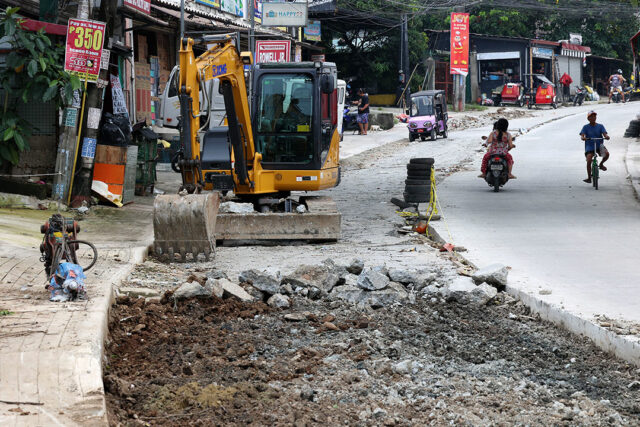
A road in Caloocan City is undergoing rehabilitation in this file photo. — PHILIPPINE STAR/MIGUEL DE GUZMAN

INFRASTRUCTURE SPENDING slumped by an annual 28% in December as tighter controls remained in place amid the corruption scandal, the Department of Budget and Management (DBM) said.

Latest data from the DBM showed that spending on infrastructure and other capital outlays fell by 27.9%, or P40.9 billion, to P105.8 billion in December 2025 from P146.7 billion in the same month in 2024.

Month on month, infrastructure spending surged by 120.3% from P48 billion in November.

The DBM attributed the annual decline to the “delays and slowdown in payments caused by tighter controls in the wake of flood control corruption issues.” It also cited adverse weather conditions that affected the implementation of some projects of the Department of Public Works and Highways (DPWH).

Infrastructure spending fell for a sixth consecutive month in December, a decline that began in July after President Ferdinand R. Marcos, Jr. first flagged anomalous flood control projects.

However, the DBM said that the decrease was tempered by the Department of National Defense’s disbursements for its revised Armed Forces of the Philippines Modernization Program, as well as payments made for building construction.

“Similarly, direct payments made by development partners for foreign-assisted projects… helped temper the decline in capital expenditures,” it added.

These projects include the Manggahan Floodway Bridges Construction Project and the Laguna Lakeshore Road Network of the DPWH and the North-South Commuter Railway Project of the Department of Transportation (DoTr).

Ateneo Center for Economic Research and Development Director Ser Percival K. Peña-Reyes said that the decline in infrastructure spending is “part of a broader pattern seen in late 2025.”

“Multiple DBM reports and related coverage point to a combination of governance issues, administrative delays, and policy adjustments as the main causes,” he told BusinessWorld via Facebook Messenger.

“This decline is largely a policy-driven, temporary slowdown, not a permanent cut in infrastructure priorities,” he added.

Mr. Peña-Reyes said a rebound in infrastructure spending will depend on how quickly governance reforms restore confidence and speed up project approvals.

“So, the rebound may be uneven throughout the year,” he added.

FULL-YEAR PERIOD
Data from DBM showed overall infrastructure and capital outlay disbursements declined by 17.3% to P1.1 trillion in 2025 from P1.33 trillion a year ago. This was 18.8% short of the P1.35-trillion program for the year.

DBM said that the decline in the full-year infrastructure spending reflects the spending slump in the second half amid the probe on anomalous flood control projects.

In the fourth quarter alone, disbursements dropped by 36.2% to P219.8 billion from P344.3 billion in the same period in 2024. This was P127.3 billion lower than the P347.1‑billion program for the October-to-December period.

Meanwhile, overall infrastructure disbursements slid by 15.1% to P1.35 trillion in the end-December period from P1.59 trillion in 2024.

This includes infrastructure components of subsidy and equity to government corporations and transfers to local government units.

The Budget department said that the decline in infrastructure spending was among the reasons for the slower economic expansion in 2025.

The economy grew by 4.4% in 2025, a post-pandemic low and well below the government’s 5.5%-6.5% target.

“The slower performance was attributed to several converging factors, including severe weather conditions and climate-related disruptions, persistent global economic uncertainties largely driven by protectionist trade policies and weaker demand from advanced economies, as well as the flood control corruption issues, which weighed on business and consumer confidence,” the DBM said.

John Paolo R. Rivera, a senior research fellow at the Philippine Institute for Development Studies, attributed the decline in infrastructure spending to delays in implementation rather than a lack of funding.

“This suggests a timing issue, so spending could rebound once these are resolved,” he said in a Viber message.

“However, if delays persist, there is a risk of spillover into 2026, which could weigh on growth given the importance of infrastructure to economic activity,” he added.

OUTLOOK
Meanwhile, the DBM said that it expects muted spending in the first half of 2026.

“Spending growth for the first semester of 2026 is expected to be tempered given the base effect of sizable capital outlays in the same period last year due to the settlement of accounts payables and the frontloading of some expenditures ahead of the election ban,” it said.

The DBM said it expects disbursements to be mainly driven by “human capital development and agriculture expenditures, particularly under the education, health, and social services sectors, given their higher budgets this year.”

The Philippine government approved a P6.79-trillion national budget for 2026, 7.4% higher than the P6.326 trillion in 2025.

Programs to help cushion the impact of the Middle East conflict will also help lift spending this year, the Budget department said.

These programs include the fuel subsidies of the DoTr and the Department of Agriculture, as well as the release of P20 billion to the Department of Energy for the procurement of fuel products to augment the country’s supply.

“Meanwhile, efforts are also being undertaken to strengthen infrastructure spending this year, with particular focus on the completion of flagship foreign-assisted projects,” it said.

The DBM recently released P44.2 billion to fast-track the implementation of the Metro Manila Subway Project Phase I and the North-South Commuter Railway System. — Justine Irish D. Tabile

ACEN sees ‘silver lining’ in excess RE supply

STOCK PHOTO | Image by acenrenewables.com

ACEN CORP. said it sees a “silver lining” in having excess power to sell to customers, as energy market volatility linked to the Middle East conflict creates opportunities for renewable energy (RE) providers, its chief executive said.

“The silver lining is we have excess power to sell to customers. So, this is a good time to offer our renewable energy product to customers because we do have inventory,” ACEN President and Chief Executive Officer Eric T. Francia told reporters on the sidelines of the 2026 Philippine Energy Forum on Wednesday.

He said the company expects its overall financial performance this year to improve from last year. “What I can say is this year, of course, is expected to be stronger than last year from an overall financial performance perspective.”

He added that the company is looking to boost renewable energy output through the restoration of damaged wind farms in Ilocos Norte, as well as the continued contribution of large power plants that began operations last year.

ACEN operates in several markets, including the Philippines, Australia, Vietnam, India, Indonesia, Laos, and the United States.

Amid risks linked to the Middle East conflict, Mr. Francia said the company’s operations outside the Philippines and Australia have seen minimal impact on existing power plants.

“It’s not that impacted because we don’t rely on fuel and the tariff is fixed,” he said.

Global markets, particularly those reliant on imported oil, continue to face volatility in supply and prices amid disruptions in the Middle East.

Mr. Francia said the situation highlights the need to invest in indigenous energy sources such as renewable energy and energy storage to reduce dependence on fossil fuels.

At the same time, he said rising inflation and interest rates linked to the conflict may temper investment and spending decisions.

“You have to consider that there will be some cost pressure on renewables as well because of supply chain issues, delay issues, cost of capital increase and so forth,” Mr. Francia said.

In 2025, ACEN’s net income fell 60% to P3.8 billion due to lower spot market prices and operational challenges.

Revenues declined by 14% to P32 billion, reflecting lower spot market prices and reduced power generation in its core markets. — Sheldeen Joy Talavera

Why has Mary Grace opened in Singapore? Family.

MARY GRACE CAFE SINGAPORE

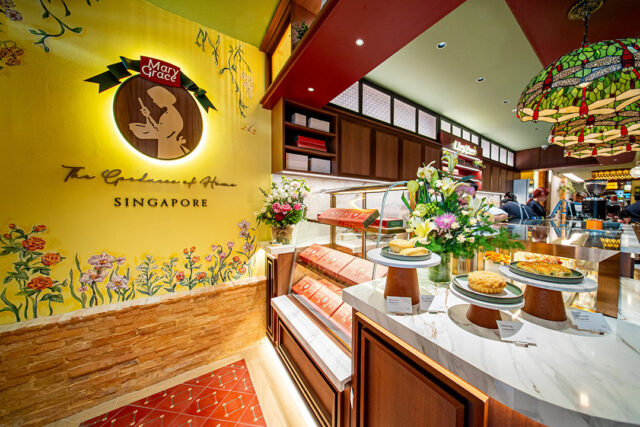
MARY GRACE CAFE, a well-loved fixture in the Manila dining scene, has opened its first international branch at 52 Tras Street, Tanjong Pagar in Singapore.

While planning took over a year and there were a series of pop-ups held in the city-state in preparation, the branch officially opened on March 13.

Seating 28 people, the first Singapore Mary Grace Cafe also comes with a central bakery. “In Mary Grace, everything has to be freshly baked. We can’t ship the ensaymadas and cheese rolls to Singapore from Manila. It won’t be freshly baked, so we had to bake them in Singapore,” explained Chiara Dimacali-Hugo, executive director of Mary Grace International, and daughter of Mary Grace’s founder, Mary Grace Dimacali, during a press conference at its branch in Rockwell on March 26.

Singapore also gets a few exclusives not found in the Philippines, such as Salted Egg Ensaymadas, Kaya-Pandan Cheese Rolls, and a Crab Cake Brioche, spinning off the city state’s most famed dishes and ingredients.

Mary Grace Cafe first opened in Serendra, Bonifacio Global City, in 2006, but had already been a home-based bakery in Parañaque 10 years prior. The company is thus celebrating being around 30 years in the business. Locally, she plans to open four more branches this year.

Founder Mrs. Dimacali talked about her feelings about expanding from her home kitchen to another country. “Victorious,” she said in a Q&A session. “Every step of the way — setting up the store, polishing the recipes… was a struggle.

“Everything fell into place,” she said, responding to a question about why they decided to open abroad after 30 years. “It was time.”

Why she hasn’t opened any branches outside Luzon but has in Singapore? The answer is simple — family. “‘Di ba Mary Grace is all about family?” she said. “I have a daughter, her husband, and two children, who live in Singapore.” She said that if she had family in Cebu or Davao, she would have opened there too.

On a serious note, she said, “It’s the doorway to Asia. If we can make it in Singapore, we think we can make it anywhere else in Asia.”

First a homemaker, then a home baker, then at the head of a cozy chain, she talked to BusinessWorld how she did it. “Take your time. Life is an ensaymada.” That meant that an ensaymada takes a longer time to bake than a cake, and she relates that to how she lived and worked. “If you happen to be a mother at a certain point, and you have children: raise your children well. Then everything will be opened unto you — in God’s time.”

“I could not be a businesswoman, and skip my role as a mother. It had to be them first,” she said during the Q&A. “I think it was a family effort. It’s not only me. It’s family.”

In light of the ongoing conflict in the Middle East between the US, Israel, and Iran, which has driven fuel prices up, she explained to BusinessWorld how she plans to navigate around the crisis. “Truthfully, we’re looking at rising prices and the availability of ingredients. Just like COVID, we don’t know what’s out there. But certainly, we’re vigilant; we’re alert. We’ll just cross the bridge when that time comes.” — Joseph L. Garcia

Airlines adjust Middle East flights after ceasefire

PHILIPPINE STAR/ WALTER BOLLOZOS

BUDGET CARRIER Cebu Pacific (CEB) has extended the suspension of its Manila-Dubai flights until the end of the month, while Philippine Airlines (PAL) will resume Manila-Riyadh flights starting April 10, as airlines adjust schedules following easing conditions after a two-week ceasefire in the Middle East conflict involving the United States, Israel, and Iran.

“CEB continues to assess its flight operations to and from the Middle East amid the ongoing security situation in the region. As this remains a developing situation, further schedule adjustments may take place,” CEB said in an advisory on Wednesday.

CEB said it had initially planned to cancel its Dubai flights only until April 20 but extended the suspension to prioritize the safety of its crew and passengers.

The airline said affected passengers may avail of flexible options, including free rebooking and conversion to travel funds.

Separately, PAL said it will resume Manila-Riyadh flights starting April 10.

“As Riyadh operations resume, PAL will temporarily operate via an alternate flight route to ensure the highest safety standards are maintained during this period,” PAL said in a separate advisory on Wednesday.

PAL said select Manila-Riyadh flights will include a brief technical stop in Bangkok for refueling. Passengers will remain on board during the stop.

“We continue to closely monitor the situation and will restore normal routing and full capacity as conditions allow. Updates will be communicated to affected passengers accordingly,” PAL said.

On Tuesday, PAL said it would extend the suspension of its Manila-Doha and Manila-Dubai flights until May 31 due to the conflict in the Middle East, citing risks to airspace safety and critical infrastructure. — Ashley Erika O. Jose

Offshoring trend to cushion office slowdown — Leechiu

STOCK PHOTO | Image by Dit26978 from Freepik

THE Philippine office market may slow down slightly, but demand is expected to be supported by continued offshoring by global firms, according to Leechiu Property Consultants (LPC) Chief Executive Officer David Leechiu.

“I think office will probably slow down a little bit, but it will be the best performing of the asset class because now more than ever, companies are going to offshore to the Philippines even more,” he told reporters on the sidelines of LPC’s first-quarter market briefing on Tuesday.

He said demand may soften alongside broader economic pressures, but offices are expected to remain the most resilient asset class even as some firms adopt flexible or hybrid work arrangements.

“They still need the office. Now more than ever, COVID has taught people that we need the office,” Mr. Leechiu noted.

The country’s office market started 2026 with stronger net demand, as net absorption rose 77% to 133,000 square meters (sq.m.) in the first quarter.

Traditional occupiers drove demand, accounting for 143,000 sq.m., or 61% of total take-up. Information technology and business process management (IT-BPM) firms contributed 79,000 sq.m., or 34%.

Expansion deals dominated both segments, with 112,000 sq.m. recorded for traditional tenants and 51,000 sq.m. for IT-BPM firms.

Mr. Leechiu said property demand is beginning to soften as global geopolitical developments push inflation higher and dampen consumer spending.

“I think we’re feeling it now. Ever since this war started, the inflation numbers are going to be so high,” he said. “It’s going to be higher, and so it’s really hitting the middle class and the lower class, which is why this corruption issue has to be managed quickly.”

Oil price shocks linked to the Middle East conflict pushed Philippine headline inflation to a 20-month high of 4.1% in March, from 2.4% in February and 1.8% a year earlier. This exceeded the central bank’s 3.1%-3.9% forecast for the month.

Some property markets are showing early signs of pressure as rising costs and economic uncertainty weigh on demand.

Tourism-driven Palawan may be among the hardest hit, as limited flights, high airfares, and elevated logistics costs increase travel and goods expenses.

In Metro Manila, areas with large existing supply such as the Bay Area, Ortigas, Mandaluyong, and Quezon City may face pressure due to a mismatch between supply and demand across residential, office, and retail segments.

“The most balanced market is still Makati, Bonifacio, and Alabang,” Mr. Leechiu said.

“I think Bonifacio Global City (BGC) is the safest market in every asset class, followed by Makati, Cebu, and Iloilo,” he added.

In the first quarter, Makati City led office transactions in Metro Manila with 76,800 sq.m., equivalent to 54% of its total demand in 2025. Bonifacio Global City recorded the lowest vacancy rate at 8%, compared with the Metro Manila average of 18%.

Outside Metro Manila, office demand reached 34,000 sq.m., led by Cebu with 11,700 sq.m., followed by Iloilo with 11,000 sq.m. and Clark with 6,600 sq.m.

Residential demand is expected to slow, while retail activity may also weaken. However, Mr. Leechiu said malls could prove relatively resilient as consumers continue to visit them, partly due to amenities such as free air conditioning.

“So I think yes, there will be a slowdown in malls, but not as bad as what people think it will be,” he said.

He added that if geopolitical pressures persist and lead to further price increases, consumer behavior inside malls could shift. Foot traffic may decline slightly, but purchasing power could weaken more significantly.

“People will still be in the mall, but they will not be spending the same way as pre-March 2, when the war started.” — Alexandria Grace C. Magno

A no-nonsense guide to Tokyo’s sushi scene

FREEPIK/TIMOLINA

THERE may be no sport more gruesome in the realm of travel than scoring a reservation at Tokyo’s most famous sushi establishments. With just six to eight seats — and one or two rounds of service per night — they’re the ultimate get on a holiday in Japan.

Their desirability has only skyrocketed as international tourism to Japan has grown to an all-time high of over 42 million arrivals in 2025 (a 15.8% increase from the year before). As a result, a set menu meal in Tokyo that was ¥20,000 ($130) in 2024 is now over ¥35,000 ($220).

And it’s not just because high-paying Americans are happy to spend less than the $500 omakases they’ll find in New York, either. Rising ocean temperatures have made it more difficult for Japanese fishermen to access fecund waters; petrol costs are driving up wholesale seafood prices; the closure of generational rice farms is making quality rice harder to come by and global demand is dispersing top talent to more profitable culinary capitals.

None of this makes it easier to find open seats at the sushi counter. Japanese sushiyas prioritize regulars — even at a time when fewer of them can afford to come as frequently. The most dedicated of these diners build long-term relationships with sushi chefs, often making their next reservation at the end of their meal. Many restaurants even hold empty seats and deny first-time guests if it means they’d be able host a cherished regular.

So how do you break in? This is the most frequent question I get about Tokyo, as someone who has spent more than two decades living, working, or making frequent trips there.

First, know that the math works in your favor: There are over 5,000 sushi restaurants in the city, from cheap conveyor-belt eats to $1,000 meals showcasing the rarest, most premium ingredients. Here’s how to navigate them, based on my years of experience and recent conversations with esteemed sushi masters, restaurant jurors for World’s 50 Best and top contributors to Opinionated About Dining, a user-generated global dining guide that factors experience into its ranking algorithm.

HOW MUCH SHOULD I SPEND?
To determine your budget, learn the vocabulary. Kaitenzushi — conveyor belt sushi restaurants — are the most affordable. A meal at Sushiro, the largest such chain in Japan, will only set you back around ¥2,500 ($15) per person.

“I take my children to Sushiro at least once a month,” says Hiroyuki Sato, the acclaimed sushi master at Hakkoku in Ginza. Even the cucumber roll here is a hit, he says, proving the importance of rice quality to the sushi experience.

Up next: tachigui (stand-and-eat establishments) offer some of the best price-value correlation around. They keep real estate and staffing costs low, so (nearly) all your yen go directly to your food. Standouts like Tachiguizushi Akira, tucked into a basement in the business-centric Shinbashi district, will run you around ¥8,000 ($50) for an a la carte meal. That buys you a noticeable upgrade in fish quality; fresh catches get carted into the restaurant from a market that’s only a mile away.

For great value, try higher-end restaurants at lunch, when a meal can cost half as much as dinner — figure around ¥6,000 ($28) to ¥12,000 ($75). The cost difference usually accounts for fewer courses; lunch is also a place for chefs to minimize food waste by using any leftover ingredients from the night before. A recent favorite is Sushi Komari, a relative newcomer decorated in blonde wood; while it excels with the classics, it also offers some playful creations like nori-wrapped charred octopus with wasabi and a dab of cream cheese.

If you aren’t a sushi fanatic, this is where you should cap your spending, as the aforementioned options will still yield better quality than what you can get at home. Go anywhere fancier and you’ll have less agency over what you eat, as fine-dining establishments are chef’s choice to accentuate the seasonal delicacies — which in Japan often means more challenging textures to the Western palate, like raw abalone and shirako (google it.)

These high-end dinners and omakases start around ¥30,000 ($188) and climb to ¥60,000 ($375) — at which point, you’re largely paying for prestige and bragging rights. Quality rarely degrades at critical darlings like Sushi Arai, Sushi Nanba Hibiya, and Sawada — the problem is the relative impossibility of getting into any them without knowing a few tricks.

HOW TO CHOOSE A HIGH-END RESTAURANT
Very few people have the knowledge it takes to understand the diminutive differences that make sushi go from great to exceptional. Even professional critics struggle here, which is why fish fanatics ignore Michelin and World’s 50 Best. Tabelog, Japan’s version of Yelp, is seen by Japanese diners as a better authority: Any restaurant with four or more stars (out of five) is regarded as excellent. Its top 10 sushi restaurants set the gold standard for sushi across the world, but you’d do well with most spots in the top 100.

Much like other aspects of Japanese culture and tradition, sushi has clearly delineated rules, with a mission to prioritize the same seasonal ingredients and time-honored techniques. So if you’re interested in how a chef asserts their creativity, look at their otsumami — the smattering of small courses that precedes the nigiri portion of the meal. These steamed, seared, and sauced plates are often how chefs earn acclaim.

When it comes to sushi itself, the differences can be so minute that I find vibes to matter at least as much as food, especially when you’re seeking a full experience. Many masters operate their establishments with such seriousness that they can often feel like sushi mausoleums, which zaps the fun out of the experience. Some don’t like foreigners, full stop. And since most top sushi chefs speak only Japanese, you can find spots with affable, English-speaking staff by Googling a particular restaurant and adding “English” or “foreigner” to your search term; it’ll give you surprisingly good insight into how comfortable you’re likely to feel.

Another hack: Choose a sushi restaurant within a hotel or on the restaurant level of a department store. It often feels more relaxed and geared toward an international palate, though prices can be inflated by around 30% as a result.

Wherever you go, avoid the dreaded sub-counter, where apprentices prepare your meal instead of the master (and often for the same price!). Many pro diners I spoke with say these experiences can range from fine to completely lackluster. But they’re easy to spot: Only once in my experience did a booking website not clearly indicate which counter I was reserving.

And finally, if your heart isn’t set on a particular restaurant, concentrate your energy on places run by rising stars — young masters who’ve completed their grueling, decade-long apprenticeships at legendary restaurants and have recently struck out on their own. (The booking site TableAll is your go-to source here, as its restaurant listings contain chef bios.) Sushi Akira is my current favorite: The chef is laidback and friendly, plus the place doesn’t have a sub-counter and you can still score an online reservation with a month’s notice. Sushi Ryujiro is another worthy choice.

MAKING THE BOOKING
Even when you know where you want to go, booking is complex: Every establishment has its own idiosyncratic system and even five-star hotel concierges have limited power. The main reservation-making portals are TableCheck, the aforementioned TableAll, Omakase, and Pocket Concierge, and most high-end spots use some but not all of them. If there’s an option to sign up for alerts, do — you’ll get pinged when seats open up at your preferred spot. But be warned, each booking site uses its own algorithm to either prioritize frequent users or those with Japanese phone numbers. (You can invest in the latter with one of the many eSIM services like Mobal or Ubugi if you’re planning a serious food trip to Tokyo.) They can also charge exorbitant fees, sometimes adding 30% to the cost of the meal.

Trip timing can be everything. If you want to increase your odds of success, summer travel makes for easier reservations; the seasonal fish selection is less compelling to Japanese diners than in November or December, when crab, pufferfish, and mollusks steal the show.

Don’t write off secondhand bookings, which could look scammy but are an entire cottage industry in Japan. Known resellers like Jad Ibrahim are frequent sushi-hounds who leverage their connections with chefs to scalp counter seats like they’re tickets for a sold-out concert. Oftentimes they’ll book dinner with “friends,” then sell all but one seat over Instagram and ask you (the buyer) to join them and pay for their meal.

It’s not as much of a racket as it sounds (though do your homework on the original price of your intended meal, as some of these dealers like to pay themselves handsomely for their time as well). The scalpers often speak fluent Japanese and can help elucidate the more arcane aspects of a meal such as highlighting the knife technique used on different cuts of fish, understanding the provenance of various ingredients, or helping you pair your sake with the evening’s courses.

They can also help you with some of the rules of engagement ahead of your night out, of which there are many. But I can help you there, too: Never wear cologne or perfume, avoid over-photographing your food, plan to wait outside for 10 minutes before your reservation and always greet the chef. Saying “oishii desu” (it’s delicious) is a nice way to express your appreciation, but complimenting every course can make you look disingenuous. For best results, save it for your favorite dish or the end of the meal. — Bloomberg

ADVERTISEMENT
ADVERTISEMENT