Home Blog Page 4324

Apple unveils iPhone 15 Pro with titanium case, holds line on prices

STOCK PHOTO | Image by matcuz from Pixabay

CUPERTINO, California — Apple launched a new series of iPhones that included a new titanium shell, a faster chip and improved video game playing abilities.

The biggest surprise with the i-Phone 15 that will come out Sept. 22: It did not raise prices, reflecting the global smartphone slump.

The event at Apple’s Cupertino, California, headquarters comes amid lingering economic uncertainty, especially in China, Apple’s third-largest market where it faces challenges from expanded restrictions on using its iPhones in government offices and the first new flagship phone in several years from Huawei Technologies.

Huawei raised its second-half shipment target for the new Mate 60 series smartphone, which has satellite capability, by 20%, the country’s official Securities Times reported on Tuesday shortly before the Apple event.

Apple did not deliver any blockbuster surprises, and shares closed down 1.7% after event.

APPLE EMBEDDING MACHINE LEARNING
While Apple avoids the terms artificial intelligence, or AI, the technology was the driver of several new features.

An Apple executive said the company used machine learning to detect a person in the frame, allowing users to turn a picture into a portrait immediately or later in the Photos app.

Apple also showed off new watches, including a Series 9 Watch with a feature called “double tap” where users tap thumb and finger together twice, without touching the watch, in order to perform tasks like answering a phone call.

It uses machine learning to detect tiny changes in blood flow when the user taps their fingers together, freeing up the other hand for other tasks like walking a dog or holding a cup of coffee, said Apple Chief Operating Officer Jeff Williams.

IPHONE 15 LAUNCH
Both the Pro and other iPhone 15 models will have a brighter display and a 48-megapixel camera as well as 100% recycled cobalt in their batteries.

Apple said the iPhone 15’s satellite connectivity can now be used to summon roadside assistance. It is rolling out the feature out with the American Automobile Association in the United States.

Apple said that USB-C charging cables are coming to both its iPhone 15 and the charging case of its AirPods Pro devices. The move reflects requirements from European regulators to use USB-C and allows the use of the same charging cables already used for iPads and Macs.

“I was expecting Apple to try and spin the all USB-C decision in certain way but they didn’t they were very matter of fact in the way they talked about it,” said Carolina Milanesi, an analyst with Creative Strategies. She said the shift “brought some differentiation to the iPhone Pro, because there’s faster throughput for data transfer. That is going to be valuable for people” who use the device for professional photography, Ms. Milanesi said.

Apple also said the iPhone 15 Pro can capture what it calls “spatial videos” by using two of the device’s cameras to capture a three-dimensional video. Those videos will be viewable on Apple’s Vision Pro headset that is due out early next year, marketing chief Greg Joswiak said.

The Pro’s use of titanium makes it lighter and stronger than previous models of other metals.

Bob O’Donnell, head of TECHnalysis Research said the steady prices were a surprise.

“I think both Apple and the carriers recognize that with consumers feeling pressure on their budget and the lack of dramatic changes it’s getting harder to convince people to upgrade. Keeping prices stable should help with that,” he said.

The iPhone 15 costs $799, the iPhone 15 Plus starts at $899, and the Pro series starts at $999. The Pro Max starts at $1,199, the same prices as last year for the same levels of storage. Last year, Apple offered a $1,099 iPhone Pro Max model with less memory.

Apple still relies on iPhone for more than half of its sales, but the global smartphone market has slumped from shipping 294.5 million total phones to 268 million in the second quarter. Apple’s shipments declined the least of any major smartphone maker, dropping from 46.5 million phones to 45.3 million, according to data from Counterpoint Research.

NEW WATCH OUT
The outdoor sports-focused Apple Watch Ultra 2 has new features for cycling and diving and what Apple said is the brightest screen it has ever made. The Series 9 will start at $399 and the Ultra 2 watch will start at $799 and be available Sept. 22.

Apple will no longer use leather in any of its products, said Lisa Jackson, the company’s environmental chief. The company is replacing some of those products with a textile called “FineWoven” that it says feel like suede. — Reuters


Taylor Swift racks up trophies at MTV’s Video Music Awards

REUTERS

POP superstar Taylor Swift dominated MTV’s annual Video Music Awards on Tuesday, adding nine trophies to her collection as she claimed the top prize for her smash hit song “Anti-Hero.”

The first single from Swift’s 2022 Midnights album, “Anti-Hero” depicts a litany of insecurities with a chorus declaring: “It’s me, hi, I’m the problem, it’s me.”

“This is unbelievable,” the singer, on a break from her record-setting Eras Tour, said on stage as she held the Moon Person statuette for video of the year. “The fact this is a fan-voted award means so much to me.”

It was the second straight win for Ms. Swift in the video of the year category. Last year, she won the prize for her 10-minute version of breakup song “All Too Well.”

Ms. Swift’s nine awards on Tuesday tied the record for the biggest VMA haul in one night, MTV said. Her accolades included song, artist, and album of the year, bringing her lifetime VMA total to 23, second only to Beyonce.

At the start of Tuesday night’s show at the Prudential Center in Newark, New Jersey, the 33-year-old Ms. Swift gushed as she received the pop video award from members of 1990s boy band NSYNC, the group that won the same honor 20 years ago.

“I had your dolls!” Ms. Swift said to band members including Lance Bass and Justin Timberlake. “You are pop personified. So to receive this from your golden pop hands, it’s too much.”

Among other winners, rapper Ice Spice was named best new artist. Stray Kids, a band put together through a reality show, won the best K-pop award, and SZA scored best R&B video for “Shirt.”

Rema and Selena Gomez won the first VMA for Afrobeats music for their collaboration “Calm Down.”

Performers at the ceremony included Demi Lovato, Lil Wayne, Olivia Rodrigo, host Nicki Minaj, and rapper Sean “Diddy” Combs, who received the Global Icon award.

Ms. Minaj, who won the best hip hop video trophy, also joined Grandmaster Flash, LL Cool J and other rap luminaries for a multi-song celebration of the 50th anniversary of hip hop that concluded with Run DMC’s “Walk This Way.”

Colombian pop singer Shakira was honored with the Video Vanguard Award for her 20-year career. After performing a bilingual medley of her hits including “Hips Don’t Lie” and “Whenever, Wherever,” the singer saluted her fans.

“Thank you so much for being my army and helping me fight all my battles,” she said.

Later, she and fellow Colombian singer Karol G won best collaboration for “TQG.” — Reuters

Sustainable aviation is a pie in the sky

SHAWNANGGG-UNSPLASH

ONE of the first major industries to start selling climate-conscious products to its consumers may be one of the last to actually decarbonize.

Airlines have been offering customers dubious carbon offsets on their booking sites since at least 2005. This summer holiday season, many of the same carriers have been replete with boasts that they’ll use revolutionary sustainable fuels to go green. As a growing number of bans, consumer complaints, and lawsuits over the past year have demonstrated, those claims are bunk.

Despite what the aviation sector claims, it has no viable pathway to net-zero. The repeated assertions that it does are becoming unconscionable. The sooner companies, governments and passengers reckon with that fact, the sooner we can start work on the changes desperately needed to reduce the climate impact of flying.

It’s not hard to see why companies keep making such pronouncements. Their customers care about sustainability. One 2020 survey by aviation consultants OAG found that 56% would consider switching airlines if a more environmentally friendly option was available. A study last year found passengers were willing to pay up to €21 ($23) more to cut the carbon footprint of their flight.

Unfortunately, the technology just isn’t there unless you’re willing to pay a far higher price. Forget rechargeable batteries and hydrogen, which in a best-case scenario won’t be taking a noticeable bite out of aviation’s emissions this side of 2070. The path the airline industry is getting behind instead is sustainable aviation fuel, or SAF — made from crops or by combining green hydrogen with captured carbon dioxide, and capable of being burned in conventional jet engines. The potential of SAF is equally limited, though.

Even the cheaper, biofuel-based version would drastically raise the cost of tickets, but there’s not enough farmland on the planet to supply all the hydrocarbons that would require. Air traffic will triple over the next two decades, and the US already grows more crops for fuel production than for feeding its population. A more scalable hydrogen-plus-CO2 version, known as eSAF, would be yet more expensive. The cost of capturing CO2 straight from the atmosphere, known as direct air capture or DAC, is currently $600 to $1,000 a metric ton. The price of that key ingredient is unlikely to fall enough to make such fuel competitive with jet kerosene any time before 2050 — if ever.

The political economy of aviation makes this worse. The one place currently planning to impose SAF mandates is the European Union (EU), but that’s going to progressively make its carriers costlier than their main competitors — airlines in the oil-exporting US and Middle East that are less idealistic about getting off fossil fuels. As we saw during the COVID-19 pandemic, governments ultimately end up protecting their airlines, so it’s far more likely that Europe’s SAF rules get watered down than extended to the rest of the world.

A more viable pathway to decarbonization would jettison such byzantine complexities. Ultimately, it’s passengers who will end up paying the cost of getting airlines to zero, so let’s make those costs transparent.

The EU’s emissions trading scheme, which will start to affect flights within the continent from about 2026, needs to be applied to international routes too. The International Civil Aviation Organization (ICAO), the United Nations agency in charge of the sector, should then make those rules global. With a will, the votes should be there to mandate it: A majority of ICAO member states have either made net-zero pledges, or are small island countries at existential risk from climate change.

Purchase of carbon offsets should then be mandatory on each plane ticket, and benchmarked to the price of European carbon credits to prevent the sort of junk offsets that have plagued the sector for decades. That would add about €50 to the cost of a return flight from London to New York, rising to €150 if non-carbon dioxide impacts are included. Better still, price them to converge over time with the cost of DAC to help stimulate a technology the world desperately needs.

All these measures will be expensive and unpopular, so voluntary rules won’t be enough. Still, there are ways to sweeten the bitter medicine. It’s likely only the public sector will be prepared to take on the vast investment risks that would be involved in making DAC affordable, but state support would go a long way to bring down costs.

Governments can also use their expertise in weather forecasting, basic scientific research, and air-traffic control to tackle the problem of contrails, the cirrus-like clouds that aircraft leave in the air. Those formations trap solar energy and may have twice the warming effect of the carbon dioxide that airplanes emit. Minimizing their impact may be a relatively straightforward matter of improving our understanding of the cold, humid pockets of air where contrails form, and ensuring aircraft are routed to fly above or below them.

The vast technological and economic challenges of decarbonizing the airline industry make it an unenviable task, but companies should support such aggressive policies. If they think they’re unpopular now, imagine how they’ll feel in a 2050 when climate damage is even more severe, and they’re responsible for a fifth of our carbon emissions, compared to about 2% today.

The past two decades of voluntary carbon offsets and dubious green claims have been a phony war on aviation’s carbon footprint. The real fight is about to begin. If we want clear skies on the route to net-zero, we can’t delay takeoff any longer.

BLOOMBERG OPINION

Manila Broadcasting Company to hold 2023 Annual Stockholders’ Meeting on Oct. 5


Spotlight is BusinessWorld’s sponsored section that allows advertisers to amplify their brand and connect with BusinessWorld’s audience by enabling them to publish their stories directly on the BusinessWorld website. For more information, send an email to online@bworldonline.com.

Join us on Viber at https://bit.ly/3hv6bLA to get more updates and subscribe to BusinessWorld’s titles and get exclusive content through www.bworld-x.com.

BayaniPay aims to bring payment platform to Canada

GLOBAL PAYMENT solution platform BayaniPay targets to bring its presence to Canada after expanding its seed funding to $6.6 million, its top official said.

“We’ll follow where the Filipino money is. Next, we will be in Canada,” BayaniPay Chief Executive Officer Winston L. Damarillo said during a press briefing on Wednesday.

The company said it was able to secure an additional $2.1 million in a funding round with existing investors. It earlier secured about $4.5 million in seed funding, allowing it to enhance its product features and expand to new territories. Its existing investors are Talino Ventures and PTGB, the company said in a media release.

BayaniPay said that with the additional funding, it intends to bankroll new projects such as developing a rewards system and expanding in North America where a huge Filipino population resides.

The platform has reached about P100 million worth of transaction value per month, marking a significant increase from the monthly average of P30.64 million recorded last year.

“We are on track to meet this milestone, as we continue to acquire more customers each month. The demand for BayaniPay continues to grow as more and more Filipinos see the value and benefit of convenience while allowing them to enjoy zero fees and competitive foreign exchange rates,” Mr. Damarillo said.

The financial technology or fintech company aims to reach about P1 billion in total transaction value this year, Mr. Damarillo said.

“We aim to sustain this momentum and explore new territories. Our commitment towards improving and growing our platform is driven by the desire to make the lives of Filipinos easier, wherever they may be found,” he said.

To date, BayaniPay caters only to customers in California, Hawaii, New Jersey, and Alaska through remittance and direct payments to service providers in the country.

Based in Los Angeles, BayaniPay is a collaboration among Talino Ventures, The Asian Journal, East West Bank, and Wavemaker Partners. — Ashley Erika O. Jose

Yields on central bank’s term deposits decline

ANGIE REYES-PEXELS

YIELDS on the Bangko Sentral ng Pilipinas’ (BSP) term deposits dropped on Wednesday following recent changes in the regulator’s money market operations.

Demand for the BSP’s term deposit facility (TDF) amounted to P446.698 billion on Wednesday, surpassing the P340-billion offer and P311.766 billion in tenders for a P260-billion offer last week.

BSP Deputy Governor Francisco G. Dakila, Jr. said in a statement that the central bank’s term deposit facility was met with sustained strong demand.

“The BSP raised the total volume offering in the TDF to P340 billion, with the 7-day tenor increased to P200 billion (from P160 billion) and the 14-day tenor raised to P140 billion (from P100 billion),” he said.

“Looking ahead, the BSP’s monetary operations will continue to be guided by its assessment of prevailing liquidity conditions and market developments,” Mr. Dakila said.

The seven-day term deposits fetched bids amounting to P248.137 billion, surpassing the P170 billion auctioned off by the BSP and P167.276 billion in tenders logged the previous week for a P160-billion offer.

Accepted rates for the tenor ranged from 6.33% to 6.575%, lower than the 6.498% to 6.6% band logged a week ago. This caused the average rate of the one-week deposits to drop by 6.42 basis points (bps) to 6.5191% from 6.5833% previously.

Meanwhile, demand for the two-week deposits amounted to P198.561 billion, higher than the P140-billion offer as well as  P144.490 billion in bids for the P100 billion auctioned off last week.

Banks asked for yields from 6.34% to 6.58%, a lower and wider margin compared with the 6.5% to 6.605% seen last week. This caused the average rate of the paper to decline by 6.45 bps to 6.5227% from 6.5872% quoted on Sept. 6.

The BSP has not auctioned off 28-day term deposits for more than two years to give way to its weekly offerings of securities with the same tenor.

The term deposits and the 28-day bills are used by the central bank to mop up excess liquidity in the financial system and to better guide market rates.

TDF yields were lower on Wednesday as the central bank shifted to a variable-rate auction format for its overnight reverse repurchase (RRP) facility last week, Rizal Commercial Banking Corp. Chief Economist Michael L. Ricafort said in a Viber message.

The central bank on Sept. 8 introduced a formal operational target called the overnight (ON) RRP rate. Mr. Ricafort said the average ON rate eased to about 6.22%, lower compared with the BSP’s target RRP rate of 6.25%.

Similar to the BSP’s TDF and securities auctions, the variable rate format for the RRP has a pre-determined offer volume.

TDF yields were lower amid the implementation of the price ceiling for local rice prices that is meant to help curb inflationary pressures, Mr. Ricafort said.

The government has imposed a price ceiling of P41 per kilo for regular milled rice and P45 per kilo for well-milled rice since Sept. 5.

The Department of Finance is also proposing to cut the tariff rates for rice to help augment supply amid the price ceiling.

Mr. Ricafort added that TDF yields declined as BSP officials said inflation could still fall within the 2-4% in the fourth quarter or first quarter next year despite higher rice and oil prices recently.

Headline inflation quickened to 5.3% in August from 4.7% in July.

For the first eight months, the consumer price index averaged 6.6%, still above the BSP’s 5.6% forecast and 2-4% target for the year. — K.B. Ta-asan

Scammers using device releases to steal personal data, money

TOWFIQU BARBHUIYA-UNSPLASH

SCAMMERS have exploited awaited smartphone releases through pre-launch fraud schemes requiring upfront payment or personal financial information, according to cybersecurity firm Kaspersky.

Unsuspecting consumers face potential data and financial losses through these schemes, Kaspersky said in a statement on Tuesday.

“In the digital age, scammers are constantly adapting and exploiting our excitement for the latest tech trends,” Tatyana Kulikova, security expert at Kaspersky, said.

“It’s crucial for consumers to stay vigilant, verify offers, and safeguard their personal information,” she added. “If something seems too good to be true, it often is.”

The Philippines was the second most-attacked country by web threats worldwide last year with 39,387,052 detected cases, data from Kaspersky showed.

Recently, scammers have claimed to provide exclusive pre-release Apple iPhone 15 units, Kaspersky said.

“Users are asked to provide personal identification details such as their name, address, and phone number,” it said. “Following the submission of payment, the scammers vanish, leaving victims without the promised iPhone and deprived of their funds.”

“Beyond the financial risks, this scam also raises significant privacy concerns, as the pilfered data may potentially be sold on the Dark Market,” Kaspersky added.

Giveaway schemes are also used in these scams, where customers are instructed to pay a small fee, often disguised as a “processing” or “registration” fee, for a chance to win a new smartphone, it said.

“Users are drawn in by the allure of a free iPhone 15, perfectly complementing their anticipation for the impending release,” it said.

Customers should verify the source, avoid up-front payments, look at official channels and check reviews, especially for pre-release purchases, to avoid becoming a victim of these schemes, Kaspersky said. — M.H.L. Antivola

French wine output falls with sharp contrasts between vineyards

JOSE ALFONSO SIERRA-UNSPLASH

PARIS — Wine production in France is expected to fall 2% this year, with major disparities between regions after some vineyards were severely hit by fungal diseases while good weather in other regions boosted potential output, the French farm ministry said.

Total wine production in France is expected to reach nearly 45 million hectoliters this year, within an initial range of 44 million-47 million projected last month, and slightly above the average of the past five harvests, the ministry said on Friday.

“However, the situation of the different vineyards is contrasted. Attacks of mildew (disease) in Bordeaux and the southwest and drought in Languedoc and Roussillon are affecting harvest potential,” the ministry said.

Elsewhere, the situation was more favorable despite the presence of botrytis fungus at the end of the campaign.

The ministry sees wine output in the Bordeaux region fall 9% from last year and 17% below the average of the past five harvests. In the Southwest the fall would be 6% and 18%, respectively.

Meanwhile in Champagne good weather conditions helped undamaged clusters to reach a record weight this year, leading to a production potential seen 24% above average.

Hot weather in recent weeks has favored an early grape harvest in most producing regions, it said.

A hectoliter is the equivalent of 100 liters, or 133 standard wine bottles. — Reuters

Energy realism: Why we need more coal, gas and nuclear power plants

(Part 5)

I attended Day 1 of the Giga Summit 2023 organized by the Meralco Power Academy, which was held from Sept. 11 to 13. I was particularly interested in the viability of nuclear power generation in the Philippines and there were three good speakers that afternoon.

They were Ike Dimayuga of Atomic Energy of Canada Ltd. talked about small modular reactors (SMR), Roland Backhaus of Ultra Safe Nuclear in the US talked about micro modular reactors (MMR), and representative Mark Cojuangco of Pangasinan’s 2nd District and author of HB 6030, “An Act Providing for a Comprehensive Nuclear Regulatory Framework, Creating for the Purpose the Philippine Atomic Energy Regulatory Authority, and Appropriating Funds Therefor.”

Among the stories reported in BusinessWorld from Days 1 and 2 of the Giga Summit were: “Meralco taps US company to study nuclear energy development in PHL” (Sept. 12), “AboitizPower on track to build LNG facility” (Sept. 12), “ERC: Revised CSP guidelines expected by end of September” (Sept. 12), and “Net metering program reaches 8,500 customers” (Sept. 13).

Mr. Dimayuga emphasized nuclear power’s main advantage, which is high energy density as just a small amount of fuel can generate a huge amount of energy, and so it requires the least amount of land to generate electricity. And once built, a nuclear plant can operate for many years with low operating costs. He mentioned that some SMRs that can run for 20 years non-stop, 24/7.

Mr. Cojuangco pointed out that nuclear power is the safest energy source of all — in cases of power plant accidents, it has the lowest deaths per terawatt-hour (TWH). He also mentioned that if the 620-MW Bataan Nuclear Power Plant (BNPP) was allowed to operate, 18 months of continuous operation would need only 20 tons of fuel assemblies, which can fit in just one truck.

Mr. Backhaus said MMRs are safe and can be sited anywhere as they have modular designs and brief on-site construction period. They have a plant life of 40 years, with three to 30 years refueling period — very practical.

The speakers recognized that public perception of nuclear power remains generally negative, so they emphasized the safety aspect of nuke plants, whether large like the BNPP or SMR or MMR.

The last nuclear accident was the Fukushima reactor meltdown in Japan in 2011, which resulted in no casualties. The last major nuclear accident before that was the Chernobyl reactor in Ukraine, then under the USSR, which resulted in about 60 casualties.

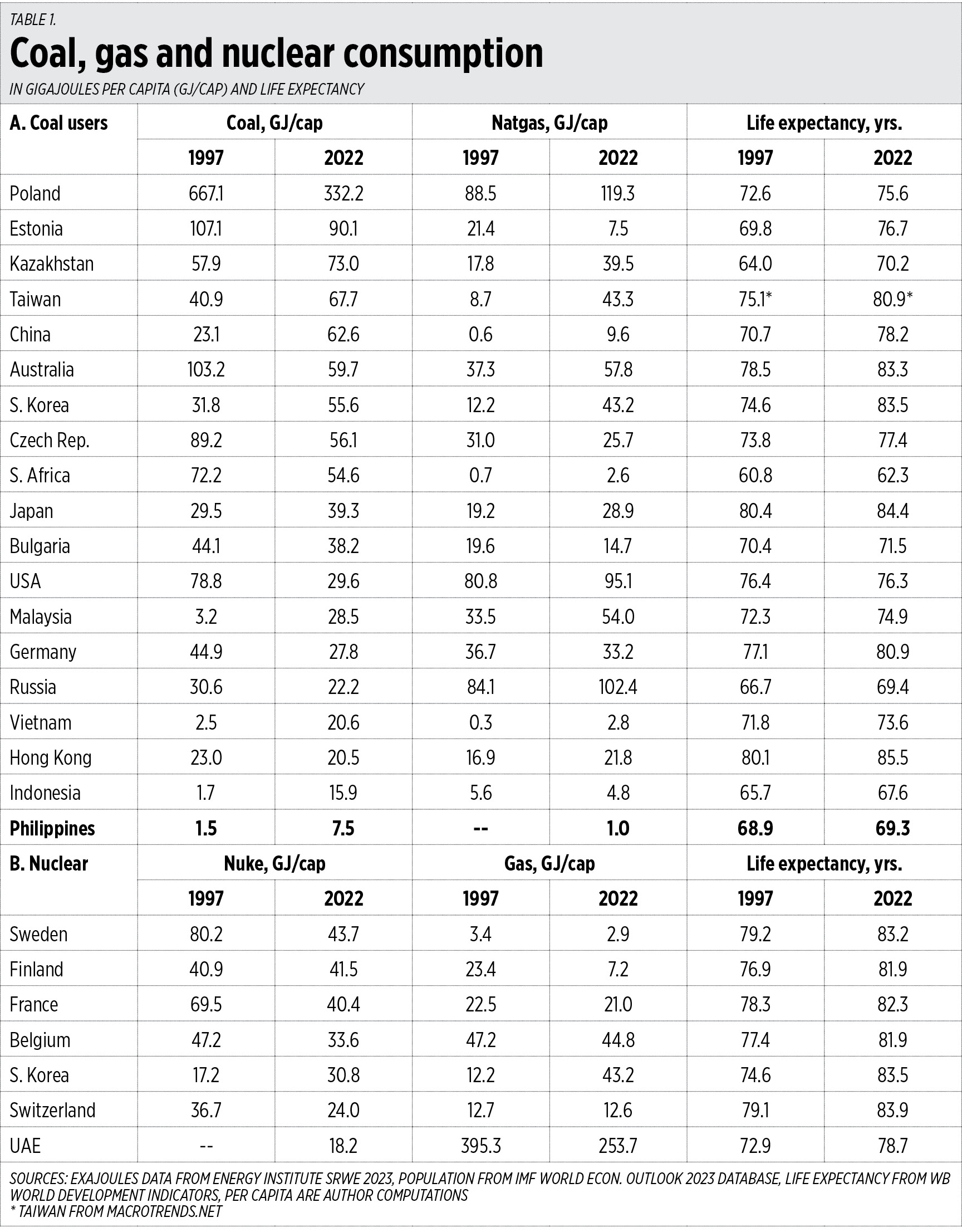
I put together a table showing the per capita energy consumption of coal, natural gas, and nuclear in various countries. It is clear that the high consumption of thermal power and/or nuclear power leads to a more modern life, more developed economies, and longer life expectancy of the people in those countries.

The most coal-intensive countries in the world — those which consume more than 50 gigajoules (GJ) per capita — are Poland, Estonia, Kazakhstan, Taiwan, China, Australia, South Korea, South Africa, and the Czech Republic. They also have high gas consumption (except South Africa and Estonia) and have high life expectancies of 70-83 years.

The most nuclear-intensive countries in the world — which consumed more than 20 GJ per capita in 2022 — are Sweden, Finland, France, Belgium, Switzerland, the Czech Republic, Bulgaria, Slovakia, Slovenia, Canada, the USA, and South Korea. And all of them have long life expectancies, 72 years and up. So the narrative that “nuclear power is dangerous, more deaths” is fiction.

The United Arab Emirate is a surprise newcomer in nuclear power. A powerhouse in oil and gas production, their first nuclear electricity generating plant started only in 2020 with 1.6 TWH, jumping to 20.1 TWH in 2022. Now they have nuke consumption of 18 GJ per capita.

The other speakers on Day 1 were Dr. Caleb Brooks of the University of California, Berkley, Tat Ming Yu of PacificLight Pte. Ltd. in Singapore, Emmanuel Rubio of Aboitiz Power (AP), and Dan Neil of MGen Power and Global Business Power (GBP).

Mr. Tat Yu discussed something which I consider a disturbing trend — Singapore will raise the carbon tax from the current $5/ton to $25/ton in 2024-2025, the increase it to $45/ton in 2026-2027, and $50-80/ton by 2030. Singapore developed fast on cheap, stable energy but now thinks expensive energy is beautiful and wants to follow the UK, Germany, other western countries in shooting themselves in the foot in the wild pursuit of “net zero.” It is understandable if they shoot themselves in the foot provided they wear bullet-proof shoes, but they do not.

Mr. Rubio emphasized that “Meeting today’s energy needs is imperative. It fuels our nation’s growth, sustains our industries, and powers our homes. A secure energy system is not a luxury but a necessity.” I fully agree with him on this, including one of his slides showing that the country needs “consistent enforcement of regulations, strengthening of political and regulatory institutions, fostering transparent markets, reducing energy taxes, creating an investor-friendly environment.”

Mr. Neil said that “Towards a balanced energy mix: Expansion in both RE and baseload capacity is a way forward for MGen.” I also fully agree with him. Their current renewables comprise 10% of total capacity and will rise to 39% by 2027, meaning some 61% of MGen’s power will still be conventional thermal — good.

I briefly passed by on Day 2 of the conference and saw the presentation by the Ayala group including ACEN. Their goal is weird — net zero by 2050 and 100% renewables-only power generation. I say “weird” because the main business of the Ayalas is real estate, not power generation. They have 32 big malls, 24 hotels and resorts, 264 residential condos, 88 office condos, etc. These hotels and condos need electricity 24/7. Last July, we had three weeks straight of cloudy days and on-off rain, and it was not windy either. In early September we have had one week straight of similar weather. Solar output at night is zero and solar power had very little output in the daytime due to the clouds and rain. Those glitzy condos and malls were running on coal and gas, the energy sources they demonize but which save their malls and hotels from blackouts.

I think MGen, AP, and SMC Power with their coal and gas plants are the conglomerate heroes of Philippine’s bid for industrialization. Germany and the UK have had two to three decades of “decarbonization” policies and they have not succeeded until now. We should focus on our national agenda — more sustained growth, more jobs for our people, more lights for our houses, schools, offices and streets. Net zero and the climate crisis are just narratives with dangerous policy implications of deindustrialization and degrowth economics. We should avoid these.


Bienvenido S. Oplas, Jr. is the president of Bienvenido S. Oplas, Jr. Research Consultancy Services, and Minimal Government Thinkers

minimalgovernment@gmail.com

Globe expands 5G coverage with 356 new sites

GLOBE TELECOM, Inc. has built about 356 new fifth-generation (5G) sites as it aims to expand 5G coverage in the country, the listed telecommunications company said on Wednesday.

“Our relentless pursuit of expanding 5G technology is a testament to Globe’s dedication to innovation and our commitment to our customers,” Joel R. Agustin, senior vice-president and head of network planning and engineering at Globe’s network technical group, said in a media release.

“We believe in the transformative power of 5G to enhance the digital lives of Filipinos,” he added.

Its efforts to deploy 5G sites have resulted in 5G outdoor coverage of 97.44% in the National Capital Region and 91% in parts of Visayas and Mindanao, Globe said.

5G technology allows quick data or data transfer rates, expansive reach, and steadier connectivity.

Globe earlier set a capital expenditure budget of around $1.3 billion for this year. It previously said that it had spent about P37.7 billion in the first six months as its commitment to infrastructure development.

Its first-semester spending represents a 25% decline from the level in the same period last year. The company said it is expecting to reach about P71.5 billion or $1.3 billion in spending by the end of the year.

“Our continuous infrastructure investment is focused on uplifting customer experience, delivering a highly consistent and available network. These investments cover capacity and coverage expansion to improve service performance, network fortification to further improve service availability, and continuous optimization to improve service quality,” Mr. Agustin said.

Earlier this month, Nokia Corp. said it was deploying its latest interleaved passive active antennas for Globe to help advance 5G deployment in the Philippines. — Ashley Erika O. Jose

High rates and inflation seen to hurt Asian banks

HIGH INTEREST RATES due to elevated inflation may negatively affect Asia and the Pacific (APAC) banks’ operating conditions in the medium term, an analyst said.

Banks may have profited from high rates, but this could only be a short-term gain, Standard Chartered Bank Chief Financial Officer in Asia Saleem Razvi said in a virtual conference hosted by S&P Global Ratings held on Wednesday.

“The reality is, in the medium term, this is not a good environment for banks to operate in. I’d rather we have lower interest rates — the economy be humming rather than be muted, banks would generally be healthier. There would be better sustainable growth,” he said.

The Bangko Sentral ng Pilipinas (BSP) raised its policy rate by 425 basis points (bps) to a near 16-year high of 6.25% from May 2022 to March 2023 to help bring down inflation, which was above 5% in that period, even peaking at 8.7% in January.

The BSP has since held borrowing costs for three straight meetings amid easing price pressures.

Inflation quickened for the first time in seven months in August to 5.3% from 4.7% in July. This also marked the 17th consecutive month that inflation surpassed the BSP’s 2-4% annual target.

The consumer price index averaged 6.6% in the first eight months, still above the central bank’s full-year forecast of 5.6%.

With inflation gradually easing, central banks are expected to lower rates eventually, which would put banks’ income “under pressure,” Mr. Razvi said.

“At the same time, cost spaces have gone up because of the accelerated inflation for the last two years, so banking profitability is going to be under pressure. We have to find a way of dealing with that,” he added.

The cumulative net income of the Philippine banking system grew by 24.7% to P178.51 billion in the first half from P143.12 billion in the same period in 2022, based on preliminary data from the BSP.

Net interest income stood at P414.45 billion in the January-to-June period, up by 16.9% from P354.32 billion a year prior.

“The other obvious consequence of this interest rate environment is when they’ve been so high for so long, there will be credit quality issues… Banks would have to be very watchful in dealing with that,” Mr. Razvi said.

The Philippine banking sector’s gross nonperforming loan (NPL) ratio was steady at 3.43% at end-July from a month ago, BSP data showed.

As of July, bad loans rose by 4.5% to P439.328 billion year on year.

The shift to digitalization will also affect APAC banks, Mr. Razvi said.

“It’s also an opportunity, frankly, and we’re seeing a lot more of this in the retail sector. But the reality is that you’re going to have traditional banking models disrupted, and you’re going to have the need for banks to evolve very quickly, very flexibly,” he said.

Banks will also need to adapt to climate change adaptation, he added.

“Banks clearly have a massive role to play in terms of marshalling that financing, making sure it goes in the right place but there’s no abuse, there’s no greenwashing,” Mr. Razvi said. — K.B. Ta-asan

French watchdog halts iPhone 12 sales over too-high radiation — minister

TRUSTPAIR.COM

PARIS — Apple must stop selling its iPhone 12 model in France due to above-threshold radiation levels, France’s junior minister for the digital economy told newspaper Le Parisien in an interview published on Tuesday.

France’s radiation watchdog ANFR notified Apple of its decision to ban iPhone 12 sales after it had carried out tests which showed the smartphone’s Specific Absorption Rate (SAR) was slightly higher than legally allowed, Jean-Noel Barrot told the paper.

Apple did not immediately reply to a Reuters request for comment.

Mr. Barrot said a software update would be sufficient to fix the radiation issues linked to the phone which the US company has been selling since 2020.

“Apple is expected to respond within two weeks,” he said, adding: “If they fail to do so, I am prepared to order a recall of all iPhones 12 in circulation. The rule is the same for everyone, including the digital giants.”

The European Union (EU) has set safety limits for SAR values linked to exposure to mobile phones, which could increase the risk of some forms of cancer according to scientific studies.

The French watchdog will now pass on its findings to regulators in other EU member states. “In practical terms, this decision could have a snowball effect,” said Mr. Barrot.

In 2020, France widened regulations requiring retailers to display the radiation value of products on packaging beyond cell phones, including tablets and other electronic devices. — Reuters

ADVERTISEMENT
ADVERTISEMENT