Home Blog Page 429

EU, Mercosur sign trade deal after 25 years of negotiations

REUTERS/CESAR OLMEDO TPX IMAGES OF THE DAY

ASUNCION — Top officials from the European Union (EU) and the South American bloc Mercosur signed a free trade agreement on Saturday in Paraguay, paving the way for the EU’s largest-ever trade accord after 25 years of negotiations.

The agreement, designed to lower tariffs and boost trade between the two regions, must now gain the consent of the European Parliament and be ratified by the legislatures of Mercosur members Argentina, Brazil, Paraguay and Uruguay.

European Commission President Ursula von der Leyen and European Council President Antonio Costa joined the presidents of Mercosur countries at Saturday’s ceremony, with the exception of Brazilian President Luiz Inacio Lula da Silva, who sent his foreign minister.

The deal received the green light from most European nations last week, despite concerns from farmers and environmental groups, who fear a surge of inexpensive South American imports and increased deforestation.

Ms. Von der Leyen, who met with Mr. Lula before heading to Asuncion for the signing, said the deal would create the largest free trade zone in the world.

“This agreement sends a very strong message to the world. It reflects a clear and deliberate choice. We choose fair trade over tariffs. We choose a productive, long-term partnership over isolation,” she said.

Just before the ceremony on Saturday morning, US President Donald Trump vowed to impose increasing tariffs on eight European nations if the US is not permitted to purchase Greenland.

“This agreement will help both our blocs navigate an increasingly turbulent political environment without abandoning our values, marking a true milestone in shoring up our economic security,” Mr. Costa said.

While Mercosur officials have expressed reservations about certain regulations within the pact, Mr. Lula affirmed on Friday in Rio de Janeiro that it will unlock greater opportunities and stimulate more trade and investment for both parties.

Brazil’s government said in a statement that the deal is “emblematic of Lula’s efforts to expand and diversify markets,” adding that South America’s largest economy is also negotiating agreements with the United Arab Emirates, Canada and Vietnam, besides the expansion of a tariff-preference pact with India. 

Trade between the EU and Mercosur, which encompasses a market of 700 million people, reached a value of 111 billion euros in 2024. European Union exports mainly consist of machinery, chemical products, and transport equipment, whereas Mercosur’s exports are concentrated in agricultural goods, minerals, wood pulp, and paper. — Reuters

Red-letter year

PHOTO BY ANGEL RIVERO

Heading up to Tagaytay as Mercedes-Benz PHL braces for a busy milestone year

TWO THOUSAND Twenty-Six is an exceptionally significant period for Mercedes-Benz. It marks 100 years since the brand was formed. In June 1926, Benz & Cie. merged with Daimler-Motoren-Gesellschaft to become what was then known as Daimler-Benz AG. This officially formed the Mercedes-Benz we know.

This year also marks the 140th anniversary of Carl Benz filing his patent for a three-wheeled vehicle with “gas-engine drive” back in January 1886 — which was, in fact, a patent for the first automobile. Here’s a fun fact: Many people even fondly refer to this patent as “the birth certificate of the automobile.”

And it doesn’t end there. This year also commemorates 50 years since the presentation of the Mercedes-Benz W123 model series — the foundational predecessor of today’s modern E-Class. These and several other milestones are all part of the Three-Pointed Star’s historical celebrations this 2026. There is a lot to look forward to in the coming months.

What has Mercedes-Benz been up to, before the eventual start of these festivities? Well, last year, Mercedes-Benz Philippines, through the management of Inchcape, launched several electrified models in the country as part of its EQ lineup, alongside the goal to further enrich the local market’s luxury segment with more electrified choices. We even got to drive some of them to the long-famous Highlands Steakhouse in Tagaytay Highlands — itself now also celebrating 20 years since it opened, becoming one of the much-coveted steakhouses within easy reach of the metro.

During this drive, we took the Mercedes-Benz Philippines top sales performer, the GLE Series, specifically the GLE 400e 4Matic Plug-in Hybrid and the GLE 450 — alongside the GLC 350e Plug-in Hybrid — out for a casual spin. We started at the brand’s Greenhills dealership early on a regular weekday and threaded through EDSA’s congested lanes until we got to the South Superhighway.

The GLE SUV has long been the brand’s best-selling model for good reason. It is practical, versatile, offers generous cargo space, and boasts all the usual luxuries and prestige associated with Mercedes-Benz. The vehicle is comfortable to drive and ride as a passenger, has good sound insulation, and feels planted and safe at high speeds. Of course, it has electronically adjustable front seats and its proprietary MBUX multimedia system that supports intelligent voice control. It also has the marque’s valuable driver-assist systems and even a cool transparent bonnet feature that gives the driver a virtual view beneath the car.

The GLE 400e 4Matic Plug-in Hybrid carries a 2.0-liter gasoline engine with an electric motor and battery system, matched with nine-speed automatic transmission. It has sporty front seats, dual 12.3-inch displays, real nice AMG sport pedals, and a swanky 15-speaker Burmester Surround Sound System. The car has a Dynamic Select Drive Program so that driving modes can be adjusted based on where the vehicle is or what it’s doing — city traffic, highway cruising or climbing hills. A good 252hp will take you through mountain resorts — such as the aforementioned Tagaytay Highlands — with ease. Whenever the moment calls for additional power, the combustion engine kicks in via MB’s 9G-Tronic automatic transmission. An 11-kW AC charging system also makes energy collection a breeze. The 21-inch AMG multi-spoke light alloy wheels look great.

But I have to admit that I found the GLE 450 (which is equipped with the same AMG appointments but with a regular internal combustion engine) to be sprightly and a tad bit more fun to drive. But they’re both awesome and almost practically twins. It just comes down to preference.

Meanwhile, the GLC 350e Plug-in Hybrid with EQ hybrid technology had notably strong electric-only driving range. Its well-engineered regenerative braking system helped extend the electric driving range even further. In fact, with this car, you can probably avoid using fuel for all but the longest commutes. It is also compatible with Type 2 sockets.

The GLC 350e is a smooth-riding SUV with the same comfortable and feature-rich cabin as a non-hybrid GLC. For instance, it has a 360-degree exterior camera system, rear A/C vents, rear USB charging ports, and pretty cool multicolor interior ambient lighting for when it starts getting dark. Even driving in low-light situations is improved with its adaptive high-beam system that carves you out a clean path of visibility. In a nutshell, the vehicle exudes the typical well-rehearsed poise of German engineering. No wonder it also remains one of MB Philippines’ best-selling series.

Stay tuned for more exciting news and festivities from Mercedes-Benz this eventful 2026!

PhilWeb-Hann partnership boosts positioning, minimal near-term earnings impact — analysts

Gaming Area

PHILWEB CORP.’S new operational tie-up with Hann Casino Resort strengthens its position in the Philippines’ regulated e-gaming sector, but is unlikely to meaningfully boost earnings in the near term, according to analysts.

“The PhilWeb-Hann partnership modestly improves PhilWeb’s positioning in regulated e-gaming but does not materially change its earnings outlook,” F. Yap Securities investment analyst Marky Carunungan said in a Viber message.

The deal is an operational and technology collaboration, he added, with no equity joint venture or direct gross gaming revenue exposure, keeping PhilWeb in a fee-based, asset-light role.

“Based on Hann briefings last year, management indicated that its online gaming operations remain small and have yet to gain meaningful traction, with revenues still largely driven by its land-based casino business. As such, any contribution to PhilWeb is unlikely to be meaningful in the near term,” Mr. Carunungan said.

Toby Allan C. Arce, head of sales trading at Globalinks Securities and Stocks, Inc., said that while the partnership won’t immediately lift PhilWeb to the scale or revenues of large integrated resort operators, it reinforces the company’s niche as a compliant technology and platform provider for premium land-based gaming assets rather than mass-market or offshore competitors.

“Against peers that are either heavily exposed to brick-and-mortar casinos or purely online platforms, the partnership allows PhilWeb to anchor its digital gaming operations to a strong, reputable integrated resort brand. This association enhances credibility with regulators and players alike and helps differentiate PhilWeb from smaller or less established e-gaming operators,” he said.

Mr. Arce added that the tie-up expands PhilWeb’s revenue streams by leveraging Hann’s customer base and brand for cross-platform engagement between physical and digital gaming, aligning with hybrid industry models where online platforms complement integrated resorts.

He noted that the partnership reinforces legitimacy, consolidation, and ties with established operators, potentially attracting risk-averse customers and institutional capital. “Over time, this could support steadier, more predictable revenue growth compared with standalone online gaming models that rely heavily on promotions and rapid customer churn,” Mr. Arce said.

Analysts also flagged regulatory risks, including policy changes, tax adjustments, and overhangs that could limit online growth and monetization.

“Revenue growth will depend on execution, regulatory consistency, and the pace at which regulated e-gaming adoption expands locally. PhilWeb remains exposed to policy shifts, taxation changes, and evolving regulatory frameworks that can quickly alter economics in the gaming sector,” Mr. Arce said. 

He added that reliance on a limited number of major partners may concentrate operational and revenue risk if market conditions or strategic priorities change. “Competition from other licensed e-gaming operators and integrated resorts pursuing their own digital strategies could also limit upside if the market becomes crowded.”

Mr. Carunungan said that while online gaming remains a structural growth driver, regulatory overhangs persist and marketing remains constrained, limiting monetization, particularly for operators without established digital ecosystems.

He added that with PhilWeb under a tender offer, investor attention is likely focused on the tender’s progress and regulatory hurdles rather than small gains from new partnerships.

In October, Gregorio Araneta, Inc. (GAINC) sold its 57% controlling stake in PhilWeb to holding companies Nexora Holdings, Inc. and Velora Holdings, Inc. The transaction covered 829.57 million common shares for P1.8 billion, or P2.17 per share.

At the local bourse on Friday, PhilWeb shares fell 2.12% to close at P6.93 apiece. — Alexandria Grace C. Magno

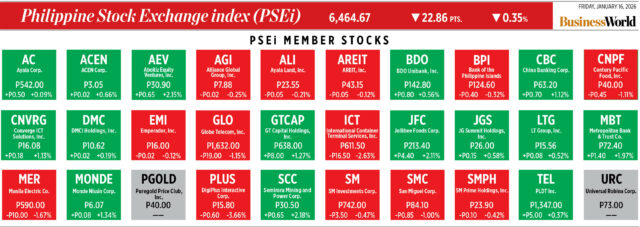
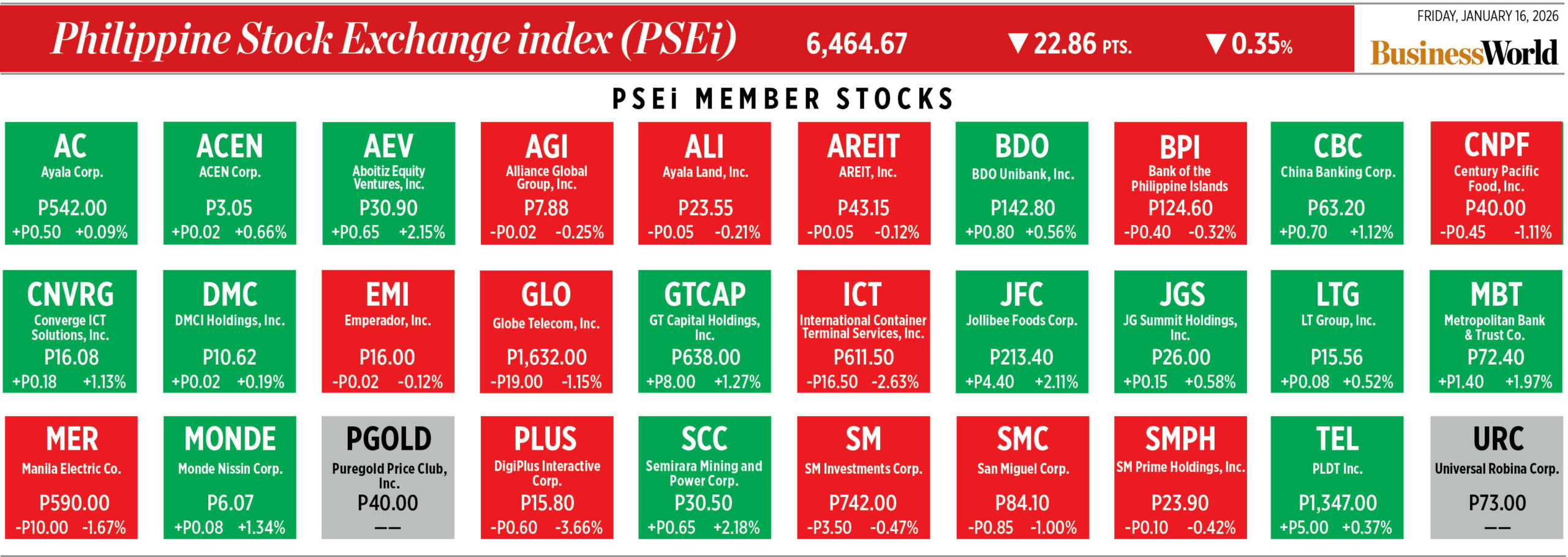
How PSEi member stocks performed — January 16, 2026

Here’s a quick glance at how PSEi stocks fared on Friday, January 16, 2026.


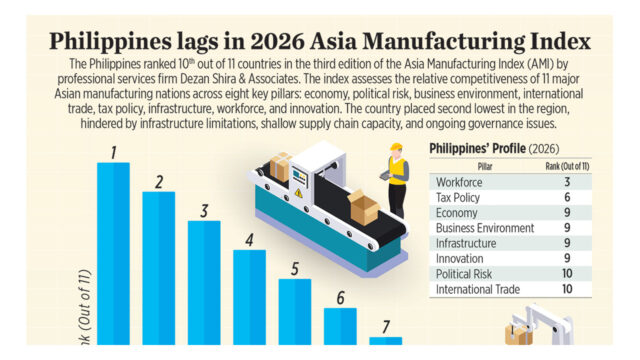
Philippines lags in 2026 Asia Manufacturing Index

The Philippines ranked 10th out of 11 countries in the third edition of the Asia Manufacturing Index (AMI) by professional services firm Dezan Shira & Associates. The index assesses the relative competitiveness of 11 major Asian manufacturing nations across eight key pillars: economy, political risk, business environment, international trade, tax policy, infrastructure, workforce, and innovation. The country placed second lowest in the region, hindered by infrastructure limitations, shallow supply chain capacity, and ongoing governance issues.

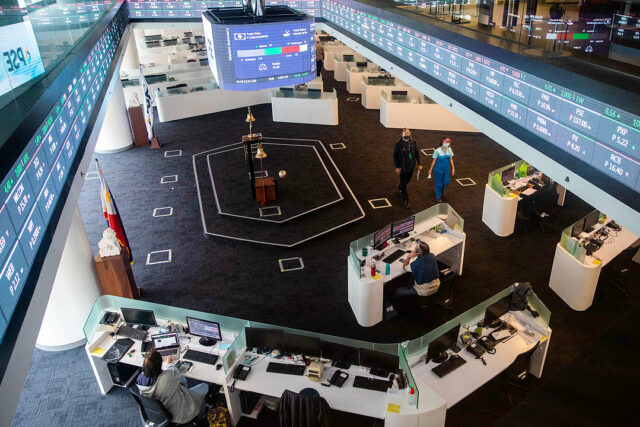
Stocks may drop as players book gains from rally

REUTERS

PHILIPPINE SHARES could decline this week as investors continue to book their gains from the market’s recent rally and with the peso’s weakness weighing on sentiment.

On Friday, the Philippine Stock Exchange index (PSEi) fell by 0.35% or 22.86 points to end at 6,464.67, while the broader all shares index edged down by 0.22% or 8.37 points to close at 3,652.33.

Meanwhile, week on week, the PSEi climbed by 116.53 points from its Jan. 9 finish of 6,348.14, marking its fourth consecutive week of gains.

“The local market continues with its bullish move, extending its rally to a fourth straight week. Other numbers are also encouraging with net value turnover averaging P6.64 billion, reflecting quite strong conviction. Net foreign buying is already on an 11-day streak amounting to P5.61 billion,” Japhet Louis O. Tantiangco, Research Manager at Philstocks Financial, Inc., said in a Viber message.

“The local bourse rallied [last] week, buoyed by bargain hunting in index heavyweights and rate-sensitive names. Confidence took its support from a potential February BSP (Bangko Sentral ng Pilipinas) rate cut and cheap valuations,” 2TradeAsia.com said in a market note.

BSP Governor Eli M. Remolona, Jr. this month said that a cut remains on the table at the Monetary Board’s Feb. 19 meeting, even as he noted that the policy rate of 4.5% is already “very close” to where they want it to be, signaling an imminent end to their easing cycle.

The Monetary Board has lowered benchmark borrowing costs by a total of 200 basis points since this current rate cut round began in August 2024.

Meanwhile, analysts have said that the central bank could still ease further to help support domestic demand as prospects have weakened due to a wide-ranging corruption scandal that has stalled both public and private investments, dragging economic expansion.

For this week, Mr. Tantiangco said profit taking could weigh on the local market, adding that valuations remain at bargain levels despite the market’s recent climb.

“The peso’s weakness, if it extends, may also challenge the local bourse,” he said.

On Thursday, the peso slumped to a new record low of P59.46 versus the dollar. It rebounded on Friday, closing the week at P59.35.

“On a positive note, hopes that the BSP would cut rates in their February meeting may give the market support. Investors are also expected to be on the lookout for further catalysts,” Mr. Tantiangco said.

He added that the market remains “bullishly biased” as it is now trading above its 10-day, 50-day, and 200-day exponential moving averages.

He put the PSEi’s support at 6,400 and resistance at 6,600.

For its part, 2TradeAsia.com placed the PSEi’s immediate support at 6,350 and resistance at 6,500-6,600. — A.G.C. Magno

Watchdog flags graft risks across PHL health and education spending

PEOPLE raise their placards during the 2nd Trillion Peso March at the People Power Monument in Quezon City on Nov. 23, 2025. — PHILIPPINE STAR/MIGUEL DE GUZMAN

By Chloe Mari A. Hufana and Adrian H. Halili, Reporters

CORRUPTION risks in the Philippines’ 2026 national budget are shifting beyond infrastructure to health and education spending, a budget watchdog said, warning that weak safeguards during implementation could expose some of the government’s biggest social programs to political interference.

Social Watch Philippines said allocations approved by Congress for education facilities and health assistance warrant closer scrutiny as the P6.793-trillion General Appropriations Act moves from legislation to execution, particularly after a recent graft scandal involving public works projects.

“Corruption risks are not unique to infrastructure agencies,” Alce C. Quitalig, senior budget analyst at Social Watch Philippines, said via Viber. “The education and health sectors likewise contain questionable budget provisions that warrant close scrutiny.”

The group flagged funding increases added by lawmakers to the Department of Education’s basic education facility program beyond the agency’s original proposal, as well as allocations for the Department of Health’s (DoH) Medical Assistance to Indigent and Financially Incapacitated Patients approved at the bicameral conference stage.

President Ferdinand R. Marcos, Jr. signed the 2026 budget on Jan. 5 after vetoing P92.5 billion in unprogrammed funds. The spending law was passed amid heightened concern over corruption following revelations of misuse of public works funds.

One reform included in the budget was the removal of politicians’ guarantee letters for the DoH program, ending the requirement for endorsements to access hospital bill assistance. The DoH is set to issue revised guidelines by February to simplify procedures, widen coverage and reduce political influence in aid distribution.

Education again received the largest share of the budget, in line with constitutional requirements, with a record P1.345-trillion allocation. The health sector was allotted P448.125 billion, also its highest on record.

Corruption risks in these sectors are structural given the scale of procurement, logistics and documentation involved, said Hansley A. Juliano, a political science lecturer at the Ateneo de Manila University.

“Even during the 1990s, corruption and overpricing of procurement persisted, either to launder money or facilitate patronage,” he said via Facebook Messenger. He added that urgency in delivering health and education services creates pressure points where rules could be bent.

As implementation begins, Mr. Quitalig said the President has broad authority under the budget to enforce accountability, including the power to suspend or withhold expenditures when public interest requires. The challenge, he said, lies in enforcement.

The central issue is implementation — whether these provisions are enforced in good faith or circumvented, ignored or violated in practice, he pointed out.

Social Watch Philippines urged stronger citizen oversight, calling for wider use of budget monitoring, procurement observation, participatory audits, and transparency seal data. It also pushed deeper institutional reforms, including full civil society membership in the state’s bids and awards committees, passage of a Freedom of Information law, and a national budget transparency platform that tracks outcomes.

Despite existing safeguards, the group said restrictions on cash aid distribution and limits on political branding in government projects remain weak, warning that poorly framed implementing rules could entrench patronage practices if left unchecked.

Sustainable accountability, it said, depends on stronger enforcement by the Executive branch, sustained legislative oversight and active public participation in monitoring how funds are spent.

‘LEGISLATIVE CORRECTIONS’
The Senate should begin examining projects that combine large budgets with weak oversight mechanisms, said Ederson DT. Tapia, a political science professor at the University of Makati.

“These include major transport projects with repeated cost overruns, digital and ICT (information and communications technology) systems procured under claims of innovation but shielded from scrutiny, and climate-related infrastructure where urgency often substitutes for accountability,” he said in a Messenger chat.

The Senate Blue Ribbon Committee could also look into social welfare programs and other forms of infrastructure, including public roads, said Anthony Lawrence A. Borja, an associate political science professor at De La Salle University.

“It should veer off to other public projects like social welfare programs,” he said via Messenger. “Looking into other forms of infrastructure would also be good, especially public roads.”

Mr. Borja added that the Senate body should take a broader approach and coordinate closely with government investigative bodies.

“If the Senate committee wants to show it is serious about accountability, investigations should be more comprehensive and in lock step the work of agencies like the Office of the Ombudsman,” he said.

The Blue Ribbon Committee has been investigating irregularities in flood control projects since August, following reports that government officials and senior lawmakers might have received multibillion-peso kickbacks from funds allocated for flood mitigation.

The hearings have become a key source of leads for the government’s anti-corruption drive, with testimonies used as bases for filing cases against officials and contractors.

Mr. Tapia said the Senate panel might already have fulfilled its fact-finding role on flood control projects and should begin wrapping up the inquiry.

“Closure should be accompanied by clear attribution of responsibility, documented referrals to enforcement agencies and a short list of legislative corrections,” he said. “Otherwise, ending merely becomes another form of forgetting.”

He warned that extended hearings could detract from the Senate’s legislative work, including reforms related to the budget process, climate adaptation and social protection.

“Excessive investigation can paradoxically weaken the capacity of Congress to correct what it has exposed,” Mr. Tapia said. “We should pay more attention to building and strengthening institutions.”

Joy G. Aceron, convenor-director of transparency group G-Watch, said the flood control investigation remains relevant but should now focus on policy failures.

“The Senate needs to start zeroing in on the policy issues that led to the plunder, since Senate hearings are in aid of legislation,” she said via Messenger.

She said lawmakers should examine weak accountability systems and how contractors exploit procurement rules, adding that both areas need legislative action.

Senator Panfilo “Ping” M. Lacson, who heads the Blue Ribbon Committee, said hearings are set to resume on Jan. 19.

The next hearing will tackle the so-called Cabral files, which allegedly detail budget insertions, infrastructure projects and kickbacks linked to flood control and other public works.


Storm Nokaen batters eastern Philippines as it moves offshore

PAGASA

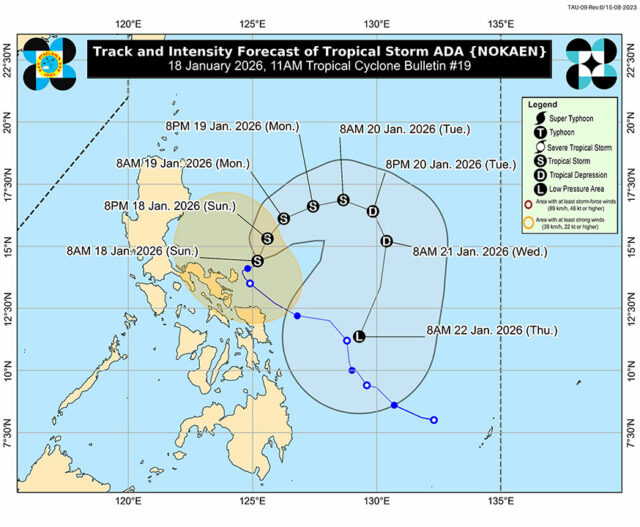
TROPICAL STORM Nokaen, locally known as Ada, is expected to track farther away from land while maintaining its strength over the next 24 hours, though the state weather bureau warned that strong winds, rain and rough seas would continue to affect large swaths of eastern Philippines as the northeast monsoon intensifies.

Ada was last seen on Sunday about 140 kilometers (km) northeast of Virac, Catanduanes, slowly moving east-northeast with maximum sustained winds of 75 kilometers per hour, according to the Philippine Atmospheric, Geophysical and Astronomical Services Administration (PAGASA).

The storm was forecast to continue moving northeastward through Monday before shifting into a looping track over the Philippine Sea east of Luzon, it added.

It said Ada was likely to remain a tropical storm as it stays offshore before weakening into a tropical depression by Tuesday and further slowing into a low-pressure area by Thursday as monsoon winds strengthen.

An earlier weakening remains possible, it added, while cautioning that heavy rain and strong winds could still occur outside the forecast track and confidence cone.

Wind Signal No. 2 was expected to stay in place over Catanduanes and parts of Camarines Sur, with Signal No. 1 covering portions of southern Quezon, the Bicol Region and Northern Samar, posing minimal to moderate risks to life and property.

Beyond the storm’s immediate circulation, enhanced monsoon winds were forecast to bring strong to gale-force gusts to northern and eastern Luzon, Bicol and parts of Eastern Visayas through Tuesday.

Coastal flooding remained a concern in low-lying communities in Camarines Sur, Catanduanes, Albay and Sorsogon, where storm surge of up to two meters was possible within the next 24 hours.

At sea, rough to moderate conditions were forecast to persist along the eastern seaboards of Luzon and parts of the Visayas, prompting warnings for small vessels to avoid sailing as authorities brace for lingering weather disruptions even as the storm gradually weakens.

The storm’s forecast positions showed a continued drift away from land: by 8 p.m. on Sunday, Ada was expected to be 425 km east of Infanta, Quezon; by 8 a.m. on Monday, 500 km east of Baler, Aurora; and by 8 p.m. on Monday, 565 km east of Casiguran, Aurora. 

On Tuesday, it was projected to be 705 km east of Casiguran in the morning and 830 km east of Central Luzon by evening.

By Wednesday morning, Ada was expected to be 810 km east of Southeastern Luzon and then 390 km east of Guiuan, Eastern Samar by Thursday.

Meanwhile, Ada had already triggered flooding, landslides and transport disruptions, according to an 8 a.m. situation report from the National Disaster Risk Reduction and Management Council.

More than 10,000 people had been affected, with evacuations underway in several regions. It was earlier reported that two died in Region 5.

Authorities reported flooded communities in Bicol and Caraga, damaged roads and bridges, power interruptions and the suspension of sea travel in dozens of ports, leaving thousands of passengers and cargoes stranded. — Chloe Mari A. Hufana

Lawmakers reposition as corruption row dogs Marcos

PRESIDENT FERDINAND R. MARCOS, JR. FACEBOOK PAGE

By Kenneth Christiane L. Basilio, Reporter

LAWMAKERS are expected to begin repositioning and quietly shifting allegiances this year as President Ferdinand R. Marcos, Jr.’s influence over Congress weakens, with a widening graft scandal complicating efforts to hold the ruling coalition together, political analysts said over the weekend.

Senators and congressmen are expected to start hedging as Mr. Marcos enters the “lame duck” phase, when presidential influence traditionally fades in the second half of a six-year term.

That decline, they said, is being accelerated by corruption allegations tied to government infrastructure projects, which have weighed on public trust and unsettled political alliances.

“The positioning for 2028 is already happening,” Ederson DT. Tapia, a political science professor at the University of Makati, said in a Facebook Messenger chat. “You can see it in who chooses to speak loudly, who suddenly rediscovers independence and who carefully avoids being too closely associated with unpopular decisions.”

Public support for the President has weakened. A December survey by the Social Weather Stations showed Mr. Marcos’ net trust rating slipping to -3 from +7 in September, reflecting growing frustration among Filipinos over corruption issues and governance concerns.

Congress is set to resume session on Jan. 26, with lawmakers returning amid lingering outrage over irregularities in flood control projects and looming impeachment complaints against both Mr. Marcos and Vice-President Sara Duterte-Carpio.

The administration is also pushing legislation it says will address corruption concerns and ease business conditions, even as scrutiny of public spending intensifies.

The Philippines ranked 114th out of 180 countries in the 2024 Corruption Perceptions Index, underscoring the depth of governance challenges confronting the administration. Analysts said that while bills framed as vital for economic recovery are likely to pass, tougher measures that threaten entrenched interests might struggle.

“Reforms especially those involving accountability, redistribution or entrenched interests may face stronger resistance,” Mr. Tapia said. “Legislators have begun to ask why they should absorb political risk for a President whose influence is perceived to be declining.”

Arjan P. Aguirre, a political science lecturer at the Ateneo de Manila University, said allies of Mr. Marcos might try to keep the coalition intact by distributing political favors and maintaining access to resources. However, he said this approach faces limits.

“The controversy surrounding flood control projects, increasing public demand for transparency in the budget process and growing resistance to discretionary funds all limit the administration’s room to maneuver,” he said via Messenger.

He added that the same scandal could also be used as a tool to enforce discipline within the ruling bloc.

“Many incumbents and established political families have been linked — directly or indirectly — to these projects during the 19th and 20th Congresses, making them vulnerable to political pressure,” Mr. Aguirre said.

Anthony Lawrence A. Borja, an associate political science professor at De La Salle University, said Mr. Marcos could still retain some control over lawmakers if corruption investigations remain credible and active.

“The President can maintain some semblance of control if the threat of being subject to corruption-related investigations remains credible,” he said in a Messenger chat. “If the corruption investigations intensify, then Mr. Marcos might get a better grip on legislators.”

Authorities have accused several government officials, politicians and private contractors of diverting funds meant for flood mitigation projects in a country frequently battered by typhoons. Some contractors and lower-level public works officials have been arrested, but no senior politicians have been detained so far.

Despite these pressures, analysts said a sudden collapse of the ruling coalition is unlikely. Instead, lawmakers are expected to move cautiously as they assess political winds ahead of the 2028 presidential race.

“Defections will come, but not immediately,” Mr. Tapia said. “What we are seeing first is hedging. Legislators are testing how far they can go without fully severing ties.”

Bonoan back in PHL, BI says

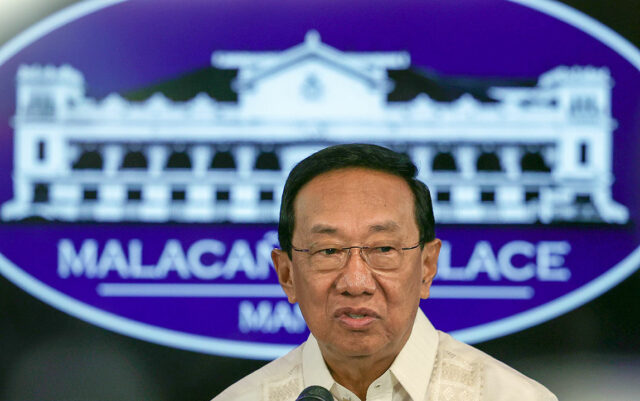
Former Public Works Secretary Manuel M. Bonoan speaks during a press briefing in Malacañang, March 14, 2023. — PHILIPPINE STAR/KRIZ JOHN ROSALES

FORMER Public Works Secretary Manuel M. Bonoan returned to Manila from the United States on Sunday, the Bureau of Immigration (BI) confirmed, amid ongoing inquiries into alleged anomalous flood control projects during his tenure.

“Bonoan arrived aboard China Airlines flight CI0701 from Taipei,” the BI said in a statement on Sunday. “Records indicate he left the country last year to accompany his wife for a medical procedure.”

Mr. Bonoan is subject to a travel lookout issued by the Department of Justice (DoJ) following legislative and executive scrutiny of purported ghost projects under the Department of Public Works and Highways. BI Commissioner Joel Anthony M. Viado said the bureau had already informed the DoJ of his arrival.

The former official is expected to attend a Senate Blue Ribbon Committee hearing on Monday, Jan. 19, after a subpoena was issued last week. Senate President Pro Tempore Panfilo “Ping” M. Lacson had noted that the subpoena could be withdrawn if the DoJ approved an extension of Mr. Bonoan’s stay abroad.

The senator earlier said that Mr. Bonoan had submitted documents to Malacañang that allegedly contained incorrect grid coordinates for thousands of flood control projects.

The DoJ had approved his request to remain in the US until mid-February, making his return ahead of schedule. — Erika Mae P. Sinaking

Bill resetting BARMM polls filed

@BANGSAMOROGOVT

A SENATOR has filed a bill setting the Bangsamoro Autonomous Region in Muslim Mindanao’s (BARMM) parliamentary elections in March 2026.

Under Senate Bill No. 1587, Senator Juan Miguel F. Zubiri proposed to set the BARMM election to March 30, with the elected officials’ term of office commencing at noon of April 30.

“It has been more than six years since the BARMM was established, and the Bangsamoro people have yet to exercise their power to elect their own leaders,” he said in a statement.

The bill mandates that the next BARMM parliamentary elections coincide with the 2028 national elections and should be held after three years.

It also orders the Commission on Elections, through the Bangsamoro Electoral Office, to promulgate rules and regulations for the conduct of the elections and enforce and administer it in pursuant to national law, the Bangsamoro Organic Law and the Bangsamoro Electoral Code.

The bill also states that the Bangsamoro Transition Authority (BTA) will continue as the interim government of BARMM during the extension of the Transition Period, unless the President replaces any interim members or their tenure is shortened by election to another office.

The interim members will serve until their successors have been elected and qualified in an automated election.

“It is very important that the BARMM elections proceed. Let us pray for the speedy enactment of our proposal so that preparations can be completed in March,” the senator said.

The BARMM was initially set to hold its first election in October last year, this was postponed following the Supreme Court’s ruling that declared as unconstitutional two laws passed by the BTA creating and reconstituting parliamentary districts. — Adrian H. Halili

DoF may secure loans for military modernization

THE Philippines’ Finance department is authorized to secure loans for modernizing the Southeast Asian nation’s armed forces, a congressman said on Sunday, a move that may give military planners fresh funding sources to sustain the buildup.

Lawmakers have authorized the Finance department chief to enter into loan agreements to fund the Philippines’ military modernization under the 2026 budget law, a power not previously allowed, House Minority Leader and Party-list Rep. Marcelino C. Libanan said.

“This special provision gives the national government greater flexibility to finance critical modernization projects in a timely and cost-effective manner,” he said in a statement. “Access to a mix of financing options — such as concessional loans, grants, or blended facilities — can significantly reduce costs and speed up project delivery.”

The Philippines is at the tail-end of its military modernization program called “Horizon,” which began in 2012 when tensions with China flared after a naval standoff at Scarborough Shoal in the South China Sea. Manila has earmarked about $35 billion for military upgrades in the next decade.

Mr. Libanan said the 2026 budget law allows the Finance department to “negotiate, contract, and enter into foreign and domestic financing arrangements, including but not limited to loans, grants, credit facilities, and blended financing mechanisms” for the military modernization program.

Any funding schemes need to have President Ferdinand R. Marcos, Jr. and the Monetary Board’s approval, he added. — Kenneth Christiane L. Basilio

ADVERTISEMENT
ADVERTISEMENT