Home Blog Page 4223

More sleepless nights in the Palace

THIS piece is based on what we wrote yesterday on the Philippines’ headline inflation for September in our capacity as the new GlobalSource Partner for the Philippines. Our friend and colleague at the Foundation for Economic Reforms, Romy Bernardo, asked us to assume this role as he swore in as a member of the Bangko Sentral ng Pilipinas (BSP) Monetary Board. For whatever we could contribute to a greater understanding of the Philippine economy and politics, outside our two weekly columns, Romy got it for a bottle of mineral water. We hope we can convince our potential foreign investors that our public policy and political leadership are stable, and that economic management in this country is much more profound and informed than what they see. Needless to say, it is not our commentaries, or those of others, that would bring in new foreign money, but it is the actual demonstration of good and competent governance by those in authority.

An excellent case in point is inflation management.

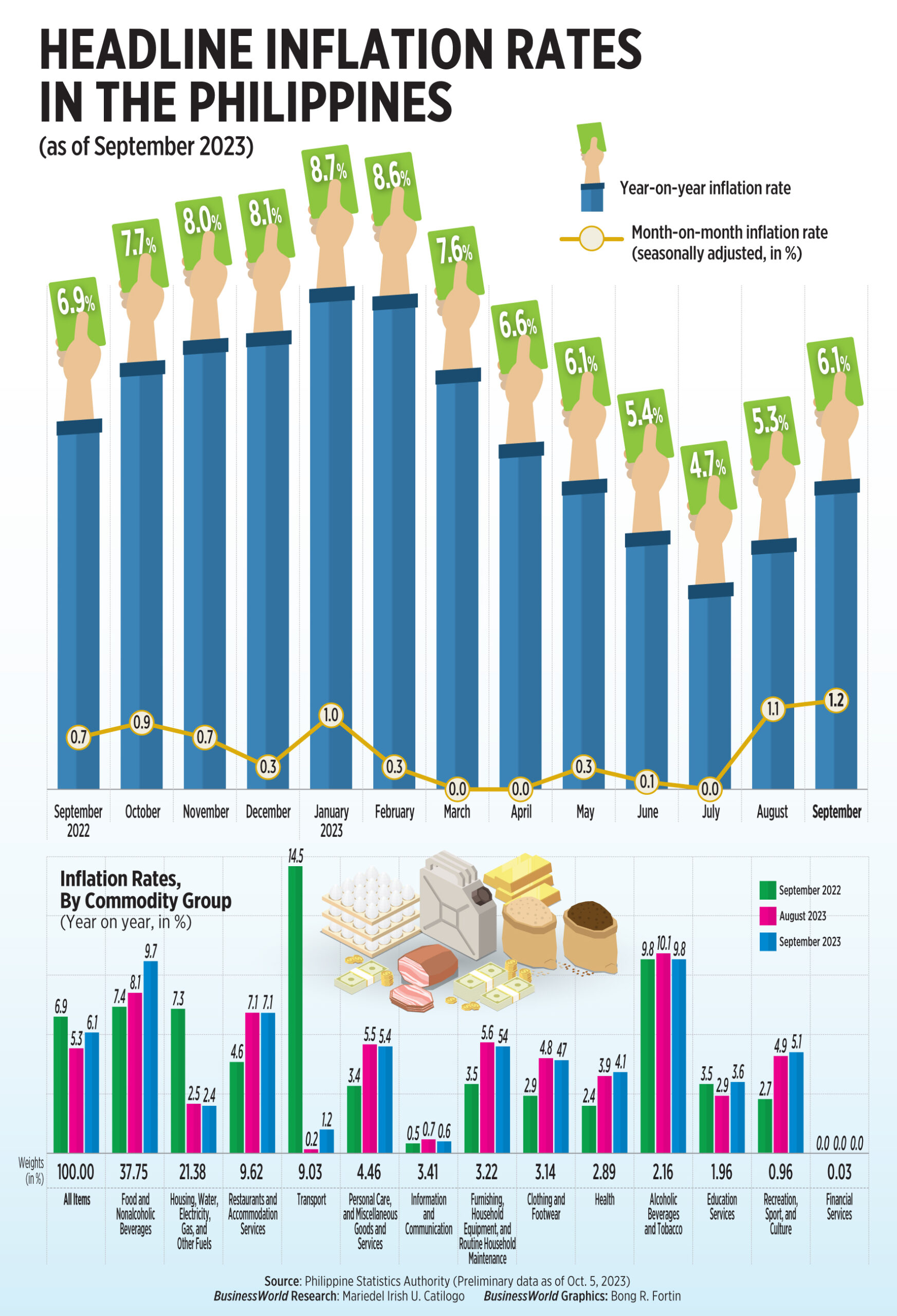
Yesterday, the Philippine Statistics Authority (PSA) announced a most disconcerting statistic, and that is that the Philippine headline inflation for September was 6.1%. What this number is telling us is that, one, it is several basis points higher than the August inflation of 5.3%; two, it kept the year-to-date average inflation at 6.6% which is way above the 2-4% inflation target of the National Government (NG) and the latest BSP forecast of 5.8%; and, three, if this trend is sustained, the slowdown in real GDP to 4.3% that we witnessed in the 2nd quarter is likely to continue because inflation depresses domestic consumption and discourages investment.

Such momentum seems to not be letting up. The month-on-month inflation based on the PSA report is 1.1% which, when translated to annual growth, represents 13% inflation. To be sure, the breakdown of the inflation dynamics is a mirror image of the failure of governance as far as controlling inflation is concerned.

The main driver of September inflation’s further advance was, of course, the heavily weighted category of food and non-alcoholic beverages which moved by near double digits at 9.7%. This group accounts for 38.34% of the consumer basket. Of the 6.1% annual increase in domestic inflation in September, it accounted for 61% or 3.7 percentage points (ppts), together with restaurants and accommodation services with 11.4% share or 0.7 ppt, and, finally, housing, water, electricity, gas and other fuels, with an 8.6% share or 0.5 ppt.

Of the food items, the major driver was rice inflation, rising by 17.9% in September against August’s only 8.7%, reflecting the serious supply problem and the failure to import a sufficient volume of rice before the harvest season. More fundamentally, the government has also failed to address the root problem of land use and agricultural productivity. Running after hoarding and profiteering involving this staple commodity would have limited impact; the rice crisis is not an issue of law enforcement. It’s a question of sound judgment and administration. Price control and the rejection of the proposal to temporarily reduce the rice tariff did not help any. Rice became inaccessible to many ordinary Filipinos who must be feeling left behind by this time.

The problem with the other inflation drivers can also be traced to weak public policy. Housing prices have increased because supply could not cope with the rising demand of a rising population. Water remains a paradox in the Philippines: we don’t have water when we need it, but there is too much of it when we don’t need it. Good public policy could have caused the construction of more dams and water impounding facilities, and irrigation. We wasted the Malampaya gas field and all the cash resources associated with it.

How is the Filipino civil society taking it?

The Pulse Asia Survey results of Sept. 10-14 said it all.

President Ferdinand Marcos, Jr. suffered a major decline in his approval rating as consumer prices in the Philippines weakened his base support. Some 65% of the 1,200 respondents approved of his performance, but this was down 15 ppts from 80% in an earlier poll in June. After all, didn’t he promise to reduce the price of rice to P20 per kilo?

The Filipino people are simply demanding a receipt.

And when they rate, they rate wholesale. The decline in popular support was not limited to the President. The Vice-President also suffered an erosion of public trust. Likewise, all the heads of key government agencies did not see the people trusting them more.

And this trend may not reverse very soon. Inflation may be here to stay, at least until the end of the year through early next year. Upside risks are just too great, and their likelihood of happening may not exactly be trivial.

With this latest inflation outturn, and the BSP’s elevated inflation forecasts for this year and the next, we don’t see monetary policy shifting out of a pause. The BSP itself admitted during the last press conference on monetary policy in September that upside risks continue to be dominant. These risks include higher prices of fuel and, consequently, transport and food prices. The prolonged dry spell of El Niño could exacerbate the unfavorable price condition. We have also seen that many regional productivity and wage boards have already approved the additional wage increase petitions. The secondary effects are nearly in full swing.

We believe that if all those risks materialize, it is possible even the 2024 within-target forecast of 3.5% could breach the 2-4% inflation target. What we see happening is that in the next meeting, if the October inflation sustains this uptrend, the BSP must then be more than prepped up to adjust by another 25 to 50 basis points, especially if core inflation blips up again.

Clearly, the Pulse Asia Survey and the latest inflation footprint make a strong case against the poor management of inflation in the Philippines.

On inflation expectations, analysts and forecasters appear broadly consistent with the BSP’s own forecasts for this year, but the two-month inflation trend might help de-anchor them. Most of them were quite on the low side of the BSP’s forecast range. While monetary policy could inspire better prospects, the non-monetary interventions are failing miserably.

Yes, headline inflation remains supply driven — even as core inflation sustains its elevated readings — but policy makers should try to avoid repeating the mistake of last year. Supply shocks should not be immediately dismissed as transitory. As it turned out, they could be more persistent with large, second-round effects.

After all, we believe that even with the economic scarring during the pandemic, the Philippine economy has somewhat recovered quite reasonably quick. The output gap must be generally neutral with the phase down of economic momentum. This was never lost on both private sector analysts and international financial institutions that all downgraded the growth prospects for this year and the next.

The point is that the economy continues to grow, and in that respect, monetary policy continues to enjoy some space to sustain its battle against inflation and the National Government to do its share on the supply side.

We recall that last year, the President expressed his concern over rising prices, that they were giving him sleepless nights. Since then, prices have remained elevated. But lest anyone forget, higher inflation does not only produce sleepless nights in the Palace, but could also reduce economic growth. And erode public trust and confidence.


Diwa C. Guinigundo is the former deputy governor for the Monetary and Economics Sector, the Bangko Sentral ng Pilipinas (BSP). He served the BSP for 41 years. In 2001-2003, he was alternate executive director at the International Monetary Fund in Washington, DC. He is the senior pastor of the Fullness of Christ International Ministries in Mandaluyong.


Good morning Vietnam

MOVIE REVIEW
The Creator
Directed by Gareth Edwards

GARETH Edwards’ The Creator begins with a prologue updating us on recent history: an AI detonates a nuclear device in Los Angeles and Western nations outlaw machine intelligence; a country called New Asia defies the ban and allows peaceful coexistence, and in response the United States wages an extended military campaign against said nation, seeking to assassinate the intelligences’ chief designer Nirmata (“creator” in Sanskrit).

The film proper begins with a raid on a beachside home: Sgt. Joshua Taylor (John David Washington) happily lives there with his pregnant wife Maya (Gemma Chan); turns out Taylor had gone undercover to try get close to Maya, who’s believed to be the daughter of the mysterious Nirmata — falling in love with her wasn’t in his brief. The raid ends with Maya and her unborn child killed by NOMAD, short for North American Orbital Mobile Aerospace Defense — an all-seeing Angel of Death holding its Damoclean sword over the world, ready to smite all things artificial.

Five years later Taylor is dragged back in from a Los Angelos ground zero cleanup detail and handed a new assignment: turns out Maya may still be alive, and involved in her father’s project to build a weapon meant to end the war. Midway through the mission Taylor finds the weapon: a robot in the guise of a small girl (Madeleine Yuna Voyles), a “simulant” with the ability to turn on and off other machines at a distance, at will — basically a bipedal remote control. The robot has the words Alpha-Omega etched on the side of its head; Taylor decides to call her “Alphie.”

The film is actually quite fun, with Edwards’ relatively clean staging of action sequences and firefights, and the occasional striking imagery: NOMAD gliding across the sky’s upper reaches like a triumphant angel out of Neon Genesis Evangelion, screening the ground with a curtain of blue light for subversive elements; when it finds any — a rebel base say or a village hiding AI troops — it hurls a rocket-propelled slug downwards and the land erupts in a burst of heavenly fury. Think of Indra flinging lightning bolts at his enemies, or God wiping Sodom and Gomorrah off the face of the earth — the visuals are well-done, but what sells the moment is Edwards’ use of sound — the hum of the blue curtain, the slight phht! of the missile, the breathless pause, the numbing roar. Stealthy giant predators seem to be an Edwards specialty, as evidenced by his depiction of a surprisingly nimble Godzilla stalking the edges of his own movie before making a full-frame appearance in the epic finale — call NOMAD the sleeker more sinister hi-tech equivalent.

The weakest element is the script. The premise is inventive enough: yet another battle between humans and robots (Edwards cites Blade Runner as an influence) where the humans code as oppressive American military and robots code as valiant Vietnamese insurgents. Maybe the biggest difference is that Blade Runner reeks of film noir, while this explicitly plays on imagery from Francis Ford Coppola and Oliver Stone; the scene of a US soldier ransoming a dog at gunpoint before a weeping Vietnamese — sorry, New Asian — child is a direct quote from Platoon. The rhetoric is about as simplistic: Ugly Americans on a rampage in peaceful Southeast Asian country (the film was shot in Thailand) — we’re not meant to question if perhaps the American military might have a point (the nuking of Los Angeles is what started all this), or if AIs could be trusted not to exterminate us when they’ve gained the upper hand.

That and a plot that seems to count on characters making the dumbest decisions (skip the next three paragraphs if you plan to see the film).

NOMAD is the most egregious example: spending a trillion dollars on the world’s biggest drone seems like a debatable use of taxpayers’ money — it’s an easy open target for missiles and a powerful symbol to rally against (the New Asians and AIs stand solidly against the Western invader); likewise making the counterweapon a child that still has to grow into full power — why not just build an adult model bulked up with extra batteries (that said, would Arnold Schwarzenegger be as adorable?)? When the bipedal bomb sprints down the bridge seemingly impervious to small-arms fire, no one thinks of blowing up the bridge; likewise, when Alphie and Taylor are surrounded by robot police, no one thinks to ask Alphie to switch them off.

Taylor is recruited to the new mission because two-day-old footage was found of Maya walking about, with analysis certifying that Maya was human; when Taylor finds her in a five-year coma no one even bothers to explain the discrepancy (Was the footage a lie? An old recording mistaken for new? A simulant misidentified as human?). When Taylor forms a plan to smuggle Alphie up to NOMAD, he doesn’t think beyond pausing NOMAD’s operations long enough to plant a mine (meanwhile a few more thousand AIs are destroyed). When simulant and former ally Harun (Ken Watanabe) tells Taylor that the destruction of Los Angeles was “an accident” and not the AI’s fault, Taylor doesn’t bother to question the truth of his friend’s statement — does Taylor trust Harun that much or is he that gullible? Or if the point is moot (he started it / no he started it!) why not say so?

Likewise, we’re told by the military that when Alphie is deactivated, she’d normally be taken up to NOMAD for analysis — but they’ve decided on immediate cremation. Couldn’t the writers just send her up directly, or did they need yet another escape sequence, this time from an armored vehicle? When Alphie finds a Maya simulant aboard NOMAD and spends precious time trying to revive her while Taylor waited in the escape pod — did anyone realize that Alphie’s little side mission may have killed Taylor? Maybe exploit this development somehow? 

Which matters less than one might expect; the film carries you along with the solid emotional throughline of Taylor’s emerging relationship with Alphie, so that by the end of the picture you’re invested in the notion that the two stay together. We could use more definition to Alphie’s character — but she’s a blank slate after all, waiting for a personality to be written in; thankfully she isn’t the standard-issue wisecracking brat so prevalent in recent Hollywood movies.

As interesting if not more so was Edwards’ methods in making the picture — just shoot on location, assemble the footage, add special effects in postproduction. Done this way Edwards only spent $80 million on a film that could have cost $300 million — and the results look fairly good, even if story and plot don’t enjoy the same level of plausibility.

Especially interesting is the film’s stance on machine intelligence, which runs counter to the popular sentiment that artificial intelligence (AI) is to be feared not embraced (Taylor does the latter, literally). Edwards’ interviews suggest he took the position opportunistically without giving it much thought, which may be unfortunate — the film did a miserly $32 million first weekend, and may struggle to earn back its relatively low production cost. If you’re going to jeopardize your commercial prospects with a contrarian idea, it would probably be more worthwhile if it was at least an interesting contrarian idea — “Love thy enemy” is as old as the bible. I’m thinking of Kubrick’s 2001 — with only the sound of an actor’s cool voice on the soundtrack barely suppressing the onset of panic and mental degradation, Kubrick provokes more sympathy for a rogue computer than for, well, practically any other character in his filmography.

Meanwhile we have this, which isn’t as bad as one might fear, but isn’t quite as good as one might hope.

InLife expects to meet NBAPE, profit goals

INSULAR LIFE Assurance Co., Ltd. (InLife) saw its new business annual premium equivalent (NBAPE) more than double in the first half, putting it on track to exceed the insurer’s annual target.

InLife’s NBAPE more than doubled (127%) to P1.706 billion in the first half from the same period a year ago, it said.

“We will exceed our NBAPE (sales) target this year. As of the first half this year, we are at 127% increase already over the same period last year. And we see this growth momentum being sustained,” InLife President and Chief Executive Officer (CEO) Raoul Antonio E. Littaua said in a statement on Thursday. However, InLife did not disclose its NBAPE target for the year.

He said during a briefing in Makati City on Thursday that he expects that the firm’s NBAPE will end the year “almost double.”

However, InLife’s net income will “not necessarily follow the same growth rate,” Mr. Littaua said.

“Profit emergence for a life insurance company does not happen in the first year, and it will take some time before the remarkable topline growth we are currently experiencing significantly impacts net income,” he said.

“So, for this year at least, the parent company’s net income will not be too far off from last year’s,” he added.

InLife’s consolidated net income stood at P5.2 billion in 2022, up around 35% from 2021.

InLife Chief Operating Officer Efren C. Caringal, Jr. said they will “definitely not hit” the same level of net income last year, but they will exceed their planned income for the year. InLife did not specify its income target.

“We will meet our target for the year, but even coming into 2023, we knew it’s going to be difficult to replicate or sustain that (2022 level),” Mr. Littaua added.

InLife’s income will be lower amid one-off gains last year and the nature of “long-term business” in insurance, Mr. Caringal noted.

“In life insurance, you notice that the emergence of profit is different. Generally, at the start of the product, there’s higher distribution cost, etc. and your profit will emerge over at a later (period),” he said.

“Therefore, short-term profits would be lower, but long-term profitability is going to be good. That’s our strategy now.”
Meanwhile, Mr. Caringal added that elevated interest rates work in favor of insurers.

“With the high interest rate environment, insurers are able to introduce much higher yielding investment products. That’s where we see significant growth, at least, in the last year for us. We offer what we call endowment products. These are not just pure protection — there are benefits that we pay basically when they’re alive. We’re able to give higher yields, higher coupon, for them because of the high interest rate environment,” he added.

The Bangko Sentral ng Pilipinas (BSP) raised borrowing costs by 425 basis points (bps) from May 2022 to March 2023. This brought the key interest rate to a near 16-year high of 6.25%.

Meanwhile, elevated inflation has affected insurance demand, Mr. Caringal added.

“Insurance is not really top of the basket of goods that a consumer would buy. Generally, when inflation is high, you would see a smaller savings rate in general. But still, the reality in the Philippines is that the insurance penetration is very low, so there’s really room to grow. It’s a matter of increasing the financial literacy of Filipinos,” he said.

Headline inflation accelerated to 6.1% in September from 5.3% in August and 6.9% in the same month a year ago.

This marked the 18th straight month that inflation breached the central bank’s 2-4% annual target. — Luisa Maria Jacinta C. Jocson

Prime Media eyes new platforms for joint venture forged with ABS-CBN

PHILIPPINE STAR/BOY SANTOS

PRIME MEDIA HOLDINGS, Inc. is looking at expanding into other platforms via Media Serbisyo Production Corp. (MSPC), the joint venture company it forged with ABS-CBN Corp.

“MSPC President Marah Capuyan anticipates a forthcoming milestone, including a shift to 24/7 operations and extending their reach to platforms such as YouTube and other social media networks,” Prime Media told the stock exchange on Thursday.

TeleRadyo Serbisyo and DWPM Radyo 630 highlight the joint venture’s offering. The listed company said the two “will continue to redefine public service broadcasting with an unwavering commitment to the entire Philippines and Filipinos worldwide.”

The public service programs started operations in June this year.

“Since the launch on June 30th and in just a period of 90 days, they have undertaken an impressive journey, operating seven days a week, setting a new standard in Philippine broadcasting,” Prime Media said.

For now, Teleradyo Serbisyo is available on cable TV, Prime Media said, adding that it is optimistic about the company’s operations.

“Importantly, TeleRadyo Serbisyo and DWPM Radyo 630 News Exchange partnership with nearly 30 regional radio stations nationwide revolutionizes news connectivity from Luzon to Mindanao and supported by cable subscriptions and various partnerships, have gained the trust of both public and corporate sectors, paving the way for future growth,” Prime Media said.

Earlier, ABS-CBN formally ceased the operations of TeleRadyo on June 30, citing that the news channel has been incurring losses since 2020.

Shortly after the announcement, the listed media company announced that it was forging a joint venture agreement with Prime Media, which will become the majority stakeholder of the new entity.

The new company, ABS-CBN said, will produce various programs which will be supplied by third-party platforms and broadcasters.
At the local bourse on Thursday, shares in Prime Media and ABS-CBN closed unchanged, respectively at P2.82 P4 each. — A.E.O. Jose

Unlocking every dollar for a world in crisis

By Masatsugu Asakawa

THE WORLD is at a tipping point. The pandemic left a toxic legacy of spiraling poverty, debt distress, and inequality, all amid a worsening cost-of-living crisis. Even more alarming is climate change, a long-term existential threat that is already wrecking lives and costing billions.

Recent climate-related disasters are a tragic foretaste of the world that awaits if we don’t act now to prevent these immense and overlapping threats, or polycrises, from defining our future.

Multilateral development banks (MDBs) like the Asian Development Bank (ADB), of which I am president, must do more and act faster to overcome these crises and help people — while there is still time. Business as usual isn’t an option, especially in Asia and the Pacific where nearly 70 million people have fallen back into extreme poverty since the pandemic, and which accounts for more than half of the world’s greenhouse-gas emissions.

We need bold action to deliver the estimated $3 trillion needed annually by 2030, according to the G20, to tackle global challenges and revive progress on the Sustainable Development Goals (SDGs).

The G20 believes MDBs can help deliver this finance by wringing every last dollar from their balance sheets. I agree, and at ADB that process is well underway. In September, we announced capital management reforms that include optimizing our prudential level of capitalization.

These reforms unlock $100 billion in new commitments capacity over the next 10 years. They expand the bank’s annual new commitments capacity to more than $36 billion — an increase of approximately $10 billion, or about 40%. This will make up to $360 billion available over the next decade to expand our climate investments, spur momentum on the SDGs, and increase our support for economies still suffering from pandemic impacts. Importantly, the reforms are designed to ensure ADB’s AAA credit rating is safeguarded.

This is part of a series of innovations ADB has made to expand its lending capacity. In May, ADB announced the Innovative Finance Facility for Climate in Asia and the Pacific, which allows donors to guarantee parts of the existing sovereign loan portfolio on ADB’s balance sheet, allowing ADB to leverage and generate $5 in climate finance for every $1 of guarantees. ADB has also entered into sovereign exposure exchange agreements with other MDBs to reduce portfolio concentration risks.

And it won’t be our last step. I see this as another advance on a continuous path of reform that all MDBs must take to respond effectively to rapidly evolving challenges like global warming.

To meet these challenges head on, MDBs need to take urgent actions across three fronts.

First, it is vital that MDBs expand their capacity to mobilize private investment for climate and sustainable development programs. MDBs are uniquely placed to catalyze the move from billions of dollars in development finance to the trillions needed, by leveraging their balance sheets to generate private investment at all stages of the project cycle.

This includes promoting policy development upstream to create an enabling environment for private investment, creating bankable projects midstream through advisory support, and financing projects downstream to crowd in private capital.

Second, as many countries can’t afford to take on debt after spending to manage pandemic impacts, they need to raise more funds domestically. The G20 estimates that two-thirds of the required $3 trillion for global challenges can be raised through domestic revenue mobilization and local finance.

Economies must mobilize more tax revenue, modernize tax authorities through digitalization, and cooperate to ensure a fair and well-functioning international tax system. Environmental taxes are one way to increase domestic revenue and contribute to low carbon development, while a more efficient value-added tax (VAT), including VAT on the digital economy, could be a key source of income for developing countries. Countries should also revisit policies on fossil fuel subsidies.

Finally, financial innovation must continue. The ADB is working to deepen the region’s domestic capital markets. Stepping up the use of blended finance will crowd in private investment. De-risking instruments such as credit enhancement products through guarantee schemes and insurance can unlock capital for climate action, as can instruments such as thematic and sustainable bonds.

We can further promote climate action by engaging with evolving carbon markets. ADB’s Climate Action Catalyst Fund provides relevant mitigation projects with upfront carbon finance through the purchase of carbon credits under Article 6 of the Paris Agreement. This complements our ongoing work to help our members develop the policies and skills needed to participate in carbon trading.

Crises can escalate quickly. We must move even faster to reduce the pain they cause and help secure a bright future for our region and beyond.

Masatsugu Asakawa is president of the Asian Development Bank.

Stuff to Do


Birhen ng La Naval at Gateway

THE IMAGE of the Virgin of La Naval will be enthroned at the Sagrada Familia Church in the New Gateway Mall 2 on Oct. 6. The enthronement at 10 a.m. will be followed by the rosary at 10:30 a.m., and mass at 11 a.m. There will be several activities that afternoon including a video presentation and talk at 1:30 p.m., and the Harana ni Maria concert with the Solemne Choir at 8 p.m., followed by fireworks at 9 p.m. Mass will be held several times throughout the afternoon, along with the recitation of the rosary.


Madz marks 60th anniversary with a concert

THE PHILIPPINE Madrigal Singers (Madz) is celebrating its 60th anniversary this October. To mark the milestone, a concert entitled Sixty of Plenty will be held from Oct. 6 to 8 at the Samsung Performing Arts Theater in Circuit, Makati. It will celebrate the group’s six decades of being of service to God and the world through music. The shows will also give the audience a glimpse at what is in store for the group in the coming years. Tickets, priced from P400 to P2,500, can be bought at https://premier.ticketworld.com.ph/shows/show.aspx?sh=PMADSING23.


PETA restages Walang Aray

THE PHILIPPINE Educational Theater Association (PETA) is bringing back its recent musical sensation, Rody Vera’s Walang Aray, an irreverent reimagining of Severino Reyes’ classic zarzuela Walang Sugat. This combination of Mr. Vera’s libretto, original catchy tunes by Vince Lim, and director Ian Segarra’s storytelling runs on PETA’s theater stage from Oct. 6 to 22. The limited three-weekend run of Walang Aray can be seen at the PETA Theater Center, Quezon City. Tickets are now on sale via TicketWorld.


Gateway Art Fair runs this weekend

IN CELEBRATION of Museums and Galleries Month, the 2023 Gateway Art Fair is being held at the Quantum Skyview, Gateway Mall 2, from Friday to Sunday. Organized by Gateway Gallery, the three-day art fair will gather art groups from Metro Manila and nearby provinces to showcase their works and talents. Apart from exhibits and art demonstrations, the Gateway Art Fair will also have local artists selling their artworks, and other creative services.


TP brings back Anak Datu

Tanghalang Pilipino (TP) presents its restaging of National Artist for Visual Arts Abdulmari Imao’s Anak Datu until Oct. 15 at the Tanghalang Ignacio Gimenez (Blackbox Theater) of the Cultural Center of the Philippines. It officially opens TP’s 38th season. A play with music, Anak Datu is based on a story written by Mr. Imao in 1968 and adapted for the stage by veteran playwright Rody Vera. It is about the son of a village chieftain in the Sulu Archipelago in pre-colonial Philippines who grows up believing that his father is a former pirate. When the old man dies, the son discovers the truth. Tickets, costing P1,500, can be booked at https://premier.ticketworld.com.ph/shows/show.aspx?sh=ANAKDATU23.


FTG presents Ang Unang Aswang

THE FINAL production in the FEU Theater Guild (FTG)’s 89th season is Ang Unang Aswang. Written by Palanca awardee playwright Rody Vera and directed by FTG’s Artistic Director Dudz Teraña, the play is about the unusual life of a girl, abandoned as a baby in the forest, who is raised by a dog, cat, and boar. The show runs every Wednesday, Thursday, Friday, and Saturday until Dec. 9 at the FCA Studio, Engineering Bldg. at FEU Manila, Nicanor Reyes St., in Sampaloc, Manila. Tickets are priced at P200 for the FEU community and P400 for guests. For details, visit the official webpage of FTG: feutheaterguild.com or FTG’s social media pages.


Steel Magnolias restaged in Cebu

THE HEARTWARMING play Steel Magnolias, produced by 2TinCans Philippines, Inc. returns to Cebu this weekend. Mixing seasoned talent and fresh faces, the restaging is set on Oct. 7 to 8 at the Siddhartha Theater, Guang Ming Institute of Performing Arts, V. Rama Ave., Cebu City. Steel Magnolias is a tribute to the bonds of friendship, the strength found in adversity, and the indomitable human spirit. For ticket information and seat reservations, visit https://2tincans-philippines.yapsody.com.


Talk on printmaking

AS PART of a special Cultural Center of the Philippines (CCP) exhibit on women printmakers at the Iloilo Museum of Contemporary Art (ILOMOCA) in Iloilo City, there will be a two-part discussion on how prints are curated and collected by the CCP on Oct. 7, 4 p.m., at The Box, with Con Cabrera and Desi Tolentino of the CCP Visual Art and Museum Division. This is an adjunct activity of Potential, Potency, and Women Printmakers: Selection of Prints from the CCP 21st Century Art Museum (21AM) Collection which brings together prints by women artists from different generations from the “CCP 21st Century Art Museum (21AM) Collection.” The exhibit runs from Oct. 7 to March 2024 at ILOMOCA. The exhibit is part of the Proven and Printed: ILOMOCA Print Festival, together with two other exhibitions, namely “BAKAS: Filipina Imprints and Print Exchange + @ILOMOCA” at the museum. Guided tours of the exhibits will be held on Oct. 7, at 11 a.m. and 2 p.m. ILOMOCA opens on Tuesdays to Sundays, from 10 a.m. to 5 p.m. The museum is located at Casa de Emperador Festive Walk Parade, Mandurriao, Iloilo City, Iloilo.


Ortigas Malls host Sustainability Yard Sales

THE ORTIGAS Malls make it easy for people to buy and sell preloved items, upcycle, and donate with the Sustainability Yard Sale drive which is held every second Sunday of the month at Greenhills and Estancia, from 8 a.m. to 2 p.m. The next Yard Sale will take place on Oct. 8. NGOs, a number of LGU (barangays) and schools participate in the Yard Sale every second Sunday of the month. Buyers include Envirocycle, a full-service e-waste recycling company that helps minimize the amount of electronic equipment being deposited in landfills, and the environmental organization Philippine Advocates for the Care of the Planet, Inc. (PACOPI). Sellers include residents from the barangays of Addition Hills, Wack Wack, Batis and Pasadena; La Salle Greenhills, La Salle Greenhills Alternative Education; and BJMP Dorms. Exhibitors are KILUS Foundation, KILOS, Akbayanihan Eco Store, RVM, RCAM — organizations that help clean up the environment by recycling and upcycling items. Shoppers get the chance to win raffle prizes from Yard Sale partners. A Zumba session will be held to boost the morning energy of participants and visitors; free coffee and pandesal will be given for free to the first 100 customers to register onsite. For more information, download the Ortigas Malls app, and like Ortigas Malls on Facebook, and follow @greenhillsph on Instagram.

PHL seen as alternative for region’s hyperscalers

FREEPIK

GLOBE Telecom, Inc. expects increased investment interests for the country’s data center hubs, the company’s top official said.

“Location-wise, we are in the middle of Southeast Asia, not far from most capitals in the ASEAN. With the added connectivity, with the added data center capacity, we believe that the Philippines will become a great alternative now for the many hyperscalers that have to serve the region,” Ernest L. Cu, president and chief executive officer of Globe, said in a media release on Thursday.

The Philippines is seen as an attractive location for hyperscalers, Mr. Cu said, adding that the country is strategically positioned to take advantage of the transitions in the Southeast Asian region.

Mr. Cu said Globe, through its unit, is planning to venture into the data center business in the coming years.

ST Telemedia Global Data Centres (Philippines), Globe’s joint venture with Ayala Corp. and ST Telemedia Global Data Centres (STT GDC), will be building its data centers in the country, which is expected to come online by the first quarter of 2025 in Fairview, Quezon City.

Mr. Cu said the construction of the Fairview site is on track with a potential capacity of about 124 megawatts (MW).

STT GDC Philippines has announced its data center expansion plans, Globe said, with an expected expansion capacity of about 5.2 MW for its existing data centers in Makati, Cavite, and Quezon City.

At the local bourse on Thursday, shares in the company fell by P40 or 2.20% to end at P1,780 apiece. — Ashley Erika O. Jose

Starbucks worker opposed to union challenges US labor board structure

ASAEL PENA-UNSPLASH

Starbucks Corp. employee who wants to dissolve a union at a New York store filed a lawsuit on Wednesday claiming the structure of the federal agency overseeing a nationwide union campaign targeted at the coffee chain is unconstitutional.

The worker, Ariana Cortes, filed the lawsuit in Washington, DC federal court after an official at the US National Labor Relations Board (NLRB) dismissed her petition seeking to decertify the union at the Buffalo, New York, store where she works. Ms. Cortes is represented by the conservative National Right to Work Foundation.

Ms. Cortes claims that restrictions in US labor law on the president’s ability to remove the NLRB’s five members from office violate the US Constitution.

NLRB spokeswoman Kayla Blado declined to comment on the lawsuit. Starbucks is not involved in the case.

Federal law only allows NLRB members, who are appointed by the president and confirmed by the Senate, to be removed for “neglect of duty or malfeasance in office.”

The NLRB typically has three members from the president’s party and two from the opposing party. The members’ five-year terms are staggered, so it can take years for control to change hands under a new presidential administration. The NLRB currently has a 3-1 Democratic majority, with one vacancy.

Ms. Cortes says the president should be able to remove NLRB members at will because they wield executive power by enforcing federal labor law, including overseeing union elections, issuing subpoenas and making rules.

The lawsuit seeks to strike down the limits on the president’s removal powers. Ms. Cortes said she also will move to block the NLRB from ruling on her petition pending the outcome of the lawsuit.

The National Right to Work Foundation represents workers in legal disputes with unions and has criticized recent rulings by the Democrat-led labor board making it easier to unionize.

The Buffalo store is one of more than 360 Starbucks locations in the US to unionize since 2021.

The labor board is currently considering more than 100 cases accusing Starbucks of unlawful conduct, including firing union supporters, barring organizing in stores and refusing to bargain with unions. Starbucks has denied wrongdoing.

Ms. Cortes in her lawsuit says the union is unpopular at the Buffalo store and that a majority of employees there are in favor of dissolving it.

An NLRB official dismissed Ms. Cortes’ petition in May, saying no election could be held until cases accusing Starbucks of unfair labor practices at the Buffalo store were resolved. Ms. Cortes has appealed that decision to the five-member board. — Reuters

Undeterred by dollar’s renewed strength, analysts see weakness ahead

FREEPIK

BENGALURU — Foreign exchange (FX) strategists are sticking with their forecasts for a weaker dollar despite having been wrong-footed for years in predicting a downturn in the greenback, the latest Reuters poll showed.

The dollar hit an 11-month high this week and is up nearly 3.5% this year against a basket of currencies as expectations that US interest rates will stay higher for longer take hold.

Much of the greenback’s strength has been driven by Treasury yields, which have soared to 16-year highs, based on the resilience of the US economy in the face of the US Federal Reserve’s interest rate rises since March 2022.

That outlook remains at odds with the consensus view in Reuters foreign exchange polls, including the latest Oct. 2-4 survey of 80 FX strategists, which showed forecasters still expect the dollar to weaken against most major currencies.

Adam Cole, the chief currency strategist at RBC, says he is biased toward a stronger dollar but admits the prevailing foreign exchange view in markets remains a tough nut to crack.

“If you look at consensus forecasts, the consensus has been dollar negative for five years now and it hasn’t worked,” Mr. Cole said. “I don’t think the timing is right for that call yet.”

Net US dollar positioning by traders was long for the second week in a row, according to the latest Commodity Futures Trading Commission data.

Despite a base case that showed the dollar weakening over the 12-month polling horizon, analysts who answered additional questions in previous polls have repeatedly said their bias was for the greenback to strengthen in the near-term period.

EURO’S UPSIDE LIMITED

The dollar has dominated nearly all major currencies this year, demonstrating particular strength against the currencies of countries whose central banks didn’t hike rates or failed to keep up with the Fed’s monetary tightening.

One notable outlier among major central banks is the Bank of Japan (BoJ), which has made the yen one of the worst-performing major currencies this year, down over 13%. Trading below 150 per dollar on Tuesday, it was expected to recoup more than 10% in a year to trade at 135 per dollar.

“If they (BoJ) keep on threatening and they don’t do it, finally, the market’s going to say you’re not going to intervene and dollar/yen moves higher, so it’s a bit of a poker game,” said Jane Foley, head of FX strategy at Rabobank.

“The longer they can get away with verbal intervention the better. As far as they’re concerned they keep their powder dry.”

Losses among most major emerging market currencies polled by Reuters ranged between around 2% to as much as 32%, and they were not expected to recoup those losses over the coming year.

At roughly $1.05, the euro was faring better than the yen and emerging market currencies. But it is down 2% on the year, far behind where most expected it to be in a January poll, when the consensus view was for about a 4% rise against the dollar by the end of this year.

While the euro was forecast to claw back all of those losses and gain around 6% in the next 12 months, the currency’s upside will be limited by a weak euro zone economy and expectations the European Central Bank is done hiking rates.

Among 20 analysts who answered a separate question on how low the euro will go this month, the median view was $1.04, with only one respondent saying the currency would touch parity. But no forecaster had a parity call anywhere in their point predictions.

“We talked about putting parity on the forecast table and in the end we didn’t, only because when you start putting parity on the forecast table, it just creates a little bit too much attention. So we went for $1.02,” Rabobank’s Ms. Foley said.

“I think if the euro is down at $1.03, $1.04, quite obviously people will be talking about the risks of parity, it will become a lot closer and I will not rule it out for early next year.”  — Reuters

Britain’s migration advisor recommends scrapping visa rules for key occupations

UNSPLASH

LONDON  —  The British government’s independent migration advisor recommended abolishing one of the main routes for businesses to hire migrant workers in sectors where there are severe staff shortages.

The Migration Advisory Committee (MAC), which was commissioned to conduct a review of the Shortage Occupation List (SOL), said making it easier to recruit low-wage workers increased the risk of exploitation.

Business lobby groups have previously called for the government to expand the number of occupations on the list to help firms facing significant issues recruiting staff post-Brexit. But the committee also said low-wage migrants were more likely to result in a net fiscal cost for Britain, and the high administrative burdens of the scheme made it uneconomic for many businesses.

“These concerns mean that we are not convinced that the SOL provides a sensible immigration solution to shortage issues in low-wage sectors, and so our preference is for the government to abolish it,” the committee said in a report.

Employers can hire migrant workers at 80% of a job’s usual “going rate” in Britain for occupations on the list, which includes roles such as bricklayers and care workers.

Being a shortage occupation can allow employers to bypass the general minimum salary threshold for a skilled worker visa of 26,200 pounds ($31,610), meaning sectors with a going rate below that level particularly benefited from being on the list, MAC said.

MAC recommended no employer should be able to pay below the going rate, which it said helped to protect resident workers from undercutting and reduced the exploitation of migrants.

A spokesperson for Britain’s Home Office said the government would consider the findings of the report and respond, “in due course.”

MAC said in future it could instead examine individual occupations or sectors with particularly acute labor market issues, looking at how far immigration policy is helpful, and focusing on changes to things such as wages, training and investment in technology.

The committee said these actions were “likely to be a more sustainable response to the problems.” — Reuters

Renaissance animé

Denmark Maribojoc exchanged engineering for art

SOFT lighting and soft femininity are the focus of Denmark Maribojoc’s second solo show, “As Light Whispers,” in Art Underground.

The 24-year-old was discovered through social media, where he posted his pandemic-born artwork; and then he was invited to join group shows, including one in Art Underground’s sister gallery, Galerie Joaquin. His first solo show in Art Underground was concluded in May, and then he sat down to work on this next exhibit, on view until Oct. 6. Mr. Maribojoc led BusinessWorld on a walkthrough of the exhibit earlier this week.

“As Light Whispers” sees 11 female figures in various period dress (some outfits are Victorian, some are from the Renaissance, and some are sourced from the medieval period), with soft chiaroscuro lighting shone on their faces. The old Italian technique of highlighting features on a subject while keeping the background dark and obscured is used frequently in portraiture. Mr. Maribojoc’s own favorite painter, Italian master Caravaggio, used this technique extensively, especially in religious and mythological-themed paintings. Mr. Maribojoc’s work costs between P30,000 to P75,000. As of the day of the viewing, all the works had been sold.

While the clothes are close copies of the magnificent detail in earlier masterpieces (details in lace; creases and folds on fabric), the faces have been updated for the 21st century, resembling the wide-eyed figures in modern animation (think Tangled and Frozen). Disney animator Preston Blair in his book, Advanced Animation, gives a definition for cuteness in art: “Cuteness is based on the basic proportions of a baby and the expressions of shyness or coyness,” with cute features described as “[eyes] spaced low on the head… usually large and wide-set; the nose and mouth are always small.” These features can be seen on the faces of Mr. Maribojoc’s subjects.

But he talks less about the faces, but more on the light shining on them: “Mas nalalaro ko iyong ilaw, mas nabibigay ko iyong emosyon (the more I play with light, the more I give it emotion).” This might reflect shifts in art paradigms, where in the past, light was used to emphasize art’s proximity to reality; while now (with artist’s subject’s proximity to animated works), light is being used to emphasize emotion.

As for concentrating on female faces, Mr. Maribojoc points to feminism. “Through my art, I want to prove that women are both soft and powerful.”

He concentrated on art during the pandemic, pausing his studies in engineering when he figured that the online class format was not working for him. His once-hobby has now become his livelihood. “Parang mas nae-enjoy ko na iyong pagpipinta (I think I enjoy painting more),” he said about this career shift. “Unlike dati, pressure. Sobrang masakit sa ulo. (Unlike what I was doing before, there was a lot of pressure. It gave me a headache).”

“As Light Whispers” by Denmark Maribojoc is on view at Art Underground until Oct. 6. Art Underground is at 2F Mabini180, 180 A. Mabini, Brgy. Addition Hills, San Juan, Metro Manila, and is open 10 a.m. to 7 p.m., Mondays to Saturdays. For inquiries, send an e-mail to artundergroundmanila@gmail.com. — Joseph L. Garcia

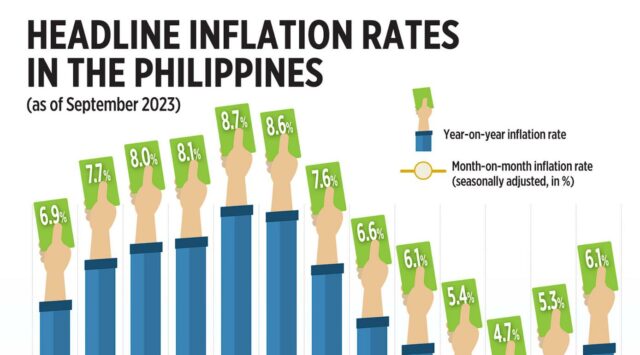
Headline inflation rates in the Philippines

INFLATION quickened for a second straight month in September due to a double-digit increase in rice prices, putting pressure on the Bangko Sentral ng Pilipinas (BSP) to resume monetary tightening. Read the full story.

ADVERTISEMENT
ADVERTISEMENT