Home Blog Page 422

Raising PHL’s excellence in business integrity
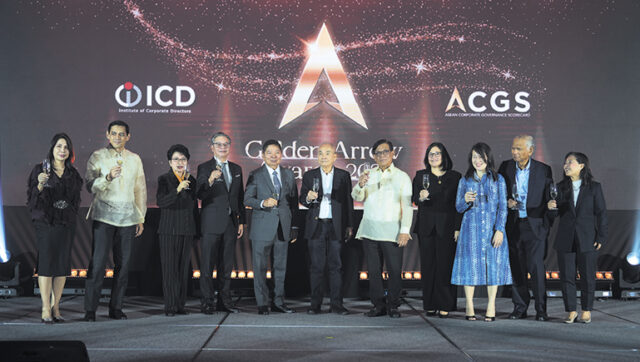
Board of trustees of the Institute of Corporate Directors and esteemed guests gather for a toast during the Golden Arrow Awards ceremony.

Golden Arrow Awards honor anew top companies for strong corporate governance

By Mhicole A. Moral, Special Features and Content Writer

The Institute of Corporate Directors (ICD) once again recognized the country’s leading publicly listed (PLCs) and insurance companies (ICs) at the 2025 Golden Arrow Awards held on Oct. 23 at the Grand Ballroom, Okada Manila.

The event highlighted firms that showed excellence in corporate governance, transparency, and accountability based on the 2024 ASEAN Corporate Governance Scorecard (ACGS) and the Corporate Governance Scorecard (CGS). The evaluation also included sustainability practices, board independence, and active engagement with investors and the public.

Each company went through a detailed assessment covering 193 publicly available indicators. The metrics examined areas such as board structure, audit quality, executive compensation, and sustainability reporting. The ACGS follows a 130-point grading scale, where companies must earn at least 75 points to qualify for the Golden Arrow distinction.
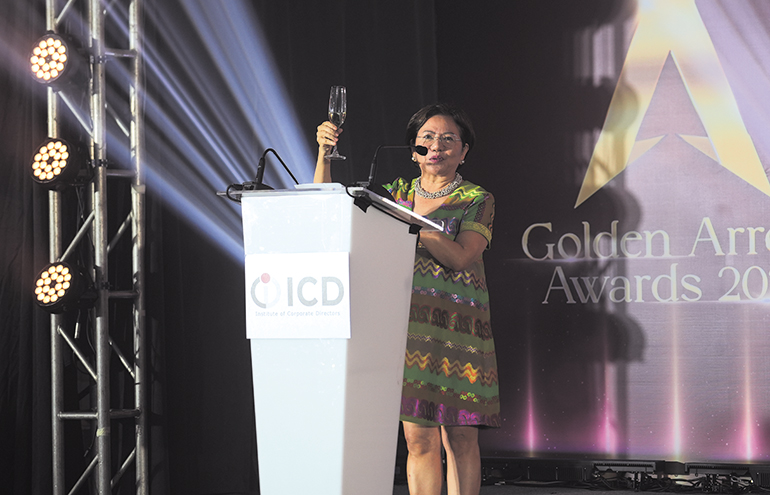
ICD Chairperson Atty. Benedicta Du-Baladad, FICD, leads the toast.

The recognition is divided into five levels. Companies with 75 to 84 points receive one arrow; those with 85 to 94 points receive two; 95 to 104 points earn three; 105 to 114 points get four; and those scoring between 115 and 130 points receive five arrows.

Insurance companies are evaluated separately. Their scoring begins at 80 points for one arrow and extends up to 130 points for five arrows, depending on their overall performance.

ICD President Senen L. Matoto, FICD

This year, 109 publicly listed companies and 26 insurance firms were honored for their strong governance practices and commitment to ethical business leadership.

Commitment to trust and progress

Five of the country’s leading corporations received the highest distinction at this year’s Golden Arrow Awards, recognizing their outstanding commitment to corporate governance and ethical business practices. These include Ayala Corp., Converge Information and Communications Technology Solutions, Inc., Globe Telecom, Inc., SM Investments Corp., and SM Prime Holdings, Inc.

Ayala Corp. President and Chief Executive Officer Cezar P. Consing said the recognition validated the company’s continuous effort to uphold transparency and accountability in its operations.

“At Ayala, we believe that the highest standards of corporate governance are a prerequisite for a sustainable business. It strives to create institutions that are stakeholders that always remind them,” Mr. Consing said in a video message. “Strong corporate governance is key to building and keeping this trust. Thank you for firming our efforts with this distinguished honor. We will strive to do better.”

SM Investments Corp. Chairman Amando M. Tetangco, Jr. accepted the same distinction, noting that good governance guides how the company makes decisions every day.

“For SM, good governance is not a separate factor. It is how we think, decide, and act, guided by stewardship, transparency, and a longer view of value creation across the globe. We share this honor with our board, management, and employees whose daily commitment gives life to these principles,” Mr. Tetangco said. “We thank ICD for encouraging companies like ours to keep raising the standard.”

Seventeen companies received the four-arrow recognition, a level given to organizations that consistently perform above industry standards. Among them were Aboitiz Equity Ventures, Inc., ACEN Corp., Ayala Land, Inc., Bank of the Philippine Islands, Manila Electric Co., and GT Capital Holdings, Inc.

The three-arrow award went to 26 corporations that demonstrated consistent improvement in their governance practices. The list included ABS-CBN Corp., AREIT, Inc., Atlas Consolidated Mining and Development Corp., Cebu Air, Inc., and International Container Terminal Services, Inc.

Thirty companies earned the two-arrow distinction for strengthening their governance structures and practices. These included Alliance Global Group Inc., Cebu Landmasters Inc., Century Pacific Food Inc., Citystate Savings Bank, Crown Asia Chemicals Corp., DigiPlus Interactive Corp., East West Banking Corp., and Philippine Business Bank (PBB).

PBB Vice-Chairman, President, and Chief Executive Officer Rolando R. Avante said the recognition serves as a reminder of the broader responsibility that comes with good governance.

“Awards like this puts more responsibility on us as a corporation to continue exercising good corporate governance; to be part of the government’s ongoing effort to improve the economy; and, lastly, to be a close partner of the business sector in creating more employment,” Mr. Avante told BusinessWorld.

Meanwhile, 21 corporations received the one-arrow recognition for showing steady alignment with the ICD’s standards on governance. Among those recognized were Alliance Select Foods International Inc., Altus Property Ventures Inc., Bank of Commerce, Citicore Energy REIT Corp., EEI Corp., Empire East Land Holdings Inc., as well as Solid Group, Inc.

Recognizing top insurers

The insurance sector showed consistent commitment to integrity and compliance this year through the Golden Arrow Awards, which honor companies that practice strong corporate governance.

Leading the group were The Insular Life Assurance Company, Ltd. (InLife) and Pru Life Insurance Corp. of U.K., both receiving the four-arrow distinction for their outstanding governance standards.

For InLife, this marked its sixth straight year of recognition and its fifth time earning the four-arrow award, a milestone that highlighted its sustained adherence to good corporate conduct.

Close behind were three institutions that earned three-arrow awards: BPI-AIA Life Assurance Corp., the Center for Agriculture and Rural Development Mutual Benefit Association (CARD MBA), Inc., and Kasagana-Ka Mutual Benefit Association, Inc.

CARD MBA and Kasagana-Ka MBA, known for serving low-income and underserved communities, were recognized for their dedication to good governance despite operating within inclusive finance sectors that face unique challenges.

Companies that received two-arrow distinctions represented a mix of local and international insurers known for maintaining stability and transparency. The list included AIA Philippines Life and General Insurance Company, Inc.; Allianz PNB Life Insurance, Inc.; Armed Forces & Police Mutual Benefit Association, Inc. (AFP MBAI); Etiqa Life and General Assurance Philippines, Inc.; FWD Life Insurance Corp.; Pacific Cross Insurance, Inc.; and Sun Life of Canada (Philippines), Inc.

Meanwhile, firms recognized with one-arrow awards demonstrated good standing based on the Corporate Governance Scorecard (CGS) framework. Honorees in this group included AXA Philippines Life and General Insurance Corp.; BDO Life Assurance Company, Inc.; Beneficial Life Insurance Company, Inc.; Alalay sa Kaunlaran (ASKI) Mutual Benefit Association, Inc.; Manulife Chinabank Life Assurance Corp.; and Sun Life Grepa Financial, Inc.

Why corporate governance matters

Corporate governance has moved beyond being a technical requirement for listed companies. It now stands as a benchmark for accountability, transparency, and integrity in Philippine business.

ICD Founder and Chairman Emeritus Dr. Jesus P. Estanislao, FICD

Dr. Jesus P. Estanislao, founder and chairman emeritus of the ICD, has long advocated for a governance framework that strengthens both corporations and the nation. In his recent address during the event, he emphasized that corporate governance serves as the backbone of a country’s economic and moral recovery, especially in a period marked by low public trust in institutions.

“When we started corporate governance 26 years ago, we had to prove that discipline and transparency were possible in Philippine corporations,” Dr. Estanislao said. “Today, we have proven that they are not only possible but necessary.”

The Philippines now ranks among the top three countries in Asia in corporate governance standards, alongside Singapore and Malaysia. Such achievement did not come overnight, as it began with the cooperation of regulatory agencies such as the Bangko Sentral ng Pilipinas, the Securities and Exchange Commission, and the Insurance Commission that helped define governance benchmarks in both the private and public sectors.

For Dr. Estanislao, true governance begins when companies internalize values beyond policy. He pointed to the importance of instilling civic-mindedness, responsible citizenship, and moral discipline within corporations.

“Governance is not only about reports and audits,” he said. “It is about who we are as individuals and how we influence the communities around us.”
PLCs that earned the Golden Arrow recognition, he added, must now go beyond their boardrooms. They are being called to serve as catalysts for national renewal by promoting transparency and social responsibility in their operations.

RCBC net income climbs 32% as consumer segment grows

BW FILE PHOTO

RIZAL COMMERCIAL Banking Corp. (RCBC) saw its net income surge by 32% year on year to P8.2 billion in the first nine months as its consumer lending business continued to expand.

This translated to a return on equity of 6.94% and a return on assets of 0.84%, it said in a disclosure to the stock exchange on Tuesday.

RCBC’s financial statement was unavailable as of press time.

The bank said its nine-month performance was mainly backed by the 13% growth in its gross customer loans and the 25% increase in its fee income. As a result, its gross income rose by 24% year on year.

Net interest income grew by 32% to P40.8 billion in the period, with its net interest margin improving by 86 basis points year on year to 4.68%.

“This was fueled by the expansion in higher-yielding consumer loans, which soared 33% year on year and now account for 46% of the bank’s total loan portfolio,” RCBC said.

Credit card receivables and personal loans jumped by 38%, and auto and housing loans combined rose by 29%.

“The sustained momentum in the consumer lending segment was driven by continuously leveraging data science and digital channels for selective new customer acquisition, alongside the bank’s existing customer network,” it added.

Its growing consumer business also helped drive the growth in its fee income to P7.8 billion amid gains from loan-related transactions, credit cards fees, and bancassurance activities.

“Our continued momentum in the consumer segment affirms that our deliberate approach anchored on data-driven decisions, prudent risk management, and collaboration across businesses continues to drive sustainable growth for the bank,” RCBC President and Chief Executive Officer Reginaldo Anthony B. Cariaso said.

Meanwhile, on the funding side, the bank booked deposits worth P997 billion at end-September, with 50.4% being low-cost current account, savings account deposits.

This supported RCBC’s total assets, which stood at P1.31 trillion in the period.

“This was strengthened by the P12.2-billion sustainability bond issuance in July 2025 as funding costs improved amid the easing interest rate environment,” it added.

Meanwhile, total equity reached P146.68 billion.

RCBC’s common equity Tier 1 ratio was at 13.27%, while capital adequacy ratio stood at 14.15%, both well above regulatory requirements.

Its shares declined by 45 centavos or 1.76% to close at P25.05 apiece on Tuesday. — Aaron Michael C. Sy

Art theft is due for a market-share shift

A TIARA adorned with pearls worn by French Empress Eugenie, which was among the items stolen by thieves during a heist at Paris’ Louvre Museum on Oct. 19, on display in this undated still frame from a video. — LOUVRE MUSEUM/HANDOUT VIA REUTERS

By Robert Cyran

NEARLY A WEEK after they stole perhaps $100 million of royal jewelry from Paris’ Louvre museum, the thieves are still at large. What’s unusual about their spectacular heist isn’t just the prestigious location, the in-broad-daylight execution, or the incredible monetary value. It’s that the perpetrators took something they could sell for a change.

After using a crane to climb through a second-floor window before cutting into displays and threatening staff, the criminals managed to escape by scooter within eight minutes. The temptation is to assume operations like this are sophisticated, in the mold of silver-screen capers like Ocean’s Twelve, The Thomas Crown Affair, or How to Steal a Million. After all, media, police, and hapless museums have an incentive to play along in order to attract public attention, deflect blame if they fail to crack the case, and earn praise if they succeed.

While thieves’ taste may be exquisite, the methods aren’t. Researchers find that most use brute force and physical intimidation of guards for access. While half used deception, including inspired examples — a Brazilian robbery during carnival and Norwegian heists during an Olympic ceremony — burglars mostly just wore balaclavas.

The choice of location isn’t unusual either. France is the most common site for museum theft in the world, with Italy second, according to Interpol and the Federal Bureau of Investigation data. These countries are ground zero for the world’s best-known art.

Oddly, jewelry isn’t a popular choice of target. Nearly six times as many paintings are nabbed as gold or gems.

This represents a colossal market failure. Well-known paintings are nearly impossible to sell. Few buyers will touch one with an obviously illegal provenance, and The Art Loss Register’s extensive database provides an easy means of checking. All this for little payoff: black-market prices are less than 10% of open-market value, according to the Federal Bureau of Investigation’s Art Theft Program.

These difficulties mean that stolen paintings often linger in limbo, before sometimes resurfacing. Two Laughing Boys with a Mug of Beer, by Dutch painter Frans Hals, has been nicked three times in four decades.

Gold and many gems, on the other hand, are easy to sell, hard to trace, and fetch good prices. Society may also be better off if museum thieves stuck to jewelry. A horrible outcome, say thieves tearing apart a necklace, leaves hope for reconstruction. A painting burned or thrown in the river is gone forever. — Reuters Breakingviews

SEC logs over 40,000 discounted transactions under cost-cutting measures

BW FILE PHOTO

THE Securities and Exchange Commission (SEC) said it has awarded more than P80 million in fee discounts across 40,157 transactions processed under three memorandum circulars (MCs) issued between July and October.

More than half of the total savings went to micro, small, and medium enterprises (MSMEs), the SEC said in a statement Tuesday.

The discounts stem from MC Nos. 6, 8, and 9, series of 2025, which aim to reduce the cost of corporate registration and capital market access.

The SEC said the measures are part of its broader strategy to streamline incorporation and promote MSME participation in the formal economy.

SEC Chairperson Francis Ed. Lim said the reforms reflect the commission’s commitment to “unlock the massive potential of the MSME sector in driving the Philippine economy’s growth.”

MC No. 6, which took effect July 1, granted a 50% discount on physical and authenticated copies of corporate filings, including articles of incorporation and by-laws. This resulted in P36.5 million in savings for registrants, the SEC said.

MC No. 8, released July 16, reduced filing fees for MSME registrations and capital stock increases. The SEC reported that 8,506 MSMEs benefited from P21.4 million in registration fee discounts, while more than 200 MSMEs saved P19.4 million when increasing their authorized capital stock.

MC No. 9 provided a 30% discount on registration fees for companies raising funds through the capital market, generating P3 million in savings, the SEC said.

The circular applies to all registration statement applications filed until yearend.

“The SEC will continue to assess its rules and policies to see where we can provide further assistance to our stakeholders,” Mr. Lim said.

The SEC’s latest initiatives align with broader government efforts to formalize MSMEs, which account for 99.5% of registered businesses and employ over 60% of the country’s workforce. — Alexandria Grace C. Magno

Industrial policy for the Philippines: A tale of 4 Tigers

MOUNtain TOP VIEW of Hong Kong — STOCK PHOTO | Image by TravelScape from Freepik

(Part 2)

During the second half of the 20th Century, industrial policy was given a lot of prominence in the efforts of some East Asian countries to “lift themselves from the bootstraps.” Select countries in Asia took seriously the promotion of certain industries judged to be important for growth, modernization, poverty eradication, or national security by implementing a set of government strategies, laws, and programs aimed at shaping the structure of the economy. This usually included such tools like tariffs or protection for infant industries; subsidized credit or tax incentives; direct state investment in strategic sector; support for research, training, and infrastructure; and especially export-promotion measures. The essence of industrial policy is for the government to actively guide and accelerate industrialization, rather than leaving everything to the free market.

Four territories in East Asia stood out in the successful use of industrial policy: Singapore, Taiwan, Hong Kong, and South Korea — usually referred to as the Four East Asian Tigers. During the second half of the last century, they followed distinct but overlapping industrial policies. All four experienced rapid industrialization, high GDP growth, and poverty eradication. Their approaches, however, reflected different political, institutional and geographical circumstances.

They were all poorly endowed with natural resources, in contrast with their Southeast Asian neighbors like Indonesia, the Philippines, Thailand, and Malaysia. However, during the period after the Second World War all of them were enjoying a baby boom that endowed them with young and growing labor forces. For example, South Korea’s population increased from 20 million in 1950 to 32 million in 1970 while Taiwan’s grew from 7.6 million 1950 to 14.7 million in 1970. Their leaders were very conscious of the fact that their respective economies had to provide employment opportunities for their young and growing population. This explains why their respective governments wisely chose a labor-intensive, export-oriented path toward economic progress.

In the case of South Korea, after the armistice agreement in its war with North Korea, its policy makers under the authoritarian leadership of Park Chung Hee, initially protected domestic industries, focusing on light manufacturing, such as textiles, toys, food, and other consumer goods. This was the import-substitution stage of industrialization (1950s to early 1960s). Then followed the export-oriented stage (1960s to 1980s). There was a shift toward the promotion of exports through strong state intervention. The government provided subsidized credit, an undervalued currency, tax incentives, heavy infrastructure support, and protection for firms that achieved export targets. From light manufacturing, there was a deliberate push towards heavy and capital-intensive industries such as steel, shipbuilding, automobiles, and petrochemicals. Credit was especially directed to the large conglomerates called chaebols such as Hyundai, Samsung, Daewoo, Hanjin, SK Group, LG Group, and Lotte Group. The final stage involved investments in technology and R&D. Policies promoted electronics, semiconductors, and IT, aiming at global competitiveness. The result was that the economy was transformed from agrarian poverty to a leading high-tech and industrial power, now considered as a First World economy with a per capita income of more than $30,000.

Then there was Taiwan that started with a thorough-going agrarian reform program that distributed large tracts of land for small farms that were made highly productive through significant government support of infrastructure spending (especially farm to market roads and irrigation facilities), cooperatives development, agricultural extension services, and ready access to credit. As food security was given the highest priority, the initial industrialization was also based on import substitution focused on light industries. Quickly following the short period of import substitution was a shift towards export-oriented industrialization (1960s to 1970s), with the government creating export processing zones and promoting small- and medium-sized enterprises (SMEs) in labor-intensive manufacturing such as in textiles, garments, toys, plastics, furniture, etc. In the 1980s and 1990s, the focus was on electronics, semiconductors, and precision industries through state sponsored research institutes and public-private collaboration. This culminated in a proliferation of high-tech industrial parks such as the Hsinchu Science Park which nurtured enterprises like TSMC, creating the semiconductor powerhouse that Taiwan is famous for. Such an industrial policy resulted in Taiwan becoming today a flexible, SME-driven economy that became a global leader in electronics and semiconductors. It is also a leader in the production of high-value agricultural products with the use of advanced technology.

The Hong Kong model stands out as the only one among the four tigers to adopt a laissez-faire or free market industrial policy. Unlike the other tigers, Hong Kong pursued minimal intervention, following classical (Adam Smith) policies under British colonial rule. Like the other three, it started industrializing with labor-intensive manufacturing (1950s to 1970s) with industries like textiles, garments, toys, wigs, furniture, etc. using cheap migrant labor and operating in open markets. In the 1980s and 1990s, as real wages rose and manufacturing relocated to mainland China, Hong Kong transitioned into a global financial and service hub, with little direct state planning. In contrast with the other three tigers, Hong Kong showed that industrialization is possible under free-market conditions. It also demonstrated what infrastructural and institutional supports are required to become an international financial hub.

Belonging to the Southeast Asian region, Singapore showed its ASEAN neighbor how to attain First World status through a state-led, Foreign Direct Investment-driven economy. Lacking a large domestic industrial base, Singapore — under the authoritarian leadership of Lee Kuan Yew — actively courted foreign multinationals through very generous tax breaks, world-class infrastructures, good governance, and political stability. From the very start, its industrial policy was that of export-orientation, quickly integrating into global production chains, focusing on electronics, petrochemicals, and later pharmaceuticals. Its high-quality infrastructure enabled it to become a major tourism destination in Asia. Government-linked corporations (GLCs) such as Singapore Airlines and port operators ensured national control of key sectors. There was strong emphasis on high-quality basic and tertiary education as well as in skills training, leading to the growth of high-value industries.

To summarize, South Korea and Taiwan grew on the basis of strong state intervention, export-led industrialization, culminating with the introduction of high-tech industries. Singapore adopted a highly state-directed industrialization strategy heavily dependent on foreign direct investments especially in services and high-tech sectors. Hong Kong had minimal state intervention, with heavy reliance on services and finance. Also notable was the high percentage of their GDP (5-8%) that these countries spent on public infrastructure. Also, a common strategy followed by all four was to move quickly away from import substitution to export orientation, unlike the Philippines that lingered too long in import substitution which was its undoing.

(To be continued.)


Bernardo M. Villegas has a Ph.D. in Economics from Harvard, is professor emeritus at the University of Asia and the Pacific, and a visiting professor at the IESE Business School in Barcelona, Spain. He was a member of the 1986 Constitutional Commission.

bernardo.villegas@uap.asia

UNO Digital Bank targets to break even by next year as it ramps up loan releases

DIGITAL BANK UNObank, Inc. (UNO Digital Bank) is targeting to break even by next year as it works to ramp up its loan disbursements by expanding its product base.

“Profitability is very important… We will be in our fourth year next year. So, of course our target is to hit operating breakeven within the first half, and then hit full breakeven within the year,” Manish Bhai, UNO Digital Bank president and chief executive officer, said at a media briefing on Tuesday.

“And right now, we seem to be on track to that.”

He added that digital banks normally take around seven years to turn profitable, with a few exceptions. Based on available data, only two of the six digital banks currently operating in the Philippines were profitable in 2024.

UNO Digital Bank booked a net loss of P1.04 billion in 2024, wider than the P653.5-million loss it posted in 2023, based on its annual report. This was mainly due to higher operating expenses that offset the increases seen in its net interest income and other earnings.

It was granted a digital banking license in 2021 and launched its mobile app in 2022. It began offering loans in 2023 and other products and services like insurance and bills payment in 2024.

UNO Digital Bank now has over four million users, it said on Tuesday.

Mr. Bhai said they hope to bring their loan releases to over P30 billion by end-2026.

“We have already disbursed loans of over P8 billion for a company which is not part of any conglomerate… We wish that number was double, but there are some challenges out there,” he said.

“We are trying to work and make sure that by the end of next year, that number stands at over P30 billion.”

The bank’s product offerings include its base savings account UNOready, high interest savings account UNOboost, time deposit UNOearn, cash loan UNOnow, sales finance UNOeasy and salary loan UNO@work.

Mr. Bhai said they are also planning to launch a new salary loan product before yearend, which they expect to help attract new customers.

“There’s a product which we’ll be launching in a month’s time. It is purposely kept under wraps,” he said. “It’s a salary loan product which will be a game changer… That, straightaway, will give us access to 400,000 to 500,000 new customers.”

He added that they are also looking to expand their touch points by expanding their merchant partnerships.

“So, you see, when you put all these things together, there’s a potential to increase your loan disbursements by a very big amount,” Mr. Bhai said.

Based on its latest balance sheet posted on the central bank’s website, UNO Digital Bank’s  assets stood at P10.22 billion at end-June.

Its gross loan portfolio was at P3.08 billion, up from P2.69 billion a year prior, with its gross nonperforming loan ratio at 10.96%, down from 15.41%.

Meanwhile, deposits were at P7.83 billion as of June, rising from P7.55 billion previously. — K.K. Chan

Arts & Culture (10/29/25)


Critic on Critic offers inside look at theater criticism

LIFESTYLE portal PalabasTayo will be posting a two-part video series titled Critic on Critic, hosted by theater reviewers Vincen Gregory Yu and Ryan Robert Flores. In collaboration with Magnify MNL and powered by Playful Prescriptions, the series will take viewers inside the world of theater criticism in the Philippines. It aims to highlight how reviewers act as allies to the craft, offering insights that help theater grow. The behind-the-scenes look will dive into critics’ thought process, writing approach, and drive to deepen appreciation for both artists and viewers. It will premiere on PalabasTayo.com’s official Facebook page starting Nov. 3.


Dance to tackle plight of SEA domestic workers

THE Cultural Center of the Philippines (CCP) and the Goethe-Institut Philippinen will be presenting Magic Maids, a cultural ritual and dance performance interlacing the fear and oppression of women, from the witches of long ago to the maids of today. Conceptualized and choreographed by Eisa Jocson and Venuri Perera, the 80-minute performance looks through the lens of feminist resistance using the broom, a metaphor for the shared experiences of prejudice and sacrifice, and a physical device that connects both witches and maids. Performances are on Nov. 7 and 8 at 5 p.m., and on Nov. 9 at 8 p.m., at the CCP Tanghalang Ignacio Gimenez (Black Box Theater). On Nov. 9 at 11 a.m., Jocson and Perera will lead a workshop titled Broomology 101 at the lobby. Regular ticket price is P600, with student’s discount ticket priced at P300 upon presentation of a valid ID. Interested workshop participants can register until Nov. 4, through the link https://docs.google.com/forms/d/e/1FAIpQLSf3GUt_9AlzYuTEt31AiA-fhPT4A_FuctYhl1-Y4viMabAFjg/viewform.


One more night for One Night in Intramuros tour

FOLLOWING sold-out dates for the popular One Night in Intramuros tours, WanderManila has added two dates in November: on the 15th and 16th, both at 5 p.m. Priced at P800 per person, it is the definitive dark history tour of Intramuros, where guests can see Manila in a darker, more sinister light. The choice of topics will focus on more violent and bloody aspects of the history of Intramuros. The tour will take around three hours to finish, with participants set to walk approximately 7,000 steps. Interested parties can register through WanderManila’s social media pages.


UNICEF makes merch with kiddie book artists

NEW UNICEF greeting cards are now available, done in collaboration with Ang Ilustrador ng Kabataan (Ang INK), a Filipino collective of children’s book illustrators. The partnership brings to life the Hiraya Collection, a new line of all-occasion cards and merchandise that turns art into a force for good. The artists of Ang INK designed the cards that provide a window into their own fondest childhood memories. The UNICEF Cards for Every Occasion are priced at P1,000 for 12 unique designs, while the UNICEF Tote Bags, which come in three designs with a keychain, cost P1,500. There’s also a mini backpack charm worth P1,200 and notebooks priced at P500 each. These items can be found exclusively at the UNICEF Philippines’ official online store: the UNICEF Giving Shop.

DMCI Homes expects Fortis Residences sales to pick up as amenities near completion

DMCI HOMES expects stronger sales for its Fortis Residences project in Makati City as the completion of project amenities draws near, signaling sustained demand for high-rise residential developments in key business districts.

Sales have reached about 14% of the 576 units launched in 2022, but DMCI Vice-President for Project Development Dennis O. Yap said the company anticipates stronger take-up once areas such as the roof deck and lobby are finished and showcased to buyers.

“We’re expecting sales take-up to spike during that time, as experienced in our existing projects,” he said at the topping-off ceremony on Tuesday.

The current selling price is about P250,000 per square meter, slightly below prevailing market rates given the unit inclusions such as air-conditioning units, cabinets, range hoods, and digital locksets.

The 47-story development, the second project under the DMCI Homes Exclusive brand after Oak Harbor Residences, was launched at the tail end of the pandemic and is expected to take longer to sell out than its predecessor, which debuted in a stronger market.

Fortis Residences sits along Chino Roces Avenue, connecting Makati to Taguig, and offers access to EDSA, Osmeña Highway, SLEX, and Skyway.

Amenities include a playground, basketball court, fitness gym, sky lounge, and sky deck pool.

The project is expected to be completed by December 2027. DMCI Holdings, Inc. shares rose by 1.64% or 18 centavos to close at P11.16 each on Tuesday. — Alexandria Grace C. Magno

Treading the path to prosperity: Technology, capital, and the spirit of dialogue

APEC Digital Economy Steering Group held exchanges and dialogue on approaches to artificial intelligence in Incheon, Republic of Korea on July 25. — APEC.ORG

Twenty-one member economies comprise the Asia-Pacific Economic Cooperation (APEC). Together, they account for 61% of global gross domestic product and half of global trade. Indeed, for the past 36 years, APEC has served as a venue for the incubation of ideas. APEC meetings have allowed its members a platform for presenting their views, forging consensus, and working collectively toward regional prosperity.

One such gathering, the 2025 APEC Economic Leaders Meeting, will take place from Oct. 31 to Nov. 1 in the Republic of Korea, specifically in the city of Gyeongju, Gyeongsangbuk-do. Gyeongju is the ancient capital of a millennium-old kingdom, and the center of its culture. Serving as the capital of Silla Dynasty from 57 BC to AD 935, Gyeongju flourished for nearly a thousand years and is home to a remarkable concentration of UNESCO World Heritage sites.

The theme for the APEC meeting is “Building a Sustainable Tomorrow: Connect, Innovate, Prosper.”

As this year’s host, Korea will put forth two key issues affecting global prosperity: cooperating in the area of artificial intelligence (AI), and responding to demographic shifts.

Specifically, on AI cooperation, it will set an APEC-wide direction for AI utilization by focusing on capacity building and the creation of a sustainable AI investment ecosystem.

Korea is an acknowledged world leader in the field of AI. It has passed its AI Basic Act, which will take effect in January, that establishes the country as a global pioneer in the development of reliable and forward-looking AI. South Korean President Lee Jae Myung has secured a landmark partnership with asset manager BlackRock to help make Korea a regional hub for AI.

Korea was also the president of the recent Security Council Open Debate on Artificial Intelligence and International Peace and Security, through Mr. Lee, at the United Nations.

Mr. Lee described AI using metaphor — that of a very cute tiger cub, according to an op-ed by South Korean Ambassador Lee Sang-Hwa published in another newspaper. The tiger cub, like AI, may grow into a devouring predator, or it could also be a beloved companion, citing a character from a famous Korean show.

Aside from this AI milestone at the UN, Korea is also a leader, alongside the Netherlands, of the Responsible Artificial Intelligence in the Military Domain (REAIM) Initiative. This is a global platform that seeks to ensure the transparency and accountability of AI applications in defense, and to keep it firmly under human control.

Korea enjoys great credibility in this area, because it believes that “innovation and ethics must advance as one, and that even in matters of security, humanity’s fate should never be left to an algorithm,” wrote the ambassador.

Yet another key issue to govern the coming talks is the need, and ideal ways to respond to demographic shifts, Korea will propose cooperative policies to build responsive systems for aging societies, strengthen human resource mobility, and promote innovation in healthcare and technology to turn demographic challenges into opportunities for future growth and innovation.

But at a time of heightened geopolitical and geoeconomic challenge, both within the individual economies and in the greater Indo-Pacific and Asia-Pacific regions, is it even realistic and possible to imagine any pathways to prosperity for our people? And how does the Philippine economy, with all its nuances and unique features, fit the bigger picture?

Just this September, at the Subic Shipyard, the HD Hyundai shipbuilding venture was inaugurated through a symbolic cutting of steel, which marks the birth of a vessel.

At least 2,000 jobs will be created by this investment, which was granted fiscal incentives under the CREATE More Act.* According to Ambassador Lee, the Philippines-Korea Free Trade Agreement was — signed by the leaders of both countries in September 2023, ratified by their respective legislative bodies the following year, and which took effect at the end of 2024 — solidifies Korea’s standing as one of the biggest investors in the Philippines. Hyundai has substantially committed to Subic.

“It has always been more than a harbor,” he wrote. “It is a symbol of openness to trade, business, and diplomacy.”

Given all these, the Philippines will be an eager participant in the coming APEC meeting in Korea. The principles of the economic block resound with our own economic objectives as a nation. We also aim to advance trade and investment within the Asia-Pacific region and strengthen connectivity through physical, institutional, and people-to-people exchanges.

We seek to promote digital innovation by ensuring that we tap into the advantages of technology while mitigating their pitfalls and risks.

Through all these, we pursue sustainable and inclusive growth as we prepare to squarely address global issues of energy, food security, and demographic shifts.

We share APEC’s commitment to dialogue and cooperation. While we face many daunting issues domestically, regionally, and globally, we keep our faith in the power of dialogue and cooperation, just as the APEC does.

* Corporate Recovery and Tax Incentives for Enterprises to Maximize Opportunities for Reinvigorating the Economy


Victor Andres “Dindo” C. Manhit is the president of the Stratbase ADR Institute.

Pre-need companies post higher premiums

BW FILE PHOTO

THE PRE-NEED INDUSTRY saw its premium income inch up by 2.82% year on year at end-June amid higher plans sold.

The sector’s premium income stood at P11.49 billion as of June, up from P11.17 billion in the same period last year, according to Insurance Commission (IC) data based on the submissions of 13 licensed pre-need companies.

Its combined net income surged by 84.67% to P5.32 billion in the period from P2.88 billion a year prior, with only four companies posting losses.

The number of plans sold by pre-need firms in the first six months rose by 29.47% to 424,467 from 327,841 last year.

Bulk of the plans sold were life policies, which rose by 29.39% to 423,727.

Sales of pension plans jumped by 117.41% year on year to 687, while education plans sold rose by 47.22% to 53.

Meanwhile, the industry’s combined investment in trust funds increased by 9.39% year on year to P145.61 billion, IC data showed.

Pre-need reserves, which include benefit obligations or payables as mandated by the Pre-Need Code, went up by 2.97% to P128.99 billion in the period.

As a result, the difference between the combined trust funds and pre-need reserves of companies stood at a P16.61-billion surplus at end-June, 112.13% wider than the P7.83-billion surfeit a year prior, the report showed.

The pre-need industry’s combined net worth rose by 26.81% to P31.58 billion from P24.9 billion.

This was driven by the 54.25% increase in their retained earnings to P24.131 billion.

Meanwhile, pre-need companies’ combined capital stock dropped by 12.56% year on year to P3.5 billion, and other net worth accounts went down by 24.85% to P3.95 billion.

The sector’s total assets grew by 7.23% to P168.36 billion as of June from P157.02 billion a year prior.

Total liabilities likewise rose by 3.53% to P136.78 billion from P132.11 billion.

The IC’s report showed that St. Peter Life Plan, Inc. recorded the highest premium income in the period at P11.04 billion, followed by Philplans First, Inc. with P320.47 million, Cosmopolitan Climbs Life Plan, Inc. with P44.33 million, and GoldenFuture Life Plan, Inc. with P34.64 million.

In terms of sales, St. Peter Life Plan was also the top performer with 395,257 plans sold for a total contract price of P22.36 billion.

Goodlife Plans, Inc. placed second with 12,341 plans sold for a contract price of P494.03 million. Rounding out the top three was Freedomlife Plan Corp., which sold 12,242 plans with a total contract price of P448.8 million.

Lastly, in terms of net income, St. Peter Life Plan placed first with P4.69 billion, followed by Philplans First with P801.11 million and GoldenFuture Life Plan, Inc. with P15.33 million. — Aaron Michael C. Sy

ASEAN Foundation to train 17,500 MSMEs in AI use

PHILIPPINE INFORMATION AGENCY

THE Association of Southeast Asian Nations (ASEAN) Foundation plans to train more than 17,000 Philippine micro, small and medium enterprises (MSME) by 2027 to help them integrate artificial intelligence (AI) into their business operations.

The initiative forms part of the AI for MSME Advancement in ASEAN (AIM ASEAN) program, a two-year effort led by the ASEAN Foundation in partnership with the Asian Venture Philanthropy Network through the AI Opportunity Fund: Asia-Pacific Phase 2.

“Through AIM ASEAN, Limitless Lab will train at least 17,500 MSMEs across the Philippines by 2027,” the ASEAN Foundation said in an e-mail.

Social innovation company Limitless Lab has been tapped to implement the program, which aims to equip entrepreneurs with the knowledge and skills to accelerate AI adoption.

The group will design five localized training modules for smaller firms in sectors such as retail, manufacturing, agriculture and services.

The modules will focus on AI-powered marketing, e-commerce solutions and financial management tools, with sessions delivered through both online and on-site formats nationwide. The training will include live and self-paced learning options to ensure accessibility across regions.

“Our ‘learn–apply–scale’ approach ensures that each participant can immediately apply AI tools in their business after every session,” the foundation said.

It added that the group has been working with the Department of Trade and Industry, business organizations and cooperatives to broaden the program’s reach.

MSMEs — considered the backbone of the Philippine economy — account for about 99% of all registered businesses in the country. However, many remain constrained by limited access to AI tools, low awareness of digital solutions and inadequate technical capacity.

“Many small business owners lack the know-how to identify practical AI use cases or assess the return on investment for adopting digital systems,” the foundation said.

Challenges such as high implementation costs, poor internet infrastructure and unequal access to data and digital talent have also widened the divide between urban and rural firms.

“In the Philippines, AI can help small businesses work more efficiently, make smarter decisions and access wider markets, which in turn supports job creation and contributes to the country’s digital and economic growth,” it said.

The foundation noted that MSMEs can use low-cost or no-code AI tools to automate marketing, analyze customer behavior and improve financial forecasting. It underscored the importance of digital upskilling and responsible AI use as small businesses expand their digital operations.

Beyond the Philippines, the AIM ASEAN program also supports MSME digital growth in Brunei, Thailand, Vietnam, Cambodia, Indonesia, Laos, Myanmar, Malaysia and Singapore. — Beatriz Marie D. Cruz

Smart partners with Lynk Global to expand satellite connectivity in remote areas

PHILSTAR FILE PHOTO

PLDT INC., through its wireless subsidiary Smart Communications, Inc., has partnered with US-based Lynk Global, Inc. to provide mobile connectivity in areas without network coverage through satellite technology.

“When it’s fully rolled out, we think this will transform rural and remote connectivity in the Philippines,” PLDT Chief Operating Officer and Head of Network Menardo G. Jimenez said in a statement on Tuesday.

Smart said the partnership will enable mobile communications in areas with no signal by directly connecting ordinary mobile phones to satellites. The company said it will start by integrating its core systems with Lynk’s satellite-to-mobile network before conducting live field tests using Smart’s existing spectrum.

The initiative will prioritize coastal and mountain barangays and key maritime routes while ensuring secure, reliable, and stable connections, Smart said.

Once the Lynk satellite direct-to-device network is fully operational in the next few years, Smart said it expects to offer full mobile voice and data connectivity.

The initial rollout will cover basic text messaging and mobile applications over LTE (Long Term Evolution), designed to help maintain communications during typhoons, earthquakes, and other emergencies.

Lynk Global develops satellite-to-mobile-phone constellation technology designed to enhance mobile service coverage worldwide.

“We are more than excited to work with Smart to deliver reliable satellite connectivity directly to mobile phones in the Philippines,” Lynk Global Vice-President for Asia Pacific James Alderdice said.

Smart is the wireless arm of PLDT. Hastings Holdings, Inc., a unit of the PLDT Beneficial Trust Fund’s MediaQuest Holdings, Inc., holds a majority stake in BusinessWorld through the Philippine Star Group, which it controls.

At the local bourse on Thursday, shares in PLDT gained P6 or 0.54% to close at P1,110 apiece. — Ashley Erika O. Jose