Home Blog Page 4203

Over 50 advanced manufacturing innovations to launch at Industrial Transformation ASIA-PACIFIC 2023

Headlined by Singapore’s Deputy Prime Minister Mr Heng Swee Keat, ITAP 2023 will convene over 18,000 global Industry 4.0 leaders, solution providers and delegates from Oct. 18 -20 at Singapore EXPO

The sixth edition of Industrial Transformation ASIA-PACIFIC (ITAP) will be the launchpad for over 50 new-to-market and new-to-region products and solutions set to transform the region’s advanced manufacturing sector.

Organized by Constellar with international partner Deutsche Messe, ITAP 2023 will focus on three key dimensions: Sustainability, Optimising Manufacturing Efficiency, and Supply Chain Resilience; convening over 300 exhibitors, 100 speakers and 18,000 delegates, trade visitors and attendees from Oct. 18-20 at Singapore EXPO.

Guest-of-Honor Mr. Heng Swee Keat, Deputy Prime Minister and Coordinating Minister for Economic Policies, will be launching the event at its opening ceremony on Oct. 18.

“Recent disruptions have placed a greater impetus for manufacturers and businesses in the global supply chain to adopt new technological innovations and sustainable solutions to remain competitive. As the region’s leading marketplace for connecting businesses, ideas, and networks in the advanced manufacturing sector, ITAP 2023 continues to be the preferred platform for industry players to discover Industry 4.0 innovations and gain insight to how emerging technologies such as AI and digital twins contribute to the accelerated pace of industrial transformation experienced in many sectors today,” said Paul Lee, Chief Executive (Markets) at Constellar.

Key product highlights will be showcased at the I4.0 Tech Capsule stage on the ITAP 2023 exhibition floor, including direct current grids by LAPP Asia Pacific to increase energy efficiency and cost savings for industry 4.0 solutions, a unified data collection and analytics platform by Litmus Automation to make sense of industrial data, as well as Profet AI which empowers organizations to efficiently implement AI solutions that address daily production and business needs.

Spanning 20,000 sq.m. across two halls, the exhibition will also feature made-in-Singapore innovations such as a new plug-and-play IoT-powered Ops-analytics Solution by Auk Industries, an AI-powered AR platform by Clemvision combining machine vision with human dexterity, as well as the industry’s first mobile robot-powered dual-unit picking station.

“For the past five years, ITAP has played an important role in bringing together manufacturers from the Asia-Pacific region to connect with global technology leaders game on meeting the industry’s changing needs. I’m confident that this year’s edition of ITAP will continue to be a critical platform in fostering international collaboration, catalyzing cross-border innovation and further advancing manufacturing capabilities for a better, brighter future,” said Dr. Jochen Köckler, Chief Executive, Deutsche Messe.

Event Highlights

Global industry leaders, decision makers and key players in the region’s business ecosystem will be joining the robust three-day conference program at ITAP 2023, with highlights such as the Industrial Transformation Forum, the invitation-only Future of Manufacturing (FOM) CXO Summit, and the Industrial Innovation Stage.

Expert speakers at ITAP this year include President of Boeing Southeast Asia Alex Feldman, Global CTO of Smart Manufacturing, Edge Compute and Digital Twins at DELL Technologies Todd Edmunds, Managing Director & Co-Founder of Semodia GmBH Anna Menschner, Head of Enterprise ASEAN at Amazon Web Services Vikram Rao, Senior Director Factory Automation Sales Asia-Pacific of Siemens Digital Industries Sascha Maennl, and General Manager Logistics Technology Business of Cainiao Candice Yuan.

On the exhibition floor, delegates and trade visitors can explore cutting-edge technologies and learn from use-cases at interactive experience zones, as well as join off-site tours to leading innovation centers and advanced factories in Singapore. ITAP 2023 Founding Sponsor Siemens will also be presenting solutions such as the open digital business platform Siemens Xcelarator with a curated portfolio of products, services and solutions, as well as Industrial Operations X, which helps to accelerate the engineering, execution and optimization of industrial operations.

Siemens will also showcase how it is applying its industrial automation and digitalization solutions to a vertical farm from local startup Artisan Green, boosting the farm’s operational efficiency and productivity. Additionally, visitors to the Siemens booth at ITAP 2023 can meet with the winners from Siemens’ “This is Industrial Edge” competition, who will be showcasing solutions that can either improve manufacturing processes and/or sustainability, using Industrial Edge products.

“As a conference that is designed and curated to help companies start, scale and sustain their adoption of Industry 4.0 processes and solutions, ITAP is the perfect platform for Siemens to show how we are combining the real and digital worlds to help our customers become more competitive, resilient and sustainable,” said Isabel Chong, Head of Siemens Digital Industries ASEAN.

ITAP is also excited to welcome global semiconductor leader Analog Devices as the Platinum Sponsor at the event for the first time. “As the prime event that brings together leading players and stakeholders across the manufacturing value chain, ITAP is the go-to platform for Analog Devices to showcase our innovation and manufacturing capabilities that create long-term value for our customers,” said Jerry Fan, Senior Vice-President, President of Asia Pacific for Analog Devices.

If you’d like to attend ITAP 2023, click here to register.

To check out the key topics and speakers at this year’s ITAP, click here.


Spotlight is BusinessWorld’s sponsored section that allows advertisers to amplify their brand and connect with BusinessWorld’s audience by enabling them to publish their stories directly on the BusinessWorld website. For more information, send an email to online@bworldonline.com.

Join us on Viber at https://bit.ly/3hv6bLA to get more updates and subscribe to BusinessWorld’s titles and get exclusive content through www.bworld-x.com.

Coal industry faces 1 million job losses from global energy transition – research

PHILSTAR FILE PHOTO

 – The global coal industry may have to shed nearly 1 million jobs by 2050, even without any further pledges to phase out fossil fuels, with China and India facing the biggest losses, research showed on Tuesday.

Hundreds of labour-intensive mines are expected to close in the coming decades as they reach the end of their lifespans and countries replace coal with cleaner low-carbon energy sources.

But most of the mines likely to shut down “have no planning underway to extend the life of those operations or to manage a transition to a post-coal economy,” US-based think tank Global Energy Monitor (GEM) warned.

Dorothy Mei, project manager for GEM’s Global Coal Mine Tracker, said governments needed to make plans to ensure workers do not suffer from the energy transition.

Coal mine closures are inevitable, but economic hardship and social strife for workers are not,” she said.

GEM looked at 4,300 active and proposed coal mine projects around the world covering a total workforce of nearly 2.7 million. It found that more than 400,000 workers are employed in mines set to cease operations before 2035.

If plans were implemented to phase down coal to limit global warming to 1.5 degrees Celsius (2.7 degrees Fahrenheit), only 250,000 miners – less than 10% of the current workforce – would be required worldwide, GEM estimated.

China’s coal industry, the world’s biggest, currently employs more than 1.5 million people, GEM estimated. Of the 1 million job global job losses expected by 2050, more than 240,000 will be in the province of Shanxi alone.

China’s coal sector has already undergone several waves of restructuring in recent decades, with many mining districts in the north and northeast struggling to find alternative sources of growth and employment following pit closures.

“The coal industry, on the whole, has a notoriously bad reputation for its treatment of workers,” said Ryan Driskell Tate, GEM’s program director for coal.

“What we need is proactive planning for workers and coal communities … so industry and governments will remain accountable to those workers who have borne the brunt for so long.” – Reuters

SEC plan to hike fees comes under fire

STOCK PHOTO | Image Dmitry Berdnyk from Unsplash

ELEVEN BUSINESS GROUPS and associations opposed the Securities and Exchange Commission’s (SEC) proposal to increase its fees and charges, calling it “anti-business” and “unnecessary.”

The business groups, led by the Philippine Chamber of Commerce and Industry (PCCI) and Management Association of the Philippines (MAP) said the SEC should review, “if not totally scrap” the proposed increase in fees, saying it is detrimental to the economy.

“Consistent with the ease of doing business law, we then strongly recommend that SEC submit this proposed policy to the Anti-Red Tape Authority (ARTA) for a Regulatory Impact Assessment (RIA) to check against harmful impacts to business and the economy,” they said in a joint statement, adding there is a need for stakeholder consultations.

The business groups objected to “unreasonable, if not ‘obscene’ fees and charges,” such as the proposal to charge corporate issuers one-fourth of 1% of total indebtedness when creating bonded indebtedness.

“Using 2022 numbers, SEC’s fees would amount to P1.27 billion on the total bond issuances of P508 billion for that year,” the groups said.

The business groups also opposed the proposed fee on the total transactions cleared and settled in the previous year by Securities Clearing Corp. of the Philippines and Philippine Depository Trust Corp. at 0.1 basis point (bp) and 0.05 bp, respectively.

Based on the transactions in 2022, the groups said this would mean P14.51 million and P7.25 million in additional friction cost for stock market investors.

According to the business groups, the current fee collections of the SEC far exceed the cost of its operations.

“Proof of this includes the purchase of its own building in Makati commercial business district reportedly costing about P2.5 billion, in addition to about 90 commercial parking slots estimated at about P1 million per slot,” they said.

The business groups also cited the case of Philippine Association of Stock Transfer and Registry Agencies, Inc. versus Court of Appeals in which the Supreme Court held that “fee increases that have far-reaching effects on the capital market should be frowned upon.”

They also cited the case of First Philippine Holdings Corp. (FPHC) versus SEC in 2020 when the Supreme Court declared the fees imposed by the SEC for application of amended articles of incorporation as invalid and unreasonable for being arbitrary.

The current fee proposal by the SEC is even higher than the relevant fees struck down by the Supreme Court in the case of FPHC, they added.

“Fees that far exceed the costs of regulation are beyond the authority and power of the SEC to impose,” they said.

The business groups also noted the SEC’s proposal to impose “unconscionable” increases on fees may discourage new investments in the country.

“The increased cost of doing business will also hurt small and medium enterprises covered by SEC due to the ripple effects of the fee increases,” they added.

Sought for comment, the SEC is yet to respond as of press time.

Aside from the PCCI and MAP, the statement was also signed by the Philippine Retailers Association, Philippine Franchise Association, Chamber of Thrift Banks, Philippine Exporters Confederation, Inc., Federation of Filipino Chinese Chambers of Commerce and Industry, Inc., Employers Confederation of the Philippines, Philippine Association of Legitimate Service Contractors, Stratbase ADR Institute for Strategic and International Studies, and Philippine Food Processors and Exporters Organization, Inc. —  Justine Irish D. Tabile

BSP likely to resume tightening as upside risks materialize

Recent wage hikes may further stoke inflation in the country. — PHILIPPINE STAR/MIGUEL DE GUZMAN

THE IMPLEMENTATION of higher minimum wages and jeepney fares this month may further stoke inflation, giving the Bangko Sentral ng Pilipinas (BSP) more reason to resume monetary tightening next month, GlobalSource Partners said.

GlobalSource country analyst Diwa C. Guinigundo said on Monday that the P1 provisional increase in jeepney fares, which took effect nationwide on Sunday, “could have further inflationary consequences, not the least of which is the possible upset of inflation expectations.”

“In addition, what could further lead to elevated inflation print is the wage order that mandates a P40 increase in the daily minimum wage of workers in private establishments in Central Luzon, a major contributor to both output and inflation dynamics,” Mr. Guinigundo said in an Oct. 9 brief.

Regional wage boards also approved a P30 increase in the daily minimum wage in Cagayan Valley and P35 for the Soccsksargen (South Cotabato, Cotabato, Sultan Kudarat, Sarangani, and General Santos City) regions. All wage orders will take effect on Oct. 16.

A P40 increase in the daily minimum wage in the National Capital Region (NCR) took effect on July 16.

“All these will bolster our initial view that while the BSP could choose to keep its hawkish stance by maintaining its policy rate at 6.25% against its latest (inflation) forecasts of 5.8% and 3.5% for 2023 and 2024, respectively, these are mounting motivations for an ultimate resumption of monetary tightening,” Mr. Guinigundo said.

The Monetary Board has kept the benchmark interest rate at 6.25% since March. It has hiked borrowing costs by 425 basis points (bps) since May 2022 in a bid to tame inflation.

However, headline inflation accelerated for a second straight month to 6.1% in September from 5.3% in August amid a spike in food and transport costs. This brought the nine-month inflation average to 6.6%.

“With all of these upside risks materializing, and the fact that the 3.5% forecast for 2024 is uncomfortably inching towards the high end of the 2-4% target, we are now inclined to see a possible resumption of monetary tightening starting next month,” Mr. Guinigundo, a former central bank deputy governor, said.

“To avoid market jitters, baby steps are likely, but sustained.”

Even before the release of September inflation data, BSP Governor Eli M. Remolona, Jr. has signaled the possibility of an off-cycle rate hike before the Monetary Board’s November meeting.

However, Mr. Guinigundo said weak economic growth could prompt the BSP to pull back on further rate hikes.

“This will be an unpopular decision. But the Philippines’ gross domestic product (GDP) continues to grow while demand pressures remain given the elevated readings of core inflation. Hence, a proactive monetary policy does not necessarily destroy business activities but could actually inspire them,” he added.

The economy grew by a weaker-than-expected 4.3% in the second quarter, its slowest growth in more than two years. Economic managers earlier said GDP would need to grow by 6.6% in the second half in order to meet the lower end of the government’s 6-7% target.

Finance Secretary Benjamin E. Diokno and National Economic and Development Authority (NEDA) Secretary Arsenio M. Balisacan earlier said that there is no more need for further monetary tightening.

Mr. Balisacan said that raising interest rates could hurt consumers and the economy, while Mr. Diokno said that the BSP has “done enough” in terms of monetary tightening.

Third-quarter GDP data will be released on Nov. 9. The Monetary Board’s next policy-setting meeting is on Nov. 16. — Luisa Maria Jacinta C. Jocson

Wider Middle East conflict may send oil prices skyrocketing, say analysts

REUTERS

By Luisa Maria Jacinta C. Jocson, Reporter

A WIDER CONFLICT in the Middle East could send global oil prices skyrocketing, adding to concerns over inflation, analysts said.

“A conflict involving Israel and Palestine, while not directly linked to oil production, could still have broad implications for the oil market due to the region’s geopolitical significance. If the conflict escalates and draws in oil-producing Middle Eastern states, oil prices could skyrocket,” Security Bank Corp. Chief Economist Robert Dan J. Roces said in a Viber message.

“This surge would have a cascading effect on global economies, potentially triggering a third wave of inflation,” he added.

Oil prices surged more than 2% on Monday, as military clashes between Israel and Hamas ignited fears of a wider conflict in the Middle East (Related story Middle East conflict adds risks to global outlook).

Brent crude was up by $2.28 or 2.7% to $86.86 a barrel by 0859 GMT, while US West Texas Intermediate (WTI) crude was at $85.23 a barrel, up by $2.44 or nearly 3%. Both benchmarks spiked by more than $4 a barrel earlier in the session.

The surge in oil prices reversed last week’s downtrend — the largest weekly decline since March — in which Brent fell about 11% and WTI retreated more than 8% as a darkening macroeconomic outlook intensified concerns about global demand.

“If the crisis escalates either by affecting other economies or if other economies get involved, we will likely see higher oil prices as Israel is very near oil-producing nations,” China Banking Corp. Chief Economist Domini S. Velasquez said in a Viber message.

Mr. Roces noted that the positioning of global superpowers in the conflict “could either mitigate or exacerbate oil supply concerns.”

Raymond T. Zorrilla, senior vice-president for external affairs of Phoenix Petroleum Philippines, Inc., said that since Israel is a marginal oil producer, recent developments may have “little” direct impact on oil supply.

“However, given the ensuing tension there might be a risk that the conflict could spread resulting in prolonged tension eventually impacting supply and pricing,” he said in a Viber message.

Mr. Roces said that rising oil prices would impact input costs and fuel inflationary pressures.

Headline inflation quickened to 6.1% in September, the fastest print in five months. This brought the nine-month average inflation to 6.6%, above the central bank’s 5.8% full-year forecast.

In September, gasoline inflation accelerated by 3% while diesel inflation rose by 3.8%. Fuels and lubricants for personal transport equipment account for 2.4% of the consumer price index (CPI) basket.

“In response, central banks may again tighten monetary policies, such as raising interest rates, to combat rising inflation, which could have its own set of economic consequences,” Mr. Roces added.

Apart from oil prices, Ms. Velasquez noted that remittance inflows into the Philippines may also be impacted.

“Remittances from the Middle East might also get affected especially if it becomes too dangerous for overseas Filipinos,” she said.

Saudi Arabia is the country’s third-biggest source of remittances.

Rizal Commercial Banking Corp. Chief Economist Michael L. Ricafort also noted the possibility of Iran’s involvement in the conflict.

“The Israel-Hamas war over the weekend partly weighed on global market sentiment amid geopolitical risks that could involve Iran, which is a major global oil producer and finances and supports Hamas,” he said in a Viber message.

“All told, the conflict is in its early stages, and at this point market reactions seem to be knee jerk. Nonetheless, this has the risk of complicating economic conditions globally and as such we must monitor this closely.” — with Reuters

Philippine exports to feel the pinch from China’s economic slowdown

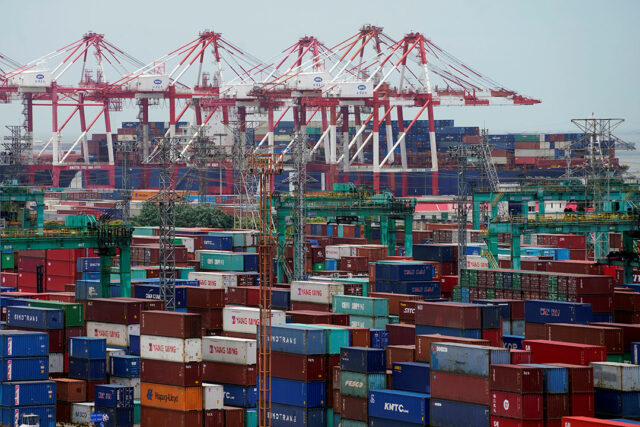
Shipping containers are seen at a port in Shanghai, China, July 10, 2018. — REUTERS

CHINA’S ECONOMIC SLOWDOWN will likely dampen Philippine exports and potentially lead to lower investments, according to experts.   

“China’s slowdown will weigh directly on the Philippines’ exports, and lower export earnings will suppress investment and consumption,” Makoto Tsuchiya, economist from Oxford Economics, said in an e-mail.

Mr. Tsuchiya said China’s economy is projected to expand by 5.1% this year, and by 4.6% in 2024.

This is in line with the China growth projections by the multilateral lenders World Bank (5.1% this year) and Asian Development Bank (4.9%). S&P Global Ratings last month cut its growth forecast for China to 4.8% this year from 5.2% previously.

International Monetary Fund Mission Chief to the Philippines Shanaka Jayanath Peiris last week said the impact of China’s slowdown will depend on the Philippines’ exposure to the Chinese economy.   

“Philippines, out of all Asian countries, is less exposed to China,” he said.

“The service sector is doing well; goods sector globally is not doing very well. Philippines is more of a services-driven economy, so it benefits more on whatever the current level of global growth is. Also, Filipinos cater a bit more to the US market than the China market.”

The United States is top destination of Philippine-made goods. Of the Philippines’ total exports of $6.14 billion in July, the US accounted for 16.9% or $1.04 billion.

China was the Philippines’ fourth top export trading partner in July, making up 12.3% or $758.22 million of the month’s total.

However, Confederation of Wearables Exporters of the Philippines Executive Director Maritess Jocson-Agoncillo said the slowdown in China is already being “felt” by the export industry.   

“In terms of investment, as much as we were expecting to catch a windfall of investments from China, these past two years, with the US imposing trade restrictions on Chinese goods, we are not seeing any new investments from China at the moment,” she said in a Viber message.   

Ms. Jocson-Agoncillo said the export industry is seeing a negative trend by end-2023, largely due to the slowing global demand.   

“Buyers tend to source from cheaper neighboring ASEAN (Association of Southeast Asian Nations) countries. For example, a major European brand pulled out sourcing from the Philippines mid-2023,” she added.

Oxford Economics’ Mr. Tsuchiya said dampened investor sentiment in the region may also lead to capital outflows and weaker currencies. This could add pressure to Philippine inflation, which would also make the Bangko Sentral ng Pilipinas’ job more difficult.   

ING Bank N.V. Manila Senior Economist Nicholas Antonio T. Mapa said the slowdown of the world’s second-largest economy will directly impact the Philippines’ growth prospects.   

He noted China is one of the country’s major trading partners and holds a significant importance in the Asian supply chain. 

“However, the better-than-expected resilience of the US economy, which is also a major source of tourism and trade for the Philippines could be a potential offset to the slowdown in China,” Mr. Mapa said.   

“In terms of trade, the Philippines can also explore trading opportunities with other countries, case in point with the US given its better-than-expected performance of late,” he added.

Mr. Mapa said China was the Philippines’ biggest source of visitor arrivals prior to the coronavirus disease 2019 (COVID-19) pandemic, but so far Chinese tourists have not returned to the country.

Chinese tourist arrivals surged by 38.58% to 1.74 million in 2019. Of the 2.02 million foreign arrivals in 2022, China only accounted for 39,627.

“The Philippines can hopefully work double time to improve our tourism sector to attract the few Chinese tourists that are still able to travel while also finding other sources of tourist arrivals,” Mr. Mapa said. — Keisha B. Ta-asan

Century Pacific, JE Holdings increase Shakey’s Pizza stake

SHAKEY'S PHILIPPINES FACEBOOK PAGE

CENTURY PACIFIC Group, Inc. and JE Holdings Inc. have increased their stakes in listed restaurant operator Shakey’s Pizza Asia Ventures, Inc. after buying out shares that were previously held by Arran Investment Pte. Ltd. 

In a stock exchange disclosure on Monday, Shakey’s said Century Pacific and JE Holdings bought the stake of Singapore’s sovereign wealth fund GIC Pte. Ltd., through affiliate Arran Investment, under a private placement scheme.

Century Pacific and JE Holdings are the private holding firms of the Po and Gokongwei families, respectively.

As part of the transaction, Century Pacific bought 185 million shares, increasing its stake in the operator of casual dining restaurants to 62%, while JE Holdings purchased 98 million shares, hiking its stake to 14.9%. The shares were bought at P9.50 apiece.

GIC previously held 283 million shares, accounting for a 16.8% stake in Shakey’s.

“Shakey’s Pizza is deeply grateful for the trust of our shareholders, both outgoing and current. They have been very supportive of our growth plans, especially when we were prudently navigating through the pandemic and when we boldly entered new grounds, and have helped propel the company to greater heights through the years,” Shakey’s President and Chief Executive Officer Vicente L. Gregorio said.

JE Holdings entered Shakey’s as a strategic investor in 2021 after infusing P1.25 billion in capital to support the restaurant chain’s organic and inorganic opportunities. Since then, Shakey’s has expanded its portfolio with the acquisition of flavored fries chain Potato Corner.

“Since being elected in 2021 as a board member of [Shakey’s], I have seen the company navigate through a pandemic and emerge from it a better, more diversified group. This gives me confidence in the group’s vision and capability to execute,” JE Chairman and President Lance Y. Gokongwei said. 

“We are pleased with the opportunities that lie ahead, strongly support [Shakey’s] expansion in the years to come, and look forward to creating synergies with the Gokongwei group,” he added.

To date, Shakey’s has about 2,000 stores and outlets globally. The company’s attributable net income in the first half rose 96% to P489 million while its revenues improved 69.2% to P6.92 billion.

Shakey’s is aiming to achieve 30% annual growth for both its top line and bottom line this year.

“GIC had been with Shakey’s prior to our initial public offering in 2016. As strategic investors, they have been big supporters and have added value to the company. Thus, in turn, I am pleased that the Company was able to generate gains for them,” Shakey’s Chairman Christopher T. Po said.

He said he is grateful for the opportunity to increase his group’s investments in Shakey’s “as we are firm believers and are excited by our future prospects.”

“We are also grateful to the Gokongwei family for their belief in our company and the additional investment,” he added.

Shakey’s shares at the local bourse rose 28 centavos or 3.04% to P9.48 apiece on Monday. — Revin Mikhael D. Ochave

Tax court grants refund claim of Petron on alkylate imports

CTA.JUDICIARY.GOV.PH

THE Court of Tax Appeals (CTA) has granted Petron Corp.’s appeal to refund its wrongly paid excise tax on alkylate gas imports totaling P44 million for the period covering October 2016 to January 2017.

In a 35-page decision dated Sept. 28, the CTA Special Second Division cited a Supreme Court (SC) ruling that ruled alkylate does not fall under substances that are subject to excise tax mandated under the Tax Code.

The law imposes taxes on naphtha gas, regular gasoline and similar products of distillation, but not on the raw materials and ingredients that compose them.

“Considering the foregoing, it is now beyond dispute that alkylate is not a product of distillation similar to naphtha and regular gasoline; hence, not subject to excise tax,” Associate Justice Jean Marie A. Bacorro-Villena said in the ruling.

The appellate court noted that alkylate was a product of another process called alkylation and not distillation.

“Based on the petitioner’s (Petron) evidence that respondent (commissioner of internal revenue) failed to rebut and disprove, the court is convinced that alkylate is indeed not a product of distillation but of alkylation,” it said.

Petron backed its claim by submitting customs payment receipts, statements of settlement of duties and taxes, and bills of lading.

The High Court in March granted a separate refund claim of the firm in the amount of P219.15 million paid in 2012, based on the same conclusion.

In July, the tax court granted a separate Petron refund claim in the amount of P20 million, upholding the SC jurisprudence.

“Substantial justice dictates that the government should not keep money that does not belong to it,” the tax court said.

“Taking all the above circumstances together, it is evident that the petitioner was able to sufficiently establish, by a preponderance of evidence, that it is entitled to the refund or credit of the total amount of P44 million.” — John Victor D. Ordoñez

Concepcion Industrial partners with JS Global to distribute Shark and Ninja home appliances

LISTED home and buildings solutions provider Concepcion Industrial Corp. (CIC) has partnered with JS Global APAC Pte. Ltd. for the exclusive distribution of Shark and Ninja branded products in the country.

“Our commitment to improving the lives of Filipino consumers is perfectly aligned with JS Global APAC’s mission to redefine home appliances that offer real solutions for real life,” CIC Chairman and Chief Executive Officer Raul Joseph A. Concepcion said in a regulatory filing on Monday.

CIC described Shark and Ninja products as globally recognized brands in the home appliance space. The “innovative” product range to be launched in the Philippine market would include those used in hair styling, kitchen tasks, and home cleaning. 

According to CIC, the introduction of Shark and Ninja products to the Philippine market “is expected to revolutionize the way consumers approach home maintenance and cooking.” 

“SharkNinja is renowned for its dedication to reimagining everyday household appliances and creating products that make life easier, more efficient, and more enjoyable. Similar to CIC, SharkNinja’s legacy dates back several decades,” CIC said.

“Behind SharkNinja is a proud history of being a pioneer in small household appliances in America, which grew into a portfolio of trusted and global home appliance brands driving rapid growth and innovation across multiple categories in the United States and United Kingdom markets,” it added.

CIC logged a 33% increase in its first-half consolidated net income to P350.3 million as the company’s net sales jumped 8% to P7.2 billion.

Shares of CIC at the local bourse were last traded on Oct. 6 at P15.34 apiece. — Revin Mikhael D. Ochave

Boosting PHL property amid a skidding economy (part 2)

GIANT Christmas balls are displayed inside a mall in Mandaluyong City. — PHILIPPINE STAR/MIGUEL DE GUZMAN

Editor’s note: This is the second of a two-part article by Colliers Philippines. The first article was published on Oct. 3. https://www.bworldonline.com/property/2023/10/03/549180/boosting-philippine-property-amid-a-skidding-economy-part-1/

SUBDUED CONDO DELIVERY
Metro Manila office transactions in the first half of 2023 reached 306,000 square meters (3.3 million square feet), down 9% from the 324,000 sq.m. (3.5 million sq.ft.) recorded a year ago.

By the end of 2023, we expect new supply to reach 668,400 sq.m. We project the Ortigas central business district, Fort Bonifacio and Quezon City to cover more than half of the new supply.

From 2023 to 2025, we expect the annual delivery of 492,400 sq.m. (5.3 million sq.ft.) of new office space. This is half of the nearly 1 million sq.m. (10.8 million sq.ft.) delivered annually from 2017 to 2019, a period wherein completion and demand was positively influenced by the Philippine Offshore Gaming Operators sector.

The vacancy rate reached 18.4% as of the end of the second quarter. By end-2023, we expect vacancy to reach 21.2%. We attribute the potential rise in the vacancy rate to the substantial new supply likely to be completed in the second half, which we estimate at about 538,900 sq.m. (5.8 million sq. ft.).

While vacated spaces across Metro Manila have been on a decline, some occupants continue to rationalize office space due to various reasons such as non-renewal, pre-termination, and rightsizing.

Average Metro Manila office rents were stable in the second quarter of 2023. We have observed that submarkets with sustained take-up saw a recovery in rents.

However, business districts with substantial supply coming online in the second half 2023 as well as those with double-digit vacancies are likely to see further decline in rents.

The good news is that we are recording office space transactions even outside Metro Manila. At Colliers, we always recommend that developers continue to be on the lookout for opportunities to develop more office towers in major outsourcing hubs outside Metro Manila including Iloilo. 

Property firms should further explore development opportunities in key growth areas and maximize the availability of skilled manpower and topnotch infrastructure.

TEMPERED REVENGE DINING, SPENDING
Given a sanguine macroeconomic and consumer confidence outlook, Colliers believes that the retail sector will continue to grow, especially as the Philippine economy is primarily led by household spending. Malls continue to record high foot traffic especially during weekends and experiential retail is starting to recover lost ground.

Lease rates are starting to increase, that’s why retailers should be quick in locking in prime spaces in major business districts — from north to south of Metro Manila.

Meanwhile, given the growing interest from foreign retailers, Colliers recommends that mall operators seize the demand from these firms by taking into account their size and fit out requirements.

Online and offline shopping will continue to complement each other, which should compel mall operators and retailers to ramp up their omnichannel strategies.

Innovation will be the name of the game for several retailers, especially those that are trying to sustain heavy footfall and substantial level of spending per capita. Reactivation of activity and event centers is a must, particularly now that people are willing to go out and spend and participate in various mall events.

There is no doubt Filipino shoppers are back. Brick-and-mortar mall spaces are regaining their relevance as the Filipinos’ de facto public spaces, but online shopping remains in-demand. Hence, distribution points for large and popular retailers should be strategically located within and outside Metro Manila to cater to discerning buyers, especially those who prefer deliveries within 24 hours.

Interest in experiential retail is reverting to pre-pandemic level and presents a perfect opportunity for retailers and mall operators to diversify, differentiate, and eventually corner a greater fraction of the Filipino consumer base.


Joey Roi Bondoc is the research director for Colliers Philippines.

SM Investments bullish about sustained growth — Tetangco

LISTED holding firm SM Investments Corp. (SMIC) is optimistic about sustaining growth for the remaining months of the year due to increased consumer spending, according to its chairman.

“The growth will continue, especially that Christmas is coming. The latter part of the third quarter and the fourth quarter are the strong periods,” SMIC Chairman Amando M. Tetangco, Jr. said on the sidelines of a conference organized by the Financial Executives Institute of the Philippines in Pasay City last week.

“The performance will continue to be very good. With the reopening of the economy, we have seen the recovery over the last year and a half. We think that given the continued growth of the economy, this would further support the continuing expansion in the operations of the SM group,” Mr. Tetangco added.

According to Mr. Tetangco, SMIC’s growth will still be led by its core businesses in the retail, banking, and property sectors.

“The three core businesses are all moving in the right direction,” Mr. Tetangco said.

Mr. Tetangco, who is a former central bank governor, said that one challenge for SMIC in the remaining months of the year is to mitigate the effects of surging inflation.

The country’s inflation rate accelerated to 6.1% in September from 5.3% in August due to a double-digit increase in rice prices.

“The challenge would be possibly how consumers would react to higher inflation. We remain sensitive to that and we look at how we can better serve our customers and our clients even in this period of prices moving up relatively faster,” Mr. Tetangco said. 

“We are finding ways to address that and see what products and how these products can be brought to the market so that we can remain competitive and we can continue to come up with steps that would benefit our consumers,” he added.   

Meanwhile, Mr. Tetangco said that SMIC is looking for opportunities to boost the company’s portfolio. He did not provide details.

Some of the company’s portfolio investments are in mining firm Atlas Consolidated Mining and Development Corp., real estate developer Belle Corp., local bakeshop Goldilocks, and Philippine Geothermal Production Co.

“The idea is really to look for opportunities that we believe have potential so that we’ll have greater room for growth in the future. That strategy continues and we are always looking for opportunities that can be tapped, something that will be consistent with the overall approach and that will further enhance the ecosystem of the SM Group,” Mr. Tetangco said.

SMIC posted a 32% increase in its first-half net income to P36.5 billion compared with P27.7 billion last year on the back of higher revenues.

On Monday, shares of SMIC at the local bourse fell P3 or 0.36% to P830 each. — Revin Mikhael D. Ochave

Lowering ‘green premium’ key to sustainable cities 

PEOPLE enjoy a car-free Sunday morning along Ayala Avenue in Makati City. — PHILIPPINE STAR/MIGUEL DE GUZMAN

BRINGING DOWN the cost of eco-friendly choices and securing National Government support will help make cities become more sustainable, experts said.

“I think for the most part, people want to live sustainably, what is really preventing them is maybe the cost and that is where the ‘green premium’ comes in. So, the whole objective is how do we work to bring down the green premium,” Anna Ma. Margarita B. Dy, president and chief executive officer of Ayala Land, Inc., said during a panel discussion on building sustainable cities at the FINEX Conference 2023 on Friday.

The green premium is defined as the additional cost of picking a green-labeled building over conventional buildings.

“In the property development sphere, if all of us have that net-zero target, then all our suppliers need to work towards that and all our customers will now demand that, and with that, we all have to work towards bringing down the green premium,” Ms. Dy said.

The focus of companies should be on bringing down the green premium, she added.

Paulo G. Alcazaren, urban planner and landscape architect at PGAA Creative Design, said one of the main challenges in developing a sustainable city is access to land.

“It is really land and access to land. There should be an audit of all the remaining government land because the natural tendency for the government is to sell it off when in fact all of these spaces can be used,” he said.

Makati Mayor Mar-len Abigail Binay-Campos said that existing land resources and the National Government support are things to be considered  in developing sustainable cities.

“The biggest frustration are things that are beyond our control. So number one, you need the support of the National Government,” she said.

Ms. Binay-Campos noted an LGU (local government unit) can try to decongest its city, but it needs relocate people to another area and provide livelihood for them.

“There are certain things that need or require the support of the National Government, for example if you want to decongest your city, you will have to relocate people in another area but if you do that, you’ll have to find a space for that and provide livelihood,” she said.

Ms. Binay-Campos said decongestion and decentralization will be ineffective if the government will not be able to provide the needs of the people in the area where they are relocated.

D.M. Wenceslao Group Chief Executive Officer Delfin Angelo C. Wenceslao said property developers should aim to improve urban mobility within their projects.

“In Aseana City, the smallest size of sidewalks are five meters, so whenever somebody builds or leases land from us, we ask them to follow the guidelines and enforce it,” Mr. Wenceslao said.

“And we see that people who bought or leased land from us, if they see that the first two builders have already done it, they will see that it’s natural (to be) continuing it,” he added. — Justine Irish D. Tabile

ADVERTISEMENT
ADVERTISEMENT