Home Blog Page 4119

Can new law help tackle Philippines’ teen pregnancy emergency?

Pregnant teenagers wait in line for a free pre-natal checkup at a clinic in Tondo, Manila, Aug. 31, 2012. — REUTERS

A new bill that could be a game changer in the battle against teen pregnancies in the Philippines is inching through Congress with activists hoping it could galvanize a wider campaign to tackle this “national social emergency”.

The Adolescent Pregnancy Prevention Bill, which was passed by the House in September and has now moved to the Senate, aims to expand access to sexual and reproductive health services, like contraception, in this mainly Catholic country where early pregnancies, even among girls as young as 10, are rife and where the age of consent was only raised from 12 to 16 last year.

The Philippine Legislators’ Committee on Population and Development, one of the groups campaigning for the bill, said it was only two steps away from a vote in the Senate.

“We are hopeful that the senators will find the time to deliberate on the measure and see not only the bill’s merit … but also its urgency,” Rom Dongeto, the group’s executive director, said in a statement.

“This is a critical issue that Filipinos deeply care about, and expressing unified support will emphasize its significance and urge swift action for its passage,” he said.

If the bill is eventually passed into law, it would end the contradiction inherent in the fact that the legal age of consent for sexual relations is 16 but that written parental consent is needed for children aged under 18 to access contraceptives.

This discordance, a lack of sufficient information on sexual and reproductive health, and the silencing effect of social stigma have fused to foster high rates of teenage pregnancies, health experts say.

“When girls are already sexually active, abstinence is not enough. They need to have access to contraceptives, which is another legal barrier in the country,” said Leila Joudane, United Nations Population Fund (UNFPA) Philippines representative.

“This is why I’m happy to see in the Senate and the House, there is the Adolescent Pregnancy Prevention Bill that is now being discussed, so that adolescents can have access to contraception, at least when they are 15 and over,” she told Thomson Reuters Foundation.

The bill recognizes the “evolving capacities of children” to make their own informed decisions when it comes to their health and sexuality.

It calls for children aged 15 and under, who are sexually active or pregnant or who have begun childbearing, to have full access to reproductive health services without parental consent. All boys and girls from 15-18 should also be allowed the same, it says.

In 2019, the government declared pregnancies among 10- to 14-year-olds a national social emergency. The following year, UNFPA quoted World Bank data showing that the Philippines had 47 births annually per 1,000 women aged 15-19, equating to more than 500 Filipino adolescent girls getting pregnant and giving birth every day.

And although there was a drop in teenage pregnancy among girls aged 15 to 19 from 8.6% in 2017 to 5.4% last year, UNFPA’s Ms. Joudane says early childbearing is a “vicious cycle” and the issue is far from being resolved, with rates remaining stubbornly high among girls aged 10-14.

The costs of teen pregnancies in a country where around 30% of the population is under 15 and where recent estimates say one in six girls gets married before she is 18, ripple out from the individual to affect communities and the economy as well. That’s why the bill is so important, say its supporters.

“It will save young girls from the clutches of maternal death, unemployment, poverty, improve their future and reinforce their self-esteem,” Edcel Lagman, one of the authors of the bill, said in a statement after it was passed by the House.

RIPPLE EFFECTS

Mr. Lagman has previously said that early pregnancy is one of the most reliable predictors of future poverty. This is because girls who become pregnant often fail to finish basic education and become economically vulnerable, entrenching inter-generational poverty.

“If we are to truly uplift the lives of women, we must start by improving the future of young girls,” he said after the vote.

The estimated net effect of early childbearing, taking into account lost opportunities and foregone earnings, is around 33 billion pesos ($579.86 million) annually, according to a 2016 study commissioned by UNFPA.

Adolescent pregnancy is also a major reason why the Philippines’ female labor force rate is one of the lowest in Southeast Asia.

The 2016 UNFPA study also found that only 65% of girls who begin childbearing early are expected to complete high school, and that represents a further loss of earnings as girls who finish high school are likely to earn 300 pesos more per day.

Ms. Joudane said early childbearing increases the rate of maternal mortality and affects girls’ access to education, opportunities to be productive and future life choices.

There are also health risks and these can be particularly debilitating for younger girls. They could include anemia, sexually transmitted infections, postpartum hemorrhage and poor mental health outcomes, like depression.

The bill may help to turn the tide against teen pregnancies but activists acknowledge the challenge goes deeper. Changing mindsets will also be critical as will expanding access to adolescent-friendly sexual health services.

BIGGER PICTURE

“We need to address social norms and the legal barriers to sexual reproductive health services, and family planning programs need to be accessible and available everywhere,” Ms. Joudane said.

“For the 10-14 (year-olds), we need to educate parents so that they can give consent to girls to access contraceptives. It’s important to work on social norms and also the legal barriers.”

Last year, UNFPA, which wants to see zero teenage pregnancies by 2030, launched a $1 million campaign alongside the Department of Health, the World Health Organization and the Korea International Cooperation Agency to support health workers as they work to combat teen pregnancies.

The project is designed to help 275,000 adolescents in 20 towns in Samar and Southern Leyte — two poor and typhoon-prone provinces in the Eastern Visayas region, which has one of the highest teenage pregnancy rates in the country with girls as young as 12 and 13 getting pregnant.

Eva Estonillo, a midwife and planning officer on adolescent health in the municipality of Marabut in Samar, helped turn her health unit into what the Department of Health calls an “adolescent-friendly facility”, offering peer consultations and information on maternal care and family planning.

“Before our facility became adolescent-friendly, young people would often shy away from seeking help, or they would be sent away by rural health staff,” said Ms. Estonillo.

“Because adolescents are now encouraged to seek help from our facility, I noticed that more teen mothers have become interested in our family planning services,” she said.

This too is important as many teens have a rapid series of pregnancies after an early first birth. The availability of such services could benefit people like Sandra, who lives in Marabut and who had her first child in July last year.

Now 18, she dropped out of school after the high-risk birth.

“I want to go back to school to finish my studies for my baby’s future, but right now it’s difficult to do,” said Sandra, who asked not to be identified by her real name due to fears about stigma.

Ms. Joudane is encouraged by the efforts to tackle teen pregnancy but says the focus needs to be maintained.

“The issue still needs to be a priority for all of us. It will continue to affect the life of girls in the Philippines,” she said. “It will continue to affect the economy of the Philippines, and the cycle of poverty will continue.” — Reuters


Millennium Market: Relive the 90s NOWstalgia at Makati Street Meet

Are you ready to step back in time and experience the vibrant and nostalgic era of the 90s? Get ready to rock those baggy jeans, neon windbreakers, scrunchies, and platform sneakers because the Millennium Market is here to take you on a journey down memory lane. With a minimal entrance fee of only P50, you can immerse yourself in all the incredible activities and attractions that await you at this iconic event on Oct. 28 to 29, 2023, 10 a.m. to 10 p.m. at Paseo de Roxas, side of Ayala Triangle Gardens.

The Millennium Market is part of the Makati Street Meet series, initiated by Make it Makati and Estates on Fleek, and organized by Ayala Land, Inc. It is a lively and dynamic market that brings together various vendors, food stalls, and entertainment options, creating a vibrant atmosphere where visitors can indulge in delicious food, shop for unique products, and enjoy live entertainment.

Ayala Land aims to create spaces where people can come together and celebrate the unique flavors, talents, and traditions that make Makati a melting pot of creativity and innovation.

Engaging Activities at Millennium Market

90s Flashback Fashion Contest

The Millennium Market is calling on all fashionistas and vintage enthusiasts to dress up like it’s the 90s. Show off your style and stand a chance to win a FREE 3D2N stay for 2-4 people in Hatch, Sicogon Island, Iloilo.

Dance Thru Competition

Are you a dance enthusiast? Showcase your moves and groove to the beats of your favorite 90s hits. Participants will have a chance to win a cash prize of P15,000. Get ready to show off your best dance moves and wow the judges with your talent and energy!

Dance the Night Away

On Oct. 28, get ready to dance the night away at the Millennium Market. This event will feature a dance floor where you can showcase your moves and groove to the beats of the DJ. With amazing prizes from our sponsors, including Philips and Ubisoft, and partners The Lobby and GG Truck.

Retro Game Night

Remember the days when you spent hours playing classic video games like Tekken and Street Fighter? Relive those moments at the Millennium Market’s Retro Game Night. Challenge your friends to a friendly match and see who reigns supreme in these timeless games.

Sabado Night with San Miguel Beer

Join the Millennium Market’s Sabado Night with San Miguel Beer. From 6 p.m. to 10 p.m., you can enjoy a special offer of buying 6 pcs. of San Mig Light and saving P100. Sip on your ice-cold beer, mingle with fellow attendees, and soak in the vibrant atmosphere of the event.

Tastemakers by Mercato Centrale

A trip down memory lane wouldn’t be complete without indulging in some delicious snacks. At the Millennium Market, you can satisfy your taste buds with a wide array of delectable treats from Tastemakers by Mercato Centrale.

Vintage Retail

Looking for the perfect 90s-inspired finds? Explore the Vintage Retail section and discover a treasure trove of nostalgic items, from vintage clothing to retro accessories. Embrace your love for all things 90s and shop to your heart’s content.

Gather your friends, bring your best 90s outfit, and get ready to relive the nostalgia of the iconic era. Experience the sights, sounds, and flavors of the 90s at Makati Street Meet’s Millennium Market on Oct. 28-29, 2023. See you there!


Spotlight is BusinessWorld’s sponsored section that allows advertisers to amplify their brand and connect with BusinessWorld’s audience by enabling them to publish their stories directly on the BusinessWorld website. For more information, send an email to online@bworldonline.com.

Join us on Viber at https://bit.ly/3hv6bLA to get more updates and subscribe to BusinessWorld’s titles and get exclusive content through www.bworld-x.com.

All Eyes on Manila for FAPHL 2023

Franchise Asia Philippines (FAPHL) 2023 continues this coming October with one of the biggest weeks in the global franchising calendar happening here in Manila!

This October, Philippine Franchise Association (PFA) is proud to present a jam-packed week of networking, business meetings and expo as part of the PFA’s tools to grow, strengthen and advocate for the Philippine franchising sector.

Joseph Tanbuntiong, the overall chair of the FAPHL 2023 Organizing Committee and chief business officer of Jollibee Foods Corp., stated after the International Conference was held in June 2023 to a positive reception from various members of the franchising industry, the PFA is bracing for what is to be one of the biggest events in franchising history: the International Franchise Expo on Oct. 27 to 29, 2023 coinciding with the meetings of the World Franchise Council (WFC) and Asia-Pacific Franchise Confederation (APFC) which will both be hosted by the Philippines in Manila.

PFA President Chris Lim hopes FAPHL 2023 will be an avenue for more Philippine brands to go international and Filipino small and medium enterprises (SMEs) to expand domestically.

International Franchise Expo

After the triumphant conference drew crowds of members of the franchising community, the PFA is once again bringing the entire franchising world to Manila for what is one of the Asia-Pacific region’s biggest franchise shows: the Franchise Asia Philippines 2023 International Franchise Expo at the entirety of the SMX Convention Center, Manila.

According to Mr. Lim, the Expo is an opportunity for Filipino brands to grow their businesses internationally as well as for global brands to expand their operations to the Philippines. He also considers this an event to place the Philippines in the map of the global franchising community.

Sherill Quintana, the Association’s chairman, has the Expo to thank for the success of her own company Oryspa, which joined the show in 2011 and is now a prosperous enterprise not just in the Philippines but also overseas. She calls her personal experience with the Expo as a testament on how SMEs can grow and expand to greater heights.

This year’s Expo is one of the biggest event the PFA will ever organize as it will occupy both floors of the SMX Convention Center in Manila. Expo Committee Chair and Bo’s Coffee President and CEO Steve Benitez stated that 1,000+ international and local franchise brands in the food, retail and service sectors will be featured this year. He said there will also be special zones for Emerging Franchises, Highly Franchise-able Concepts, and Business Solutions Providers, among others.

In line with the PFA’s capacity-building efforts, the Expo will also have seminars for prospective franchisees and aspiring franchisors.

Philippine hosting of global franchise events

Coinciding with the Expo is the twin meetings of the Asia-Pacific Franchise Confederation (APFC) and the World Franchise Council (WFC) hosted by the Philippines at Conrad Manila on Oct. 25-27, 2023. This event promises to be an opportunity for the Philippines to show its economic progress as well as its famous hospitality to international visitors.


These events, along with the other activities on Franchise Asia week, will be attended by hundreds of delegates from 26 country franchise association members of the WFC.

For more details and information regarding Franchise Asia Philippines 2023 and the international hosting activities, you may contact the PFA Secretariat through the email addresses: pfa@pfa.org.ph, advocacy@pfa.org.ph, cfe@pfa.org.ph or projects@pfa.org.ph.

You may visit the website www.franchiseasiaph.com for more details on the events. You may also access the PFA website for more information on Franchise Asia Philippines and other activities in store for the franchising sector.

Franchise Asia Philippines 2023 is co-presented by BPI, Inlife Health Care and PLDT Enterprise, and powered by SM Supermalls and Vista Mall.

This event is made possible with the help of our beloved partners. Our platinum partners are Jollibee, Caltex, 7-Eleven, Seaoil, The Generics Pharmacy and Megaworld. Our gold partners are Potato Corner, LT&G Credit Line, Francorp, Qualiplus Int’l., K2 Pharmacy, Robinsons Malls, Gateway Mall 2, and Globaltronics. Our silver partners are Master Siomai, Shawarma Shack, Famous Belgian Waffles, Paluto Nga Po!, Kurimi Milk Tea, Julie’s Bakeshop, Bo’s Coffee, Living Water, Pure Nectar, BBK Group (Bibingkinitan), Max’s Group, Oryspa, Beanleaf Coffee & Tea and Shell. Our bronze partners are Bench, Fruitas, Farron Café, Grains Mart, KFC, Mister Donut, Tokyo Tokyo, McDonald’s, Shakey’s, Macao Imperial, Perfume Dessert, Unioil, Yale Smart Shop, Angkas, Blooming Ventures, Coolaire Consolidated Inc., Meralco & WalterMart

Our event partners are Department of Trade and Industry (DTI), Tourism Promotions Board (TPB), Go Negosyo, Philippine Chamber of Commerce and Industry (PCCI), PwC Philippines, Media Blitz, Action Coach, U-Franchise Sales & Management, Greenwich, Red Ribbon, Mang Inasal, Chowking, Café Amazon, Generika, Minute Burger, Persian Avenue, Reyes Haircutters, Carl E. Balita Review Center, BCS Systems and Technologies, Inc., Jimac, Commerce Asia, Cabalen, Hungry Pita, Mesa, Wendy’s, Island Souvenirs, Crows Beverage Ventures, Inc., Ayala Malls, Market! Market!, Sports House, Pik-Nik, Barefoot, Arbor Mist, Smirnoff and TerioS.

Our media partners are Business Mirror, Philippine Graphic, BusinessWorld, Philippine Daily Inquirer, Inquirer Mobile, Inquirer.Net, The Philippine Star, Manila Bulletin, Asian Journal Balikbayan Magazine, SMNI News Channel, Entrepinoy Revolution and NET 25 Eagle Broadcasting Corp.

Our hotel partners are Microtel by Wyndham, Citadines, Hop Inn, Hotel 101, TRYP HOTEL.

Get your FREE ticket now! https://register.franchiseasia.com.ph/.


Spotlight is BusinessWorld’s sponsored section that allows advertisers to amplify their brand and connect with BusinessWorld’s audience by enabling them to publish their stories directly on the BusinessWorld website. For more information, send an email to online@bworldonline.com.

Join us on Viber at https://bit.ly/3hv6bLA to get more updates and subscribe to BusinessWorld’s titles and get exclusive content through www.bworld-x.com.

Hungary, Slovakia criticize more aid to Ukraine as EU fights over budget

REUTERS

 – Hungarian Prime Minister Viktor Orban on Thursday opposed the European Union giving Ukraine 50 billion euros in aid, and his Slovak counterpart cited corruption in expressing reservations over extending new financial support to Kyiv.

The two spoke at a summit of the EU’s 27 national leaders, who highlighted diverging priorities in a first debate on where to put money from their shared budget in the next four years.

Mr. Orban drew criticism from some of his peers at the summit for having met Russian President Vladimir Putin in China this month as Moscow wages a war against Ukraine and the European Union is shunning the Kremlin.

The EU is due to decide in December on a revision of its 2021-27 budget worth 1.1 trillion euros ($1.2 trln), which is already strained by emergency spending during the COVID pandemic and since Russia invaded Ukraine in 2022.

The bloc’s executive proposed that member states chip in more to the shared coffers to provide 50 billion euros to Ukraine and spend another 15 billion euros on migration. Another proposal would allocate 20 billion euros in military aid for Ukraine.

Budgetary decisions require unanimity and divisions were on display on Thursday.

Mr. Orban said Hungary would not back more aid for Ukraine unless it saw “a very well-justified proposal”.

“The one in front of us … that’s not going to work. So, for the time being, we will reject that as well and we will see where we get in December,” he said.

Mr. Orban’s comments came as Budapest is trying to unlock billions in aid envisaged for Hungary in the EU budget but blocked by the executive European Commission over rule-of-law concerns.

Slovakia’s Robert Fico – in Brussels a day after being appointed prime minister for the fourth time – said Bratislava would no longer support Ukraine militarily.

“We will only concentrate on humanitarian aid,” Mr. Fico wrote on social media from Brussels.

Mr. Fico cited endemic corruption in warning against providing new resources to Kyiv, according to two EU diplomats briefed on the leaders’ closed-door discussions.

Other states in eastern Europe disagreed, with Lithuanian President Gitanas Nauseda saying the proposed 50 billion euros for Ukraine was not enough.

Estonian Prime Minister Kaja Kallas said that – beyond supporting Ukraine – joint expenditure should grow for improving EU defence capabilities.


CASH CALL

Belgian Prime Minister Alexander De Croo backed continued support for Ukraine but also called on the Commission to make better use of the cash in its own coffers.

“What is on the table today is unacceptable for us,” he said.

“We ask the Commission and other institutions to look at their own funds and look at the funds that are not being fully used … instead of asking the member states for bigger contributions.”

Summit chairman Charles Michel said after the talks some new spending might be financed through fresh contributions, and some could come from reshuffling resources in the budget.

In the south, Greece pleaded for more money for migration as the bloc is pushing to tighten its external borders and reduce unauthorised arrivals from the Middle East and Africa.

“Greece is a country of first reception and needs more European support to deal with the immigration problem,” said the Greek premier, Kyriakos Mitsotakis.

Ireland’s Leo Varadkar added investments in EU competitiveness to the long list of conflicting priorities.

“Where that money is found of course will be a matter of significant debate,” he said. – Reuters


Putin aims to have Russian space station by 2027

President Vladimir Putin said on Thursday the first segment of Russia’s new orbital station, which Moscow sees as the next logical development in space exploration after the International Space Station (ISS), should be put into operation by 2027.

In a meeting with space industry officials, Mr. Putin also vowed to proceed with Russia’s lunar program despite the failure in August of its first moonshot in 47 years, Russian news agencies reported.

Mr. Putin said Moscow’s decision to extend to 2028 its participation in the ISS, now 25 years old, was a temporary measure.

“As the resources of the International Space Station run out, we need not just one segment, but the entire station to be brought into service,” Mr. Putin was quoted as saying of the new Russian orbital station.

“And in 2027, The first segment should be place in orbit.”

He said the development of the station had to proceed “all in good time” or the Russian program risked falling behind in terms of the development of manned space flight.

The new station, he said, had to “consider all advanced achievements of science and technology and have the potential to take on the tasks of the future”.

Yuri Borisov, head of the Russian space agency, Roscosmos, endorsed Mr. Putin’s position as a means of maintaining the country’s capabilities in manned space flight.

“The ISS is getting old and will come to an end sometime around 2030,” Russian agencies quoted him as telling reporters.

“If we don’t start large-scale work on creating a Russian orbital station in 2024 it is quite likely that we will lose our capability because of the time gap. What I mean is the ISS will no longer be there and the Russian station won’t be ready.” In his remarks, Putin also said he had been informed fully about the technical mishaps that led to the crash landing of the Luna-25 craft in August on the moon’s south pole.

“We will of course be working on this. The lunar program will continue. There are no plans to close it,” Mr. Putin said.

“Mistakes are mistakes. It is a shame for all of us. This is space exploration and everyone understands that. It is experience that we can use in the future.”

Mr. Borisov said the next moon launch might be moved forward to 2026 from 2027 as now planned. – Reuters

China’s Wang to Blinken: ‘In-depth’ dialogue can steady ties

US and Chinese flags are seen in this illustration. — REUTERS

 – The United States and China have disagreements and need “in-depth” and “comprehensive” dialogue to reduce misunderstandings and stabilize ties, China’s foreign minister, Wang Yi, said on Thursday, kicking off a long-anticipated visit to Washington.

Standing next to US Secretary of State Antony Blinken, Mr. Wang said the two countries share important common interests and challenges that they need to resolve together.

“Therefore, China and the United States need to have dialogue. Not only should we resume dialogue, the dialogue should be in-depth and comprehensive,” Wang said, speaking through an interpreter.

Dialogue would help reduce misunderstandings, help stabilize the relationship and “return it to the track of healthy, stable and sustainable development,” he said.

Mr. Blinken responded: “I agree with what the foreign minister said.”

Before Wang spoke, Mr. Blinken had said he looked forward to constructive talks with his Chinese counterpart.

Mr. Wang’s three-day visit is the latest in a flurry of diplomatic engagements between the two strategic rivals as they seek to manage their differences to avoid conflict. The trip primarily is to prepare for an expected summit between President Joe Biden and President Xi Jinping in November.

The Israel-Hamas conflict has added a fresh dynamic to the testy relationship of the superpowers, and Washington is hoping Beijing can use its influence with Iran to prevent an escalation into a wider war in the Middle East.

Wang is expected to meet with US national security advisor Jake Sullivan on Friday. He is also expected to speak with Mr. Biden during his visit to the White House, although it is unclear how substantial their interaction will be.

The Biden administration’s priority with Beijing has been to prevent intense competition between the two largest economies and disagreements on a host of issues – including trade, Taiwan and the South China Sea – from veering into conflict.

However, while both Beijing and Washington have spoken of looking for areas where they can work together, and Xi on Wednesday said China was willing to cooperate on global challenges, experts do not expect immediate progress.


PATH TO BIDEN-XI MEETING

Policy analysts in China and the US say both sides share an interest in averting a wider war in the Middle East and that China, as a major oil purchaser, could exert considerable influence on Iran. Whether it will remains to be seen.

“The Chinese certainly have an interest in preventing a direct US-Iranian confrontation, as they are major oil consumers and that would spike prices,” said Jon Alterman, head of the Middle East program at Washington’s Center for Strategic and International Studies.

“Still, the Chinese are unlikely to do any heavy lifting here. I expect they’ll want a seat at the table when the Israel-Gaza struggle gets resolved, but they don’t feel much need or ability to hasten resolution.”

Shi Yinhong, professor of international relations at Renmin University of China, said Beijing exerting its influence over Iran was “almost the only serious and practical U.S. expectation of China on the Middle East situation.”

However Shi added: “The US position on Iran is far from acceptable to China and vice versa. Mutual compromise on this issue could be too limited and small to be of any significance.”

Mr. Wang’s visit to Washington comes after several top US officials, including Mr. Blinken, visited Beijing in the past several months.

Analysts expect Mr. Wang’s talks to focus on preparations for an anticipated meeting between Biden and Xi on the sidelines of the summit of Asia Pacific Economic Cooperation (APEC) countries in San Francisco from Nov. 11 to 17. It would be Mr. Biden and Mr. Xi’s first in-person meeting since a summit in Bali last November.

The two sides go into APEC from different economic perspectives, with economic policy analysts saying the US has weathered challenging global conditions after the COVID-19 pandemic somewhat better than China.

US and Chinese officials held a virtual meeting on Monday on macroeconomic developments.

US officials said Taiwan and the South and East China Seas, where they accused Beijing of “destabilizing and dangerous actions” against rival territorial claimants, would also be on the agenda. Re-establishing military-to-military ties with China remains a top priority to avoid unintended conflict, they said. – Reuters

Amazon’s cloud stabilizing, shoppers cautious heading into holiday season

REUTERS

Amazon.com on Thursday said growth in its cloud business is stabilizing as it signed new deals, but warned that consumers remained wary about spending going into the holiday quarter.

The company predicted a rise in revenue over the key holiday season that could still miss Wall Street expectations, as it reported strong third quarter results buoyed by a recent marketing blitz and faster delivery.

Shares in the company ricocheted after hours, rising, falling and ultimately rising 5%.

Facing an array of challenges to its business, Amazon is trying to keep its mantle as the world’s biggest cloud provider and online retailer.

The company has sought to bolster its cloud, answering rivals Google and Microsoft with a deal to invest up to $4 billion in chatbot-maker Anthropic and touting an AI service drawing thousands of users.

Amazon likewise has reorganized its delivery network to locate goods closer to shoppers, letting it fulfill orders faster than before, and more cheaply.

At the same time, it has faced an array of challenges, among them tight household budgets, businesses scrutinizing their cloud spending and a September lawsuit by the U.S. Federal Trade Commission, which accuses Amazon of inflating prices and wielding monopoly power. The company is contesting the claims.

Against this backdrop, the company forecast revenue in the range of $160 billion and $167 billion for the all-important holiday quarter ending Dec. 31. Analysts polled by LSEG were expecting sales of $166.62 billion, at the higher end of Amazon’s guidance.

Sophie Lund-Yates, equity analyst at Hargreaves Lansdown, said Amazon’s ramp-up in seasonal hires boded well for consumer discretionary spending, to a point.

“We could be looking at a final spending push before a substantial pull back in the new year. So, this is a risk that will need monitoring closely,” she said.

Amazon’s fortunes are often tied to those of its cloud-computing division. Long a major source of profit, Amazon Web Services (AWS) saw growth slow down in earlier quarters. Rival Microsoft, the second-largest cloud provider by revenue after Amazon, meanwhile beat Wall Street estimates this week as its customers geared up for AI upgrades.

On a call with reporters, Amazon’s Chief Financial Officer Brian Olsavsky said efforts to help customers fine-tune how much they were spending in the cloud were “starting to slow down.”

CEO Andy Jassy added in a call with analysts that AWS was picking up the pace of signing and closing deals, among them large expansions with existing customers as well as first-time agreements. He said in a statement: “Our AWS growth continued to stabilize.”

The company also is piquing customers’ interest through so-called generative AI, which, like the chatbot ChatGPT, can be prompted to conjure text, images and other content with human-like ability. Jassy said he expected generative AI to lead to tens of billions of dollars in revenue for AWS over the next several years.

In total, AWS brought in revenue of $23.1 billion in the just-ended third quarter, compared with analysts’ expectations of $23.09 billion. – Reuters


‘CAUTIOUS ABOUT PRICE’

Amazon’s overall revenue in the third quarter rose 13% to $143.1 billion, beating Wall Street estimates of $141.41 billion, according to LSEG data. Net income rose to $9.9 billion in the third quarter from $2.87 billion a year earlier.

CFO Olsavsky said the company in general saw strong demand in sales categories such as beauty and health, although discretionary spending was lower.

“We still see customers remaining cautious about price, trading down where they can and seeking out deals,” he said.

Abating inflation helped lower some of Amazon’s transportation spending, somewhat offset by fuel costs, he said.

Several initiatives helped Amazon navigate the terrain. The company has said a third-quarter shopping blitz known as Prime Day notched its biggest sales day ever, while a follow-up promotion period was its largest October holiday kickoff to date.

Amazon’s same-day delivery services have also helped its margins by spurring shoppers to place more frequent and bigger orders. The retailer invested heavily in recent years to make the service available in more places.

Sales in Amazon’s North America segment increased 11% to nearly $88 billion in the third quarter, and the company reported a $4.3 billion operating profit in the business in that region compared with an operating loss a year earlier.

Amazon has cut costs aggressively since that loss. After planning 27,000 layoffs, or what had been 9% of its roughly 300,000-person staff starting last year, it has since revealed more role reductions, at Amazon Fresh stores, for instance.

Sam Bankman-Fried testifies lawyers were involved in key FTX decisions

SAM BANKMAN-Fried, the founder of bankrupt cryptocurrency exchange FTX, arrives at a courthouse in New York, U.S., Aug. 11, 2023. — REUTERS/EDUARDO MUNOZ

 – FTX founder Sam Bankman-Fried testified on Thursday at his fraud trial outside the jury’s presence that lawyers at his now-bankrupt cryptocurrency exchange were involved in key decisions at the heart of the case, as he sought to distance himself from responsibility for any wrongdoing.

Mr. Bankman-Fried, taking the witness stand hours after the prosecution rested its case presented over 12 trial days, gave testimony that fit with the defense argument that he acted in good faith while running FTX, which collapsed in November 2022 following a wave of customer withdrawals.

But on cross-examination by prosecutors, Mr. Bankman-Fried often struggled to point to specific conversations in which lawyers approved his actions. US District Judge Lewis Kaplan said several of Mr. Bankman-Fried’s responses did not directly answer prosecutors’ questions.

“The witness has what I’ll simply call an interesting way of responding to questions,” Mr. Kaplan said.

Accused of stealing billions of dollars from unwitting customers, Mr. Bankman-Fried has pleaded not guilty to two counts of fraud and five counts of conspiracy. If convicted, he could face decades in prison. Prosecutors have said Mr. Bankman-Fried used the misappropriated funds to prop up his crypto-focused hedge fund, Alameda Research, make speculative venture investments and donate more than $100 million to US political campaigns.

The 31-year-old former billionaire, clad in a gray suit, was called to the stand in Manhattan federal court after his lawyers kicked off the defense case with testimony from two other witnesses.

Mr. Kaplan decided that Mr. Bankman-Fried would initially provide testimony without jurors present so he could determine which portions of it, if any, would be admissible as evidence. Prosecutors have said Mr. Bankman-Fried should not be allowed to suggest that the involvement of lawyers in decision-making showed that he lacked criminal intent.

Speaking in a confident tone, Mr. Bankman-Fried often gave lengthy responses to questions from defense lawyer Mark Cohen.

Mr. Bankman-Fried said FTX’s lawyers were involved in crafting its document-retention policies, setting up a system under which FTX customers deposited their funds into an Alameda bank account, and crafting loans that he and other executives took from Alameda.

Prosecutors have said Mr. Bankman-Fried encouraged employees to use encrypted messaging platforms such as Slack and Signal and auto-delete their communications to hide their tracks. They also have said he stole funds by having FTX customers deposit money into accounts controlled by Alameda, which then lent money to FTX executives.

Mr. Bankman-Fried is expected to testify to the jury on Friday. Kaplan said he would decide then whether jurors could hear his testimony about lawyers’ involvement.


SWAYING SIDE TO SIDE

Under cross-examination by prosecutor Danielle Sassoon, Mr. Bankman-Fried swayed slightly side to side and motioned with his hands when speaking. He frequently began responses by saying “yep.”

Much of Ms. Sassoon’s questioning focused on what FTX lawyers told Bankman-Fried about the company’s practice of having FTX customers deposit funds intended for the exchange into accounts belonging to Alameda, which Mr. Bankman-Fried testified happened for a time because FTX did not yet have its own bank account.

When Ms. Sassoon asked if he ever spoke with lawyers about the “permissibility” of Alameda spending the deposits, Mr. Bankman-Fried paused for several seconds and said, “I don’t recall any conversations that were contemporaneous and phrased that way.”

The judge sent the jurors home for the day after Mr. Bankman-Fried’s lawyers said they planned to elicit testimony from the defendant about the involvement of FTX lawyers in key company decisions.

Legal experts have said Mr. Bankman-Fried has little to lose by bucking conventional wisdom and testifying to the jury, given weeks of the testimony against him by insiders painting an unflattering portrait of his character. Cohen said Bankman-Fried’s direct testimony to the jury could last close to five hours, before prosecutors get a chance to cross-examine him.

Former close FTX colleagues who testified for the prosecution told the jury that Mr. Bankman-Fried directed them to commit crimes by diverting customer funds to Alameda and lying to investors and lenders. Mr. Bankman-Fried’s risky decision to testify gives prosecutors the chance to cross-examine him on those claims.

His lawyers have said three of his former colleagues, who have pleaded guilty and agreed to cooperate with prosecutors, tailored their testimony to implicate Mr. Bankman-Fried in the hopes of receiving lenient sentences. Mr. Bankman-Fried has maintained that while he made mistakes running FTX, he never intended to steal funds.

The prosecution rested after calling one final witness – FBI agent Marc Troiano, who told jurors about Mr. Bankman-Fried’s use of Signal. The defense’s first two witnesses were Krystal Rolle, Mr. Bankman-Fried’s lawyer in the Bahamas; and database expert Joseph Pimbley. – Reuters

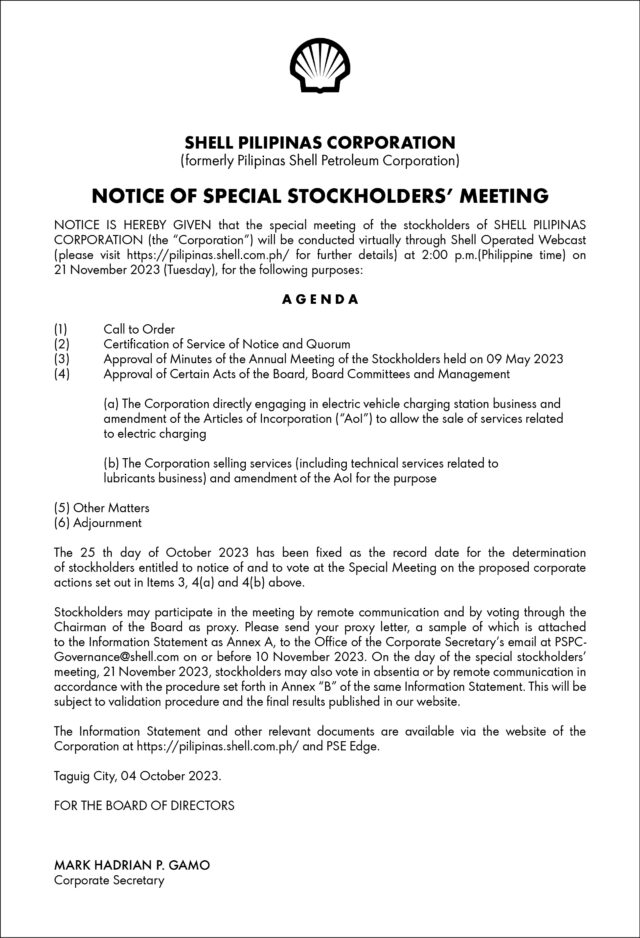
Shell Pilipinas Corp. to conduct Special Stockholders’ Meeting virtually on Nov. 21


Spotlight is BusinessWorld’s sponsored section that allows advertisers to amplify their brand and connect with BusinessWorld’s audience by enabling them to publish their stories directly on the BusinessWorld website. For more information, send an email to online@bworldonline.com.

Join us on Viber at https://bit.ly/3hv6bLA to get more updates and subscribe to BusinessWorld’s titles and get exclusive content through www.bworld-x.com.

Budding grounds for Philippine real estate’s growth

Photo from Freepik

By Angela Kiara S. Brillantes, Special Features and Content Writer

Real estate is seen as one of the major drivers of the Philippine economy. Global data and business intelligence platform Statista bases this on the gross value added generated by the industry, which amounted to P536 billion from 2020 to 2022. Such share can be sustained, or even boosted, as big opportunities are seen for the industry this year.

As global management consulting firm McKinsey & Company shared on its website last March, “real estate is likely to experience continued recovery which is supported by emerging industries and easing restrictions.”

This development is set on a background where the Philippine economy grew by 4.3% in the second quarter (Q2) of 2023, continuously being one of the countries with the fastest gross domestic product growth rates in Southeast Asia.

According to diversified professional services and investment management company Colliers, in Q2 real estate is experiencing decelerating inflation, as well as the increase of development of office spaces (18.4%) and residential rentals, which are key factors for economic growth. With this, vacancy is expected to decline from 17.6% to 17% during the last quarter of the year, positively impacting residential rents and prices.

Similarly, Ayala Land, Inc. (ALI) sees the growth of the country’s real estate market to continue throughout this year. The developer sees that although the pace of growth may vary, the outlook remains positive given factors such as low interest rates, government infrastructure projects, and increased consumer confidence.

ALI also sees a variety of trends and opportunities in the current real estate investment environment.

“The rise of remote/online work and flexible office spaces has created a demand for residential developments that cater to work-from-home setups,” ALI shared in an email to BusinessWorld. “The growth of e-commerce has also led to increased demand for logistics and warehousing facilities. Additionally, sustainable and eco-friendly developments are gaining popularity among investors and consumers.”

Residential

Looking deeper into property segments, the residential segment is anticipated to remain buoyant, with the middle-income segment driving demand for affordable housing.

Such improvement can be seen in increased demand, as shown by figures from Colliers, which Global Property Guide cited in their recent analysis of the country’s residential real estate market. The data shows that 20,000 units were sold in 2022, a 54% increase from the previous year. In the first half of 2023, the high demand for outsourcing firms, consular offices, and multilateral lending firms from foreign investors has resulted in an increased use of offices, thus, positively impacting rents and prices.

Colliers added that rents climbed to 1%, with continued residential leasing in business districts. This was coupled with an increase in prices (3.3%), and a decrease in vacancy rate (16.9%). The vacancy rate, however, is more likely to increase in the following year due to new supply.

“Vacancy in the Metro Manila secondary market is stabilizing and this has been resulting in gradual improvement in rents and prices. Colliers still sees slower launches and completion this year, but we see the latter making a big comeback in 2024,” Joey Roi Bondoc, senior research manager at Colliers International Philippines, said in its most recent report for the residential segment.

“The upside for the sector is that developers have aggressively been scouting for developable parcels of land outside Metro Manila, targeting the end-user market,” he added. “Developers are undeniably banking on the government’s infrastructure push, aggressively and strategically acquiring land near the government’s big-ticket public projects. Moving forward, this should result in the development of more horizontal projects including resort-oriented master-planned communities.”

Furthermore, McKinsey sees residential buildings to likely drive growth in real estate and its recovery to pre-pandemic levels.

“Much of the sector is expected to recover to pre-pandemic levels by the end of 2023, and construction by the end of 2024. Much of this growth will likely be driven by residential building construction, predicted to grow by 12%. Non-residential construction, by contrast, has yet to recover to pre-pandemic levels,” it added.

Office

Within the office segment, McKinsey noted that the “return to office” trend caused a high demand for office spaces, as well as a resurgence in the need for industrial, retail, and leisure spaces. These two factors are seen to boost growth in this segment.

“Office spaces may need to be reinvented as companies look to adopt more hybrid ways of working,” McKinsey’s article read. “This could result in vacancy rates persisting, however, the growth of coworking facilities and the desire for sustainable buildings will necessitate innovations in construction techniques and leasing agreements, thus encouraging sector-wide growth.”

Colliers, meanwhile, stated in their report that the sector has seen a decline in office vacancy in the first half of the year, from 18.7% to 18.4%. Moreover, net absorption has also increased, resulting in a higher net take-up by the end of the year. With this, elevated vacancy is expected due to the incoming supply that is bound to happen later.

Retail

As long as Filipinos continue to enjoy shopping, the retail sector is seen to rebound faster than expected. Following the previous year, the growth rate for retail is looking positive. Back in the first quarter (Q1), Colliers found, mall vacancies have decreased from 15.4% to 14%. Currently, consumer traffic is returning to pre-COVID levels and the mall foot traffic jumped higher than it was before the pandemic — from a 1% growth in 2022 to a 2.5% in 2023.

According to Colliers, in Q1 2023 the physical mall space is swarmed with mostly food and fashion retails. This, as a result, has attracted foreign retailers.

Moreover, despite the growth of e-commerce in the Philippines, in-store buying will continue to rebound, as seen by the rising absorption of physical mall space by retailers.

Industrial and leisure

In addition, there is a consistent industrial demand in the Philippines this year, and the country is setting high records for investment pledges as foreign investments are more likely to use major industrial hubs in the country. By seeking foreign investments, industry players can further strengthen the country’s manufacturing.

Currently, the Philippines is seeking for foreign investors that are likely to consider the Southeast Asia region as a hub for manufacturing, as well as investments from trade deals. According to Colliers, industrial park developers should use this as an opportunity to expand their industrial footprint and modernize warehouses to meet the needs of their clients and continuously strengthen the industrial sector for a long time.

Green buildings

One notable trend within real estate recently is the rise of green buildings, or structures that incorporate environmentally-responsible and resource-efficient measures. McKinsey noted that the emergence of green real estate, which the firm sees as a “promising step” to the Philippines’ goal of reducing carbon emissions by 75% in 2023, contributes to an optimistic projection for the country’s real estate.

ALI, likewise, finds that “green buildings have become a significant factor in real estate investments due to increasing awareness of environmental sustainability.”

In response, the developer plans to expand its green real estate portfolio by incorporating sustainable features in its developments, such as green spaces, energy-efficient systems, and waste management initiatives.

“ALI aims to create communities that prioritize environmental stewardship while providing quality living and working spaces,” the developer added.

Key considerations to know in real estate investing

Photo from xb100 on Freepik

Properties have been luring in investors for their various pros. But before stepping in and realizing the edge of real estate investing, some factors must be considered.

Investors might each have their own objectives through their investments; and real estate is widely seen to meet several of them. Among these is providing an opportunity for investors looking to diversify beyond the stock market or those wanting to gain more control of their investments. And for investors who merely seek to earn from passive income, returns from real estate investments could be generated as such.

Whatever goals one has in mind as an investor, venturing into property investing must involve exploring the real estate industry, the market, and one’s finances.

There are different ways for investors to embark on the real estate sector. Each of them is expected to vary in terms of the amount to put in, potential risks and returns, as well as the management needed, all of which are considerations that investors must be aware of to know which is best for them to add to their investments.

Perhaps one of the most known means to profit from real estate is through investing in properties to rent out. Ideally, such kind of real estate investing could generate steady cash flow, whether an investor leases their property to tenants for a long term that extends years or for a short term like overnight staycations.

But, while rental properties could be rewarding, investors must understand that this real estate investment demands continuous effort and expenses. Among the responsibilities that could cost investors in managing their properties are maintenance and repairs. Rentals could thus be challenging especially if investors manage several properties for lease in their portfolio.

Another way of getting investment returns from procuring a property is through flipping. This meant purchasing a property, renovating it, and putting it up for sale in the market, which then could generate earnings in the short term. However, this investment could be complex, particularly because of the costs it would require for the renovation and its processes.

Apart from rentals and flipping properties, some also view their own homes as an investment. As the owners, investors can earn from their homes someday when they decide to sell them. Investing in one’s home could build its value in the long term.

Such ways to invest in real estate entail managing the properties. Nevertheless, for investors who prefer not to always oversee their properties but still want to partake in real estate investing, they could look into real estate investment trusts (REITs). Investing in REITs involves purchasing a share of a company that owns income-producing real estate assets. When such companies get revenues from their properties, they return the dividends to their investors.

These advantages and risks that come with a particular way of investing in real estate must be looked into by investors to decide which they would go for. But whatever ways one chooses to invest in the real estate sector, investors would need to have their finances ready to pay the costs of such investments.

As mentioned, spending for a real estate investment does not stop at purchasing the property. Especially if such properties would be leveraged for rent or would undergo flipping, investors would have to make expenses for their investments to earn.

In addition, investors must be acquainted and updated about the real estate market to leverage possible opportunities and somehow have expectations. Among the factors they should look at are the property’s location, tenants’ housing preferences, and even the economic conditions.

For instance, looking at the inflation situation in the Philippines during the past months, Colliers held that investors must continuously monitor deviations in inflation and interest rates, and their effect on mortgage rates.

“Colliers encourages investors to proactively monitor interest and mortgage rates, particularly as these strongly influence the viability of condominium as a residential investment,” the professionals services and investment management firm said in its report from July.

The location also matters in real estate investing, such as if a property is surrounded by many conveniences.

In relation to location, Colliers stated in the same report that vertical units within integrated communities and close to public infrastructure developments possess “great capital appreciation potential,” which therefore are among key features that investors should consider in investing in condominium units. This as the firm observed that the investor market in Metro Manila still depends on the potential capital appreciation of condominium units.

Investors should also watch out for the trends and preferences of home seekers. These preferences could deal with the amenities such as outdoor spaces; the location or its proximity to essential establishments; or features that enable smart or sustainable home living. But what tenants look out for in a home constantly shifts, so property investors should stay updated on the market. — Chelsey Keith P. Ignacio

Factoring ESG into property investment

Photo from Freepik

In recent years, there has been a significant change in the property investment industry towards a more sustainable and responsible approach. This trend is driven by several factors, including the growing awareness of environmental, social and governance (ESG) issues, and the long-term benefits of responsible investment.

ESG has a significant impact on the performance, risk, and value of real estate investments.

According to a report published by Deloitte, ESG can be a value driver for real estate by helping to ensure that buildings are designed and operated in a sustainable and socially responsible way. Hence, ESG investments in real estate properties can translate to lower vacancy rates, lower operating expenses, and higher market value.

In a report by McKinsey & Company in 2022, residential and commercial buildings are responsible for approximately 40% of global carbon dioxide (CO) emissions from fuel combustion and 25% of overall greenhouse gas emissions. As the world moves towards reducing carbon, environmental sustainability is one of the pillars of ESG in property investment.

Nowadays, property investors are giving more importance to green practices to minimize the overall environmental impact of real estate development.

According to McKinsey, real estate leaders have accelerated the need for economic and environmental resiliency planning to combat ecological risks. Property investment leaders need to shift how they design, build, operate, and decommission assets with green growth.

Property investments are also contributing to the development of creating inclusive, accessible, and safe spaces.

Investors are ensuring that the property is secure and well-lit, with working smoke detectors, carbon monoxide detectors, alarm systems, and security cameras. They are also accommodating people with disabilities, such as wheelchair ramps, accessible entrances, and elevators; attracting a wider range of market segment.

Furthermore, proper governance in real estate can help investors implement and assess its policies, goals, and reporting efforts for ESG initiatives.

Based on a study published in the open-access journal Sustainability, strong government policies and procedures can help build trust, attract buyers or renters, and prevent costly mishaps while meeting community needs. Policies and regulations have a significant impact on the real estate market, and property investors can take advantage of opportunities and avoid potential risks.

While the world is facing post-pandemic challenges, property owners and investors who consider ESG-driven actions may be better positioned for success in the future.

According to PwC, ESG-focused investment is expected to soar 84% to US$33.9 trillion by 2026.

Furthermore, real estate investments with strong ESG practices have higher returns on invested capital and assets compared to those without, according to a report by investment research firm MSCI ESG Research, Inc.

Buyers and tenants are also increasingly looking for buildings that are designed and operated in a sustainable and socially responsible way.

ESG, in turn, has become an essential consideration for investment decisions. Investors can attract and retain buyers or tenants, increase the value of their investments, and have a positive impact on sustainability. Consequently, those who ignore ESG factors may be at risk of losing out on opportunities.
Mhicole A. Moral

ADVERTISEMENT
ADVERTISEMENT