BUENOS AIRES – Argentine drivers ran the gauntlet on Monday to find scarce supplies of petrol to fill their tanks amid the most acute fuel shortage in years, which has left many filling stations out of supply and long lines at any pumps still operating.
The South American country, a major shale oil and gas producer, has suffered shortages of petrol and diesel since late last week because of domestic refining problems and as a lack of dollars has delayed imports.
That has sparked anger at the government ahead of a second-round presidential election runoff next month between the ruling Peronist coalition’s economy chief Sergio Massa, seen as the front-runner, and radical libertarian Javier Milei.
“The truth is that I work with the car and it’s like looking for water in the desert,” said 38-year-old Cabify driver Raul Paretto. “It is distressing because you don’t know on a day-to-day basis what can happen; we are living one day at a time.”
Around the capital Buenos Aires, Reuters reporters saw empty filling stations with signs saying no more petrol. In other places, long queues formed and some rationed sales. There were, however, some signs of things starting to improve.
“Today they sold me only super, though there was no premium,” said self-employed worker Leonardo Villa with his car. “But, well, yesterday there was none anywhere, the day before neither. At least today I was able to fill up.”
In Argentina‘s farmlands, producers said a shortage of diesel showed signs of abating too, key for the start of the planting season of soy and late season corn, the country’s main cash crops.
“It is not completely normalized but there is a little more supply,” Jorge Chemes, the head of the Argentine Rural Confederations (CRA), told Reuters on Monday.
EXPORT HALT THREAT
Oil executives cited planned halts at local refineries, which provide 80% of domestic supply, and the country’s scarce foreign currency reserves that have held up imports.
“It’s not a problem of lack of crude oil, the problem is that there’s no more processing capacity with the refineries we have in Argentina,” said one industry source, asking not to be named because he was not authorized to speak to the media.
“On top of that, you need dollars to pay for imports and the central bank does not have them. And even when they do import, the refining companies make a loss selling at the pump below the price they are buying,” the source said.
Argentina‘s government has fixed a local oil price at $56 per barrel, far below the international price around $86 LCOc1 to try to calm local inflation of nearly 140%. That skews the economics for firms importing product from overseas.
During the weekend Economy Minister Massa told oil companies they must solve the domestic supply crisis by the end of Tuesday or the government would halt crude oil export shipments from the huge Vaca Muerta shale formation.
“I am going to defend the internal supply, I am going to defend the consumption of Argentines,” he said.
Argentina‘s largest fuel producers and refiners said in a joint statement on Monday they had presented a plan to the government to bring gas stations back up to full supply and to boost stocks.
“We will use all methods possible to accelerate the unloading of ships with imported fuel, which, like every year, supplements local production,” they said.
Local unions backed Massa’s position and threatened a strike from Wednesday unless the domestic situation was resolved. They said crude production was at a record and the oil companies were being “opportunistic and petty.” — Reuters
LONDON – Britons are turning to unregulated “buy-now–pay-later” credit in ever increasing numbers to pay their bills, the Financial Conduct Authority said on Tuesday, in the latest sign of how the country’s cost of living crisis continues to bite.
Companies that offer “buy-now–pay-later” (BNPL) unsecured loans are not regulated by the FCA, though it has used Britain’s consumer rights law to make contracts fairer.
The watchdog said its latest Financial Lives survey showed that 27% of UK adults or about 14 million people, have used BNPL at least once in the six months to January 2023, up from 17% in the 12 months to May 2022.
Since then, Bank of England interest rates have risen further, making credit more expensive.
BNPL is offered over a short period to shoppers who buy to clothes or other retail goods. Frequent users were more likely to be in financial difficulty and to have missed a payment of a bill or credit commitment, the FCA said.
The regulator said it was concerned that PayPal and QVC customers were at risk of harm because of how some of the contract terms were drafted.
“As a result of the FCA’s continued focus in this area, both firms have voluntarily made their continuous payment authority terms easier to understand – and PayPal has made terms relating to what happens when a consumer cancels the purchase funded by the loan clearer and fairer,” the FCA said in a statement.
In 2022, the FCA told Clearpay, Klarna, Laybuy and Openpay to change their contracts.
“When used appropriately, the product provides valuable benefits, but we want to ensure that consumers, particularly those in vulnerable circumstances, have adequate protections and are given sufficient information,” said Sheldon Mills, FCA executive director for consumers and competition. – Reuters
US President Joe Biden is seeking to reduce the risks that artificial intelligence (AI) poses to consumers, workers, minority groups and national security with a new executive order on Monday.
It requires developers of AI systems that pose risks to US national security, the economy, public health or safety to share the results of safety tests with the US government, in line with the Defense Production Act, before they are released to the public.
The order, which Biden signed at the White House, also directs agencies to set standards for that testing and address related chemical, biological, radiological, nuclear, and cybersecurity risks.
“To realize the promise of AI and avoid the risk, we need to govern this technology,” Biden said. “In the wrong hands AI can make it easier for hackers to exploit vulnerabilities in the software that makes our society run.”
The move is the latest step by the administration to set parameters around AI as it makes rapid gains in capability and popularity in an environment of, so far, limited regulation. The order prompted a mixed response from industry and trade groups.
Bradley Tusk, CEO at Tusk Ventures, a venture capital firm with investments in tech and AI, welcomed the move. But he said tech companies would likely shy away from sharing proprietary data with the government over fears it could be provided to rivals.
“Without a real enforcement mechanism, which the executive order does not seem to have, the concept is great but adherence may be very limited,” Tusk said.
NetChoice, a national trade association that includes major tech platforms, described the order as an “AI Red Tape Wishlist,” that will end up “stifling new companies and competitors from entering the marketplace and significantly expanding the power of the federal government over American innovation.”
GROUP OF SEVEN CODE OF CONDUCT
The new order goes beyond voluntary commitments made earlier this year by AI companies such as OpenAI, Alphabet and Meta Platforms, which pledged to watermark AI-generated content to make the technology safer.
As part of the order, the Commerce Department will “develop guidance for content authentication and watermarking” for labeling items that are generated by AI, to make sure government communications are clear, the White House said in a release.
The order also set out requirements for intellectual property regulators and federal law enforcement agencies to address the use of copyrighted works in AI training, including a call to “evaluate AI systems for IP law violations.”
Prominent writers and visual artists have filed multiple lawsuits accusing tech companies of theft for using their works to train generative AI systems. Tech companies argue their use of the content is protected by U.S. copyright law’s fair-use doctrine.
The Group of Seven industrial countries on Monday will agree a code of conduct for companies developing advanced artificial intelligence systems, according to a G7 document.
“The truth is the United States is already far behind Europe,” said Max Tegmark, President of Tech policy think tank Future of Life Institute. “Policymakers, including those in Congress, need to look out for their citizens by enacting laws with teeth that tackle threats and safeguard progress,” he said in a statement.
A senior administration official, briefing reporters on Sunday, pushed back against criticism that Europe had been more aggressive at regulating AI, saying legislative action was also necessary. Biden on Monday called on Congress to act, in particular by better protecting personal data.
US Senate Majority Leader Chuck Schumer said he hoped to have AI legislation ready in a matter of months.
US officials have warned that AI can heighten the risk of bias and civil rights violations, and Biden‘s executive order seeks to address that by calling for guidance to landlords, federal benefits programs and federal contractors “to keep AI algorithms from being used to exacerbate discrimination,” the release said.
The order also calls for the development of “best practices” to address harms that AI may cause workers, including job displacement, and requires a report on labor market impacts.n – Reuters
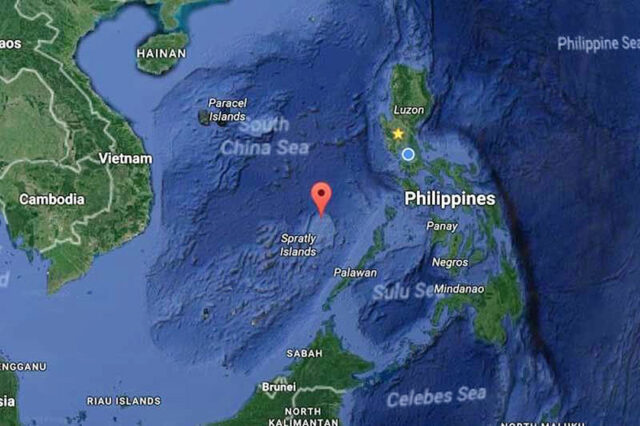
The Philippines National Security Adviser on Tuesday said Manila’s vessel did not illegally enter any space under Chinese sovereignty and called on China to stop “its aggressive action in Philippine waters”.
The remarks came after the Chinese military on Monday said in a rare warning that a Philippine military ship “illegally entered” waters near the Scarborough Shoal in the South China Sea without authorization.
National Security Adviser Eduardo M. Año accused China of “over hyping” the incident and “creating unnecessary tensions between our two nations.”
“We urge China to act responsibly, respect UNCLOS, adhere to the 2016 Arbitral Ruling, promote the rules-based international order, and stop its aggressive and illegal actions in Philippine waters,” Mr. Año said in a statement.
Mr. Año was referring to the UN Convention on the Law of the Sea (UNCLOS) and the ruling, handed down by the Permanent Court of Arbitration in The Hague in 2016 that concluded Beijing’s claim to almost the entire South China Sea was groundless.
China and the Philippines have had several confrontations in the South China Sea, recently trading accusations about a collision between a Chinese coastguard vessel and a boat from the Philippines. — Reuters
By Chelsey Keith P. Ignacio, Special Features and Content Senior Writer
Businesses and executives in the country who have shown significant accomplishments in particular areas were once again recognized in this year’s Asia CEO Awards with Title Sponsor Globe Telecom.
Over 700 nominations were received in the awards for 2023, the largest in its 14-year history. Its Circle of Excellence awardees and the grand winners for the year were celebrated last Oct. 24 at the Manila Marriott Grand Ballroom in Pasay City.
From L-R: Asia CEO Awards Chairman Richard Mills, Asia CEO Events CEO Rebecca Bustamante, and Alex Mills
“When we first started doing this event 14 years ago, we had a hard time getting quality companies to really show themselves. Now, there’s more of the diversity and quality,” Asia CEO Awards Chairman Richard Mills said.
In each of the 15 categories, notable organizations and leaders that made important contributions to their industries and the country’s development were selected to be part of the Circle of Excellence. One of these Circle of Excellence awardees was hailed as the grand winner in their respective category during the awarding ceremony.
1 of 2
Former Ombudsman Conchita Carpio Morales (fourth from left) receives the Lifetime Contributor Award in the Public Sector. She is joined by (from L-R) Richard Mills; Alex Cabrera; Felino “Jun” Palafox, Jr.; Dr. Winston Conrad B. Padojinog; Yoly Crisanto; and Don Felbaum.
Dr. Andrew Tan (fourth from left) receives the Lifetime Contributor Award in the Private Sector. He is joined by (from L-R): Richard Mills; Alex Cabrera; Dr. Winston Conrad B. Padojinog; Dr. Andrew Tan; Yoly Crisanto; Don Felbaum; and Felino “Jun” Palafox, Jr.
Asia CEO Awards also recognized Lifetime Contributor Awardees in the public and private sector, which were given to Former Ombudsman Conchita Carpio Morales and Alliance Global Group Chairman and Founder Andrew Tan, respectively, for 2023.
Foreign leaders who have attained success while running companies in the Philippines were honored in the Circle of Excellence for Expatriate Executive of the Year. This year, the recognition was bestowed on Wipro Philippines Country Head Aseem Roy. Executives who were part of the said award’s Circle of Excellence were Amit Jagga, SVP and country leader of Concentrix Philippines; Eng Teng Wong, president and CEO of Pru Life UK; Kais Marzouki, chairman and CEO of Nestlé Philippines; Praveer Chadha, SVP for Customer at Datamatics; Sanjiv Gupta, president and country head of IBM Solutions Delivery; Shiju Varghese, country head of Tata Consultancy Services; and Sudhir Agarwal, founder and CEO of Everise.
Young Leader of the Year for 2023 was given to Walther Buenavista, president and CEO of Shawarma Shack Group. Other young leaders who were recognized in the Circle of Excellence were Eric Darryl Lim, executive vice-president of Autokid Subic; James Lacsamana, head of IT at Eastvantage; Joshua Palisoc, COO of Ask Lex PH Academy; Mark Alvarez, managing partner for Southeast Asia at Human8; Ralph Ray Chua, chairman and president of Immuni Global; Rolan Marco Garcia, CEO and managing partner at Embiggen Group; and Sean Gabriel Villoria, CEO of GerWeiss Motors.
Asia CEO Awards’ Technology Company of the Year was EdukSine Production Corp., who bested other thriving technology companies in the Circle of Excellence, which included Ask Lex PH Academy; Dyson Electronics Pte. Ltd. Philippine Branch; GoTyme Bank; PCCW Solutions, Philippines, Inc.; Pili Seal; and Tata Consultancy Services (Philippines), Inc.
An organization with notable success in minding workplace health was awarded the Wellness Company of the Year, which went to Seda Hotels this year. Companies in the Circle of Excellence of this award were CBRE; Diageo APAC SSC Ltd, Inc.; Dyson Electronics Pte. Ltd. Philippine Branch; Hewlett Packard Enterprise; Infosys BPM Philippines; Manulife Business Processing Services; TDCX (PH), Inc.; Teleperformance Philippines; and VXI Global Holdings B.V. (Philippines).
From left: Oscar Sañez delivers his keynote speech; Bruce Winton delivers the welcome remarks; and Roderick Danao explaining the judging process.
Meanwhile, Nestlé Philippines, Inc. was recognized as the Diversity Company of the Year, winning over among the Circle of Excellence awardees, which included Aboitiz Land, Inc.; Foundever Philippines Corp.; Genpact Services LLC Philippines Branch; Hewlett Packard Enterprise; HSBC GSC Philippines; loveyourself, inc.; Manulife Business Processing Services; Northern Operating Services Asia, Inc.; Shell Companies in the Philippines; Teleperformance Philippines; TTEC; and Ubisoft Philippines.
Successful small and medium-sized enterprises (SMEs) were also celebrated by the Asia CEO Awards. The SME Company of the Year was conferred to Immuni Global. Autokid Subic Trading Corp.; DynaQuest Technology Services, Inc.; eBIZolution, Inc.; Embiggen Group; Hytex Power, Inc.; Motovita; Ova Virtual; PSO (Manila) Limited Philippine Branch Office; and What’s your FLAN International Group of Franchise Companies were the SMEs who make up the Circle of Excellence.
Winning the Service Excellence Company of the Year was Asian Hospital and Medical Center. Other organizations that demonstrated service excellence and belonged to this year’s Circle of Excellence were Amaia Land Corp.; CGI Philippines, Inc.; Eastvantage Business Solutions, Inc.; GoTyme Bank; ING Hubs Philippines; the Public Attorney’s Office; Sprout Solutions; Sutherland Global Services; Theos Cybers Solutions; Tech Mahindra Limited; and Unified Internship Program.
Organizations that have developed “a meaningful innovation” are recognized in the Circle of Excellence for Most Innovative Company of the Year, with Maya being hailed as the grand winner. Among the companies in the Circle of Excellence were ALLCARE Technologies Philippines, Inc.; CGI Philippines, Inc.; Converge ICT Solutions, Inc.; Embiggen Group; GoTyme Bank; Maybank Philippines; MDI Novare; Ramco Systems; Traxion Tech; VXI Global Holdings B.V. (Philippines); and Western Digital Storage Technologies (Philippines) Corp.
Filipino women leaders in the private sector and the government were also honored by the Asia CEO Awards with the recognition of Woman Leader of the Year. The award went to Microsourcing and Beepo CEO Haidee Enriquez. Notable women leaders in the Circle of Excellence were Abigail Del Rosario, country director of Maybank; Annalyn Cuisia, CEO and founder of Traxion Tech; Cosette Canilao, president and CEO of Aboitiz InfraCapital; Divine Gomez, partner – BPO, Talent at IBM Business Services; Grace Vera Cruz, country head of Grab Philippines; Lotis Ramin, country president of AstraZeneca; Ma. Rhodora Campos, country head of Infosys BPM; Marilene Acosta, CEO of Pag-IBIG Fund; Nerissa Gerial, deputy executive director at NKTI; Rosemarie Rafael, chairperson and CEO of Airspeed Group; and Tonichi Parekh, vice-president at Concentrix.
In the area of sustainability, Robinsons Land Corp.’s Commercial Centers Division (Robinsons Malls) won as the Sustainability Company of the Year. Organizations that are also recognized for their sustainability commitment were Aboitiz InfraCapital; Alaska Milk Corp.; Bank of the Philippine Islands; Concentrix Philippines; DynaQuest Technology Services, Inc.; Filinvest REIT Corp.; Foundever Philippines Corp.; Land Bank of the Philippines; Lexmark Research and Development Corp.; Nestlé Philippines, Inc.; and the Securities and Exchange Commission Philippines.
Entrepreneurs who have successfully grown their businesses from scratch were also recognized, with Sante International CEO Jesus Joey Marcelo winning the honor of Entrepreneur of the Year. The award’s Circle of Excellence included Charlotte Reyes, founder and president of OVA Virtual; Chet Pastrana, president and CEO of APFC; Francisco Magsaysay, founder of Carmen’s Best; Joash Tubaga, owner founder of FIXMYMAC I.T.; Maria Angeline Fon, founder of Thinkstitute PHL; Mharicar Castillo-Reyes, president and CEO of Asticom Group; Regieno Valencia, owner of Interior Construction; Rolan Marco Garcia, CEO and managing partner at Embiggen Group; Rommel Carlos, CEO of Nokarin & Arcus; and Victor Lim, co-founder and CEO of Kraver’s.
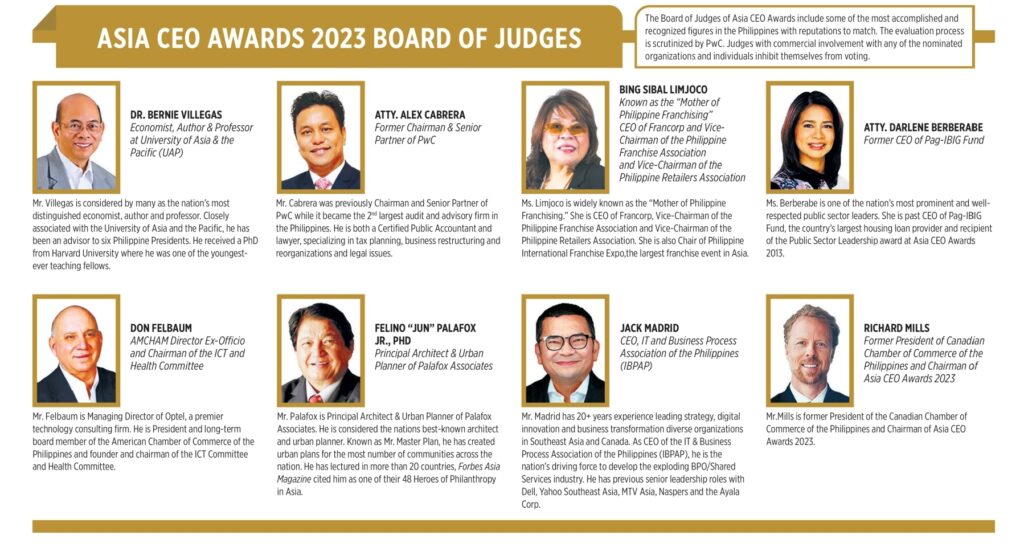
From left: Don Felbaum, Richard Mills, Dr. Winston Conrad B. Padojinog, Alex Cabrera, and Felino “Jun” Palafox, Jr., members of the board of judges of Asia CEO Awards 2023
Asia CEO Awards also celebrated Filipino business leaders who have shown success within or beyond the country. Infosys BPM Philippines Country Head Ma. Rhodora Campos was awarded as the Global Filipino Executive of the Year, winning over other leaders in the award’s Circle of Excellence, including Dante Abando, president of Makati Development Corp.; Eppie Titong III, SVP and country manager at VXI Global; Jennire Torres, CEO of Atos; Atty. Jose Martin Loon, president and CEO of Cocolife; Lito Villanueva, EVP and CIIO at RCBC; and Raymund Berja, chief financial officer at AirAsia Philippines.
Meanwhile, the Executive Leadership Team of the Year was given to companies with successful executive management. IBM in the Philippines Consulting Client Innovation Center won the recognition, while the other organizations in the Circle of Excellence were Airspeed Group of Companies; Datamatics Global Services Corp.; Eastvantage Business Solutions, Inc.; Filinvest Land., Inc.; Maya; Northern Operating Services Asia, Inc.; Sante International, Sprout Solutions; and VXI Global Holdings B.V. (Philippines).
Organizations notably demonstrating their corporate social responsibility (CSR) became part of the Circle of Excellence for CSR Company of the Year, with Maybank Philippines being the grand winner while the other recognized organizations were DynaQuest Technology Services, Inc.; EXL Service Philippines, Inc.; Gardenia Bakeries (Philippines), Inc.; Genpact Services LLC Philippines Branch; HSBC Global Service Centre Philippines; Innodata Knowledge Services, Inc.; KMC Solutions; Manila Water Foundation; Nezda Technologies, Inc.; OpenText (Philippines), Inc.; Personal Collection; Procter & Gamble Philippines; TDCX (PH), Inc.; and Wipro Philippines, Inc.
Companies are also honored as employers in the Asia CEO Awards. Concentrix Philippines won as the Top Employer of the Year. Employers in the Circle of Excellence were [24]7.ai Philippines; United Coconut Planters Life Assurance Corp.; Gardenia Bakeries (Philippines), Inc.; Hewlett Packard Enterprise; HSBC Global Service Centre Philippines; IBM in the Philippines; PepsiCo, Inc. Philippine Branch; Shopping Center Management Corp.; Tech Mahindra Limited; Teleperformance Philippines; TTEC; and Wipro Philippines, Inc.
Grand winners and Circle of Excellence awardees in this year’s Asia CEO Awards were also acknowledged and reminded on their role for economic growth.
“All the industries that each of you represent tonight are builders of economic progress. You are all stakeholders standing behind the industries that are boosters of economic engine. Each one of you has a stake in this; each one of you is invested in this. I’d like every one of you to remember that,” said Oscar Sañez, founding CEO of what is now IT & Business Process Association of the Philippines (IBPAP) and an emeritus judge at Asia CEO Awards, in his keynote during the event. “Your leadership expertise is being recognized for your contribution to building this economy.”
“All of you in the Circle of Excellence, as soon as you walk up the stage to receive your trophies, are committing to this mission to invest your talent in boosting this engine of economic growth. This is the only way we can prove that this program has stayed true to its mission,” he continued.
The Bureau of Internal Revenue is looking to start implementing a creditable withholding tax on partner-merchants of online platforms before December. — REUTERS
THE BUREAU of Internal Revenue (BIR) is hoping to start imposing a creditable withholding tax on partner-merchants of online platforms before the start of December, an official said.
“The process could be shorter, and we might just come up with it before the start of December. It will not be unreasonable to expect it before the start of December,” BIR Assistant Commissioner Jethro M. Sabariaga told reporters on the sidelines of the SGV Tax Symposium last week.
“The longer you withhold this release, you’re hobbling a significant portion of today’s economic transactions,” he added.
The BIR last week released the final draft of the amendments to Revenue Regulation No. 2-98 which currently does not cover income payments by online platform providers.
Under the final draft, the BIR would impose a withholding tax of 1% on one half of the gross remittances by domestic e-marketplace operators to the online merchants for the goods or services sold through their facility.
However, the withholding tax will not apply if annual total gross remittances to an online merchant for the past taxable year has not exceeded P250,000, or if the cumulative gross remittances to an online merchant in a taxable year has not yet exceeded P250,000.
Also exempted are online merchants who are part of a cooperative duly registered with the BIR with a valid Certificate of Tax Exemption.
Mr. Sabariaga said the BIR took note of the suggestions and objections to the draft rules raised by affected sectors. The BIR’s deadline for comments from stakeholders on the final draft ended on Oct. 27.
“This will all be taken into consideration and then be studied and then the final draft will be released and exposed,” he said.
Under the final draft, the BIR defined an electronic marketplaceas a digital platform whose business is “to connect online consumers with online merchants, facilitate and conclude the sales, process the payment of the products, goods or services through platform, or facilitate the shipment of goods or provide logistics services and post-purchase support within such platforms, and otherwise retains oversight over the consummation of the transaction.”
These would cover marketplaces for online shopping; food delivery platforms; platforms for booking accommodations at a resort, hotel, motel and inn; and other service or product marketplaces.
The BIR had first introduced its proposal to implement a withholding tax on online sellers in April.
Since then, Mr. Sabariaga said the agency consulted with various industries to come up with the latest version of the draft.
“It’s the first exposition of the draft, you have to consider the various industries, the applicability of the withholding (tax) on the various industries, the rates, the economic provisions of it,” he added
The BIR has been seeking ways to tax the digital economy, particularly as e-commerce surged during the pandemic.
In 2022, the digital economy contributed P2.08 trillion, equivalent to 9.4% of gross domestic product. Of this, e-commerce had the highest growth at 26.5%, with its share to the economy reaching 20% or P416.12 billion.
Aside from the withholding tax on online sellers, the Marcos administration has also proposed a value-added tax on digital services.
In November 2022, the House of Representatives approved the measure seeking to impose the 12% value-added tax (VAT) on nonresident digital service providers. A similar measure is still pending before a Senate committee.
If passed into law, a 12% VAT will be imposed on the digital sale of services like online advertising, video-on-demand subscriptions, and the supply of other services which are delivered through online marketplaces, webcasts and mobile applications, among others. — Luisa Maria Jacinta C. Jocson
HEADLINE INFLATION may ease to 5.3% in October, which would put less pressure for the Bangko Sentral ng Pilipinas (BSP) to further tighten monetary policy, according to Pantheon Macroeconomics.
However, Bank of the Philippine Islands (BPI) said another rate hike cannot be ruled out at the Monetary Board’s Nov. 16 meeting if the October print was faster than expected and the peso further depreciates against the US dollar.
In a note dated Oct. 30, Pantheon Macroeconomics Chief Emerging Asia Economist Miguel Chanco and Senior Asia Economist Moorthy Krshnan said Philippine inflation may still return to the 2-4% target band by the end of the year.
“Indeed, we expect inflation for October to fall to 5.3%, from September’s four-month high of 6.1%, as the reversal of the August surge in rice prices finally filters through; it should have in the last report,” the UK-based think tank said.
With easing October inflation, Pantheon Macroeconomics sees no rate action from the BSP at its last two meetings for this year.
“We are maintaining our end-2024 rate forecast of 5.5% too, implying a more pronounced unwinding of one of the region’s most aggressive rate-hiking cycles, which could start as early as February, if our relatively benign outlook for inflation and downbeat view on growth prove accurate,” it said.
The BSP last week hiked its key policy interest rate by 25 basis points (bps) to a fresh 16-year high of 6.5% in an off-cycle move. This has brought the cumulative rate hikes to 450 bps since May 2022.
Meanwhile, BPI Lead Economist Emilio S. Neri, Jr. said another rate increase is still possible on Nov. 16 since it would be based on the upcoming inflation data as well as the peso-dollar exchange rate.
“An inflation print significantly higher than 6.1% might trigger another rate hike in that meeting. Aside from this, the central bank may also consider a rate hike if the exchange rate breaches the P57 level and moves closer to P58,” he said.
The Philippine central bank is scheduled to release its October inflation forecast today (Tuesday) while the local statistics agency will release the inflation data on Nov. 7.
Inflation quickened for a second straight month to 6.1% in September. It also marked the 18th consecutive month inflation was above the BSP’s 2-4% target range. This brought the nine-month average inflation to 6.6%.
DBS Bank Senior Economist Radhika Rao said the off-cycle rate hike was a preemptive move ahead of the release of October inflation, “which is expected to show another jump on the back of high food and fuel prices.”
“The door remains open for a follow-up hike this quarter if conditions warrant. We pencil in another increase this quarter, followed by a prolonged pause into the first half of 2024,” she said in a note.
BSP Governor Eli M. Remolona, Jr. on Friday said there is a “good chance” the BSP will not hike at its meeting on Nov. 16, as he expects October inflation to ease.
The central bank currently sees full-year inflation at 5.8% for 2023, before declining to 3.5% in 2024 and 3.4% in 2025. But officials said the BSP will be revising its inflation forecasts on Nov. 16.
BPI’s Mr. Neri said market players should not downplay the effectiveness of a rate hike in taming inflation.
“Monetary policy continues to have a role in managing inflation even if the cause is mostly on the supply side. Inflation driven by supply may eventually lead to second-round effects, which the BSP aims to counter with its rate hikes,” he said.
The BSP’s credibility as an inflation-targeting central bank is another reason why a rate hike was necessary, despite high consumer prices being mostly driven by supply-side issues.
“The rate hike is a statement from the BSP that it is determined to bring inflation back to its target. Inflation expectations may shoot up further if the market doesn’t see any action from the BSP. It might hurt the BSP’s credibility and make it more difficult to bring down inflation,” Mr. Neri said.
He noted the peso may continue to depreciate against the US dollar even after the rate increase, as market players consider substantial imports, global financial market developments, and the central banks’ future policy moves.
He noted that remittances during the holiday season may offset some of the pressure, but the movements of the local currency for the rest of 2023 would largely depend on what the US Federal Reserve does.
“Once the Fed is done hiking, the peso may strengthen as markets will likely assess the possibility of rate cuts. If a recession in the US happens, the Fed may cut its rates and the BSP will likely follow,” he said.
The US Federal Reserve kept its own policy rates at 5.25-5.5% last month — its highest level in 22 years. From March 2022 to July 2023, the Fed has raised a total of 525 bps.
The local unit closed at P56.955 per dollar on Friday, gaining half a centavo from its P56.96 finish on Thursday, based on Bankers Association of the Philippines data.
“But in this situation, the appreciation of the local currency will likely be smaller compared to other currencies given the still substantial current account deficit of the Philippines this year and in 2024,” Mr. Neri added.
In the second quarter, the current account deficit reached $3.6 billion, equivalent to -3.4% of gross domestic product (GDP). This brought the current account deficit at $8.2 billion (-4% of GDP) in the first semester.
The BSP projects the current account deficit to reach $11.1 billion this year (-2.5% of GDP).
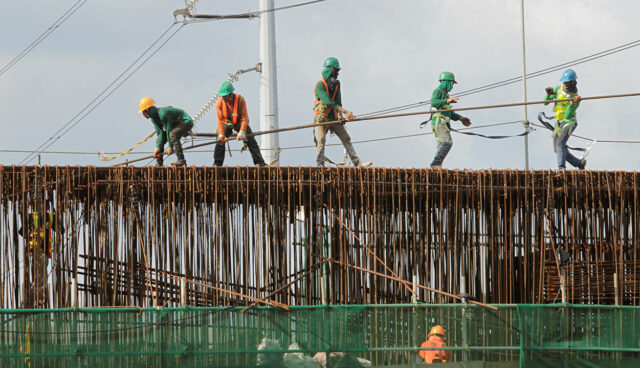
Laborers work at a construction site in Manila, Philippines, Nov. 17, 2016. — REUTERS/CZAR DANCEL
By Luisa Maria Jacinta C. Jocson, Reporter
THE NATIONAL Government (NG) may likely miss its spending targets this year, which could potentially weigh on economic growth, analysts said.
“We expect the National Government to miss their spending targets for the year given the gap between program and actual (expenditures),” ING Bank N.V. Manila Senior Economist Nicholas Antonio T. Mapa said in an e-mail.
The budget deficit narrowed by 2.89% to P983.5 billion in the first nine months, but it was 11% lower than its program for the period, data from the Bureau of the Treasury (BTr) showed.
Government revenues rose by 6.79% to P2.84 trillion, surpassing its target by 2.98%. However, state spending went up by 4.12% to P3.82 trillion but missed its target for the period by 1.06%.
The government has set a budget deficit ceiling of P1.499 trillion this year, equivalent to 6.1% of the gross domestic product (GDP). The program consists of P3.729 trillion in revenues and P5.228 trillion in expenditures.
“Although we do note a pickup in spending in the third quarter, we believe that challenges related to the devolution of certain expenditure to the local government units (LGU) level may be hampering the ability for spending to pick up in a considerable and sustained manner,” Mr. Mapa said.
Ateneo de Manila University economics professor Leonardo A. Lanzona said the year-to-date fiscal deficit is only over 60% of the full-year deficit program, noting that revenues have also lagged behind spending.
“The government spending was indeed pretty low for the whole year, but after raising spending to spur growth in the last six months of the year, the revenues have not kept pace with the programmed expenditures for the year,” Mr. Lanzona said in an e-mail.
“The problem apparently is the failure to spend because of limited funding apart from revenues.In order to engage in deficit spending, resources other than tax revenues need to be available. However, it seems that the government has not been able to obtain these nontax generated resources in order to support its deficit spending,” he added.
Filomeno S. Sta. Ana III, coordinator of Action for Economic Reforms, said that the government has so far “underperformed” in both generating revenues and ramping up spending.
“The government’s actual conduct to narrow the deficit is to underspend. (It’s) bad for growth,” he said via Facebook Messenger.
Mr. Mapa also noted the potential impact of slow government spending on gross domestic product (GDP) growth this year.
“We have already witnessed the negative impact on underspending with second-quarter GDP sliding to 4.3% after the -7.1% performance of the National Government,” he said.
The economy grew by a weaker-than-expected 4.3% GDP growth in the second quarter, slower than the 6.4% growth in the first quarter and 7.5% a year ago. It was also well below the government’s 6-7% target this year. The Philippine Statistics Authority (PSA) is set to release third-quarter GDP data on Nov. 9.
After the 7.1% contraction in government expenditures in the second quarter, the Finance department has ordered agencies to come up with catch-up plans for spending.
Mr. Lanzona said that the government will need to focus on strengthening the domestic economy to support growth.
“In effect, the government economic programs have been limping instead of sprinting despite the higher tax revenues, it is crucial to focus more on preparing the local economy to adapt to current economic and technological trends, instead of spending time abroad looking for foreign investments, in order to avail of loans and added borrowings to pursue their programs,” he said.
“With the recent hike in interest rates, the problem seems to have worsened, and the government is stuck to this lower budget deficit as it becomes more and more difficult to avail of outside funds,” he added.
THE BENCHMARK Philippine Stock Exchange index (PSEi) could close the year at 6,500, if economic activity improves, a market expert said.
“If the market could reach the 6,300 to 6,500 level. I would be happy,” BDO Capital and Investment Corp. President Eduardo V. Francisco said during a BusinessWorld roundtable discussion last week.
This would be around 1-4% lower than the PSEi’s 6,566.39 close on the last trading day of 2022.
The PSEi closed at 5,961.99 on Oct. 27, 0.94% lower than the previous day. The benchmark index has declined by 9% since the beginning of 2023.
Mr. Francisco said investors could turn positive on stocks if the gross domestic product (GDP) growth picks up in the third quarter and inflation eases.
“If we have 6% growth for the gross domestic product in the third quarter, plus inflation goes down and we can control that, then (market) optimism will increase,” he said.
The third-quarter GDP data is scheduled to be released on Nov. 9.
The Philippine economy grew by 4.3% in the second quarter, the slowest in two years. In the first half, GDP growth averaged 5.3%.
Economic managers have said GDP has to expand by at least 6.6% in the second half to reach the 6-7% target for this year.
Headline inflation accelerated for a second straight month to 6.1% in September, which also marked the 18th consecutive month inflation was above the Bangko Sentral ng Pilipinas’ (BSP) 2-4% target range. This brought nine-month average inflation to 6.6%, still above the BSP’s 5.8% forecast for 2023.
Last week the BSP resumed monetary tightening in an off-cycle move, amid increasing inflation risks. It cited the need for “urgent monetary action to prevent supply-side price pressures from inducing additional second-round effects and further dislodging inflation expectations.”
Meanwhile, Mr. Francisco said that it would be difficult for the local market to hit the 7,000 level before the year ends.
“The 7,000 level is very hard to attain… The volumes are very low. The foreigners are not here. They have been selling. The locals, in fairness to them, they have been the ones supporting the market. But there is not much good news and there is not much movement,” he said.
Mr. Francisco said he does not see any major movements in the stock market towards the end of the year.
As of end-September, PSE data showed that the average daily value traded declined by 9.6% to P6.6 billion, while total market capitalization rose by 0.9% to P16.7 trillion.
Foreign investors have sold a net P43.8 billion worth of Philippine stocks as of end-September. The rise in US interest rates over the past year has made emerging market equities less attractive to foreign investors.
“I think even without the foreigners, the (local) stock market will be stronger,” he said. — R.M.D.Ochave
LUFTHANSA TECHNIK Philippines, Inc. (LTP) is looking at expanding its operations to Clark, its president said, as he outlined the company’s plan to build two large hangar bases for P15 billion.
“We are maxed out here in NAIA (Ninoy Aquino International Airport) so we cannot build anything anymore. New hangars have to be built somewhere else. We are looking at Clark because its airport is ready, it fits our operations,” LTP President and Chief Executive Officer Elmar Lutter told reporters last week.
He said the company is targeting to build hangars that can accommodate large aircraft like Airbus A380.
“A380s are large aircraft, which is also a problem in NAIA, but in Clark, the space is much better for us and it is much better for the airport,” Mr. Lutter said.
The first phase of the planned expansion would roughly cost about P5 billion, he said, adding that the second phase is estimated to cost as much as P10 billion.
“Probably P10 billion to make it a full complement for the whole wide-body portfolio which we have: 777, A330. That will be built either in Clark or in one of the new airports,” Mr. Lutter added.
Aircraft maintenance, repair, and overhaul provider LTP said however that this plan is still pending necessary approvals.
“Yes, subject to the necessary approvals. We are a joint venture, so we have to get approvals from both of our shareholders,” he said.
LTP is a joint venture between MacroAsia Corp. and Germany’s Lufthansa Technik AG. It provides aircraft MRO services at various airports in the country, including NAIA, Mactan-Cebu International Airport, Kalibo International Airport, and Puerto Princesa Airport, among others.
“Our logical step to move forward and in the long term, we have to build an alternative to NAIA. As you all know, there are new airports that might also shift our priorities toward NAIA,” Mr. Lutter said.
To recall, LTP earlier said that it was planning to expand outside the National Capital Region amid the new airports to be built in Cavite and Bulacan as potential locations for its aircraft maintenance, repair and overhaul services hubs. — Ashley Erika O. Jose
Angat Hydropower Corp. (AHC) will undertake a major repair and rehabilitation of its existing penstock to modernize its hydro-electric power plant in Bulacan, said the Metropolitan Waterworks and Sewerage System (MWSS), which assured of uninterrupted water supply.
“The primary objective of the undertaking is to prolong the lifespan of the plant to ensure a stable water supply for the domestic and irrigation water supply,” MWSS said in a joint release with Maynilad Water Services, Inc. and Manila Water Co., Inc.
The agency said the move requires a total plant shutdown for 61 days from Nov. 6, 2023 to Jan. 6, 2024.
Angat Hydropower, a joint-venture asset of San Miguel Global Power Holdings Corp. and Korea Water Resources Corp., is the operator of the Angat Hydro-Electric Power Plant (AHEPP).
AHEPP has a generating capacity of 218 megawatts and is comprised of four main units and three auxiliary units.
MWSS said it had spearheaded the creation of comprehensive guidelines on the operation of the Angat Dam spillway and low-level outlet together with the two concessionaires. This is to ensure water supply for domestic and irrigation water supply during the plant shutdown.
According to the agency, the guidelines have been unanimously agreed upon by members of the interagency technical working group (TWG) on Angat Dam operations and management, including the National Water Resources Board, the National Power Corp., the National Irrigation Administration, the MWSS as well as other key stakeholders such as Maynilad, Manila Water, and AHC.
Patrick James B. Dizon, head of the MWSS Angat/Ipo operations management division, said that since AHC will be doing rehabilitation works, raw water releases from auxiliary turbines — where MWSS usually gets its allocation — are not possible.
In a Viber message, he said the Angat TWG had agreed that during the 61-day shutdown, water releases to MWSS would be through the spillway and low-level outlet.
Angat Dam is the main source of water for Metro Manila, accounting for about 90% of the capital’s potable water.
MWSS said the current water level Angat Dam at 209.48 meters or near the normal high water level of 210 meters assures a continuous supply of raw water for its service areas throughout the entire shutdown period.
Manila Water serves Manila’s east zone network, which comprises Marikina, Pasig, Makati, Taguig, Pateros, Mandaluyong, San Juan, portions of Quezon City and Manila, and several towns of nearby Rizal province.
Maynilad serves the cities of Manila, except portions of San Andres and Sta. Ana. It also operates in Quezon City, Makati, Caloocan, Pasay, Parañaque, Las Piñas, Muntinlupa, Valenzuela, Navotas, and Malabon. It also supplies the cities of Cavite, Bacoor, and Imus, and the towns of Kawit, Noveleta, and Rosario, all in Cavite province. — Sheldeen Joy Talavera
THE SINGAPORE International Film Festival (SGIFF), which has been held annually since 1987, will take place from Nov. 30 to Dec. 10 this year. This 34th edition boasts 101 films from all over the world, four of which are short films by Filipino filmmakers.
Competing in SGIFF’s Southeast Asian Short Film Competition are All This Wasted Space by Cris Bringas, Primetime Mother by Sonny Calvento, Cross My Heart Hope to Die by Sam Manacsa, and The River That Never Ends by JT Trinidad.
Emily J. Hoe, SGIFF executive director, said at the online media launch that the theme for the year is “tapestry.”
“It’s textured, intertwined, reflecting the diversity of perspectives through film, through threads that come together to show stories. Film connects us all, to each other and to the world,” said Ms. Hoe.
FILIPINO NARRATIVES Cris Bringas’ All This Wasted Space is an experimental documentary that follows Nica, who returns to her mother’s home to retrieve an item to place in her mother’s coffin. The film aims to trace her invisible personal traumas as a queer woman and the hidden historical traumas present in the physical space where she returns.
“Going back means confronting a buried past, remembering a history of abuses,” the film’s director told BusinessWorld via Zoom. “It’s a contemplation of the meaning of home,” said Mr. Bringas.
JT Trinidad’s fictional short The River That Never Ends, which premiered in QCinema last year, is also a reflection on space. It centers on transwoman Baby who struggles to keep up when the rest of her life is so easily swept away, much like how the Pasig River she lives next to being overwhelmed by the construction of an expressway.
Sonny Calvento, whose short film Primetime Mother starring Meryll Soriano is also in the competition, felt honored to share that his work told “in a very Filipino way” finds itself in the international film scene, starting with the Toronto International Film Festival earlier this year.
It is a film about a Filipino gameshow “complete with dance showdowns and melodramatic contestant life stories,” he said in a Facebook post. The fictional story follows how their fortitude, tenacity, and devotion to the maternal role are tested in an exploitative gameshow audition.
Meanwhile, Sam Manacsa’s Cross My Heart Hope to Die tackles worker exploitation and love through the character of Mila, who struggles with unpaid work and finds comfort in constant phone calls with a love interest. Her film debuted at the Venice Short Film Competition earlier this year.
Mr. Bringas, who is proud of his and his fellow Filipino filmmakers’ ability to showcase Filipino narratives on the world stage, believes that cinema exists as a form of keeping records.
“As a documentarist, my perspective is that filmmaking is about taking up space; reclaiming space. The role of keeping records is important,” he said. — Brontë H. Lacsamana










 “All the industries that each of you represent tonight are builders of economic progress. You are all stakeholders standing behind the industries that are boosters of economic engine. Each one of you has a stake in this; each one of you is invested in this. I’d like every one of you to remember that,” said Oscar Sañez, founding CEO of what is now IT & Business Process Association of the Philippines (IBPAP) and an emeritus judge at Asia CEO Awards, in his keynote during the event. “Your leadership expertise is being recognized for your contribution to building this economy.”