Home Blog Page 41

US pledges $2 billion in new UN model for delivery of humanitarian assistance

A woman in Turkana County, Kenya stands as her malnourished 4-year-old son eats wild fruits outside their thatch hut, October 29, 2025. — REUTERS

GENEVA/WASHINGTON — The United States on Monday pledged $2 billion in assistance to tens of millions of people facing hunger and disease in more than a dozen countries next year, part of what it said was a new mechanism for the delivery of life-saving assistance following major foreign aid cuts by the Trump administration.

The US slashed its aid spending this year, and leading Western donors such as Germany also pared back assistance as they pivoted to increased defense spending, triggering a severe funding crunch for the United Nations.

The billions of dollars in assistance pledged by Washington on Monday will be overseen by the United Nations Office for the Coordination of Humanitarian Affairs, the State Department said, under what it described as new model of assistance agreed with the UN that aims to make aid funding and delivery more efficient and increase accountability for the spending of funds.

UN data shows total US humanitarian contributions to the UN fell to about $3.38 billion in 2025, equating to about 14.8% of the global sum. This was down sharply from $14.1 billion the prior year, and a peak of $17.2 billion in 2022.

The US and United Nations will sign 17 memorandums of understanding with individual countries identified by the US as priority countries, officials from the State Department and UN said in Geneva.

But some areas that are priorities for the UN, including Yemen, Afghanistan, and Gaza, will not be receiving US funding under the new mechanism, UN aid chief Tom Fletcher said, adding that the UN will seek support from other donors to find funding for those.

Jeremy Lewin, State Department Under Secretary of State for Foreign Assistance, Humanitarian Affairs and Religious Freedom, said further countries would be added as more money is contributed to the mechanism.

“These are some countries where I think our interests overlap … But over time, we will thoughtfully add additional countries,” Mr. Lewin said.

GAZA TO BE HANDLED ON SEPARATE TRACK
A UN spokesperson said Ukraine, Democratic Republic of Congo, Nigeria, and Sudan were among the countries covered in Monday’s package.

But Gaza – where aid agencies have repeatedly said far more aid needs to get into the small, crowded enclave – is not covered in Monday’s announcement and will instead be handled on a separate track, Mr. Lewin said.

He said that the US had approved over $300 million after President Donald Trump’s administration helped broker a Gaza ceasefire “to give pipeline to the UN agencies”, adding that the US will be working to get additional donors for a pooled mechanism under a separate track for Gaza under phase two of the deal.

Mr. Fletcher said that donors would have “specific requirements” around which countries and what type of work should be funded.

“But the humanitarian action at the other end of that must always be neutral and impartial and independent, and nothing in the work that we’re doing together here in this partnership undermines those principles,” he said.

Mr. Lewin said the focus of the funding was on life-saving assistance, while funding for climate-related and other projects that were not a priority for the administration would be cut out.

Earlier in December, the United Nations launched a 2026 aid appeal for $23 billion to reach 87 million people at risk – half the $47 billion sought for 2025, reflecting plunging donor support despite record global needs.

Mr. Fletcher acknowledged it had been a tough year for the UN, following a slew of cuts while humanitarian crises in war-torn countries such as Sudan surged, but said he was optimistic following the US pledge.

“Millions of lives will be saved across 17 countries,” said Mr. Fletcher. — Reuters

BSP sees December inflation between 1.2% and 2.0%

Various clothing items were on sale at a mall in Cubao, Quezon City, Dec. 23. PHOTO BY MIGUEL DE GUZMAN, THE PHILIPINE STAR

By Katherine K. Chan

PHILIPPINE INFLATION likely eased year on year in December as lower electricity prices may have offset costlier food items during the holiday season.

In its month-ahead forecast, the Bangko Sentral ng Pilipinas (BSP) said headline inflation likely fell within the 1.2%-2% range in December, slowing from the 2.9% clip seen a year ago.

At 2% or the upper end of the forecast, inflation may have picked up from 1.5% in November and would be the fastest clip in 10 months or since the 2.1% clip in February. It would likewise mark the first time in 10 months that inflation returned to the central bank’s 2%-4% target.

At the bottom end of the forecast, inflation likely eased to its slowest pace in five months or since the 0.9% in July.

“Upward price pressures may come from increased prices of major food items due to the lingering effects of adverse weather and strong holiday demand, as well as higher LPG (liquefied petroleum gas) and gasoline prices,” the central bank said in a statement on Monday.

This comes despite the Department of Trade and Industry’s imposition of a 60-day price freeze on basic and prime commodities last November, following President Ferdinand R. Marcos, Jr.’s declaration of a state of national calamity.

The Department of Agriculture also implemented a maximum suggested retail price for pork, onions and carrots starting Dec. 1 and is set to last until the end of January.   

However, the central bank said lower prices of electricity, kerosene and diesel during the month may have offset the inflationary pressures from food prices.

In December, the Manila Electric Co. (Meralco) reduced electricity rates by P0.3557 per kilowatt-hour (kWh) to P13.1145 per kWh from P13.4702 per kWh in November.

This is equivalent to a P71 decrease in the monthly electricity bills of households consuming an average of 200 kWh.

Meanwhile, pump price adjustments in December stood at a net increase of P0.80 per liter for gasoline. On the other hand, it posted a net decrease of P3.80 per liter for diesel and P4.40 per liter for kerosene.

The Philippine Statistics Authority is set to release the December inflation data on Jan. 6.

In a separate commentary, Metropolitan Bank & Trust Co. (Metrobank) research officers Maria Kaila Balite and Joaquim Pantanosas said inflation likely settled at 1.4% in December, bringing full-year inflation to an average of 1.6%. 

The bank noted that elevated prices of food such as vegetables, fruits, meat and fish amid increased demand brought inflationary pressures in December.

“Food inflation continues to exert upward pressure to headline inflation this month, with holiday demand providing a push to prices,” it said. “Elevated oil and electricity prices also add to the weight. Metrobank forecasts headline inflation at 1.4% year on year in December.”

Meanwhile, the central bank said it will keep monitoring the country’s inflation and economic growth data in deciding its monetary policy.

“The BSP will continue to monitor domestic and international developments affecting the outlook for inflation and growth in line with its data-dependent approach to monetary policy,” the central bank said.

At its Dec. 11 meeting, the BSP lowered its policy rate by 25 basis points (bps) to an over three-year low of 4.5% as it continues to see subdued inflation and sluggish growth. It has so far delivered a total of 200 bps in cuts since August 2024.

As of November, headline inflation averaged 1.6%, matching the central bank’s full-year forecast.

For 2026, the central bank sees inflation accelerating to 3.2%, before slowing to 3% in 2027.

Mr. Remolona earlier said that the current easing cycle is nearing its end but still left the door open to a final 25-bp reduction next year depending on economic data.

The Monetary Board is scheduled to hold six regular policy meetings in 2026, with the first one set on Feb. 19.

Congress ratifies 2026 national budget

Members of the House of Representatives pose for a group photo after ratifying the bicameral conference committee report on the proposed P6.7-trillion 2026 national budget during a plenary session at the House of Representatives in Quezon City, Dec. 29. — PHILIPPINE STAR/MIGUEL DE GUZMAN

By Adrian H. Halili, Reporter

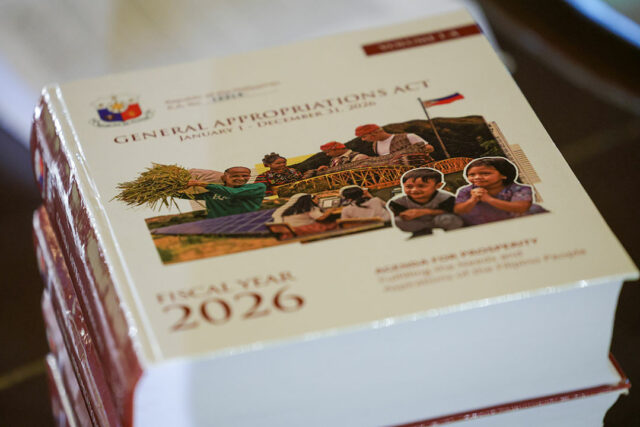
CONGRESS on Monday ratified the bicameral conference committee report on the P6.793-trillion national budget for 2026, marking the end of contentious deliberations that unfolded against the backdrop of a multibillion-peso corruption scandal.

Senator Sherwin T. Gatchalian, who heads the Senate Finance Committee, said next year’s budget is mainly focused on improving education, health, and agriculture.

“These highlights illustrate our commitment to strengthening the services that carry the most significant impact on the daily lives of our fellow Filipinos — better education for our children, adequate healthcare for those in need, and long-term food security for our communities,” he told plenary before the Senate ratified the report through a voice vote.   

At the same time, the House of Representatives approved the ratification of the 2026 General Appropriations Act (GAA) in under two minutes, also through a voice vote. 

After Congress’ ratification, the GAA will be sent to Malacañang for President Ferdinand R. Marcos, Jr.’s signature.

Mr. Marcos is expected to sign the 2026 national budget on Jan. 5.

Mr. Gatchalian said the bicameral panel had also enforced safeguards that would ensure transparency and accountability during budget process.

“The bicameral conference committee was also very deliberate in ensuring that equal attention was given to protecting the management of public funds — through safeguards that are anchored on transparency and accountability,” he said.

Reforms include the uploading of budget documents online, the livestreaming of bicameral proceedings, and the involvement of civil society in budget deliberations.

This year, several transparency initiatives were implemented during budget deliberations, amid public outrage over congressional insertions and opaque allocations in the 2025 national budget.

Government officials, lawmakers and contractors allegedly colluded to siphon off billions from funds meant for flood control projects.

During deliberations, the bicameral panel raised funding for the education sector to P1.35 trillion, which Mr. Gatchalian said was equivalent to 4.4% of economic output.

The budget of the Department of Education was increased by P47.18 billion to P961.32 billion, which would mainly be used for the construction of 34,000 new classrooms.

Funds would also be used to support the school feeding program with P25.7 billion aimed at covering 180 days and the procurement of textbooks at P19.51 billion.

“There will be clear and meaningful steps to reduce the shortage of classrooms. Millions of malnourished students will benefit from the School-Based Feeding Program. And we will ensure that every student has their own textbook,” Mr. Gatchalian said.

The budget of state universities and colleges was also raised by P6.22 billion to P137.9 billion under the 2026 national spending plan.

Funding under the health sector now stands at P447.6 billion, after lawmakers raised the Department of Health’s budget by P14.68 billion to P297.85 billion.

The budget of the Philippine Health Insurance Corp. (PhilHealth) was increased by P16.52 billion to P129.78 billion as the additional funds were rechanneled from the Public Works department.

Mr. Gatchalian said the panel also hiked funding for Zero-Balance Billing program for government hospitals to P1 billion, and expanded the program to include selected local government units.

The panel had also raised the Agriculture department’s budget by P5.48 billion to P185.77 billion to fund the construction of farm-to-market roads, post-harvest facilities, and support its modernization program.

“Programs that will help our farmers’ income and our country’s food security, such as credit insurance and direct market access, will now be properly funded,” the senator said.

The bicameral committee has slashed the Department of Public Works and Highway’s (DPWH) budget by P94.89 billion to P529.595 billion, mainly from the P52.3-billion cut for foreign-assisted projects.

Unprogrammed allocations are now set at P243.4 billion, close to the P250 billion under the National Expenditure Plan. These include P4.32 billion to support Fiscal Support Arrearages for Comprehensive Automotive Resurgence Strategy Program, and P250 million for the Revitalizing the Automotive Industry for Competitiveness Enhancement Program.

Unprogrammed appropriations are standby funds for pre-planned government projects or emergency contingencies, which are sourced from revenues or new collections.

Adolfo Jose A. Montesa, an adviser for the People’s Budget Coalition, said that delays in the bicameral conference could have been avoided if lawmakers had finalized the funding for infrastructure projects before the start of proceedings.

“The delays could have been avoided if the finalization of the projects of the DPWH, farm-to-market roads, etc. came earlier than the bicam, which it should have,” he said in a Viber message.

Mr. Montesa said there were improvements in the budget process “but there has been a clear crisis of trust in the budget process, which requires more than just piecemeal or incremental reforms.”

“Full transparency is necessary, but not sufficient,” he said. “Declaring that the budget is ‘corruption-proof’ or ‘pork-free’ should be up to the people, not the politicians.”

John Paolo R. Rivera, a senior research fellow at the Philippine Institute for Development Studies, said that delays in the budget proceedings indicated a week institutional capacity and coordination.

“Compared with 2025, the budget process showed greater emphasis on transparency, but the persistence of delays suggests that institutional capacity and coordination still lags,” he said in a Viber message.

He said that transparency measures must translate into timely approval and faster execution that should support growth.

“A reenacted budget in the first week of 2026 would have limited but noticeable short-term effects. Day-to-day government operations continue, but new projects, capital outlays, and program expansions are delayed, which can soften economic momentum early in the year especially for infrastructure, procurement, and employment linked to public spending,” Mr. Rivera said.

“Growth may see a temporary drag in Q1 as agencies wait for authority to release new funds. This can be recovered later if catch-up spending is executed well,” he added.

Peso, PSE index close lower on last trading day of 2025

The Philippine Stock Exchange index (PSEi) closed at 6,052.92 on Dec. 29, the last trading day of 2025. This was 7.3% lower than the end-2024 close of 6,528.79. — IMAGO IMAGES VIA REUTERS CONNECT

By Aaron Michael C. Sy, Reporter

PHILIPPINE financial markets closed lower on the last trading day of 2025 — a year that saw new record lows for the Philippine peso and an over-five-year low for the stock market amid a corruption scandal that hurt investor sentiment.

The peso on Monday closed at P58.79 per dollar, depreciating by eight centavos from its P58.71 finish on Friday.

Year to date, it weakened by 94.5 centavos or by 1.61% from its P57.845 close on Dec. 27, 2024.

“The peso ended the year on a weaker stance as the latest third-quarter US GDP (gross domestic product) growth figures showed the robust performance of the US economy, providing boost for the greenback,” a trader said in a Viber message.

Another trader said in a text message that the peso was one of the weaker performing currencies among the region this year.

“Narrow interest differential vs. the USD, lackluster equities market, gloomy outlook due to corruption scandal all contributed to peso weakness,” the trader said.

The Philippine Stock Exchange index (PSEi) closed at 6,052.92 on Monday, 7.3% lower than the 6,528.79 close on Dec. 27, 2024.

“The PSEi’s decline this year is not just about numbers — it’s about trust and confidence. The corruption scandal, the deteriorating peso and the disappointing GDP performance for the third quarter have clouded our economy’s outlook and triggered persistent selling by foreign investors in the market this year,” PSE President and Chief Executive Officer Ramon S. Monzon said in a statement.

Mr. Monzon said there are “a lot of positives” to look forward to in 2026, as corporates continue to post earnings growth and more listings are expected.

“If our government succeeds in its drive to hold the corrupt accountable and institute real and lasting improvements in transparency and governance, our market should be one of the best-performing markets in the region next year,” he said.

China Bank Capital Corp. Managing Director Juan Paolo E. Colet said there was “too much uncertainty and disruption” that weighed on the local stock market this year.

“For many local equity investors, 2025 is perhaps the most disappointing year since the pandemic crash of 2020,” he said.

He cited US President Donald J. Trump’s tariff policies, the Philippine midterm elections in May and the flood control scandal as factors that affected stock market activity.

Mr. Colet noted the PSEi had underperformed most analysts’ initial base case targets.

“When we started the year, I don’t think a lot of us expected a massive corruption scandal to shake our stock market,” he added.

On Nov. 14, the PSEi plunged to 5,584.35, its weakest close in nearly five and a half years or since the 5,570.22 close on May 28, 2020. Investor confidence further fell after GDP grew by 4% in the third quarter — the slowest in more than four years. This brought the nine-month average to 5%, below the 5.5-6.5% GDP growth target for this year.

“It has been a bearish year for the local market, reflecting the drop in investors’ confidence towards the local economy amid its growth slowdown and dimmed outlook,” Philstocks Financial, Inc. Research Manager Japhet Louis O. Tantiangco said in a Viber message on Monday.

He said net value turnover averaged P5.91 billion per day in 2025, an improvement from P5.15 billion in 2024.

According to Mr. Tantiango, foreigners were net sellers in the local stock market with net outflows reaching P47.13 billion this year, 86.6% up from P25.25-billion net outflows in 2024.

“Well, a lot has certainly happened this year, some of which already started at the end of 2024 from President Trump’s policies, trade uncertainties, and we got macro-shock from lower growth levels, FX (foreign exchange) volatility, monetary policy guidance, and some may attribute geopolitical scandals that weighed on the market,” Regina Capital Development Corp. Head of Sales Luis A. Limlingan said in a Viber message last Tuesday.

Mr. Tantiangco said the local bourse also ranked among the worst performing markets in East and Southeast Asia this year.

AP Securities, Inc. Equity Research Analyst Shawn Ray R. Atienza said that even with solid corporate earnings, the PSEi still lagged due to corruption concerns, trade uncertainties, and weak spending dragging growth and triggering foreign fund outflows.

“Most investors toggled defensive mode on and shelled the entire year, leading to utilities and mining sector thriving and even breaching new highs. While most sector counters dove beneath the red seas as various headwinds affected toplines and eroded margins due to dampened demand, weather disruptions, and volatile commodity prices,” Mr. Atienza said in a Viber message last Monday.

PESO OUTLOOK
The peso was led by the dollar movement throughout 2025, Oikonomia Advisory and Research, Inc. Economist Reinielle Matt M. Erece said in a Viber message.

He said the local unit earlier in the year was dragged by the dollar’s appreciation due to hawkish expectations on the US Federal Reserve as Mr. Trump’s shifting tariff policies caused market jitters.

However, the peso further declined near the end of the year amid the dollar’s recovery and the corruption mess.

“The flood control corruption scandal has soured investor sentiment, causing capital outflows. The flight from Philippine assets caused the Philippine peso’s attractiveness to slip. While strong overseas Filipino worker  remittances offset some of the slippage in USD-PHP exchange rates, it failed to reverse the impact of the corruption issue,” Mr. Erece said.

The peso fell to a new all-time low of P59.22 per dollar on Dec. 9.

“Hitting new lows hurts confidence at the margin, especially for foreign investors, but it is not panic-inducing on its own. What matters more is whether weakness becomes persistent and inflationary. So far, the impact has been contained, but expectations of further slippage can keep positioning cautious,” Philippine Institute for Development Studies Senior Research Fellow John Paolo R. Rivera said in a Viber message.

Mr. Erece said the peso hitting P60-per-dollar levels is a low possibility as it is expected to rebound in 2026, driven by managed inflation, strong business environment, and strong consumer demand.

“If political issues are addressed deliberately and productively, it can definitely help in restoring confidence in the country. Strong capital inflows will result in more demand for Philippine pesos, which can cause the PHP to appreciate.”

Mr. Erece added that economic managers could use the peso’s current weakness and implement strong industrial policies that encourage the selling of high-value goods to foreign countries.

“Strong industrial policy results in higher earnings from foreign countries through trade, which then results in faster economic growth,” he said.

Meanwhile, eManagement for Business and Marketing Services Managing Director Jonathan L. Ravelas said the peso could trade as low as P61 per dollar early next year due to pressure from global uncertainty and Fed rate cuts

“Expect it to trade in the P58- to P61-per-dollar range, with volatility tied to tariff, oil and geopolitical risks,” he said in a Viber message.

“For policy rates, the BSP will keep a cautious stance — maybe one or two cuts in the first half of the year as inflation stays tame. Peso performance matters, but it’s not the sole driver; inflation and growth risks weigh heavier. BSP’s top priority is price stability, not defending a level,” he added.

At its Dec. 11 meeting, the BSP lowered its benchmark rates by 25 bps to bring the policy rate to 4.5%, the lowest level in more than three years.

BSP Governor Eli M. Remolona, Jr. has said that the central bank has room for one more 25-bp cut next year as economic recovery will take longer than expected.

Its first policy meeting for 2026 is scheduled for Feb. 19.

“The (Philippine peso) will be driven by Fed-BSP policy differentials, capital flows, trade balance and remittances, and domestic confidence tied to fiscal execution and governance,” Mr. Rivera said.

The peso is also sensitive to external shocks and oil price movements, he added.

“Yes, (peso) can recover if inflation stays anchored, the Fed eases, and investment inflows improve, the PHP can recover modestly toward the high P58-P59 range. A stronger rebound would require clearer policy signals and faster growth momentum,” Mr. Rivera said.

For the first week of 2026, the trader expects the peso to move from P58.60 to P59 per dollar. — with AGCM

Vista Land secures P13.61-B notes facility to refinance debt

VISTAESTATES.VISTALAND.COM.PH

VILLAR-LED property developer Vista Land & Lifescapes, Inc. has signed a five-year corporate notes facility of up to P13.61 billion to refinance its obligations, the company said.

Vista Land made an initial drawdown of P7.22 billion at a fixed interest rate of 7.8947% per annum, it said in a stock exchange disclosure on Monday.

“The proceeds of the corporate notes facility will be used to refinance existing or maturing obligations of the group and for the other general corporate purposes,” Vista Land said.

The company entered into the corporate notes facility agreement with China Bank Capital Corp. as the sole arranger and bookrunner.

China Banking Corp., through its Trust and Asset Management Group, serves as the facility and paying agent, notes registrar, and security trustee.

Vista Land’s subsidiaries — Brittany Corp., Crown Asia Properties, Inc., Camella Homes, Inc., Communities Philippines, Inc., Vista Residences, Inc., and Vistamalls, Inc. — act as guarantors for the facility.

In a statement last week, Vista Land said it had settled P3.5 billion worth of retail bonds using proceeds from advances provided by its majority shareholders.

The company reported a 4% increase in nine-month net income to P9.5 billion, while rental income for the period rose by 3% to P12.8 billion.

Separately, Villar Land Holdings Corp. announced the election of Manuel B. Villar, Jr. as chairman of the board; Cynthia J. Javarez as president; Estrellita S. Tan as chief financial officer, chief information officer, and investor relations officer; Gemma M. Santos as corporate secretary; Ma. Nalen S.J. Rosero as assistant corporate secretary; and Kate D. Cator as compliance officer.

Ma. Luisa B. Villacorta and Marilou O. Adea were elected as independent directors, replacing Ana Marie V. Pagsibigan and Garth F. Castañeda, who reached the maximum term limit set by the Securities and Exchange Commission.

Villar Land, formerly Golden MV Holdings, Inc., posted a net income of P1.423 billion in 2024, slightly higher than the P1.416 billion recorded a year earlier.

At the local bourse on Monday, Vista Land shares rose by 11.83% or 11 centavos to close at P1.04 apiece, while Villar Land shares ended unchanged at P1,000 each. — Beatriz Marie D. Cruz

What are you doin’ New Year’s Eve?

UNSPLASH/RENE BERNAL

A roundup of celebrations counting down to 2026

WITH 2025 drawing to a close, Metro Manila is set to mount large New Year’s Eve celebrations. Here is a list of countdown events to choose from for a joyful start to the year ahead, ranging from community-based festivities to giant concerts, DJ-led parties, and festive hotel shindigs.

QUEZON CITY’S COUNTDOWN TO 2026
Quezon City is set to rock the New Year’s Eve Countdown at the Quezon Memorial Circle, featuring some of the country’s most iconic bands and artists. Kicking off at 4 p.m. on Dec. 31, the event organizers promise a night filled with music, entertainment, and celebration.

The musical lineup includes Kamikazee, Mayonnaise, Soapdish, The Itchyworms, Lola Amour, Gloc-9, Angeline Quinto, Streetboys, Reese Lansangan, Dilaw, and Mike Levet. The concert will be hosted by Allan K, Pokwang, Super Tekla, Donita Nose, Uma Rojo, and Camil.

This plastic-free celebration encourages attendees to bring their own tumblers to stay hydrated. Admission is free.

MAKATI GOES FULL COLOR
Ely Buendia and Cup of Joe are just some of the many performers in Makati’s New Year’s countdown, titled Makati in Full Color. Aside from the two popular rock acts, the other countdown headliners include acclaimed singer Morissette, hit musician Juan Karlos, singing competition star Sofronio Vasquez III, drag queen trio the Divine Divas, and select cast members from Theater Group Asia’s A Chorus Line.

The celebration will be held at Ayala Avenue starting at 6 p.m. Admission is free but tickets will be sold for VIP seats (with a dedicated lounge, buffet dinner, and prime viewing spots), available via TicketWorld.

As the clock strikes midnight, there will be a spectacular fireworks display accompanied by a Filipino version of Times Square’s ball drop. Guests are then invited to keep the energy going at a street party with beats by DJ Cupcakes and an after party with music by The Studio Dance Club at the Ayala Triangle Gardens.

SB19 HEADLINES COUNTDOWN AT BGC
For a P-Pop takeover, head to Bonifacio Global City’s (BGC) NYE at the 5th in Taguig City on Dec. 31, starting at 7 p.m. The event will be headlined by P-pop boy group SB19. It will also feature performances from OPM acts Apl.de.Ap, Parokya ni Edgar, Jay R, Dionela, and G22, among others.

Aside from the concert at 5th Avenue itself, there will be satellite live streams along the stretch of Bonifacio High Street, including family and senior-friendly viewing areas.

FIREWORKS at BRIDGETOWNE
Over at Pasig City, Bridgetowne Estate’s Where We Shine As One countdown promises an unforgettable New Year’s Eve celebration on Dec. 31, starting at 7 p.m., with performances by Bamboo, Hey June, Rob Deniel, Angela Ken, Imago, and DJ Jimmy Rocon.

There will also be a fireworks display, a light display at The Victor statue, and a drone show above the Bridgetowne skyline. The event — admission is free — will be hosted by Macoy Dubs and MJ Lastimosa.

EASTWOOD’S STAR DROP, FIREWORKS
Eastwood City in Quezon City will hold a New Year Countdown to 2026 featuring live music, star-studded performances, and other festivities starting at 8 p.m. at the Eastwood Mall Open Park. Join Rico Blanco, Klarisse de Guzman, Maki, Ena Mori, and KAIA as they welcome the New Year with the dazzling Star Drop and a grand fireworks display at midnight.

KAPUSO STARS AT MOA’S COUNTDOWN
Stars like Julie Anne San Jose, Rayver Cruz, Christian Bautista, and Rocco Nacino will take the stage at the Kapuso Countdown to 2026 on Dec. 31 at the Mall of Asia (MOA) Seaside Boulevard in Pasay City. Joining the festivities are former housemates from the two recent hit editions of Pinoy Big Brother: Celebrity Collab Edition: Will Ashley, AZ Martinez, Charlie Fleming, Vince Maristela, Marco Masa, Eliza Borromeo, Waynona Collings, and Lee Victor.

Gates open at 6 p.m. for the lantern parade and pre-show featuring international singer Bonnie Bailey. The show itself kicks off at 8:30 p.m., with the live broadcast on GMA and Kapuso Stream starting at 10:30 p.m.

TOP STARS AT SOLAIRE
Celebrate in grand style at Solaire Resort Entertainment City’s Symphony of the Stars, where a special New Year’s Eve awaits featuring world-renowned Broadway legend Lea Salonga and OPM icon Raymond Lauchengco, under the musical direction of Gerard Salonga.

The evening begins with handcrafted cocktails at 7:30 p.m., followed by a dinner buffet at 8 p.m. The celebration continues at 10 p.m. in the Grand Ballroom. Secure a spot at sec.solaireresort.com/symphony-of-the-stars. For reservations and more information, call 8888-8888 or e-mail restaurantevents@solaireresort.com.

MUSIC ICONS AT SOLAIRE RESORT NORTH
International theater performer Rachelle Ann Go, balladeer Martin Nievera, and singer-actress Sharon Cuneta are headlining A Night of Icons, a concert that has Louie Ocampo and Marvin Querido at the helm, at the Grand Ballroom of Solaire Resort North in Quezon City.

The event promises a night of stellar performances, free-flowing drinks, and a party atmosphere starting at 8 p.m. on Dec. 31. Tickets are available at ticketworld.com.ph.

OKADA’s STAR-STUDDED COUNTDOWN
Okada Manila will welcome 2025 with a grand New Year’s Eve celebration featuring top artists like Gary Valenciano, Yeng Constantino, Randy Santiago, Regine Tolentino, Tom Taus, DJ Pretty Dragon, and DJ Sofia Miguel. The Countdown Concert at Cove Manila is ticketed. For those looking to join the celebration for free, there will be live entertainment and a fireworks display at The Fountain, along with a fireworks display at The Garden, which are open to all guests.

To get tickets, visit SM Tickets (okdmnl.ph/StepRightUp2026SMTickets), Ticketnet (okdmnl.ph/StepRightUp2026Ticketnet), or Ticket2Me (okdmnl.ph/StepRightUp2026Ticket2ME).

AN ELEGANT COUNTDOWN AT THE PEN
As the year draws to a close, The Peninsula Manila extends an invitation to mark the arrival of 2026 with world-class dining and celebrations. The Lobby will host a New Year’s Eve dinner and ball with the theme of 1976 Disco for its “Disco Chic New Year’s Eve Gala Ball.” Tickets are priced at P17,888 for adults and P8,888 for children under 12.

For inquiries and restaurant reservations, call 8887-2888, extension 6694. Or visit the official hotel website at peninsula.com/manila/special-offers for more details.

DIAMOND HOTEL RINGS IN 2026
The Diamond Hotel Philippines invites guests to celebrate the arrival of 2026 with their New Year’s Eve Countdown Party to 2026 at the Upper Lobby. It will feature live performances by Project M and High School Playlist. Guests may first enjoy a dinner buffet during the first seating from 5:30 to 7:30 p.m. at P4,050 per person, inclusive of one round of juice. The second seating from 8 p.m. onwards is priced at P4,480 per person with one round of red or white wine.

At the hotel’s Bar27, guests can indulge in a four-course set menu priced at P2,750 per person, complemented by live performances from the Wolfe Band. The New Year’s Countdown Buffet at the second floor mezzanine starts at 8 p.m., with balcony seating available at P3,680 per person and function room seating at P3,250 per person. For reservations, call 8528-3000 or e-mail restaurant_rsvn@diamondhotel.com.

PARTIES AT NEWPORT WORLD RESORTS
As 2025 draws to a close, the Newport World Resorts sets the stage for an unforgettable New Year celebration, with countdown parties and lavish spreads in its various hotels and restaurants.

The Marriott Grand Ballroom will be the venue for The Grand Countdown to 2026 from 7:30 p.m. There will be performances by Jessica Sanchez, Sarah Geronimo, Bamboo, Matteo Guidicelli, Cup of Joe, Amiel Sol, Earl Agustin, Janine Teñoso, GAT, and RAYA, with Billy Crawford hosting the festivities. Limited tickets are available across several tiers, ranging from SVIP (P25,000) to Bronze (P15,000).

The Hilton Manila will host ICONIQ 2026, a poolside countdown party priced at P5,000 net from 8:30 p.m. onwards. To be held at the Vega Pool, the fully outdoor, open-air venue will have illuminated cabanas and immersive lighting for a party under the stars. It includes food stations featuring global street flavors and crowd-favorite dishes, along with selected beverages. Alternating performances by Tirso Cruz IV and The TAC 4 Band and DJ Renee will keep the party going up to 1 a.m.

Dance the night away ‘til the year ends at Marriott Manila’s So Bright We Gotta Party! Countdown to 2026 at The Greatroom. DJs take the deck from 7 p.m. onwards starting with DJ Rocelle, the Retro Rewind Band, and DJ Yuuna.

Celebrate at the SORA Rooftop of Hotel Okura Manila with live music, a DJ, and a buffet meal. The celebration starts at 9:30 p.m. Finally, there will be raffle prizes, DJ sets, and a performance by the Amigo Band at Sheraton Hotel Manila’s Shining Soirée 2026 at the Sheraton Ballroom from 8 p.m. to 1 a.m., priced at P5,500 net per person, inclusive of raffle entries for dining experiences, spa treatments, and overnight stays. — Brontë H. Lacsamana

LANDBANK eyes ‘stable’ start to 2026 on sustained profitability

BW FILE PHOTO

STATE-RUN Land Bank of the Philippines (LANDBANK) aims to post steady profits next year, with the lender also having enough safeguards against potential asset quality risks stemming from its transactions with government contractors amid increased scrutiny due to a wide-ranging corruption scandal.

“We expect a stable start to 2026, supported by strong 2025 results,” LANDBANK President and Chief Executive Officer (CEO)Lynette V. Ortiz told BusinessWorld in a text message on Dec. 24.

“We aim to sustain profitability, which we’ve demonstrated through the years while ensuring we continue to have strong risk management controls and capital buffers that can withstand emerging risks.”

Asked about the impact of a possible delay in government contractors’ loan repayments amid a graft scandal involving these entities, Ms. Ortiz said: “We maintain confidence in our loan portfolio’s quality, backed by strong risk controls. However, we are monitoring developments closely and will be proactive in managing risks.”

The bank’s net income surged by 41.79% to P35.64 billion in the nine months ended September from P25.14 billion in the same period last year.   

LANDBANK’s net loans stood at P1.22 trillion, up by 4.87% from P1.16 trillion the previous year. Meanwhile, gross loans reached P1.7 trillion at end-September.

Its loan loss provisions decreased by 46.17% year on year to P7.56 billion in the period.

A wide-ranging scandal linking officials of the Public Works department, lawmakers, and private contractors to corruption in allegedly anomalous flood control projects has resulted in increased scrutiny of state-run banks’ transactions with these entities.

Development Bank of the Philippines President and CEO Michael O. de Jesus said this month that they expect their net income to decline by P1 billion to P2 billion this year due to higher provisioning as the corruption scandal has affected repayments by contractors.

LANDBANK said in September that its handling of government transactions and accounts related to the anomalous infrastructure projects were within Philippine banking laws, adding that the funds it that went through the financial institution were legitimate government disbursements.

Jonathan L. Ravelas, a senior adviser at Reyes Tacandong & Co., said state-run banks could see a slight uptick in their nonperforming loans as the corruption mess is expected to continue stalling government projects and affecting the overall economy, which could affect their lending.

“They’re already setting aside P1-2 billion in provisions, which will trim net income but keep risks contained,” he said.

“The real watchpoint is how fast government spending normalizes — because prolonged delays could tighten lending, especially for MSMEs (micro, small, and medium enterprises).”

Meanwhile, Ms. Ortiz said they are still finalizing their planned sustainability bond issuance, which the bank earlier said could happen by next quarter.

“We are carefully assessing market conditions to ensure timing aligns with investor confidence.”

She earlier said the bank is eyeing to raise over P20 billion from a sustainability bond offering. The papers will be branded as “Asenso bonds” and are expected to have a tenor between one and five years, and could also be issued in multiple tranches. — Aubrey Rose A. Inosante

Metro Manila Film Festival 2025: Beautiful but flawed

By Brontë H. Lacsamana, Reporter

Movie Review
I’mPerfect
Directed by Sigrid Andrea Bernardo
Produced by Nathan Studios
MTRCB Rating: G

I’mPerfect — which bagged the Best Picture award at the Metro Manila Film Festival (MMFF) — is a love story between Jiro and Jessica, two adults with Down Syndrome, an empowering celebration of people that society would consider as flawed. But in its effort to tick all the boxes of a sickly sweet romance, it adds unnecessary layers of drama that weigh the film down with glaring flaws.

It stars Earl Jonathan Amaba and Anne Krystel Daphne Go, marking the first film in Philippine history to have leads with Down Syndrome (DS) themselves. Plus, the production worked with organizations of Filipinos with DS, resulting in a level of detail grounded in real experiences. That alone makes it worth a watch, especially for those who want to learn about the lives, struggles, and motivations of these individuals and their family members.

Director Sigrid Andrea Bernardo sets everything up nicely, giving the two leads solid characterization. There’s Jessica (played by deserving MMFF Best Actress winner Ms. Go), a 28-year-old lady with DS who is independent enough to maintain her beauty and makeup hobby and work part-time as a waitress at a café. At the school where DS individuals can socialize with each other, she meets Jiro (played by a charming Mr. Amaba), a shy and aloof 29-year-old young man with a sheltered upbringing and love for swimming and windchimes.

The supporting cast, mainly their parents, provide some realistic levity to the cheesy whirlwind romance that unfolds between the two. Single mom Norma (played by Sylvia Sanchez) is a seamstress who takes pride in raising Jessica to be her own person despite her disability, while absent father Arman (Joey Marquez) enters the picture and learns of the beautiful woman his daughter has become. Jiro’s parents are both physicians, which explains his upscale yet isolated lifestyle: there’s the overprotective Lizel (Lorna Tolentino) and more easygoing yet equally concerned Dan (Tonton Gutierrez).

An interesting character is Jiro’s younger brother Ryan (Zaijian Jaranilla) who is pressured to pursue medicine like his parents and finds solace in his older brother’s unwavering support for his budding music career. His development pretty much stalls, however, with little to endear us to him outside of his scenes with Jiro. A scene stealer would be Janice de Belen, who plays Jiro’s former yaya (nursemaid) who is sympathetic to Jiro and Jessica’s struggle for independence — but there is one scene where she kind of over-acts and scares the audience into thinking someone died.

Though DS is a condition which many people know something about, I’mPerfect exceeds in going beyond how those who have it look and what they can’t do. It sheds light on their capabilities in supportive environments, and their potential to live relatively normal lives. Jiro and Jessica’s adventures range from mischief with friends to romantic love and even to sexual feelings. Most eye-opening for many viewers would be the health risks that DS individuals have, such as heart problems, and the reality that they may have shorter life expectancies due to these risks.

Unfortunately, in its attempt to be a full-blown romcom and informative drama at the same time, it feels quite long, especially in the back half when Jiro and Jessica take on an us-against-the-world mentality. The parents grappling with letting go of their adult children is engaging, but the extremes to which the couple take their rebellion borders on laughably fantastical. It careens towards an ending that is designed to make you cry, even though it doesn’t really need to get there for this story to pack a punch.

I’mPerfect already hits the right notes but ultimately falls off with poor narrative choices. Does running away with your lover have to mean making the worst possible decisions? Why establish a class difference between them when the discomfort inherent in this dynamic doesn’t manifest at all in the story? Especially when they resort to a simple life in the province to live out their so-called dream together?

All these flaws are frustrating, given all the good the film accomplishes in the first half. It’s what makes the MMFF Best Picture win baffling, because despite the achievements of this film, it did not do the wonderfully conceived story the most justice. It has decent cinematography, editing, production design, score, the works, but the story really goes off the rails at times. The main takeaway, though, is that Krystel Go is an amazing actress who deserves to get more roles after this. Every micro expression she gives is intentional, brimming with emotion, and her line delivery is always impeccable.

I’mPerfect, despite its flaws, manages to break the preconceived notion that those with developmental disabilities are lesser beings. It shows that, with the support they need, persons with DS can actually do so much, and Ms. Go is the exact manifestation of that. At best, the film is a lovely, cute, eye-opening experience, and hopefully even more stories will come (without the unnecessary drama) that can express its core message better.

Analysts see cautious upside for REITs if rates fall and inflation stays on target

An aerial view of Metro Manila in this undated file photo. — PHILIPPINE STAR/WALTER BOLLOZOS

By Beatriz Marie D.  Cruz, Reporter

PHILIPPINE real estate investment trusts (REITs) are expected to become more attractive next year if the central bank delivers another rate cut and if inflation remains within the Bangko Sentral ng Pilipinas’ (BSP) target range, analysts said.

“The outlook for Philippine REITs in 2026 is cautiously constructive, anchored mainly on macroeconomic easing and income stability rather than aggressive capital appreciation,” Toby Allan C. Arce, head of sales trading at Globalinks Securities and Stocks, Inc., said in a Viber message.

He noted that prospects for rate cuts and within-target inflation would make REIT yields more appealing, supporting both valuations and demand from yield-seeking investors.

The BSP delivered its fifth consecutive 25-basis-point (bp) cut at its Dec. 11 meeting, bringing the key policy rate to 4.5%, the lowest in more than three years.

While the central bank said it could be nearing the end of its easing cycle, BSP Governor Eli M. Remolona, Jr. indicated that there is still room for a final 25-bp cut next year, depending on economic developments.

The Monetary Board is scheduled to hold its first meeting of 2026 in February.

Headline inflation in the first 11 months met the central bank’s revised full-year forecast at 1.6%.

Unicapital Securities, Inc. Research Head Wendy B. Estacio-Cruz said economic growth and the expansion of the business process outsourcing (BPO) sector will drive demand for office, retail, industrial, and logistics spaces, which underpin REIT rental income.

“Offices could benefit from BPO expansion, while retail and hospitality from rising domestic tourism, and industrial/logistics properties from electronic commerce and data center demand,” she said in a Viber message.

Philippine gross domestic product (GDP) growth slowed to 4% in the third quarter, the weakest rate in over four years. The BSP expects growth to pick up to 5.4% next year and 6% in 2027.

However, the outlook for REITs is clouded by still-high interest rates, which could reduce valuations and limit dividend growth, Ms. Estacio-Cruz said.

Sector-specific risks, such as vacancy pressures in the office market and increased competition between retail and e-commerce, also pose challenges.

“Market liquidity and valuation conditions in the Philippine stock market are relatively constrained, which can deter issuers and limit investor participation,” she added.

Analysts maintained a cautious outlook for REIT initial public offerings (IPOs) next year.

“Unless the list of REIT-able assets is expanded, a REIT listing for next year is highly unlikely — especially with the most anticipated developer for a REIT listing, SM Prime Holdings, Inc., already expressed pocketing the REIT listing idea,” AP Securities, Inc. Equity Research Analyst Shawn Ray R. Atienza said in a Viber message.

SM Prime earlier ruled out its $1-billion REIT IPO until after 2026 due to unfavorable market conditions.

China Bank Capital Corp. Managing Director Juan Paolo E. Colet projected at least two REITs could enter the stock market next year.

“Upcoming amendments to the REIT rules and lower interest rates could encourage certain sponsors to push through with their REIT IPOs in 2026,” he said in a Viber message.

Last month, the Securities and Exchange Commission said it is updating REIT rules to expand the definition of income-generating assets, extend sponsors’ reinvestment deadlines, and strengthen disclosure and governance requirements.

The revised rules, effective January, are expected to allow more companies beyond traditional real estate to register REITs.

“Regulatory reforms that expand the types of income-producing properties eligible for REITs, including data centers and infrastructure-linked assets, could also widen the pool of potential issuers, creating opportunities for innovative REIT vehicles,” Ms. Estacio-Cruz said.

Currently, the Philippines has eight REITs operating in office, hotel, mall, land, renewable energy, and infrastructure segments.

The country’s REIT portfolio includes AREIT, DDMP REIT, Inc., Filinvest REIT Corp., RL Commercial REIT, Inc., MREIT, Inc., VistaREIT, Inc., Citicore Energy REIT Corp., and Premier Island Power REIT Corp.

Cognitive defense and the strength of a nation: Protecting the Filipino mind in the age of information warfare

STOCK PHOTO | Image by Vectorjuice from Freepik

(This was the author’s speech given at the 90th Founding Anniversary of the Armed Forces of the Philippines on Nov. 24.)

It is an honor to stand here today, celebrating nine decades of courage, service, and sacrifice. But it is also a moment to confront a reality: that the battlefield has fundamentally changed.

For decades, we defended our shores, our skies, and our sovereignty. But today, another front has emerged — one without borders, without uniforms, without warning.

The new battlefield is the Filipino mind.

And on this battlefield, our adversaries do not need to fire a shot. It is enough to sow doubt, spread disinformation, erode trust in institutions, fracture our unity, and make us question one another.

This is the essence of cognitive warfare… and defending against it is now one of the AFP’s (Armed Forces of the Philippines) most urgent missions.

What is Cognitive Defense?

Cognitive defense means protecting how our people think, what they believe, and whom they trust.

It means defending:

• the Filipino’s capacity for discernment;

• the integrity of public discourse;

• the unity of our democratic identity; and,

• the collective will upon which our security depends.

Today, cognitive warfare is waged through coordinated influence operations, distortion of facts, algorithmic manipulation, foreign political warfare, and targeted disinformation.

You can weaken a society not by attacking its armies, but by attacking its confidence, its memory, its sense of identity, and its national purpose.

And in the AFP’s emerging framework of Archipelagic Defense through Multi-Domain Operations — where our forces operate jointly across maritime, land, air, cyber, space, and the electromagnetic spectrum — the cognitive domain becomes the connective tissue of all domains. It shapes how we understand threats, how we coordinate, how we respond, and ultimately, how we prevail.

For even the most advanced platforms and the most sophisticated technologies rely on the clarity, unity, and resilience of the Filipino mind. This is why cognitive defense is no longer optional. It is essential to national survival.

THE AFP’S ROLE
The Armed Forces of the Philippines is no stranger to evolving threats. From sea to air, from land to cyberspace, the AFP has always adapted.

But cognitive warfare demands something deeper.

It demands:

• strategic communication that earns public trust;

• collaboration with media, academe, and the private sector;

• strong internal and external information security;

• unity of message and purpose; and,

• a whole-of-nation effort to protect truth.

As a member of the Multi-Sector Governance Council, I have seen firsthand how committed the AFP is to this transformation. The AFP recognizes that the defense of the cognitive domain is not merely a military task. It is a national task.

THE PRIVATE SECTOR
Let me now speak wearing another hat: as Head of Government Relations and Public Affairs at Metro Pacific Investments Corp. (MPIC).

In MPIC, we operate critical infrastructure: power, water, transportation, healthcare, and digital connectivity. These sectors form the backbone of our daily national life.

And because they are critical, they are also targets of cognitive and information attacks.

A single falsehood about water, power outages, toll operations, or public health can cause panic, erode confidence, or paralyze essential services. This is why corporate institutions must step into the cognitive defense mission.

Under the leadership of our Chairman, Manuel V. Pangilinan, we believe that defending the Filipino mind is part of nation-building. We believe that:

• transparency is security;

• truth is infrastructure; and,

• trust is stability.

This is where the AFP and the private sector become allies — not only in physical defense, but in protecting the information environment that allows society to function with coherence and purpose.

MINING AS CASE STUDY
Allow me to give an example from a sector I know so well: the mining industry. As many of you know, among the many hats I wear is the chairmanship of the Chamber of Mines of the Philippines.

Mining in the Philippines has long been contested not only on the ground but also in the cognitive space. The battles of perception have often overshadowed the facts.

For years, responsible mining suffered from:

• misinformation;

• outdated images;

• ideologically driven narratives; and,

• foreign-influenced campaigns.

But today, responsible miners are learning what the AFP already knows: If we do not tell our story, someone else will… and not always truthfully.

Through transparency, community engagement, environmental stewardship, and initiatives like Towards Sustainable Mining (TSM) and the Extractive Industries Transparency Initiative (EITI), the sector is rebuilding trust by anchoring truth in the minds of the Filipino people.

What is happening in mining is a microcosm of cognitive defense: the fight for the narrative, the defense of truth, the rebuilding of public trust.

NATIONAL COGNITIVE RESILIENCE
Cognitive defense is not about propaganda. It is about resilience.

A resilient nation is one where:

• citizens think critically;

• the media verifies responsibly;

• institutions communicate truthfully;

• communities stand together; and,

• no adversary can divide us with lies.

This is the level of resilience we must build — in our Armed Forces, in our industries, in our schools, and in every Filipino family. Because a people united in truth cannot be defeated.

THE ULTIMATE HIGH GROUND
As we celebrate 90 years of the AFP, let us honor the bravery of our soldiers by strengthening the battlefield that lies beyond terrain and territory.

Let us defend the cognitive domain.

Let us defend the Filipino mind.

And let us commit to a future where no foreign actor, no hostile organization, no malicious network can divide us, deceive us, or weaken our resolve.

In the end, the greatest weapon of a nation is the unity of its people. And the greatest victory is a people who believe in one truth — the truth that the Philippines is worth defending.


Michael “Mike” T. Toledo is vice-president for 2025 of Management Association of the Philippines (MAP), a member of the Multi-Sector Governance Council of AFP, and director of Government and Public Affairs of MPIC.

map@map.org.ph

mttoledo@mpic.com.ph

FCDU loans drop to $15.1 billion at end-September

REUTERS

OUTSTANDING LOANS granted by banks’ foreign currency deposit units (FCDU) dropped by 5% quarter on quarter as of September, the Bangko Sentral ng Pilipinas (BSP) said.

Loans extended by banks’ FCDUs declined to $15.126 billion at end-September from $15.928 billion at end-June, based on central bank data released on Monday.

Year on year, outstanding FCDU loans also went down by 3.9% from $15.747 billion as of September 2024.

FCDUs are units of local banks or local branches of foreign banks authorized by the BSP to service transactions involving foreign currencies, including deposits and loans.

Resident and nonresident borrowers, including individuals and businesses like importers, use these loans for their foreign currency payables or needs.

The end-September figure reflects $9.77 billion worth of new loans disbursed by FCDUs and $10.56 billion in loan payments, the BSP said.

Of the total outstanding loans, $12.068 billion or 79.8% have medium- to long-term maturities, or those payable in a year or more. This was down from the $12.577 billion as of June, which was 79% of the total.

Short-term loans were at $3.057 billion, accounting for 20.2% of the total. This was also lower than the $3.35 billion (equivalent to 21% of the total) recorded at end-June.

The BSP said $9.592 billion or 63.4% of the outstanding FCDU loans went to Philippine-based borrowers, which were all extended to private sector entities.

These included merchandise and service exporters with $2.51 billion or 26.2% of the total; towing, tanker, trucking, forwarding, personal and other industries with $2.05 billion or 21.4%; and power generation companies with $1.71 billion or 17.8%.

FCDU loans to nonresidents were at $5.534 billion at end-September, which was 36.6% of the total.

Meanwhile, by creditor, local banks granted the bulk or 84% of the outstanding FCDU loans at end-September with $12.713 billion. Of this, $12.682 billion came from commercial banks, while $30 million was from thrift banks.

Foreign bank branches or subsidiaries extended $2.413 billion or 16% of the loans during the period.

Preliminary central bank data also showed that banks’ FCDU deposit liabilities inched up by 0.1% to $60.732 billion as of end-September from $60.669 billion as of end-June.

Meanwhile, year on year, it rose by 5.69% from $57.464 billion previously.

This brought the FCDU loans-to-deposits ratio to 24.9% at end-September, lower than 26.3% as of June and 27.4% the prior year. — Katherine K. Chan

Metro Manila Film Festival 2025: An insightful picture of annulment

By Brontë H. Lacsamana, Reporter

Movie Review
UnMarry
Directed by Jeffrey Jeturian
Produced by Quantum Films, Cineko Films
MTRCB Rating: PG

ANNULMENT is an unpleasant subject matter, because it involves the end of a marriage and the (usually) bitter fight of two parties to gain custody of children or properties. In a Catholic-majority country like the Philippines, it’s a last resort, because most people would urge couples to stay together and work things out. In UnMarry, we get to see what it’s like for those who have decided it is simply not possible to be together anymore.

Directed by Jeffrey Jeturian, this MMFF Second Best Picture-winning drama follows Celine (played by Angelica Panganiban) and Ivan (Zanjoe Marudo), a couple who separately process the dissolution of their marriages through annulment. While it’s loosely based on real-life annulment cases in the Philippines, it doesn’t take a totally serious route to get there. The film is mainly a meet-cute between the two leads, who arrive together at the law office of their attorney, Jacqueline (Eugene Domingo), their separate appointments mistakenly booked at the same time. By then, the seed for the unmistakable chemistry between these two strangers has been planted.

Before all of that, the film opens with Atty. Jackie, also the host of a law-centered YouTube channel, taking her subscribers through the step-by-step process of getting an annulment. Both the courtroom drama and love story aspects of the film are cute and entertaining, and blend surprisingly well together, which is a testament to the strength of Chris Martinez and Therese Cayaba’s screenplay. The film shines when it goes into the nitty-gritty, where couples are pressured to relive their traumas and tarnish each other’s images, and the children are forced to enter an unfair arrangement of being volleyed back and forth between parents.

Eventually, the chance encounter that introduces Celine and Ivan to each other evolves into a close friendship, where they navigate heartbreak and the possibility of starting over. Jeffrey Jeturian’s direction is able to blend accessible comedic moments with the nuances of a pensive character study — and that’s what makes UnMarry such a smooth ride, even for those who have no real-world knowledge or experience with annulment.

Angelica Panganiban was the stand-out as Celine, a headstrong Caviteña who built a successful bakeshop and now seeks to annul her marriage with the wealthy, elitist snob of a man who funded her dream (Tom Rodriguez in a one-note evil role that wasn’t really Best Supporting Actor-worthy). Though Panganiban didn’t win the MMFF Best Actress award, we think she most likely came very, very close with this excellent performance, where she grapples with how a controlling man molded her into something she’s not and takes steps to extricate herself from him.

Zanjoe Marudo holds his own as the artist Ivan, who is dealing with a failing career and subsequent alcoholism, which has led his beautiful TV reporter wife (played by Solenn Heussaff in a strong comeback role) to seek out an annulment. Things become even more dire when it’s revealed he was a negligent parent at his rock bottom. Marudo plays the pathetic desperation yet heartfelt motivation to do better well, but it’s still Panganiban who carries the film, as she comforts him and confides in him. Her inherent charisma and sympathetic acting choices lead to natural chemistry with every person around her.

Of course, there’s the unflappable Eugene Domingo, whose supporting role as their attorney serves as both the comedic yet logical and informative backbone of the story. Through her, the audience can easily pick apart the legalese and get to the heart of why these annulment cases happen, and what must be done to see them through — on either side of the custody or property battle. Most importantly, we experience it all with the light touch of a drama-ready comedienne. With that said, Domingo doesn’t overpower anyone, her part in the film just enough to let the leads take the limelight.

This courtroom drama/unlikely story of friendship between two struggling souls utilizes the ensemble, each character playing a vital role in Celine and Ivan’s attempt to calmly see through the supposed ends of their respective marriages. A highlight scene would be Celine’s return home to her mother (Shamaine Buencamino), who wistfully yet lovingly embraces her daughter amid the less-than-ideal circumstances that she has found herself in.

As the cross-examination of Celine and Ivan’s marriages continues, the emotional depth becomes clear. In a country where dissolving a marriage is extra painstaking, the film suggests that this escalates the hurt that is caused in everyone involved. It breaks down the strangeness of the process, and the unlikely lessons one learns going through it. There is no doubt whatsoever that UnMarry is one of the strongest MMFF films in recent years.