Home Blog Page 42

Global regulators softening bank capital rules

PEXELS-PIXABAY

LONDON/WASHINGTON — Seventeen years on from the global financial crisis, regulators are cutting red tape for their banks in a bid to keep lenders competitive and stimulate their economies.

The Trump administration is leading the charge, including with measures that will reduce the amount of capital lenders need to set aside. Lowering capital requirements is worrying some observers that the US has triggered a global rowback from regulations designed to keep financial systems safer, just as chatter about market bubbles and financial stability risks intensify.

So how do bank capital requirements in the major markets stack up, and which lenders might emerge winners?

THE GLOBAL LANDSCAPE
At the highest level, each country’s regulators should align with the Basel regulatory regime agreed after the 2008 global financial crisis. That’s designed to ensure supervisors worldwide apply similar minimum capital standards so lenders can survive loan losses during tough times. It suggests a level playing field.

But in practice there is lots of wiggle room, as the different approaches to implementing the latest rules — the “Basel III Endgame” — show.

The European Commission and Bank of England (BoE) have delayed implementation of key parts such as those governing banks’ trading activities, while they wait to see what the US does.

THE US VS EUROPE
Capital ratio requirements for banks in the euro zone, Britain and the US look similar on paper.

The Federal Reserve has a core equity tier-1 ratio (CET1) — the most common measure of capital — ranging from 10.9% to 11.8% once some add-ons are included for Wall Street banks such as JPMorgan, Citi and Goldman Sachs.

Lenders in the euro zone such as Deutsche Bank, Santander and BNP Paribas need, on average, to hold a minimum CET1 ratio of 11.2%, according to the European Central Bank (ECB).

The BoE’s financial policy committee last month lowered its system-wide estimate of capital requirements by 1 percentage point (ppt), to an equivalent CET1 ratio of around 11%.

All major lenders hold more capital than required, with these self-imposed buffers designed to keep regulatory worries at bay and investors confident.

BUT CAN YOU COMPARE?
Ask big bank CEOs and most will tell you their lender has it tougher. In reality, the picture is much murkier than that.

That’s because comparing simple ratios can be misleading, as prudential regulators take different approaches, reflecting how their local banking industries differ.

Capital rules have two parts: the risk-weighting, which gauges the risk of a bank’s assets, and a capital ratio that sets how much capital they must hold as a share of those assets.

Unlike in the UK and euro zone, US banks cannot rely on internal models to set their risk weightings, which for larger banks often means tighter constraints.

“Say it quietly, but the US may have a tougher approach,” said Jackie Ineke, chief investment officer at Spring Investments and a former banks analyst.

Higher US weightings also reflect different models: US banks tend to offload residential mortgages to public groups Fannie Mae and Freddie Mac, whereas mortgages stay on European and UK bank balance sheets.

ISN’T THE US SOFTENING ITS STANCE?
Yes.

Bank regulators appointed by President Donald J. Trump are seeking to delay and water down the introduction of new rules, and they are reviewing and rewriting existing capital regulations. They argue there is am-ple room to make them better tailored to actual risks.

Led by the Federal Reserve’s Michelle Bowman, proposals include tweaking leverage rules, the so-called “GSIB (Global Systemically Important Banks) surcharge” applied to the largest global banks, and a redo of Basel III End-game requirements.

The Fed is also overhauling its annual “stress tests” of large banks, a shift expected to shrink the capital banks must set aside against hypothetical losses.

Taken together, it means US lenders will have a lot more excess capital. Morgan Stanley analysts have estimated possible changes could hand US banks another $1 trillion in lending capacity.

That doesn’t mean the banks will necessarily lend more, however, with some preferring to increase payouts to investors to aid their share price or fund acquisitions.

WHERE DOES THAT LEAVE THE EURO ZONE, BRITAIN AND JAPAN?
Both want to ease the burden on banks, but in limited ways that suggest there is no regulatory race to the bottom.

The ECB in December announced plans to simplify its rule book but maintain capital levels. That was despite lobbying from banks arguing that softer rules would free up lending to boost the bloc’s lackluster economic growth.

Jose Manuel Campa, outgoing chairperson of the European Banking Authority, said it was wrong to conclude lower capital demands made lenders more competitive. “Well-capitalized banks are much better at taking lend-ing decisions,” he told Reuters.

The BoE last month cut its headline estimate of system-wide bank capital needs by 1 ppt to 13%, the first move downwards since the financial crisis, and said it would review the leverage ratio, which sets a minimum level of capital banks must hold relative to their total exposures, regardless of asset risk.

Analysts described the changes as important but measured.

In Japan, however, the banking regulator has pushed ahead with implementing the finalized Basel III framework, which went into effect for its three “megabanks” at the end of March 2024. The regulator had pre-viously delayed implementing the rules amid the coronavirus pandemic and war in Ukraine.

MORE TO IT THAN CAPITAL
There is more to the debate than the scale of capital requirements.

In Switzerland, for example, the government wants to toughen the rules on what counts as capital, much to the annoyance of UBS.

Then there are country-specific frameworks like Britain’s ring-fencing regime that requires banks including Barclays and HSBC to capitalize their retail units separately from their investment banking op-erations.

Supervisory enforcement often matters more than headline capital ratios in determining what banks hold, according to economist Enrico Perotti at the University of Amsterdam.

He said this is particularly true in the US, where the latent message under Mr. Trump is “to get regulators off the backs of banks,” showing that what mattered today was “less to do with numbers.” — Reuters

SEC warns public vs unregistered platforms

BW FILE PHOTO

THE SECURITIES and Exchange Commission (SEC) has issued advisories against HFM-HF Markets and Exness Global Ltd., warning investors that both platforms operate without the required license in the Philippines.

In separate notices, the corporate regulator noted that while the firms are registered as broker-dealers in other countries, they lack Philippine registration as required under the Securities Regulation Code to operate as securities dealers or exchanges.

HFM-HF Markets describes itself as a multi-asset contract for difference (CFD) trading platform offering access to foreign exchange, commodities, bonds, metals, energies, shares and indexes. The platform promotes a seamless trading experience combining technology, education and trading conditions, according to its website.

Exness Global, meanwhile, positions itself as a global brokerage providing access to financial markets including foreign exchange, cryptocurrencies, stocks and commodities, largely via CFDs.

The SEC said both platforms use social media and mobile apps to attract Filipino investors. Local users can access HFM-HF and Exness through their websites and apps on Google Play and Apple App Store.

Commission records show neither HFM-HF nor Exness is registered as a corporation in the Philippines, nor are they licensed to sell securities, act as brokers or dealers or operate an exchange under the Securities Code.

The SEC advised the public to exercise caution when engaging with unregistered online investment platforms and their representatives.

It warned that anyone selling or promoting these platforms in the Philippines, including through online channels, may face fines of as much as P5 million or a jail term of up to 21 years.

Representatives, brokers, agents, promoters, influencers or enablers could be held liable under the code, the regulator said.

Both HFM-HF and Exness did not immediately reply to separate e-mails seeking comment. — Alexandria Grace C. Magno

Young Filipino adults prefer human financial advisers over online tools

ANGIE REYES-PEXELS

YOUNG ADULTS in the Philippines prefer to get financial and insurance advice from humans over online resources, a study by Prudential plc showed.

“Young adults in the Philippines actively seek guidance from human advisers and are less inclined to rely on digital tools for financial management. When it comes to insurance, the human touch matters most,” the insurer said in the report titled “Financial Mindset of Young Adults in Asia.” There were 657 Filipino respondents aged 20 to 35 for the survey.

The results showed that Filipinos are people-based planners as 76% of these respondents said they prefer human advisors, while the remaining 24% prefer digital tools.

This was the widest gap seen among the seven markets included in the study, which were the Philippines, Hong Kong, Indonesia, Malaysia, Singapore, Taiwan, and Thailand.

Indonesia had the most digitally progressive respondents, with only 51% preferring human advisors. Among the total 5,348 respondents surveyed across all seven markets, 64% said they prefer human advisors, while the re-maining 36% prefer digital tools.

Majority of the Filipino respondents said they rely on human interactions for financial guidance, with 80% having met or spoken with a financial adviser in the past five years.

This was higher than the 71% share recorded overall in the survey.

It showed that 76% of Filipinos also said they prefer consulting a human adviser for insurance advice over digital tools, also higher than the 64% seen for all markets.

Meanwhile, 36% of Filipino respondents believe that artificial intelligence (AI) can replace financial advisers within the next 10 years, close to the 28% overall share.

In terms of preferences, Filipino respondents said they are set on investing long term with a moderate risk appetite.

“They favor a balanced approach to risk in investing with a clear preference for long-term investment. Financial security and stability dominate their motivations,” Prudential said.

It added that 44% of young Filipinos prefer safe, low-risk options to protect their savings, while 37% prefer high-risk investments for higher returns. Meanwhile, 67% prefer to invest in long-term instruments, while 19% prefer short-term instruments.

Young Filipino adults are also optimistic about their financial future and are focused on enjoying the present despite health and financial concerns, Prudential said.

“Amidst a sense of unpredictability, they are enjoying the present moment. They are also highly positive about better personal finances in the future, although worries about increasing living expenses and family members’ health weigh heavily.”

The survey showed that even as 73% said they feel they are living in an era of unpredictability, 81% still expect their personal finances to improve over the next five to 10 years.

Some 32% of respondents also said they are focusing on enjoying the present more than worrying about the future. The report added that 44% see more opportunities from the uncertainties than risks, compared to the 38% that expect more risks.

However, respondents flagged related to increasing living expenses, family members’ health, and financial security and support in old age.

The top three reasons of Filipino respondents for buying insurance were to ensure family’s health expenses are covered, worries about unexpected events in the future, and to secure their incomes in case of unexpected health issues. — Aaron Michael C. Sy

Just can’t teach old dogs new tricks

AI IMAGE SUPPLIED BY THE AUTHOR

It hasn’t been that happy of a new year that greeted us a week ago, at least not on the governance front.

The state’s momentum here seems to have stalled, with top-level resignations crippling an already underfunded, underpowered ad hoc fact-finding commission; the untimely death of a ranking Public Works official who may have taken secrets of influential corruptors to the grave; the apparent lack of progress in legal action against several top lawmakers and officials (except one, for now); and the persistence of funds available to lawmakers and which could be used as political leverage by the Executive in what is supposed to be a “pork-free” 2026 national budget1, among others.

In contrast, broadsheets and news sites on Dec. 28 reported that ex-Malaysian prime minister Najib Razak was meted at least four 15-year jail terms after that country’s High Court ruled that he had diverted more than $700 million from the state investment fund 1MDB to his personal bank accounts. The jail terms come on top of some $2.8 billion in fines for abuse of power and another $514 million in assets to be confiscated under Malaysia’s anti-money laundering law. He faces more years in prison should he fail to cough up these amounts2.

Add to that periodic reports on ranking state officials and top businessmen charged or sentenced to death in China and Vietnam for corruption. Not that I espouse the capital penalty for any crime (especially not in our seriously flawed justice system in which our underprivileged sectors are always compromised), but I do think that we are far too lenient with criminals who — by their socioeconomic/political stature/educational attainment — ought to know better.

Parochial minds among us are wont to downplay such comparisons by saying that we Filipinos deal with the same problems differently. Go say that to parents who cannot feed their kids or afford them even just basic life-saving medicines/treatment due to a lack of sufficient income (as well as fund diversions from healthcare and other social programs).

GOVERNANCE NOW PARAMOUNT
Gainful jobs are generated only when business grows. Business groups have cited graft and corruption as among their top five constraints for quite some time (signaling that the government has never done enough to curb this blight), and the Philippines has long been counted by foreign investors as the most corrupt among Southeast Asia’s seven biggest economies (minus Cambodia, Laos, Myanmar, and Timor-Leste… for now).

So, yes, such optics count in the eyes of investors who are always on the lookout for the best sites for setting up shop or expansion. Those who wonder how the Philippines can still stagnate or even fall in various global competitiveness rankings despite improving scores need to remember that the country is always compared to close competitors like Indonesia and Vietnam which may improve by a greater degree that we do.

In the latest report on its annual economic health check on the Philippines, the International Monetary Fund (IMF) joined other outfits (and, on Jan. 5, the government itself3) in further tempering economic growth projections of the Philippines, blaming “uncertainty from global trade policies, corruption allegations related to flood control projects, and extreme climate events”.4

“[IMF Executive Board d]irectors underscored the need to continue prioritizing governance reports, greater private investment, economic diversification, and resilience to climate shocks to sustain inclusive growth,” according to the Dec. 15, 2025 public statement on the multilateral lender’s 2025 Article IV Consultation with the Philippines (note that this is the first time, at least in recent memory, that this report has brought governance concerns to the fore). “Directors emphasized the importance of strengthening governance and the rule of law, reducing corruption vulnerabilities, and enhancing human capital and workforce skills to support inclusive, sustainable growth.”

ELEPHANT IN THE ROOM
I have yet to see more business groups cite their concerns for 2026, but I am sure that more convincing anti-corruption measures would top their lists.

Not that there is a total lack of such efforts. For example, the Executive at least addressed one nagging investor concern early last month by suspending the Bureau of Internal Revenue’s field audits, which taxmen have used to extort money from otherwise compliant businesses ever since I can remember (in effect, one is punished for complying with the law).

But such state measures have been few and far between compared to our competitors in the region (watch out for the four smaller ASEAN economies — remember that we had outclassed Vietnam in many indicators up to a decade ago, but it has beaten us across the board since then).

Business chambers release their reform wish lists every year and have not been sparing of late in flagging corruption concerns and recommending remedies. But due to the constraints of bureaucracy or vested interests at the top — likely both — the government has not moved as fast as we want it to.

Hence, it behooves business and civil society to constantly tighten the screws on the government, which has proven sensitive to public opinion provided that such pressure is considerable and sustained.

In a recent opinion piece for the Makati Business Club (MBC), Guillermo M. Luz, who has led the Livable Cities Philippines since March 2014 and who had co-chaired the National Competitiveness Council for more than seven years until June 2018, cited a few examples of private sector initiatives5. He noted, among others, that in 2000 the MBC teamed up with the Social Weather Stations, the Philippine Center for Investigative Journalism, and the Philippine Center for Policy Studies to form the Transparent Accountable Governance project, which in 2004 evolved into the Coalition Against Corruption under the MBC, the Church, academe and civil society. This coalition then developed into the Integrity Initiative in 2009. And then…

SUSTAINED
Right there lies one problem, I think: what happened to that worthwhile effort? If anything, graft and corruption in the Philippines has only worsened since at least 2016, according to Transparency International’s annual Corruption Perceptions Index. Hence, the need to revive this multisectoral pressure amid the currently improved democratic space.

“I believe it is possible to combat corruption, but it will take citizen action combined with internal reforms by honest government workers, reinforced by the rule of law and strengthened by values,” Mr. Luz wrote.

Neither have the Church and other religious groups in the country been wanting in calling the government to account for the flood control project mess since this was highlighted in the State of the Nation Address last year.

Can the Church do more? OMG, yes! Starting by training its priests better when it comes to delivering more effective, relevant homilies. I mean, how many sermons has one sat through that left one wondering at the end: “What on earth was that about?” Which is probably why the late Pope Francis had prescribed that homilies be capped at 10 minutes, in order to force priests to prepare their messages better and not treat them as extemporaneous speeches6. Those of us who conduct briefings and product presentations can relate, knowing that audience attention lasts for only that long, and so we have only that much time to make our point/s.

Let’s not forget that the Mass is the only point of regular contact between the Church and most of the faithful, making the pulpit the perfect communication platform(which is not available to any other institution, mind you) to impart social values. Man, what a waste of a uniquely precious platform. Perhaps this explains the contradictory perceptions of us being the most corrupt major Southeast Asian economy and “the only predominantly Catholic country in Asia” (so can we please, please stop calling ourselves that from now on, sheesh.)

Similarly, each one in the private sector also needs to determine how one can contribute to the anti-corruption drive.

Two organizations that have been at the forefront of this effort for more than a quarter of a century now — the Institute of Corporate Directors since 1999 for the private sector and the Institute for Solidarity in Asia since 2001 for the public sector — have soldiered on, notwithstanding potentially discouraging cases in which participants in their programs slid back to “the old ways” after they succumbed to pressure from bureaucratic culture.

GENERATIONS IN THE MAKING
Think about it: a quarter of a century of such well-crafted, well-executed governance programs, and yet the results have been less than desired.

What has been missing all this time?

Perhaps the University of Asia and the Pacific (UA&P) is on to something, as this year it starts its Bachelor of Arts program in Public Governance and Leadership. Noting that some students are children of senior career government officials or belong to political dynasties, Nicomedes B. Alviar, dean of UA&P’s School of Politics and Governance, said in a recent chat: “We want to train these people to be good leaders in the future,” hence, a focus “on the practical side of governing.”

A primer he e-mailed to me said the new interdisciplinary course “addresses the growing need for ethical, effective, and visionary leadership in government, politics, and civil society” in the face of “governance crises, economic inequality, corruption, climate change, and political instability…”

It builds on the “typical” public administration course by aiming “to produce leaders, not just bureaucrats or functionaries.”

Starting with foundational courses in political science, public administration, economics, and ethics that will “lay the groundwork for understanding the political and institutional frameworks of governance, as well as the moral principles guiding leadership and decision-making in the public realm,” students will engage in “specialized subjects such as policy analysis, public finance, governance innovations, local and National Government systems, and public sector management,” with “strong emphasis… [on] research methods, data analysis, and strategic planning — core competencies for addressing complex governance challenges.”

Development of governance and leadership values “is integrated throughout the curriculum, with courses focusing on organizational leadership, negotiation, conflict resolution, and communication.”

Program requirements include a group capstone project involving a community development initiative, on top of the usual internship in a national or local government office.

Next on the program menu: a support system by which graduates making a career in politics or the bureaucracy can draw inspiration or seek advice from top proven public reformers, as well as tips from each other.

Let’s see how this program will pan out, shall we?

And so we hope to see more private sector initiatives on governance in the next few years, based on the core competencies of each organization.

Because this is clearly a protracted war that the corrupt, even now, hope will soon be forgotten, and each one of us is in it for the long haul.

1 https://tinyurl.com/247v6h5t
2 https://tinyurl.com/27w7pt4r
3 https://tinyurl.com/2ycpnret
4 https://tinyurl.com/272gb3m6
5 https://tinyurl.com/2ar5ozd2
6 https://tinyurl.com/26tjqu4h


Wilfredo G. Reyes was editor-in-chief of BusinessWorld from 2020 through 2023.

Boulevard Holdings posts 17% December sales gain

BOULEVARDHOLDINGS.COM

LISTED hotel and resort developer Boulevard Holdings, Inc.’s (BHI) consolidated sales rose 16.9% in December, driven by the strong performance of its luxury resort in Puerto Galera, Oriental Mindoro.

In a disclosure to the Philippine Stock Exchange on Wednesday, BHI reported that total sales of products and services for the month rose to P2.89 million from P2.48 million a year earlier.

The growth was largely attributed to Friday’s Puerto Galera Beach Resort, which posted a 44.8% month-on-month sales increase. The resort is owned and operated by BHI unit Friday’s Puerto Galera, Inc.

BHI operations focus on hotels, leisure and tourism developments. Its other notable properties include Friday’s Boracay Beach Resort, which was demolished in August 2023 and has yet to begin reconstruction, and Friday’s Siargao Beach Resort in Surigao del Norte, registered under unit Friday’s Siargao, Inc. in June 2024, which has yet to open.

The company’s units also invest in hotel and resort operations, leisure estates, residential and office condominiums, as well as travel-related services and other allied businesses both in the Philippines and overseas.

Despite the December sales gains, BHI posted a net loss of P11.43 million for the three months ending Aug. 31, 2025.

In its quarterly report released in October 2025, the company outlined plans to strengthen its resort operations through enhanced marketing, promotional activities, and a focus on attracting the “upper niche market” of Western and Asian travelers.

BHI shares rose 8.11% or 0.3 centavos to close at 4 centavos each on the Philippine Stock Exchange. — Beatriz Marie D. Cruz

HONOR X9d 5G set for PHL launch on Jan. 9

HONOR.COM

HONOR PHILIPPINES is set to launch its latest mid-range smartphone, the HONOR X9d 5G, in the country on Friday (Jan. 9.)

The brand is dubbing the device as “the toughest phone,” with pre-release promotions showing it being subjected to various durability tests, including a high-altitude drop test from an ultralight plane and pitting it against the all-steel Tesla Cybertruck in smash and rollover tests.

“Positioned as the toughest mid-range smartphone of the year, the latest addition to the X Series is built to withstand extreme challenges while delivering powerful everyday performance,” it said in a statement.

“Year after year, HONOR fans and consumers push us to go beyond expectations, and that inspires everything we do,” said Stephen Cheng, vice-president of HONOR Philippines. “The HONOR X9d 5G was designed with Filipino users in mind — combining toughness, innovation, especially value. Our extreme durability tests reflect our confidence in delivering a device that can keep up with real life challenges.”

Based on the brand’s website, the HONOR X9d 5G has a 6.79-inch AMOLED screen made of aluminosilicate glass.

It has water and dust resistance ratings of IP66, IP68, IP69, IP69K, which HONOR said would allow it to withstand up to 85°C high-temperature water, 24 hours of high-humidity, salt-rich environments, and 10,000 water exposure cycles. Users can automatically expel dust and water with a single tap, and the phone also has rainproof and glove friendly touch control.

It also has drop resistance of up to 2.5 meters.

The HONOR X9d 5G is powered by a Snapdragon 6 Gen 4 octa-core chipset and runs on MagicOS 9.0 based on Android 15. It has 12GB in memory and 256GB storage.

At the rear, it features a 108-megapixel (MP) main camera and a 5MP wide lens. The camera system supports up to 10x digital zoom and 4K video shooting, and also has optical image stabilization. It also has various capture modes, including Highlights Capture, Moving Photo, AI photography, time-lapse photography, and Multi-Video, among others.

The smartphone also has a 16MP front camera that supports up to 1080P video recording.

It has a typical battery life of 8,300 mAh and supports 66-watt wired charging, as well as reverse charging. — Bettina V. Roc

Glam dining at Morton’s

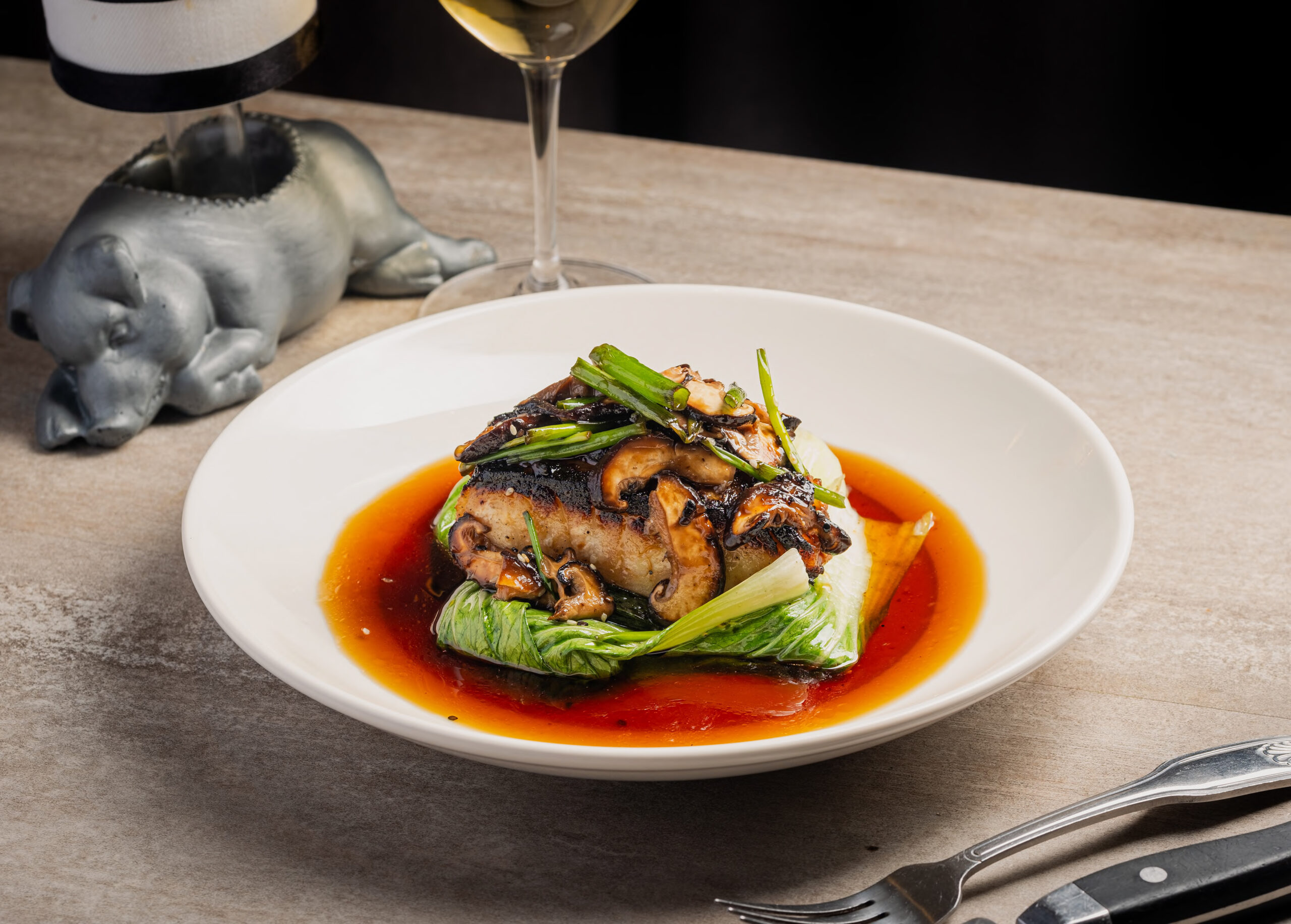
Miso-Marinated Seabass

WITH the Art Deco-style lettering in the sign and the impressive interiors, it’s easy to think one has somehow traveled back to a more glamorous time at Morton’s The Steakhouse in Bonifacio Global City (BGC). It is absolutely helped by the menu, which relies on classic flavors.

For its first anniversary in the Philippines on Dec. 16, BusinessWorld sat down to a lunch in one of the private dining rooms at the steakhouse, brought here by The Bistro Group. A franchise from the US, the chain was founded in Chicago by Arnold J. Morton and Klaus Fritsch. Both of them had worked together at the Playboy Club in Montreal, so the pair knew a thing or two about glamor. The restaurant has since changed hands, and is now owned by Landry’s.

Starters that day included a classic Jumbo Shrimp Cocktail and a Bacon Steak, paired with Tenuta Ammiraglia Alìe Rosé Toscana. The shrimp had an old-fashioned cocktail sauce and tasted quite clean to the palate. The wine it was paired with was nice and fruity, and accented the sweet flavors in the cocktail sauce. With the Bacon Steak, basically a huge fat slab of cured bacon, the wine tempered the saltiness and smokiness and made it milder.

Another pair of classics came next, a Lobster Bisque and a Caesar Salad. (The lineup of appetizers made this writer thankful he wore a nice blazer because, despite the pleasant company, the restaurant made one feel as if they were in a mid-century period drama and had to dress and act the part.) These selections were paired with Bouchard Père & Fils – Pouilly Fuissé Bourgogne. The soup was made with fresh cream and chopped lobster (with the broth poured on top of it by a server). The wine, with a soft skin scent and a citrusy taste, was a bit lost in the weight of the bisque; however, the same citrusy notes made the salad sparkle.

A Miso-Marinated Seabass was served next, almost too pretty to eat. This was paired with a Domaine du Bouchot Pouilly-Fume, a wine with a scent that reminded one of fresh linen. With the silky seabass, both bathed each other with elegance.

Then came the main events: the steaks. There was the Wagyu Sirloin (12 oz, price unlisted), a Ribeye (16 oz, at P6,900), and a Tomahawk (36 oz, at P14,995). These were paired with Black Stallion – Héritage Cabernet Sauvignon. While the steaks performed as expected at those prices, we give a special commendation to the wagyu, which could have veered into too-tender, but the right doneness and its supreme flavor give it some fight and light cheer. The wine was elegantly flavored and paired it correctly. The steaks had sides of Smoked Gouda au Gratin, Truffle Creamed Corn, and Garlic Rice.

The desserts, paired with a proper Sauternes Castelnau de Suduiraut, were the Morton’s Legendary Hot Chocolate Cake and a Candied Walnut Cheesecake. The chocolate cake, oozing in the center, lived up to its name and gave a dark contrast to the sweet, light wine; we thought the cheesecake a bit too rich after everything.

Morton’s chef Daniel Lachica explained to BusinessWorld that “Morton’s is a classic steakhouse from the US. We wanted to do the same here. We went the old-school Morton’s theme, with an upgrade of something new; more dynamic. As we would say, a ‘sexier’ vibe of a dining experience.”

One notices the attention paid to the wine for the lunch, and all credit goes to their sommelier, Ryan Escabillas. Mr. Escabillas, that day, wore a tastevin on a chain, a mark of his profession. He earned his certification from the Court of Master Sommeliers Americas, and is currently in charge of over the 300 bottles and vintages in the restaurant.

Mr. Lachica said, “Wine is always important. It’s not just to enhance the meal, but also a reflection of different countries and things out there.” Morton’s is at Uptown, 11th Ave. corner 36th St., BGC, Taguig. For reservations and inquiries, visit www.mortons.com.ph or call 0917-144-9415. — Joseph L. Garcia

10 major players in the Philippine electricity sector

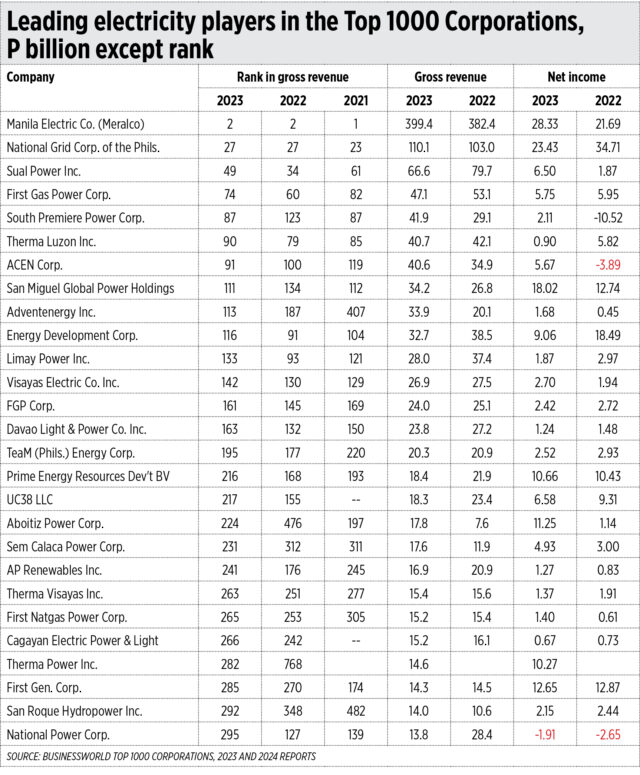
I saw BusinessWorld Top 1000 Corporations in the Philippines 2025 edition yesterday, and I quickly checked some numbers. Today I focus on players in the power and electricity sector (I did not include petroleum players). Here are the changes that I noticed from previous editions.

  1. Manila Electric Co. or Meralco remains the top electricity company in the country. In the Top 1000, it interchanges with Petron Corp. for the No. 1 and No. 2 slot.
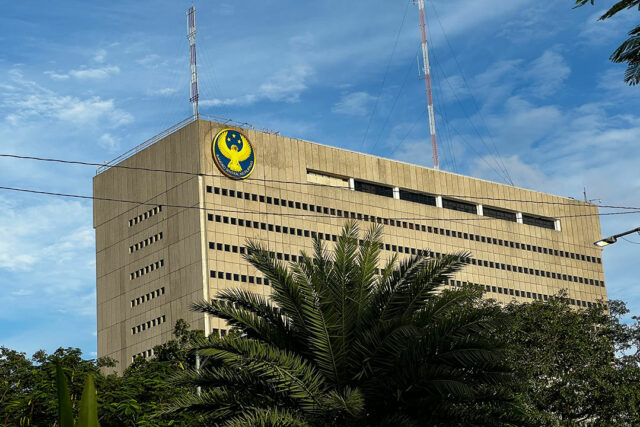
  2. The National Grid Corp. of the Philippines (NGCP) has kept its regular rank in the No. 23-27 range. It is the transmission and system operator of the country’s power grid.
  3. San Miguel Corp. (which has Sual Power, South Premiere, SMGP, Limay, San Roque, etc.) is the largest power generation company. Plus, there are its retail electricity arms.
  4. Aboitiz Power (AP, Therma Luzon, Therma Visayas, Therma South…) is the second largest power generation company. Plus, there are its distribution companies VECO, Davao Light, Advent, etc.
  5. FirstGen (First Gas, EDC, FGP…) was the third largest. At least, this was the case until 2023. It may not be so by 2025 because its gas power companies have been bought by Prime Energy of EKR.
  6. Meralco Power Gen (MGEN, San Buenaventura, PEDC, CEDC…) is the fourth largest. Plus, it has a huge gas plant in Singapore, the Pacific Light Plant.
  7. ACEN/Ayala is the fifth largest power generator.
  8. The Malampaya consortium, now led by Prime Energy and UC38 LLC, owned by Enrique Razon and Dennis Uy respectively, are also huge players though they are on the upstream side.
  9. Companies with coal and gas plants — SMC, AP, MGEN — have the advantage when it comes to gigawatt-hour sales and billion-peso revenues. ACEN and FirstGen are focused on intermittent solar-wind power plus geothermal.
  10. Government-owned Napocor remains a loser and subsidy-dependent. PSALM – the Power Sector Assets and Liabilities Management Corp. — should dispose of more big hydro plants, especially in Mindanao, and stop getting subsidies. It should instead contribute dividends to the national treasury.

Private distribution utilities like Meralco, VECO, Davao Light, etc. are a lot better run than electric cooperatives. I still believe that all electric cooperatives should become corporations someday, or merge with private distri-bution utilities, or be bought entirely by distribution utilities.


Bienvenido S. Oplas, Jr. is the president of Bienvenido S. Oplas, Jr. Research Consultancy Services, and Minimal Government Thinkers. He is an international fellow of the Tholos Foundation. minimalgovernment@gmail.com

ACEN eyes 2027 start for Palauig solar farm in Zambales province

ACENRENEWABLES.COM

GIGA ACE 8, INC., a unit of ACEN Corp., plans to begin commercial operations of its P26-billion expansion of the Palauig solar farm in Zambales province in northern Philippines in the first quarter of 2027, according to a filing with the Department of Environment and Natural Resources (DENR).

The company is seeking to increase the project’s capacity to 420 megawatt-peak (MWp) from the earlier proposed 300 MWp. The expansion will cover 369.83 hectares, up from 275 hectares, and include 196,784 more photovoltaic modules.

Giga Ace 8, a special purpose vehicle for renewable energy projects in the Philippines, secured an environmental compliance certificate (ECC) for a 246-MWp solar plant. The amended certificate reflects the higher power output and expanded project area.

The plant, located in the villages of Bulawen and Salaza, was selected for its accessibility, high solar irradiance and low risk of geological hazards such as earthquakes and landslides.

The expansion will include a battery energy storage system with up to 347-megawatt capacity to supply electricity during peak demand or deficits. The company said lithium-ion batteries are preferred for their energy density, long lifespan and environmental benefits.

“The Giga Ace 8 solar power project aims to achieve sustainable development and supply electricity to the Luzon grid to address the expected lack of supply and increasing demand,” the company said.

As of November 2025, construction was 88.19% complete. The solar plant is expected to have a 25-year operational lifespan, while the battery units are projected to last 15 years.

The project is scheduled for a public hearing on Jan. 28-29, an initial step in the environmental impact assessment process before the ECC is granted. — Sheldeen Joy Talavera

Term deposit yields move sideways on inflation report, rate cut ex-pectations

BW FILE PHOTO

YIELDS on the Bangko Sentral ng Pilipinas’ (BSP) seven-day term deposits moved sideways on Wednesday amid strong demand and as the market reacted to faster-than-expected inflation data and monetary policy signals.

Total bids for the central bank’s term deposit facility (TDF) amounted to P127.602 billion on Wednesday, well above the P110 billion placed on the auction block and the P76.657 billion in tenders for an P80-billion of-fer of 10-day papers on Dec. 23.

This translated to a bid-to-cover ratio of 1.16 times, rising from the 0.9582 ratio recorded in the previous auction.

The BSP made a full P110-billion award of the seven-day deposits.

Accepted yields for the one-week papers were from 4.44% to 4.53%, narrowing slightly from the 4.44% to 4.55% band seen in the Dec. 23 auction. This caused the average rate of the one-week deposits to edge up by 0.23 basis point (bp) to 4.5099% from 4.5076% previously.

The BSP last auctioned off both the seven-day and 14-day deposits on Oct. 29.

It has not offered 28-day term deposits for over five years to give way to its weekly offerings of securities with the same tenor.

Both the TDF and BSP bills are used by the central bank to mop up excess liquidity in the financial system and better guide market rates towards the policy rate.

“The BSP TDF average auction yield was marginally higher… after the faster-than-expected latest inflation data at 1.8% in December,” Rizal Commercial Banking Corp. Chief Economist Michael L. Ricafort said in a Viber message. Despite the uptick, this was still “relatively benign” as this remained below the central bank’s 2-4% target, he said.

The December print brought the full-year average to 1.7%, the slowest annual clip since 2016. This was a tad faster than the BSP’s 1.6% full-year forecast but was also below the annual goal.

The peso’s recent weakness and its potential impact on importation costs and inflation also contributed to the slight increase in TDF yields, Mr. Ricafort added.

He said yield movements were also affected by the latest policy signals from BSP Governor Eli M. Remolona, Jr.

On Tuesday, the BSP chief said another rate cut remains on the table at the Monetary Board’s first meeting for this year scheduled for Feb. 19, but could be “unlikely” considering current data.

The Philippine central bank has so far slashed key borrowing costs by a cumulative 200 bps since it began its easing cycle in August 2024, bringing it to an over three-year low of 4.5%. — Katherine K. Chan

How to cook the perfect pasta — we used particle accelerators and reactors to discover the key

Image from FREEPIK

WHETHER you prefer your spaghetti al dente or soothingly soft, it can be difficult to achieve perfection at home. Many of us will have experienced our pasta disintegrating into a beige mush — particularly for gluten-free al-ternatives.

So how much water and salt do you really need, and how long do you cook it for if you want optimal results? What’s more, how should you amend your cooking process when using gluten-free pasta? A recent study my col-leagues and I conducted, published in Food Hydrocolloids, has provided answers by unveiling the physics behind the cooking process.

Turning to the Diamond light source, the UK’s national synchrotron (a circular particle accelerator) facility, we studied the scattering of X-rays off pasta (at low angles) to uncover its internal structure. Then we went to Isis and to the Institut Laue Langevin, which are neutron facilities in the UK and France, and used neutrons (which make up the atomic nucleus along with protons) to shed light on the microstructure of regu-lar and gluten-free spaghetti under different cooking conditions.

The study shows how the hidden structure of pasta changes as it cooks, and why gluten-free versions behave so differently.

The setup enabled us to investigate the structure of starches and gluten within spaghetti on small scales that spanned from tens of times the radius of an atom to thousands of times. In this way, we could compare the trans-formation that happens in regular and gluten-free pasta while they are cooked in different conditions, such as being cooked for too long or cooked without salt.

Our experiments allowed us to “see” different components of the pasta separately. By mixing normal and “heavy water” (which contains an isotope called deuterium), we could make either the gluten or the starch invisi-ble to the neutron beam. In this way, we could effectively isolate each structure in turn, and understand the effects of starches and gluten during cooking.

Our study reveals that, in regular pasta, the gluten acts as a strong scaffold that holds starch granules in place even during boiling, giving the pasta its firmness and slow digestion rate. In gluten-free pasta, the starch granules swell and collapse more easily — explaining the mushy texture and faster breakdown experienced when this kind of pasta is cooked in non-optimal conditions.

We also probed the effect of salt in the cooking water on the pasta structure. What we found is that salt doesn’t just make pasta taste better; it also strongly affects the microstructure of the spaghetti. When regular pasta is boiled in salted water, the gluten maintains its structure, and the starch granules are less deteriorated by the cooking process.

So how much salt should you add to preserve the pasta’s microscopic structure? Our study revealed that the optimal salt level is seven grams per liter of water, with more water required for larger amounts of pasta. The pasta should be cooked 10 or 11 minutes in the case of regular and gluten-free altertnative, respectively. In contrast, when the salt concentration was doubled, the internal order broke down more rapidly and the structure within the starches granules was significantly altered by the cooking process.

In gluten-free pasta, the story was different again due to the lack of protection of gluten. Even small amounts of salt couldn’t compensate for the absence of gluten. Artificial compounds of processed starches, used by compa-nies to substitute the gluten, degraded fast. The most extreme example of this degradation occurred when the gluten-free spaghetti was cooked too long, for instance, for 13 instead of 11 minutes, and in very salty water.

The main finding was therefore that gluten-free pasta is structurally more fragile and less tolerant of being cooked both for too long and with the wrong amount of salt.

IMPROVING GLUTEN-FREE ALTERNATIVES
Understanding pasta’s structure on these very small scales, that are invisible even under a microscope, will help the design of better gluten-free foods. In particular, the hope is to obtain gluten-free alternative that are more resili-ent to bad cooking conditions and are more similar in texture to regular spaghetti.

Regular wheat pasta has a low glycaemic index because the gluten slows how starch granules are broken down during digestion. Gluten-free pasta, made from rice and corn flour, often lacks this structure, meaning sugars may be released faster. With neutron scattering, food scientists can now identify which ingredients and cooking conditions best recreate gluten’s structure.

This is also a story about how cutting-edge experimental tools, mainly used for fundamental research, are transforming food research. Neutron scattering played a fundamental role in advancing our understanding of magnetic materials, batteries, polymers, and proteins. Now it is also helping us to explain how everyday foods behave at the microscopic level. — The Conversation via Reuters Connect


Andrea Scotti is a Senior Lecturer of Physical Chemistry at Lund University. He receives funding from the Knut and Alice Wallenberg Foundation, and the Swedish Research Council.

Taking action on vaping

STOCK PHOTO | Image by FREEPIK

W

hat began years ago as a technological promise, a tool for smoking cessation, has become a serious cause for concern across the region. E-cigarettes and vaping devices are no longer just nicotine delivery systems for adults trying to quit cigarettes. They are becoming covert drug-delivery systems.

Reports indicate that innocent-looking, candy-flavored vape pods are bought openly online or near schools. But inside, the liquid has been laced with illegal drugs that users can inhale through any vape device. What began as a smoking alternative has become a new way to use illegal drugs.

In my view, the risk is too great to ignore, despite the regulations already in place. Vaping has all the makings of a drug-delivery device disguised as a lifestyle product, and it has become accessible to the youth. Reports claim that drug-laced vape pods can be ordered online with ease.

I concede that I have no data to cite, and no studies or compelling evidence to offer, other than anecdotal reports of illegal drug use via vape devices. Even so, I will support any initiative to ban all commercial vape sales and imports before this problem spirals out of control.

The promise of “harm reduction” falls short. E-cigarettes may offer a less toxic alternative to combustible tobacco, but that does not make them safe. People have gotten sick from vaping. In the Philippine context, vaping has not simply replaced smoking among adults. It has led to nicotine use among the youth.

A product originally intended to help 50-year-olds quit smoking is now consumed by 15-year-olds for a nicotine kick. Worse, the same product can deliver illegal drugs to both young and old. Harm reduction is becoming harm multiplication, and we do not have enough safeguards to prevent abuse.

In 2022, I wrote about how Juul Labs faced a marketing denial order from the US Food and Drug Administration (FDA), which initially moved to ban its e-cigarettes from the US market. After further scientific review and a prolonged legal battle, the FDA eventually authorized some Juul products in 2025.

But Juul did not walk away unscathed. To reach that point, the company paid over $2 billion to settle lawsuits and investigations over youth marketing, and it now operates under some of the strictest marketing restrictions imposed on any nicotine product in recent history.

In contrast, in July 2022, just as the US FDA was trying to push Juul off the market, here Republic Act No. 11900, the Vaporized Nicotine and Non-Nicotine Products Regulation Act, lapsed into law. And with it, the floodgates for vape products were opened.

This law lowered the access age for vapes from 21 to 18. It transferred primary regulatory jurisdiction from health experts at the Food and Drug Administration to trade regulators at the Department of Trade and Industry (DTI). It also allowed flavored products that appeal to the youth to remain on the market.

I fear we are now seeing the consequences. The DTI has tried to plug the gaps through inspections, seizures, and certification rules, but these measures are not enough. A House bill has since been filed to raise the access age back to 21 and return regulatory leadership to the FDA.

Cigarette smoking kills; there is no debate about that. But vaping has become a technological threat because people can manipulate the same technology to covertly deliver illegal drugs. No one can realistically inject liquid drugs into a conventional cigarette made of dried leaves wrapped in paper.

A drug dealer, however, can dissolve synthetic substances into a vape pod and sell it to a teenager who thinks he is just buying “mint” vape pods online. Vape devices can become Trojan horses for illegal drugs. And reports indicate the threat is real, not just imagined.

In banning vaping, we are not just rejecting another nicotine product. We are prohibiting a technology that offers relatively undetectable camouflage for illicit substances. In contrast, cigarettes produce smoke and stink. People cannot hide cigarette smoking in a classroom or a jeepney.

Vapes, on the other hand, produce no ash, are a far subtler aerosol, and have a much less lingering smell. Many are designed to look like USB drives or highlighters. It is far more difficult to regulate what you cannot easily detect. Vape devices make addiction easier to hide.

Singapore bans vaping because it follows a simple Precautionary Principle: do not add a new epidemic while you are still fighting the old one involving cigarettes. Its government decided early on that e-cigarettes bring addi-tional risks such as new youth users, unknown contents, and now drug-laced vapes.

In our case, it is bad enough that we are still dealing with combustible tobacco. Why should we knowingly add another problem by letting a stealthier, more programmable form of nicotine and drug delivery continue to spread, especially among our youth?

Cigarettes are an entrenched historical mistake. Banning them overnight would create a massive black market and spark unrest among millions of existing users. The wiser policy for cigarettes is strangulation: tax them to death, severely restrict where people can smoke or sell them, and wait for the demographic to age out. For vaping, urgency is greater because of the illegal drug threat to the youth.

Locally, a ban needs to be executed through legislation rather than executive action because of the existing Vape Law. We need an Anti-Vape Act that explicitly repeals the Vape Law; creates a Vape Industry Transition Fund financed by vape and tobacco taxes to provide grants, retraining, and capital for vape shop owners to shift to legitimate businesses; and, possibly allows the limited sale of vape devices in pharmacies, by prescription, as a smoking cessation tool.

Personally, I would prefer a world without cigarettes too. But while we are still fighting the old war against tobacco, let us not further complicate things for ourselves by opening a new battlefront with vaping. Let us get rid of vaping, while we still can. And if we can eventually do the same with cigarettes, then so be it. After all, one should not benefit from the death of the other.


Marvin Tort is a former managing editor of BusinessWorld, and a former chairman of the Philippine Press Council matort@yahoo.com