Home Blog Page 3964

Four BTS members to begin South Korean military service mid-December

WIKIMEDIA COMMONS

SEOUL — The remaining four members of K-pop supergroup BTS will begin their military service in mid-December, joining the three who are already serving, South Korea’s Yonhap news agency reported on Wednesday, citing music industry sources.

The seven-member group is on temporary break while members carry out South Korea’s mandatory military service.

South Korea has one of the world’s largest active armies to defend against North Korea, with all able-bodied men between the ages of 18 and 28 required to serve between 18 and 21 months.

There has, however, been public debate over whether BTS members should be given exemptions considering their contributions to the lucrative K-pop industry.

The group’s main rapper and leader RM and vocalist V will enlist on Dec. 11, while Jimin and Jung Kook will follow suit the next day, Yonhap reported.

After initial training, the four will serve as active-duty army soldiers for 18 months, according to another report in entertainment media outlet Star News.

BTS’ management agency HYBE, which has said the four had begun the process of enlistment, did not immediately respond to a request for comment. Earlier this month, Jung Kook announced in a blog post he would serve in the military in December.

Jin, 30, the group’s oldest member, is set to be discharged from military service in June. — Reuters

PetroGreen solar project secures Bugallon town’s nod

PETROGREEN Energy Corp., a subsidiary of Yuchengco-led PetroEnergy Resources Corp., said it had gained support from the municipal government of Bugallon in Pangasinan for its 25-megawatt (MW) solar power project.

“Such commitment from local governments is vital so that the investments and efforts of the private sector and the Marcos Jr. administration to increase the country’s renewable energy supply eventually succeed,” PetroGreen lawyer Roberto Santos said in a media release on Thursday.

Located in a 25-hectare site in Brgy. Salomague Sur, the solar project is expected to deliver renewable energy (RE) in the area by the fourth quarter of next year that will generate 41,000 megawatt-hours of power annually and reduce carbon emissions by 29,056 metric tons.

The company quoted Bugallon Mayor Priscilla I. Espino as saying: “We are grateful, and we welcome this much-needed investment by PetroGreen here in our locality that will not only add to our power supply, but will also con-tribute green jobs, social upliftment, and fiscal benefits to Bugallon and to Pangasinan province.”

“If [PetroGreen] has other upcoming RE projects, they can bring and develop them here in our town,” she added.

In March, the company acquired the San Jose solar project in Nueva Ecija and the San Pablo solar project in Limbauan, Isabela.

Currently, the company through its subsidiary PetroSolar Corp. operates the 50 MW of direct current (MWDC) Tarlac-1 and the 20-MWDC solar power facilities in Tarlac City.

It is also developing the 27-MWDC solar project in Dagohoy, Bohol. — Sheldeen Joy Talavera

The Ramon Magsaysay Awards: Hope for a better world

FREEPIK

“The Ramon Magsaysay Awards and each year’s awardees from different countries and societies have a common trait carried by each one: The action and passion the awardees practice to improve the social inequality in society. They do not seek any reward, award even recognition from anyone… They know that each must contribute to do their share to lessen the burden and pain of the ordinary people.”

— Former Senator

Ramon Banzon Magsaysay, Jr.


THIS year’s four recipients of the Ramon Magsaysay Award (RMA) — presented at the Manila Metropolitan Theater on Nov. 11 — were Miriam Coronel-Ferrer from the Philippines, Ravi Kannan R. from India, Eugenio Lemos from Timor-Leste, and Korvi Rakshand from Bangladesh.

In his speech during the awarding ceremony, RMA Foundation chairman Aurelio Luis R. Montinola III pointed out that “The Ramon Magsaysay Award, Asia’s premier prize and highest honor, is a celebration of the women, men and organizations that have passionately and tirelessly worked on preserving and cherishing our planet and its inhabitants on all fronts. These are the transformative leaders who illuminate the darkness.

“They are the visionaries who carry the torch in humanity’s nature; the innovators who light up new paths that lead to our progress. They are the public servants, the activists and the humanitarians who gather precious kindling and light the spark for peace and social justice. They are the scientists, doctors, and health practitioners whose hearts for healing are fully ablaze. They are the artists who ignite new fires with fresh eyes the complexities of the human condition.”

WORDS FROM THE LAUREATES
Below are quotes from the responses of the awardees that evening.

India’s Dr. Ravi Kannan R, a surgical oncologist and director of Cachar Cancer Hospital and Research Center which provides free or subsidized cancer treatment to impoverished patients: “All lives on this earth are so intimately linked to one another around the world. We cannot afford to be exclusive… An ancient Sanskrit verse goes, ‘For the wise, the entire earth is one family.’

“The road to human happiness and fulfillment truly lies in holding every life on this planet sacred and worthy of our love in an all-inclusive spirit. People have given us their time, talents, treasures not merely to help the sick regain their health but to give much — needed hope to the hopeless. Together, all of us can change the way we take care of sickness and suffering, promote universal health, and control of cancer and other diseases.”

The Philippines’ Miriam Coronel-Ferrer, who co-founded the Southeast Asian Women Peace Mediators and champions inclusivity in peacebuilding: “We know that this (peace) process will take time. It has to prevail over both conservative and extremist mindsets. It must consequently remove the guns from politics and everyday life. Most important, it has to tame the unruly behavior of the political class, and eventually produce transformative leadership in the next batches of leaders to come.”

Bangladesh’s Korvi Rakshand, who was cited for Emergent Leadership, promotes inclusive quality education for underprivileged children through the JAAGO Foundation: “Youth is the power. Bangladesh and the Philippines both have one thing in common. Through Volunteer of Bangladesh, we bring like-minded youth to come together… to achieve the mission of the United Nations to have a better world.

“Imagine, if we can have a Volunteer for (the) Philippines Program where young people can come together, discuss their ideas and take action to make (the) Philippines even better, Now imagine the same in every country in Asia. Let’s join hands together and promise to stand beside the people of our countries, Asia and Humanity. Together, let’s make this a better place for you, me, and the future generation.”

Timor-Leste’s Eugenio Lemos, the founder of the youth camp Permakultura Timor-Lorosa’e and an advocate of food sufficiency, environment conservation and local autonomy: “Young people of the world are key to achieving sustainable development and restoring the long-term viability of our environment across the globe. It is essential that all young people receive equal access to quality education and training to social justice and quality health services, to protection from violence and abuse and to opportunities for employment and meaningful participation in society.”

MILESTONES
Mr. Montinola commented on the most significant milestones and achievements of the foundation, one of which is “Just being around and relevant after 65 years to fulfil its original ‘Greatness of Spirit’ award mission.”

He cited the quality of its 348 laureates. “It is the Beacon of Hope in this troubled world,” he said, mentioning some of the most impressive past awardees: “the Dalai Lama, Mother Teresa, Akira Kurosawa — before they hit their prime.”

“The RMAF anniversary has been an incredible journey and I am happy to exit as Chairman on this 65th milestone,” he said.

He has fond memories, of the dynamic new President Susan B. Afan, the pandemic virtual operation, the march towards financial sustainability, the spirited award selection discussions, the dedicated staff, and the heartwarming support from the Ramon Magsaysay family.

“I am proud to have contributed to the increased Asianization of the RMAF audience, the creation of the Ramon Magsaysay Transformative Leadership Institute (RMTLI), and the renovation of our iconic Ramon Magsaysay Center. The impact and vision of the RMAF have evolved over the years. The awards remained resolute in its mission while honoring the legacy of former President Magsaysay,” he said.

There is a younger Asian context, a core second project pillar, and increased interaction among the laureates. The RMTLI arranges inspirational Laureate speaking engagements for the younger, next generation audience. The highlight would be a several volume series called Greatness of Spirit, focusing on each of the 348 Laureates.

“Promoting and honoring Asian changemakers brings fulfillment; connecting current heroes with upcoming leaders and steering the foundation’s impact fosters a deep sense of purpose in this humbling role,” said incoming RMAF president Susan B. Afan.

“I always look forward to the awards,” said Mila Magsaysay Valenzuela, daughter of the late president. “It gives me hope for a better world to know that people do good things that lift other people’s lives. I am always in awe hearing what people, groups, organizations do for the love of their fellow men.”

Warm congratulations to the 2023 Ramon Magsaysay Laureates and Happy 65th Anniversary to the Ramon Magsaysay Awards Foundation!


MARIA VICTORIA RUFINO is an artist, writer and businesswoman. She is president and executive producer of Maverick Productions. mavrufino@gmail.com


Sun Life sees better performance

SUN LIFE of Canada (Philippines), Inc. (Sun Life Philippines) expects its performance to improve in 2024, along with the rest of the life insurance industry, as inflation and interest rates are expected to ease.

“There’s some indication that interest rates have started to top out, and I think the impact of the last 18 months where interest rates rose really quickly, I think we’re through that. Inflation is starting to come down in North America,” Sun Life Financial, Inc., President and Chief Executive Officer (CEO) Kevin D. Strain told BusinessWorld on the sidelines of an event on Wednesday.

“So, with the current environment, with lingering challenges from the pandemic, the volatility of markets, the escalating tensions from geopolitical concerns, this impacted the industry… Things are looking brighter for the fol-lowing year. We expect the growth to even be better,” Sun Life Philippines CEO and Country Head Benedict C. Sison said in a separate interview.

Sun Life Philippines expects its own and the life industry’s performance to be boosted by better economic prospects, as it expects gross domestic product (GDP) to grow by 6-7% next year.

For this year, it expects the economy to expand by 5.9%.

The government targets 6-7% and 6.5-8% GDP growth this year and next, respectively.

Mr. Sison said their GDP outlooks for 2023 and 2024 would put the Philippines among the fastest-growing economies in the region.

Sun Life Philippines is expected to outperform the company’s other branches in the Association of Southeast Asian Nations region amid the economy’s strength, Mr. Strain said.

“The Philippines is our flagship in Asia and it’s a place that we have the biggest footprint — it’s number one. It does so many great things with our brand, with servicing clients. It’s one of our examples that we use for the rest of the re-gion. The Philippines is really the crown jewel of Sun Life in Asia,” he said.

“I think there’s a core set of motivated and educated people in the Philippines that I think really serves us all. We’re seeing lots of digital innovation and I think that’s just a really good place for us to build a strong base,” Mr. Strain added. — A.M.C. Sy

Sun Life Philippines wants to continue investing in digitalization to get to know its customers better, which could fuel its growth, Mr. Sison said.

“We always focus on our clients… so we’re always addressing their needs. On top of that, one key imperative of ours is digital leadership. We continue to invest in digitalization, but that will really be an enabler for us more than being a business because majority of our clients still want to talk to somebody they trust,” he said.

“They want to talk to an advisor because they’re making some of the most important and complex decisions in their life. So, our products still require human interaction, with digital becoming a clear enabler,” he added.

The insurer also aims to focus on business owners, employees, professionals, high net worth individuals and overseas Filipino workers for product distribution next year.

In the first quarter, Sun Life Philippines was the top life insurer in terms of premium income with P13.21 billion. Its new business annual premium equivalent (NBAPE) stood at P2.43 billion in the period.

In 2022, the company posted a net income of P11.73 billion.

Meanwhile, the life insurance sector’s premium income declined by 2.25% year on year to P149.47 billion in the first semester, data from the Insurance Commission showed.

The sector’s NBAPE rose by 9.62% to P29.5 billion in the period, while its overall net income went up by 2.58% year on year to P16.37 billion. — A.M.C. Sy

Employers warned about not granting VAWC leave

BW FILE PHOTO

THE Department of Labor and Employment threatened to sanction employers that do not approve leave applications of female victims of violence.

The Violence Against Women and Children (VAWC) law, or Republic Act 9242, grants female employees 10 days’ leave after having experienced physical, sexual, psychological, or economic violence.

Bureau of Working Conditions Director Alvin B. Curada said in an online seminar on Wednesday that employers refusing to grant VAWC leave could potentially face criminal, administrative, and civil action.

Refusal to grant the 10-day leave to victims carries penalties under both the Labor Code and Civil Service Rules and Regulations in the case of public organizations, he said.

Mr. Curada said female employees may apply for multiple VAWC leaves in a year if they face continuous violence. He also emphasized that female employees, regardless of their length of service, are entitled to file for VAWC leave.

He clarified that VAWC leave is not convertible to cash if left unused.

Mr. Curada said VAWC victims must submit a barangay certification to accompany any leave applications. He said employers may not demand additional requirements not indicated in the law.

Victims may also apply for a barangay protection order which “will prohibit the offenders from committing the acts by preventing them from being around the women victims and their children.” He added that the victims may also seek the help of the courts in issuing temporary and permanent protection orders against offenders.

Mr. Curada said that aside from physical and sexual violence, the law also contemplates psychological forms of abuse — or acts that cause mental or emotional suffering, including public humiliation, repeated verbal abuse, and threat of physical harm. Economic violence, meanwhile, happens when “another person prevents a woman from working and exercising her profession, and unjustly controls her property and money.” — Jomel R. Paguian

Dove Cameron sheds Disney past to become her own kind of pop star

LOS ANGELES — Singer-songwriter and actor Dove Cameron is breaking away from her Disney star persona and putting a new version of herself out there with Alchemical: Volume 1, the first part in her debut studio album.

Alchemical: Volume 1, which has eight songs, including “Sand,” will be released on Dec. 1.

The former child star, who appeared in Disney’s 2015 film Descendants, its sequels and TV spin-off for many years, has been reflecting on her self-growth since her days as a kid working in Hollywood.

“Growing up in the public eye, I trained my brain to think first about what other people wanted from me rather than what I knew I needed,” Ms. Cameron said in an interview. “When you start that young, and your whole life is cataloged and interpreted in a way that might not actually be reality, I think you start to look at things from an external point of view and you start to reject your own personal experiences as being valid,” she added.

In 2022, she released her first non-Disney hit song called “Boyfriend,” which served as an avenue for Ms. Cameron to share with the world that she’s part of the LGBTQ+ community.

“Boyfriend” is based on events from Ms. Cameron’s life that helped shape her sexuality and was performed during the 2022 American Music Awards (AMAs) the same night she won new artist of the year.

“I just decided, it’s now or never,” Ms.Cameron said. “I was really grateful with how people responded,” she added. “Still, obviously there’s still quite a lot of negativity around it, but I just think when it’s for yourself, you can’t find issue with that.”

After releasing “Boyfriend,” Ms. Cameron decided to delete all her previous song-writing work from streaming services, as she felt it didn’t represent who she was anymore.

The Daytime Emmy-award winning actress feels that she is in an “amazing place in her life” now where anything feels possible for her, which means not conforming to a certain image.

Compassionate workplace justice

A 50-year-old department clerk, father of five children of school age, was caught by a newly assigned security guard bringing out of the office a small quantity of stationery. The offender, an average work performer, has been with the company for 15 years and has no prior record. Our policy considers this as qualified theft and grounds for dismissal. The chief executive officer (CEO) tasked the human resource (HR) manager to decide on the case, while the department head recommends a five-day suspension instead of termination. If you were the HR manager, what would you do? — Blue Mountain.

Almost all religions preach compassion. But then, when confronted with an actual situation, most people would agonize about the right approach.

Psychologists have spent decades of research to understand the meaning of compassion and human suffering.

Emma Seppala, a director at The Center for Compassion and Altruism Research and Education at Stanford Medical School, says “human suffering is often accompanied by beautiful acts of compassion by others wishing to relieve it.” This is seen in the case of volunteers serving food at homeless shelters or in people who stop on the highway in the rain to help someone with a broken-down vehicle.

To some, acts of compassion (or empathy) are difficult to understand except to explain it as “an automatic mirroring of another’s emotion.” Therefore, if a stranger can volunteer to help another stranger in need, what more a person be-longing to the same organization? This is where HR should perform a delicate balancing act.

This requires a fair and impersonal judgment of what is right, considering the interests of the offender-employee and those of the whole organization.

ACT OF KINDNESS

If “survival of the fittest” describes people in a rat race, a contrary maxim calls for “survival of the kindest,” which generates a lot of positive vibes in the workplace. Being kind is the most welcome as it generates tons of acceptance.

As I’ve said in my previous articles, people management is an act of kindness. It automatically expires the moment workers show that they don’t deserve such kindness from management. It is in this light that HR professionals must consider the needs of both employees and management.

This is the time when HR must decide on the best solution. HR may be misunderstood. But as long as the decision is right and fair, all you have to do is to explain it gently to those who may feel unhappy about your decision. Take it from the department manager.

He has already recommended that the penalty be reduced to a one-week suspension instead of dismissal. Without your knowing for sure, other employees may support such an approach. It becomes a matter of writing a balanced decision that does not set a bad precedent. In writing such a decision, the HR manager must consider the following:

One, emphasize due process. This requires giving the employee both the substantive and procedural aspects of due process. Give the worker an ample chance and opportunity to explain his side of the story.

Two, state the decision finding the worker to have committed the offense. Cite the specific provision of the Code of Conduct and other pertinent provisions of the Labor Code. Explain how management came to the collective decision. Take note of a Supreme Court decision finding that dismissal is too harsh.

Three, explain that the penalty is reduced to suspension. The HR manager may increase the recommended suspension from five days to 10 days or even more. Also, the suspension must reflect a pro-rata deduction to 13th month pay and other cash allowances and benefits when they become due.

Four, include a disclaimer against setting precedent. Emphasize it clearly that future offenders may not use such case if it favors them. Do this even if you treat the case with utmost confidentiality and you promise to treat each case differently.

COMPASSIONATE JUSTICE

I’ve implemented compassionate justice in a number of cases brought before me in the past. I was happy to note that the experience taught me many valuable lessons. Compassion can go a long way in reforming employees. Many of them have succeeded in changing their image before management. They’ve become loyal to the organization.

In conclusion, however, be careful in making a decision like this even in the name of compassionate justice. Chances are, some management people, including CEOs, will object to your leniency. If that happens, you have no choice but to implement what they want — but not before explaining everything in this article.


Bring Rey Elbo’s leadership program called Superior Subordinate Supervision to your organization. For details or your workplace questions, chat with him via Facebook, LinkedIn, X (Twitter) or via https://reyelbo.com 

Strengthening the military and identifying a Philippine defense industry

PHILIPPINE STAR/KRIZ JOHN ROSALES

NEXT year, 2024, might prove crucial in determining the fate of many countries, including that of the Philippines. When one considers the wars happening in Europe and the Middle East, the only thing left is a triggering event in Asia and you essentially have a world war.

It is thus disconcerting to view the state of our capabilities should such wars reach our seas, never mind our shores. Our Armed Forces, in a world now beset by online information, artificial intelligence, and globalized supply chains, is amazingly structured by a law made before the Philippines even became a republic.

THE NEED FOR A NEW NATIONAL DEFENSE ACT
Thus, as pointed out by The Diplomat, the “AFP (Armed Forces of the Philippines) was established following the passage of Commonwealth Act No. 1, also known as the National Defense Act of 1935. For almost 85 years now, this law has remained the legal basis for the AFP’s existence, mandate and even strategy. Though specific provisions of the law were rescinded by presidential decrees or executive orders, especially during the time of President Ferdinand Marcos, and different Department of National Defense (DND) department orders have been published over the years, the act itself has yet to face Congress’ meticulous legislative deliberations.”

More significantly, aside from being clearly obsolete, considering the Philippines is an archipelagic country now beset by aggressive illegal claims by a regional bully, the National Defense Act unfortunately “institutionalized the importance of ground forces in territorial security. Since 1935, the Philippine Army (PA) has dominated the entire defense establishment. Though other factors helped establish the PA’s leading responsibility, particularly the communist insurgency, secessionist Moro rebels, and now terrorism.” (“Why the Philippines Needs to Revise Its National Defense Act,” September 2020).

THE NEED TO INCREASE DEFENSE SPENDING
One study, “The Implications of Defense Expenditure on Philippine Economic Growth” (Julia Rocio S. Gatdula, University of Asia and the Pacific) examined the relationship between Philippine defense spending and economic growth, and found that for every 1% increase in defense expenditure there results an estimated increase of 0.12% in GDP.

The findings thus suggest that “it may be more imperative for the Philippines to allow the Defense Department greater flexibility in terms of budget allocation due to its possible multi-dimensional effect, particularly the geopolitical, economic, social, and cultural dimensions of the Philippines. This, coincidentally, is similarly indicated in the aims pointed out in the National Security Policy (NSP) of 2023 to 2028 and the Philippine Development Plan (PDP) of 2023 to 2028. Investing in the defense sector should be seen more and more not merely as a purely national security matter but also as a positive catalyst in sustaining or facilitating the country’s economic growth.” (“Philippine defense spending and its impact on economic growth,” BusinessWorld, September 2023).

This therefore leads to the necessity of reexamining and amending the Constitution’s Article XIV.5.5, which requires the State to “assign the highest budgetary priority to education,” including the humongously misguided policy of giving everyone a college education. Surely, the State must be afforded enough flexibility to allow adequate responses to urgent circumstances particularly if it affects national survival.

IDENTIFYING OUR NATION’S DEFENSE INDUSTRY
Which leads then to discussing the Self-Reliant Defense Posture (SRDP) program, usually with armament and transportation manufacturing and purchases as the main focus of attention.

Nevertheless, while that alone is beset with a myriad of difficulties, discussions regarding a self-reliant defense posture should not be limited to armaments and must include clothing, food, energy, finance, technology and communications, and human resources. This leads to the necessity of identifying what exactly are “defense industries,” for which government support and oversight can be applied.

OFFICIALLY CATEGORIZING CHINA’S ENCROACHMENTS AS WITHIN PHILIPPINE TERRITORY AND CRIMINAL JURISDICTION
Finally, there was a very thoughtful position paper by the International Law and Relations Society of the Philippines, November 2023, which centered its discussions on the so-called posse comitatus and the distinction between police action and armed conflict. In other words, the difference in application between domestic law and international law.

The reliance on police measures is a good point because it indicates application of domestic law and thus by implication categorizes the events happening as within Philippine territory, full stop.

However, while admittedly such distinctions may exist, such ultimately is of no consequence. The reason is that, whether a circumstance is governed by domestic law or international law, both are within the ambit of the President’s powers.

Thus, the Constitution’s Article VII.18 provides that the “President shall be the Commander-in-Chief of all armed forces of the Philippines and whenever it becomes necessary, he may call out such armed forces to prevent or suppress lawless violence, invasion or rebellion.”

The point is that, while the coast guard may be classified as civilian, our own Constitution authorizes the president to deploy the Armed Forces in order to put down “lawless violence” done within our territory, arguably a domestic law matter and thus avoids re-classifying such measures as one under international law.


Jemy Gatdula read international law at the University of Cambridge and is a Philippine Judicial Academy lecturer for constitutional philosophy and jurisprudence.

https://www.facebook.com/jigatdula/

Twitter  @jemygatdula

How can boards oversee emerging technology?

In a recent event, EY gathered insights from over 100 board directors and business leaders regarding the challenges of rising inflation, geopolitical crises, rapid digital transformation, and the impact of generative artificial intelligence (AI), the metaverse, and other disruptive platforms. The event emphasized the importance of directors gaining hands-on experience with rapidly evolving technologies, meeting the expectations of investors and stakeholders, embracing innovation dur-ing times of uncertainty, and focusing on purpose and principles when innovating.

To effectively oversee emerging technology, boards should note four key points of action: fostering curiosity, employing a hands-on approach, carefully embracing innovation, and building inclusive ecosystems.

FOSTER CURIOSITY

Board leaders now face the challenge of navigating emerging technology platforms that were virtually nonexistent before the pandemic, such as AI, the metaverse, and advanced language models. These technologies hold a unique po-tential for each company’s mission and purpose. It is no longer enough for boards to simply cast their votes in favor of or against these technologies; they must engage in a process known as “visioning.” This involves discussing and for-mulating actionable strategies to immediately embrace these technologies, fueled by curiosity to determine potential opportunities, thereby realigning business and operating models towards growth and productivity.

EMPLOY A HANDS-ON APPROACH

The new generation, particularly Gen Z, are fully immersed in the digital realm and are both current and future consumers and employees. These young individuals have a strong desire to own their data, have influence over AI, and cu-rate their own metaverse experiences. For instance, just like previous generations of teenagers who would gather at shopping malls for socializing, it is predicted that soon teens will engage in similar activities within the metaverse.

The concept of professionals interacting as avatars in virtual realities is also gaining traction, such as for corporate training purposes. Simply acknowledging the existence of these technologies is no longer sufficient. Boards must adopt the same hands-on mentality as Gen Z, stepping out of their comfort zones to personally explore and experiment with these technologies, all while maintaining a mindset of continuous learning. Boards that eagerly embrace AI on a wide scale and envision the potential to transform their businesses, even considering its applications within their own boardrooms, will undoubtedly reap the benefits. On the other hand, those that fail to do so will fall behind, and this future is not far away.

CAREFULLY EMBRACE INNOVATION

The current business landscape drastically shifted due to the onset of the COVID-19 pandemic, leading to a cascade of transformative events, including supply chain crises, the conflict in Ukraine, and inflation. These phenomena have had a profound impact on how companies conduct business on a global scale as labor and energy costs also continue to rise steadily. While cost-cutting measures and job reductions can provide temporary relief, they can only take companies so far. It is imperative for boards to incorporate AI, intelligent automation, and alternative energy sources into their scenario planning and capital reallocation strategies.

While innovation is undoubtedly vital, boards must strive to strike a balance between enthusiasm and caution. Flashy new technologies may captivate attention, but they alone do not form a robust business plan, especially in times of economic uncertainty. Disruptive platforms must be supported by well-founded business cases. By asking the right questions, boards can gain a deeper understanding of their customers and talents as human beings rather than solely as consumers or employees. As early as now, companies should also already start evaluating their readiness for AI, and how leveraging on its powerful algorithms can help enhance their products and services, and im-prove lives.

BUILD INCLUSIVE ECOSYSTEMS

The shortage of tech skills necessary to drive innovation has become apparent. However, with less restrictive immigration policies and the rise of remote work, there is an opportunity to tap into a broader pool of high-tech profes-sionals. Recognizing the value of human diversity as a fundamental principle ultimately leads to better business outcomes, and while empathy and soft skills are significant, cultivating a culture of innovation necessitates construc-tive conflict to push forward new ideas.

Furthermore, responsible innovation entails vigilance towards the unintended consequences that may arise from the rapid advancement of digital technology. The era of “move fast and break things” has come to an end. Alt-hough innovation often outpaces regulation, boards must acknowledge and oversee the associated risks posed by AI. Just because something is technologically feasible does not mean it is ethically right. AI will be an integral part of our future, and leaders must strike a balance between harnessing its potential benefits and safeguarding against cyber threats, biases, and other adverse impacts on workers and consumers.

INNOVATE WITH PURPOSE AND CONSIDER THE RISKS

It is important for boards to gain hands-on experience with new technologies, adopting a curious and continuous learning mindset but while simultaneously practicing caution to ensure their decisions are backed by informed busi-ness plans. Leading boards welcome innovation but do so with purpose and with the careful understanding of unintended consequences.

This article is for general information only and is not a substitute for professional advice where the facts and circumstances warrant. The views and opinions expressed above are those of the author and do not necessarily repre-sent the views of SGV & Co. and FINEX.

Wilson P. Tan is the chairman and country managing partner of SGV & Co. and the president of FINEX.

How PSEi member stocks performed — November 30, 2023

Here’s a quick glance at how PSEi stocks fared on ThursdayNovember 30, 2023.


Save for DICT, Congress unlikely to restore agencies’ secret funds

By John Victor D. Ordoñez, Reporter

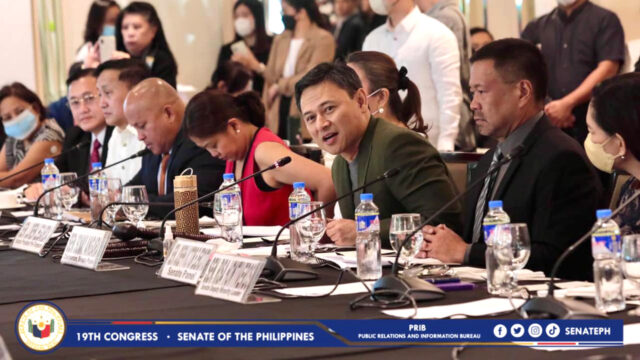
PHILIPPINE lawmakers on Thursday said they are unlikely to restore the confidential funds sought by civilian agencies in the P5.768-trillion 2024 national budget as Congress reconciles the House of Representatives and Senate versions of the spending bill.

“I don’t think so,” Senator Juan Edgardo M. Angara, who chairs the Senate Finance Committee, said about the chances of restoring confidential funds when asked by reporters on the sidelines of the Bicameral Conference Committee hearing finalizing the 2024 spending measure in Makati City.

But he did acknowledge that with regard to confidential funds for civilian agencies, “what is being talked about” at the bicam is the Department of Information and Communications Technology (DICT).

He said lawmakers will consult Senator Grace Poe-Llamanzares, who sponsored the DICT’s budget, whether or not the bicameral committee will make an exception since the department needs it to boost the country’s cybersecurity programs.

Still, Mr. Angara clarified: “By and large, the Senate adopted what the House did in realigning the (confidential and intelligence) funds of civilian agencies.”

Following plenary debates on the DICT’s budget for next year, the Senate approved the proposed P9.9-billion budget which included P280 million as confidential fund. But Poe-Llamanzares explained that the fund was transferred into its regular line item in order to be subjected to Commission on Audit (COA) scrutiny.

Defending this decision, Mr. Angara said: “Sometimes the war is not on the battlefield, but someone can disable your cybernetworks, information… and our economy would come to a halt.”

When asked about the most contentious provisions in the House and Senate versions of the budget bill, Mr. Angara confirmed that “there are a lot.”

“Sometimes the same funds that are being realigned or moved… we need to discuss what to agree on,” he said in Filipino without going into detail.

Party-list Rep. Elizaldy S. Co, who chairs the House Committee on Appropriations, said lawmakers are talking over when they can finish reconciling disagreeing provisions in next year’s P5.77-trillion spending plan.

Mr. Angara said lawmakers hope to end before Congress adjourns on Dec. 15 and before President Ferdinand R. Marcos, Jr.’s trip to Japan this month.

The President is set to attend the 50th anniversary of the Association of Southeast Asian Nations-Japan Friendship and Cooperation Commemorative Summit.

“We want to be prepared for next year; (ensure the delivery of) social services, we want to fight inflation, (address) rice prices to help lower middle class and poor Filipinos, since problems such as war and inflation may worsen next year,” he said in Filipino.

Last Tuesday, the Senate approved on final reading its version of the budget bill with Mr. Angara highlighting the budget boost for defense agencies to ensure national security.

Vice-President and Education Secretary Sara Z. Duterte-Carpio said her office would no longer pursue its request for P500 million in confidential and intelligence funds (CIF) next year “because it is seen to be divisive.”

Marcos skips COP28 to focus on Filipino seamen held hostage

By Kyle Aristophere T. Atienza, Reporter

PHILIPPINE President Ferdinand R. Marcos, Jr. on Thursday canceled his participation in the United Nations’ climate conference in Dubai to prioritize the situation of 17 Filipino seafarers who were captured by Yemen militants in the Red Sea earlier this month.

Mr. Marcos, who made a last-minute decision to cancel his trip to Dubai for the COP28, cited “important developments” in the situation of 17 Filipino seafarers who were taken hostage after Yemen’s Houthi rebels seized an Israeli-linked cargo ship in the Red Sea on Nov. 19.

The Philippine leader was expected to convene a meeting to facilitate the dispatch of a high-level delegation to Tehran, Iran “with the aim of providing necessary assistance to our seafarers.”

He has entrusted his environment chief, Ma. Antonia Yulo-Loyzaga, to lead the Philippine delegation at the COP28 and “articulate the country’s statement on his behalf,” the presidential palace said in a statement.

It was unclear when the Philippine negotiating team would leave for Iran. The foreign affairs department did not immediately disclose the composition of the delegation.

The 17 Filipino seamen were among the 25 crew members of cargo vessel Galaxy Leader, which was hijacked by Houthi rebels in response to what they called as “heinous acts” being committed by Israel in Gaza. The other crew members were from Bulgaria, Ukraine, Mexico and Romania.

The militants said that the ship was Israeli, but Israel had claimed it’s a British-owned cargo vessel that’s operated by a Japanese firm.

Citing data from the London Stock Exchange Group, Reuters has reported that the vessel is owned by a company registered under Ray Car Carriers, a unit of Tel Aviv-incorporated Ray Shipping.

“Ray Car Carriers is headquartered in the Isle of Man, which is a self-governing territory under British sovereign,” it said.

The Filipino hostages were in good condition and would eventually be released, said. Ma. Teresita Daza, Department of Foreign Affairs spokesperson. “Efforts are ongoing for this to happen as soon as possible,” she said in a statement.

The Yemen-backed Houthis have launched a series of missile and drone strikes against Israel, which had bombarded Gaza Strip following a surprise attack by Hamas on Oct. 7.

Upon the imposition of a four-day truce between Israeli military and Hamas that began last Nov. 24, the latter had released 24 hostages, including Filipino caregiver Gelienor Pacheco. It was extended for another two days on Nov. 28 and for at least 24 hours on Nov. 30.

Under the deal, the truce could be extended if more hostages are released at a rate of 10 daily. Israel also agreed to release 150 Palestinian prisoners in exchange for the hostages. There were still 173 people being held in Hamas captivity as of Wednesday, the Israeli embassy in Manila said.

ADVERTISEMENT
ADVERTISEMENT