Home Blog Page 389

PNB targets strong profit growth amid consumer push

BW FILE PHOTO

PHILIPPINE NATIONAL Bank (PNB) targets to sustain its strong profit growth this year as it continues to expand its core businesses, backed by its investments in technology and strong capital position.

The bank is looking to ramp up its consumer business as its modernized core banking system and risk buffers give it ample room for further growth, PNB President and Chief Executive Officer Edwin R. Bautista told reporters on the sidelines of a central bank event on Friday.

“Number one, if you look at our capital adequacy ratio, we’re pushing 20%. We’re overcapitalized. That means that we don’t have capital constraints. We can be more aggressive,” he said.

“Last year, we fixed our core banking [system]. We modernized. So, normally, if you attack the consumer business, that’s one of your fears. Will my system break? Since it’s modern, it gives us confidence that we can push it.”

PNB’s attributable net income rose by 25.88% year on year to P5.96 billion in the third quarter of 2025 amid higher revenues. This brought its nine-month profit to P18.42 billion, up by 23.18% from the same period in 2024.

Meanwhile, its capital adequacy ratio was at 20.79% as of end-September 2025.

Revenues are also expected to expand at the same double-digit pace amid widening margins and improving asset quality, Mr. Bautista added.

They also expect to post a better cost-to-income ratio as the bank has already completed the upgrade of its core banking system, which made up bulk of its capital expenditures, he said.

Meanwhile, PNB is also looking to bring down its branch count to 600 from the current 635 as it continues to streamline its network, Mr. Bautista said, adding that this number could drop to 500 in the near term.

“We might get there eventually at this rate. The BSP (Bangko Sentral ng Pilipinas) just announced the rate of digitization in the Philippines is faster than their original forecast. People are shifting to digital much faster,” he said.

“We fixed the core bank. The next thing there is we can now use AI (artificial intelligence) and automation to drive the streamlining of our processes. The natural consequence would be streamlining.”

Mr. Bautista said they target to become one of the country’s three biggest banks in terms of assets, capital, and net income in the coming years.

“We are realistic. But we can get to top three. PNB was number one before. So, we’ve been there. You want to retain the glory of old. But we’re not in a hurry,” he said.

PNB was the eighth-biggest bank in asset terms at end-September 2025 with P1.24 trillion, central bank data showed. All private banks in the top three have assets above P3 trillion.

Shares in PNB declined by 25 centavos or 0.41% to close at P61.10 apiece on Monday. — A.M.C. Sy
Illicit trade and tobacco taxation

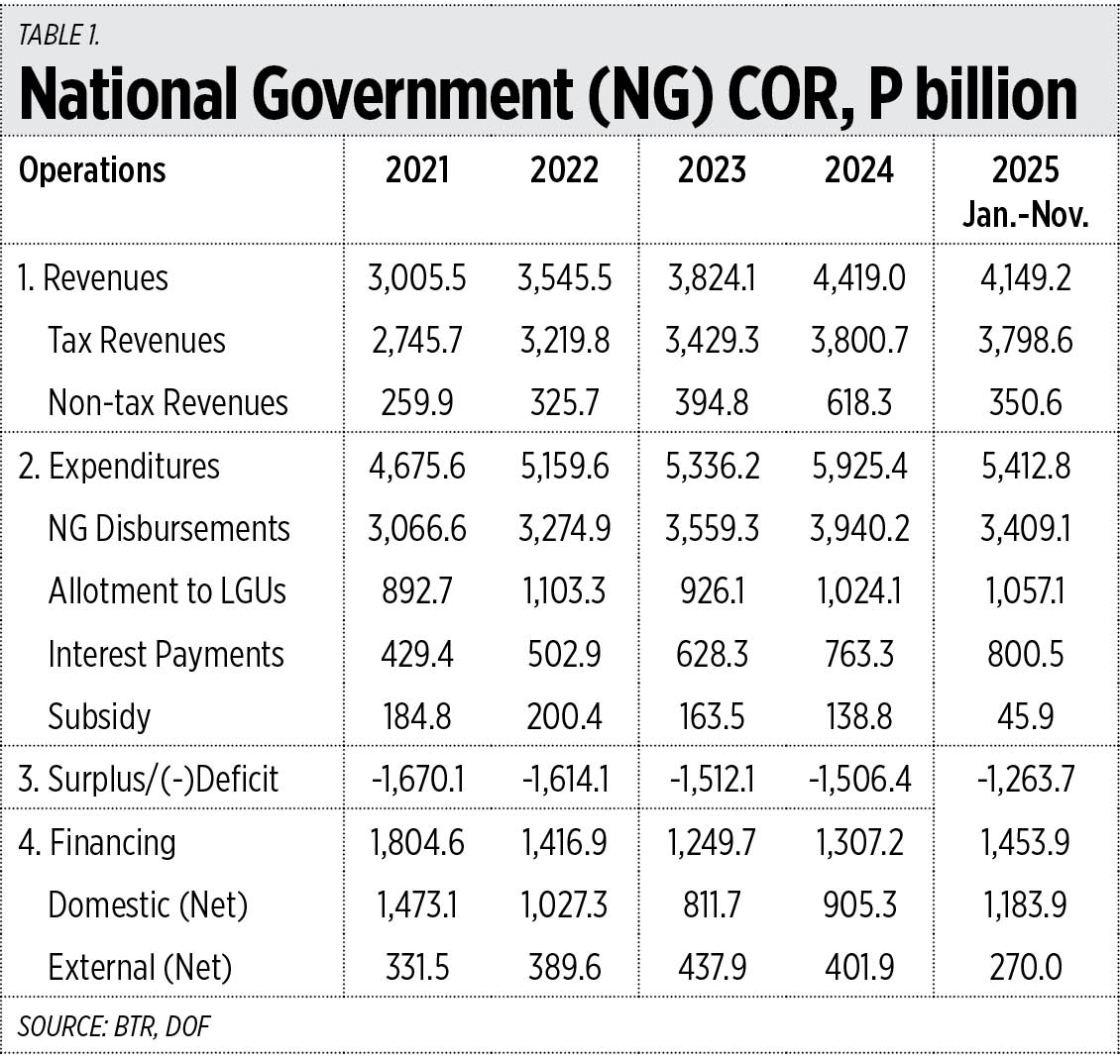
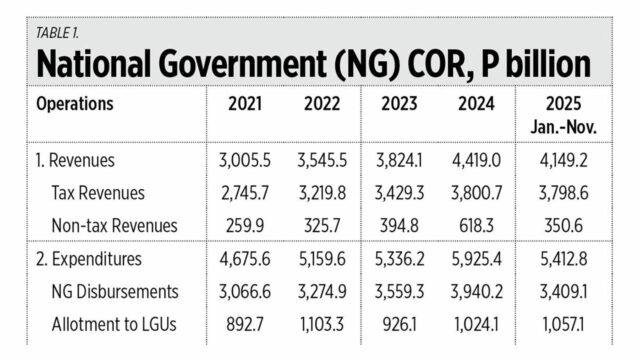
While waiting for the full year 2025 cash operations report (COR) of the Bureau of the Treasury (BTr), I checked the data from January-November 2025. The budget deficit is P1.26 trillion and since National Government disbursements in December reached around P600 billion while revenue was around P300 billion, the full year deficit may reach P1.56 trillion.

The bulk of our budget deficit comes from interest payments alone, an average of P1.7 billion/day in 2023; P2.1 billion/day in 2024; and P2.4 billion/day in 2025. New financing or net borrowings were P1.45 trillion in the first 11 months of 2025 (see Table 1).

TOBACCO SMUGGLING
Recently I noticed that there have been many reports on tobacco smuggling. Look at how many stories on the topic came out in the Philippine Star this month alone: “P1.5 billion smuggled cigarettes found in Malabon” (Jan. 2), “3 nabbed over P21.2 million smuggled cigarettes” (Jan. 7), “Cops seize P97.4-M worth imported cigarettes in Maguindanao del Norte” (Jan. 8), “P100.57 million smuggled cigarettes seized in Bataan” (Jan. 11), “P20 million worth of smuggled cigarettes seized by cops” (Jan. 12), “Security officers tagged in illegal cigarette trade” (Jan. 20), “House to probe pols over cigarette smuggling” (Jan. 22), “Gatchalian wants Senate probe on tobacco smuggling” (Jan. 23), “BIR seizes P516 million illicit cigarettes; Senate eyes probe” (Jan. 25), “Running after smugglers” (“Commonsense” opinion column by Marichu A. Villanueva) Jan. 23, and the Jan. 26 Editorial, “Get the smugglers” (Jan. 26).

Kudos to actions by Customs Commissioner Ariel F. Nepomuceno and Bureau of Internal Revenue (BIR) Commissioner Charlito Martin R. Mendoza, and to the investigations made by Representative Miro S. Quimbo, the Chair of the House Committee on Ways and Means, and Senator Sherwin T. Gatchalian, the Chair of the Senate Committee on Finance.

Mr. Quimbo cited the calculations of both the BIR and Customs Bureau that in 2025, there were revenue losses of P44.8 billion from cigarette smuggling across the country.

Mr. Gatchalian believes that “Tobacco smuggling can only happen with collusion between politicians and law enforcement agencies.”

I believe that the decline in the amount from tobacco tax revenues coincided, or is directly caused by a consistent rise in the tobacco tax rate — from P50/pack that yielded P176 billion in tobacco tax revenues in 2021, to P63.20/pack that yielded only P134 billion in 2024. Meanwhile, tax collections from alcohol, sugar-sweetened beverages, mining, and automobiles have been either flat or rising somewhat (see Table 2).

Ordinary and poor smokers will not buy the legal cigarettes at P100/pack or more because the tax alone is already P66.20/pack. They will instead shift to smuggled cigarettes at P50/pack or less because the tax is zero. The BIR and Department of Finance get nothing from the smuggled cigarettes to help finance public expenditures.

Reports or “studies” that claim “illicit tobacco trade is as low as less than 1% in Metro Manila cities” are not accurate and here are two pieces of proof.

One, during the Senate Committee on Finance public hearings chaired by Senator Gatchalian in March and May 2025, on both instances he instructed his staff to buy smuggled tobacco in Quiapo. Within an hour, the staff members returned with many reams of illicit products, saying that those goods were easy to buy, cheap, and were openly displayed and not hidden. Mr. Gatchalian displayed the newly bought illicit tobacco to all participants of the Committee hearing, including the health activists and physicians who were repeatedly arguing that the amount of illicit tobacco is small and exaggerated.

Two, I personally saw such illicit products being sold when I walked along Ongpin St. in Binondo, Manila about two years ago to check out some jewelry for my daughter. I saw a girl, who looked about high school age, openly displaying reams of cigarettes that were obviously 100% illicit because they were (a.) cheap, P60 or less if you bought more at a time (2024) when the tax rate was already P63/pack; (b.) the packs had no graphics warning; and, (c.) many sported Chinese characters. The young girl’s “stall” was less than 100 meters from a nearby police station and barangay outpost.

The BIR and Finance department could collect P176 billion/year or more, not just P134 billion/year, from tobacco and help reduce the deficit and borrowings. How? I can think of two ways.

One, reduce the price differential between legal and illegal cigarettes by bringing the tax rate back to P60/pack or less, reducing the temptation of smokers to patronize illicit tobacco where government tax collection is zero.

Two, for vapes and heated products, reduce the opportunity for tax dodging by having a low single rate or just two rates with low differential between the two rates.

The government should focus on controlling crime — murder, robbery, destruction of property, abduction, and rape — acts that harm other people. The government should step back from controlling people’s actions that do not harm others except themselves — high-speed downhill cycling, climbing tall trees, sedentary living, drinking, smoking, vaping, consuming fatty-oily-sugary food and drinks, and so on. Allow for more personal and parental responsibility to protect personal and public health.


Bienvenido S. Oplas, Jr. is the president of Bienvenido S. Oplas, Jr. Research Consultancy Services, and Minimal Government Thinkers. He is an internationa fellow of the Tholos Foundation.

minimalgovernment@gmail.com

China espionage thriller to focus filmgoers on national security

Scare Out (2026)
Scare Out (2026)

HONG KONG — China’s first big feature film focused on contemporary national security is being released for Lunar New Year box office crowds as the government looks to ramp up awareness of the risks of foreign espionage.

In the film Jingzhe Wusheng, known in English as Scare Out, information about China’s latest fighter jet is leaked, prompting a thrilling cat-and-mouse game that pits national security officers against a spy.

Filmed mainly in China’s booming tech hub of Shenzhen, the movie is being promoted in Chinese media as the country’s first feature film to focus on contemporary national security.

Guided by China’s Ministry of State Security (MSS), the fictional plot aims to push issues such as counter-espionage and secrecy into mainstream popular culture, China’s Central Television (CCTV) said.

MSS has previously produced or influenced television dramas and documentaries on national security, but this is the first potential blockbuster with a Lunar New Year release.

That is the peak movie-going season that typically produces record-setting revenues and draws families and young people to cinemas in large numbers.

Directed by internationally acclaimed film director Zhang Yimou, and starring local celebrities Yi Yangqianxi and Zhu Yilong, the film showcases a tense spy-hunting operation against the backdrop of Shenzhen’s futuristic skyline.

The framing and narrative of the movie fit into China’s broader soft power strategy of using cinema to promote national security narratives in a modern and urban setting.

Official news agency Xinhua said that in recent years foreign espionage has been active frequently and counter-espionage is “no longer a distant topic.”

The film focuses on the “current hidden front, and counter-espionage and counter-infiltration has become an unavoidable proposition of the times, which is closely related to each of us,” Xinhua said.

Beijing has in recent years placed renewed emphasis on cultural influence and “telling China’s story well,” linking China’s soft power to broader national goals.

China’s President Xi Jinping has called for strengthening China’s international narrative and for presenting an image of China that is “credible, appealing and respectable,” according to official readouts and state media including newspaper China Daily.

China has rapidly modernized its military, producing new aircraft, ships and missiles even as a corruption crackdown is underway.

China’s People’s Liberation Army was one of the main targets of a broader corruption crackdown ordered by Mr. Xi in 2012, reaching the upper levels of the military in 2023 when its Rocket Force was targeted. — Reuters

Developers set sights on horizontal housing in regional growth areas

DEMAND for horizontal developments outside Metro Manila remains steady, according to property developers. — WIRESTOCK/FREEPIK

By Beatriz Marie D. Cruz, Reporter

PROPERTY DEVELOPERS are targeting regional growth areas and pacing the rollout of horizontal residential projects this year, amid economic uncertainties and cautious buyer sentiment.

“We expect the horizontal segment to perform better, supported by steady end-user demand and a preference for larger living spaces,” SM Prime Holdings, Inc. President Jeffrey C. Lim said in an e-mailed reply to questions.

He added that demand for horizontal developments outside Metro Manila remains steady, supported by continued growth in overseas Filipino workers’ remittances, low inflation, and buyers’ increasing preference for larger homes.

Federal Land, Inc. President Jose Mari H. Banzon said the horizontal market remains a “safe investment,” but noted that external factors such as political concerns and geopolitical tensions could affect market sentiment.

“The current political and geopolitical noise have distracted the market from the fundamental soundness of horizontal residential investments,” he said in a Viber message.

Mr. Lim described SM Prime’s outlook for the horizontal residential segment as “cautiously optimistic,” citing potential risks from slower economic growth and weaker buyer confidence.

“As a result, we will remain selective in our 2026 project launches, focusing on locations where our developments have a clear market advantage and sound demand fundamentals,” he said.

The developer is also keeping its development phasing flexible depending on demand conditions while enhancing design and infrastructure to appeal to buyers.

Pueblo de Oro Development Corp. (PDO), known for its ‘live-work-play-learn’ communities, said more families and first-time buyers are seeking township-style living.

“PDO has a positive outlook for the horizontal residential sector in 2026, especially in regional growth corridors,” PDO President and Chief Operating Officer Prim B. Nolido said in an e-mail.

The company expects strong demand for horizontal residential projects in areas with robust economic growth, such as Batangas, Pampanga, Cebu, and Cagayan de Oro.

Mr. Nolido added that the segment could face challenges from rising construction and material costs, as well as competition from affordable housing.

For this year, SM Prime is set to launch a premium residential development within the Susana Heights village in Muntinlupa City and continue its Symphony Homes rollout in Pampanga.

Meanwhile, Federal Land plans to launch another residential subdivision in Biñan, Laguna, and General Trias, Cavite.

“We will also launch residential condominiums to replenish the depleting inventory of our successful projects in Pasig and Bonifacio Global City, catering to the high-end and luxury markets,” Mr. Banzon said.

Gold has more room to run as geopolitical tensions, central bank and retail buying fuel gains, analysts say

ZLATAKY CZ-UNSPLASH

ANALYSTS expect spot gold prices, which hit a record high above $5,000 per ounce on Monday, to climb further toward $6,000 this year on mounting global tensions as well as strong central bank and retail demand.

Gold raced to a peak of $5,092.70 as geopolitical and economic risks rattled markets. The safe-haven metal is up more than 17% this year, after soaring 64% in 2025.

The London Bullion Market Association’s annual precious metals forecast survey shows analysts projecting gold rising as high as $7,150 and averaging $4,742 in 2026.

Goldman Sachs has raised its December 2026 gold price forecast to $5,400 from $4,900.

Independent analyst Ross Norman expects a high of $6,400 this year, with an average of $5,375.

“The only certainty at the moment seems to be uncertainty, and that’s playing very much into gold’s hands,” Mr. Norman said.

Gold’s recent rally has been fuelled by geopolitical tensions, from the US-North Atlantic Treaty Organization friction over Greenland and tariff uncertainty to rising doubts over the independence of the US Federal Reserve, among others.

“With the upcoming US mid-term elections, political uncertainty may increase further. At the same time, persistent concerns about over-valued equity markets are likely to reinforce portfolio diversification flows into gold,” said Philip Newman, a director at Metals Focus.

“After crossing the $5,000/ounce milestone, we expect further upside,” he added.

ROBUST CENTRAL BANK PURCHASES
Central bank gold buying, a key driver of prices in 2025, is expected to stay strong this year.

Goldman Sachs forecasts purchases to average 60 metric tons a month as emerging-market central banks continue diversifying reserves into gold.

Poland’s central bank, which held 550 tons of gold at end-2025, aims to lift reserves to 700 tons, Governor Adam Glapinski said this month.

These plans reaffirm the view that the key driver behind the spike in gold is central banks “looking to de-dollarize… and where else could you go except into gold?” Mr. Norman said.

China’s central bank extended its gold-buying spree for a 14th month in December.

ETF INFLOWS, RETAIL DEMAND
Inflows into gold-backed ETFs, which store bullion for investors and account for a significant amount of investment demand for the metal, are also underpinning prices as markets expect further US rate cuts this year.

“There’s an opportunity cost to holding gold which has no yield. As interest rates decline, so does this opportunity cost. If the Fed continues to lower rates in 2026, demand for gold should rise,” said Chris Mancini, co-portfolio manager of the Gabelli Gold Fund.

Gold ETFs saw record inflows in 2025, led by North American funds, according to World Gold Council data, with annual inflows surging to $89 billion. In tonnage terms, inflows totaled 801 metric tons, the highest since their record in 2020.

Gold demand for jewelry has weakened amid high prices, partly offset by a strong appetite for small bars and coins in key markets such as India.

Bar-and-coin buying is also evident in Europe, though some investors are taking profit, analysts said.

For many retail investors, gold’s appeal lies in its simplicity, said Frederic Panizzutti, global head of sales at Numismatica Genevensis, which trades precious metals coins.

“You don’t need to analyze a balance sheet, assess credit risk or worry about a country or sovereign risk,” he said. “Your only risk with physical gold is the price direction. And as geopolitics and geoeconomics have become more complicated … that simplicity has become more attractive.”

Analysts say several factors could trigger a correction, including a pullback in US rate-cut expectations, margin calls in equities, and easing concerns about Fed independence.

However, most expect any pullback to be short-lived and treated as a buying opportunity.

“A meaningful and sustained decline in gold would require a return to a more stable economic and geopolitical backdrop, which currently appears unlikely,” Mr. Newman added. — Reuters

SEC updates rules for qualified buyer registrars

BW FILE PHOTO

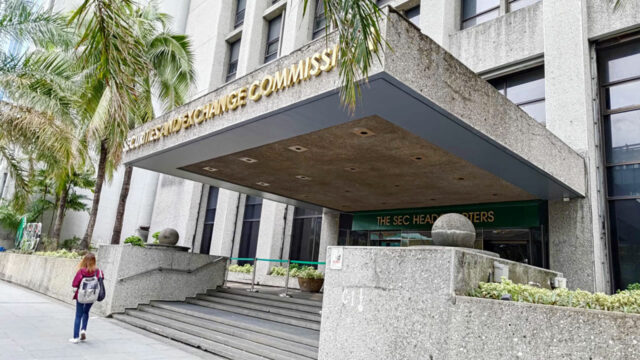
THE SECURITIES and Exchange Commission (SEC) has issued updated guidelines for entities acting as registrars of qualified institutional and individual buyers.

Memorandum Circular No. 5, Series of 2026, introduces amendments to Rule 39.1.4 of the 2015 Implementing Rules and Regulations of Republic Act No. 8799, or the Securities Regulation Code.

Under the revised rules, entities must meet new requirements to act as registrars of qualified buyers (QBs), including assigning permanent identification numbers and being allowed to rely on certifications issued by other registrars.

The changes also introduce an Inter-Registrar Registry, which will be accessible to all registrars for QB verification.

“The amended guidelines ensure standardized and uniform implementation of the Commission’s rules, making compliance more efficient and accessible for registrars and qualified buyers,” SEC Chairperson Francisco Ed. Lim said in a statement on Monday.

“This is in line with our goal of promoting investor protection while still ensuring effective regulatory oversight,” he added.

Entities with appropriate SEC secondary licenses — such as banks (acting as broker-dealers or government securities eligible dealers), brokers, dealers, investment houses, investment advisers, issuer companies for their own offerings, and SEC-registered crowdfunding portals — may apply to become QB registrars.

Applications must be submitted electronically and must include a letter of intent, SEC Form 39-Registrar, and a board resolution certified by the corporate secretary and attested to by the president.

Applicants are also required to submit internal procedures for SEC approval, including organizational charts, QB evaluation criteria, compliance verification controls, and renewal processes.

Authorized registrars must assign a permanent QB identification number to each buyer. This number will remain unchanged through renewals and will not be reissued, even after cancellation, suspension, or revocation.

Registrars may issue three-year registration certificates if qualifications are maintained and must submit annual attestations verifying their clients’ continued eligibility.

For transactions involving QBs registered with other registrars, registrars may rely on existing certificates and may request additional documents if necessary, with support from the new Inter-Registrar Registry for validation.

“Registrars that relied on the registration submitted by a QB shall not incur any liability for doing so, provided that they complied with the requirements as they are deemed to be acting on good faith,” the SEC said.

Registrar authorization remains valid indefinitely unless revoked by the SEC or unless the commission approves a request to cease registrar functions.

“To cease registrar functions, a registrar must notify the SEC at least 30 days before the intended cessation date, and submit the required documents including the letter of intent, board resolution approving the cessation, and an attestation confirming the verification of continued compliance of all QBs in its registry before the cessation, together with the list of verified buyers, among others,” the Commission noted.

The SEC said it will evaluate complete submissions within 10 calendar days. If approved, the registrar must inform clients and counterparties at least 15 days before the effective cessation date. — Alexandria Grace C. Magno

Can ASEAN+3 economies still escape the middle-income trap in the AI era?

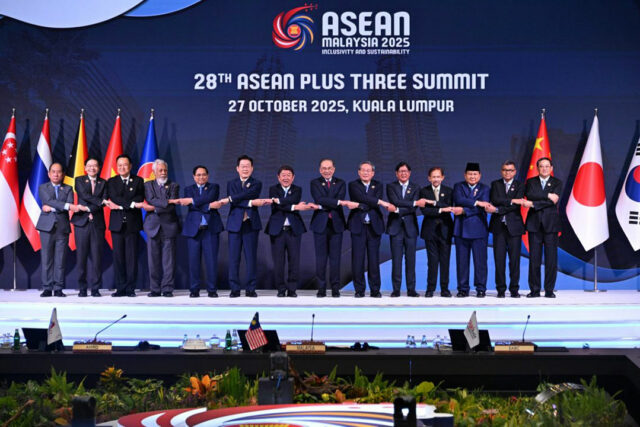
THE ASEAN Plus Three (APT) countries convened in Kuala Lumpur, Malaysia and reaffirmed their commitment to further strengthening the APT framework, which plays a key role in fostering regional cooperation and addressing emerging issues and challenges. — ASEAN.ORG

By Abdurohman and Xianguo Huang

FOR DECADES, the middle-income trap was viewed as a slow-burn structural dilemma. Economies grew rapidly by mobilizing labor and capital, then slowed when easy productivity gains faded and reforms stalled — leaving many countries caught between rising wages and limited productivity growth.

Today, this framing is no longer sufficient. The global economy is now shaped by repeated shocks, geopolitical fragmentation, and rapid technological change. For middle-income economies in the ASEAN+3 region, the ladder to high income remains climbable, but the window is narrowing and closing faster than before.

UNEVEN CONVERGENCE
Growth fundamentals across ASEAN+3 remain broadly robust. Macroeconomic frameworks have strengthened, inflation is better contained, and many economies retain adequate fiscal and monetary policy space. However, beneath these positive indicators lies a large and persistent productivity gap relative to global frontier economies.

In some middle-income economies such as Indonesia and Thailand, manufacturing productivity has stagnated since the global financial crisis, while the services sector — which now employs the majority of workers — has struggled to upgrade. China’s experience stands in contrast. Its sustained growth in GDP per capita reflects decades of structural transformation, industrial advances, and a consistent emphasis on productivity-driven competitiveness. These factors have positioned China closer to attaining high-income status than many of its regional peers.

There are clear lessons within and beyond the region. Korea overcame the middle-income trap through strong macroeconomic discipline, export-driven industrial upgrading, and substantial investment in skills and technological infrastructure. On the other hand, several Latin American economies, including Brazil and Mexico, achieved occasional economic stability but struggled to implement lasting productivity-enhancing reforms. As a result, manufacturing stagnated, services absorbed more workers without becoming more efficient, and growth became increasingly reliant on domestic demand and credit cycles rather than global competitiveness.

The implications are clear. Economic growth and employment can advance, but income convergence will remain elusive without productivity gains. Manufacturing that fails to incorporate technological advancements may reach an impasse, while service-sector expansion without digitalization and skills upgrading becomes counterproductive.

In this environment, simply accelerating growth is insufficient. The priority must shift toward sustainable, high-quality growth — driven by productivity, underpinned by inclusivity, and safeguarded by economic resilience.

AI, PRODUCTIVITY AND GROWTH IN ASEAN+3
What distinguishes today’s world is the speed of technological change. Unlike past waves of industrial catch-up largely driven by diffusion, artificial intelligence (AI) increasingly rewards early movers and strong ecosystems. Productivity gains tend to accrue to firms and countries with advanced digital infrastructure, abundant data, deep talent pools, and large markets.

This poses a challenge for ASEAN+3, where development has traditionally relied on diffusion — through learning by doing, technology transfer through trade and investment, and steadily advancing along value chains. If diffusion slows, or if emerging technologies intensify “winner-takes-most” effects, productivity leaders could pull even further ahead — especially in economies with smaller domestic markets and weaker innovation networks.

AI is already transforming productivity not only across sectors, but within them. Companies with strong data resources, digital systems, and skilled employees are using AI to reorganize production, streamline logistics, and advance to higher value-added activities. Smaller firms, especially in traditional services, face a growing risk of being left behind.

This widening gap across companies, workers, and regions could worsen inequality, strain social cohesion, and erode political support for essential long-term reforms needed to sustain growth.

POLICY PRIORITIES FOR HIGH-QUALITY GROWTH
Escaping the middle-income trap will require a renewed push to boost productivity through timely structural reforms. Key priorities include reducing entry barriers, improving firm resource allocation, and strengthening competitive edge.

Equally important is improving infrastructure governance so that investments translate into productivity gains rather than simply expanding balance sheets. Investing in human capital is vital, as skill shortages and limited adaptability have become binding constraints in many middle-income economies. Coordinated reform efforts, particularly within ASEAN, can amplify these gains.

Technology policy must also adapt. AI should be regarded as a general-purpose technology rather than a niche sector. Promoting its adoption, especially among small- and medium-sized enterprises, is as important as fostering frontier innovation. Without targeted interventions, AI risks entrenching dual economies, where a select group of highly productive leaders coexist with a large number of low-productivity firms, exacerbating inequality and informal market pressures.

Ultimately, even robust domestic reforms may not be sufficient. The development landscape is increasingly shaped by international rules, standards, and networks — from digital trade and data governance to climate finance and resilient supply chains. Regional and global cooperation is therefore becoming more critical.

ASEAN+3 is well positioned to respond. Deeper regional integration can help economies overcome scale constraints, share technological advancements, and sustain income convergence.

AI and global fragmentation are reshaping the path to development. For ASEAN+3, sustaining income convergence will depend on productivity-driven reforms, effective use of policy space, and deeper regional cooperation. Escaping the middle-income trap is no longer a slow, incremental process — it is a high-stakes race against a rapidly advancing frontier. In an era defined by AI-driven disruption and increasing global fragmentation, inaction is not an option.


Dr. Abdurohman is the deputy director (Functional Surveillance and Research) for the ASEAN+3 Macroeconomic Research Office or AMRO. Xianguo Huang is a senior economist at AMRO.

Entertainment News (01/27/26)


Regine Velasquez, Martin Nievera joining Josh Groban show

REGINE VELASQUEZ and Martin Nievera will be the special guests on the Philippine leg of singer-songwriter Josh Groban’s Gems World Tour. The concert, presented by Wilbros Live, will be held on Feb. 18 at the SM Mall of Asia Arena. The tour celebrates Mr. Groban’s legacy of blending classical power with pop accessibility, featuring cinematic hits like “Believe” and “Evermore,” alongside an orchestra and choir. Tickets are on sale and available at SMTickets.com and SM Ticket outlets nationwide. Limited VIP Soundcheck Experience and VIP Superfun Package with Josh Groban are also available.


FDCP presents A Curation of World Cinema

THE Film Development Council of the Philippines (FDCP) is set to bring back FDCP Presents: A Curation of World Cinema, its annual program showcasing internationally acclaimed films from around the world. The program will screen in select Philippine cinemas from Jan. 28 to Feb. 3. This edition’s films are: Jafar Panahi’s Palme d’Or-winning It Was Just an Accident, Joachim Trier’s Cannes Grand Prix-winning Sentimental Value, Mascha Schilinski’s Cannes Jury Prize-winning The Sound of Falling, and Bi Gan’s Cannes Prix Special Award-winning Resurrection. The select cinemas are SM Mall of Asia, SM Megamall, SM North EDSA, SM Southmall, SM Seaside City Cebu, SM Davao, Robinsons Manila, Robinsons Galleria Ortigas, TriNoma, Ayala Malls Manila Bay, Gateway Mall, Shangri-La Plaza, Power Plant Mall, and Cinema ’76 Film Society. Tickets are priced at P250 for both Metro Manila and provincial screenings.


Glaiza de Castro at docu premiere in Rotterdam

KAPUSO actress Glaiza de Castro will attend the International Film Festival Rotterdam (IFFR) this January in the Netherlands for the world premiere of the GMA Public Affairs and GMA Pictures’ documentary film, 58th, which revisits the Maguindanao Massacre through the story of Reynaldo “Bebot” Momay, recognized as its 58th victim. Directed by Carl Joseph Papa, it stars Ms. De Castro as Reynafe Castillo, Mr. Momay’s daughter, whose story reflects the families’ enduring grief and pursuit of justice following the tragedy. Blending animation with archival footage, 58th retells the story of the massacre for a new generation, ensuring the victims’ stories are not forgotten.


New movies premiere on HBO Max in February

THE star-studded lineup of premieres on HBO Max in February kicks off with The Bad Guys 2, which lands on the platform on Feb. 6. After that, Eddington, with Joaquin Phoenix and Pedro Pascal, premieres on Feb. 13. Action thriller Nobody 2, starring Bob Odenkirk and Sharon Stone, will be available starting Feb. 20. Finally, Honey Don’t! premieres on Feb. 27.


The Bluff released on Prime Video

PRIME VIDEO will be releasing the film The Bluff on Feb. 25. Set against the real‑world landscapes of the Cayman Islands, it stars Priyanka Chopra Jonas in one of her most intense and physical roles as Ercell “Bloody Mary” Bodden, a former pirate with a peaceful life that is threatened when her ruthless ex‑captain returns seeking vengeance. The film, which blends a historical backdrop with modern action, is directed by Frank E. Flowers and produced by Anthony and Joe Russo.


Harry Potter series gets new score

HBO HAS announced that Oscar-winning composer Hans Zimmer and Emmy-winning collective Bleeding Fingers will collaborate on a new score for the HBO Original Harry Potter series. The show will debut sometime in 2027 on HBO and HBO Max. In the meantime, the full Harry Potter movie collection can be found on the HBO Max platform.


Ben&Ben drops new song, music video

BEN&BEN has released their new single, “Duyan,” on all digital music platforms worldwide via Sony Music Entertainment. Written and composed by frontman Miguel Benjamin, and produced by longtime collaborator Ziv, the pop-rock ballad was written by Mr. Benjamin three days before his wedding, while sitting alone in his car. It is accompanied by the release of a music video starring real-life couple and actors Gabbi Garcia and Khalil Ramos. The wedding-themed music video is directed by Daniel Aguilar under Lunchbox Studios.


Sony Music pushes new artists for 2026

SONY MUSIC Entertainment is pushing new artists for 2026. They are: HARA, a six-piece P-pop girl group from Davao set to release a pre-debut track on Feb. 25; AYO, a seven-member boy group from Davao planning to release new music this year; DAELUX, a seven-piece girl group from Davao that has posted teasers for their upcoming debut; Rock Opong, a singer from Iloilo who was a grand finalist on The Voice Teens and a semi-finalist on Asia’s Got Talent; Trisha Puso, a singer-songwriter from Bicol with a new single out this week; Mikee Sarmiento, a pop musician from Metro Manila who will release his debut single this week; LU, a folk-pop artist from Aurora featured on Spotify’s Fresh Finds Philippines; and NEW LORE, a three-piece band from Metro Manila that mixes dream pop and alt-pop.


Girl group no na releases new single, music video

THE first-ever global pop girl group from Indonesia, no na, has kicked off the new year with “work,” a high-energy single that is out now via 88rising. As the group’s most dance-forward pop release to date, it is drum-driven and powered by Indonesian beats and gamelan-inspired rhythms. It is available on all digital music platforms nationwide.


Harry Styles returns with new single, music video

GRAMMY award-winning singer Harry Styles has premiered the music video for “Aperture,” the lead single from his upcoming album KISS ALL THE TIME. DISCO, OCCASIONALLY, set for release on March 6 via Columbia Records. The music video is directed by Aube Perrie. The upcoming album will be Mr. Styles’ fourth and his first release since 2022. “Aperture” is out now on digital streaming platforms.

Megaworld’s Mactan Expo readies for ASEAN Summit

Mactan Expo in Lapu-Lapu City, Cebu. — EDG ADRIAN A. EVA

By Edg Adrian A. Eva, Reporter

TAN-LED Megaworld Corp. is ramping up preparations for the P1.5-billion Mactan Expo, its first convention center, as the company positions the facility to host key events for the upcoming Association of Southeast Asian Nations (ASEAN) Summit and expand into the meetings, incentives, conferences, and exhibitions (MICE) sector.

Located within the 30-hectare Mactan Newtown township in Lapu-Lapu City, Cebu, the more than 9,000-square-meter facility is set to host the ASEAN Travel Exchange (TRAVEX) from Jan. 28 to 30 and will serve as one of the venues for the ASEAN Leaders’ Summit in Cebu from May 8 to 9.

“We are already in the quality control phase. We will make sure that we are ready to impress our guests and participants,” Harold Brian C. Geronimo, Megaworld Corp. first vice-president, told reporters during the expo’s first media preview last Thursday.

“We are also closely coordinating with the ASEAN organizing committee to ensure we provide a world-class experience for the leaders,” he added.

Megaworld officially announced its entry into the MICE sector last week through the launch of the Mactan Expo.

According to Mr. Geronimo, the construction of the Mactan Expo was prompted by the Philippines’ hosting of the ASEAN Summit and is intended to complement the Mactan Newtown township.

“In every township we build, we see an opportunity to contribute to local tourism,” he said. “The new Mactan Expo is Megaworld’s gift to the Philippines.”

Meanwhile, Louella Caridad, head of conventions and events and the recently appointed lead for the Mactan Expo, said the MICE sector remains vibrant, with a positive outlook for 2026, as demand continues to grow from both local and international markets.

For the Mactan Expo, Mr. Geronimo said Ms. Caridad’s team is working to secure bookings beyond the ASEAN Summit, extending as far as 2030.

“The outlook is always positive. For Mactan, we will manage it with discipline and rigor,” Ms. Caridad said.

One of the major events scheduled at the convention center is the Ironman race on Aug. 9, set to take place in Lapu-Lapu City and to be presented by Megaworld.

Although new to the convention center business, Megaworld said it aims to differentiate its facilities by incorporating local culture and history into their design.

“It’s the character that we put into these developments. Even in the convention center business, we’re not just building a ‘shoebox’ facility,” Mr. Geronimo said.

Designed by JSLA Architects with interiors led by Leandro V. Locsin Partners, the Mactan Expo features three high-ceiling convention halls that can be combined into a 2,500-square-meter space accommodating up to 2,500 guests.

The facility also includes meeting rooms, a showroom, a prayer room, and a private suite for the President of the Philippines.

At the main entrance, a large mural titled Echoes of Mactan welcomes delegates. The abstract expressionist work, depicting the island’s history and development, was created by Mamerto “Jojo” Gubalane, head artist of the Cebuano Arts Club.

Ms. Caridad said the expo was designed to showcase Cebu’s cultural heritage to international visitors.

“It is about time that we focus on Cebu. Because this also shares the vision of Megaworld to actively participate in nation building. And having a convention center is one way of fostering trade as well as supporting tourism,” she said.

The convention center is within walking distance of Mactan Newtown’s curated beach, which is accessible to township guests, residents, and employees.

AI-POWERED HOMES
On Monday, Megaworld said it would introduce artificial intelligence (AI)-powered homes this year.

The initial rollout will cover selected Megaworld developments, beginning with Park McKinley West in Taguig City, under a partnership with global technology firm Samsung.

Through the collaboration, Samsung will integrate a full AI-powered ecosystem into these homes, the company said in a statement.

“This initiative marks a significant milestone in the Philippine real estate industry as it combines Megaworld’s pioneering expertise in real estate innovation with Samsung’s global leadership in AI-powered living,” it said.

“Megaworld’s AI-powered homes go beyond basic automation by leveraging the Samsung SmartThings ecosystem — an advanced digital hub that serves as the backbone of this technology integration,” it added.

According to the company, the system allows residents to manage and customize their homes through a single mobile application, enabling automated “intelligent” routines based on factors such as time, weather conditions, device status, and user behavior.

“These AI-powered homes are precision-engineered living spaces that integrate functions like intelligent climate control, adaptive lighting, and voice-activated command centers — all seamlessly integrated to respond intuitively to occupants,” the company said.

“The entire ecosystem functions to anticipate needs, adapt dynamically, and optimize performance, as in the case of energy optimization and management, to make the experience more personalized, efficient, and convenient for dwellers,” it added. — Beatriz Marie D. Cruz

Globe earns A- climate rating, expands sustainability initiatives

GLOBE.COM.PH

GLOBE Telecom, Inc. said it is expanding its sustainability initiatives after securing an A- climate score from CDP in 2025, marking its inclusion in the global environmental disclosure platform.

“This CDP Climate Leader rating reflects disciplined action, strong governance, and a clear commitment to transparency… It confirms that our climate strategy is both credible and measurable,” Globe Chief Sustainability and Corporate Communications Officer Yoly C. Crisanto said in a media release on Monday.

CDP, formerly known as the Carbon Disclosure Project, is a nonprofit organization that operates a global environmental disclosure system for companies and cities.

Its disclosure system assesses how organizations manage climate change, water security, and deforestation.

CDP has established a scoring framework that evaluates companies based on the depth of risk awareness, the quality of management, and evidence of leadership through strategy and performance.

Globe said its A- climate score reflects its continued focus on incorporating sustainability initiatives into its operations.

The telecommunications company said it has transitioned 171 cell sites, corporate offices, and other facilities to renewable energy.

In 2025, Globe said it is also ramping up the shift of cell sites and other low-energy utilization facilities to renewable energy as part of its net-zero goal.

The recognition will be added to its “growing list of sustainability milestones, including international and regional awards for ESG performance and environmental leadership,” Globe said.

In a separate media release, Globe said it will also expand its prepaid offerings to connect more users to fifth-generation (5G) mobile networks as the company aims to widen its 5G reach.

The company previously said its 5G coverage was about 97%.

The launch is also in line with the Konektadong Pinoy Act, it said, citing the measure’s goal of providing reliable and accessible internet.

At the stock exchange on Monday, shares in the company closed P2, or 0.12% lower, at P1,617 apiece. — Ashley Erika O. Jose

Peso jumps to P58 level on broad dollar weakness

BW FILE PHOTO

THE PESO jumped on Monday to return to P58 level amid broad dollar weakness, with the yen also surging against the greenback on intervention bets.

The local unit ended at P58.971 versus the dollar, strengthening by 11.9 centavos from its P59.09 finish on Friday, data from the Bankers Association of the Philippines showed.

This was the peso’s strongest finish in more than three weeks or since it closed at P58.841 on Jan. 2, which was also the last time it finished at the P58 range.

The currency opened Monday’s trading session stronger at P58.97 against the dollar. Its intraday best was at P58.92, while its worst showing was at P59.048 against the greenback.

Dollars traded went down to $954 million from $1.159 billion on Friday.

The dollar was generally weaker on Monday as the yen jumped amid speculations of market intervention, a trader said by phone.

The yen jumped to more than a two-month high on Monday as speculation mounted that coordinated intervention by authorities in the US and Japan could be imminent, a prospect Tokyo’s top currency diplomat left wide open while keeping markets guessing, Reuters reported.

Investors were also trimming dollar positions ahead of a Federal Reserve meeting and possible announcement by the Trump administration of a new Fed chairman.

The yen rose as much as 1.2% to 153.89 per dollar, its strongest since November. The euro made a four-month high of $1.1898 and was last up 0.2% at $1.1855.

A source told Reuters that the New York Federal Reserve had checked dollar/yen rates with dealers, seen as a precursor to intervention, and the scramble to get out of short yen positions has the currency some 3% off Friday’s low.

Japanese Finance Minister Satsuki Katayama declined to comment on the rate checks, while top currency diplomat Atsushi Mimura said the government would maintain close coordination with the United States on foreign exchange and act appropriately.

The US dollar index, which measures the greenback’s strength against a basket of six currencies, was down 0.1% at a four-month low of 97.155.

Several other Asian currencies also strengthened, with the Korean won climbing 1.5%, the Malaysian ringgit advancing to its strongest since June 2018 and the Singapore dollar surging to its strongest in more than a decade.

The peso was also supported by signals from Bangko Sentral ng Pilipinas Governor Eli M. Remolona, Jr. that the local unit is unlikely to reach the P60 level versus the dollar in the near term, Rizal Commercial Banking Corp. Chief Economist Michael L. Ricafort said in a Viber message.

For Tuesday, the trader sees the peso moving between P58.80 and P59.10 per dollar on market positioning of market players ahead of the Fed’s policy meeting, while Mr. Ricafort expects it to range from P58.85 to P59.05 per dollar. — Aaron Michael C. Sy with Reuters

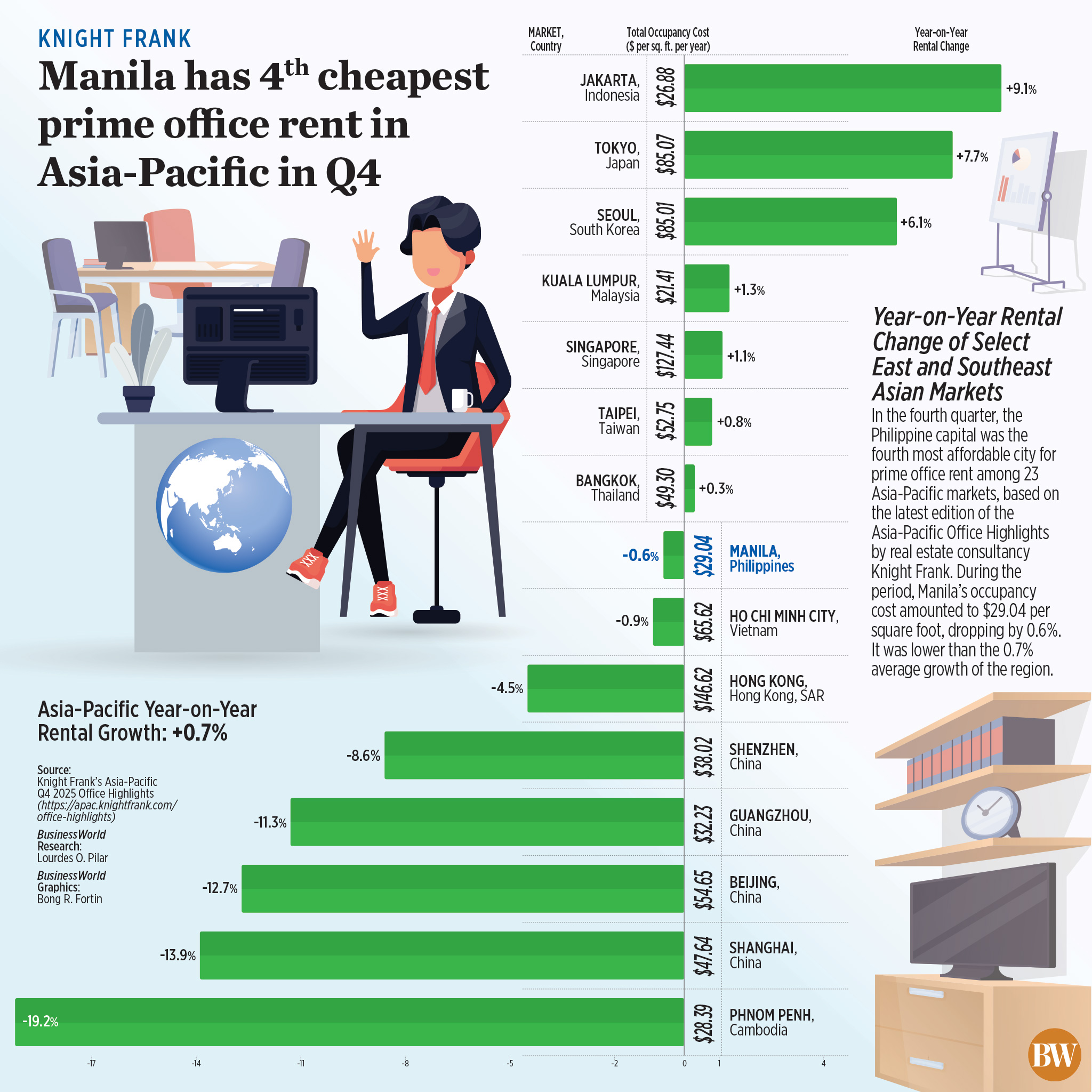
Knight Frank: Manila has 4th cheapest prime office rent in Asia-Pacific in Q4

In the fourth quarter, the Philippine capital was the fourth most affordable city for prime office rent among 23 Asia-Pacific markets, based on the latest edition of the Asia-Pacific Office Highlights by real estate consultancy Knight Frank. During the period, Manila’s occupancy cost amounted to $29.04 per square foot, dropping by 0.6%. It was lower than the 0.7% average growth of the region.

ADVERTISEMENT
ADVERTISEMENT