Home Blog Page 38

UK says it deployed military to deter Russian submarines from attack on undersea cables
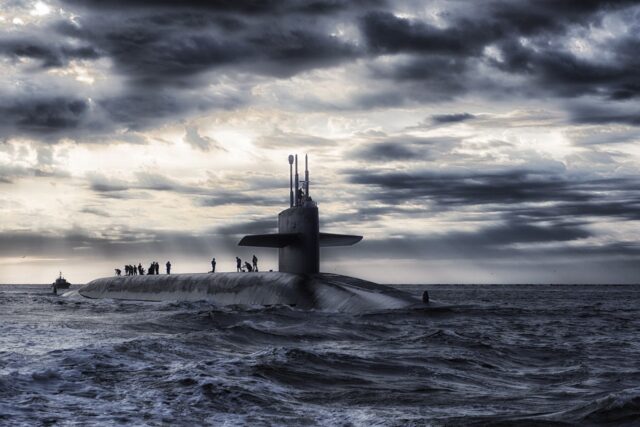
STOCK PHOTO | Image by 12019 from Pixabay

LONDON — Britain deployed military vessels to prevent any attacks on cables and pipelines by Russian submarines that spent more than a month in and around British waters earlier this year, Defense Minister John Healey said on Thursday.

Britain accused Russia of using the distraction of events in the Middle East to try to conduct the covert operation in the High North maritime region, home to key shipping routes and critical infrastructure such as undersea cables.

Mr. Healey said British forces and allies including Norway tracked and deterred malign activity by the Russian vessels, adding that the submarines had now left the area and there were no signs of damage to underwater infrastructure.

Revealing the operation publicly at a press conference, Mr. Healey said the intent was to show Russian President Vladimir Putin that the activity had been detected.

“To President Putin, I say ‘We see you. We see your activity over our cables and our pipelines, and you should know that any attempt to damage them will not be tolerated and will have serious consequences’,” he said.

“Our armed forces left them in no doubt that they were being monitored, that their movements were not covert, as President Putin planned, and that their attempted secret operation had been exposed.”

Russia’s embassy in London said Mr. Healey’s statement was “impossible to either believe or verify.”

“Russia does not threaten undersea infrastructure, which is of critical importance to the UK. Nor do we employ aggressive rhetoric in this regard,” the embassy said in a statement.

Moscow has previously denied allegations of involvement in a series of incidents in which European countries’ cables were damaged.

BRITAIN SENT WARSHIP AND PATROL AIRCRAFT

Mr. Healey said the Russian operation involved a Russian Akula-class attack submarine and two specialist submarines from Moscow’s Main Directorate for Deep-Sea Research (GUGI).

“They are designed to survey underwater infrastructure during peacetime, and sabotage it in conflict,” Mr. Healey said.

After detecting the Russian vessels passing into international waters, Britain sent a frigate, a support tanker and a maritime patrol aircraft to monitor their movements.

Norway’s defense ministry said its armed forces had also deployed a P-8 maritime patrol aircraft and a frigate.

Mr. Healey said the submarines had not entered Britain’s territorial waters, but had been in the wider band of sea around the country, known as its “Exclusive Economic Zone,” and the waters of British allies.

Britain’s naval capacity has been under scrutiny in recent weeks after US President Donald Trump criticized the British response to the Iran war, describing Britain’s aircraft carriers as “toys.”

Mr. Healey referenced that criticism in his statement, saying it had not been in Britain’s national interest to deploy all its military assets in that region.

“The greatest threats are often unseen and silent. And as demands on defense rise, we must deploy our resources to best effect,” he said.

NATO Secretary General Mark Rutte welcomed the British and Norwegian operations against Russian submarines in the High North.

“These efforts to disrupt Russian surveillance of our critical undersea infrastructure protect us all,” Mr. Rutte said in a post on X.

NATO allies have boosted their presence in the North Atlantic and the Baltic Sea, after a series of power cable, telecom, and gas pipeline outages since Russia invaded Ukraine in 2022. Most have been caused by civilian ships dragging their anchors. — Reuters

Israel seeks Lebanon talks after bombardments threaten Iran truce

A view shows illumination flares in the sky by Israel's border with Lebanon, in northern Israel, as seen from its Israeli side October 21, 2023. — REUTERS

JERUSALEM/BEIRUT/ISLAMABAD — Israeli Prime Minister Benjamin Netanyahu said on Thursday he is seeking direct talks with Beirut, a day after the worst bombardment of the war killed more than 300 people in Lebanon and placed Donald Trump’s US-Iran ceasefire in jeopardy.

The US president announced a ceasefire in the six-week-old Iran conflict late on Tuesday, just hours before a deadline after which he threatened to destroy Iran’s entire civilization.

In Pakistan, authorities were preparing for the first round of US-Iran talks, locking down parts of the capital Islamabad.

But there was no sign Iran was lifting its near-total blockade of the Strait of Hormuz, which has caused the worst-ever disruption to global energy supplies. It cited Israel’s ongoing attacks on Lebanon as a key sticking point.

In a defiant statement, Iran’s Supreme Leader Mojtaba Khamenei said Iran would be “resolute in avenging” the deaths of his father, Ayatollah Ali Khamenei, and the country’s “martyrs”, and “will take management of the Strait of Hormuz into a new phase.”

The statement, attributed to Mr. Khamenei, was read on state TV. He has not been seen in public since he took over from his father, who was killed on the first day of the war.

“We will certainly not leave unpunished the criminal aggressors who attacked our country. We will undoubtedly demand compensation for every single damage inflicted,” he said in the statement.

FEW SIGNS OF INCREASED TRAFFIC

In the first 24 hours of the ceasefire, just a single oil products tanker and five dry bulk carriers sailed through the strait, which typically accommodated 140 ships a day before the war and accounted for a fifth of the world’s oil and liquefied natural gas flows.

Mr. Trump said in a social media post that oil would start flowing again, although he gave no indication of what actions the US might take.

“Because of me, IRAN WILL NEVER HAVE A NUCLEAR WEAPON and, very quickly, you’ll see Oil start flowing, with or without the help of Iran and, to me, it makes no difference, either way,” he said.

In a separate post, Mr. Trump said Iran should not charge fees to tankers going through the strait. “They better not be and, if they are, they better stop now,” he said.

Mr. Netanyahu, whose government rebuffed an offer for direct talks with Lebanon last month, said in a statement he had given instructions to start peace talks as soon as possible, which would include disarming Iran-aligned armed group Hezbollah.

“The negotiations will focus on disarming Hezbollah and establishing peaceful relations between Israel and Lebanon,” he said.

An hour before Netanyahu’s statement, Lebanese President Joseph Aoun said he was working on a diplomatic track that was starting to be seen “positively” by international actors.

A senior Lebanese official told Reuters Lebanon had spent the last day pushing for a temporary ceasefire to allow for broader talks with Israel, describing the effort as a “separate track but the same model” as the US-Iran truce.

Israel was preparing to scale down its attacks in Lebanon, a senior Israeli official said on Thursday.

Another Israeli official said talks with Lebanon were expected to begin in Washington next week. A US State Department official confirmed the US would host next week’s meeting to “discuss ongoing ceasefire negotiations.”

Under a November 2024 US-brokered ceasefire accord that halted more than a year of fighting between Israel and Hezbollah, Lebanon agreed that only state security forces should bear arms, which means Hezbollah must be fully disarmed.

But an attempt the following year by the Lebanese army to disarm the group fell short, Israel said.

Hezbollah lawmaker Ali Fayyad said in a statement on Thursday that the group rejected direct negotiations with Israel and the Lebanese government should demand a ceasefire as a precondition to further steps.

The US and Israel have said the latest ceasefire does not include Lebanon, which Israel invaded last month – in parallel with the war on Iran – to root out Hezbollah.

But Iran and Pakistan, which acted as mediator, say Lebanon was explicitly part of the deal. Iran’s Parliament Speaker Mohammad Baqer Qalibaf, expected to head the Iranian delegation opposite US Vice President JD Vance, tweeted that Lebanon and the rest of Iran’s “axis” of regional allies were inseparable parts of any ceasefire.

A Pakistani source said Pakistan was working on ceasefires for Lebanon as well as Yemen, where Israel has also hit Iran-aligned forces.

LEBANON DECLARES DAY OF MOURNING

Earlier on Thursday, Israel kept up its bombing of Beirut’s southern suburbs and other parts of the country, Lebanese state media said.

Hezbollah announced at least 20 military operations on Thursday, saying it had targeted Israeli vehicles on Lebanese territory as well as firing into northern Israel.

Lebanese officials declared a day of mourning after Wednesday’s attacks on heavily populated areas, which they described as a “massacre.”

Outside Beirut’s Rafik Hariri University Hospital, a stream of ambulances arrived throughout Thursday afternoon full of mangled bodies recovered from the sites of Israeli strikes the previous day.

“We’re picking up body parts for the most part. It’s very rare that we find entire bodies intact,” said a rescue worker on condition of anonymity because he was not authorised to speak to the press.

Lebanon’s Health Ministry said the death toll since March 2 had risen to 1,888 dead and more than 6,000 wounded. — Reuters

S&P cuts PHL outlook to ‘stable’ on Middle East risks

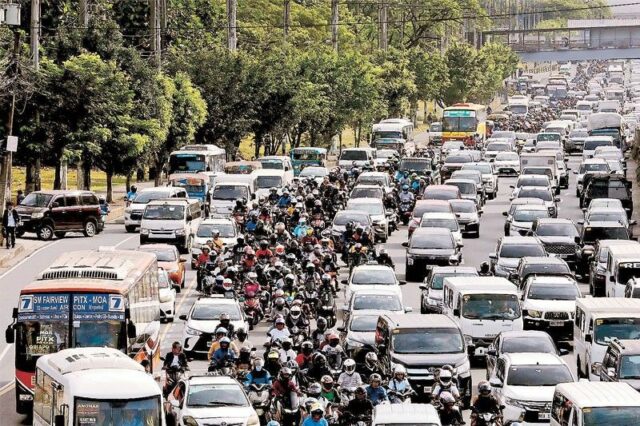
Vehicles are caught in heavy traffic along Philcoa in Quezon City. — PHILIPPINE STAR/MICHAEL VARCAS

By Katherine K. Chan, Reporter

S&P GLOBAL RATINGS revised the Philippines’ credit outlook to “stable” from “positive,” citing risks to the country’s external and fiscal position from surging energy prices due to the Middle East conflict and a slowdown in infrastructure spending.

“We revised the rating outlook on the Philippines to stable from positive because the war in the Middle East has increased risks for the trajectory of the country’s external and fiscal metrics,” the rating agency said in a report by analysts YeeFarn Phua and Andrew Wood released late on Wednesday.

A stable outlook means the Philippines’ credit rating will likely be maintained over the next two years, reflecting expectations that the country will “maintain healthy economic growth rates that will allow fiscal performance to improve gradually while external metrics deteriorate slightly.”

S&P noted that “elevated energy prices will widen the Philippines’ current account deficit this year, reducing cushion on its net external asset position.” Global oil prices have risen to over $100 per barrel following the Middle East conflict, up from about $60-70 per barrel earlier this year, increasing import costs for energy-dependent economies such as the Philippines.

The current account deficit is projected to widen to 4% of gross domestic product (GDP) in 2026, as higher energy import costs offset reduced capital goods imports following the suspension of some infrastructure projects.

The energy shock has also bucked the country’s easing inflation trend.

After inflation cooled to 1.7% in 2025, S&P said the “trend has bucked since the outbreak of the Iran war led to a surge in oil prices,” with inflation projected to rise to 3.4% in 2026. Inflation averaged 2.8% in the first quarter, as back-to-back oil price hikes pushed March inflation to a near two-year high of 4.1%, the first time since July 2024 that it breached the central bank’s 2%-4% target.

On the domestic front, the credit watcher said the “investigations into flood control projects that commenced in August 2025 have severely hit the Philippines’ growth momentum,” leading to a “temporary reduction in public infrastructure spending.”

This contributed to GDP growth slowing to 4.4% in 2025, though S&P expects a rebound to 5.8% in 2026 as these factors ease in the second half.

Still, S&P affirmed the country’s “BBB+” long-term investment grade rating, two notches above the minimum investment grade, and its “A-2” short-term rating, citing “above-average economic growth potential,” anchored by a “strong external position.” This is supported by foreign exchange reserves that reached $107.5 billion in March and record-high remittances of $35.6 billion in 2025, the agency said.

However, S&P also noted that the “prolonged fiscal consolidation path also warrants” the shift to a stable outlook, pointing to the December 2025 recalibration of deficit targets, which signals a slower path to fiscal recovery over the next four years.

The credit watcher said the Middle East conflict is expected to continue disrupting global economies in the coming months, although it assumes the intensity of the war will peak and disruptions to key oil supply routes such as the Strait of Hormuz may ease within April.

“However, uncertainty over how the situation will unfold is high,” it added, noting that external and fiscal support may not improve sufficiently over the next two to three years to provide a meaningful boost to the country’s credit profile.

Consumer spending may weaken in the near term amid higher oil prices.

“The ongoing energy price shocks that started in March 2026 will further dampen economic activity in the Philippines,” S&P said. “We expect consumer sentiment to be undermined, with decreased growth in household spending.”

Despite these headwinds, S&P said the Bangko Sentral ng Pilipinas (BSP) is likely to maintain a “neutral stance” on monetary policy for the rest of the year.

“We believe the central bank will take a broadly neutral stance on monetary policy for the rest of the year, given its need to balance inflationary risk with a slowing economy,” it added.

The BSP kept its benchmark interest rate unchanged at 4.25% in an off-cycle meeting last month following market volatility triggered by the Middle East conflict, marking its first pause since June 2024 after nearly two years of policy easing.

Over the medium term, S&P expects the Philippine economy to remain resilient, projecting GDP growth to average 6.2% from 2027 to 2028 and 6.1% in 2029, driven by strong household consumption, investment recovery, and sustained remittance inflows.

“Solid household and corporate balance sheets, and sizable remittance inflows underpin the Philippine economy’s positive medium-term trajectory,” it said, adding that ongoing infrastructure development and regulatory reforms should further boost productivity.

However, the agency warned that fiscal pressures could persist, particularly if the government implements measures such as fuel tax cuts that may reduce revenues amid elevated global oil prices.

Last month, President Ferdinand R. Marcos, Jr. signed a law authorizing the Executive branch to temporarily suspend or reduce excise taxes on fuel to cushion the impact of oil price shocks driven by the Middle East conflict.

However, Malacañang has yet to announce whether it will implement the measure.

“Additionally, if the economic situation worsens, the government could be compelled to absorb a higher deficit with a supplementary budget to support the economy,” S&P said.

The agency said it could lower the ratings if the country’s long-term growth trend “erodes significantly” or if “persistently large current account deficits” lead to a structural weakening of the external balance sheet.

S&P also said it may raise the ratings if the Philippines’ current account deficits “taper over the next two years such that the narrow net external balance maintains a structural net asset position,” and if “the government achieves more rapid fiscal consolidation than we currently anticipate.”

“The BSP will continue to monitor local and overseas data to effect policies aimed at safeguarding price and financial stability amid a challenging economic and geopolitical landscape,” BSP Governor Eli M. Remolona, Jr. said in a statement on Thursday.

Gov’t eyes P60-billion EV incentives

TOTAL ELECTRIC VEHICLE SALES jumped by 66.9% to 5,701 units as of end-February from 3,416 units in the same period last year, according to a joint report by the Chamber of Automotive Manufacturers of the Philippines, Inc. and the Truck Manufacturers Association. — PHILSTAR FILE PHOTO

By Beatriz Marie D. Cruz, Senior Reporter

THE PHILIPPINE government is looking to earmark P60 billion to support the local manufacturing of electric vehicles (EVs), with the Department of Trade and Industry citing rising fuel costs and the need to reduce reliance on gasoline-powered vehicles.

Based on recent consultations with prospective investors on the proposed Electric Vehicle Incentive Strategy (EVIS), a government program aimed at attracting EV manufacturers and boosting local production, the government plans to provide fiscal support of P15 billion per participant for the domestic production of four-wheeled EVs.

The package will cover makers of battery EVs (BEVs), plug-in hybrid EVs (PHEVs), and hybrid EVs. The details of the framework have yet to be finalized.

On the sidelines of the Manila International Auto Show on Thursday, Trade Undersecretary Ceferino S. Rodolfo said the government is focusing its efforts on incentivizing EV makers in the Philippines amid growing demand for electrified vehicles.

“Given the increasing fuel prices and the logistics cost of importing vehicles into the country rather than in-country production, those producing here would benefit,” he told reporters.

The government plans to release the executive order for the EVIS before President Ferdinand R. Marcos, Jr.’s State of the Nation Address in July, Mr. Rodolfo said.

EV makers would also benefit from the Philippines’ ecosystem of parts manufacturers and workers that can support their assembly facilities, he added.

The proposed package under EVIS is larger than the P9 billion earmarked under the Revitalizing the Automotive Industry for Competitiveness Enhancement (RACE) program, the government’s initiative to incentivize the local production of internal combustion engine (ICE)-powered cars.

Trade Secretary Ma. Cristina A. Roque said on Wednesday that the government is dropping the RACE program to focus on providing incentives to EV makers.

The RACE program was meant to be a successor to the recently concluded Comprehensive Automotive Resurgence Strategy (CARS), which sought to incentivize manufacturers of four-wheeled vehicles.

Mr. Marcos vetoed P4.32 billion worth of unprogrammed appropriations in the 2026 national budget for the CARS program and P250 million for the RACE program.

The government is seeking to attract more EV manufacturers to the Philippines, as oil price volatility caused by Middle East tensions positions EVs as an alternative to ICE-powered cars.

Mr. Rodolfo also said another automotive player is looking to set up an EV manufacturing plant in the country, but he did not disclose details.

Earlier this week, the Department of Finance said Mitsubishi Motors Corp. is planning to establish a hybrid electric vehicle manufacturing facility within Mitsubishi Motors Philippines Corp.’s plant in Santa Rosa, Laguna.

In a statement, the Chamber of Automotive Manufacturers of the Philippines, Inc. (CAMPI) said it is optimistic that the government and the private sector can ensure an attractive environment for both EV and ICE carmakers.

“We look forward to the continued collaboration between the government and the private sector in developing an attractive environment for local production of various vehicle types, including electrified and ICE vehicles, as aligned with local market needs,” it said.

To further boost EV adoption, Philippine Institute for Development Studies Senior Research Fellow John Paolo R. Rivera said affordability and charging infrastructure remain key.

“The EVIS signals a clear policy pivot toward electric mobility and future-oriented manufacturing. This will likely support EV demand over time, as stronger incentives, ecosystem development, and investor interest make EVs more accessible and viable locally,” he said in a Viber message.

Rizal Commercial Banking Corp. Chief Economist Michael L. Ricafort said the government’s shift to incentivizing EV makers is a “timely move” as the Philippines grapples with oil price and supply uncertainties.

“The granting of incentives must be more circumspect and prudent, all the more now where the priority is to secure more and at least conserve the country’s oil/petroleum/energy supply,” he said in a Viber message.

Total EV sales jumped by 66.9% to 5,701 units as of end-February from 3,416 units in the same period last year, according to a joint report by the CAMPI and the Truck Manufacturers Association.

Banks’ bad loan ratio hits 6-month high in Feb.

BW FILE PHOTO

THE PHILIPPINE BANKING sector’s gross nonperforming loan (NPL) ratio rose to a six-month high in February, preliminary data from the Bangko Sentral ng Pilipinas (BSP) showed.

Domestic banks’ gross NPL ratio increased to 3.33% as of end-February from 3.31% a month earlier but eased from 3.38% a year ago.

This was the highest bad loan ratio in six months, or since 3.5% in August last year, and matched the ratio recorded in October.

Loans are considered nonperforming when they remain unpaid for at least 90 days after the due date. These are classified as risk assets since borrowers are unlikely to pay.

Based on BSP data, banks’ nonperforming loans in February reached P553.678 billion, up 0.52% from P550.812 billion in January.

Year on year, bad loans rose by 7.86% from P513.348 billion.

The total loan portfolio of Philippine banks stood at P16.603 trillion at end-February, 0.2% lower than P16.636 trillion in the previous month. It was, however, 9.43% higher than the P15.173-trillion portfolio recorded in February 2025.

Jonathan L. Ravelas, a senior adviser at Reyes Tacandong & Co., said the recent increase in bad loans mainly reflected “normalization” rather than issues in the banking system’s lending activities.

“The slight uptick in NPLs reflects the lagged impact of last year’s high interest rates, some seasonal cash-flow pressure early in the year, and faster loan growth where a bit of slippage is normal at the margins,” he said in a Viber message.

He noted that an NPL ratio of 3.33% is still “very manageable and well below stress levels,” indicating that banks have strong capitalization and adequate provisioning.

“This is a mild bump, not a red flag — but it reinforces the need for closer credit monitoring if rates stay high longer,” Mr. Ravelas added.

At end-February, banks recorded P715.658 billion in past due loans, up 0.57% from P711.581 billion in January and 12.21% higher than P637.808 billion a year ago.

The past due loan ratio edged up to 4.31% from 4.28% in the previous month and 4.2% a year earlier.

Meanwhile, restructured loans declined by 0.48% month on month to P335.392 billion in February from P336.999 billion. However, these rose by 7.81% year on year from P311.106 billion.

This brought the restructured loan ratio to 2.02%, easing from 2.03% in January and 2.05% in February 2025.

Banks’ loan loss reserves grew by 0.12% to P519.525 billion in February from P518.91 billion a month earlier and by 6.12% from P489.551 billion in the prior year.

These accounted for 3.13% of the industry’s total loan portfolio, up from 3.12% in January but down from 3.23% a year ago.

Central bank data also showed that lenders’ NPL coverage ratio, which gauges allowances for potential losses from bad loans, slipped to 93.83% in February from 94.21% in January and 95.36% a year earlier. — Katherine K. Chan

OFW remittances at risk as Mideast war drags on

Around 2.4 million Filipinos are based in the Middle East, with most in the United Arab Emirates, Saudi Arabia, Qatar, and Kuwait. — PHILIPPINE STAR/WALTER BOLLOZOS

THE PHILIPPINES could see a drop in cash sent home by overseas workers if the Middle East conflict persists, global debt watcher Moody’s Ratings said.

The country’s “Baa2 stable” rating places it among higher-rated sovereigns, which Moody’s Ratings said generally have stronger financial and institutional buffers, although prolonged disruptions could pose risks to the country’s external and fiscal position.

In a report titled “Middle East shock will test sovereigns with limited credit buffers,” the debt watcher said a key risk is the potential impact on overseas Filipino workers (OFWs) stationed in the region.

“A prolonged conflict would reduce incomes and employment prospects from migrant workers in the Middle East, dampening remittance inflows to… the Philippines (Baa2 stable), among other sources of foreign labor,” it said.

Latest central bank data showed that Filipinos abroad sent home a total of $3.02 billion in January, up 3.5% from $2.918 billion a year ago but down 14.3% from the record-high $3.522 billion in December.

Of the total, 17.1% or $516.512 million came from the Middle East.

Around 2.4 million Filipinos are based in the Middle East, with most in the United Arab Emirates, Saudi Arabia, Qatar, and Kuwait, according to government data.

The Philippines is also exposed to higher energy costs as a net importer of oil and gas.

Moody’s Ratings said supply disruptions and higher energy prices are key transmission channels of the conflict, which could affect inflation, fiscal balances, and external accounts.

While higher-rated sovereigns such as the Philippines have stronger buffers, Moody’s Ratings said a “sustained increase in energy and fertilizer prices” could “constrain fiscal and monetary flexibility.”

The agency added that the overall credit impact will depend on the duration and severity of disruptions to global trade and energy markets, as well as governments’ ability to respond through policy measures.

Moody’s Ratings also noted that Asia-Pacific is among the regions most exposed to supply disruptions.

“Apart from the Middle East, Asia-Pacific is the region most vulnerable to negative credit effects from the conflict, with more than half of its sovereigns having moderate exposure,” it said.

Separately, Fitch Ratings said the Philippines remains vulnerable to energy shocks given its reliance on imported oil.

“For the Philippines, this shock basically comes on top of already quite significant domestic pressures,” Fitch Ratings Head of APAC Sovereigns Thomas Rookmaaker said during a webinar on Thursday.

He said governance-related issues last year, including a flood control corruption scandal, weighed on investment and economic growth.

“So, growth dropped quite significantly in the second half of last year as a result of governance issues, a corruption scandal which the government tries to tackle, which in itself is a good thing, but it does lead to a large drop in public capex (capital expenditure) with a significant impact on growth,” Mr. Rookmaaker said.

He also cited the country’s dependence on Middle East oil imports.

“Now, the Philippines is also not in a great position when it comes to the impact of the war in Iran with basically importing virtually all of its oil from the Middle East,” he said. “And I think they have roughly 15 days or so of oil reserves, which is not bad compared to others, but it’s not great either.”

Local pump prices have increased in recent weeks following the escalation of the conflict, with fuel retailers implementing hikes of as much as P52.30 per liter for gasoline, P100.05 per liter for diesel, and P82.40 per liter for kerosene.

The Department of Energy has warned that oil prices could remain elevated even if the conflict de-escalates, as energy infrastructure in the Middle East has been affected by the attacks.

Fitch earlier said that “more ingrained and structural” growth risks from the Middle East war could weigh on the country’s credit profile.

Mr. Rookmaaker also noted that high debt levels and slow fiscal consolidation could pose challenges to the Philippines’ medium-term growth.

“The question is to what extent they will be able to keep growth up, which is important in a solidating context, especially over the medium term because of the debt dynamics,” he said. “So, the fiscal consolidation in the Philippines is happening, but it is rather slow. So, the debt is still relatively high.”

“The sovereign needs growth basically to keep the debt-to-GDP ratio gradually declining,” he added.

At end-February, the government’s outstanding debt rose to a record P18.16 trillion, up 0.14% from P18.13 trillion at end-January, latest Treasury data showed.

The National Government expects its outstanding debt to reach P19.06 trillion this year, with P13.28 trillion in domestic debt and P5.78 trillion in external debt. — Katherine K. Chan

Maharlika backs proposal to tap fund for energy diversification

STOCK PHOTO | Image by Photoangel from Freepik

By Justine Irish D. Tabile, Senior Reporter

MAHARLIKA Investment Corp. (MIC) said it is open to a proposal raised during a House hearing to tap the sovereign wealth fund for energy diversification as fuel supply risks rise.

“We fully welcome and support the policy direction and recommendations raised during [Wednesday’s] House Committee on Ways and Means hearing,” MIC President and Chief Executive Officer Rafael D. Consing, Jr. said in a Viber message to BusinessWorld late on Wednesday.

“Tapping the Maharlika fund for energy diversification perfectly aligns with our mandate to invest in critical infrastructure that drives sustainable, long-term national development,” he added.

A lawmaker on Wednesday asked the Department of Economy, Planning, and Development (DEPDev) about the possibility of tapping the Maharlika fund for energy diversification.

DEPDev Secretary Arsenio M. Balisacan said the MIC has already invested in the energy sector, particularly in transmission.

“I think (yes), of course, if it meets the objectives of Maharlika, that is, it must be sustainably profitable,” he said.

“And I think that industry is quite profitable, so it should be a good project,” Mr. Balisacan said during the hearing.

The Philippines remains heavily dependent on fossil fuels, with renewables accounting for 26% of the power generation mix, close to the government’s 35% target by 2030.

As a net importer of crude oil, largely sourced from the Middle East, the country remains exposed to global price volatility.

Mr. Consing said energy security and diversification are among MIC’s priority sectors.

“Currently, due diligence and technical studies are ongoing for our purchase and upgrade of the distribution system in Mindoro, which is targeted to be completed by the end of 2027,” he said.

“Meanwhile, we have entered into an agreement with the Palawan Electric Cooperative (PALECO) to undertake a project in Palawan,” he added.

He said the rollout of upgraded island grid infrastructure and distribution networks in these areas is expected to catalyze private power generation.

In particular, he said the initiative will help deliver reliable electricity to over 2.6 million residents, reduce reliance on diesel and bunker fuel generators, and wean off-grid areas from the Universal Charge for Missionary Electrification subsidy, among others.

“I think the point about energy diversification is very critical, and we should explore many ways. But at the same time, engage the private sector to be a key driver for that because of the massive investment requirements,” Mr. Balisacan said.

Private sector groups welcomed the proposal, citing their expertise and capital as key to advancing energy diversification.

Jose Rene D. Almendras, private sector representative to the Legislative-Executive Development Advisory Council, said such initiatives are well-suited for public-private partnerships.

He said the private sector has advantages in terms of expertise, capital, and long-term maintenance.

Management Association of the Philippines President Donald Patrick L. Lim said the private sector must play a central role in diversifying the country’s energy mix.

“Government alone cannot move fast enough or invest at the scale required. The private sector has the capital, technology, and operational capability to accelerate renewable energy, energy efficiency, battery storage, and even emerging technologies such as liquefied natural gas and nuclear,” he said in a Viber message.

Instead, he said the government’s role is to create “the right environment by speeding up permits, ensuring policy consistency, modernizing the grid, and giving investors the confidence to commit long term.”

“If we want real energy security, this has to be a true public-private partnership,” he added.

Meanwhile, Philippine Chamber of Commerce and Industry President Ferdinand A. Ferrer said the private sector’s strengths include innovation, technology, and networks.

“It is an opportune time for the private sector and government to work hand in hand in finding and implementing solutions to this crisis,” he said in a Viber message.

The country was placed under a one-year state of national energy emergency on March 23, giving the government expanded powers to shield the economy from surging oil prices triggered by the war involving Iran, Israel, and the US.

Oil companies implemented another round of pump price increases this week, with diesel rising by P15 to P19.80 per liter and gasoline by P1.50 to P5.90 per liter.

As a result, diesel prices may climb to as high as P172 per liter, while gasoline could near P120 per liter.

SEC says umbrella fund rules to make market access easier

BW FILE PHOTO

THE SECURITIES and Exchange Commission (SEC) said its move to allow umbrella funds — investment companies that house multiple sub-funds under a single legal structure — is meant to simplify participation in Philippine capital markets.

“[The rationale behind the umbrella fund] is to make things easy,” SEC Chairman Francisco Ed. Lim told reporters on the sidelines of an event on Wednesday.

“The mutual fund industry is a key stakeholder in our capital markets because they’re the ones buying,” he said. “If the institutional investors are few, if the retail investors are few, I think that’s one of the reasons why our market is small.”

Mr. Lim said easing regulations could help speed up market development by lowering barriers to entry for both institutional and retail participants.

The SEC on Wednesday issued Memorandum Circular No. 14, which sets the guidelines for umbrella funds that allow multiple sub-funds to operate under a single investment company.

Umbrella funds are open-end investment companies composed of at least two sub-funds with varying investment objectives, strategies, currencies and fee structures.

Each sub-fund functions as a distinct portfolio with its own assets and liabilities, even as it operates under a single legal entity.

The rules require umbrella funds to maintain at least two sub-funds and set timelines for registering additional sub-funds. Extensions for registration may be granted only for meritorious reasons approved by the commission.

The memo outlines procedures for launching, reallocating and terminating sub-funds. These include board approval requirements and investor notification obligations.

It also allows investors to switch between sub-funds, subject to disclosures in the prospectus.

Fund managers must submit separate reports for each sub-fund. Monthly submissions should include the average net asset value per unit, while quarterly and annual reports must include five-year performance data.

The framework also requires detailed disclosure of cross-sub-fund investments, including holdings, market value, net asset value share and related fees.

These disclosures are intended to give investors a clearer view of exposure across sub-funds within the same umbrella structure.

Umbrella funds must file financial statements for both the overall entity and each sub-fund.

Consolidated financial statements are allowed if sub-fund details are disclosed in the notes, in accordance with Philippine Financial Reporting Standards and SEC reporting rules.

Investment companies must secure a license and register their securities before offering them to the public.

Securities may be registered in full for allocation across sub-funds or in stages as additional sub-funds are introduced.

The SEC said the framework aims to support capital market development, enhance investor protection and ensure full and fair disclosure.

It added that allowing multiple sub-funds under a single entity could improve operational flexibility while offering investors more diversified and cost-efficient investment options. — Alexandria Grace C. Magno

Meralco Q1 energy sales dip as cooler weather curbs demand

PHILIPPINE STAR/ MICHAEL VARCAS

MANILA ELECTRIC CO. (Meralco) reported a 1.8% decline in energy sales volume in the first quarter as cooler weather dampened demand.

“Lower temperatures reduced organic demand, partially offsetting the contribution of new connections,” Charina P. Padua, senior vice-president and head of customer relations and services at Meralco, said in a Viber message on Wednesday.

Energy sales volume for the January-to-March period fell to 12,273 gigawatt-hours (GWh) from 12,493 GWh a year earlier, she said.

Residential and commercial sales declined as colder weather curbed consumption and reduced the use of ventilation and air-conditioning systems, she said.

Industrial sales also slipped, weighed by operational constraints and macroeconomic headwinds affecting steel and plastics, along with limited output from embedded generators.

Meralco expects a 3% increase in energy sales volume this year, supported by demand normalization as temperatures stabilize following the high base from the El Niño period in 2024.

The projected growth would reverse the 0.7% decline recorded in 2025, when softer demand, increased rooftop solar adoption and slower economic growth weighed on sales.

Despite flat sales volume, the distribution business remained the biggest contributor to the power distributor’s earnings last year, with income reaching P29.55 billion.

Core net income rose 12% to P50.57 billion, driven by growth in power generation and steady performance of the distribution business.

Meralco is the country’s biggest private electric distribution utility, serving more than 8.2 million customers in Metro Manila and nearby provinces.

Beacon Electric Asset Holdings, Inc., the company’s controlling stakeholder, is partly owned by PLDT Inc. Hastings Holdings, Inc., a unit of PLDT Beneficial Trust Fund subsidiary MediaQuest Holdings, Inc., holds an interest in BusinessWorld through the Philippine Star Group, which it controls. — Sheldeen Joy Talavera

A modern royal romcom

AFTER winning the hearts of K-drama lovers for years, stars IU (real name Lee Ji-eun) and Byeon Wooseok are coming together as leads in a romantic comedy for the first time, in Perfect Crown.

The original series, which is now on Disney+, tells the story of modern-day grand prince I-An (played by Mr. Byeon) and corporate heiress Huiju (played by IU).

In a preview event on April 6, BusinessWorld glimpsed the first episode, which laid down the groundwork for the twists and turns of the two characters’ marriage of convenience. According to the series’ summary, the prince’s power struggle with other members of the royal family and the heiress’ ambitions for her conglomerate will eventually clash.

While the first episode sets up the dynamic between the two, it’s also an interesting look at how a monarchy would be like in modern South Korea, with characters like a prime minister and a dowager queen.

What drives the K-drama, however, are its romcom aspects, with the leads’ actions and antics front and center of the story.

“I feel like we have a chemistry that stretches over a decade and you can really see that chemistry in this series,” Mr. Byeon said in Korean which was translated into English, at a separate press event in Seoul that was streamed online.

He added that IU made him feel at ease instantly. “She’s such a great scene partner, so I enjoyed it so much,” he said.

Both actors appeared together 10 years ago, in Moon Lovers: Scarlet Heart Ryeo, where IU played the lead and Byeon Wooseok had a cameo role as her ex. This makes Perfect Crown their debut as the main onscreen couple.

“In that [other] series, he was actually a boyfriend who cheated on me. Now, after 10 years have passed, we get to work alongside each other again as main characters,” IU told the Korean press. “It almost felt like we had been friends all along in that time, so it made me feel like I wanted to do another project with him.”

As for their characters, I-An is described as “the favorite royal of 21st century Korea, but with a status where he can’t outshine anyone,” while Huiju is a “greedy character who yearns for a lot of things.”

Mr. Byeon explained that he studied his role deeply. “Prince I-An is very strong on the outside, but he’s very lonely and scarred on the inside,” he said.

Meanwhile, IU said that she found her role fascinating. “Frustration is a key word that really describes Sung Huiju, but she’s also very adorable,” she said.

The series is directed by Park Joonhwa and written by Yoo Jiwon.

Perfect Crown is now on Disney+. — Brontë H. Lacsamana

A showcase of the future of mobility in PHL

Photo from facebook.com/ManilaInternationalAutoShow

The highly anticipated and much-beloved Manila International Auto Show (MIAS) is returning this weekend, getting car enthusiasts and enjoyers excited for the showcase of vehicles to be expected from the event, as well as a vivid portrayal of an industry in transition due to recent geopolitical and economic events.

From April 9-12, the MIAS reverts back to the two-venue format as the halls of the World Trade Center Metro Manila and the Philippine Trade Training Center will once again transform into a dynamic arena where innovation, sustainability, and shifting consumer preferences come together. With over 170,900 visitors expected, 145 exhibitors, and more than 310 vehicles on display across a sprawling 33,000 square meters, MIAS 2026 is poised to be one of the most important editions yet.

For longtime observers, the evolution has become clearer. What began years ago as a celebration of sedans and combustion engines has steadily become a platform for more sustainable and smarter options, such as electrification and intelligent mobility. These changes reflect a Philippine market with a growing appetite for cleaner, smarter, and more versatile vehicles, and MIAS has become one of the clearest ways to understand that shift.

One of the biggest highlights this year is the wave of major vehicle launches, many of which signal a strong move toward electrified and technology-driven mobility. Leading the charge is the China-based GAC Motor, whose Philippine arm promises a double reveal that could redefine its presence in the local market. By introducing two brand-new models at once, GAC is expanding its lineup while also showing confidence in the growing demand for modern mobility solutions among Filipino buyers.

Photo from manilaautoshow.com

Another highly anticipated debut comes from another China-based manufacturer, Changan Automobile, which is preparing to unveil a new model positioned as a breakthrough in mobility. While full details remain under wraps, early messaging suggests a vehicle that blends design, performance, and advanced features in a way that appeals to a new generation of drivers.

The shift toward electrification becomes even more evident with the South Korea-based Kia, which will introduce the much-awaited EV5. This launch highlights how electric vehicles (EVs) are becoming more relevant in the Philippine market. Kia’s move signals that EV adoption is something that is steadily becoming part of everyday driving, perhaps accelerated by the increasing costs of gas and diesel.

Electric innovation continues with BYD Auto, a global leader in EV development. Its showcase at MIAS 2026 is expected to feature new electric models along with the technologies that support them, including battery systems and energy efficiency solutions. BYD’s presence reinforces the idea that the future of mobility in the Philippines will increasingly rely on electric power.

Alongside BYD, manufacturer Geely Auto is set to present an expanded lineup of EVs. Known for integrating advanced technology into accessible models, Geely is likely to emphasize connectivity, intelligent features, and energy efficiency.

Meanwhile, luxury and advanced technology come together at the booth of AITO, a brand that is gaining attention for its focus on intelligent premium vehicles. At MIAS 2026, AITO aims to demonstrate how modern luxury now includes smart systems, seamless connectivity, and user-focused design.

Conversely, BAIC Group will bring a different kind of excitement by showcasing new pickup trucks and rugged vehicles. These models highlight strength and durability, qualities that remain important, and even fashionable, for many Filipino drivers. While electrification is gaining ground, there is still strong demand for vehicles that can handle both urban roads and more challenging environments.

Newer Asian brands are also making their mark. Deepal will debut models that reflect a fresh approach to sustainable mobility and modern design. Meanwhile, Bestune will showcase compact and efficient vehicles suited for city driving, offering practical solutions for increasingly busy urban areas.

Adding to the excitement is the debut of the ROX Motor’s ROC Adamas, a model that promises a unique driving experience. Its exclusive appearance at MIAS makes it one of the most intriguing attractions for visitors looking to discover something new.

212 Motor will also introduce models designed for adventure and exploration. These vehicles combine rugged styling with modern engineering, appealing to drivers who seek both performance and character. Another key participant is Great Wall Motor (GWM), which arrives with a clear vision centered on offering multiple powertrain options for different users.

Beyond the vehicle launches, MIAS 2026 offers a wide range of activities that enrich the overall experience. The event includes technical seminars, interactive brand programs, and livestream sessions that allow visitors to engage more deeply with the automotive world. These activities create opportunities for both industry professionals and everyday enthusiasts to learn and connect.

Car club displays add another layer of excitement, showcasing communities built around shared passion for different brands. Interactive programs hosted by companies such as MG provide hands-on experiences that bring new technologies closer to the public. Additionally, Hot Wheels’ “Driven To Be Legendary” media launch can even bring out the inner child of many of the event’s participants.

What makes MIAS truly significant is its ability to reflect the changing preferences of Filipino drivers. The growing presence of EVs, the focus on sustainability, and the integration of smart technologies all point to a market that is evolving quickly.

MIAS 2026 tells a story of progress and possibility that the country’s automobile industry has gone through. The future of mobility is no longer something to wait for. It has already taken shape on the show floor of the country’s most-awaited automotive event. — Jomarc Angelo M. Corpuz

Federal Land steady, readies contingency plans amid Iran war

Aerial view of Met Park in Pasay City

By Alexandria Grace C. Magno, Reporter

PROPERTY DEVELOPER Federal Land, Inc. said its operations remain steady despite war in the Middle East, while preparing contingency measures to cushion potential risks to demand and costs.

“It’s too early to gauge the impact of the Middle East war on our operations,” Federal Land President Jose Mari H. Banzon told BusinessWorld in a Viber message. “Our commercial leasing and residential sales volume remain steady.”

“However, we have already prepared contingency plans to address the anticipated business slowdown and higher operating and construction costs,” he added.

Mr. Banzon said the company might defer some commercial and residential project launches and adjust operating and capital expenditures to preserve cash.

He said the company remains in a “wait-and-see mode,” noting that the rollout of projects scheduled this year depends on how the situation in the Middle East develops.

Federal Land’s net income fell 30% to P522.3 million in 2025 from a year earlier. During the year, it completed and turned over five towers located in Manila, Pasig, Marikina, Pasay, and Taguig.

The company plans to expand two residential developments in Laguna and Cavite, citing sustained demand for horizontal projects outside Metro Manila.

Mr. Banzon said the planned developments in Biñan, Laguna and General Trias, Cavite are succeeding phases of existing projects, with launches targeted for the second half following steady sales.

Federal Land is set to expand Hartwood Village in Biñan by an additional 21 hectares.

The project features amenities such as a parking area, multi-purpose court, gym, swimming pools, pet park, garden and clubhouse. Its first phase covers 11 hectares with 110 lots, while the second phase will offer 55 lots.

The company is also preparing the second phase of its Japanese-inspired Yume at Riverpark in General Trias, which is being developed by unit Federal Land NRE Global, Inc.

Federal Land NRE Global, Inc., a joint venture with Nomura Real Estate Development Co., Ltd., sold out the first-phase commercial lots of Riverpark North last year.

Federal Land has residential developments across Metro Manila and operates commercial and hotel projects in Makati, Taguig and Pasay.

ADVERTISEMENT
ADVERTISEMENT