


Home Blog Page 3737

Style (01/29/24)


Polo Ralph Lauren marks Lunar New Year

POLO RALPH LAUREN is celebrating the Lunar New Year with a new watch. Its familiar Polo Bear image is dressed in a festive Lunar New Year outfit consisting of a velvet smoking jacket in auspicious red. Set in a 38-mm frame, the Lunar New Year Bear takes center stage in 3D on a round cream-white lacquered dial with the collection’s hallmark bold black Arabic numerals, railway minute track and the Polo Ralph Lauren logo signature at 9 o’clock. The hour, minute, and central seconds hands are glossy black, matching the dial markings. Crafted from stainless steel per Swiss watchmaking tradition, the watch is powered by Ralph Lauren’s RL200 caliber, a mechanical self-winding Swiss movement hand-finished with vertical Ctes de Genve stripes and circular graining, known as perlage. Water-resistant to 5 ATM (approximately 50 meters or 160 feet), the watch features a stylish black grosgrain silk strap with leather details and a steel pin buckle engraved with the word “Polo.” The Lunar New Year Polo Bear watch will be available for purchase in a limited run of 50 pieces on Feb. 10.


COS unveils capsule collection

COS unveils a new capsule collection celebrating the arrival of spring. It presents selections of neutral-toned casual separates with accents of vibrant crimson, soft knits in auspicious red, and fluid silhouettes. Cotton and merino wool complement tailoring, with pieces seamlessly transitioning from day to night. The new spring edit is available at the COS Store Manila, SM Aura Premier, and on cos.com.


Marks & Spencer introduces Goodmove range

THANKS to the Goodmove collection by Marks & Spencer, customers can reach this year’s fitness goals in style. The new collection of women’s activewear introduces a diverse selection of smart fabrics, tailored for those engaging in more adventurous activities. It has moisture-wicking and quick drying selections, such as selected crop tops featuring Cool Comfort-Tech, ensuring a fresh and comfortable experience. Hoodies have StayNew technology with an anti-pilling finish that prevents it from bobbling. These items are made with recycled polyester, along with several Goodmove pieces such as the supersoft yoga top with Flexifit technology for easy movement. Shop selected lines and earn rewards points online on www.marksandspencer.com.ph.


Uniqlo collaborates with Claire Waight Keller

A NEW COLLABORATION from British designer Claire Waight Keller and Uniqlo for Spring/Summer 2024 called Uniqlo: C “captures the fresh energy of spring and summer in a leisurely, airy and light wardrobe with strong color, modern classics, and eclectic proportion,” according to a release. These include coats, tops, dresses, skirts, bottoms, dresses, accessories, and shoes. The complete collection is available online, at the Uniqlo Manila Global Flagship Store in Glorietta, and in SM Megamall, with some pieces available in select stores. The collection is set to launch this February.


Galderma uses new retinoid molecule

Trifarotene — the first new retinoid molecule in over 25 years to receive FDA approval for treating acne — is now in Galderma products. Trifarotene offers both dermatologists and acne patients a safe and effective prescription acne medication for the face, back, chest, and shoulders. Trifarotene cream is a topical single-agent retinoid cream which helps the skin replace its old skin cells at a faster speed, exfoliating the old cells in the process and preventing new acne from forming. Trifarotene works by specifically targeting the retinoic acid receptor gamma (RAR-y), the most prevalent receptor in the skin, to reduce inflammation and target the important factors that cause acne. Trifarotene will only be prescribed by duly licensed healthcare practitioners, primarily dermatologists, and is recommended for patients 12 years and older.
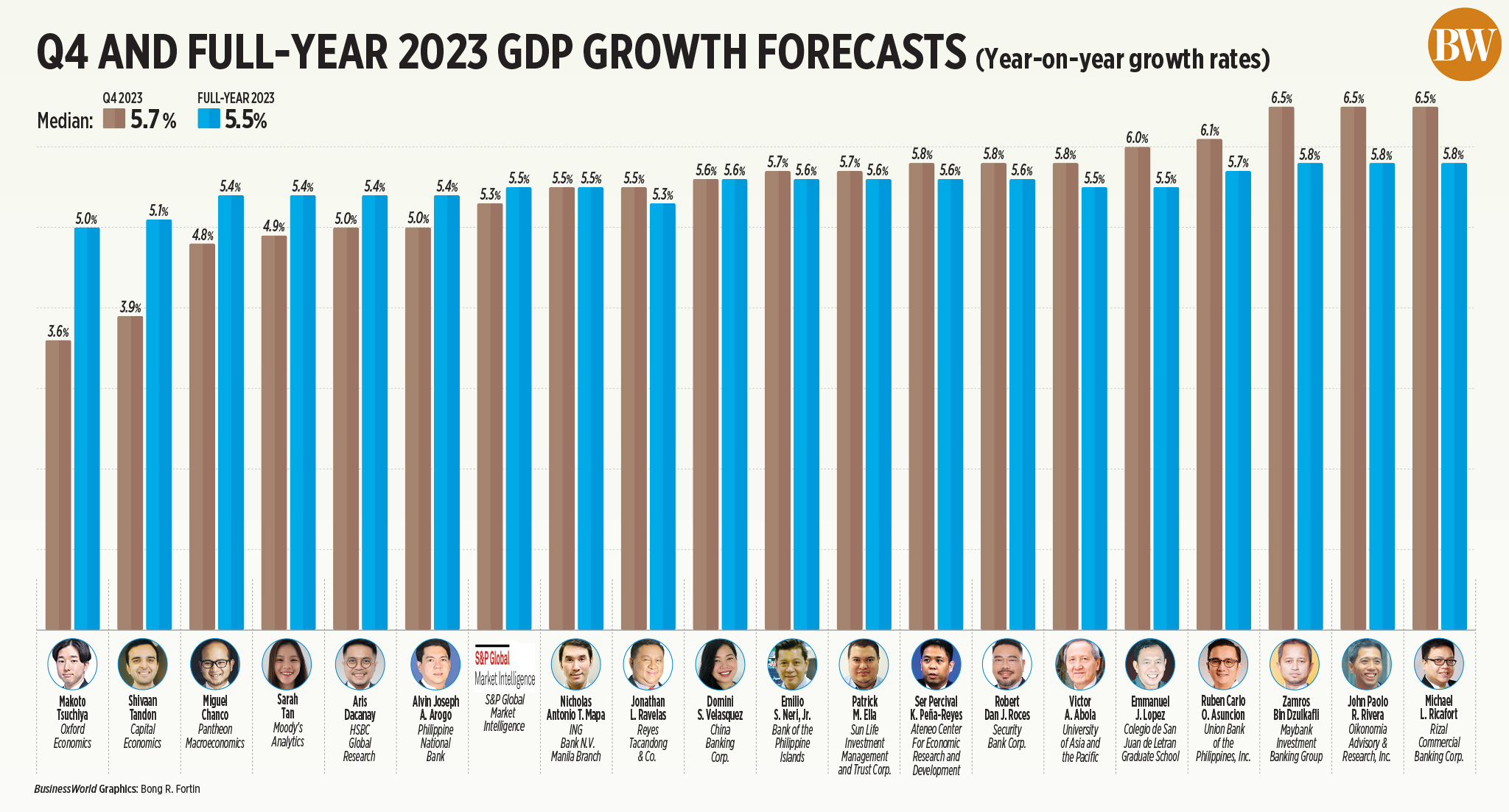
Q4 and Full-year 2023 GDP Growth Forecasts

THE PHILIPPINE ECONOMY may have slowed in the fourth quarter of 2023, which likely resulted in gross domestic product (GDP) growth falling below the government’s full-year target, according to analysts. Read the full story.

Q4 and Full-year 2023 GDP Growth Forecasts

Raize 1.0 Turbo CVT: Not-so-basic instincts

The Raize offers more than a trusted badge. — PHOTO BY DYLAN AFUANG

Toyota’s entry-level contender in the crossover segment goes beyond fundamentals

By Dylan Afuang

THAT TOYOTA builds vehicles with rock-solid reliability and sells them by the millions is now a tale that’s as old as time. In the foreground, meanwhile, consumer preference has shifted from sedans and hatchbacks to high-riding, supposedly more rugged SUVs and crossovers.

The Japanese car maker responded to that industry trend with the Raize. Derived from Toyota’s partner company Daihatsu, it’s a crossover featuring SUV-inspired looks and capabilities, matched with an exterior size and pricing comparable to that of the Vios.

We explore Toyota’s answer through the model’s 1.0 Turbo CVT variant. Going for P1.063 million, the Raize Turbo features the best the model range has to offer — chief among which is a turbocharged one-liter engine.

Since the model’s 2022 launch, Toyota Motor Philippines (TMP) has also offered the Raize in E MT (P751,000), E CVT (P851,000), and G CVT (P936,000) guises, with all three models featuring a non-turbo 1.2-liter mill.

Sporting familiar Toyota design cues, such as a triangular front grille and rear windows with black panels to appear like it “wraps” around the rear quarters, the Raize holds an aesthetic distinction above its ilk from China and South Korea.

The variant-exclusive turquoise metallic color and LED headlamps certainly enhance the car’s appearance, too. Ensuring that the Raize looks and rides over uneven terrain as close to a true off-roader as possible are the car’s upright body shape and ground clearance of 200mm. Large door apertures and raised seats grant easy access to the cabin.

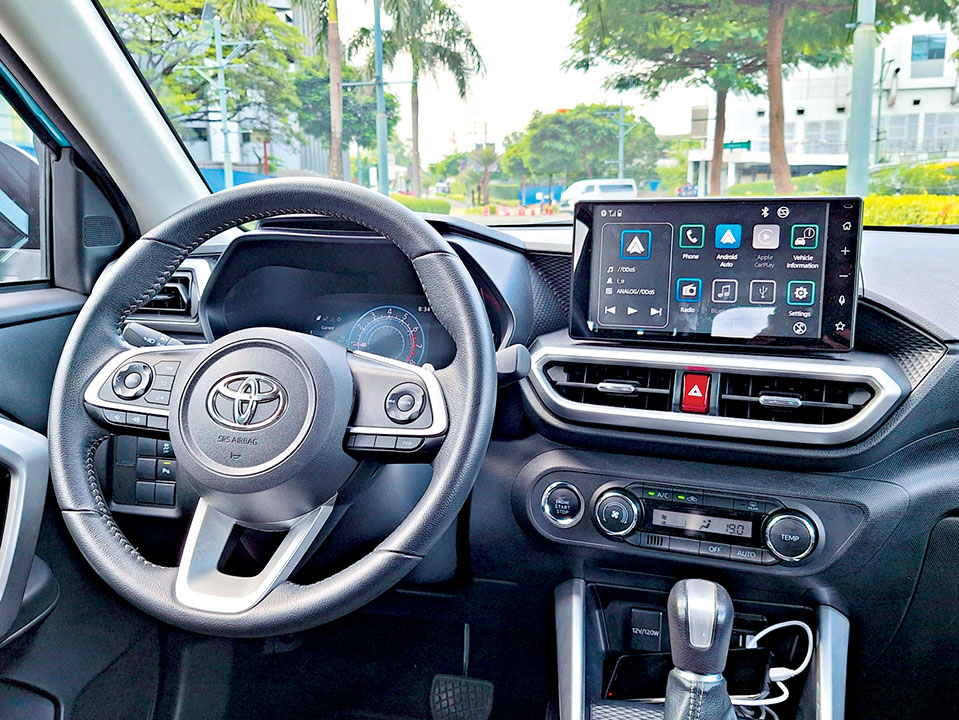
The dashboard layout is similar to that in the Wigo, Yaris Cross, Avanza, and Veloz. Controls dotted around the dashboard are easy to find and operate, and the generous amount of leg-, shoulder-, and headroom for all five occupants are matched with plenty of storage provisions, and a sizable 369-liter cargo area that can be expanded by the split-folding rear bench.

Notable equipment of the Raize Turbo includes part-leather seats, remote locking and push-button start, fully digital instruments with configurable displays, steering-wheel controls, dual USB ports, and an Android Auto and Apple CarPlay-compatible nine-inch touchscreen infotainment with six-speaker sound system.

These features compensate for the few interior foibles. The plastics used on the doors and dashboard feel low-rent, perhaps in a bid to save production costs and to lower SRP, while the seamless device input for the infotainment is not matched with crisp audio output.

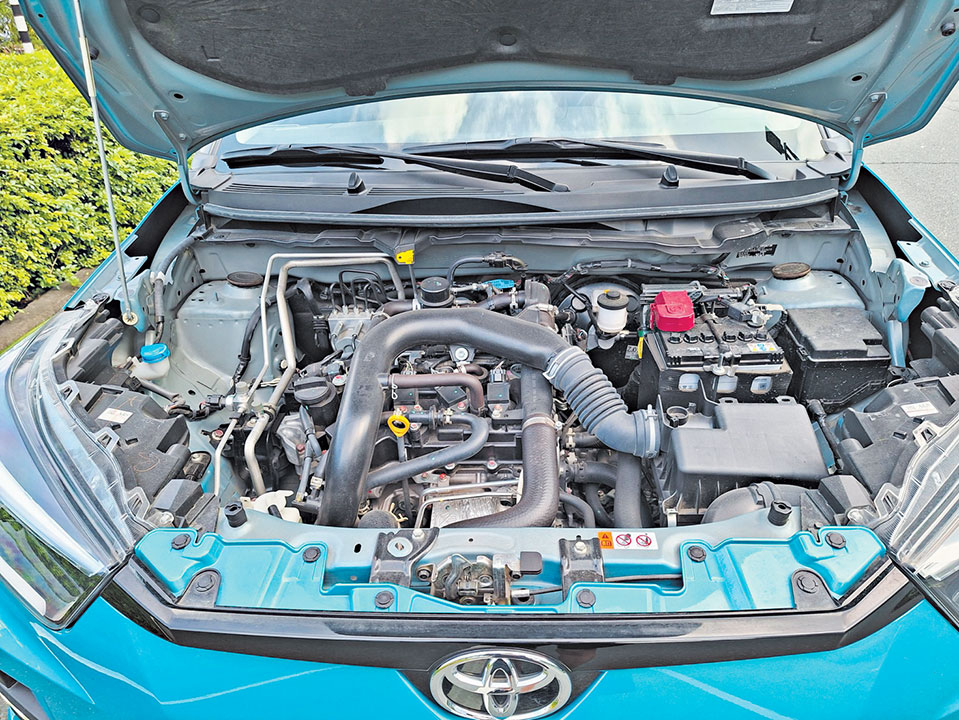
Well worth the car’s P1-million asking price is that one-liter, three-cylinder mill sourced from the Wigo, but with a turbocharger bumping the output to 97hp and 140Nm of torque. Mated to a CVT that drives the front wheels, engine performance is adequate — not breakneck as the “turbo” moniker would suggest — for pretty much any driving condition.

What the turbo and smooth gearbox do are assist the engine gain and maintain speed easily, so as to achieve fuel economy figures of above 10kpl in the city and almost 20kpl on the highway. “Easy” also encapsulates the Raize’s driving dynamics, helped by a light steering feel, good visibility outward the expansive windows, and a relatively fine ride and acceptable NVH levels.

On top of parking sensors, the Raize Turbo has blind-spot and front-clearance sensors that sound an alert when motorbikes or people enter the vehicle’s blind areas. This variant is also outfitted with side air bags, while standard on all Raize models are stability control and hill-start assist.

Commercial success didn’t meet the Raize just because it’s a crossover and of Toyota’s stellar reliability record. If its Turbo variant is any indication, the vehicle’s merits, such as decent levels of performance and equipment, make it an acceptable product of the times.

The Maharlika strategic investment fund: Starting with credibility through The Peterson Institute Governance scorecard for SWFs

BW FILE PHOTO

(Part 6)

“A journey of a thousand miles begins with a single step.” — Lao Tzu

My previous column (https://tinyurl.com/2xbm8mtk) detailed the 24 Santiago principles, or, more specifically, the generally accepted principles and practices (GAPP), to which 15 sovereign funds have signed to commit to such principles and reported the progress of their implementation in a 2014 report.

With the theme of “Reflecting on 15 Years of the Santiago Principles,” the International Forum for Sovereign Wealth Funds (IFSWF) conference 2023 in Madrid affirmed the need to continue and strengthen adherence to the principles, and is worth repeating here:

• Sovereign wealth funds are becoming increasingly professional organizations, competing effectively alongside private-sector counterparts on world markets.

• Markets will always be skeptical about the presence of state capital. Hence, in the current geopolitical environment, there is greater scrutiny of the governance of sovereign wealth funds and the professionalism of their investment teams.

• Sovereign wealth funds have written and adopted the Santiago Principles to ensure their capacity as global investors. The consistency of this implementation is what provides certainty for third parties and has enabled the Principles to enter the realms of so-called soft law.

• Good governance is a work in progress, and a culture of good governance has to be built. The Santiago Principles are a compass to guide our members … improve their governance processes and disclosure.

As recommended in the previous column, a more comprehensive approach should be guided by a governance scorecard that incorporates both the Santiago principles and the scorecard for sovereign funds by The Peterson Institute for International Economics (PIIE).

This column continues with a more detailed discussion of the PIIE scorecard.

THE PIIE SCORECARD
The initial PIIE scorecard was part of the PIIE Policy Brief by Allie Bagnall and Edwin Truman (“Progress on Sovereign Wealth Transparency: An Updated SWF Scoreboard,” August 2013). Starting from a scorecard first developed by Truman in 2007 and subsequently refined, it also reflects the works of other scholars on SWF governance such as Sarah Stone and Edwin Truman (“Uneven Progress on Sovereign Wealth Fund Transparency and Accountability,” 2016), and Diego Lopez (“Governance, Sustainability & Resilience Scoreboard for Sovereign Wealth Funds and Public Pension Funds,” 2020).

The PIIE scorecard is an improvement over the Lindburg-Maduell Transparency Index for SWFs associated with the Sovereign Wealth Fund Institute. It has also been assessed as strongly correlated, with a “high level of significance,” with similar indexes such as the Revenue Watch Institute’s Resource Governance Index and Transparency International’s 2012 Corruption Perceptions Index.

The Peterson scorecard has 33 indicators in four categories: structure, governance, transparency and accountability, and behavior.

Structure. The structure category contains eight elements that describe the legal basis of the fund and how it is funded and used: Objective stated, Legal framework described, Clear procedure for changing the fund’s structure, Investment strategy described, Source of funding stated, Use of fund earnings stated, SWF operations Integrated with other government policies, and,  SWF resources separated from international reserves

Governance. The governance category contains seven elements that describe how the fund operates: Role for government defined, Role for governing body defined, Role for managers defined, Investment decisions made by managers, Internal ethical standards specified, Guidelines for corporate responsibility established, and, Guidelines for ethical investment stated.

Transparency and accountability. The transparency and accountability category groups 14 elements covering the fund’s presentation of information to the public: Discloses investment categories, Discloses use of benchmarks, Discloses use of credit ratings, Discloses holders of mandates, Discloses size of fund, Discloses returns on investments, Discloses location of investments, Discloses specific investments, Discloses currency composition of investments, Publishes annual reports, Publishes quarterly reports, Conducts regular audits, Publishes audits, and, Conducts independent audits.

Behavior. The behavior category contains four operational elements: Reports risk management policies, Reports policy on use of leverage, Reports policy on use of derivatives, Discloses policy on adjusting portfolio.

SCORECARD HISTORY
The first PIEE scorecards in 2009 covered only 18 countries (Norway was not yet covered). The 2012 scorecard covered 49 SWFs — with Norway scoring highest at 98 — and nine pension funds — with the California Public Employees Retirement Systems (CALPERS) scoring highest at 95.

The 2019 scorecard covered 64 funds with an average score of 66. Not surprisingly, the Norwegian Pension Fund-Global scored a perfect 100, followed by New Zealand Superannuation Fund, and the Wyoming Mineral Trust Fund. Notably, developing countries with excellent scores include Chile (92), Azerbaijan (the Azerbaijan State Oil Fund, 92) and newcomer Timor-Leste (91).

DESIRED RESULTS
The gold standard for the Peterson scorecard is, of course, Norway. As demonstrated by Azerbaijan, Chile, and Timor-Leste, a very high score is achievable. A score in the mid-70s would be a good target for the Maharlika Fund, at par or better than the Asian funds existing for at least a decade.

RECAP
A consolidated matrix of the Peterson scorecard and the Santiago principles combines the best of both and covers the missing parts in each. A gap analysis should then drive the formulation of the board policies, committee charters, governance manuals, operating procedures, etc. to address the gaps between the desired parameters and the starting point.

The Maharlika Fund will not be starting from scratch, as it can draw upon the various issuances by the GCG, also known as the Governance Commission for Government-owned and/or -controlled corporations (GOCCs). Since its creation by RA 10149 (the GOCC Act of 2011), the GCG has already produced substantive guides for GOCCs, such a Governance Manual (2012), a Governance Scorecard (2015), Guidelines on Integrated Reporting System (2014) and a Performance Evaluation System (2023).

In addition, the “tuition fee” already paid by the dozens of sovereign funds established much earlier means we can apply the lessons from their experience and mistakes, translating to a steeper learning curve.


Alexander C. Escucha is president of the Institute for Development and Econometric Analysis, Inc. (IDEA), and chairman of the UP Visayas Foundation, Inc. He is a fellow of the Foundation for Economic Freedom and a past president of the Philippine Economic Society. He wrote the handbook on the Overview of the Banking Industry for the Bankers Association of the Philippines’ 60th anniversary in 2014. He is an international resource director of The Asian Banker (Singapore).

alex.escucha@gmail.com

Filinvest subsidiary plans to boost capacity of Mindanao solar project

STOCK PHOTO | Image by Pixabay from Pexels

FILINVEST Development Corp. (FDC), through its subsidiary, has announced plans to increase the capacity of its solar project in Misamis Oriental to 19.78 megawatts (MW) from the initial 11.5 MW following feasibility studies.

FDC Green Energy Corp. (FDCGEC), a wholly owned subsidiary of FDC Utilities, Inc. (FDCUI), has identified ways to maximize the output of the solar project, Filinvest said in an e-mailed statement on Sunday. FDCGEC has secured a 25-year solar energy operating contract from the Department of Energy (DoE).

“We are excited to share the positive outcome of our feasibility studies, which have paved the way for the expansion of our first solar power project in Mindanao,” said Juan Eugenio L. Roxas, president and chief executive officer of FDCUI, the utility arm of FDC.

The solar project, situated at the Philippine Veterans Investment Development Corp. (Phividec) Industrial Estate in Misamis Oriental, involves the installation of over 34,000 monocrystalline solar panels, capable of supplying 30,450 megawatt-hours of energy annually to the grid.

The Phividec Industrial Estate is the largest industrial estate for light industries in the country, managed by the Phividec Industrial Authority, a government-owned and controlled corporation.

FDCGEC has expanded its land lease agreement with the Phividec Industrial Estate, adding 7.2 hectares of land to the existing 11.65 hectares allotted for the project.

The company said that the solar project can prevent more than 21,000 tons of carbon dioxide annually upon completion, “which will help PHIVIDEC locators reduce the environmental impact of industrial operations while utilizing a sustainable and cost-effective energy solution.”

FDCGEC has secured necessary permits and is undergoing a system impact study by the National Grid Corporation of the Philippines to assess the potential impact of adding energy sources to the grid. — Sheldeen Joy Talavera

OFBank may offer digital loans

OFBANK.COM.PH

LAND BANK of the Philippines (LANDBANK) is looking at offering digital loans through its digital arm Overseas Filipino Bank (OFBank).

“We are actually considering that (digital loans). We’re looking at it. As of right now, the loans of OFBank are mostly salary loans. But we are taking a serious look and making sure first that we have the proper risk framework, because that’s something a lot of digital banks are struggling with,” LANDBANK President and Chief Executive Officer Lynette V. Ortiz told reporters on the sidelines of a central bank event on Friday.

The bank is targeting to have the study done within the first six months of the year, Ms. Ortiz added.

“You have a deposit base, you have funding, but you also have to be very circumspect around how you’re going to roll out loans and just make sure that you have the proper risk management framework in case,” she said.

“We’re really looking to put more legs in terms of the strategy for OFBank,” Ms. Ortiz added.

OFBank currently offers three loan products.

OFBank is a subsidiary of LANDBANK and is the official digital bank of the government.

It is one of the six Bangko Sentral ng Pilipinas (BSP)-licensed digital banks in the country.

In the third quarter of 2023, LANDBANK’s net income rose by 24% year on year to P31.85 billion amid higher loans and yields from its investments. This made up 90.9% of its P35-billion profit target for the year. — AMCS

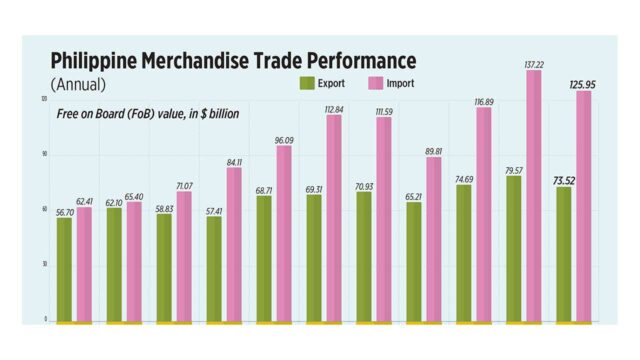
Philippine Merchandise Trade Performance (Annual)

THE PHILIPPINE trade deficit widened in December from the previous month after exports declined to the lowest in more than two years, while imports continued to fall for the second straight month, the Philippine Statistics Authority (PSA) said on Thursday. Read the full story.

Philippine Merchandise Trade Performance (Annual)

Chery Auto Philippines grows 64% in 2023

IMAGE FROM CHERY AUTO PHILIPPINES

CHERY AUTO PHILIPPINES (CAP) concluded 2023 with healthy growth of 64% versus its 2022 sales performance. CAP recorded total sales of 3,600, cornering 1.2% share of the passenger vehicle segment.

“This previous year was a challenge for the automotive industry as the competition becomes tougher with more and more players especially China brands coming in. We attribute our success last year to the attractive sales and marketing promotions, flexible financing offers extended by our bank partners and the increasing confidence of the market toward our vehicles and after-sales support,” Chery Auto Philippines Managing Director Froilan Dytianquin said.

The Tiggo 5 was CAP’s sales driver last year with 1,851 units sold. Year on year, Tiggo 5 sales significantly increased by 169% compared to 2022, maintaining its fourth place in the subcompact SUV segment with 11% market share.

Meantime, the Chery Tiggo 7 performed well in the compact SUV segment last year with 31% sales growth, selling a total of 910 units in 2023. Based on the data presented by the Chamber of Automotive Manufacturers of the Philippines, Inc. (CAMPI), the Tiggo 7 was also fourth in its class.

Midsize SUVs continued to dominate the SUV category with more than 40,000 sales in 2023 which is equivalent to 12% growth. This paved the way for Chery’s midsize SUV Tiggo 8 to register a 6% sales growth with a total of 473 units sold last year.

“As we welcome the New Year, Chery Auto Philippines remains confident as it aims to double its sales for this year. This will be triggered by the refreshed and new additions to our vehicle model lineup as well as the new Chery dealerships to rise this year,” Mr. Dytianquin added.

The ‘invisible hand’ or the ‘visible hand’?

STEFANO POLLIO-UNSPLASH

A basic economic concept I learned in school is the “invisible hand” — the metaphor Adam Smith used for the unseen forces of self-interest moving prices and production to meet at an “equilibrium point” where the demand and supply curves meet. “It is not from the benevolence of the butcher, the brewer, or the baker,” Smith wrote, “that we expect our dinner, but from their regard to their own self-interest.” Self-interest, therefore, makes markets self-correcting, self-regulating, and self-sustaining in terms of what to produce, what to charge, or how to organize distribution — as if guided by an “invisible hand.”

I explored whether the invisible hand thesis may explain why smallholders turn to illicit opium and coca cultivation in Afghanistan, Myanmar, Colombia, and Bolivia. It did not. Instead, what I found more useful was the visible hand of political entrepreneurship, interdependent relationships, and the metrics of precarity. I believe this story offers useful lessons for economists in the Philippines and elsewhere.

A dominant version of the invisible hand is embedded in claims made by various agencies tracking the illicit drug trade. In 1999, the UN Office on Drugs and Crime (UNODC) said that “prices are among the most complex indicators of markets, reflecting not only the interaction of supply and demand but also various other factors relating to quality (purity), competition, and risk.” Prices, therefore, provide market-based signals that influence the decision of producers, traders, consumers, and other actors. Hence, when drug price data is analyzed, weaknesses and vulnerabilities in the market and structure of the illicit drug economy may be identified and exploited, and thus contribute to a more effective counternarcotics strategy.

There are problems with such an approach, however. Firstly, there is an empirical anomaly — the expected higher prices triggered by reductions in supply due to tougher law enforcement have generally not emerged in practice. From 1990 to 2005, for example, researchers found that the prices of cocaine and heroin in Western Europe and the US dropped by 50% to 80%, despite intensified wars on drugs globally and the 1998 launch by the UN General Assembly of a 10-year program for a “drug-free world.” It is as if the actual market went against the so-called “law” of supply and demand. Second is the chicken-and-egg problem — are price levels a cause or consequence of movements in the supply and demand curves? I dove into actual historical cases to probe further.

The first case I examined was Bolivia. Sometime in June 1980, poor subsistence farmer Paulino Vasquez was on his way to the town of Chimore to sell the 100 pounds of coca leaves he carried on his back, worrying about wildly fluctuating prices. Paulino was interviewed by Bolivian economist Roberto Laserna. In February, Paulino got P6,000 for a similar 100-pound load (about US$240). However, in April and May, the prices dropped to about P1,500 ($60). At least, Paulino reassured himself, coca always had buyers, unlike his other crops. Moments later, a truck driver pulled up and offered P16,000 ($640) for his coca leaves. The unexpected price rise and Paulino’s windfall began what Laserna described as Bolivia’s “coca boom” of the 1980s.

In 1980, Bolivia’s economy was collapsing due to the sharp decline in the global prices of its main exports — tin and gas. Suddenly, mine workers were unemployed, foreign currency ran scarce, and debt service payments multiplied. As the financial crisis deepened, inflation started to spiral out of control — reaching a staggering 8,000% by some accounts. On top of these economic convulsions were political crises. Between 1978 and 1982, there were three general elections and 10 presidential changes — four by military coup, three by legitimate processes through Congress, and three by internal disputes in the Armed Forces.

A structural adjustment package was prescribed by international creditors led by the International Monetary Fund. Critics called it “The Brick” that was dropped on the heads of the Bolivian public. It eliminated food subsidies, canceled almost all price controls, hiked oil prices by 300%, froze government wages, cut government spending, opened Bolivia’s borders to unrestricted imports, and downsized state companies in preparation for privatization. Bolivians eligible for social security between 1983 and 1988 dropped by 61%.

As crisis after crisis and the impact of The Brick overwhelmed Bolivia, coca production, intriguingly, was expanding. Although illicit, coca-growing rapidly rose to become an alternative source of income. The lure of high coca prices induced more migration to the sparsely populated, flat, low-lying eastern provinces, which became the main coca-producing areas. Coca production significantly increased, peaking in 1986-87, thereby acting, according to another expert, James Painter, “as a huge social safety net, absorbing labor from the collapsed mining and industrial sectors, and replacing large portions of dollars previously generated by minerals, gas, and other exports.”

Both Laserna and Painter argued separately that the clandestine coca-cocaine economy facilitated Bolivia’s most radical restructuring of its economy and created the conditions necessary for structural adjustment to work — a matter that international economic experts have never acknowledged.

So, to what extent did the “invisible hand” shape outcomes? Laserna’s answer was that although global demand for cocaine played a role, the crisis conditions, he contends, primarily stimulated and initiated the coca boom. Producing coca and cocaine made sense — like an emergency measure taken because nothing else was working (like a kapit sa patalim — holding tight to the knife’s edge — strategy). He further points out that “whether they were effectively protected, or they simply knew that the possibility of repression was minimal, the illegal purchasers of coca and coca paste exerted tremendous pressure on the coca market, forcing prices to rise rapidly and thus initiating the coca boom.” Actual actors with visible hands in real markets, rather than a predetermined invisible hand of supply and demand, were the main reasons behind price changes.

It thus emerged that illicit crop markets, like it or not, bring a certain level of productivity. It can generate income that can tame crises or relieve pressures in the national economy. Most importantly, coca growing as experienced by Paulino provided predictability and reduced risks, especially because coca harvests “will always be sold.”

To conclude, it seems the “invisible hand” is only an attribution to outcomes generated by what actually are visible hands. The notion of an invisible hand becomes distorted when taken as an a priori metaphor emerging from purely theoretical deduction. Rather, it is posteriori, i.e., it proceeds from observation and experience, as Smith himself used it. It seems, therefore, that while the dynamics of supply and demand are real, whether in licit or illicit markets, there really is no “law” — it is only a suggestion.


To read the other cases, Eric D. U. Gutierrez’s open-access article on “Precarity, illicit markets, and the ‘mystery’ of prices’” is freely available in the The Journal of Peasant Studies. See https://tinyurl.com/yscslccx. He has written on corruption, governance, political families and the conflict in the Muslim areas of Mindanao. Since 2000, he has worked for three international NGOs running programs and policy advocacy in Africa, Asia, and Latin America.

CAR vegetable farmers targeted for assistance

BW FILE PHOTO

THE Department of Agriculture (DA) said it will help vegetable producers in the Cordillera Administrative Region (CAR) to raise their output, with P130 million worth of financial aid, equipment, and irrigation projects.

In a statement on Sunday, Agriculture Secretary Francisco P. Tiu Laurel, Jr. said that the assistance is designed to increase the output of highland crops.

“To further enhance the region’s output, we are turning over P417,000 worth of farm machinery to three cooperatives and associations in Mountain Province,” Mr. Laurel added.

The region produces 80% of the country’s highland vegetables.

He said that P454 million was also earmarked to fund three infrastructure projects in the area, while P13.9 million was allocated for an unspecified agriculture project. The works are set to be completed within the year.

“The assistance we’re providing will promote sustainable growth through better production, processing, marketing, and distribution of high-value crops,” he added.

Mr. Laurel said that the DA is planning to tap local government units in the region to promote crop diversification, in an effort to stabilize farmer incomes and encourage the cultivation of other crops.

“The government can also tap the abundant harvests of farmers for distribution and sale in Kadiwa centers,” he added, referring to the government-subsidized direct-from-farmers outlets.

CAR farmers earlier sought government intervention due to the low prices offered by traders for highland vegetables, forcing some of them to dump their crops.

The DA’s regional office in CAR reported that the drop in prices was due to a lack of buyers for the upland vegetables between Dec. 28 and Jan. 3.

Additionally, Mr. Laurel said that the agency has allotted P25.9 million for the rehabilitation of rice farms affected by Super Typhoon Egay (international name: Doksuri). The storm had affected 14,714 farmers in the area.

The Philippine Center for Postharvest Development and Mechanization disbursed P82.9 million worth of rice production and post-harvest equipment and facilities in Kalinga and Ifugao provinces.

Some P41.2 million worth of irrigation projects were also turned over to CAR irrigator associations, according to Mr. Laurel.

“These irrigation systems will increase yields on 195 hectares tilled by 299 farmers,” the DA said. — Adrian H. Halili

Benilde offers textile design program

THE De La Salle-College of Saint Benilde (DLS-CSB)is now offering a Bachelor in Textile Design (BTD).

“BTD aims to champion textile innovations rooted in Filipino culture and heritage with a multidisciplinary approach. It is a radical paradigm that considers the ecological, cultural, social, and economic impacts in a way that will not compromise the needs of future generations,” says a press release.

The undergrad program is made up of fundamental courses that will equip students with advanced knowledge, technical skills, and sustainable business essentials. Classes will cover experiences from design conceptualization, until the production processes.

Students will have access to the Design + Arts Campus’ laboratories dedicated to Computer-aided Drafting and Design (CADD), Cloud-based Infrastructure, Industrial Design, Textile, Architecture, and Sewing.

Print and digital materials are likewise available through the Br. Fidelis Leddy Center for Learning Resource, which also covers subscriptions to the global trend forecast WGSN and design authority Material ConneXion.

Students will also have access to the laboratories of the Department of Science and Technology (DoST) Philippine Textile Research Institute (PTRI), as well as the Museo Negrense De La Salle in Bacolod, which houses a large collection of international textiles.

Graduates may pursue careers as textile designers and fabric technologists, to textile engineers, technical consultants, and haute couture textile developers. They may delve into the craft sector as weavers, embroiderers, knitters, printmakers, and illustrators or in design studios as creative directors, colorists, trend forecasters, and trend analysts.

Applicants for the course’s first term of Academic Year 2024 to 2025. It will run for 10 trimesters, which include electives, capstone projects, as well as practicum training.

For more information, visit https://www.benilde.edu.ph/undergraduate-textile-design/.

CTA affirms ruling granting part of Ginebra San Miguel’s refund claim

CTA.JUDICIARY.GOV.PH

THE Court of Tax Appeals (CTA) has affirmed its ruling, granting part of Ginebra San Miguel, Inc.’s (GSMI) refund claim for wrongly paid excise taxes on distilled spirits, totaling P319.76 million for the period from Jan. 1 to May 31, 2013.

In a 26-page decision dated Jan. 18, the CTA full court upheld its previous finding that GSMI demonstrated paying excise tax twice on raw materials and finished liquor products, amounting to P319.76 million.

“The imposition of excise taxes on the finished liquor products manufactured from tax-paid ethyl alcohol is contrary to law,” said Associate Justice Marian Ivy F. Reyes-Fajardo in the decision.

GSMI initially sought a total refund claim of P715.26 million for its excise tax liabilities.

The tax court disallowed the remaining amount due to GSMI’s failure to include the in-transit ethyl alcohol, measuring 4,063,500 proof liters, in its claim. This alcohol was in transit to its factory during a year-end inventory count.

“Notably, GSMI acknowledges that it failed to include the in-transit volume in its petition, as well as in its administrative claim,” the CTA noted.

“All in all, there is no reason for us to deviate from the Court in Division’s (Third Division) conclusion.” — John Victor D. Ordoñez

ADVERTISEMENT
ADVERTISEMENT