Home Blog Page 3693

Award-winning documentary centers on children with cleft palates

ONE in 700 babies is born with cleft lip or cleft palate, which means the affected child has difficulty eating, breathing, and speaking. In the Philippines, one in 500 babies is born with the condition.

The HollyShorts-winning 35-minute documentary Every Day After offers a focused view on life with this condition within that larger context.

It follows Jary, a boy who was neglected and shunned by his own parents because of his appearance, and Jessa, his older sister who protects and raises him in their stead. Watching their story unfold is undoubtedly an important lesson on the realities of cleft treatment.

For Emmy-winning American director Elisa Gambino, the appeal of Jessa and Jary’s story goes beyond its educational value — it is also a beautiful testament to the power of a loved one.

“It was a profound honor to direct this film and share Jessa’s masterclass in unconditional love,” she said in a video message at the premiere screening on Jan. 31 in Power Plant Mall, Makati City.

“Through our film, we shed light on the daily challenges faced by a boy who is seen as imperfect and share the resilience, struggles, and triumphs of Jary and Jessa,” said Ms. Gambino.

Every Day After, filmed in black and white, is as much about Jessa as it is about Jary, depicting her unwavering dedication as a sister who raises him alongside her own two children in a fragile house on a hill.

“There’s a reason I decided to film it in black and white,” said Neal Broffman, the film’s cinematographer and editor.

The choice was inspired by a 1940s photo essay in Life Magazine called “Country Doctor” by W. Eugene Smith. “[The photographer] spent a year in a community in Colorado, following a doctor who sees his patients. I wanted to emulate that classic, black-and-white documentary style,” Mr. Broffman explained.

As the world’s largest cleft-focused organization, Smile Train saw the value in supporting the documentary, which began production in 2022. While the charity group provides training, funding, and resources in over 75 countries to provide 100%-free cleft surgery and other forms of essential cleft care, more can still be done to spread awareness in the Philippines.

Smile Train has supported more than 80,000 cleft surgeries, as well as the delivery of vital non-surgical cleft care, over the past 20 years. With Every Day After gaining attention, the goal is to inspire meaningful conversations about the availability of cleft treatment.

“Clefts are one of the most common birth conditions, but many parents do not realize that they are treatable — babies and children with clefts can lead healthy, fulfilling lives,” said Jun Grimares, Smile Train’s program director for the Philippines, at a panel discussion after the premiere screening.

He added that future educational screenings of the documentary will help attract donors and sponsors who could make monetary contributions.

“At Smile Train, we aim to make comprehensive cleft care treatment more accessible to patients, and this documentary helps create that awareness that help is available,” Mr. Grimares said.

After the screening, the film’s producer, Elaine Bobadilla, told BusinessWorld that it wasn’t easy putting together the documentary with the American film crew due to various logistical hurdles.

Jessa and Jary, for instance, were not the first choice of subjects for the documentary.

“It was serendipitous. We followed different families at first, and it just so happened that every time we visited some of them, there were hindrances, like the baby in the family would be sick. It all fell into place that we came to focus on Jessa and Jary,” Ms. Bobadilla said.

She explained that she and the filmmakers were drawn to the unconditional love between the siblings.

“Sometimes it’s the people whom no one imagines of who can do the things no one can imagine. That’s the unique type of love story we thought was worth sharing to the rest of the world.”

Every Day After provides a nuanced look at the complexities of the healing process for cleft lip and palate patients, from the health inequity they must overcome to the strength and empathy of their families and communities.

For more information on Smile Train, visit smiletrain.ph. —  Brontë H. Lacsamana

It’s time to celebrate the nanny state, not apologize for it

TARA CLARK-UNSPLASH

The phrase “nanny state” used to be one of those automatic argument-winners, like “freedom and democracy” and “you sound like Hitler.” Nobody wants to be treated like an infant, let alone like an infant that is tied to the government’s apron strings.

The phrase is losing some of its power in the UK. Labor leader Keir Starmer recently proclaimed that he would not be deterred from launching his “child health action plan” (which includes supervised tooth brushing at school) by accusations of nannyism. Prime Minister Rishi Sunak is pushing ahead with plans to ban the sale of disposable vapes (which are favored by children) and phase out smoking by 2050 despite complaints from the libertarian right of his party or its amen corner at the Institute of Economic Affairs.

But the important modifier up there is “some.” The government has shied away from taking on the food and supermarket lobby that continues to stuff us with all sorts of noxious additives. Starmer’s health plan only devotes a few lines to the all-important question of obesity despite the fact that highly addictive foods of various kinds — either ultra-processed and/or soaked or coated in fat, sugar, and salt — make up half of our meals in the UK. Even before Starmer had spoken, party newspaper Labour List raised the problem of snobbery: Starmer risked coming across as a middle-class do-gooder (he lives in Islington), who wants to deprive working-class citizens of their right to eat chip sandwiches and fried Mars Bars.

It’s time to forget about such worries and embrace — nay celebrate — the Nanny State. Ban fast-food advertising before 9 p.m.! Increase taxes on sugary drinks and processed food! Put on a national exercise campaign! And boast about the fact that you are doing it!

The phrase “nanny state” has only ever been used to crush common sense and block social progress. The term was coined by the Tory MP Iain Macleod who used it to demonize the Labor government’s plans to introduce a 70-mile-an-hour speed limit. Since then, the limit has saved thousands of people from horrific death in a ball of fire and metal. The term was then used to demonize a succession of life-saving and health-enhancing policies — banning tobacco advertising, banning smoking from underground trains or offices, cracking down on drunk driving. If you haven’t been accused of nannyism, you haven’t done your bit to improve public health.

The idea that the nanny state is a bad thing rests on the assumption that individuals are isolated, rational entities, who are the best judges of their long-term interests. This has never been a remotely realistic view of human nature. Contrary to libertarian propaganda, founders of modern liberalism such as Adam Smith and John Stuart Mill recognized that human beings are social creatures who can be deceived about their own interests. But now in the age of the welfare state and preference-shaping algorithms, the rationalist view has gone from unrealistic to absurd.

The British state provides (or tries to provide) its citizens with all sorts of cradle-to-grave benefits: healthcare, education, old-age pensions, law and order, and, if you’re over 60, goodies such as free and subsidized transport. Have a heart attack and an ambulance will come (eventually). Get lost on a mountain, and rescuers will arrive.

Given all this, it’s only reasonable that the state should take an active interest in the lives of people it has to care for — that it should be a nanny rather than just a sugar daddy. And by the state, I don’t mean an abstract entity, still less a terrifying goblin. I mean the British people in their collective capacity. People who overeat while taking no exercise are not just harming themselves; they are imposing a cost on the rest of the population. A responsible state has to strike a balance between the rights of the individual and the rights of the rest of us.

Today more than a quarter of Britons, and more than a fifth of 10 to 11-year-olds, are classified as obese. Obesity is linked to all sorts of other health problems such as diabetes, cancer, and arthritis; 16% of the labor force report that they suffer from long-term health problems. Ignoring the country’s health crisis on the grounds that you dislike nannying is thus doubly irresponsible — irresponsible to the mass of people who rely on the NHS if they fall sick or have an accident, and irresponsible to future generations who will inherit a broken health system if the government does not address the problem.

What about individual responsibility? Conservatives kvetch that the Nanny State robs us of the freedom to make our own decisions and our responsibility for the consequences of those decisions. This argument not only fails to address the problem of the unintended consequences of other people’s decisions (for example, the safe driver who is injured by a reckless drunk). It fails to address the way that powerful people can shape our choices.

Big business has long been able to call on the power of a vast advertising industry that encourages us to give into our basic instincts. It can now also call on the power of the high-tech industry that has invented smart phones that accompany us everywhere and services that know our innermost secrets. Recommendation algorithms know what we like and tell us how to get more of it. Newsfeeds reinforce our prejudices and whip up our emotions. The Nanny that we need to fear today is not the Nanny State. It is the Nanny Tech Company in Silicon Valley that is in the business of telling us what to want and when.

The critics of the Nanny State are right to worry about the loss of freedom. Freedom is not only a good in itself but also a key to economic progress. They are also right to be worried about encouraging dependence on the state, which can rob us of our dignity while also rendering us both needy and sluggish.

But the biggest threat to freedom these days does not come from a state that is elected by the people and subject to all sorts of oversight. It comes from a rapacious corporate world that has more power over our preferences than any world has ever had before. And it comes from people who keep indulging their appetites and hoping for the best. What sort of freedom do we lose if greedy companies are prevented from advertising junk food before 9 p.m.? What sort of freedom do we have if we spend decades dependent on the state because we became obese when we were young?

We should stop apologizing for the Nanny State as an unfortunate limitation on freedom and start recognizing it for what it is: a chance to improve our lives and free ourselves from the overweening power of big companies and base appetites.

BLOOMBERG OPINION

DFNN board OK’s increase in authorized capital stock to P1 billion

THE BOARD of listed gaming technology company DFNN, Inc. has approved an increase in its authorized capital stock to P1 billion.

In a stock exchange disclosure on Monday, DFNN said that its board approved on Feb. 2 an increase in its capital stock to P1 billion from P500 million.

Following this approval, the company will issue up to 500 million common shares as a subscription to the increase.

“The amendments will increase the authorized capital of DFNN which will allow DFNN to issue additional shares to potential investors,” the company said.

In a separate disclosure, DFNN said the Bureau of Internal Revenue issued on Jan. 19 the certificate authorizing registration (CAR) for the sale of its subsidiary Nico Bayan, Inc. to Double Crown Holdings Corp.

According to the DFNN, the issuance of the CAR effectively transfers the ownership of Nico Bayan to Double Crown Holdings.

The CAR is needed to finalize the disposition of shares.

Nico Bayan is a company that develops software solutions.

In September last year, DFNN’s board authorized the sale of Nico Bayan to Vanguard Investments for P2 million. Vanguard Investments then assigned any and all of its rights to purchase shares of Nico Bayan to Double Crown Holdings.

The company said the deal seeks to streamline its current technology operations reporting, focusing on revenue generation and optimizing wholly owned resources and improving overall profitability.

Shares of DFNN rose improved by eight centavos or 2.68% to P3.07 each on Monday. — Revin Mikhael D. Ochave

DMCI Homes teams up with Marubeni for Pasig project

The Valeron Tower will soon rise along the C-5 Ortigas Corridor in Metro Manila. — COURTESY OF DMCI HOMES

DMCI Homes and Japanese conglomerate Marubeni Corp. have unveiled a new residential condominium development in Pasig City.

The Valeron Tower will soon rise along C-5 corner P.E. Antonio Street in Pasig City.

“Elegantly designed with exquisite living spaces spread across an expansive floor area, The Valeron Tower aims to offer residents sophisticated living along one of the metro’s newest growth corridors,” the Consunji-led developer said in a statement.

The condominium offers studio, one-, two-, and three-bedroom units ranging from 32.5 square meters (sq.m.) to 91 sq.m.

“The Valeron Tower is competitively priced, starting from P7.62 million, delivering value for money for future unit owners,” DMCI Homes said.

The resort-inspired condominium offers several amenities such as a lawn, two pools, an entertainment room, and a basketball court — all located on the seventh floor. A third pool is located on the roof-deck, alongside a Sky Lounge.

The ground floor will feature al-fresco commercial establishments and a convenience store.

The Valeron Tower is located less than 10 minutes from Bridgetowne commercial complex, Arcovia City, Parklinks, and Eastwood City. It is also a few minutes from the planned Rosario Station of the Metro Rail Transit Line 4 and the Ortigas Station of the Metro Manila Subway.

The Valeron Tower is a joint venture between DMCI Homes and Marubeni.

PHL likely achieved end-2023 payments digitalization target

BW FILE PHOTO

The Bangko Sentral ng Pilipinas (BSP) is confident that the country has achieved its target to digitize 50% of retail transactions by end-2023 and is now ready for the next phase of its 2024-2026 Digital Payments Transformation Roadmap.

“I believe we reached our 50% target by the end of 2023,” BSP Deputy Governor Mamerto E. Tangonan was quoted as saying in a statement on Monday.

“In 2013, we started with a mere 1% share of digital to total retail payments. Fast forward to 2022, and we saw a whopping 42.1% share in digital retail payments transactions,” he added.

The continued growth of digital payment technologies will help facilitate the delivery of financial services to unbanked Filipinos and micro, small, and medium enterprises, the BSP said.

Based on the 2022 Status of Digital Payments report of the BSP, the share of online payments in the total volume of retail transactions rose to 42.1% in 2022 from 30.3% a year earlier.

Transaction volume stood at 4.85 billion in 2022, with those done via digital platforms totaling 2.04 billion. The top contributors for the increase in volume were merchant payments, person-to-person transfers, and salaries and wage payments.

To help boost the adoption of digital payments, the BSP launched the Paleng-QR Ph program in November 2022, which aims to maximize the use of online payments in markets and tricycle hubs through the QR Ph initiative.

QR Ph is a national QR or quick response code standard for digital payments to make transactions interoperable and convenient for merchants and consumers.

The BSP also launched Bills Pay Ph in 2022 “to unify the country’s fragmented bills payment system and allow users to pay their bills whether or not they have an account with their billers’ payment service provider.”

Bills Pay Ph is also expected to help streamline financial processes and serve those with or without access to financial services.

“Through these digital payment facilities, an even greater portion of the population can now actively participate in the formal economy,” the BSP said. — K.B. Ta-asan

Will AI mean the death of music, or herald a new era of creativity?

JONATHAN VELASQUEZ — UNSPLASH

By Alessandro Parodi,Olivier Sorgho and Matt Stock

GDANSK/LONDON — Inside a recording room at Queen Mary University of London, a group of researchers fiddle with novel artificial intelligence (AI) tools to develop what they call the “new virtual worlds” of music.

Andrea Martonelli and Max Graf are among more than 30 doctoral students working with Dr. Mathieu Barthet, a senior lecturer in Digital Media, to explore computational creativity and generative AI. Together, they have set up a futuristic studio where music meets cutting-edge tech.

“It’s like extended reality, XR, is a way of extending the physical reality that we live in,” Mr. Graf told Reuters while showcasing “Netz,” his virtual instrument.

Netz is played through an augmented-reality headset that tracks gestures to create corresponding outputs, like notes or chords.

Mr. Martonelli plays the “HITar,” an advanced guitar with AI sensors, which reads his movements to make drum and synthesizer sounds.

While the presence of AI in music-making can be traced back to the 1950s, recent groundbreaking advances in generative AI, with robots now making music as digital pop stars, have divided opinions in the industry.

Made popular last year by the ChatGPT language system, generative AI can create content including original sounds, lyrics, or entire songs on its own, but artists often use simpler AI to enhance their sound.

United Kingdom (UK) alternative rock singer-songwriter YUNGBLUD told Reuters he believes AI could help his music go “to another direction.” Other musicians worry that the technology could go too far.

“I feel if you need AI to help me write a song, especially when it’s for a likeness, that’s not cool,” Amy Love from alternative rock duo Nova Twins said, referring to artist’s voices being artificially generated and adding that using dead artists’ voices is “not on.”

In November, the Beatles released “Now and Then,” billed as their last song and featuring the voice of John Lennon extrapolated with AI from an old recording. Warner Music said in November it was partnering with the estate of deceased French singer Edith Piaf to re-create her voice using AI.

While labels and streaming companies partner to market the technology, many experts say AI raises legal and ethical concerns.

“Unlawful development is what would put the sort of opportunities of generative AI at risk,” said Abbas Lightwalla, director of global legal policy at the International Federation of the Phonographic Industry (IFPI).

But regulation of generative AI is only in its early stages.

“I think AI can have its place in the music production chain, again if it’s guided in the right way and if we ensure that the musicians keep a certain amount of control, and performers as well,” said Dr. Barthet.

“But there might be situations where (AI) generated music works for new things that have not even emerged yet, new virtual worlds.” — Reuters

Growth forecasts vs actual growth, and agriculture performance

Among the important reports published in BusinessWorld is the quarterly poll of economists and analysts on their GDP growth forecast, reported few days before the Philippine Statistics Authority (PSA) releases the official GDP data. This is on top of the monthly poll of the same group of economists and analysts for the monthly inflation rate forecasts.

I checked the infographics and reports on the quarterly GDP growth forecast polls for all four quarters of 2023 and came up with an analysis.

The forecasters are the chief economists of banks and consulting firms or one of the faculty members of academe. They are from banks, consulting and finance firms, and the academe.

The organizations were: Bank of the Philippine Islands (BPI), Banco de Oro (BDO), China Banking Corp. (CBC), ING Bank NV, Maybank Investment Banking Group, Philippine National Bank (PNB), Rizal Commercial Banking Corp. (RCBC), Security Bank Corp. (SBC), Standard Chartered Bank (SCB), Union Bank of the Philippines (UBP) for the banks; ANZ Research, Capital Economics, HSBC Global Research, Moody’s Analytics, Nomura, Oikonomia Advisory & Research, Inc., Oxford Economics, Pantheon Macroeconomics, Ravelas (eManagement for Business, later Reyes Tacandong & Co.), S&P Global, Sunlife Investment Management & Trust Corp., for the consulting and finance firms; and, the Asian Institute of Management (AIM), Ateneo Center for Economic Research and Development (ACERD), Colegio de San Juan de Letran Graduate School, De La Salle University (DLSU), University of Asia and the Pacific (UA&P), and the University of the Philippines School of Economics (UPSE) for the academe.

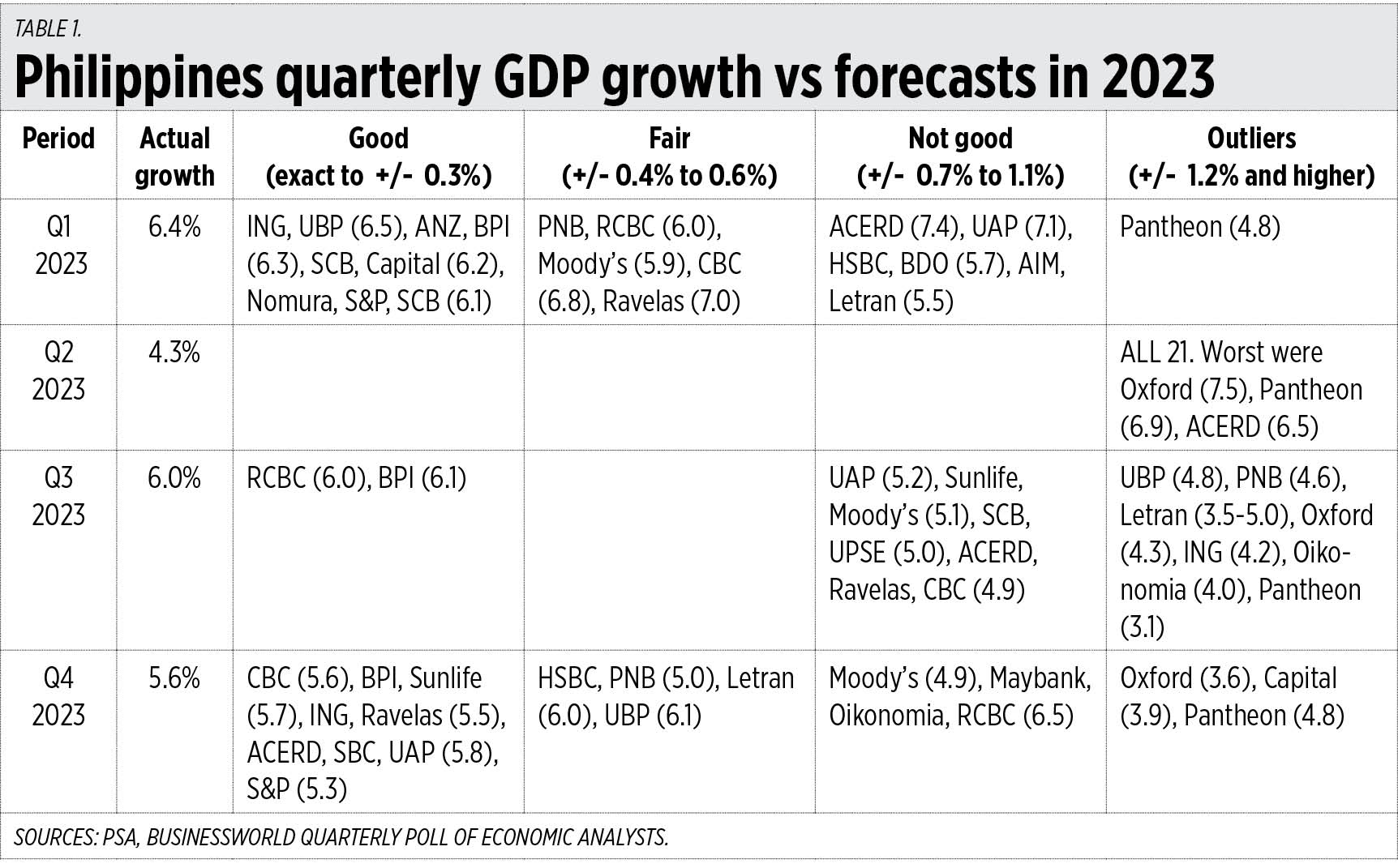
I created a category based on how near or how far the forecasts were from the actual growth, represented by “plus or minus” (+/-). “Good” forecasts are those with an exact number and those +/- 0.3%. “Fair” forecasts are those with +/- 0.4% to 0.6% from the actual GDP. “Not Good” are those with +/- 0.7% to 1.1%, and “Outliers,” or far out forecasts, are those +/- 1.2% or higher.

Not all economists and analysts participated in the quarterly poll, some participated in Q1, but not in Q2 or Q3, but on average, 21 to 23 analysts join the quarterly poll.

Q2 of 2023 is notable because all the analysts were wrong and gave outlier forecasts. Q1 and Q4 had many analysts forecasting correctly (see Table 1).

So the best forecaster is BPI’s Emilio “Jun” Neri, with three out of four forecasts that were good. Congrats Jun and the team, you are brilliant. The organizations with the greatest number of outlier projections are Pantheon (4 of 4, with no good forecast) and Oxford (3 of 4).

This exercise shows that in general, human action and reaction to certain natural and social changes are still far from being accurately predicted by humans and trained professionals, no matter how elaborate and modern the mathematical models and tools they use are. That is why government and multilaterals’ central planning, one-size-fits-all policies are likely to produce more harm and disaster than the stated goals.

3 MEASUREMENTS OF AGRICULTURE PERFORMANCE
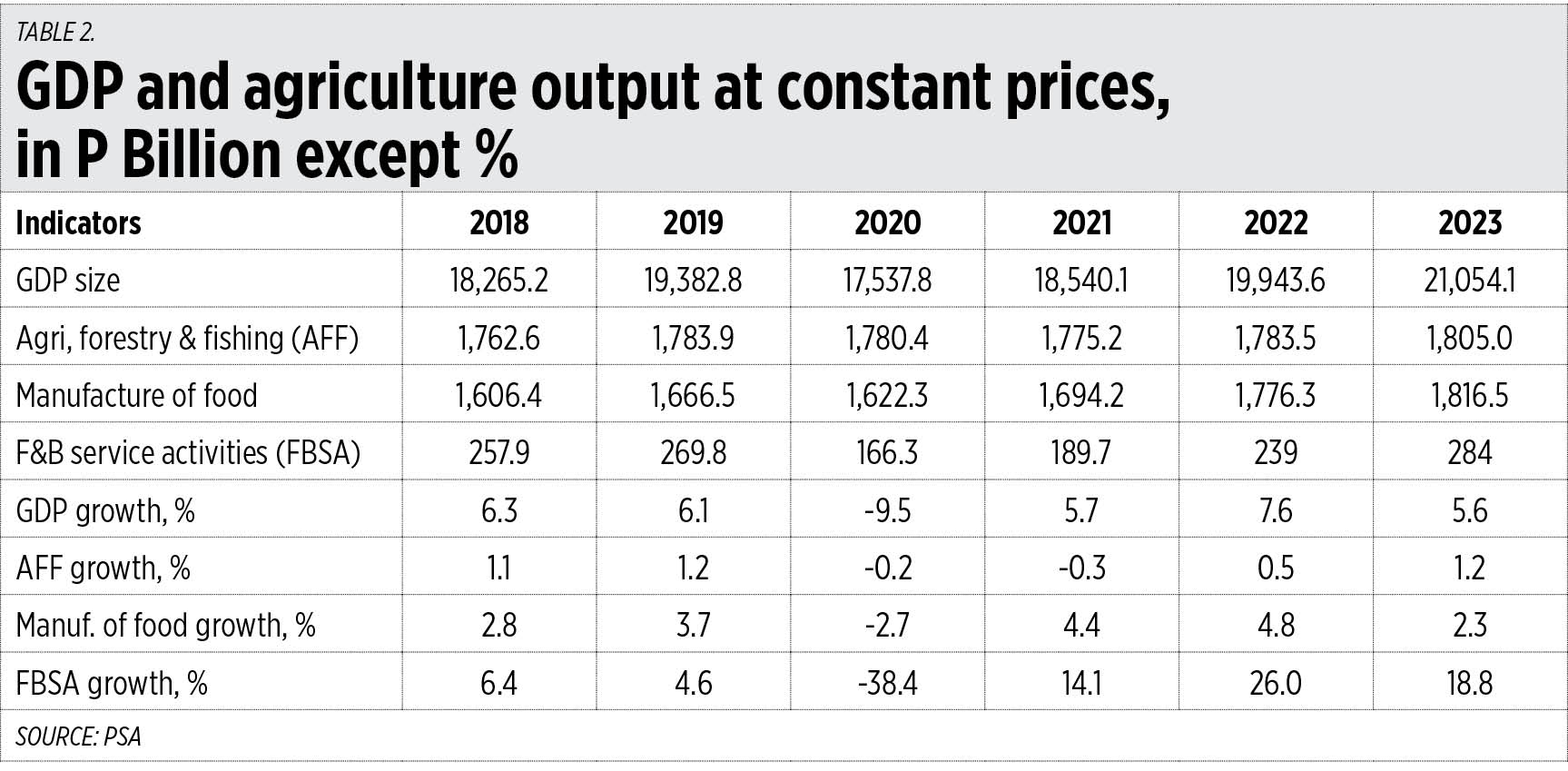
There are at least three ways to measure the performance of the agriculture sector. The first is the Agriculture, Forestry and Fishing (AFF) sector in the GDP by industrial origin or GDP by supply side. The second is manufacturing of the food products sub-sector under the industry sector. And the third is the food and beverage service activities (FBSA) sub-sector under the services sector.

We must look at the two sub-sectors because there is heavy underreporting in the output of raw agricultural, animal, and fishery products as shown by AFF growth which is always very low, with a maximum 1.2% growth in the last six years even if overall GDP grew by 7.6%.

Growth in the manufacturing of food products reached 4.8% in 2022. This is not possible if there was no growth of at least a similar level in raw agricultural products. So, by proxy, AFF should be growing 2.3% to 4.8%, not just 0.5% to 1.2% as officially recorded.

FBSA is a better proxy because it includes directly cooked and served food like those in restaurants, hotels, carinderia and litson-manok stalls. Meaning non-manufactured, preserved, and canned foods are included. Annual growth in FBSA was 4.6% to 26% (see Table 2).

So, if AFF output is actually growing by 4% to possibly 26% and not 0.5% to 1.2%, then many agricultural subsidies and freebies (free irrigation, free tractors, free seeds, etc. with no timetable to end the subsidy) and the large and elaborate agricultural bureaucracies may not be justified. Instead, the government should focus on more rural infrastructure like longer and wider paved barangay roads that benefit everyone, not just farmers and fisherfolks.

Related here are taxation and energy policies that distort agricultural production. Like the imposition of diesel tax — from zero to P6/liter under the TRAIN law of 2017 (RA 10963) implying that expensive diesel for tractors, harvesters, trucks, irrigation pumps, fishing boats is necessary to “save the planet.”

Then there is a growing trend of land conversion from agriculture to solar farms. This has short- to long-term adverse impact on food production and food inflation. This must stop. Expanding food production, saving the poor and hungry, should be prioritized over “saving the planet” because the weather is uncertain.


Bienvenido S. Oplas Jr. is the president of Bienvenido S. Oplas, Jr. Research Consultancy Services, and Minimal Government Thinkers. He is an international fellow of the Tholos Foundation.

minimalgovernment@gmail.com

PPA awards P263.64-million Tacloban port upgrade contract

ICTSI

THE Philippine Ports Authority (PPA) has awarded a P263.64-million contract to upgrade the Port of Tacloban in Leyte to Hi-Tone Construction and Development Corp.

In a notice of award dated Jan. 29, Legazpi City-based Hi-Tone Construction was awarded the improvement project contract after submitting the lowest bid among five qualified bidders and passing PPA’s post qualification evaluation.

Jay Daniel R. Santiago, PPA general manager, has directed the company to formally enter a contract with the agency and post the required performance security within 10 days from the receipt of the notice of award.

“Failure to enter into the said contract or provide the Performance Security shall constitute a sufficient ground for cancellation of this award and forfeiture of your Bid Security,” Mr. Santiago said.

According to the bids and awards committee, the approved budget for the contract is P253.84 million.

The other four companies that submitted bid proposals are Luzviminda Engineering, Vicente T. Lao Construction, Sunwest, Inc., and J.C. Piñon Construction, Inc.

PPA said the Tacloban port improvement project will be completed in 420 calendar days or 14 months from the receipt of the notice of award.

The project includes removal and excavation works; port operational area with RoRo ramp on fill and RC pier extension. — Ashley Erika O. Jose

Uneven path to finish Evergrande’s abandoned housing in Chinese city

REUTERS

SHIJIAZHUANG, HEBEI — In the heart of the northern Chinese city of Shijiazhuang, a fence displaying the slogan “Happy Every Day” hides an unfinished apartment complex, a daily reminder of the unresolved costs of the collapse of China’s once-largest developer.

Construction on the Central Plaza project that promised buyers about 1,800 new homes stalled in 2021 after China Evergrande Group defaulted. A government notice on the site says the project is seeking a new developer.

Buyers, who paid in full years ago, have been stuck watching and waiting for a lifeline.

“We seem to have no way of resolving this issue,” said a 38-year-old Shijiazhuang resident, who bought two still-unfinished units for more than $350,000 in 2017 and who asked not to be named.

A Hong Kong court on Monday ordered Evergrande to be liquidated, a process expected to take years and to include consideration of some kind of restructuring of more than $300 billion in liabilities.

Evergrande has said it would work to finish ongoing projects despite the order. China has said that completing the unfinished homes is a policy priority.

But the project in Shijiazhuang, an industrial city with about 11 million people, shows the scale and difficulty of working through the overhang of unfinished construction left by Evergrande and just how much its downfall has damaged confidence.

“This has made me lose faith in the housing authorities’ management capabilities as well as real estate,” the Evergrande home buyer told Reuters.

Shijiazhuang’s housing bureau and China’s housing ministry did not immediately respond to requests for comment. Evergrande did not reply to a request for comment.

Investment bank Nomura estimated in November there were around 20 million units of unfinished homes across China, left by Evergrande and other failed developers. The total funding gap for completing those projects stood at around $446 billion, the report estimated.

Gavekal Dragonomics, a China-focused research firm, estimated that as of last year, Evergrande had received payments in advance from homebuyers equivalent to about 600,000 housing units.

HOME DELIVERY ‘GUARANTEE’
State-owned developers and local governments have taken over some stalled projects under a government-run “guarantee home delivery” policy in recent months, according to official announcements and media reports.

Reuters could not verify the total number of unfinished Evergrande projects in Shijiazhuang. Last month, the local government announced the completion of 40 out of 44 unfinished housing projects it had taken over in 2021. None of them belonged to Evergrande.

In Shijiazhuang’s rural outskirts, construction has resumed on another Evergrande development of 48 residential blocks with nearly 3,600 units, although few workers were on site this week in the run-up to Lunar New Year.

The project includes two castle-like community buildings with decorative spires next to an unfinished retail strip and more traditional apartment buildings that appeared to be nearly finished. Weeds have grown through the yet-unpaved shopping lane.

Workers and two people who identified themselves as local officials said construction had resumed last year after the project was taken over by the local government. A developer-run WeChat page for the project said last month that the masonry on some buildings had been completed.

China has not disclosed how much funding has been provided to complete stranded developments or the number of projects authorities have taken on. China’s housing ministry said in August more than 1.65 million pre-sold units had delivered under the program.

The Shijiazhuang resident waiting for work to resume on the Central Plaza project said buying a new apartment in China was just too risky. He regrets not putting the money he committed to the project to buy a property in Tokyo or Osaka.

“I will never invest in this place again,” he told Reuters. — Reuters

BoC’s transformative projects and reforms under a new leadership

Photo from facebook.com/BureauOfCustomsPH

The Bureau of Customs (BoC) has a significant role in the country’s economy and acts as a gatekeeper for international trade and commerce. Its primary responsibility is to control and facilitate the movement of goods across borders, including a smooth flow of imports and exports.

Recently, the BoC has been progressing toward its goals under the leadership of Commissioner Bienvenido Y. Rubio. His leadership is focused on five priority programs: digitalization of customs processes, surpassing revenue targets, simplifying procedures for secure trade, curbing smuggling, and uplifting employee welfare and development.

Boosted integrity

As the central government organization entrusted with the duty of regulating and supervising the movement of goods in and out of the country, collecting customs duties and taxes, and preventing smuggling, the Bureau of Customs has recently implemented measures to improve the reliability and integrity of the agency.

In a report released by the Department of Finance (DoF), the importance of safeguarding the integrity of government agencies such as the BoC and the Bureau of Internal Revenue (BIR) has been highlighted to make tax payments more accessible and improve trade.

The DoF has stepped up its anti-corruption campaign through the Revenue Integrity Protection Service (RIPS) to achieve this goal. The RIPS conducts lifestyle checks and investigates allegations of corruption, including those involving the BoC. Because of this, the bureau has become more efficient and transparent, with streamlined processes and reduced waiting times for traders.

The DoF and the BoC have also collaborated with other agencies to improve trade facilitation. For instance, the BoC has partnered with the Philippine Ports Authority to upgrade port infrastructure and improve cargo-handling capacity, while the DoF has worked with the Department of Trade and Industry to simplify import and export procedures.

The BoC has also been recognized for its high complaint resolution rate. From January to June 2023, the agency achieved a compliance rate of 91.13% for the 72-hour compliance period and an overall resolution rate of 96.55%, guided by Executive Order (EO) No. 6 Series 2016.

In addition, BoC’s consistent performance in resolving complaints has led to several awards and commendations from the Civil Service Commission (CSC) and other government feedback mechanisms. This recognition is part of the agency’s efforts to efficiently process complaints through its Customer Assistance and Response Services, in line with the Anti-Red Tape Act and the Ease of Doing Business and Efficient Government Service Delivery Act of 2018.

As a result of these efforts, BoC has seen a significant increase in revenue collection, which has allowed the government to fund crucial infrastructure projects and social services.

Upgraded operations

Photo from facebook.com/BureauOfCustomsPH

The BoC achieved a remarkable feat by surpassing its revenue collection target in 2023, collecting an amount of P883.624 billion, which exceeded the P874.16 billion target by 1.0%.

According to a report by the Philippine News Agency, the BoC has taken strict measures to strengthen border protection by pursuing criminal cases against smugglers. As of Dec. 31, 2023, a total of 90 criminal cases have been filed before the Department of Justice, out of which 60 cases are related to agricultural smuggling.

To prevent smuggling, the bureau is also monitoring importers and brokers. As part of its monitoring efforts and post-evaluation of importers and brokers, BoC revoked the accreditation of 118 importers and 46 customs brokers found to have violated the provisions stipulated in the Customs Modernization and Tariff Act.

These measures taken by BoC are considered necessary to ensure that the borders are protected from smugglers, maintain the integrity of the agency, and prevent any illegal activities that may harm the country’s economy in the long run.

Photo from facebook.com/BureauOfCustomsPH

This year, the BoC has been tasked to collect more than P1 trillion under the proposed Budget of Expenditures and Sources of Financing (BESF). According to Mr. Rubio, he is hopeful that the improved economic conditions will help boost trade and increase revenue for the government.

“I’m confident the government is doing its job and in some of the economic meetings that I attended. Our secretaries are very optimistic that the interest rates will decrease. The projections for next year will be good,” Mr. Rubio was quoted as saying in Filipino.

The BoC has also made substantial progress in digitalizing customs processes, partnering with the Department of Information and Communications Technology (DICT) to streamline customs procedures through digitalization.

A report stated that the bureau has modernized its operations, reaching a 96.39% rate of digitalization for 160 out of 166 customs procedures under the 2021 Citizen’s Charter. Their efforts to enhance its operations include developing three new systems: the E-Service Catalog System, the Document Management System, and the Over Staying Cargo Tracking System.

In addition, the BoC introduced automation projects that proved to be game-changers in transforming the government agency, helping the BoC to streamline its digital operations and improve its efficiency. These projects included a new and improved BoC website, the implementation of the Digital Origin Review System, the Automated Export Declaration System, and the Customs Auction Monitoring System.

According to Former Finance Secretary Benjamin E. Diokno, the modernization efforts of the BoC have been recognized as the Philippines ranks the second-best among ASEAN countries in a United Nations global survey on trade facilitation.

Photo from facebook.com/BureauOfCustomsPH

This year, the BoC is expected to continue modernizing its customs administration with the help of the World Bank. The institution has announced $88.28 million in financing for the Philippine Customs Modernization Program, which aims to support the digitalization of the bureau.

With these at hand, the bureau’s digitalization efforts seek to achieve a fully automated customs procedure, making international trade transactions more efficient, transparent, and compliant with international standards.

Furthermore, Mr. Rubio had spearheaded some initiatives to enhance organizational development and boost employee morale at the BoC. One of these includes the hiring of 66 new personnel and the promotion of 186 existing personnel, addressing the bureau’s staffing and productivity challenges.

The BOC has also launched its first Employees’ Consultative Assembly, a crucial step in enhancing employees’ confidence by allowing employees to communicate their concerns, suggestions, and feedback directly to management. — Mhicole A. Moral

BSP to issue more P1,000 polymer bills

BANGKO SENTRAL NG PILIPINAS FB PAGE

The Bangko Sentral ng Pilipinas (BSP) is looking to order and issue an additional one billion pieces of P1,000 polymer banknotes as these are more cost-efficient versus producing paper money, an official said.

BSP Deputy Governor Mamerto E. Tangonan said the central bank is looking to issue more polymer banknotes following the release of 500 million pieces of P1,000 bills made of the material from 2022 to 2023 as part of the trial circulation.

“The first order was 500 million pieces (of P1,000 polymer banknotes). This time, we will probably order one billion pieces,” Mr. Tangonan said.

The new polymer bills will be outsourced and printed by Note Printing Australia, a subsidiary of the Reserve Bank of Australia, he said, the same supplier of the trial batch. The bills will be delivered on a staggered basis.

The BSP does not produce polymer bills. When asked how much the polymer banknotes cost, Mr. Tangonan said in mixed of English and Filipino: “If we compare it (ordering polymer bills) to producing paper banknotes, the actual cost difference is not that significant. But the initial estimate is that it will last us two-and-a-half times more than paper bills. So, we are able to more than recoup the cost of polymer bills.”

The official earlier said the BSP will be able to save as much as P2.4 billion in circulating polymer banknotes.

Mr. Tangonan added that the BSP is looking to finish its studies on recycling polymer banknotes next year.

“We want to prove that polymer banknotes are more durable,” he said. “(The bills) are okay in hygiene and okay with regards to sustainability.”

He added that greenhouse gas emissions from producing polymer bills is at under 40%.

Last year, the BSP said it will consult the academe, plastic producers, and recyclers for several studies on the recycling process for polymer banknotes as part of its long-term plan to shift to bills made of the material.

Polymer bills are deemed to last 2.5 to four times longer than the Philippines’ current abaca-based bills as these banknotes are water, oil, and dirt-resistant, the central bank earlier said.

The BSP is testing polymer bills to see if the positive experience of other central banks using the material in the banknotes is applicable in the local setting. — K.B. Ta-asan

A love that sparks ripples

HEIKE-MINTEL-UNSPLASH

As I cradle our firstborn son and as my wife embraces me, we feel his tiny hands warmly grip our fingers. We shower him with all the love we can give; his giggles are enough to make our hearts flutter. As a father and educator, I hope that our son grows with a kind of love that is not a favor to be returned, but a gift to be paid forward — a kind of love that sparks ripples.

And in these moments, I contemplate the boundless potential not only of my son, but also of the Filipino youth in general. As we celebrate love this February — not just romantic love, but the nurturing love of family — I am reminded that this gentle flame ignites within our children the spark to lead positive change that could transcend generations. The love that parents and mentors bestow is the first step in a lifelong journey of social responsibility. With patience and compassion, we as a society can fan these sparks into flames that illuminate the path towards national transformation and the flourishing of our collective well-being.

The Ramon V. del Rosario (RVR) Siklab Awards, spearheaded by PHINMA Corp. and De La Salle University, recognize such outstanding youth. Named after the late Ambassador Ramon V. del Rosario, who embodied the virtues of innovation and integrity, the Awards identify emerging Filipino leaders aged 25 to 40 who have established businesses or social enterprises driving inclusive growth. Check out the stories of previous Siklab awardees at rvrawards.org. Behind these promising youth are families, schools, mentors, partners — entire support systems that believed in them and fanned their sparks into flames.

We as a society must recognize those who walk the talk of social responsibility so that they can ignite ripples of inspiration amongst their peers. The RVR Siklab Awards honor those exhibiting genuine entrepreneurial spirit oriented toward nation-building and making lives better — pursuing profitability paired with purpose, and envisioning sustainable solutions born of grit, compassion, and business acumen.

The 2024 call for nominations is an opportunity to elevate such youth leaders in our communities. I urge you to take part in this nation-building endeavor. Share the stories of young change-makers working to uplift lives so that their sparks may kindle flames within others as well. Visit our RVR Siklab Awards Facebook page to learn more about how you can nominate deserving candidates.

It takes a village to raise a child, and a society to raise the youth to be the next generation of nation-building leaders. With collective effort across families, schools, businesses, government, and civil society, we can empower our youth to drive positive change. The sparks of excellence within our children can swell into an unstoppable wave of innovation and social progress, rippling across communities. The RVR Siklab Awards shine a light on these sparks of potential within our youth. Beyond celebrating outstanding individuals, the Awards highlight the power of love in developing the leaders of tomorrow. Driven by empathy and enterprise, our youth can build the nation and make lives better.

Love begets love, the kind that sparks lasting ripples.


Patrick Adriel H. Aure, PhD is the assistant dean for Quality Assurance of the Ramon V. del Rosario College of Business and is an associate professor from the Department of Management and Organization of De La Salle University.

patrick.aure@dlsu.edu.ph

ADVERTISEMENT
ADVERTISEMENT