Home Blog Page 3630

Marcos: PHL neither denies nor approves ICC presence

PHILIPPINE STAR/KRIZ JOHN ROSALES

WHILE maintaining that he has not approved an International Criminal Court (ICC) investigation of the previous administration’s bloody war on drugs in the country, President Ferdinand R. Marcos, Jr. hinted on Tuesday that he allows the presence of its investigators on Philippine soil.

“I don’t approve or deny [ICC presence in the country]. You know, they haven’t done anything illegal. Once they do, of course, we will do something about it,” Marcos told reporters. “We are an open country; we are not a closed country.”

Still, Mr. Marcos made it clear that his administration, like that of his predecessor Rodrigo R. Duterte, would not cooperate with the ICC because it has no jurisdiction over the Philippines.

The ICC probe covers alleged crimes committed in Davao City from November 2011 to June 2016 when Mr. Duterte was still its mayor, as well as cases during his presidency up until March 16, 2019, the day before the Philippines withdrew from the treaty that established the ICC.

A Social Weather Stations (SWS) survey conducted on Dec. 8 to 11 last year showed that 53% of Filipinos agreed with the ICC probe of the drug war, up from 45% in March. The pollster, in a Feb. 20 report, said 26% were undecided and 20% disagreed.

The net trust that the ICC would be impartial in its investigation rose to +12 from +1 “but uncertainty continues to dominate,” according to the poll.

Meanwhile, an OCTA Research poll on Dec. 10 to 14 showed 55% of adult Filipinos were in favor of the Philippine government cooperating with the Hague-based tribunal’s investigation of the drug war.

On the other hand, 45% are opposed to cooperating with the ICC probe, OCTA said.

It said 59% of adult Filipinos were in favor of rejoining the ICC, while 41% opposed the idea.

In Congress, lawmakers called on Mr. Marcos to allow the Philippines to rejoin the ICC and send the “correct signal” to foreigners on the country’s stand on human rights.

“It’s all about sending the correct signals to our foreign friends and investors,” Party-list Rep. Ramon Rodrigo L. Gutierrez said. “We want to show them that we respect and uphold the rule of law, human rights.”

Last year, Mr. Gutierrez and Manila Rep. Bienvenido M. Abante, Jr. filed House Resolution No. 1477, urging the Philippine government to cooperate with the ICC’s investigation of the Duterte administration’s anti-drugs campaign.

“Rejoining the ICC would provide a critical mechanism for holding the government accountable, particularly concerning grave human rights abuses,” Assistant Minority Leader Arlene D. Brosas said in a statement.

“Given the widespread human rights violations in the Philippines, having independent oversight and accountability mechanisms is crucial,” she added.

When asked whether his government would change its stance on the ICC probe given the results of the latest opinion polls on the matter, Mr. Marcos said: “It’s still those questions of jurisdiction and sovereignty. I haven’t yet seen a sufficient answer for it.”

“Until then, I do not recognize their (ICC’s) jurisdiction in the Philippines,” he added.

The government estimates that at least 6,117 people were killed in Mr. Duterte’s drug war between July 1, 2016 and May 31, 2022, but domestic and international human rights groups say the death toll could be as high as 30,000.

The December SWS poll also showed that the percentage of those who had extensive knowledge of the ICC investigation rose to 14% from 10%, while those with partial but sufficient knowledge rose to 30% from 24%.

“On the other hand, those who had only a little knowledge slightly fell from 37%, while those who had almost no or no knowledge at all fell from 30%,” the pollster said.

Mr. Marcos in January said his government would not, in any way, cooperate with the ICC. But that was before his successor openly attacked his administration and called him a drug addict in a political rally in the southern Philippine city of Davao on Jan. 29.

Mr. Marcos had vowed to shift the focus of the drug war to rehabilitation, but the University of the Philippines Third World Studies Center’s Dahas project had reported that a year into his term, a total of 342 people had been killed by state actors in connection with illegal drugs.

Earlier this month, Dahas reported that at least 28 people had been killed in the anti-narcotics campaign in January, over a dozen of which were done by unidentified assailants. — Kyle Aristophere T. Atienza with a report from Beatriz Marie D. Cruz
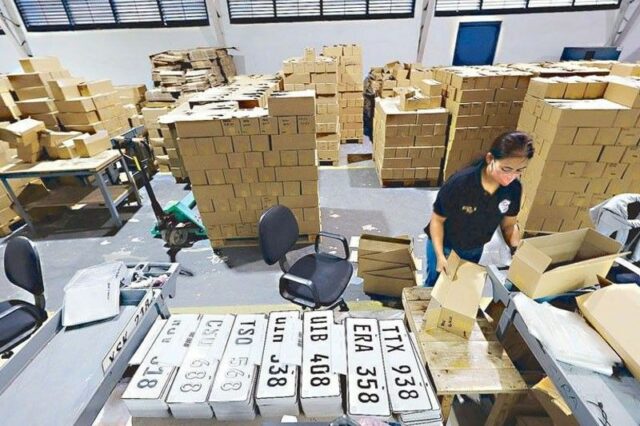

LTO to begin 24-hour production of license plates

PHILIPPINE STAR/ MICHAEL VARCAS

THE LAND Transportation Office (LTO) will shift to a 24-hour operation to clear its backlog of about 12 million license plates for motor vehicles by next year, the agency told congressmen on Monday.

LTO administrative officer for property Maria Clarissa G. Ogsimer said the agency’s plant will operate on a “three-shift’ model to increase plant productivity by 27.9% to 48,600 plates per day.

“This shift will enable the agency to complete the production of the entire backlog before the end of second quarter of 2025,” she told the House transportation committee.

A three-shift system would include a night shift to the standard two eight-hour shift, covering the proposed 24-hour production of license plates.

The LTO also has a shortage of 3.2 million plastic driver’s license cards as of Feb. 14. LTO Central office administrative division chief Louella V. Mutia said the backlog was caused by a court injunction issued against its supplier, Banner Plasticard, Inc.

This temporarily stopped the office’s P240.1-million contract with Banner Plasticard, Inc., with the LTO resorting to printed paper licenses.

The government has tapped the National Printing Office, the central bank, and government-owned APO Production Unit to supply plastic license cards.

Ms. Mutia said documents for the procurement of plastic license cards have been submitted to the Transportation department for review. Its memorandum of agreement (MoA) will be signed two weeks after the bids and awards committee’s approval.

If the TRO on the injunction is denied, the LTO will request an additional budget of P132.03 million to procure the remaining backlog, Ms. Mutia added. — Beatriz Marie D. Cruz

Philippine military defends joint air patrols with US

Two fighter jets of the Philippine Air Force fly with a bomber plane of the US Pacific Air Force over the West Philippine Sea during the third iteration of the two countries' Maritime Cooperative Activity on Feb. 19, 2024. — PHILIPPINE AIR FORCE

THE ARMED Forces of the Philippines (AFP) said on Tuesday that its joint air patrol with the United States over the South China Sea early this week had followed international rules and was aimed at boosting their interoperability.

Three Philippine fighter jets and a US bomber aircraft flew over the disputed waterway on Monday, over a week after their navies held drills at sea.

In a statement, the AFP said it was the air component of its 3rd Maritime Cooperative Activity (MCA) with the United States Indo-Pacific Command (USINDOPACOM) which began in early February.

The activity was aimed at boosting the AFP’s capability to “perform its mandate and maintain its presence over the Philippines’ exclusive economic zone (EEZ).”

“[It] demonstrates the commitment of both armed forces to enhancing interoperability and advancing regional peace and security in the Indo-Pacific.”

The Chinese military earlier accused the Philippines of stirring up trouble in the South China Sea by conducting a joint air patrol with “extraterritorial countries” and then openly hyping it up.

The activity is “in no way directed towards any country,” Philippine Air Force spokesperson Ma. Consuelo Castillo told reporters.

It is in line with the international rules, “as we were operating within our territory and within the Philippines’ EEZ,” she added.

The joint air patrol covered areas 90 nautical miles west of Candon, Ilocos Sur and 50 nautical miles northwest of Lubang, Occidental Mindoro.

Last Feb 9, the third iteration of the MCA involved the Philippine Navy’s BRP Gregorio del Pilar and the US Navy’s USS Gabrielle Giffords. Exercises included passing, communication, and division tactics to enhance coordination between the two forces in maritime scenarios.

Previous iterations took place in January and November last year.

The Philippines, particularly under the Marcos administration, has sought closer ties with the US amid escalating tensions with China, which claims vast portions of the South China Sea, including areas within Manila’s exclusive economic zone. — Kyle Aristophere T. Atienza

Lanao provinces under tight guard

COTABATO CITY — State forces have tightened security at the border of Lanao del Sur and Lanao del Norte provinces to forestall possible retaliations by Dawlah Islamiya gunmen, following clashes last Sunday that exacted fatalities on both sides.

Muslim religious leaders and local officials in Lanao del Norte told reporters on Tuesday that seven Dawlah Islamiya terrorists and six Philippine Army soldiers from the 44th Infantry Battalion were killed in the two-hour gun battles in the village of Ramain in Munai town, right next to Lanao del Sur towns.

“We are not taking chances. We are guarding against possible retaliations by these terrorists. This group is known for attacking helpless people to avenge the deaths of companions in clashes with pursuing government forces,” Brig. Gen. Allan C. Nobleza, director of the Police Regional Office-Bangsamoro Autonomous Region, said.

According to local leaders, two of the wounded Dawlah Islamiya members were one “Monid” and another named “Ariado,” who are alleged cousins of Khadafi K. Mimbesa, earlier identified by authorities as the mastermind of the deadly bombing of a Catholic mass held at the gymnasium of the Mindanao State University Gymnasium in Marawi City last Dec. 3.

Mr. Mimbesa was one of the nine Dawlah Islamiya terrorists killed in an encounter with soldiers in Piagapo, Lanao del Sur last Jan. 26.

The soldiers killed in last Sunday’s clash were Corporals Rey Anthony K. Salvador, Reland F. Tapinit, and Rodel C. Mobida, Private 1st Class Arnel L. Tornito, and Privates Michael John G. Lumingkit and James N. Porras. — John Felix M. Unson

House OK’s financial literacy bill

PHILIPPINE STAR/MICHAEL VARCAS

THE HOUSE of Representatives has approved on second reading a proposed measure that requires employers to establish a financial literacy program for all their workers and employees.

During the plenary session on Tuesday, House Bill No. 9875, the proposed Personal Finance Education in the Workplace Act, was approved through voice voting.

As a proposed amendment to the Labor Code of the Philippines, the bill mandates that the program include topics on behavioral finance, savings, fund development, debt management, investment, insurance, and retirement planning.

In his sponsorship speech, Bukidnon Rep. Jose Manuel F. Alba said “enlightened and financially secure workers and employees contribute more effectively, fostering a more robust and stable economy.”

According to the Bangko Sentral ng Pilipinas’ (BSP) 2021 financial inclusion survey, only 2% of Filipinos can correctly answer basic financial literacy questions.

The poll showed that 7% have attended a financial literacy seminar or webinar, and around half of the respondents, or 54%, said they were interested in attending the BSP’s financial literacy training session.

Less than half of the respondents (42%) noted the impact of inflation to their purchasing power, the central bank said.

“A lack of financial acumen leads to debilitating debt, stress-induced decision making, and consequently, a ripple of negative outcomes,” Mr. Alba told the plenary.

He added that the lack of financial literacy results in poor work performance, increased absences, financial dissatisfaction, and even violence in the workplace or at home. — Beatriz Marie D. Cruz

Energy expected for W. Visayas

JEROME CMG-UNSPLASH

A TOTAL of 258 megawatts (MW) of capacity is expected to be generated from the committed generating plants located in the Western Visayas islands of Panay and Guimaras, the Department of Energy (DoE) said.

“Our committed projects to be coming in the next few years… most of these are renewable energy,” Irma C. Exconde, director of the DoE Electric Power Industry Management Bureau, said in a virtual forum on Tuesday.

Committed projects are those that are already in the construction phase or have a financial close in place.

Among the projects cited is the 40-MW Luca solar power project by the Apolaki Eight, Inc., which was one of the winning bids under the second round of the Green Energy Auction Program.

There is also the 13.2-MW wind power project of PetroWind Energy, Inc., with a second phase targeted to be completed by 2024.

“Panay and Guimaras areas have many potential wind resources and also other renewable energy,” Ms. Exconde said.

She said that potential wind power projects in Panay and Guimaras have a total capacity of 5,807 MW, while other renewable energy projects have 550 MW.

To recall, multiple power plants tripped on the second day of the year on Panay Island, causing a widespread power outage in the Western Visayas. Power was restored three days after. — Sheldeen Joy Talavera

PBEd offers digital skills to youth

THE PHILIPPINE Business for Education (PBEd) forged fresh partnerships with the local governments of Samar province and the municipality of Arteche in Eastern Samar to bridge the youth’s technology skills gap, particularly in artificial intelligence (AI) and machine learning.

Backed by the Citi Foundation, the JobsNext program was launched in these areas last year to train young Filipinos in digital skills that would help them adapt and contribute to a modern and environmentally sustainable workplace.

“Through the combined efforts and collaboration of the public and the private sector, the dream of empowering Filipino youth looking for employment has come true,” said Justine B. Raagas, PBEd executive director.

She noted that the program will be pursued for a second straight year after over 1,500 young participants were trained last year. This year, the program targets the upskilling of at least 1,000 in Eastern Samar and Samar provinces.

“At Citi, we have a long track record of using our resources and expertise to empower the communities we serve,” said Citi Philippines chief executive officer Paul Favila. “Through the efforts of Citi Foundation and Citi Philippines, we hope to continue to enable growth and economic progress in support of our Filipino youth.”

In a study released in May 2023, online job portal JobStreet said technology-based work remains in high demand among jobseekers in the Philippines and other countries in Southeast Asia, despite layoffs by tech companies.

The Philippines ranked 84th out of 134 economies in the 2023 Global Talent Competitiveness Index compiled by Institut Européen d’Administration des Affaires in collaboration with the Descartes Insitute for the Future and Human Capital Leadership Institute.

“If we do not engage with the demands of digitization, we will be left behind,” Samar Governor Sharee Ann T. Tan-Delos Santos said. “I hope our youth will take advantage of this opportunity.” — John Victor D. Ordoñez

Gov’t distributes farm equipment

THE PHILIPPINE Center for Postharvest Development and Mechanization (PhilMech) has distributed at total of P302 million worth of farming equipment to farmers’ cooperatives and associations (FCAs) in the provinces of Bohol in Central Visayas and South Cotabato in Mindanao.

The agency said P225 million worth of machines were distributed to 26 qualified FCAs in South Cotabato, while P77.5 million worth of farming equipment went to 41 FCAs in Bohol.

“These machines are poised to modernize traditional farming methods, offering mechanized solutions to every agricultural process,” a PhilMech statement said.

Among the machines distributed to farming communities were rice combine harvesters, four-wheel tractors, floating tillers, hand tractors, mobile rice mills, precision seeders, walk-behind and riding-type transplanters, combine harvesters, rice threshers, single-pass rice mills, and a recirculating dryer.

The agricultural equipment was funded under the Rice Competitiveness Enhancement Fund’s (RCEF) mechanization program, which is intended to modernize the rice industry.

In a related development, PhilMech said that a rice processing facility is set to be constructed in Bukidnon, which includes a multi-stage rice mill and two mechanical dryers. — Adrian H. Halili

Apex answers environmentalists blaming mining for Maco landslide

APEX Mining Co., Inc. has reiterated the findings of the Mines and Geosciences Bureau 11 (MGB 11) that attributed the Feb. 6 landslide in the mining town of Maco, Davao de Oro to “natural factors” and not the company’s mining operations.

Still, the company which has been operating in the town for over five decades, expressed willingness to cooperate with inquiries, underscoring their commitment to Maco’s welfare.

The company’s statement follows environmentalists’ calls for accountability over the incident which killed scores of people, many of them Apex Mining employees on their way home from work.

Last week, Interfacing Development Interventions for Sustainability, Inc. (IDIS), an environmental watchdog, urged authorities to hold both Apex Mining and government agencies accountable for the tragedy.

In response, Apex Mining stood behind the MGB 11’s assessment, which stated: “As has been reiterated by the Mines and Geosciences Bureau, the landslide was caused by natural factors.”

Geologists from MGB 11 highlighted rainfall and fault lines in Davao de Oro as major contributors to the Masara landslide. “It was rain-induced… steep terrain, weak geology due to materials in the area, and the Philippine fault zone penetrating Davao de Oro contribute to the province’s susceptibility to landslides,” said Capter John Tubo, supervising geologist at MGB 11.

Regarding the location of the landslide, Apex Mining clarified it occurred outside the mine operations area and serves as a vehicle terminal for employees and community members, approximately 500 meters from the company gate.

Last Friday, disaster authorities reported that the death toll in the landslide that struck Barangay Masara in Maco reached 96, with at least 18 more people still missing.

In light of the incident, Apex Mining disclosed operational adjustments, including reduced milling activities and limited capacity due to restricted access. The company affirmed its focus on disaster relief efforts and supporting provincial government-led search and rescue operations.

Meanwhile, IDIS’s previous statement highlighted concerns about mining activities in Masara, noting the area’s designation as a “no-build zone” since 2008 due to recurring landslides. The environmental group underscored the region’s susceptibility to geological hazards and fault lineation.

IDIS called for a halt to mining operations, criticizing Apex Mining for alleged inadequate compensation and emergency response programs. The group pointed out the company’s establishment of infrastructure in designated hazard zones, implying negligence in adhering to safety regulations. — Maya M. Padillo

Shares rebound on hopes of early BSP rate cuts

REUTERS

LOCAL SHARES rebounded on Tuesday amid hopes that the Bangko Sentral ng Pilipinas (BSP) would cut rates by May on expectations of easing inflation.

The Philippine Stock Exchange index (PSEi) rose by 0.82% or 56.05 points to finish at 6,854.66 on Tuesday, while the broader all shares index climbed by 0.53% or 19.09 points to close at 3,581.70.

“This Tuesday, the local market bounced back by 56.05 points to 6,854.66 as investors regained confidence after a two-day decline. The positive sentiment was fueled by rate-cut hopes from the Bangko Sentral ng Pilipinas after Pantheon Economics stated that the central bank may start to cut rates by May,” Philstocks Financial, Inc. Research and Engagement Officer Mikhail Philippe Q. Plopenio said in a Viber message.

The BSP is widely expected to gradually cut benchmark interest rates this year starting as early as May, with prices likely to be under control, analysts said.

Monetary authorities are becoming less hawkish based on their policy statement last week, Pantheon Economics Chief Emerging Asia Economist Miguel Chanco said in a note, with a potential pivot this year on the table.

The Monetary Board last week kept the policy rate at a near 17-year high of 6.5% for a third straight meeting, as expected by 15 of 17 analysts in a BusinessWorld poll. Interest rates on the overnight deposit and lending facilities were also left unchanged at 6% and 7%, respectively.

The BSP raised borrowing costs by 450 basis points from May 2022 to October 2023.

BSP Governor Eli M. Remolona, Jr. said in a statement that the central bank is ready to adjust its monetary policy settings as necessary amid upside risks to inflation.

“Additionally, investors cheered the recent moves by the People’s Bank of China wherein it held its short-term interest rates unchanged and cut its five-year loan prime rate by 25 basis points,” he added.

The PSEi recovered following a technical sell-off on Monday, Regina Capital Development Corp. Head of Sales Luis A. Limlingan said in a Viber message.

“Economic data from the previous week raised concerns that the Federal Reserve might delay interest rate cuts, prompting uncertainty among market participants,” he said.

Majority of sectoral indices closed higher. Services went up by 2.39% or 41.34 points to 1,766.85; financials increased by 0.83% or 16.46 points to 1,999.39; holding firms rose by 0.74% or 47.38 points to 6,391.33; and property climbed by 0.71% or 20.42 points to 2,897.50.

On the other hand, industrials fell by 0.85% or 78.27 points to 9,121.59, and mining and oil fell by 0.22% or 20.25 points to 8,803.58.

Value turnover rose to P4.94 billion on Tuesday with 520.65 million issues changing hands from the P4.22 billion with 637.72 million shares seen the previous day.

Advancers outnumbered decliners, 106 versus 78, while 46 names closed unchanged.

Net foreign buying rose to P666.48 million on Tuesday from P339.37 million on Monday. — R.M.D. Ochave

Peso strengthens after China rate cut

BW FILE PHOTO

THE PESO inched up against the dollar on Tuesday after China’s central bank cut its key loan rate.

The local unit closed at P56.035 per dollar on Tuesday, strengthening by 3.5 centavos from its P56.07 finish on Monday, Bankers Association of the Philippines data showed.

The peso opened Tuesday’s session weaker at P56.09 against the dollar. Its worst showing was at P56.135, while its intraday best was its closing level of P56.035 versus the greenback.

Dollars exchanged went down to $1.14 billion on Tuesday from $1.51 billion on Monday.

“The peso appreciated as the latest substantial policy rate cut from China signaled concerns on the Chinese economy,” a trader said in an e-mail.

China announced its biggest-ever reduction in the benchmark mortgage rate on Tuesday, as authorities sought to prop up the struggling property market and broader economy, Reuters reported.

The 25-basis-point (bp) cut to the five-year loan prime rate (LPR) was the largest since the reference rate was introduced in 2019 and far more than analysts had expected.

The five-year LPR was lowered by 25 basis points to 3.95% from 4.2% previously, while the one-year LPR was left unchanged at 3.45%.

Most new and outstanding loans in China are based on the one-year LPR, while the five-year rate influences the pricing of mortgages.

In a Reuters poll of 27 market watchers conducted this week, 25 expected a reduction to the five-year LPR. They projected a cut of five to 15 bps.

The deeper-than-expected cut also suggests Beijing is no longer as concerned about the negative effects of lower lending rates on the currency or banks as they were last year.

A central bank-backed newspaper said on Tuesday that the benchmark mortgage rate cut would not create a negative impact on banks’ net interest margins.

The peso strengthened on Tuesday amid the dollar’s recent weakness, Rizal Commercial Banking Corp. Chief Economist Michael L. Ricafort said in a Viber message.

The local unit was also supported by the stock market’s rebound on Tuesday, he added.

The Philippine Stock Exchange index rose by 0.82% or 56.05 points to close at 6,854.66 on Tuesday, while the broader all shares index went up by 0.53% or 19.09 points to finish at 3,581.70.

For Wednesday, the trader sees the peso moving between P55.95 and P56.20 versus the dollar, while Mr. Ricafort expects it to trade from P55.93 to P56.13. — AMCS with Reuters

Gilas in first window of Asia Cup Qualifiers minus Fajardo and Edu

JUN MAR FAJARDO — FIBA.BASKETBALL

GILAS Pilipinas is counting on its adaptability and next-man-up mentality as it tackles the first window of the FIBA Asia Cup Qualifiers minus injured giants June Mar Fajardo and AJ Edu.

Mr. Fajardo is out two weeks due to a calf injury he sustained in last week’s PBA Commissioner’s Cup finals while Mr. Edu will only be back in action in April after tearing a meniscus last November.

This leaves Kai Sotto and stand-in Japeth Aguilar with the main task of patrolling the lanes against Hong Kong Thursday on the road and Chinese Taipei on Sunday at home with forward Carl Tamayo possibly being converted to center.

“We lost a lot of size losing June Mar (Fajardo) and AJ (Edu) so Japeth (Aguilar) is God-sent,” coach Tim Cone said of Mr. Aguilar, who was not a part of the Gilas 12 but was tapped to replace Mr. Edu and join the 11-man crew to the opening windows.

“Japeth (Aguilar) being able to back up Kai (Sotto) is going to be big for us. Carl Tamayo is our third-stringer center so he may have to be play out of position. These things happen to any basketball team all the time. You just have to roll with the punches and continue to deal with this.”

Mr. Sotto expressed readiness to take a bigger responsibility with the help of Mr. Aguilar, who is suiting up amid his wife’s delivery of his newborn daughter over the weekend, and the rest.

Mr. Fajardo, for his part, said he has big faith in the 7-foot-3 Mr. Sotto and the Nationals. — Olmin Leyba

ADVERTISEMENT
ADVERTISEMENT