Home Blog Page 3626

Philippine coast guard says Chinese claim of intrusion ‘inaccurate’

PHILIPPINE COAST GUARD PHOTO

MANILA/BEIJING – A Philippine coast guard official on Thursday described as “inaccurate” its Chinese counterpart’s claim that a fisheries vessel “illegally intruded” into Beijing’s waters.

The Chinese coast guard said earlier on Thursday it drove away a vessel of the Philippines’ Bureau of Fisheries and Aquatic Resources (BFAR) and accused them of “illegally intruding” into its waters near Scarborough Shoal.

“This statement is inaccurate. The BFAR vessel, BRP Datu Sanday, continues to patrol the waters of Bajo De Masinloc. Currently, the BFAR vessel is actively ensuring the security of Filipino fishermen in that area,” Commodore Jay Tarriela, the coast guard’s spokesperson on South China Sea issues told reporters.

Located within the Philippines’ exclusive economic zone (EEZ), the Scarborough Shoal is also claimed by China, making it one of Asia’s most contested maritime features and a flashpoint for flare-ups.

China claims almost the entire South China Sea, a conduit for more than $3 trillion in annual ship commerce. Its territorial claims overlap with those of the Philippines, Vietnam, Malaysia and Brunei.

In 2016, an international arbitration tribunal in the Hague said China’s claims had no legal basis, a decision Beijing has rejected. — Reuters

Scam Watch Pilipinas to include Whoscall app in its anti-scam education roadshows

Photo shows Scam Watch Pilipinas Co-Founder and Co-Lead Convenor Jocel de Guzman, Gogoolook COO Manwoo Joo and Gogolook's Country Representative for the Philippines and Regional Director for Information Security and Alliances Mel Migrino.

Scam Watch Pilipinas will include the use of Gogolook’s digital anti-fraud mobile application Whoscall in its roadshows nationwide to educate Filipinos against cyber fraud.

Gogolook, a leading TrustTech company in the region, recently became the technology convenor of Scam Watch Pilipinas to develop a comprehensive approach to prevent Filipinos from becoming victims of online scam.

Scam Watch Pilipinas Co-Founder and Co-Lead Convenor Jocel de Guzman said that the use of Whoscall app can provide an additional level of protection against intrusive online scam messages and calls as it can identify, detect, and filter scam and spam messages, calls, and URLs.

“We want the public to maximize the free features of the Whoscall app such as the Scan URL, caller-ID, and the report and block features to check if URLs and numbers are part Gogolook’s database of fraudulent websites and numbers,” Mr. De Guzman revealed.

Manwoo Joo, Gogoolook Chief Operating Officer, said that they can help provide Scam Watch Pilipinas with technology and expertise in educating Filipinos against cyber fraud.

“We are happy to support all the efforts of the government and advocacy group like Scam Watch Pilipinas by sharing our technology and know-how as an integral part of the anti-scam awareness campaign in the Philippines,” Mr. Joo said.

Mel Migrino, Gogolook’s Country Representative for the Philippines and Regional Director for Information Security and Alliances, said that the partnership with Scam Watch Pilipinas can provide a new channel for the company’s anti-scam awareness efforts in the country.

“Whoscall can provide an actual sense of security to Filipinos because of the many features of the app that can be used to check fake URLs, report and block numbers and filter unwanted text messages,” Ms. Migrino said.

The Cybercrime Investigation and Coordinating Center (CICC) and Gogolook signed a Memorandum of Understanding last year to build a stronger cyber fraud network in the Philippines together with countries such as Thailand, Taiwan, Malaysia, Japan, and South Korea.

Whoscall was officially launched in the Philippines in August last year and has already achieved significant traction and positive feedback from local users. Gogolook is a Taiwan-based brand which boasts a service scope covering more than 30 countries.

Scam Watch Pilipinas is the national citizen arm of the government after signing a covenant with the Department of Information Communications Technology (DICT), CICC, National Privacy Commission (NPC) and National Telecommunications Commission (NTC) in July 2023.


Spotlight is BusinessWorld’s sponsored section that allows advertisers to amplify their brand and connect with BusinessWorld’s audience by enabling them to publish their stories directly on the BusinessWorld website. For more information, send an email to online@bworldonline.com.

Join us on Viber at https://bit.ly/3hv6bLA to get more updates and subscribe to BusinessWorld’s titles and get exclusive content through www.bworld-x.com.

China 2023 coal power approvals rose, putting climate targets at risk

STOCK PHOTO | Image by PublicDomainPictures from Pixabay

 – China approved another 114 gigawatts (GW) of coal power capacity in 2023, up 10% from a year earlier, with the world’s top carbon polluter now at risk of falling short on climate targets after sanctioning dozens of new plants, research showed on Thursday.

In an effort to bring climate-warming emissions to a peak by 2030, China has vowed to “strictly control” new coal-fired generation capacity, and has also connected record numbers of new wind and solar plants to its grid.

But after a wave of electricity shortages in 2021, China also embarked on a coal power permitting boom that could slow its energy transition, according to analysis by U.S. think tank Global Energy Monitor (GEM) and the Helsinki-based Centre for Research on Energy and Clean Air (CREA).

China has approved 218 GW of new coal power in just two years, enough to supply electricity to the whole of Brazil.

Construction started on 70 GW of new coal plants last year, up from 54 GW a year earlier, with another 47 GW going into operation, up from 28 GW in 2022, the analysis said.

“Drastic action” is now required to meet 2025 carbon and energy intensity goals, and China could also struggle to meet a target to raise the share of non-fossil fuels in its total energy mix to 20% by 2025, it added.

China has pledged to start cutting coal consumption over the 2025-2030 period, but developers are building as much new capacity as they can before 2025, they said.

China’s total power capacity is already sufficient to meet demand, but its inefficient grid is unable to deliver electricity where it is needed, especially across provincial borders, encouraging more plant construction.

CREA has previously forecast that China’s carbon emissions will fall this year, with utilization rates at coal plants likely to drop significantly as more clean energy is connected to the grid.

“This risks significant financial problems for coal power plant operators and potential pushback against the energy transition,” said Lauri Myllyvirta, CREA’s chief analyst.

“This contradiction will have to be resolved in order for China to realize the emission reductions needed to get on track to carbon neutrality.” – Reuters

Dating apps are accused of being ‘addictive’. What makes us keep swiping?

A class-action lawsuit filed in the United States against Match Group – the parent company of dating apps Tinder, Hinge and The League – is making headlines around the world.

The claimants accuse Match of having a “predatory” business model and using “recognized dopamine-manipulating product features” to get people addicted to their apps.

So, can dating apps really be addictive? Are we swiping right into a trap? Here’s the science behind how dating apps are influencing our brains.

Dating apps, like many apps these days, are designed to keep users engaged. Like any product on the market, one of the developers’ goals is for the app to be sold and used.

While dating apps are designed to facilitate connections, some people may find themselves developing an unhealthy relationship with the app, constantly swiping left and right.

Dating apps can feel addictive because they activate the dopamine reward system. Dopamine is a neurotransmitter – a chemical messenger in the brain, one of many such chemicals essential for our survival.

One of dopamine’s crucial roles is to influence when and how we experience pleasure and reward. Think about the rush of winning money at a casino, or getting lots of likes on Instagram. That’s dopamine working its magic.

However, dopamine does more that just help us feel pleasure and excitement. It also has a key role in motivating us to seek out pleasurable things. It’s released not only when we experience something pleasurable, but also when we’re anticipating and seeking out a pleasurable experience.

Certain app features make it more likely we will open our phones and start swiping. When you get a match on a dating app, it feels exciting – that’s dopamine at work.

But an element of unpredictability adds to this excitement. Each time you open the app, you don’t know what profiles you might see, and who might match with you. This element of surprise and anticipation is especially important in getting us hooked.

Imagine if instead of swiping through profiles one by one, you were shown a long list of them at once. It would still feel good to match with people, but that excitement and anticipation of swiping through one by one would be missing.

Additionally, intermittent reinforcement comes into the mix. This is where “rewards” – in this case, matches – are provided at irregular intervals. We know we might eventually get some matches, but we don’t know when or with whom.

Imagine if instead of being drip-fed your matches, you received a list of any matches from the past 24 hours, at 9am each day. Your excitement and desire to check the app throughout the day would likely lessen.

Other small features, such as “hearts” and “roses”, make dating apps socially rewarding. These are all forms of approval. It feels different to receive a heart or a rose compared to something unemotional like a “tick” or “thumbs up”. These social stimuli are rewarding and activate our dopamine, too.

Not every dating app user will develop an unhealthy relationship to it. Just like not everyone who gambles, plays mobile games, or drinks alcohol develops a problem with those.

However, some people are biologically more vulnerable to addictions than others. A review of the research into problematic dating app use found the people likely to spend more time on the apps are those high on personality traits such as neuroticism, sociability and sensation-seeking. Problematic use of online dating apps is also associated with low self-esteem.

While there’s no current diagnosis of a “dating app addiction”, some people do develop unhealthy app habits and experience day-to-day harms as a result.

These six “addiction components” outline some of the signs you might be developing an unhealthy relationship with dating apps:

  • salience (dating app use dominates your thoughts)
  • mood modification (dating apps change your mood)
  • tolerance (your use of dating apps increases over time)
  • withdrawals (distress when dating app use is interrupted for a period of time)
  • conflict (use of dating apps negatively affects your reality)
  • relapse (you return to a previous pattern of dating app use after some interruption)

So, what can you do if you find yourself swiping through those matches more than you’d prefer?

Consider taking a break from the apps for a period of time. Depending on how hooked you feel, stopping completely for a while will help you reset your reliance on them.

Consider what is driving you to spend time swiping: are you feeling bored, sad or lonely? What other ways can you find to soothe these emotional experiences instead of turning to the app?

Make a list of the practical or emotional consequences of swiping, as a reminder of why you want to reduce your use. Perhaps the apps give you a brief rush, but in the long run don’t align with how you want to be spending your time, or don’t make you feel particularly good about yourself.

If you really do feel hooked, it will feel uncomfortable to take a break. Strategies such as mindfulness can help us sit with the discomfort. Consider seeking out professional help from a psychologist if you’re struggling to take time from dating apps.

Lastly, remember that apps, while great for meeting people, are not the be-all and end-all of dating.

In-person events and opportunities to mingle still exist. So, step away from the screen and embrace the excitement, unpredictability and dopamine hit you can get from face-to-face encounters too. – Reuters

Japan’s Nikkei nears record peak after Nvidia beat, rest of Asia muted

 – Japan’s Nikkei share average climbed to the cusp of an all-time peak on Thursday after unexpectedly strong revenue forecasts from US chip designer Nvidia lifted Asian tech stocks.

However, the regional mood was tempered by a retreat in Chinese stocks from multi-month highs reached amid Beijing’s efforts to boost market confidence.

Long-term US bond yields hugged three-month highs while the dollar sagged after minutes from the last Federal Open Market Committee meeting confirmed the view that interest rate cuts would be slow in coming, but weren’t markedly more hawkish that the Fed’s previously expressed views.

The Nikkei 225 share average pushed as high as 38,924.88 for the first time since January 1990 – right when the so-called bubble economy peaked – before entering the midday recess up 1.7% from Wednesday at 38,913.84. Its all-time high is 38,957.44 set on Dec. 29, 1989.

MSCI’s broadest index of Asia-Pacific shares outside Japan rose 0.07%, with a 0.71% rise for Taiwan’s stock benchmark countered by losses in Hong Kong.

The Hang Seng slipped 0.41%, threatening to snap a seven-day winning streak. A subindex of tech shares slumped 0.84%.

Mainland blue chips oscillated throughout the session between small gains and losses.

Meanwhile, US stock index futures signaled gains, following a mixed session on Wednesday for the main benchmarks. S&P 500 futures EScv1 rallied 0.75% and tech-focused Nasdaq futures NQc1 jumped 1.39%.

Following the closing bell overnight, Nvidia forecast a roughly 233% surge in quarterly revenue, sending its shares up some 10% after-hours.

The Nikkei has jumped about 16% already this year, with the S&P 500 and Nasdaq rallying some 5% each, driven in large part by mammoth expectations for artificial intelligence (AI), with Nvidia’s chips at the center of that boom.

“Nvidia’s earnings beat boosted sentiment and eased concerns over stretched valuations, providing room for the AI theme to continue to drive markets,” Saxo Markets analysts wrote in a research note.

The 10-year US Treasury yield eased slightly in Asian time on Thursday to 4.3068%, close to the 4.332% level marked a week ago and which had not been seen since the end of November.

The bulk of policymakers at the US Federal Reserve’s last meeting in January were concerned about the risks of cutting interest rates too soon, with broad uncertainty about how long borrowing costs should remain at their current level, minutes released on Wednesday showed.

That reinforced the view among traders that any rate cut is not imminent, with market pricing suggesting one-in-three odds for a first reduction in May, according to CME Group’s FedWatch Tool.

The dollar continued to retreat from a three-month high reached last week, when the US dollar index =USD, which tracks the currency against six major peers, reached 104.97. It was flat at 103.99 in early trading on Thursday.

The euro EUR=EBS was little changed at $1.08195, while the yen JPY=EBS was steady at 150.345 per dollar.

Elsewhere, oil prices rose slightly, adding to gains from the previous session that came amid signs of tighter supply. O/R

US West Texas Intermediate crude futures (WTI) CLc1 rose 17 cents to $78.08 a barrel for the prompt month. The May contract gained 14 cents to $77.45 a barrel by 0150 GMT.

Brent crude LCOc1 for April delivery ticked up 14 cents to $83.17 a barrel, while the May contract added 13 cents to $82.24 a barrel.

Oil prices rose 1% on Wednesday, with refinery restarts in the United States supporting demand after a series of outages earlier cut US refinery utilization rates to the lowest level in two years. – Reuters

Globe leaders recognized in #HRIcons2024 PH List

From left: Renato Jiao, Chief Human Resource Officer at Globe; and Robert Conrad Gonzales, Chief People Officer at GCash

Two human resource heads from the Globe Group were recently honored as among the most influential HR leaders from the Philippines in the #HRIcons2024 List by ETHRWorld.

Renato Jiao, Chief Human Resource Officer at Globe; and Robert Conrad Gonzales, Chief People Officer at GCash, were among HR executives recognized in the prestigious list — a testament to the leadership strength within the Globe Group and its commitment to driving positive change, promoting diversity and inclusion, and fostering a dynamic workplace culture.

“We extend our sincere congratulations to our HR leaders for their remarkable achievements and invaluable contributions to the HR industry in the Philippines. Their exceptional leadership serves as an inspiration, guiding others and establishing new benchmarks for excellence and innovation,” said Ernest Cu, Globe Group President and CEO.

Jiao, who has been HR chief at Globe for 13 years now, said he was “thrilled and privileged” to be among HR leaders recognized by ETHRWorld this year.

“This honor extends beyond myself and truly underscores the unwavering commitment and teamwork of my amazing team, Globe Group. Our collective effort has sparked meaningful transformation, and I’m sincerely grateful for this humbling recognition,” said Jiao.

Gonzales, meanwhile, thanked ETHRWorld for “recognizing what we are doing in GCash.”

ET HRWorld Southeast Asia’s #HRIcons2024 list recognizes HR leaders who have left exemplary footprints in the world of work and have demonstrated outstanding thought leadership, analytics, and strategic methods in advancing the HR industry.

These leaders leverage technology to improve various aspects of HR management, including recruitment, performance evaluation, and employee engagement.

“Their dedication to innovation and employee engagement and talent development has been recognized by industry peers for the HR Icons Listing. Their leadership has truly made a significant impact in the community and serves as an inspiration for HR professionals across the industry,” said ET HRWorld Southeast Asia.

The curated list was crafted through a combination of received nominations and internal editorial decisions based on the distinguished efforts of the leaders and their organizations in contributing to the overall success of the region.

HR leaders such as Jiao and Gonzales remain at the forefront of the country’s transformative HR journey, playing a vital role in spearheading initiatives aimed at enhancing the employee experience and prioritizing employee well-being. Their efforts are instrumental in driving continuous improvement and achieving organizational success.

To learn more about Globe, visit https://www.globe.com.ph/.


Spotlight is BusinessWorld’s sponsored section that allows advertisers to amplify their brand and connect with BusinessWorld’s audience by enabling them to publish their stories directly on the BusinessWorld website. For more information, send an email to online@bworldonline.com.

Join us on Viber at https://bit.ly/3hv6bLA to get more updates and subscribe to BusinessWorld’s titles and get exclusive content through www.bworld-x.com.

Can Nigeria turn the tide on plastic pollution?

STOCK PHOTO | Image by Hans Braxmeier from Pixabay

 – When it rains heavily in Lagos, the torrents of water gushing down streets and sidewalks sweep up disposable cups, plastic bottles and packaging and dump them into the coastal city’s drains and waterways.

“Most floods in Lagos happen because of blockages of non-biodegradable polystyrene packages and not the volume of rainfall,” said Joshua Babayemi, an environmental toxicologist at the University of Medical Sciences in Ondo, a state in southwestern Nigeria.

But from this week, the tide of trash should at least contain fewer foam food containers as city authorities start enforcing a ban on single-use items that reflects nascent efforts to tackle plastic pollution in the nation of about 200 million people.

Nigeria generates about 2.5 million tons of plastic waste every year, and a report by the Heinrich Boll Foundation, a German nonprofit, ranked the nation sixth globally among countries contributing the most mismanaged waste.

Other leading plastic waste polluters include China, India and the Philippines.


PUBLIC HEALTH RISKS

As plastic pollution continues to increase globally, countries are in negotiations to create the world’s first legally binding pact to reduce it by the end of this year.

But with concern growing about the impact of its rubbish-choked canals on public health, Lagos is going it alone.

“When we fly drones on the waterways of Lagos, you see Styrofoam floating across them,” the state environment commissioner Tokunbo Wahab told the Thomson Reuters Foundation about the ban on the material, which will eventually be extended to other single-use plastic items.

Flooding linked to blocked water channels and drains is of particular concern in the low-lying city of some 24 million people, which is at additional risk as sea levels rise due to climate change.

Clogged drainage systems can lead to pools of stagnant water that becomes a breeding site for mosquitoes and other insects, increasing the threat from vector-borne disease, Babayemi said, warning of the additional health risks posed by chemicals found in plastics.


JUST TRANSITION?

Lagos’s ban on foam take-away containers, which gives businesses three weeks to mop up stocks, has prompted similar measures in other parts of Nigeria such as the southeastern manufacturing hub of Abia.

It has also fueled calls from federal lawmakers for a nationwide ban on single-use plastics.

But while green campaigners have broadly welcomed the push, saying it was long overdue, there is concern that abrupt bans could take a heavy toll on factory workers in the plastic industry, food vendors and small-scale restaurant businesses.

“Investing in toxic plastics is no longer an option but people need to keep their jobs,” said Leslie Adogame, whose environmental nonprofit helped draw up a federal plastics phase-out plan alongside the Nigerian government, the European Union, the U.N. Industrial Development Organization (UNIDO).

The plan, which also drew on input from food and beverage producers and informal waste pickers, envisions eliminating single-use plastics by 2028 and setting recycling targets for all plastic packaging by 2030.

Abrupt bans in different parts of the country risk upending the federal strategy’s effort to foster a “just transition” to alternatives such as paper bags, boxes and wooden single-use cutlery without hurting informal workers, Mr. Adogame said.

“A plan allows (affected workers) to go into green production opportunities and green jobs,” said Mr. Adogame, executive director at Sustainable Research and Action for Environmental Development.

A more gradual approach, involving public awareness campaigns, would also reduce demand for single-use plastics by changing consumer habits, he said.

In the vast country, an additional risk of isolated bans is that plastics suppliers simply take their prohibited goods to sell elsewhere, said Babatunde Ajayi, head of the Lagos Environmental Protection Agency.

“A single tree does not a forest make … other cities must join us in protecting the environment to make Nigeria a better place,” Mr. Ajayi said. – Reuters

At G20 meeting, Western ministers criticize Russia over Ukraine

FREEPIK

 – Western foreign ministers from the G20 group of nations meeting in Brazil on Wednesday attacked Russia for its invasion of Ukraine as Russian Foreign Minister Sergei Lavrov listened, diplomats said.

“Russia must be made to pay for its aggression,” British Foreign Minister David Cameron told the closed session, according to his office.

The top diplomats from the United States, Australia, Canada, Germany, Italy, France and Norway made similar remarks on the first day of a two-day meeting.

Norwegian Foreign Minister Espen Barth Eide told reporters that Mr. Lavrov calmly replied to Mr. Cameron’s remarks with “a set of alternative facts” about events in Ukraine.

Mr. Lavrov did not speak to reporters. Russia’s justification of its “special military operation” in Ukraine, which began two years ago, initially was to “de-Nazify” Ukraine. More recently, Moscow has emphasized that it needs to defend against Western aggression.

The meeting was set to prepare the agenda for a G20 summit in November. At a summit in September, G20 leaders adopted a declaration that avoided condemning Russia for the war in Ukraine but called on all states not to use force to grab territory.

Mr. Cameron also noted the death of dissident Alexei Navalny in a Russian prison last week.

Mr. Eide said the G20 session in Rio focused mainly on conflicts in Gaza and Ukraine.

“We have to support Ukraine until it emerges as a free and independent sovereign country without another army on its soil,” the Norwegian minister said he told the meeting.

Mr. Eide said the ministers who spoke at the meeting agreed with the need for a two-state solution in the Middle East but there was no consensus on how to achieve it.

Brazil, this year’s president of the G20, opened the foreign ministers’ meeting by blaming the United Nations and other multinational bodies for failing to stop conflicts that are killing innocent people.

Foreign Minister Mauro Vieira called for “profound reform” of global governance as Brazil’s top priority this year.

“Multilateral institutions are not adequately equipped to deal with current challenges, as demonstrated by the Security Council’s unacceptable paralysis in relation to ongoing conflicts,” Vieira said at the meeting.

“This state of inaction results in the loss of innocent lives,” he said.

US Secretary of State Antony Blinken met with Brazilian President Luiz Ignacio Lula da Silva in Brasilia on his way to the Rio meeting and expressed US support for Brazil’s agenda to make global governance more effective.

The top US diplomat discussed Israel’s war in Gaza with Mr. Lula amid a diplomatic spat after the Brazilian leader likened Israel’s war to the Nazi genocide during World War Two, a US spokesperson told reporters.

Mr. Lula’s accusations last week of atrocities by Israel in Gaza triggered a diplomatic crisis with an Israeli reprimand and Brazil recalling its ambassador. – Reuters

HSBC cost conundrum intensifies investor bank scrutiny

 – Climbing costs at HSBC have added to growing investor concerns about how big banks manage their expenses, putting executives under pressure to quickly address spending.

Although banks have seen revenues balloon in the higher interest rate environment of recent years, fast-rising costs are now beginning to pinch, consultants and shareholders said.

Recent results have shown lenders struggling with wage bills, regulatory costs and accelerating investment plans.

HSBC on Wednesday reported a 6% hike in costs in 2023, blaming spending on levies in the U.S. and Britain. Europe’s biggest bank by assets also forecast a 5% rise in costs in 2024, after committing to invest despite stubbornly high inflation.

report last year by consultants Oliver Wyman and investment bank Morgan Stanley highlighted the need for banks to avoid one-size-fits-all cost-cutting strategies, in order to achieve savings with minimal effect on revenues.

HSBC’s 2023 pretax profit jumped 78% to $30.3 billion, but missed consensus estimates due to an unexpected $3 billion write down on its stake in China’s Bank of Communications.

And while a fresh $2 billion stock buyback went some way to soften these blows, some fund managers expressed concern.

“Costs are clearly disappointing, with inflation and investment casting a shadow and posing a risk to earnings,” Hywel Franklin, head of European Equities at Mirabaud Asset Management told Reuters after the HSBC results.

British bank Barclays on Tuesday set out savings and cost-income ratio (CIR) targets that also fell short for some investors.

Barclays BARC.L said it hoped to shave around 2 billion pounds off its costs over the next three years, lowering its CIR to “high-50s” by 2026, from 63% at end-2023.

HSBC Chief Executive Noel Quinn said his bank was navigating the cost strains better than the surprise overspend implied, with its CIR for 2023 down to 48% last year, from 64% in 2022.

Asset sales were also proving a useful cost management tool.

“We are actually selling a billion dollars worth of costs,” Mr. Quinn said, pointing to sales of HSBC’s French retail and Canadian arms which were completed in recent weeks.

“We continue to try and offset investment in the business for growth and efficiency reasons with savings elsewhere,” Mr. Quinn added on a media call.

Other European banks have also felt the squeeze. Credit Agricole this month reported a 15% jump in year-on-year underlying operating expenses in its fourth quarter, more than expected, and flagged a further 8% rise in costs for 2024.

Deutsche Bank said on Feb. 1 it would cut 3,500 roles as it tackles a 75% CIR and a 6% rise in 2023 non-interest expenses.


COMPENSATION

The Oliver Wyman and Morgan Stanley report said that global banks could redesign their workforce to clarify roles and align compensation, while corporate specialists should trim regional footprints to prioritize on recession-proof revenues.

As inflation continues to pressure their returns, some investors and analysts said bank executives needed to exercise restraint on share buybacks and pay, pending further progress on broader savings and in case of possible economic shocks.

“Buybacks artificially inflate earnings per share, potentially leading to unsustainable practices over quarterly periods,” Allen He, Research Director at FCLTGlobal, told Reuters, in comments about companies in general.

Meanwhile, compensation is being viewed as an increasingly significant component of banks’ rising cost bases.

report on Feb. 8 from shareholder advisory firm Glass Lewis said it would “carefully review the strategic rationale for any rebalancing of bankers’ pay packages” in view of changes to regulation that removed caps on bonuses.

Quinn saw his total pay double in 2023 to $10.6 million from $5.6 million the year before, as long-term incentives from his appointment in 2020 began to vest, boosting his variable pay.

HSBC’s bonus pool rose to $3.8 billion from $3.4 billion in 2022, reflecting improved performance, and it would launch a variable pay scheme for junior and middle management staff.

That contrasted with Barclays where the bonus pool dipped 3% in 2023 to 1.75 billion pounds and CEO C.S. Venkatakrishnan saw his total pay fall from 5.2 million pounds to 4.6 million.

The Glass Lewis report said it would “generally expect increases in variable incentive opportunity to be accompanied by an appropriate reduction in fixed pay”, adding that the first bank to propose substantial changes may act as a litmus test.

“If an overhaul of pay is well-supported by shareholders, the other banks’ interest may well be piqued,” it said. – Reuters

US IRS trains tax-audit sights on personal use of corporate jets

STOCK PHOTO | Image by Joel santana Joelfotos from Pixabay

 – The Internal Revenue Service said on Wednesday it plans to crack down on wealthy executives who may be using company jets for personal trips but claiming the costs as business expenses for tax purposes, as part of a new audit push to boost revenue collections.

The IRS announced that it will begin dozens of audits involving personal use of business aircraft, focusing on large corporations, large partnerships and high-income taxpayers.

The agency said it would use “advanced analytics” and other resources from the 2022 Inflation Reduction Act, which provided $80 billion in new funding over a decade for the IRS to modernize, improve taxpayer services and beef up enforcement and compliance.

The IRS said the audits aim to determine “whether for tax purposes, the use of jets is being properly allocated between business and personal reasons.” Audits could increase based on initial results and as the agency hires more examiners.

The use of business aircraft is an allowable expense against a company’s profit, reducing its tax liability. But US tax laws require that such costs be allocated between business and personal use, requiring detailed record-keeping.

IRS Commissioner Danny Werfel said this was a complex audit area where the agency’s work has been stretched thin by more than a decade of reduced funding and declining staffing.

“With expanded resources, IRS work in this area will take off. These aircraft audits will help ensure that high-income groups aren’t flying under the radar with their tax responsibilities,” Werfel said in a statement.

The IRS did not specify how much additional taxes could be collected from the audits. But for an executive using the company jet for personal travel, it said the costs should be included as additional personal income, and may reduce the firm’s ability to deduct expenses associated with the flight.

The National Business Aviation Association, which represents over 11,000 companies and professionals in the sector, called the IRS audit drive “an attempt to broadly paint with a negative brush the thousands of U.S. companies of all sizes that rely on business aircraft to effectively compete in a global marketplace.”

“It is difficult to understand why the agency is suggesting that these companies – some of the most respected, well-managed businesses in the world – are not in compliance with applicable tax laws,” the group said, adding that studies have shown that companies using business aircraft outperform peers who do not.

The Inflation Reduction Act funds allowed the IRS to hire more than 5,000 staff to answer phones and process tax returns promptly, modernize antiquated technology and rebuild enforcement by hiring thousands of staff capable of handling audits of sophisticated partnerships and tax avoidance schemes.

Republicans in the US Congress have accused the Biden administration of building an “army” of IRS agents to harass Americans over their tax bills and have sought to rescind the funding at every opportunity. A bipartisan top-line spending deal for fiscal 2024 would cut $20 billion from the total over a year.

After an initial success of collecting $38 million from more than 175 high-income taxpayers, the IRS is pursuing audits of 1,600 other wealthy taxpayers, with $482 million collected so far.

The Treasury and IRS now estimate that spending the full $80 billion would increase tax collections by $561 billion over 10 years.

thin by more than a decade of reduced funding and declining staffing.

“With expanded resources, IRS work in this area will take off. These aircraft audits will help ensure that high-income groups aren’t flying under the radar with their tax responsibilities,” Werfel said in a statement.

The IRS did not specify how much additional taxes could be collected from the audits. But for an executive using the company jet for personal travel, the costs should be included as additional personal income, and may reduce the firm’s ability to deduct expenses associated with the flight.

The Inflation Reduction Act funds allowed the IRS to hire more than 5,000 staff to answer phones and process tax returns promptly, modernize antiquated technology and rebuild enforcement by hiring thousands of staff capable of handling audits of sophisticated partnerships and tax avoidance schemes.

Republicans in the US Congress have accused the Biden administration of building an “army” of IRS agents to harass Americans over their tax bills and have sought to rescind the funding at every opportunity. A bipartisan top-line spending deal for fiscal 2024 would cut $20 billion from the total over a year.

After an initial success of collecting $38 million from more than 175 high-income taxpayers, the IRS is pursuing audits of 1,600 other wealthy taxpayers, with $482 million collected so far.

The Treasury and IRS now estimate that spending the full $80 billion would increase tax collections by $561 billion over 10 years. – Reuters

Vehicle sales jump 15% in January

Motorists are stuck in traffic along Commonwealth Avenue in Quezon City, July 28, 2022. — PHILIPPINE STAR/MIGUEL DE GUZMAN

By Justine Irish D. Tabile, Reporter

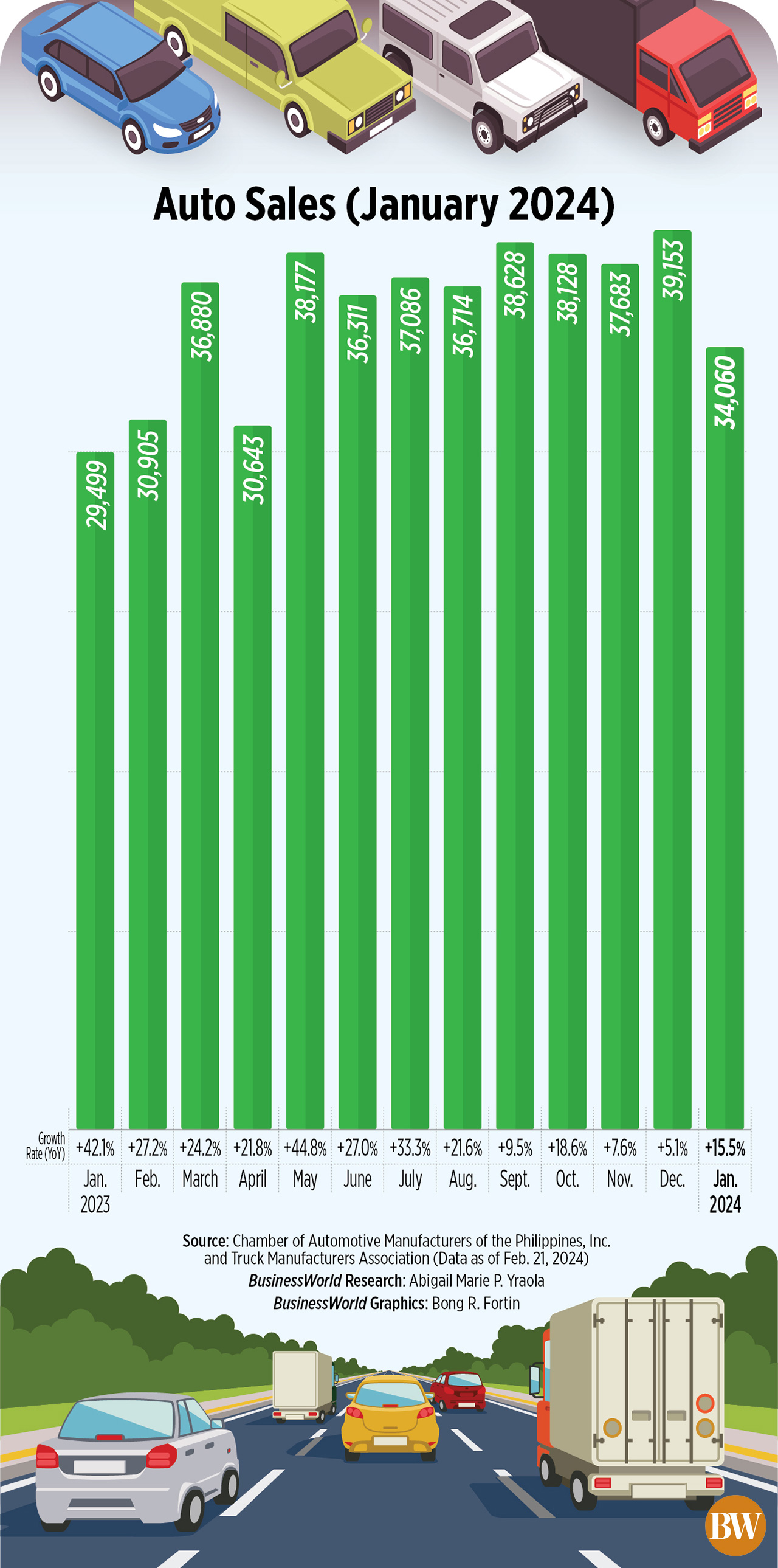
NEW VEHICLE SALES jumped by an annual 15.5% in January amid the launch of new models and the expansion of electric vehicles (EVs) in the Philippines, an industry report showed.

A joint report by the Chamber of Automotive Manufacturers of the Philippines, Inc. (CAMPI) and the Truck Manufacturers Association (TMA) showed vehicle sales increased to 34,060 units in January from 29,499 units in the same month a year ago.

Month on month, vehicle sales declined by 13% from 39,153 units sold in December when demand is typically higher.

Auto Sales (January 2024)“We are starting 2024 with positive business and consumer confidence outlook. We see new model introductions and the expansion of electrified vehicle lineup especially in the hybrid electric vehicle segment, and more brands coming into the market,”  CAMPI President Rommel R. Gutierrez said in a statement.

He noted the introduction of new models and expansion of EVs reflect a “strong and vibrant” auto market.

However, Mr. Gutierrez said the outlook remains positive despite “inflation risks and imminent taxation of double cab pickup.”

The Philippine central bank sees inflation averaging 3.6% this year, amid upside risks linked to higher prices of transport, oil, food and power rates.

The Finance department is pushing for the removal of the excise tax exemption of double cab pickup trucks as part of the proposed Passive Income Financial Intermediary Taxation Act. Pickup trucks were exempted from excise tax under the Tax Reform for Acceleration and Inclusion law.

In January, commercial vehicle sales climbed by 16.5% to 25,614 from 21,993 in the same month a year ago. This accounted for 75.2% of the industry’s total sales.

Month on month, sales of commercial vehicles declined by 13.3% from 29,554 units sold in December.

Broken down, light commercial vehicle sales went up by 13.2% to 18,965, while Asian utility vehicle (AUV) sales rose by 28.4% to 5,892. Sales of light commercial vehicles and AUVs declined on a month-on-month basis by 14.2% and 10.2%, respectively.

Sales of light trucks increased by an annual 11.4% to 412 in January, but dropped by 25.6% month on month. Medium truck sales were up 20% year on year to 282, but 1.4% down from December.

Sales of heavy trucks surged by 43.2% year on year to 63 in January, and by 16.7% month on month.

Meanwhile, passenger car sales rose by an annual 12.5% to 8,446 units in January from 7,506 units a year ago. Month on month, sales of passenger cars fell by 12% from 9,599 units in December.

Sought for comment, ING Bank N.V. Manila Senior Economist Nicholas Antonio T. Mapa said the vehicle sales growth in January reflected steady consumer demand.

“Growth was evident for both passenger cars and commercial vehicles as consumer demand proved resilient… Pent-up demand for vehicles after a more than 2-year period of hiatus helped drive demand for yet another month,” Mr. Mapa said in a Viber message.

However, he said bank data did not show a similar pickup in car loans “suggesting buyers are purchasing with cash or via other forms of financing.”

Mr. Mapa said the demand for vehicles are seen to remain “vibrant as economic growth remains robust.”

Rizal Commercial Banking Corp. Chief Economist Michael L. Ricafort attributed the double-digit sales growth to the continued recovery in the local economy.

“[Sales growth] was more than twice faster than the country’s economic or GDP growth, which has been among the fastest growing in ASEAN (Association of Southeast Asian Nations) in recent years,” Mr. Ricafort said.

The Philippine economy grew by 5.6% in 2023, this was faster than the 5.2% in China, 5% in Vietnam, and 3.7% in Malaysia.

“Consistently, Philippine vehicle sales and production are among the fastest growing in ASEAN in recent months,” Mr. Ricafort added.

Data from the ASEAN Automotive Federation showed that the Philippines had the fastest sales growth among ASEAN countries as motor vehicle sales grew by 21.9% year on year to 429,807 in 2023.

The country also registered the fastest growth in motor vehicle production, as it expanded by 19.7% to 110,350 units last year.

Both analysts said that the month-on-month decline can be attributed to seasonal demand, as December numbers typically outpace January figures.

CAMPI gave a conservative sales forecast of 468,300 units for 2024, 9% up from the 429,807 units sold in 2023.

However, the 9th Philippine International Motor Show (PIMS), which is scheduled to be held in the second half of the year, is expected to drive sales higher. “This means 2024 performance could well exceed CAMPI’s initial forecast and reach 500,000 units as motor shows generally boost sales,” the industry group said.

Mr. Ricafort said lower borrowing costs could spur greater demand for vehicles later this year.

“Further recovery of the economy would support further growth in vehicle sales, especially as possible Fed rate cuts later this year could be matched locally and lead to lower borrowing costs, which include vehicle loans, that could help spur greater demand,” he said.

In January, Toyota Motor Philippines Corp. remained the market leader with a 46.54% share as its sales rose by 19.8% to 16,093 units.

Mitsubishi Motors Philippines Corp. came in second with a 21% increase in sales to 6,085 units in January.

In third spot is Ford Motor Co. Phils., Inc. as sales jumped by 17% to 2,466 units.

Rounding out the top five were Nissan Philippines, Inc., which saw a 31.2% increase in sales to 2,463 units, and Suzuki Phils., Inc. whose sales inched up by 0.6% to 1,485 units.

House set to tackle wage hike bills next week

The House of Representatives will tackle bills seeking to hike the minimum wage by P150 on Tuesday (Feb. 27). — PHILIPPINE STAR/KJ ROSALES

THE HOUSE of Representatives is set to tackle bills seeking to hike the minimum wage by P150 next week despite concerns this would pose a significant risk to inflation and discourage the entry of foreign investments.

“We are prepared to tackle pending bills in the House related to minimum wage increases,” Marikina City Rep. Stella Luz A. Quimbo told a news briefing on Wednesday.

House Bill (HB) No. 7871, authored by Deputy Speaker and Party-list Rep. Raymond Democrito C. Mendoza, and HB No. 514, filed by Cavite Rep. Ramon B. Revilla III, are proposing a P150 across-the-board wage increase for all private sector workers, whether agricultural or non-agricultural.

“Implementing a uniform wage increase across all regions of the country, each with its unique cost of living, necessitates careful consideration. We want the wage measure to be equitable and considerate of diverse economic conditions throughout the country,” Ms. Quimbo, who is also a senior vice chairperson of the House Committee on Appropriations, said.

Last week, Iloilo Rep. Janette T. Garin said the chamber is studying a proposed P350 to P400 wage hike. Opposition congressmen also previously filed a bill seeking to increase wages by P750.

On Monday, the Senate approved on third and final reading its P100 across-the-board wage increase despite warnings that such a hike could fan inflation.

However, HSBC economist for ASEAN Aris D. Dacanay on Wednesday said a legislated minimum wage increase will likely threaten the current downward trend in inflation, because an 8% hike in wages could add 1.2 percentage points to the overall headline inflation print.

“If there’s an 8% minimum wage hike, inflation can increase by 1.2 percentage points,” Mr. Dacanay said at an economic forum hosted by the Management Association of the Philippines on Wednesday.

Headline inflation eased to 2.8% in January from 3.9% in December, the second straight month it fell within the Philippine central bank’s 2-4% target.

Mr. Dacanay said that if the proposed legislated wage hikes were approved, or other risks to the inflation outlook materialize this year, the Bangko Sentral ng Pilipinas (BSP) may keep policy rates higher for longer.

“The BSP has room to delay its rate cuts mainly because we don’t have the growth problem,” he said. “Growth has been really strong so the BSP can really take its time. It has the luxury of time to be able to wait for inflation to stay within target before cutting rates.”

Last week, the BSP kept the key rate at 6.5% — the highest in nearly 17 years — for a third straight meeting as widely expected.

HSBC Global Research expects the BSP to cut policy rates by 25 bps in June, after the US Federal Reserve starts its own policy easing in the same month.

Mr. Dacanay sees the BSP slashing rates by a total of 75 bps this year, and by another 75 bps in 2025.

HSBC Global Research projects Philippine inflation to hit 3.5% this year, before picking up to 3.8% in 2025.

Last week, the BSP lowered its baseline inflation forecast for this year to 3.6% from 3.7%, but kept its projection for next year at 3.2%. Should risks materialize, inflation may hit 3.9% in 2024 before easing to 3.5% in 2025.

BSP Senior Assistant Governor Iluminada T. Sicat has said the BSP’s baseline inflation projections did not take the most recent wage hike proposals into account.

Based on the BSP’s latest monetary policy report, the baseline forecast includes the P40 minimum wage hike in the National Capital Region in July last year and the 8.7% average wage increase for non-agricultural workers in areas outside Metro Manila.

The central bank also factored in possible wage adjustments of P28 in August this year, and P29 in September 2025. If realized, this would be equal to an annual increase of 4.6% for both years, in line with historical wage increases.

“(If) the assumed increase in minimum wage is beyond what we have incorporated in the baseline… this could pose a threat to the inflation outlook in the future,” Ms. Sicat had said.

The BSP has also flagged other upside risks to inflation such as higher transport charges, increased electricity rates, higher oil and domestic food prices, and the additional impact on food prices of a strong El Niño episode.

BUSINESS GROUP REACTS
Meanwhile, the Philippine Chamber of Commerce and Industry (PCCI) said a legislated wage hike could discourage foreign investors from entering the country.

“No one would ever try to look at the Philippines once they see that legislators can enact wage hikes anytime, even disregarding the authority of the National Wage Board,” PCCI President Enunina V. Mangio said in a statement.

The country’s last legislated wage hike was enacted in 1989. Republic Act No. 6727 or the Wage Rationalization Act raised the minimum wage by P25 to P89. The law also created the regional wage boards, which currently review and approve wage hike proposals.

Ms. Mangio said the Senate’s proposed P100 wage hike bill is unlikely to benefit the around 47 million workers in the informal sector.

“The P100 proposed wage will not even be enough when inflation goes up. Why don’t we instead legislate measures to address the rising cost in food prices and other issues that hamper our economic growth?” she added.

IMPACT OF WAGE HIKE
Trade Secretary Alfredo E. Pascual said the government is still studying the impact of the proposed wage hikes.

“We’re studying the impact on our end. I’ve not received the report yet of our analysts,” he told reporters on the sidelines of an economic forum on Wednesday.

For her part, Ms. Quimbo said lawmakers will consider the varied effects of wage hikes per region in their deliberations.

“A P100 wage hike in the National Capital Region is equivalent to a 16% increase, but in regions like the Zamboanga Peninsula, the increase would be about 26%,” she said in Filipino.

Metro Manila’s daily minimum wage rose by P40 to P610 in June, much lower than the P570 increase sought by some labor groups.

A family of five would need at least P13,797 a month or P460 a day to meet their basic needs, according to the Philippine Statistics Authority.

Meanwhile, Manila Rep. Joel R. Chua proposed a three-year staggered wage increase to offset its possible costs to employers.

“Under this format, hikes would be scheduled. Businesses, as well as the entire economy, wouldn’t be shocked,” he said in a statement in Filipino.

GoNegosyo founder Jose Ma. “Joey” A. Concepcion III said he also supports a staggered implementation of wage hikes, but expressed concern it may affect many enterprises.

“Not everybody can afford the P100 wage increase. Maybe the large corporations and those who are doing well but many are also not doing well. The micro might be exempted, but what about the medium-sized enterprises? They will be affected,” he said in a statement.

Deputy Minority Leader and Party-list Rep. Bernadette Herrera-Dy said wage hike proposals must include subsidies to ensure that employers would comply.

“A government wage subsidy covering most or all of the Cost of Living Allowance (COLA) component of wage orders can be among the incentives,” she said in a statement.

Foundation for Economic Freedom President Calixto V. Chikiamco said that subsidizing wage hikes won’t be enough, as smaller enterprises may just choose to lay off workers to cut costs or even close down.

“Small enterprises — for example, restaurants — will suffer additional costs and will have to pass on these mandated wage increases to their customers,” he said in a Viber message.

About 99.58% of Philippines’ business establishments are micro, small, and medium enterprises (MSMEs), the Department of Trade and Industry said in a 2021 report.

To help consumers, Mr. Chikiamco proposed to instead reduce tariff rates on rice imports to 10% from the current 35%.

This would “expand the minimum access volume of chicken, corn, pork, and fish, to reduce the cost of food, which will benefit not only formal wage workers but also informal workers,” he said. — Beatriz Marie D. Cruz and Keisha B. Ta-asan


ADVERTISEMENT
ADVERTISEMENT