Home Blog Page 3610

CTA affirms decision granting part of geothermal company’s refund claim

CTA.JUDICIARY.GOV.PH

THE COURT of Tax Appeals (CTA) has upheld its decision to grant Philippine Geothermal Production Co., Inc.’s (PGPCI) refund claim in the amount of P23.27 million representing its excess input value-added tax (VAT) traced to zero-rated sales for the first three quarters of 2016.

In a decision dated Feb. 20, the tribunal said the PGPCI did not need to directly trace its input tax to 0% VAT for it to seek a valid refund.

“The Tax Code does not require the input tax to be directly attributable to zero-rated sales to be refundable or creditable,” CTA Associate Justice Maria Rowena Modesto-San Pedro said in the ruling.

The commissioner of internal revenue (CIR) argued that the tribunal should have denied its claim since PGPCI failed to prove that its input taxes were directly traced to zero-rated sales.

Under the Tax Code,  zero-rated sales are transactions made by VAT-registered taxpayers that do not translate to any output tax.

The term “zero-rated sale” must be written on the company’s official receipts.

The CTA said no provision in the law requires input tax to be directly attributable to a zero-rated sale to be refundable.

It said zero-rated sales only require that the transaction paid in connection with the entity’s business should be backed by official invoices or receipts.

“The High Court ruled that ‘the findings of fact by the CTA in Division are not to be disturbed without any showing of grave abuse of discretion…,” it said.

“Evidently, contrary to the CIR’s allegation, the attribution of the input VAT to the zero-rated sales need not always be direct.” — John Victor D. Ordoñez 

Cebuana Lhuillier, Packworks boost MSME growth with sari-sari store inventory financing ‘Sari Fund’

There are around 1.3 million sari-sari stores, or neighborhood mom-and-pop shops, in the Philippines, serving as the primary source of daily essentials for about 94% of Filipino consumers. Yet, services for their business growth are limited, leaving them unbanked and operating cash-in-hand.

Recognizing this challenge in the grassroots retail sector, Packworks, a Filipino startup offering a business-to-business (B2B) fast-moving consumer goods (FMCG) marketplace for sari-sari stores, and Cebuana Lhuillier’s Kanegosyo Center have teamed up to launch Sari Fund, an inventory financing service aimed at providing support to sari-sari stores nationwide.

Sari Fund empowers sari-sari store owners with the financial freedom to stock up on their inventory to boost the growth of their business. Through Packworks’ Sari.PH app, Kanegosyo Center will provide eligible users with an exclusive credit line that they can use to purchase inventory from partner megastores. To make the service affordable, eligible sari-sari store owners only pay a minimal transaction fee so they can focus on growing their business.

The unique inventory financing program comes as a crucial tool for small enterprises like sari-sari stores, which often face significant financial challenges, primarily due to limited access to traditional banking services and credit facilities.

With Sari Fund, micro-retail stores are able to stock inventory without the immediate burden of upfront costs, allowing them to maintain a robust array of items catering to the needs of their communities while also enabling them to grow and stabilize their businesses.

Leveraging technology to provide easy, simple, and affordable credit lines, the strategic partnership between Packworks and Cebuana Lhuillier’s Kanegosyo Center aims to overcome the traditional barriers in empowering the unbanked and underbanked sectors through the innovative inventory financing program.

“The dynamic alliance between Cebuana Lhuillier’s Kanegosyo Center and Packworks exemplifies a harmonious strategy in advancing financial inclusion for MSMEs. Through the fusion of technology, they dismantle conventional barriers, presenting groundbreaking and accessible micro-financing solutions to empower the unbanked and underbanked segments,” Cebuana Lhuillier President and CEO Jean Henri Lhuillier said.

“Sari Fund is more than just a financial solution but a beacon of hope for the heart and soul of our communities — the sari-sari stores. We believe that by unlocking their potential, we’re contributing to a more vibrant and resilient MSME (micro, small, and medium-sized enterprise) sector in the Philippines. Through this partnership, we are not only providing essential financial support but also fostering financial inclusion. This is a significant step towards a future where every sari-sari store owner has the opportunity to grow and succeed,” Packworks Co-Founder and Chief Executive Officer Bing Tan said.

Sari Fund comes timely as the MSME sector will need a much-needed boost for 2024 when high inflation is still expected, posing a challenge for small businesses. Analysts expect elevated inflation to affect the country’s economic performance this year with the onset of El Niño. According to a 2023 study conducted by Packworks, the country’s inflation can be felt worse in sari-sari stores, with food prices as high as 15% in these stores last year.

The Philippine Statistics Authority reported that nearly all businesses in the Philippines are categorized as MSMEs, making up 99.58% of the total.

Movate eyes more delivery centers, targets emerging cities

DIGITAL TECHNOLOGY services company Movate, Inc. is planning to build additional delivery centers in the Philippines, mainly in emerging cities, a company official said.

“We think we are looking for the emerging cities as we look to expand and grow. In order to get to 6,000 people, we need to find the next location,” Aaron Fender, executive vice-president and chief delivery officer of Movate’s digital CX business, said in an interview last week.

The company opened its third delivery center in Antipolo City last week.

Movate’s three delivery hubs in the country are all located in Metro Manila, Mr. Fender said, adding that it is eyeing to put up delivery hubs outside the country’s capital.

“Basically, with the clients we serve and the offerings we have and given that we have very innovative offerings, platform-led, we believe that will drive the growth for us,” Movate Chief Executive Officer Sunil Mittal said.

To date, the company has over 3,000 employees in the country, Mr. Mittal said, adding that in the next three years, it hopes to double its current workforce to 6,000.

Movate, formerly CSS Corp., has operations in the US, Europe, Asia Pacific, and Africa. The company’s clients include telecommunications, gaming, media and entertainment, and mobility.

“The Philippines is a very important geography in our growth journey. A lot of demand for the country in the US, it was clear that we had to expand in the Philippines,” Mr. Mittal said.

Aside from expanding outside Metro Manila, Mr. Mittal said the company may also scale up its newest delivery center, located in East Gate Business Center.

“We want to scale here itself, in this building. That is the immediate next step. Based on the business demand, either we will expand here or we will pick up some other city in the Philippines for sure,” Mr. Mittal said. — Ashley Erika O. Jose

The Mandanas ruling and DepEd devolution

PHILIPPINE STAR/EDD GUMBAN

In previous articles, we have argued that the Department of Education (DepEd) as presently organized has failed in its mission to provide quality education for all. This calls for the drastic reforms that we are proposing.

In this article, we argue that the Mandanas ruling renders our proposal to devolve the operation of the public elementary and high schools from the Department of Education to the local government units (LGUs) timely and necessary.

Firstly, a study conducted by the Cristina Research Foundation (full disclosure, we are chairman of the Cristina Research Foundation) compared the basic educational system of the Philippines with those of Brazil, Indonesia, Norway, and the United States of America.

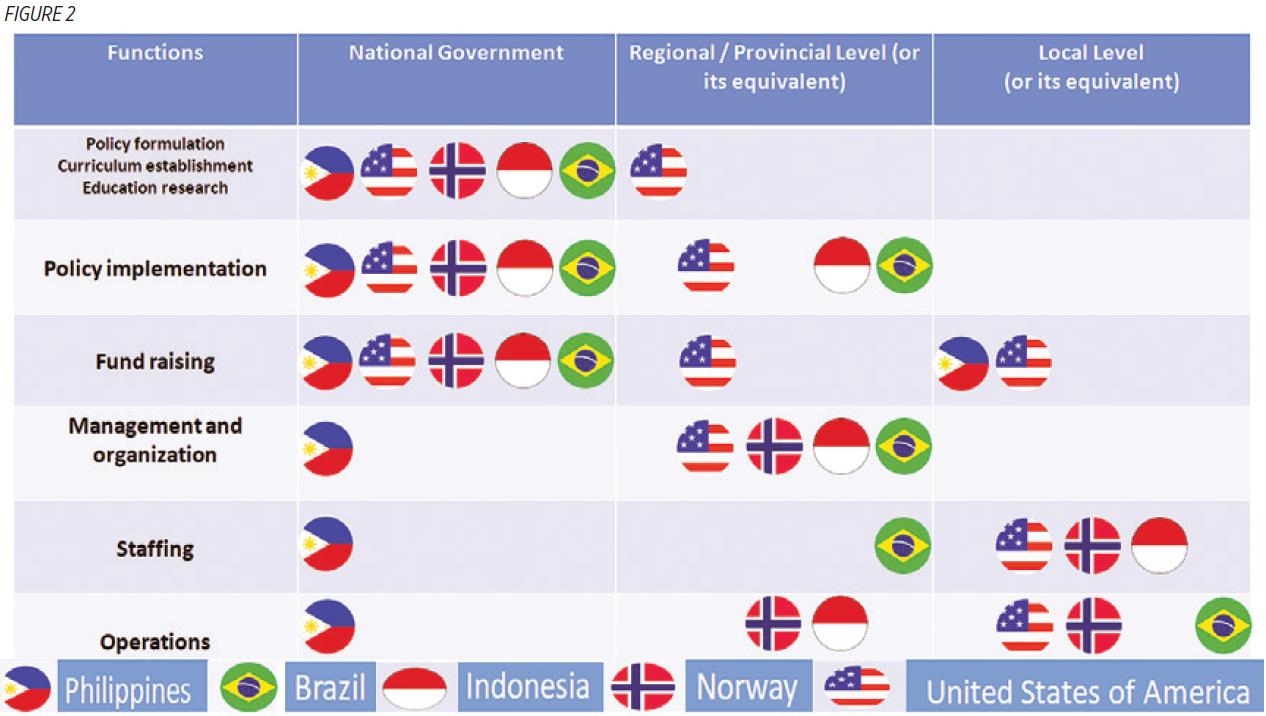
The comparison considered the six functions of: 1.) Policy formulation, curriculum establishment, 2.) policy implementation, 3.) fund raising, 4.) management and organization, 5.) staffing, and, 6.) operations and in which government levels they are lodged — National Government, regional/provincial government, and local government. (See Figure 2.)

The study found that among the five countries, the Philippines is the most highly centralized with the LGUs limited to maintaining infrastructure, and funding sports activities and contributions through the Special Education Fund.

The World Bank confirms this prevailing view, “Many developing countries have devolved the responsibility for education services to local governments in an effort to improve educational quality and make public spending more efficient. Advocates of decentralization have argued that bringing decision making closer to schools makes public policy more responsive to local needs, strengthens accountability, and fosters innovation.” (“Assessing the Role Played by Local Government in Supporting Basic Education in the Philippines,” Philippine Education Note, World Bank Group and Australian Aid, June 2016).

Secondly, the passage of the 1991 Local Government Code marked a significant shift in the approach to local development and service delivery. It provided the framework for the devolution of local public administration and service delivery responsibilities to local government units. It also provided local governments with enhanced revenue-mobilization powers and access to financing, which would accompany the increase in spending on devolved mandates. The objectives were to improve local service delivery and facilitate widespread socioeconomic development by bringing resource allocation and prioritization closer to constituents.

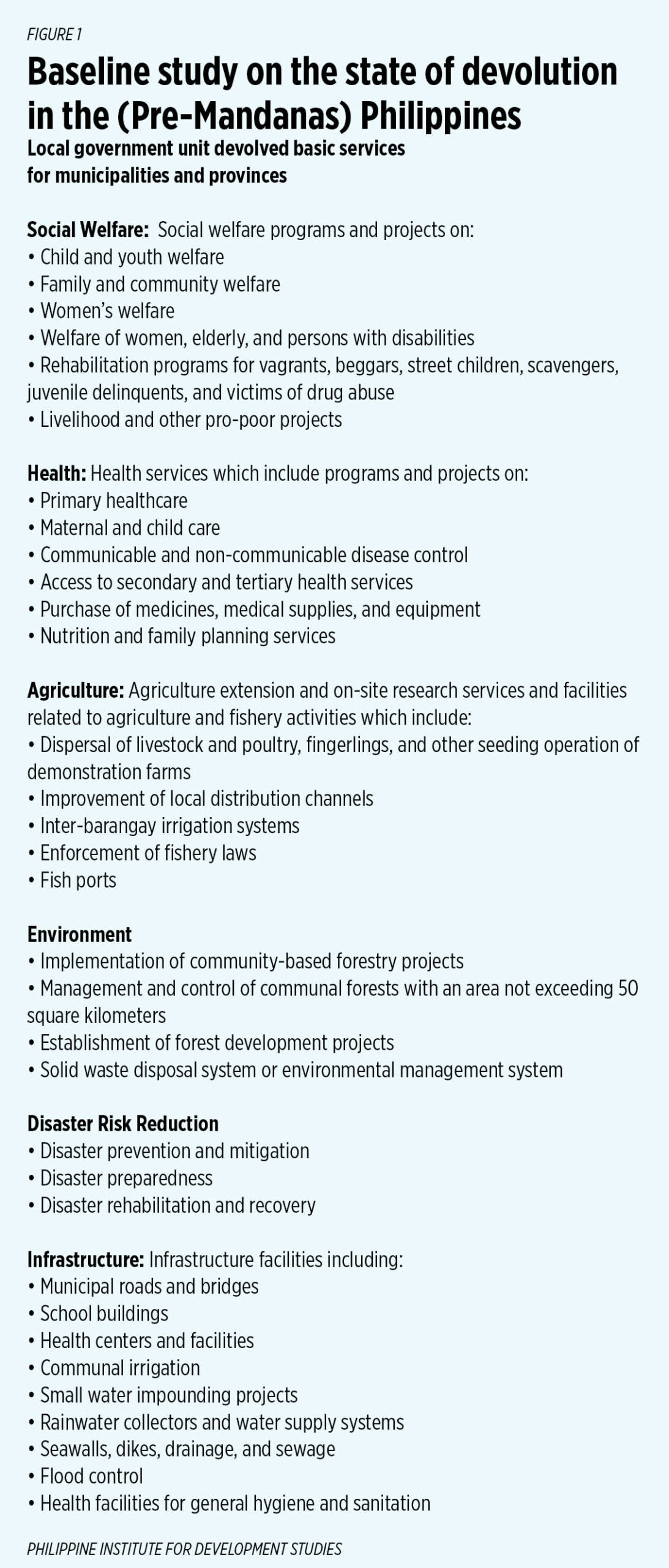
The Department of Health (DoH) was the first to devolve its operation in 1992 and has done so successfully. Today, there are 1,800 hospitals in the Philippines, of which 721 are public hospitals and the DoH operates only 70 of them.

See Figure 1 for the current state of devolution in the Philippines. Note that only Education and the National Police have not been devolved.

The proposal to devolve education to the local government units comes at just the right time given the Mandanas ruling of the Supreme Court.

There was a major development in Philippine decentralized governance in 2022 with the implementation of the Mandanas-Garcia Supreme Court (Mandanas) ruling. The Supreme Court (SC) ruled that the just share of LGUs from national taxes is not limited to “national internal revenue taxes” collected by the Bureau of Internal Revenue (BIR) but includes collections (customs duties) by the Bureau of Customs (BoC).

This SC decision effectively increases the base from which to compute the intergovernmental fiscal transfer now known as the National Tax Allotment (NTA). This amounts to a 38% increase in the overall NTA settlements at a total of P959 billion or almost 20% of the 2022 national budget of P5.024 trillion and roughly 4% of GDP.

The World Bank in its June 2021 Philippine Economic Updated stated:

“We look at the implementation of the Mandanas ruling not just as a transfer of resources but an opportunity to strengthen decentralization and improve social service delivery in the Philippines.

“If this ruling leads to better coordination in planning and implementation across levels of government, taking into account the capacity and needs of LGUs, it could improve the lives of people and communities especially those that far from the country’s economic growth centers.

“Local governments are on the ground and can directly feel citizen’s needs and aspirations. Hence, decentralization encourages prompt responses and better matching of government services to local needs, making governance more inclusive. This is especially true if citizens have effective channels through which their voices are heard to enhance accountability.”

The President also took cognizance of the implication of the Mandanas ruling. In a press release (“PBBM orders National Government agencies to analyze full devolution initiative; come up with a list of functions of LGUs”) on Dec. 25, 2023, the Presidential Communications Office stated:

“President Ferdinand R. Marcos, Jr. has ordered National Government agencies (NGAs) to conduct an analysis on the operationalization of the full devolution initiative and come up with the list of functions that should be devolved to the local government units.

“President Marcos ordered the National Economic and Development Authority (NEDA) to conduct a sensitivity analysis on the most that the government can gain from its investments, which include the functions and services to be performed by the LGUs.

“The NEDA is also tasked to recommend ways to better implement a phased-in devolution, including its timeline based on LGU capacity, which is in addition to the ongoing study on the determinants of functions and services that should performed by the NG and devolved to LGUs. President Marcos ordered the NEDA to complete the study and submit it to the Office of the President by end of February 2024.

“The President also ordered the Department of Interior and Local Government (DILG), in collaboration with the Union of Local Authorities of the Philippines, to come up with a list of basic functions and services that the LGUs should be performing based on their Devolution Transition Plans, and of the National Government. The DILG is given until January 2024 to present to the President the list by January 2024, or a month earlier than the analysis report of the NEDA.”

We are hoping that both NEDA and DILG will seriously consider our proposal to devolve the operation of the public elementary high schools from the Department of Education to the local government units.


Dr. Victor S. Limlingan is a retired professor of AIM and a fellow of the Foundation for Economic Freedom. He is presently chairman of Cristina Research Foundation, a public policy adviser and Regina Capital Development Corp., a member of the Philippine Stock Exchange.

Onsite mandates for BPOs require careful handling — KMC Savills

PHILSTAR FILE PHOTO

REAL ESTATE brokerage and consultancy firm KMC Savills has cautioned against requiring business process outsourcing (BPO) firms in economic zones to conduct on-site work, stressing the importance of careful handling and maintaining a liberal environment conducive to private companies.

“We have to be careful in terms of issuing mandates to companies and businesses on how to run their business, in terms of what they should and should not be doing,” KMC Savills Chief Executive Officer Joe Curran said on the sidelines of a media briefing in Taguig City last week.

“It is important that Western corporates feel like they’re working with the government on a liberal environment where they’re not being dictated to as to what they do,” he added.

Mr. Curran also said that companies are faced with a challenge of making their offices more appealing to employees.

“I think the challenge for companies is really to make their offices as places where people will want to come and work… One of the good things about working in the Philippines is the office culture. It’s such a fun environment and it’s such a great environment to work in,” Mr. Curran said.

“We have to understand that the Philippines is also in competition with other markets when it comes to attracting BPO work. We’re in competition with Malaysia, India, and markets around Southeast Asia or Eastern Europe, also the emergence of Africa as well, for some of these roles,” he added.

On January 3, the Justice department issued a legal opinion on the eligibility of tax incentives for registered business enterprises (RBEs) regarding remote work, saying that BPO companies within economic zones must work onsite to maintain their tax benefits.

Justice Secretary Jesus Crispin C. Remulla said that Section 309 of the Corporate Recovery and Tax Incentives for Enterprises (CREATE) law “requires registered projects under an investment promotion agency (IPA) administering an ecozone or freeport to be exclusively conducted or operated within the geographical boundaries of the zone or freeport.

The country could expand hybrid work for the BPO sector via several pending legislative proposals.

Under the CREATE to Maximize Opportunities for Reinvigorating the Economy (CREATE MORE) bill, the BPO sector will be allowed to “conduct business under alternative work arrangements.”

The Fiscal Incentives Review Board previously allowed RBEs to move their registration to the Board of Investments from the Philippine Economic Zone Authority if they wanted to continue with their remote work arrangements and retain tax incentives.

For 2024, the local BPO industry is aiming a 7-8% growth in head count, with a revenue of $39 billion. It generated $35 billion in revenue and employed 1.7 million last year. — Revin Mikhael D. Ochave

Milan Fashion Week: Dolce & Gabbana plays with the tuxedo for womenswear

DIESEL — PH.DIESEL.COM

MILAN – Dolce & Gabbana offered an array of looks inspired by the tuxedo at Milan Fashion Week on Saturday, where the Italian luxury label presented a mainly black womenswear collection for next fall.

The autumn/winter 2024 show, called “Tuxedo,” opened with cropped jackets and tied skirts slit at the front, followed by outfits and coats inspired by the formal wear. (See the show here: http://tinyurl.com/2p7c3a48)

Models wore sashes with knee-length shorts or cigarette trousers, halter necks and waistcoats inspired by tuxedo jackets and embroidered lace dresses.

Designers Domenico Dolce and Stefano Gabbana put bows on black sheer blouses as well as shoes, sometimes sparkling.

The looks were mainly all in black, with dabs of leopard print, a few shimmering silver creations and a chiffon blouse and dress adorned in large gold polka dot prints.

Models, including Naomi Campbell, wore black hats with netted veils.

FERRAGAMO
Earlier at Ferragamo, designer Maximilian Davis looked to the 1920s for inspiration, presenting dresses with dropped waistlines, feather embellishments or sequins. (Watch the show here: http://tinyurl.com/428kdnut )

Wool jackets and coats with broad shoulders were contrasted with organdie dresses and sheer skirts in the collection called “Spirit,” and which featured autumnal hues, bright red, mustard and black. Footwear consisted of thigh-high boots, stilettos, and shoes adorned with feathers. “The 1920s used clothing as a way to celebrate freedom,” Mr. Davis said in show notes. “And that expression of freedom is something which resonates with me, with my heritage, and with Ferragamo.”

GUCCI
Gucci creative director Sabato De Sarno showed a lineup of ornately decorated wool coats on the catwalk in Milan on Friday, building on his approach for reigniting Kering’s prized label with sensual, pared-back styles. (See the looks here: http://tinyurl.com/5hf988fw )

Models marched down a slightly elevated runway in a sparse, window-lined space parading soft wool coats, long bustier dresses and trim suit jackets cinched with thin belts.

Adding to the chunky loafers, mini-shorts and glossy Jackie handbags that have become label signatures under the new designer’s direction were thigh-high riding boots, small purses shaped like half moons, towering platform heels and delicate, see-through dresses with lace.

Mr. De Sarno’s designs, which have begun trickling into stores, are key to reigniting sales at Gucci, Kering’s largest brand, accounting for half of the French luxury group’s sales and over two thirds of its profit.

The French group recently overhauled top management, sending longtime executive Jean-Francois Palus to Italy to manage the label as it pushes Gucci upmarket.

This consists of emphasizing more classic styles and leather goods in a bid to regain traction after losing ground to rivals like LVMH’s Dior and Louis Vuitton.

Stores will not be fully stocked with Mr. De Sarno’s styles until later in the year — perhaps by June — but early signs are “very encouraging,” Kering deputy CEO Francesca Bellettini said earlier this month.

The group cautioned that margins will be lower this year as it continues to invest in Gucci.

UBS analysts have flagged early signs of “improving brand heat,” noting Gucci is “in a much better place than before,” earlier this month.

PRADA
Italian luxury label Prada said it looked to the past for its latest womenswear line at Milan Fashion Week on Thursday, presenting a collection that played with contrasts and feminine touches. (See the show here: http://tinyurl.com/3xffaju4)

Designers Miuccia Prada and Raf Simons kicked off the fall/winter 2024 womenswear show, called “Instinctive Romance,” with an all-black dress with flappy embellishments.

The creative duo cut dark wool skirts to reveal a white or colorful silky layer underneath or behind.

There were bomber jackets, a coat nodding to 1950s silhouettes, and slim pencil skirts worn with fitting knits.

“We strive to create something beautiful, and we cannot talk about beauty without looking at the past,” Simons said in show notes. “In this complicated moment, it is essential to know our history, who we are.”

The designers overall chose a slim silhouette: Some models wore buttoned up shirts tucked into floor-length skirts in soft pale colors.

Sleeveless dresses came in cream or pink, with floral embellishments. Some had bows, a feature also seen on the back of some skirts and on ribbon belts.

“We looked at the idea of romance, which is perhaps still considered a taboo at the moment, especially in fashion,” Miuccia Prada said. “The dresses in this collection reveal a sense of romance.”

Prada is known for its leather goods and models wore their handbags suspended from a strap on their lower arms. Hats were reminiscent of military caps, and some models wore small-framed sunglasses.

A selection of black looks wrapped the show, where a see-through catwalk overlooked a set designed to look like a stream and grass.

EMPORIO ARMANI
Giorgio Armani also used a lot of black for his second line Emporio Armani. (See the show here: http://tinyurl.com/57ke6zdb)

Models wore all black daytime outfits and eveningwear, some of which sparkled with silver or colorful shimmers.

He paired trouser suits with long shirts, offered an array of chic blazers and sleek coats as well as soft, floaty dresses in ivory with pink and blue prints.

Moon and star embellishments adorned some outfits, including the black creations for the finale where models carrying umbrellas walked under fake falling snow. “I wanted to be consistent with my beliefs, clothes that you put on, there’s a few spots that are a little over the top… but I feel like it’s all very wearable,” Mr. Armani told reporters.

DIESEL AND FENDI
Diesel livestreamed its preparations for Milan Fashion Week and highlighted its online audience at its runway show last Wednesday while a protester stormed the Fendi catwalk on the second day of the city’s leg of the autumn/winter 2024 catwalk calendar. (Watch the Diesel show here, starting at 22 minutes on the video: http://tinyurl.com/4tdctezn)

Creative director Glenn Martens took the unusual step of sharing the behind-the-scenes preparations from its atelier, fittings and catwalk space ahead of the Diesel show.

In a further bid to draw in online fans, giant screens showed some of them dialing in via video call on Wednesday to watch the show alongside guests by the catwalk and hear models’ names being called backstage as they entered.

Mr. Martens opened the show with mainly dark looks — a grey shirt, a matching black shiny coat and trousers as well as vests and dresses with cut-out sheer tops.

Dresses came in mixed leopard and floral prints, coats were shaggy and fluffy and there were plenty of denim looks.

At Fendi, which is known for its use of fur, a protester from animal rights organization PETA briefly stormed the catwalk carrying a banner reading “Animals Are Not Clothing.” The protester, who also had “Turn your back on animal skin” written on her back, was swiftly escorted off. (See the show here: http://tinyurl.com/2twf778w )

ALBERTA FERRETTI
At Alberta Ferretti, pleats and metallic embellishments dominated the runway. (See the show here: http://tinyurl.com/3ded8s9w)

Ferretti opened the show with dark colors: long black pleated skirts with paired lace trimmed tops and wide-legged grey trousers worn with black sheer shirts.

Brown trouser suits with orange or green shirts followed and there was also a range of dresses that were sleek and floor-length or short and sparkly.

Metallic embellishments adorned jackets, tops as well as evening wear.

The label is part of Italian fashion group Aeffe, which also owns Moschino and other brands and which reported a 9% decrease in sales last year, to 319 million euros ($345 million), mainly due to a slowdown in the European and American markets.

Asked about his 2024 outlook, Aeffe Executive Chairman Massimo Ferretti told Reuters in e-mailed comments: “We are fully aware of the complexities of the moment, but at the same time we are very confident about the results we can achieve this season with our (new) collections.” — Reuters


T-bill, bond rates may climb following RTB offer

BW FILE PHOTO

RATES of Treasury bills (T-bills) and Treasury bonds (T-bonds) to be auctioned off this week could mirror the increase in secondary market yields following weaker demand for debt amid the government’s retail bond offering.

The Bureau of the Treasury (BTr) will auction off P15 billion in T-bills on Monday, or P5 billion each in 91-, 182-, and 364-day papers.

On Tuesday, it will offer P30 billion in fresh 20-year T-bonds.

T-bill and T-bond rates may climb to track the rise in secondary market yields last week, which came amid decreased liquidity due to the government’s offering of retail Treasury bonds (RTBs), Rizal Commercial Banking Corp. Chief Economist Michael L. Ricafort said in a Viber message.

“There were reports that the RTB offering could have exceeded the target of P400 billion, thereby mopping up some of the excess liquidity from the financial system, increase the supply of government securities, and partly led to the upward correction in PHP BVAL (Bloomberg Valuation Service) yields recently,” Mr. Ricafort said.

Meanwhile, the 20-year bonds to be offered on Tuesday could fetch rates ranging from 6.25% to 6.375%, with demand expected to be strong, a trader said in an e-mail.

At the secondary market on Friday, rates of the 91-, 182-, and 364-day T-bill rates went up by 5.22 basis points (bps), 4.48 bps, and 5.32 bps week on week to end at 5.6226%, 5.9045%, and 6.1323%, respectively, based on PHP BVAL Reference Rates data published on the Philippine Dealing System’s website.

The 20-year bond also rose by 4.24 bps week on week to yield 6.3995%.

The BTr borrowed a record P584.86 billion from its offering of five-year RTBs, it said in a statement over the weekend.

Secondary market yields rose as strong US economic data recently bolstered views that the Federal Reserve could push back its rate cuts, Mr. Ricafort added.

Last week, the BTr raised P14.5 billion from its offering of T-bills, lower than the planned P15 billion, even as total bids reached P30.444 billion or more than twice the amount on the auction block.

Broken down, the Treasury awarded only P4.5 billion in 91-day T-bills, below the P5-billion program, despite tenders for the tenor reaching P6.072 billion. The average rate for the three-month paper rose by 8.6 bps to 5.592%. Accepted rates ranged from 5.55% to 5.65%.

Meanwhile, the government raised P5 billion as planned from the 182-day securities as bids stood at P10.26 billion. The average rate for the six-month T-bill stood at 5.972%, up by 9.3 bps from the previous week, with accepted rates at 5.894% to 5.95%.

Lastly, the BTr borrowed the programmed P5 billion via the 364-day debt papers as demand for the tenor totaled P14.112 billion. The average rate of the one-year T-bill inched up by 1.5 bps to 6.079%. Accepted yields were from 6.05% to 6.09%.

The BTr plans to raise P150 billion from the domestic market this month, or P60 billion via T-bills and P90 billion through T-bonds.

The government borrows from local and foreign sources to help fund its budget deficit, which is capped at 5.1% of gross domestic product this year or P1.39 trillion. — A.M.C. Sy

Seaweed ambitions face funding constraints

PRDP.DA.GOV.PH

By Adrian H. Halili, Reporter

THE seaweed industry is running up against funding constraints which could foil the government’s plans to develop the sector’s export potential, analysts said.

Danilo V. Fausto, president of the Philippine Chamber of Agriculture and Food, Inc., said the seaweed industry needs an allocation of up to P250 million to significantly boost production.

Last week, the Department of Agriculture (DA) said that it is seeking to reclaim the Philippines’ spot as the top exporter of seaweed.

“Budgetary support from the government is necessary to expand seaweed farms given that the country has a huge untapped potential for seaweed production,” Mr. Fausto said on Viber.

Agriculture Secretary Francisco P. Tiu Laurel, Jr. has said that the DA has allocated P1 billion for the construction of large tissue culture laboratories, dryers, warehouses, and technical training.

Mr. Fausto said that the Philippines has 102,000 hectares of municipal waters that can be used for seaweed production. Only 17,000 hectares are currently in use, with most farms being located in Mindanao.

He said that seaweed accounts for over 30% of fisheries production, with 72% of seaweed producers located in the Bangsamoro Autonomous Region in Muslim Mindanao and Zamboanga Peninsula.

The DA is hoping to expand seaweed production sites by 85,000 hectares.

Retired Pampanga State Agricultural University professor Roy S. Kempis said in a Viber message that he is not necessarily in favor of expanding production with the aim of reclaiming the top producer spot.

“Rather, the expansion and the investment required must strike a balance between addressing the domestic needs and wants of the commodity and harnessing or capturing a part of the export market,” Mr. Kempis said.

He said that aside from financial support, producers must also receive investment assistance involving seedlings, implements, lines, floaters, and counterweights.

According to the DA, the Philippines accounted for 80% of the world’s seaweed requirement in 1990, while Indonesia produced 10%.

Mr. Laurel said that Indonesian output is now five times that of the Philippines.

Mr. Fausto warned that the US government, through the National Organics Standards Board, is reviewing the organic status of carrageenan, a seaweed product.

“Delisting carrageenan would imperil the Philippine market share in the US (52%, valued at about $40 million), and have a potential adverse effect on the European market (18% market share, about $75 million), due to disinformation about carrageenan safety,” he added.

Seaweed production rose 5.3% to 1.6 million metric tons in 2023, according to the Philippine Statistics Authority.

Achievements and aspirations

Incoming TMP President Masando Hashimoto steps into the limelight. — PHOTO BY KAP MACEDA AGUILA

Toyota PHL fetes outgoing Mr. Okamoto, welcomes new chapter with youngest-ever president

“HIS ARRIVAL was literally earth-shaking.”

Not a few laughs reverberated in the Grand Hyatt’s main ballroom last Tuesday when Toyota Motor Philippines Corp. (TMP) Chairman Alfred Ty recalled with a smile the beginning of Atsuhiro Okamoto’s stint as TMP president in January 2020. From an onstage podium, he narrated: “He was greeted by the eruption of Taal Volcano after over 40 years of quiet, triggering almost 600 volcanic earthquakes in just four days. Little did we know that this was only the tip of the iceberg of the challenges that Okamoto-san or AO-san would face.”

Mr. Okamoto’s presidency had progressed uneventfully for but a few weeks — and he began it with a tenor that would mark his tenure despite everything that would happen later. The man wanted to be where the people were. That meant opening his own Facebook page to make him and what he did more accessible and visible. The executive had posted, “During my first week in the Philippines, I decided to do genchi genbutsu, or to ‘go and see’ the daily struggles of Filipino commuters. I rode a bus, took a round trip of the MRT, rode the jeepney, queued for a long time to ride the UV Express, and lastly, took a tricycle ride to Tondo! For me, it’s a good learning experience. I realize that unlike Japan or Singapore, the Philippines’ current mass transport system is not enough to accommodate the huge number of daily commuters. I would like Toyota to take part in this big challenge to upgrade the quality of life for many Filipinos.”

Unfortunately, as Mr. Ty later said, COVID-19 happened. This scuttled our plans, dashed hopes, and even took away people we loved. “The economy went into a tailspin, lives and livelihood were disrupted, and there was no answer in sight. The challenges mounted and were even compounded by extraordinary weather disturbances and geo-political conflicts,” the executive rued.

Nonetheless, Mr. Okamoto, his management team, and the network of dealerships took on challenges with an unflinching resolve. At the end of it all, TMP extended its reign as perennial triple crown holder (leading the country in overall vehicle sales, passenger car sales, and commercial vehicle sales) for 22 straight years by the end of 2023.

TMP came out of the crucible of the pandemic cornering nearly half of the Philippine auto market — and remains well-positioned to realize even further growth in 2024.

“Through it all, Okamoto-san charged ahead with steadfastness and courage, showing the way for all of Team Toyota, bringing hope where there was confusion — always with a smile and a good word for everyone,” maintained Mr. Ty.

“Looking back, I could say that those four years were among the most challenging, but also the most meaningful part of my life. And I am very thankful to have experienced it with you,” declared Mr. Okamoto during his own speech.

The turnover ceremony saw “AO” formally succeeded by former TMP Senior Vice-President Masando Hashimoto — who at 46 years of age is the youngest ever to helm the company.

In a previous interview with this writer, Mr. Okamoto said his next assignment will find him back with Toyota Motor Corp. in Japan — specifically in Nagoya, where his family lives. An economics graduate of the Keio University in Tokyo, the executive has more than three decades of cumulative experience in both the Lexus and Toyota brands, having joined TMC in 1992. According to the GT Capital Holdings 2022 Integrated Report, Mr. Okamoto was tapped in 2012 as department general manager of the Lexus Planning Division. Three years later, he found himself seconded to Toyota Motor Asia Pacific (TMAP) as vice-president for marketing and sales. Immediately before his posting at TMP, he was EVP at TMAP.

Meanwhile, Mr. Hashimoto similarly paid tribute to his predecessor, who he said leaves him with big shoes to fill. “Thank you for the immense groundwork you have laid — realizing new mobility business, leading major investments, innovating the value chain, championing sustainability, and leading Toyota to emerge strong through an unprecedented era. I am pretty sure the TMP team would agree with me. You have shown a perfect example of what the Filipino value of bayanihan is.”

Mr. Hashimoto shared that he has 24 years of industry experience, “having handled global sales and business planning, as well as genba or on-ground operations.” He completed a two-year stint in New Delhi, India and another four years in Bangkok, Thailand where he was assigned as senior coordinator for Toyota Motor Thailand. Interestingly, during his posting there he worked under the leadership of former longtime TMP President Michinobu Sugata.

The new president promised to apply his “experience in distribution — covering dealer network operations, Hilux marketing, auto finance, used car auction, and connected device projects” here. Mr. Hashimoto also vowed that Toyota “will never be complacent,” even in a market such as ours where the brand is “already considered a powerhouse.”

He declared: “I believe we should foster stronger industry collaboration and harness the fullest potential of the Philippine human capital. As CKD (completely knocked down) manufacturing remains at the core of its business, Toyota can have the best of both worlds of hardware for production quality and software for (its) high-skill workforce. One of our goals is to contribute to economic balance so we will continue to enhance our very own automotive and parts manufacturing capabilities.”

The executive pointed to the “success and impact” of manual-transmission exports by Toyota Aisin Philippines since 1992, adding, “I believe that through multi-stakeholder cooperation, we can soon make our industry much more globally competitive.”

In a release, TMP said that the “turnover of leadership comes as (the company) continues to grow its business with new mobility solutions and automotive value-chain innovations.”

Significantly, Toyota is already gearing up for the local production and rollout of the IMV 0-platformed new-generation Toyota Tamaraw this year — expected to help further boost TMP’s business while enabling local enterprises grow through a reliable, affordable mobility tool.

Smartphones for kids were a Faustian bargain

JACKY WATT-UNSPLASH

IT WOULD BE DIFFICULT to pinpoint the moment the smartphone took control of my life. Like Japanese knotweed, it grew surreptitiously in my mental garden, gradually throttling other forms of attention until it had insinuated itself into almost every activity. I check my screen time rarely, but I remember a sense of vague discomfort a few years ago on seeing that it had passed a daily average of six hours. Recently, it stood at more than 11.

Two decades ago, it seemed unimaginable that we might carry with us a handheld device that could be simultaneously: a phone; TV; radio; music player; shop; newspaper; book; map; wallet; bank; game console; admission ticket; calculator and translator. Among many other things, too numerous to list. I have used my phone as a tape measure, to identify plants and to prove my identity to the government. It was inevitable that access to such power and convenience would exact a price. Increasingly, it appears the most unanticipated and unacceptable has been our children’s mental health.

It took the murder of a high school student in northwest England for me to admit to myself that I have a problem. The case, which saw the teenage killers of transgender 16-year-old Brianna Ghey jailed this month, has acted as the trigger for a national debate over children’s use of technology. The victim’s addiction to social media made her a vulnerable target, while one of the fellow students who stabbed her testified to having viewed torture and murder videos on the dark web via mobile phone. Ghey’s mother is campaigning for under-16s to be barred from accessing social media apps. The UK government, responding to public pressure, issued new guidelines this week on preventing mobile-phone use in schools.

This rare and grisly event has helped draw attention to the far more commonplace and pervasive damage that smartphones, and particularly social media apps, do to the psychological and emotional well-being of young people. There is a burgeoning academic literature, and it is horrifying. Study after study has laid out evidence of an international epidemic of mental illness. Rates of anxiety, depression, attention deficit and hyperactivity disorder, anorexia and other conditions have soared since 2012, which happens to be just around the time when smartphones became ubiquitous. Girls are particularly at risk.

Correlation isn’t causation. But there is no other explanation that fits the data. The global nature of the decline in mental health stands as strong confirming evidence. American students might have other reasons for anxiety — school shootings, say — but that wouldn’t explain why the same trend might be observed in New Zealand or Brazil. Moreover, the younger a child gets a smartphone, the bigger the subsequent impact. Among women who acquired their first smartphone at age six, 74% had mental well-being scores that classed them as “distressed” or “struggling,” a global study of 27,969 people aged 18 to 24 by Washington-based nonprofit Sapien Labs reported last year. That fell to 46% for those who received their first device at 18. (The corresponding score for men was 42% at age six versus 36% at 18.)

Immersing myself in these findings has caused me to question my own habits. What kind of example am I setting? My five-year-old already shows an inordinate interest in my phone. Given the opportunity, he will snatch it and squirrel himself away in a cubby hole on the top floor of our house, where he watches YouTube videos about megalodons (having started with fish and then graduated to sharks). These still exist and live in the deepest parts of the ocean, he tells me, in the endearing way that five-year-olds have of explaining the world to adults. This illicit enthusiasm once seemed cute, if certainly to be discouraged; now it feels much more ominous.

Intuitively, it is easy to understand why smartphones have such a deleterious effect on young minds. Social behavior is complex, as the Sapien Labs study observes, and requires reading nuances in facial expression, body language, tone of voice, touch, and even smell. All this must be learned and, as in team sports, demands repeated field practice to develop mastery. Children who spend a large part of their formative years in a virtual world are missing out on face-to-face interactions that help to build strong social bonds and resilience.

This applies even more to social media, which replicates real-world interactions though removes the filters that modulate behavior in real-world interactions. Thoughtlessness or outright cruelty is easier when the recipient’s reactions aren’t immediately present to be seen and felt. Girls are more susceptible to social media and the compare-and-despair syndrome of apps such as Meta Platforms, Inc.’s Instagram; this helps to explain why they suffer disproportionate mental-health impacts. Boys tend to be drawn more to gaming.

Social media is also addictive by design, dealing out the dopamine hits of likes and engagement in a way that, it seems to me, mimics the behavior of slot machines that hand out small-value wins frequently enough to keep customers playing. Adults can also be prone to addiction, but we at least have the benefit of developed prefrontal cortexes that are able to inhibit destructive impulses.

The youngest of the first generation of children to be given smartphones are just coming of age. It has amounted to a giant uncontrolled experiment, and the evidence is accumulating that a high price has been paid. Like Faust, we accepted a gift of great knowledge and ease without fully appreciating the consequences, which haven’t been borne primarily by ourselves. There is still time to change course, though. For myself, this will mean putting my phone away when I am home, far less aimless scrolling on social media (Elon Musk’s X, formerly Twitter, has gone in the bin) and generally following the advice of Jean Twenge, one of the pioneering researchers in the field:

“Here’s the good news: You don’t have to give up your phone. Use your phone for all the great things that it can do — for an hour or two a day. And then go and live your life. Go for a run or a swim, watch a sunset, get some sleep. Go see a friend, not on Snapchat, but in person. Watch the expression on your friend’s face, hear the tone in your friend’s voice, give your friend a hug. In short, let your phone be a tool you use, not a tool that uses you.”

BLOOMBERG OPINION

Energy dep’t, BARMM to offer areas for exploration

PHILSTAR FILE PHOTO

THE GOVERNMENT is set to conduct the first bidding for the exploration of conventional fuels in the Bangsamoro Autonomous Region in Muslim Mindanao (BARMM), the Energy department said.

The Department of Energy (DoE) and the Ministry of Environment, Natural Resources, and Energy (MENRE) of BARMM will offer four predetermined areas (PDAs) for investment, exploration, and production of the region’s indigenous resources.

“The resources identified in the BARMM area are enormous assets that we can fully develop. As we go another step forward to harnessing these assets, our aspirations for promoting economic growth, generating employment opportunities, and nurture a thriving business landscape in the region are even closer to realization,” Energy Secretary Raphael P.M. Lotilla said in a statement.

The Energy department has yet to specify the PDAs up for bidding.

In July last year, the DoE and the BARMM’s MENRE signed the Intergovernmental Energy Board (IEB) circular on the joint award of petroleum service contracts and coal operating contracts.

Specifically, the IEB circular “jointly grant rights, privileges, and concessions for the exploration, development, and utilization of uranium and fossil fuels such as petroleum, natural gas, and coal within the territorial jurisdiction of the Bangsamoro.”

The DoE is also inviting oil and gas companies to participate in its competitive bidding for the right to explore and develop specific acreage within the country.

Under the “2024 Philippine Bid Round,” the DoE  said it will offer two PDAs for the development and production of petroleum with “confirmed resources” in northwest Palawan and southern Cebu basins and two PDAs for native hydrogen exploration in Central Luzon.

The bidding seeks to facilitate efficient oil and gas exploration and ensure responsible resource management.

Both biddings will be launched on Monday, Feb. 26.

“The Philippines holds immense potential for energy exploration that could contribute to the country’s energy security and unlock opportunities for economic growth in the area where these resources are located,” the DoE said.

“Given this, the DOE continues to pursue more gas exploration, including the exploration, development, and production of native hydrogen, which can serve as a transition fuel,” it added. — Sheldeen Joy Talavera

What makes a design Filipino?

Ongoing exhibit celebrates 50 years of the Design Center

 THE “50 Years of Philippine Design and Beyond” exhibit tried to examine and summarize the movements of the design industry in the Philippines, with a focus on the contributions of the Design Center of the Philippines.

The exhibit, with over 300 images and objects, is on display at the National Museum of Fine Arts, the former Legislative Building. While the exhibit has been up since December last year, as part of the celebrations marking the Design Center’s 50th anniversary after it was founded in 1973, it was formally launched on Feb. 23, with additional items and exhibits. The country’s president, Ferdinand Marcos, Jr. and his wife, Liza Araneta Marcos, toured the exhibit.

“I would like to thank you for the opportunity to come back here in the National Museum, here in the old Session Hall of the Senate,” said Mr. Marcos in a speech. “As a matter of fact, I spent many hours here in this place, waiting for my father to finish his work while he was senator, and then Senate President. I sat there,” he said, motioning to the back of the room. “It’s so nice to be back here. It holds very great memories for me, because these were some of the best times I spent with my father.” During the rule of his father, dictator Ferdinand Marcos, Sr., the senate building was padlocked in 1973 after the abolition of congress, a result of his father’s declaration of Martial Law in 1972.

“This event is extra-special to me, as it was my mother, Imelda Romualdez Marcos, who envisioned a future where design would shine brightly, guiding the path of our nation. In 1973, her vision came to fruition with the establishment of the Design Center, laying the groundwork for Filipino creativity to dazzle the global stage,” he said. The Design Center was established through Presidential Decree No. 279 (“Creating the Design Center of the Philippines to Develop, Promote, and Enhance the Product Design of All Philippine Products and Handicraft”).

SIGNS OF THE TIMES
Many of the objects in the exhibit came from this period, including furniture, clothing, movie posters, and even toys. The exhibit is divided into three parts, with the first showing items from 1973 to 2000, then from 2001 to 2023, and “The Future Today.” “The Future Today” section shows projects by the Design Center including Pinyapel, a specialty paper sourced from pineapples that can be made into other objects, and a collection of chairs by contemporary artists innovating on an original 1982 chair by National Artist Arturo Luz.

Unfortunately, it seems that many of the clothes from the 1970s had not survived intact. During the tour, we were shown sketches and plates by boutique Azabache, as they couldn’t find intact clothes from the store, which was then one of Manila’s most famous. Another casualty of time were barongs designed by Jean Paul Gaultier during a stint in Manila as an apprentice of Pierre Cardin, who had a boutique in Manila during that period. All that survives are photographs of the said barongs, displayed in the exhibit.

Still, there are many treasures: there are wooden toys by Francisco Mañosa, National Artist for Architecture, first designed for his children and then later mass-produced, as a response to many imported toys coming into the market (these were even given Filipino names, such as a toy grasshopper called Tipaklong). There were chairs by Designs Ligna, as well as chairs by Betty Chen Cobonpue, mother of Kenneth Cobonpue.

Comics and movie posters for controversial movies like Sister Stella L. and Itim were also on display, with curator Marian Pastor Roces discussing how politics and economics influenced these particular posters (there was the expense of colored posters; the poster for Sister Stella L. was made with woodblock printing, a favored method of Leftist movements here and abroad).

The 2001-2023 collections show magazine shoots, comics like Pugad Baboy and works from the artist Garapata, as well as furniture by Ito Kish, Mr. Cobonpue, and designs by Albert Andrada (such as the blue dress worn by former Miss Universe Pia Wurtzbach at her coronation); among others.

“It’s really about inflection points,” said Maria Rita O. Matute, Executive Director of the Design Center in an interview with BusinessWorld, when discussing how the items were chosen for inclusion in the exhibit. “Did this item, regardless of how beautiful it is — did it signal a change?”

TRANSLUCENCE
Ms. Matute attempts to make a summary of Philippine design through the items in the exhibition. Asked how one could tell whether a design was Filipino if the viewer were devoid of context, she of course talked about the material, but also, she said, “There’s a certain translucency.” One may look at the dress by Salvacion “Slim” Lim-Higgins, a National Artist for Fashion Design, or else the capiz lamps by the Design Center, but she elaborated, “It doesn’t have to be translucency literally, but there is a sort of crosscurrent — it’s a little bit woven… it’s not solid.”

“There’s an indoor-outdoor feel to it. It’s not solid, visually… there are negative spaces in between,” she said.

Since design is reflective of a people’s culture, she pointed out, “Our private and public spaces — there’s no real demarcation in traditional Philippine architecture. It’s pinapakiramdaman (a concept in Filipino hard to translate, but perhaps “tact” is appropriate) where it becomes private, and where it’s public.

“There are weak signals, but they are signals to show a relationship, or a change in relation, because we’re not confrontational as a people. Everything, you have to feel your way.”

The exhibit is on view until April 21. — Joseph L. Garcia

ADVERTISEMENT
ADVERTISEMENT