Home Blog Page 3611

George Michael honored with UK collectible coin

ROYALMINT.COM

LONDON — Late British singer-songwriter George Michael is being honored with a personalized collectible coin.

Britain’s Royal Mint said on Monday the new coin, which depicts Michael wearing his trademark sunglasses, pays tribute to the music star’s 1987 hit solo single “Faith.”

Officially approved by Mr. Michael’s estate, it was designed by artist and sculptor Sandra Deiana.

“From his debut with WHAM! to becoming one of the bestselling solo musicians of all time, George Michael is a global superstar whose work has inspired and influenced generations with his music and his unique style,” said Rebecca Morgan, director of Collector Services at The Royal Mint.

“Loved by millions of fans worldwide, we are delighted to be introducing an official UK coin celebrating his life and legacy,” she said in a statement.

Mr. Michael, who rose to stardom in the 1980s with Wham! before embarking on a successful solo career, died on Christmas Day in 2016 at the age of 53.

Wham!’s enduring 1984 festive song “Last Christmas” finally secured the “Christmas Number 1” spot for the first time on the UK music charts in December, 39 years after its release.

The new coin is the latest addition to the Royal Mint’s “Music Legends” series, which has previously honored David Bowie, Elton John, and Queen with coins, and will be available to purchase from Monday. — Reuters

GoTyme Bank targets to expand customer base to 5 million this year

GOTYME.COM.PH

GOTYME BANK expects its consumer base to more than double by the end of this year as it aims to launch more products and services.

GoTyme Co-Chief Executive Officer and Chief Commercial Officer Albert Raymund O. Tinio said on the sidelines of a central bank event on Friday that he is optimistic that the digital bank will continue to grow this year.

“Around December last year, our sister bank, Tyme, became profitable. We’re very much on track to do that. We’re bullish that we will hit five million depositors by the end of the year,” he told reporters.

GoTyme Bank hit two million customers in December 2023 or 14 months after its launch in October 2022. The lender attributed the customer growth to its “phygital” model that combines a digital system with physical banking services.

As of this month, GoTyme Bank reached 2.5 million customers, Mr. Tinio said.

The bank is planning to roll out more loan products and services for its users this year, he said.

“Our first credit product that we launched is going very well. The intent of that was to pilot and learn, and from there, we will expand,” he said.

GoTyme in November 2023 launched a loan product for micro, small, and medium enterprises in partnership with merchant payments solutions provider PayMongo Philippines, Inc.

“After we launched that credit product, we focused on launching our ATMs (automated teller machines) because it was being asked for by our users,” he said in mixed of English and Filipino.

Last week, GoTyme Bank announced that it will roll out more ATMs throughout the country this year in partnership with Euronet Technology Service, Inc.

The bank will also offer a savings interest rate of 4% per annum starting March 1.

It will also introduce a multi-currency time deposit product starting with the US dollar for a minimum investment of $1 and with an interest rate of 3% for three months and 3.5% for six months.

“We’re going to diversify these product offerings, such as the dollar time deposits,” Mr. Tinio said. “It’s good, and people are excited about that. We also started introducing practical tweaks inside the app. You can now generate your own bank certificate and bank statements inside the app.”

GoTyme Bank is a partnership between the Gokongwei group, which holds a 60% stake, and Singapore-based digital banking group Tyme, which has 40%.

It is one of the six licensed digital banks in the country, with the others being Tonik Digital Bank, Inc., Maya Bank, Overseas Filipino Bank, UNObank, and UnionDigital Bank.

The lender is the seventh bank in terms of InstaPay transactions as of January 2024. It is also the fourth bank in terms of monthly active users as of January, based on data from App Annie, a mobile data and analytics platform. — Keisha B. Ta-asan

The economic impact of 2 years of war in Ukraine, and the Philippines fiscal situation

Last Saturday, Feb. 24, marked the second year of the Russian invasion of Ukraine. Immediately after that, the US and EU allies imposed more economic sanctions against Russia, on top of existing sanctions imposed when Russia annexed Crimea in 2014. The most severe sanction was the freezing, if not confiscation, of Russia’s foreign reserves worth $300 billion.

Important questions to ask: Did those punitive sanctions vs Russia really weaken it? And were those that imposed the sanctions better off?

To help answer these questions, I again checked the economic performance of the major players — the US and G7 countries plus other major EU countries on the one hand, and Russia and its economic allies in original BRICS (Brazil, Russia, India, China, South Africa) on the other. I added other East Asian countries to the list to see their performance.

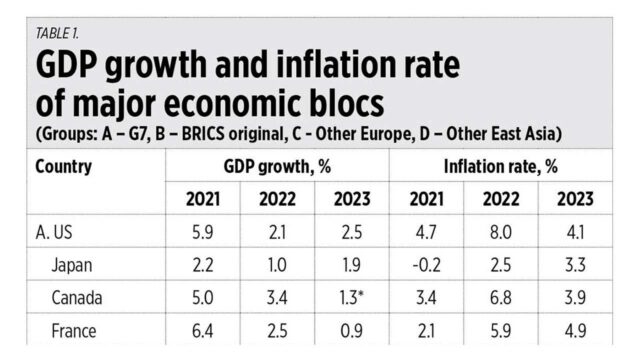
When it comes to GDP growth in 2022 and 2023, all the European countries in the G7 and others in the list suffered consistent growth decline, even contraction (Germany, Sweden, Poland, Ireland), in 2023. In contrast, the BRICS economies retained a path of growth except for South Africa. Russian growth in 2023 was more of a “base effect” from a contraction in 2022.

When it comes to inflation rate, all the G7 and other Europe countries experienced decades-high inflation rates in some months of 2022. These declined a bit in 2023 but still high rates compared to their historical average rates. BRICS, however, just had fluctuating rates from 2021 to 2023. China, meanwhile, is close to deflation.

So back to the original questions. Did those punitive sanctions vs Russia really weaken it? And were those that imposed the sanctions better off?

The answer is “no.” The countries that imposed hard sanctions were the ones that suffered economically via low growth, if not contraction, plus very high inflation. Europe’s industrialization was largely powered by cheap oil and gas from Russia, and when they reduced, if not cut off, such a cheap energy source, they had to source expensive oil/gas from elsewhere.

Meanwhile, the East Asian countries have had a mixed experience — fast growth for the countries with big populations, namely the Philippines, Indonesia, and Vietnam; and growth deceleration for those closely aligned with the US like South Korea, Taiwan, and Singapore (see Table 1).

I asked Budget Secretary Amenah F. Pangandaman and other members of the economic team about the country’s performance. She replied that “the Philippines was able to escape the economic instability suffered by many countries, we even grew fast the past two years — 7.6% in 2022 and 5.6% in 2023. I believe our measures on fiscal consolidation, productive spending for socio-economic development and hard infrastructure via Build Better More, faster implementation of projects, more efficient public spending via digitalization in transactions and open government partnership, have contributed to our economic resiliency and dynamism.”

I think this is a solid assessment. We must just make sure that the big annual budget deficit and public borrowings are controlled so that less public resources are devoted to interest payments.

I also checked the cash operations report (COR) released monthly by the Bureau of the Treasury (BTr), particularly on revenues and how they perform given the huge yearly fiscal gap.

Revenues have recovered and by 2022 were higher than 2019 levels, except when it came to excise tax collections which declined from P318 billion in 2021 to P312 billion in 2022 and P278 billion January-November 2023 (see Table 2).
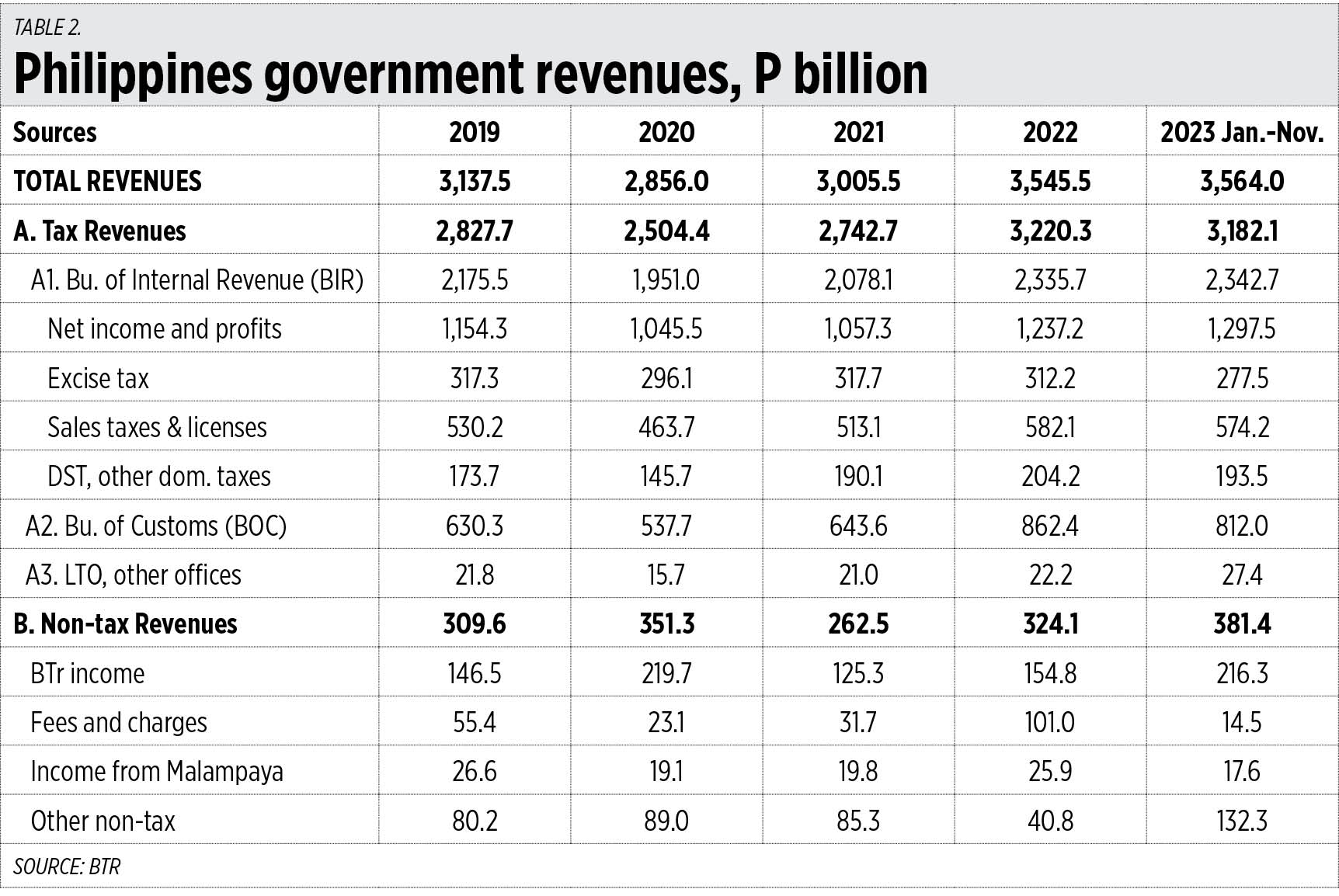
I asked Finance Secretary Ralph G. Recto about this trend, he said that “Excise taxes on tobacco are falling due to smuggling and illicit trade. When taxes are high, illicit trade and smuggling become very profitable. Furthermore, unregulated disposable vape products are being smuggled as well. I would support banning disposable vape products and penalizing e-commerce platforms selling them, including regulated vape products without stamp (excise) tax.”

Great points, Secretary Recto. I have written at least two pieces in this column about him before: “Senator Recto’s tax cut plan shadows Reagan, Thatcher, and Trump tax cuts” (Nov. 23, 2020), and “Revenue challenges faced by new Finance chief” (Jan. 16, 2024).

In my second article about Mr. Recto, I noted that for 2024, “The BoC may target collecting P1.8 trillion by significantly controlling smuggling and illicit trade. From the estimates Representative Joey Salceda gave last October, tobacco smuggling alone results in about P60 billion/year in revenue losses. The BoC plus other lead enforcement agencies like the Philippine National Police and the Coast Guard should work harder in controlling illicit trade because their annual budgets are huge and come from taxes, so they should strive to control tax leakage.”

The Philippines has gained the economic momentum, growing fast even when many countries were growing slowly if not contracting. Our economic team is composed of seasoned technocrats who have the wisdom to decide when to move forward with economic intervention and when to pull back. Thank you, Sec. Pangandaman, Sec. Recto, and Sec. Arsenio Balisacan.


Bienvenido S. Oplas, Jr. is the president of Bienvenido S. Oplas, Jr. Research Consultancy Services, and Minimal Government Thinkers. He is an international fellow of the Tholos Foundation.

minimalgovernment@gmail.com

How the Philippines’ diplomatic reach compares with other countries

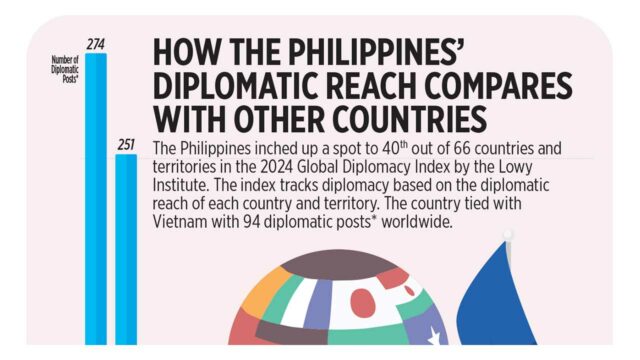
The Philippines inched up a spot to 40th out of 66 countries and territories in the 2024 Global Diplomacy Index by the Lowy Institute. The index tracks diplomacy based on the diplomatic reach of each country and territory. The country tied with Vietnam with 94 diplomatic posts* worldwide.


How the Philippines’ diplomatic reach compares with other countries

DFNN, Sy-led Data Lake team up to boost Starlink PHL

LISTED gaming technology company DFNN, Inc. has partnered with Sy-led Data Lake, Inc. to strengthen the presence of Elon Musk’s Starlink in the Philippines.

In a regulatory filing on Monday, DFNN said it had signed a partnership agreement with Data Lake to use both their complementary technology, sales channels, and marketing expertise to help expand Starlink’s domestic presence. 

“The collaboration between the two is projected to fast-track connectivity of geographically isolated and disadvantageous areas with the use of Starlink’s low Earth orbit satellites and complementary technologies, thereby expanding the digital infrastructure of the country integral to the global digital economy,” DFNN said.

 “The link-up will leverage DFNN’s historic pioneering initiatives in technology with Data Lake’s founders’ experience and business track record,” it added.

Founded in October 2022, Data Lake is led by Henry T. Sy, Jr. and Anthony L. Almeda. The company is an authorized reseller of Starlink in the Philippines.

The company is also engaged in data services, business intelligence modernization, data science, big data pilot-to-production, Internet of Things, mobile application development, cloud, and data pipeline.

Starlink is a satellite internet of Musk-led Space Exploration Technologies Corp. (SpaceX). According to its website, SpaceX continues to launch satellites into orbit to bring high-speed broadband to rural and remote areas.

On Monday, DFNN shares fell by 1.31% or four centavos to P3.01 apiece. — Revin Mikhael D. Ochave

RLC Residences unveils leasing website for condo seekers

RLC RESIDENCES has introduced a leasing website to facilitate the search and comparison of condominium units for potential renters.

“We aim to simplify the process of searching within our developments…,” RLC Residences Senior Director, Marketing Head, and Chief Integration Officer Karen Cesario said in an e-mailed statement on Feb. 21a.

The website helps prospective tenants navigate and compare properties based on location, unit type, and rental rates.

Properties are available in seven cities: Mandaluyong, Muntinlupa, Pasay, Pasig, Quezon, San Juan, and Taguig.

“The newly launched leasing website featuring condo units for rent allows home seekers to match themselves to the right place for them to live in,” the company said.

Upon selecting the desired unit, the website also displays actual residential snapshots and available amenities for each property.

For example, The Sapphire Bloc, a 36-square-meter one-bedroom unit in Pasig City, with a monthly rate of P40,000, has amenities such as a children’s playroom, playground, dry garden, fitness gym, function room, and others.

“RLC Residences’ leasing website allows unit seekers to check the rental range of fees for each unit, and even compare them with other properties within its portfolio,” the company said.

The rental rates range from P16,000 to P80,000, depending on the property type, unit type, and location.

RLC Residences is the residential division of listed company Robinsons Land Corp. — Aubrey Rose A. Inosante

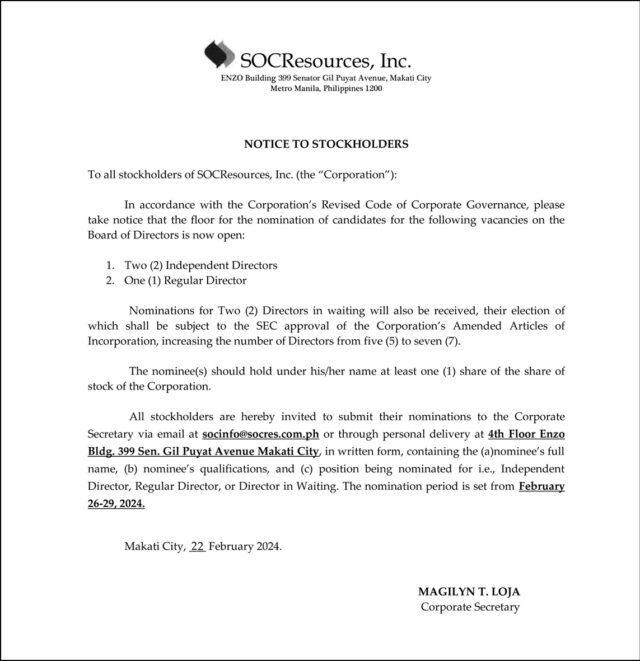
SOCResources, Inc. opens nomination of candidates for vacancies on the Board of Directors


Spotlight is BusinessWorld’s sponsored section that allows advertisers to amplify their brand and connect with BusinessWorld’s audience by enabling them to publish their stories directly on the BusinessWorld website. For more information, send an email to online@bworldonline.com.

Join us on Viber at https://bit.ly/3hv6bLA to get more updates and subscribe to BusinessWorld’s titles and get exclusive content through www.bworld-x.com.

K-pop girl group TWICE aims for top of the Billboard

AMAZON.COM

SEOUL — With an upbeat new album all about love and friendship and a world tour under way, K-pop girl band TWICE has set its sights on a new high on the Billboard main chart, the group told Reuters.

The nine-member band has helped to drive the global K-pop phenomenon since its debut in 2015, propelled by cheerful songs, catchy hooks, and choreography.

TWICE released its album With YOU-th, on Friday, following an all-English language single “I Got You” early this month.

In an interview with Reuters, members of TWICE said they were elated to perform as a group after focusing on solo or sub-unit activities over the last year.

The six-track mini album and its lead single, “One Spark,” were meant to embody the passion and love the members share among themselves and with the fans, Chaeyoung said. With two other band members, Jeongyeon and Dahyun, she wrote the lyrics.

“I think this album is a collection of things that represent our youth, the friendship and special bond that glues together nine of us and that only TWICE can show,” she said.

The pre-released single, “I Got You,” had headed iTunes’ top songs chart in 41 regions, TWICE’s management JYP Entertainment Corp. said, and the band aims for a higher spot on the Billboard main chart.

“I have a dream. I’ll be really happy if we score high on the Billboard, even if not No. 1,” Chaeyoung said.

TWICE has resumed its fifth world tour, performing in Mexico City and Sao Paulo this month and is set to visit Las Vegas in March. In July, the band’s members will become the first overseas female artists to play the Nissan Stadium in Kanagawa, Japan.

Like many other K-pop groups, TWICE faces tight schedules and public pressure, but “letting go of things” and strength as a group helped its members to cope, they said.

Jeongyeon also said she had taken boxing lessons to unwind.

“You need to learn to rely on the people around you, and to get help from them, not do everything alone,” Mina said. — Reuters

PSBank net income up 23%

COMMONS.WIKIMEDIA.ORG

PHILIPPINE Savings Bank (PSBank) recorded a higher net profit in 2023 as it saw double-digit growth in loans and higher investment revenues, it said on Monday.

The thrift banking arm of the Metrobank Group booked a net income of P4.53 billion last year, 23% higher than the P3.68 billion in 2022, it said in a disclosure to the stock exchange.

This translated to a return on equity of 11.7%, the bank said.

“This significant milestone was a result of teamwork and steadfast commitment of PSBankers in delivering effortless banking to our clients and stakeholders,” President Jose Vicente L. Alde said in a statement.

“We want to leverage on this momentum to expand our coverage, provide diversified offerings, and further invest in technology to level up customer experience in the succeeding years,” he said.

The bank’s financial statement was not available as of press time.

PSBank said its financial performance in 2023 was mainly driven by the double-digit growth in loans, higher investment revenues, and muted costs amid operational efficiencies.

Its net interest income rose by 7% year on year to P11.83 billion in 2023, while operating expenses declined by 1% amid its cost optimization efforts.

The bank’s gross loan portfolio grew by 12% to P125 billion at end-2023 from the P112 billion a year prior. Auto loans expanded by 24% year on year amid higher demand, PSBank said.

Despite the growth in its loan book, PSBank’s gross nonperforming loan ratio improved to 3.3%in 2023 from 3.5% in 2022.

On the funding side, total deposits with the bank were at P190 billion last year.

PSBank’s assets stood at P238 billion at end-2023, while its capital reached P40 billion.

Its capital adequacy ratio was at 24.5% in 2023 and its common equity Tier 1 ratio stood at 23.6%, above the minimum levels set by the central bank.

PSBank’s shares dropped by P1 or 1.82% to close at P54 each on Monday. — Keisha B. Ta-asan

A ‘re-horizoned’ AFP modernization program: What does it mean?

PHILIPPINE STAR/KJ ROSALES

LAST MONTH, President Ferdinand Marcos, Jr. approved the revised Horizon 3 of the Armed Forces of the Philippines (AFP) modernization program (AFPMP). Dubbed as a “re-horizoned” iteration of the last phase of the AFPMP, it was also announced that it will have a price tag of P2 trillion ($35 billion) covering a 10-year period. However, details about this ambitious plan remain elusive.

For the uninitiated, the question is: “What does this mean?” It is possible that its significance is lost on ordinary Filipinos because of its ambiguity. Therefore, it is important to “connect the dots” and present a picture of what this new program entails. Existing policies, pronouncements by public officials, as well as reports from traditional and nontraditional sources can help us unpack the issue and offer a possible direction of the program.

To start, the National Security Policy (2023-2028) or NSP provides a general idea of the program’s direction. The NSP underscores the importance of preserving the country’s sovereignty and advancing its national interest. It also views the attainment of a credible defense posture as a crucial component of national security.

In addition, pronouncements by public officials give us a glimpse of how the program will be realized. For instance, statements from Defense Secretary Gilbert Teodoro and AFP Chief General Romeo Brawner, Jr., declared that the revised program will allow the AFP to protect its exclusive economic zone (EEZ) and secure the country’s economic interests. Secretary Teodoro also introduced the Comprehensive Archipelagic Defense Concept which underscored the importance of protecting the country’s natural resources and guarantee the unimpeded and peaceful exploration of these resources. He further stressed that violations of Philippine territorial integrity and sovereignty cannot be tolerated.

And then there are the traditional and non-traditional media. News reports combined with reliable social media sources present the specific weapons systems for the revised horizon. There are four prominent items that are discussed in these reports. These are:

a.) The acquisition of multi-role fighters (MRFs): Initially envisioned in the 1990s, the Philippine Air Force (PAF) MRF dream has yet to come to fruition. This platform can provide the PAF with combat aircraft that can adapt to multiple missions. It can be a traditional jet fighter/interceptor and capable of air interdiction (e.g., Maritime strike and ground attack) and air support roles. For this, the highly anticipated acquisition of 12 to 14 JAS-39 Gripens from Sweden can provide the PAF with this unprecedented capability. There are also reports that used F-16s are being considered. Although the exact number and airplane variant are still unknown, these aircraft are expected to complement the Gripens. Aside from the MRFs, there is also this idea of expanding the country’s current FA-50 fleet through the additional purchase of the upgraded block 20 model. It is said that this acquisition mix will allow the AFP to achieve its desired 36 to 40 combat aircraft threshold.

b.) Renewed interest in subsurface capability: In particular, this pertains to the planned acquisition of submarines by the Philippine Navy (PN). This report has received much fanfare lately since President Marcos himself has developed a keen interest in this matter. The PN is said to be eying two to three units, with France, Spain, and South Korea as the possible contenders for this project. In addition, the navy is also eyeing the expansion of its current fleet of anti-submarine warfare helicopters.

c.) Maritime Domain Awareness: Another significant facet of the revised horizon is the improvement of the country’s maritime domain awareness capability. This means that the 3rd horizon will prioritize the acquisition of land-based radar and airborne surveillance systems that can give the AFP the ability to monitor the country’s air and maritime spaces. Combined with the proposed subsurface capabilities, an integrated domain surveillance and intelligence platform can provide a 3D and 24/7 view of our territories.

d.) Acquisition of area denial/anti-access systems: The acquisition of the Brahmos cruise missile system from India provides the AFP with a significant stand-off (long range) capability against maritime and land targets. With a range of 290 km and a speed of Mach 3, this land-based system will allow us to hit targets well beyond our EEZ. Thus, this platform is a potent deterrent against naval aggression in the West Philippine Sea. Furthermore, it has been reported that the Philippine Army is planning to acquire the High Mobility Artillery Rocket System (HIMARS) platform from the United States. This platform made its battlefield debut in Ukraine where it was used with stunning lethality against Russian frontline positions, command and control structures, as well as their logistics hubs.

If these reports are accurate, then how can we characterize the direction of this “re-horizoned” phase of the AFPMP? First, there is a strong emphasis on external defense. The previous intention of the program was to improve the country’s territorial defense and focus on restoring the AFP’s lost capabilities. However, this new phase goes beyond the earlier objectives by highlighting the importance of extending our military capabilities beyond our coastlines. For instance, having the ability to enforce the Philippine air defense identification zone combined with stand-off systems to defend our EEZ can give any aggressor something to worry about. Combined with the ability to monitor its maritime domain and airspace, this new horizon also adds a significant deterrence value.

Second, this new phase will also enable the Philippines to respond to contingencies. The potential flashpoints in the Taiwan straits and the West Philippine Sea are the obvious factors behind this shift. In addition, the new horizon can be viewed as part of the Marcos administration’s policy to strengthen its security alliances with United States, Japan, Canada, Australia, among others. Consequently, the completion of this horizon will provide the Philippines with capabilities that will allow its meaningful participation in joint military exercises in the region and even beyond.

Overall, this new direction for the 3rd horizon of the AFPMP, despite being modest, signifies the strong commitment of the Marcos administration to enhance the country’s defense posture. This will also allow for the enforcement of the country’s baseline and maritime laws. Furthermore, this new horizon recognizes the country’s crucial role in the stability of the Indo-Pacific region.

Finally, the new program can also open opportunities for collaboration especially in building the country’s defense industries. Agreements on technology transfer, in-country production, and professional exchanges can significantly contribute to national development.


Sherwin E. Ona, PhD is an associate professor of the Department of Political Science and Development Studies at De La Salle University, Philippines. He is a senior fellow of the Philippine Public Safety College and the Stratbase-ADR Institute. At present, Dr. Ona is a visiting fellow of the Institute for National Defense and Security Research in Taiwan.

Combined fund transfers hit P1.31 trillion in January

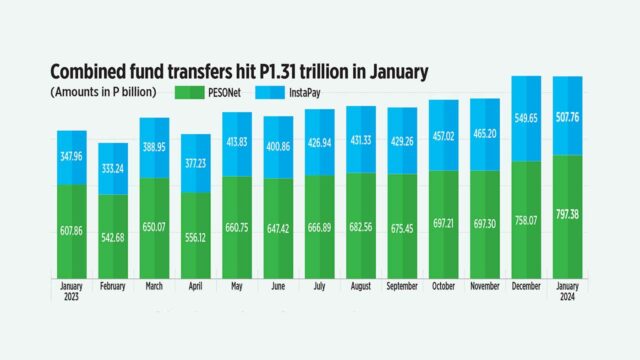
THE VALUE and volume of electronic fund transfers that went through PESONet and InstaPay continued to rise as of January from a year ago, based on data from the Bangko Sentral ng Pilipinas (BSP). Read the full story.

Combined fund transfers hit P1.31 trillion in January

PLDT plans to put up more data centers 

WIKIMEDIA COMMONS/PATRICKROQUE01

PLDT Inc. through its subsidiary ePLDT, Inc. is planning to scale up the capacity of its data centers in the country, the company’s president said.

“We are in the planning stage for the next wave of data centers. We are in the process of engaging data center designers, we are engaging contractors already to understand how to build world class data center facilities,” Victor S. Genuino, president and chief executive officer of ePLDT, told reporters last week.

ePLDT, through its data center unit VITRO, Inc., is on track to open its hyperscale data center in Sta. Rosa Laguna by July, the company said.

The 50-megawatt (MW) data center is the 11th data center of PLDT.

“So, our existing data center footprint now for our 10 data centers is around close to 50 MW combined in terms of total facility load. The Sta. Rosa facility alone will be an additional 50 MW,” Mr. Genuino said.

Earlier, the company said that for its planned 12th data center it may double the capacity of Vitro Sta. Rosa.

“We need to understand that the data center industry is undergoing a huge transformation. We feel that there’s a room for us to still build data center capacity to be ahead of the curve,” he said.

Mr. Genuino also said the company is currently engaging with data center designers to put up two more data centers.

“We are in site selection for data center 13 and 14. We are engaging different contractors already to understand how to build world-class data center facilities,” he added.

Hastings Holdings, Inc., a unit of PLDT Beneficial Trust Fund subsidiary MediaQuest Holdings, Inc., has a majority stake in BusinessWorld through the Philippine Star Group, which it controls. — Ashley Erika O. Jose

ADVERTISEMENT
ADVERTISEMENT