Home Blog Page 360

Philippine infrastructure spending declines for fifth straight month in Nov.
PHILIPPINE STAR/MIGUEL DE GUZMAN

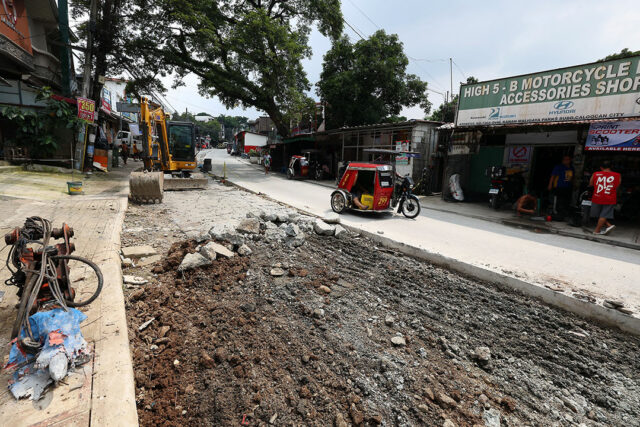
PHILIPPINE GOVERNMENT spending on infrastructure fell for a fifth straight month in November, underscoring how a widening corruption investigation has weighed on public works implementation and fiscal momentum.

State disbursements for infrastructure and other capital outlays plunged 45.2% to P48 billion from a year earlier, according to data released by the Department of Budget and Management (DBM) on Jan. 31. Spending also declined 27.2% from October.

November marked the fifth straight annual contraction since July, when infrastructure spending dropped 25.3% after allegations of corruption linked to flood control projects surfaced. The scandal has since triggered investigations, leadership changes and tighter scrutiny of project approvals, slowing the pace of government outlays.

“The spending performance of the DPWH (Department of Public Works and Highways) continued to post negative growth amid the ongoing probe and crackdown on corruption issues,” the DBM said.

The fiscal slowdown curtailed project execution and prompted contractors to submit progress billings and payment claims immediately, the agency said, as authorities sought to strengthen controls and oversight.

The DPWH, which has been at the center of the controversy, has undergone a budget overhaul, the dismissal of several officials and a continuing investigation that weakened sentiment and slowed activity across the construction sector.

The fallout has also spilled over to the broader economy, weighing on household spending and private investment.

From January to November, total government infrastructure spending fell 16% to P991.1 billion from a year earlier. This accounted for 65.51% of the government’s P1.51-trillion full-year infrastructure program.

“Infrastructure spending was weighed down significantly by the contraction of DPWH’s disbursements during the period in the wake of flood control corruption issues,” the DBM said.

Broader infrastructure disbursements, which include capital components of subsidies and equity infusions to state-owned companies, as well as transfers to local government units, also weakened. These fell 13.3% year on year to P1.2 trillion in the first 11 months of the year.

Public Works Secretary Vivencio “Vince” B. Dizon said last month the agency was seeking to lift spending while ensuring public funds are deployed prudently.

The DPWH has set a spending program of P200 billion to P250 billion this quarter, signaling an effort to regain momentum after months of subdued disbursements.

Despite the drag from infrastructure, total government spending edged up 2.5% to P5.41 trillion in January to November, equivalent to about 89% of the P6.08-trillion full-year program.

For the final stretch of 2025, the DBM said overall spending would be supported by payments to cover personnel service shortfalls across line agencies, including the release of benefits and the creation or filling of government positions.

“Based on a preliminary report of allotment releases, some P74.3 billion worth of allotments were released in December 2025, which might have helped propel spending for the remainder of 2025,” the agency said.

Additional spending drivers include the rollout of social programs such as disaster relief and recovery, education subsidies and funding for local development initiatives, the DBM added.

WAIT-AND-SEE STANCE
Economists said the corruption probe has been a major factor behind the persistent contraction in infrastructure outlays.

Michael L. Ricafort, chief economist at Rizal Commercial Banking Corp., said the scandal has forced authorities to adopt a more cautious approach to public works spending.

“This was caused by the continued caution versus the risk of corruption for various government spending on infrastructure,” he said in a Viber message.

He added that the pullback in government spending has been a key contributor to the recent softness in economic growth, given the sector’s role as a major pillar of gross domestic product.

The slowdown has also weighed on investor sentiment, prompting a wait-and-see stance that curbed private investment, Mr. Ricafort said. Against this backdrop, he noted it would be difficult for the government to meet its P1.51-trillion infrastructure target for 2025.

“Yes, tough one, as manifested by the weaker-than-expected local GDP data,” he said.

Philippine economic growth slowed sharply to 4.4% last year from 5.7% in 2024, as the infrastructure pullback dampened public spending and eroded confidence among consumers and businesses.

The expansion was the weakest in five years, excluding the 9.5% contraction in 2020 at the height of the pandemic, and the slowest since 2011 if the pandemic period is set aside.

Still, Mr. Ricafort said a rebound in infrastructure spending is likely this year, supported by catch-up programs anchored on stronger governance and anti-corruption measures.

Acting Budget Secretary Roland U. Toledo said the government remains committed to scaling up infrastructure investment over the medium term, adding that risks of project delays this year are limited after what he described as a “clean” budget process.

For 2026, the Development Budget Coordination Committee (DBCC) has scaled back its infrastructure outlay target to 4.3% of GDP, or about P1.3 trillion, from an earlier goal of 5.1% of GDP, equivalent to P1.56 trillion.

The overall government disbursement program for next year was also trimmed by 3.19% to P4.824 trillion.

Finance Secretary Frederick D. Go said public spending is expected to rebound this year, noting that authorities have worked to clear bottlenecks in the spending program.

The top five spending agencies include the DPWH and the Education, Health, Agriculture and Transportation departments, he said. — Aubrey Rose A. Inosante

Hog raisers urge gov’t to increase pork tariffs

REUTERS

HOG RAISERS want the government to restore higher pork tariffs, warning that a surge in imports has oversupplied the market and dragged down farmgate prices.

Alfred Ng, vice-chairman of the National Federation of Hog Farmers, said the group is pushing to raise pork tariffs back to 40%, arguing that lower duties have outlived their purpose and are now hurting local producers.

Lower tariff rates were introduced in 2021 to stabilize pork prices after African swine fever disrupted domestic supply. Since then, tariffs have remained at 15% for in-quota imports and 25% for out-of-quota shipments.

“Tariffs are supposed to protect local farmers from unfair trade and the dumping of subsidized agricultural products,” Mr. Ng said in a Viber message. “The reductions were meant to be temporary, but they have remained in place even as import volumes surged.”

Pork imports rose about 16% last year, or roughly 120 million kilos, bringing total shipments to more than 850 million kilos. Mr. Ng said these volumes are unprecedented and have weighed heavily on local prices.

He said live hog prices began falling in June last year and failed to recover during the usual peak months of December and January, when demand typically lifts prices.

“For the first time in more than 30 years of hog farming, liveweight prices did not improve in December and continued to decline in January,” he said.

Data from the Philippine Statistics Authority showed that average liveweight hog prices in the fourth quarter fell 14% to P182.83 per kilo, from a year-high average of P212.54 per kilo in the first quarter.

In response to the sharp drop, the Department of Agriculture agreed in November to raise the floor price for live hogs to P210 per kilo after prices sank to as low as P150 per kilo, close to production cost.

Despite the weakness at the farm level, Mr. Ng said retail pork prices in wet markets remained elevated, even as the landed cost of imported pork fell to about P120 per kilo.

“This clearly shows that consumers are not benefiting from importation,” he said. “Instead, local farmers are bearing the cost, while importers are capturing the margins.

Mr. Ng also raised concerns over food safety, saying frozen imported pork has entered wet markets and been sold as thawed meat, competing directly with locally produced pork.

He said this practice violates agriculture regulations that prohibit the display and sale of thawed frozen meat without proper chilling equipment.

Continued overimportation could undermine the Department of Agriculture’s multibillion-peso hog repopulation program, Mr. Ng said, as low prices and the risk of African swine fever discourage farmers, especially small producers, from raising hogs.

Aside from restoring higher tariffs, hog raisers are calling for tighter controls on pork import volumes to cover only supply shortfalls, as well as stronger border inspections.

These measures would help keep unsafe and smuggled meat out of the market and protect both farmers and consumers, he added. — Vonn Andrei E. Villamiel

Meralco-First Gen gas supply contract extended until June

FIRSTGEN.COM.PH

THE Energy Regulatory Commission (ERC) has granted a five-month extension of the gas power supply contract between Manila Electric Co. (Meralco) and First Gen Corp., citing its role in supporting energy security, particularly with the summer months approaching.

In an eight-page order promulgated on Jan. 30, the ERC approved the joint motion filed by Meralco and First Gen unit First Gas Power Corp. (FGPC) to continue sourcing power from the Sta. Rita gas-fired power plant in Batangas until June 25, 2026.

The approval of the second interim extension comes ahead of the Jan. 31 expiration of the previous temporary extension of the 25-year power purchase agreement.

The ERC said the renewed arrangement will be implemented under the same terms and conditions as the earlier extension and will remain a pass-through charge to Meralco customers.

In approving the extension, the ERC reiterated that spot market prices could increase by around twofold if the Sta. Rita plant were to operate as a merchant plant, citing simulations conducted by the Independent Electricity Market Operator of the Philippines.

FGPC said it would likely be constrained to shut down the power plant due to the loss of offtake. This could, in turn, compel the Malampaya gas field operations and the liquefied natural gas terminal to cease operations because of “technical interdependencies” among the facilities.

“This situation presents a critical energy security risk in the Luzon Grid with dire consequences extending beyond power rate increases to rotating power outages that would disrupt household, business, and industrial activities,” the ERC said.

The agency also noted the Sta. Rita plant’s contribution to energy security through the frequent operation of its available units at full capacity, helping increase supply and stabilize spot prices.

“The Commission is cognizant that the reliable and flexible capacity offered by the Sta. Rita Plant is much needed during the summer months,” the ERC said.

“It is thus imperative that the power grids maintain sufficient capacity available to avert yellow/red alerts, power interruptions, or worse, widespread outage.”

Meralco’s controlling stakeholder, Beacon Electric Asset Holdings, Inc., is partly owned by PLDT Inc.

Hastings Holdings, Inc., a unit of PLDT Beneficial Trust Fund subsidiary MediaQuest Holdings, Inc., has an interest in BusinessWorld through the Philippine Star Group, which it controls. — Sheldeen Joy Talavera

Tanduay eyes Central and Eastern Europe markets

PHILSTAR FILE PHOTO/TANDUAY

TANDUAY is expanding its footprint beyond Western Europe by targeting markets in Slovenia, Slovakia, and Hungary as part of its push into central and eastern regions.

Following its debut in Denmark last year, the company said that it is in talks to enter these countries.

“Right now, we’re in the western part of Europe, but we’re also trying to penetrate Central and Eastern Europe,” Tanduay International Business Development Manager Roy Kristoffer Sumang told reporters on the sidelines of an event last week.

In December, Tanduay Distillers, Inc. announced a distribution partnership with Denmark’s Bastard Spirits to enter the Nordic market and expand its premium rum portfolio.

The deal targets wine shops, online retailers, bars, and potential future duty-free listings, capitalizing on Denmark’s openness to new flavors.

Last month, the company signed a distribution agreement with Spain’s Torres to bring its brandy to supermarkets nationwide, starting with Torres 5 Light, with additional products arriving in the first quarter as part of the latter’s Philippine market debut.

Tanduay is a rum brand produced by Tanduay Distillers, Inc., a subsidiary of the Tan-led conglomerate LT Group, Inc. — Alexandria Grace C. Magno

DMCI to break ground on Kalayaan, BGC subway stations this year

OJ SERRANO-UNSPLASH

D.M. CONSUNJI, INC. (DMCI) is preparing to break ground on a key portion of the Metro Manila subway project this year, its top executive said.

The project, known as contract package 105 (CP 105), covers the Kalayaan and Bonifacio Global City (BGC) stations, with construction expected to start this year, DMCI President and Chief Executive Officer Jorge A. Consunji told reporters last week.

The project includes a short tunnel and the two stations, which were originally scheduled for completion in 2029 but have faced delays because of earlier right-of-way issues.

DMCI is undertaking the work alongside Japanese firm Nishimatsu Construction Co. Ltd., its partner for another section of the subway covering Quezon Avenue and East Avenue stations.

Meanwhile, the company is pursuing another subway project and expects the award decision as early as next month.

“That’s just the award phase. The groundbreaking for that is possibly in March or April, depending on the department that handles it — we can’t control that. But it was bid out 18 months ago,” Mr. Consunji said.

Without giving details, DMCI said it is eyeing other major projects and possible partnerships with both public and private sectors.

DMCI is the construction arm of listed infrastructure and engineering conglomerate DMCI Holdings, Inc., which also has core investments in coal mining, water, off-grid power generation, and property development. — Alexandria Grace C. Magno

Arthaland forges partnership with Mitsui Fudosan (Asia) for a premium green development in Makati

In the photo during the signing ceremony are (from left to right): Cornelio S. Mapa, Executive Vice President and Treasurer of Arthaland Corporation; Marivic S. Victoria, Chief Finance Officer of Arthaland Corporation; Jaime C. Gonzáles, Vice Chairman and President of Arthaland Corporation; Daijiro Eguchi, Managing Director of Mitsui Fudosan (Asia); Sheryll P. Verano, Executive Vice President of Arthaland Corporation; and Takashi Sugiyama, Director of Mitsui Fudosan (Asia).

Arthaland Corporation (ARTHALAND) and Mitsui Fudosan (Asia) recently entered into a joint venture for the development of Sondris, a premium, multi-certified sustainable residential condominium that will rise along Arnaiz Avenue, Legazpi Village, Makati City.

This partnership marks a significant collaboration between Arthaland and Mitsui Fudosan (Asia), a wholly owned subsidiary of Mitsui Fudosan Co., Ltd., one of Japan’s largest real estate companies and a publicly traded company with approximately $62 billion (¥9.8 trillion, as of Dec. 2024) in assets. Mitsui Fudosan has pursued mixed-use neighborhood creation that integrates office buildings, retail facilities, logistics, hotels/resorts, and residentials across various areas in Japan. Mitsui Fudosan’s area of operations is not only in Japan; the Group has been conducting business in major cities in North America, Europe, China, Taiwan, Southeast Asia, Australia, and India. The Group is continuously pursuing business expansion through driving the evolution of neighborhood creation.

“We are honored to collaborate with Mitsui Fudosan to bring Sondris to life. By combining ARTHALAND’s deep local experience with a global perspective and Mitsui Fudosan’s distinct strength in truly people-focused neighborhood creation and global expertise, we created a development that delivers durability, functionality, and a new benchmark for refined living in the heart of Makati,” said Jaime C. González, Vice Chairman and President of ARTHALAND.

Sondris brings together two like-minded, best-in-class real estate companies with shared values centered on sustainability, green building, and long-term value creation. ARTHALAND leads the project’s development and operations, while Mitsui Fudosan contributes to global expertise in design, engineering, and value preservation.

“We express our appreciation and honor in collaborating and developing this project together with Arthaland, a partnership that reflects our shared vision for excellence and sustainability. Guided by this commitment, we take pride in making Sondris one of the pioneering residential developments in the Philippines to pursue multiple prestigious green certifications—underscoring our unwavering commitment to sustainability and future-ready communities. Together, we aspire to deliver a landmark project that harmonizes world-class standards with local insight, creating a destination designed to endure and inspire for generations to come.” said Daijiro Eguchi, Managing Director of Mitsui Fudosan (Asia).

Sondris offers a rare balance of cultural richness, business connectivity, and urban convenience. Its address along Arnaiz Avenue provides immediate access to EDSA and the Skyway, connecting residents to the metro’s key business and lifestyle destinations. Its location also allows its residents to enjoy unobstructed views of the San Lorenzo Village.

Inspired by Japanese sensibilities, Sondris brings together refined architecture, wellness, and environmental stewardship to create homes shaped by intention and balance. Designed by the internationally renowned architectural firm AEDAS, the 37-story tower features 252 thoughtfully designed residences, each crafted to maximize natural light, ventilation, and comfort.

As with other ARTHALAND developments, Sondris targets to achieve the highest sustainability and wellness standards from both local and global organizations. It aims to become multi-certified, targeting LEED, WELL, EDGE, and BERDE certifications from the US Green Building Council, International Well Building Institute, the International Finance Corporation and the Philippine Green Building Council, respectively.

ARTHALAND is the only real estate developer in the Philippines with a residential and commercial portfolio 100% certified as sustainable by local and global organizations. It has made its mark in the Philippine real estate industry by pioneering the development and management of exceptional best in-class properties that adhere to international and local standards.

For more information, visit www.arthaland.com.


Spotlight is BusinessWorld’s sponsored section that allows advertisers to amplify their brand and connect with BusinessWorld’s audience by publishing their stories on the BusinessWorld Web site. For more information, send an email to online@bworldonline.com.

Join us on Viber at https://bit.ly/3hv6bLA to get more updates and subscribe to BusinessWorld’s titles and get exclusive content through www.bworld-x.com.

T-bill, bond rates may drop on BSP easing hopes

BW FILE PHOTO

RATES of the Treasury bills (T-bills) and Treasury bonds (T-bonds) on offer this week could decline as weak gross domestic product (GDP) data increased expectations of further policy easing by the central bank.   

The Bureau of the Treasury (BTr) will auction off P27 billion in T-bills on Monday, or P9 billion each in 91-, 182-, and 364-day papers.

On Tuesday, the government will offer P30 billion in reissued seven-year T-bonds with a remaining life of four years and 11 months.

T-bill and bond rates could mirror the week-on-week drop in comparable secondary market yields as weaker-than-expected fourth-quarter and full-year 2025 GDP growth heightened the odds of a sixth straight cut from the Bangko Sentral ng Pilipinas (BSP) this month, Rizal Commercial Banking Corp. Chief Economist Michael L. Ricafort said in a Viber message.

“Expect bullish momentum to translate into [this] week as players price in a poor (economic) outlook,” a trader said in an e-mail.

At the secondary market on Friday, yields on the 91-, 182-, and 364-day T-bills went down by 8.38 basis points (bps), 6.34 bps, and 5 bps week on week to 4.6826%, 4.7725%, and 4.8412%, respectively, based on PHP Bloomberg Valuation Service Reference Rates data as of Jan. 30 published on the Philippine Dealing System’s website.

Meanwhile, the seven-year bond’s yield eased by 8.19 bps week on week to close at 5.8549%, while the five-year debt, the tenor closest to the T-bond’s remaining life, fell by 11.05 bps to fetch 5.6551%.

Philippine GDP growth slowed to 3% in the fourth quarter of 2025 from 5.3% in the same period a year prior and 3.9% in the third quarter. This brought the full-year average to 4.4%, well below the government’s 5.5%-6.5% goal.

Analysts said that the weak GDP report could prompt the BSP to cut rates further to boost domestic demand. The Monetary Board will hold its first policy meeting for this year on Feb. 19.

Last week, the government raised P37.8 billion via the T-bills, higher than the P27-billion plan as the offer was oversubscribed, with total tenders reaching P155.975 billion.

Broken down, the government awarded P12.6 billion in 91-day T-bills, above the P9-billion program, as demand reached P40.1 billion. The three-month paper fetched an average rate of 4.666%, down by 5.7 bps from the previous week. Yields accepted ranged from 4.64% to 4.673%.

The Treasury also borrowed P12.6 billion via the 182-day debt as tenders hit P57.55 billion. The average rate of the six-month T-bill was at 4.751%, easing by 6.6 bps. Tenders awarded carried yields from 4.73% to 4.763%.

Lastly, the BTr raised P12.6 billion from the 364-day securities as bids totaled P58.325 billion. The one-year paper’s average yield was at 4.827%, falling by 6.1 bps. Accepted rates were from 4.81% to 4.843%.

Meanwhile, the reissued seven-year T-bonds to be offered on Tuesday were last sold on Jan. 13, where the government borrowed P40 billion versus the P30-billion plan as it opened its tap facility. The reissued bonds fetched an average rate of 5.71%, below the 6.125% coupon rate.  

The government aims to raise P308 billion from the domestic market this month, or P108 billion via T-bills and up to P200 billion through T-bonds.

The government borrows from local and foreign sources to help fund its budget deficit, which is capped at P1.647 trillion or 5.3% of gross domestic product this year. — A.M.C. Sy

BPI shares rise on PSEi rebalancing, performance outlook

BANK OF THE PHILIPPINE ISLANDS

By Isa Jane D. Acabal, Researcher

BANK OF THE PHILIPPINE ISLANDS (BPI) shares climbed last week on Philippine Stock Exchange index (PSEi) rebalancing and on improved investor sentiment following the bank’s announcement of its performance targets for this year, analysts said.

BPI was the fifth most actively traded stock from Jan. 26 to 30, with 14.09 million shares worth P1.65 billion, according to PSE data.

The stock closed at P124 per share on Friday, up 6.9% from P116 the previous week. This outpaced the financial sector’s 1.8% week-on-week gain and the 0.1% decline in the benchmark PSEi.

Year to date, BPI shares have risen 6.8%, ahead of the financial sector’s 5% growth and the PSEi’s 4.6% increase.

Franco M. Fernandez, equity research analyst at DragonFi Securities, Inc., said the stock’s gain was largely driven by “rebalancing-related flows” toward the end of the week.

On Jan. 27, the PSE announced changes to its indices, with RL Commercial REIT, Inc. (RCR) set to replace Alliance Global Group, Inc. (AGI) in the PSEi starting Feb. 2.

AGI will move to the PSE MidCap index, while Apex Mining Co., Inc. will be added and DoubleDragon Corp. removed. Meanwhile, Universal Robina Corp. will return to the PSE Dividend Yield index, which will also include OceanaGold (Philippines), Inc. as a new constituent.

“I expect prices to normalize next week, as sharp gap-ups during the run-off period, particularly those linked to PSEi rebalancing, have historically been followed by profit taking in the next session,” Mr. Fernandez said in a Viber message.

Unicapital Securities, Inc. Research Head Wendy B. Estacio-Cruz attributed the rise in BPI shares to positive investor sentiment as the market priced in the bank’s strong performance targets.

“This price movement is partly ahead of the release of its [full-year 2025] earnings, as investors anticipate strong performance driven by a rebound in borrowing demand,” she said in an e-mailed response to questions.

“Market sentiment may also have been supported by broader optimism in the banking sector amid easing inflation,” she added.

In an earlier interview with reporters, BPI President and Chief Executive Officer Jose Teodoro K. Limcaoco said the bank aims to exceed its 2025 performance this year, citing a rebound in demand for consumer loans.

BPI also started the public offer for its P5-billion Supporting Individuals Grow, Lead, and Achieve (SIGLA) Bonds, priced at 5.405% per annum, on Jan. 26.

In a disclosure to the stock exchange, the bank said this marked the second tranche of its P200-billion Bond and Commercial Paper Program, which will run until Feb. 4.

“BPI’s strategic shift toward higher-yielding segments is expected to boost profitability and help cushion any increase in provisioning, further reinforcing investor confidence,” Ms. Estacio-Cruz said.

In the third quarter of 2025, BPI’s attributable net income rose 0.6% to P17.53 billion, bringing its nine-month profit to P50.48 billion.

Ms. Estacio-Cruz projects fourth-quarter net profit at P16.9 billion and full-year earnings at P67.4 billion.

Mr. Fernandez forecasts BPI’s attributable net profit at P15 billion for the fourth quarter and P66 billion for full-year 2025. He placed support between P112 and P115 per share, with resistance at P125.

Goodbye arms control, hello nuclear anarchy

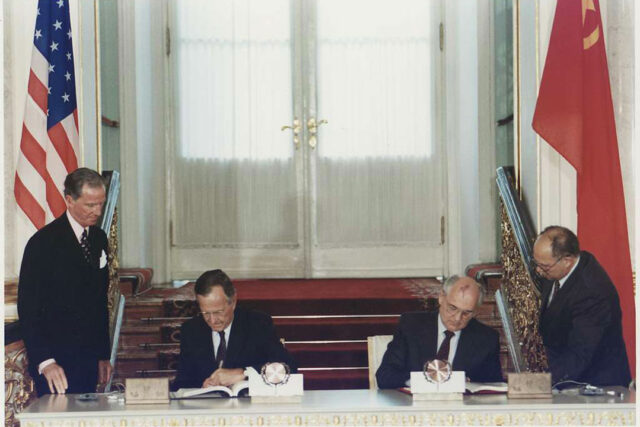
PRESIDENTS George H. W. Bush and Mikhail Gorbachev sign the Strategic Arms Reduction Treaty (START) in the Kremlin in Moscow, July 31, 1991. — PICRYL.COM

By Andreas Kluth

THE ERA of nuclear arms control officially ends this week. On Feb. 5, New START*, the last such treaty between the United States and Russia, will expire. That doesn’t necessarily mean that Washington and Moscow will begin deploying more than the 1,550 strategic warheads each that the treaty stipulated; both of them should, and probably will, observe the old limits for a while longer. Nonetheless, the moment is a milestone.

It marks the first time since the iciest Cold War when no formal arms-control regime will limit the two atomic superpowers. In that way the expiry of New START is yet another step out of a world in which the great powers restrained themselves with rules, and into a brave new world of anarchy, in which the only rules are the whims of strongmen.

On paper, a few vestiges of the previous era remain. Some 178 countries still abide by a multilateral treaty that bans the explosive (as opposed to computer-simulated) testing of fission or fusion bombs. And 191 states still subscribe, in theory, to The Treaty on the Non-Proliferation of Nuclear Weapons (abbreviated NPT), in force since 1970. The signatories include the five powers with the largest nuclear arsenals, who in Article VI explicitly commit to negotiate “in good faith” to achieve “general and complete disarmament.”

In practice, none of these long-standing promises is worth the paper it’s written on. America’s president, Donald Trump, and several of his advisers have mused about restarting nuclear testing. That would trigger competitive rounds of testing by China, Russia, and others and amount to a strategic own goal.

And Article VI of the NPT has become a joke. Instead of negotiating disarmament, all nine nuclear powers, including the five acknowledged in the NPT, are “modernizing” their arsenals. The US, for example, is projected to spend a staggering $1.7 trillion over 30 years to upgrade its nuclear missiles, submarines, bombers, and warheads. China is adding to its arsenal as fast as its can, striving for functional parity with the US and Russia within a decade. North Korea (which quit the NPT in 2003) is also growing its stash.

Worse yet, most of the nuclear powers are simultaneously investing in more exotic nukes — to be used in outer space, for instance, or mounted on deceptive torpedoes or “glide” vehicles as opposed to plain-vanilla ballistic missiles. As during the Cold War, they’re once again incorporating tactical nukes (which New START didn’t regulate at all) into their plans and scenarios.

Tactical nukes are bombs that may have “smaller” yields and can be launched at shorter ranges, at least when compared with strategic weapons, which are meant to take out entire cities in an adversary’s homeland. The theoretical purpose of tactical weapons is to win battles in a regional war, say, rather than devastating an enemy during an all-out nuclear holocaust.

Tactical nukes are inherently destabilizing, as Geoff Wilson, Christopher Preble, and Lucas Ruiz at the Stimson Center have shown. Their proponents like to argue that these bombs, because their fallout is limited, are more “usable.” But that’s exactly the problem. Once the nuclear taboo is broken, the idea that the ensuing escalation can be controlled is a “mirage,” as George Shultz, a former secretary of state, once told Congress.

For starters, all nuclear powers would have a so-called discrimination problem. Faced with an incoming volley, they wouldn’t know whether they were under a strategic or tactical attack. By the perverse logic of “use it or lose it,” states would feel they have to launch their own weapons while they still can.

The bewildering complexity and diffusion of these dangers are such that the Bulletin of the Atomic Scientists last week reset its famous Doomsday Clock to 85 seconds to midnight, where midnight represents catastrophe. That’s the closest to apocalypse the clock has ever stood since the metaphor was created in 1947 — closer even than during the Cuban Missile Crisis, say.

What should be done about this fiasco? Some experts, and parts of Trump’s MAGA movement, have concluded that the US, for one, must accelerate its nuclear build-out and grow its arsenal to match a coordinated attack from both Russia and China.

That doesn’t follow at all, says Richard Fontaine, a former national-security official and diplomat who runs the Center for a New American Security. In nuclear strategy, you don’t get safer by adding up the warheads of your adversaries and then matching the total, he told me. What matters is that even if Russia teamed up with China in a coordinated attack, “the US would retain a survivable second-strike capability.” In that sense, the old logic of deterrence survives, because any enemy contemplating a first strike on the US “would have to be prepared to be destroyed.”

The peril lies less in a first strike out of the blue (as in the movie A House of Dynamite, for instance) than in a spiral of miscalculations that could lead to uncontrolled, and possibly unintended, escalation. Paradoxically, even policies meant to be purely defensive could make the situation worse rather than better.

Trump’s beloved Golden Dome is an example. A continental anti-missile shield — even if it were technically feasible and affordable, which it probably isn’t — could invite disaster. America’s adversaries would fear that the US could feel immune to retaliation once the dome’s interceptors in space go live. They would then be tempted to destroy those interceptors and sensors with nuclear explosions in space. Or they might plan attacks that don’t go through space — with submarines or drones, for instance. However they react, America and the world would be not more but less safe.

Trump gets other things wrong too. By insulting America’s allies in Europe and Asia, he’s casting doubt on America’s nuclear “umbrella” and forcing them to consider building their own nukes. That would prompt their regional adversaries to do the same. More nuclear powers always means more risk; just think of the many times India and Pakistan have gone to the brink.

And yet Trump grasps the big picture as well as any of his predecessors did. He’s repeatedly called nukes the world’s greatest existential threat. “There’s no reason for us to be building brand-new nuclear weapons. We already have so many,” he has said; “You could destroy the world 50 times over, 100 times over. And here we are building new nuclear weapons, and they’re building nuclear weapons.”

The only way to reduce this existential threat is to return to negotiations, ideally three-way talks among Washington, Moscow, and Beijing which then include other nuclear powers over time. Russia’s Vladimir Putin, disingenuously or not, has indicated that he would be receptive. China’s Xi Jinping has so far made clear he’s not ready for talks, because his goal is parity with the other two.

That’s what Trump must set out to change. He claims to have good chemistry with Putin, so he should use it — but without mixing the fate of Ukraine into the conversation. He also thinks he has Xi’s ear. The problem is that Trump keeps distracting himself with problems of his own making, such as trade wars or the fate of TikTok, of all things.

If Trump and his advisers had any strategic bone in their bodies, they would invert this dynamic and emphasize the existential. He would invite all nuclear leaders to stipulate — as Ronald Reagan and Mikhail Gorbachev once did — that a “nuclear war cannot be won and must never be fought.” Then they would start talking about de-risking, discussing every weapon system in turn. Just in case this process should eventually lead to a modicum of trust, they could use that to haggle about everything else.

BLOOMBERG OPINION

*START stands for Strategic Arms Reduction Treaty.

Peso may be range-bound as market awaits inflation report

PHILSTAR FILE PHOTO

THE PESO may be range-bound against the dollar this week as players await the release of Philippine inflation data and assess the possible policy implications of the nomination of a new US Federal Reserve chair.

On Friday, the local unit closed at P58.86 per dollar, rising by 8.5 centavos from its P58.945 finish on Thursday, data from the Bankers Association of the Philippines showed.

Week on week, the peso jumped by 23 centavos from its P59.09 close on Jan. 23.

“The dollar-peso closed lower but traded mostly sideways, touching the P59 high amid selling on peso weakness due to lower-than-expected GDP (gross domestic product) figures,” a trader said in a phone interview, adding that there was profit taking in the afternoon session.

Philippine GDP growth slowed to 3% in the fourth quarter of 2025, bringing the full-year average to 4.4%, missing government’s 5.5%-6.5% goal.

The soft growth data raise the odds of a rate cut by the Bangko Sentral ng Pilipinas (BSP) at the Monetary Board’s Feb. 19 meeting, Rizal Commercial Banking Corp. Chief Economist Michael L. Ricafort said in a Viber message.

The Monetary Board has reduced benchmark rates by a cumulative 200 basis points since its easing cycle began in August 2024, bringing the policy rate to an over three-year low of 4.5%.

For this week, the trader said the peso will move sideways as players await the release of January Philippine inflation data on Thursday (Feb. 5) and developments following US President Donald J. Trump’s announcement of his Fed chair pick.

The market will also monitor US economic data, the trader added.

The trader sees the peso moving between P58.80 and P59.10 per dollar this week, while Mr Ricafort said it may range from P58.65 to P59.15.

The choice of Kevin Warsh to lead the US Federal Reserve clears uncertainty on Wall Street about the central bank’s likely next chair, but leaves investors weighing how the former Fed governor’s past hawkish leanings will mesh with Mr. Trump’s insistence on far lower interest rates, Reuters reported.

Mr. Warsh, whom Mr. Trump nominated on Friday to lead the US central bank, ending a months-long process, had been one of four candidates widely tipped as potential successors to Jerome H. Powell, whose term as chair ends in May. A proponent of tighter monetary policy as a Fed governor from 2006 to 2011, Mr. Warsh said recently that Mr. Trump is right to press for interest rate cuts. — A.M.C. Sy with Reuters

PHL banana exports estimated to have grown 26% in 2025

REUTERS

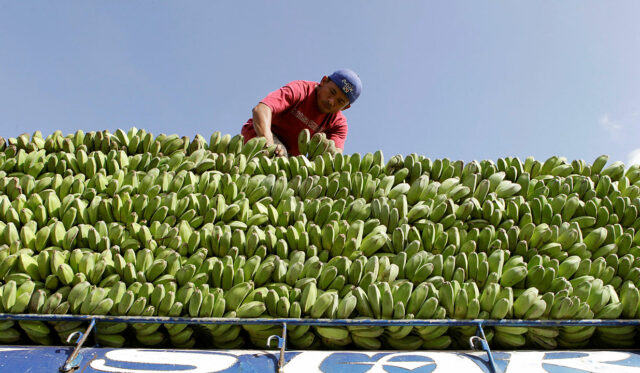
PHILIPPINE BANANA exports likely surged by more than a quarter in 2025, helping make the country the world’s number two exporter, according to the Food and Agriculture Organization (FAO).

In a market review, the FAO said that preliminary data indicate that exports of Philippine bananas likely grew 25.6% to 2.93 million metric tons (MMT) in 2025.

Ecuador likely remained the world’s biggest banana exporter in 2025, with shipments projected at 6.41 MMT. Costa Rica, which was the second-largest banana exporter last year, likely slipped to fifth place, with shipments projected to decline 17% to 1.96 MMT.

According to the FAO, the rebound in Philippine exports was the result of favorable weather as well as a recovery from setbacks caused by disease in recent years.

In 2024, banana exports amounted to 2.33 MMT, slipping from 2.35 MMT a year earlier after infestations of Fusarium wilt, a soil-borne fungal disease that blocks a banana plant’s vascular system and deprives it of nutrients and moisture.

The FAO said the Philippines, the biggest banana exporter in Asia, also benefited from renewed investments in production.

“Industry sources reported that substantial investments had been made in boosting the production of bananas in Cagayan Valley, including through the provision of organic fertilizer and other inputs by the Department of Agriculture (DA),” the FAO said.

The FAO also reported stronger demand from major Asian markets in 2025, helping support the Philippine export rebound.

Banana imports by China, one of the world’s largest buyers, were estimated to have increased 17.02% to 2.04 MMT in 2025, with shipments from the Philippines expanding in the double digits during the first nine months.

Imports by Japan likely rose, with shipments projected to have grown 1.44% to 1.06 MMT in 2025. The Philippines accounts for around 75% to 80% of Japan’s total banana imports.

Agriculture Secretary Francisco P. Tiu Laurel, Jr. said he recently met with his Japanese counterpart to negotiate lower tariffs on Philippine bananas shipped to Japan.

He said the DA is seeking amendments to the Japan-Philippines Economic Partnership Agreement (JPEPA), under which Japan imposes seasonal tariffs on Philippine bananas.

Under JPEPA, bananas shipped from the Philippines face an 8% tariff between October and March and a duty of 18% between April and September. Mr. Laurel said the government is pushing to lower the duties to a fixed rate of between 5% and 8%.

“We requested a lower, flat rate to help our banana sector. This is because other countries like Vietnam, Thailand, and Mexico are already moving toward zero tariffs,” Mr. Laurel told reporters at a briefing.

He said the tariff negotiations are meant to serve as a temporary measure to keep Philippine bananas competitive, while the country works toward securing zero duties through its application for accession to the Comprehensive and Progressive Agreement for Trans-Pacific Partnership (CPTPP).

The CPTPP is a free trade agreement among Australia, Brunei, Canada, Chile, Japan, Malaysia, Mexico, New Zealand, Peru, Singapore, the UK, and Vietnam. It provides for more liberalized trade, including zero tariffs on a wide range of goods. — Vonn Andrei E. Villamiel

Are you really buying local?

TO BUY — and learn about — authentic indigenous Filipino weaves, Metro Manila residents can visit the regular DTI fairs held in SM Megamall. — ALICIA A. HERRERA

Or is that Filipiniana blouse or skirt you are eyeing actually from China?

WHILE it’s cool right now to sport local textiles, it’s becoming a little bit too cool — by that we mean fakes are being made of handwoven textiles by indigenous people.

During a press conference on Jan. 27 as part of the 2026 National Textile Convention (TELACon), Julius Leaño, Jr., director of DoST-PTRI (Department of Science and Technology – Philippine Textile Research Institute), discussed the Weavers’ Manifesto.

TELACon was organized by the DoST-PTRI at the Philippine International Convention Center, Pasay City, and ran from Jan. 27 to 29.

The manifesto was released in December last year during the Philippine Handloom Weaving Festival in Ilocos Norte. One of the points raised in the manifesto was the “opposition to the widespread use of counterfeit handwoven textiles and machine-made woven replicas as substitutes for the authentic handwoven fabrics of the Philippines.”

During the press conference, Mr. Leaño made clear that the PTRI’s job was to put together these sentiments, although the sentiments come from the weavers themselves, collected through a focus group discussion.

Ang number one na layunin noon ay talaga para ma-ipahayag na tumututol sila doon sa paggamit ng replica at iyong mga counterfeit (Its number one goal is to announce that they are against the use of replicas and counterfeits),” he said during the press conference.

According to him, the fakes come from China. They are of foreign make, and are machine-made, while claiming to be handwoven by indigenous people. He said that the fakes began to proliferate during the pandemic, beginning with prints claiming to be of Cordillera origin.

Maria Raquel Bullayao, a weaver from Lubuagan, Kalinga said, “Parang nadudurog ang mga puso namin (it’s like our hearts are being crushed),” she said about seeing fakes passed off as their work. “It is our labor of love… ilang araw mo siya gagawin (you would have been working on it for days). Tapos makikita po namin dito (Then we’ll see it here), mostly here also in NCR na may mga nagbebenta ng peke na Filipiniana na nabibili po sa Divisoria (that they’re selling fake Filipiniana that you can buy in Divisoria).”

Meanwhile, Mervin To-Ong, a weaver from the Binugao Bagobo-Tagabawa Women Association from Davao said, “Buhay namin ito eh (this is our life).”

Nakakahiya sa atin na gumamit tayo ng mga replica at mga pekeng hinabi (it is shameful for us to use replica and fake woven products),” he said.

Mr. Leaño said that as of now, the Intellectual Property Code of the Philippines isn’t sufficient to protect the intellectual property rights of the weavers. They are currently working with several agencies to fix the problem, as well as relying on a bill by Senator Loren Legarda regarding cultural protection, which has yet to be passed into law.

Legally speaking, there are no prohibitions against these machine-made textiles: “Okay lang naman kung binenta yan na sinasabi na (it’s okay to sell it if it says) ‘this is machine-woven.’ Wala namang problema doon (there’s no problem there). Pero huwag mo lang sabihin na ito ay (but just don’t say that it is) Kalinga weave, when in fact, it is not,” said Mr. Leaño.

As for DoST Secretary Renato U. Solidum, Jr., he said, “It is also important to do a lot of educational awareness for the buyer. Bilang buyer, hindi mo naman malalaman kung totoo o hindi (as a buyer, you wouldn’t know what’s real or not).”

For now, PTRI measures to combat fake textiles include education campaigns, but also the development of a covert marking. In normal light, textiles using the marking will appear the same color, but the mark will glow under blue light. They are also rolling out handwoven marks to be distributed only to their partner weavers. “There are ways,” said Mr. Leaño. “We just have to put them together.”

The onus is still on the buyer to buy the real thing. And where can we go to guarantee that what we’re getting is a true-blue handwoven product?

“Ideally, go directly to the communities,” he said.

And one can also visit the regularly scheduled Department of Trade and Industry (DTI) fairs which bring the makers and their products to Metro Manila. Not only will you be assured that what you buy is the real McCoy, but by talking to the weavers and getting a close up look at authentic weaves you learn to identify in the future if what you are offered comes from real hand weavers or should come with a warning: Made in China. — Joseph L. Garcia

ADVERTISEMENT
ADVERTISEMENT