Home Blog Page 3572

Gov’t fully awards T-bills at slightly higher rates

BW FILE PHOTO

THE GOVERNMENT made a full award of the Treasury bills (T-bills) it offered on Monday even as rates rose due to expectations that headline inflation picked up last month.

The Bureau of the Treasury (BTr) raised P15 billion as planned from its offering of T-bills on Monday as total bids reached P36.888 billion, or more than twice the amount on the auction block.

Broken down, the Treasury raised P5 billion as programmed from the 91-day T-bills as tenders for the tenor reached P9.428 billion. The three-month paper was quoted at an average rate of 5.778%, 6.8 basis points (bps) higher than the 5.71% seen last week. Accepted rates ranged from 5.75% to 5.799%.

The government likewise made a full P5-billion award of the 182-day securities as bids for the tenor reaching P13.31 billion. The average rate for the six-month T-bill stood at 5.995%, up by 2.4 bps from the 5.971% fetched for a partial award last week, with accepted rates at 5.989% to 6%.

Lastly, the BTr borrowed the programmed P5 billion via the 364-day debt papers as demand totaled P14.16 billion. The average rate of the one-year T-bill inched up by 1.5 bps to 6.1% from the 6.085% quoted last week. Accepted yields were from 6.089% to 6.125%.

At the secondary market on Monday before the auction, the 91-, 182-, and 364-day T-bills were quoted at 5.7292%, 5.9575%, and 6.1088%, respectively, based on PHP Bloomberg Valuation Service (BVAL) Reference Rates data provided by the BTr.

The T-bills fetched higher rates on Monday amid expectations of slightly faster February inflation, Rizal Commercial Banking Corp. Chief Economist Michael L. Ricafort said in a Viber message.

Despite the increase in yields week on week, the T-bill rates seen on Monday were still lower than comparable BVAL levels, which led the Treasury to make a full award, Mr. Ricafort said.

“Market participants were cautious ahead of the inflation data [on Tuesday],” a trader likewise said by phone.

Headline inflation likely picked up in February amid higher prices of key commodities like food, electricity and fuel, analysts said.

A BusinessWorld poll of 16 analysts yielded a median estimate of 3% for the February consumer price index (CPI), within the 2.8-3.6% forecast of the Bangko Sentral ng Pilipinas (BSP) for the month.

If realized, February inflation would be slightly faster than the 2.8% print in January but slower than 8.6% in the same month a year ago. It would also mark the first time that inflation picked up on a month-on-month basis since September 2023. 

Still, February would be the third straight month that the CPI was within the BSP’s 2-4% annual target.

The Philippine Statistics Authority will release February inflation data on Tuesday, March 5.

On Tuesday, the BTr will offer P30 billion in reissued seven-year Treasury bonds (T-bonds) with a remaining life of six years and 10 months.

The Treasury is looking to raise P180 billion from the domestic market this month, or P60 billion from T-bills and P120 billion via T-bonds.

It borrows from local and foreign sources to help fund its budget deficit, which is capped at 5.1% of gross domestic product this year. — A.M.C. Sy

Women entrepreneurs key to accelerating financial inclusion in the Philippines

FREEPIK

DURING a visit to Manila last year, I spent time with three inspiring women entrepreneurs, Bambi Sia, Jenny Yrasuegui, and Linda Moya. I was greatly impressed by their determination and sense of duty not just to their clients but also to their employees. In a country where over 99% of registered businesses are considered micro, small and medium enterprises (MSMEs), small business owners like Bambi, Jenny, and Linda are truly the lifeblood of the nation.

In the bigger picture of global emerging markets, they also represent an engine of growth whose full potential remains unrealized. Women own or run more than a third of all small and medium enterprises (SMEs) in emerging markets. Yet one of the biggest barriers to their growth is lack of finance — amounting to an estimated $1.48 trillion for women-owned SMEs. When women-owned enterprises lack support to grow, the entire country misses out on inclusive development and shared prosperity.

That is why a concerted focus on women-owned businesses is vital for the Philippines’ future. The good news is that despite enduring the shocks of the COVID-19 pandemic and other subsequent global headwinds, the Philippines was the fastest growing economy in Southeast Asia, expanding 5.9% in the third quarter of 2023. In fact, the World Bank is projecting growth of at least 5.8% this year.

Much of this tenacity can be attributed to the government’s efforts to ramp up financial inclusion. According to the Financial Inclusion Survey (2021) by the Bangko Sentral ng Pilipinas (BSP), the number of adult Filipinos with bank accounts almost doubled in just two years to 56% of the population, spurred by the pandemic and accelerated use of digital payments. However, the share of borrowers sourcing their loans from banks stood at only 4%, just above pawnshops. Half of adult Filipinos perceived that borrowing from formal institutions was difficult. Across formal institutions, the top reasons provided on the perceived difficulty were lack of documentation, IDs, or collateral, among others. Many would rather bear the burden of predatory interest rates than walk into a bank’s branch office.

This can change if financial institutions stop overlooking women-owned businesses, a strategic customer segment. Better addressing their needs can unlock tremendous growth potential. Data show there is a strong business case for financing women-owned SMEs. They are known to be profitable clients while being averse to risks and having lower default rates than their male counterparts.

To optimize this untapped potential, financial institutions need to think unconventionally. They need to find innovative delivery channels to address the barriers that women entrepreneurs typically face. Additionally, a simpler loan application procedure, flexible collateral requirements, or alternative lending conditions are key to serving a high-potential yet underserved market. Training bank staff and helping them overcome unconscious bias is equally important.

It is a win-win situation for financial institutions as well. Our experience shows that when financial institutions diversify product offerings and improve loan procedures, they usually see a return on their investment in one to two years with the acquisition of new clients and a deeper engagement with existing clients. We have also seen that when financial institutions provide non-financial services to women entrepreneurs, the returns are greater than providing those services to men.

The women entrepreneurs I met in Manila told me the loans they were granted through Esquire Financing, an IFC-supported financial institution focused on supporting MSMEs, not only tided them over but gave them enough room to scale up. As a result, we are doubling down this year. We will work more closely with the local financial industry to bring more people into the fold.


Riccardo Puliti is regional vice-president of Asia and the Pacific at the International Finance Corp.

Raye sets record at Britain’s pop music honors

RAYE’s My 21st Century Blues won Album of the Year at the BRIT Awards. — AMAZON.COM

LONDON — Singer-songwriter Raye was the big winner at the BRIT Awards, the biggest night in British music, on Saturday, setting a new record for most prizes in one night at the annual ceremony.

Raye won six awards, including for artist of the year, album of the year for My 21st Century Blues and song of the year for “Escapism.”

The 26-year-old also triumphed in the genre category for R&B act and was named best new artist. Her tally of seven nods had broken the record for the most nominations by a single artist in any one year, according to the annual ceremony’s organisers, the British Phonographic Industry (BPI).

Raye, who parted ways with her record label in 2021 to work as an independent artist after she said the label had withheld her debut album, began early celebrations on Saturday, when she was named BRITs Songwriter of the Year. She is the first woman to win the award since its launch in 2022.

“You just don’t understand what this means to me,” a tearful Raye said in her acceptance speech for album of the year, while standing next to her grandmother, whom she also thanked for “her prayers.”

“I’m so proud of this album. I’m in love with music. All I ever wanted to be was an artist and now I’m an artist with an album of the year.”

Jungle won group of the year, while rock band Bring Me the Horizon won the alternative/rock act category, beating the likes of Blur and The Rolling Stones.

Blur, who had three nominations, went home empty handed.

Dua Lipa, who also had three nominations, won pop act.

More than half, 55%, of this year’s nominations featured women — either as a solo artist or as part of an all-woman group, the BPI said.

Artist of the year is a gender neutral category now counting 10 nominees after organizers doubled its number following an outcry over an all-male list of contenders last year.

US singer SZA won the gender neutral international artist of the year category, which also now counts 10 nominees, beating the likes of Taylor Swift and Miley Cyrus. The latter won international song of the year for her hit “Flowers.”

Indie rock band boygenius won international group of the year

Ahead of the awards, Kylie Minogue was named as this year’s BRITs Global Icon, while indie rock band The Last Dinner Party were revealed as winners of the rising star award. — Reuters

HSBC rolls out payment solution in Philippines

HSBC PHILIPPINES has launched an application programming interface (API)-based e-commerce payment solution to allow companies to offer and manage payments across multiple channels.

Omni Collect supports multiple online and offline payment options for customers and delivers transaction data through HSBC’s global digital platform, HSBCnet, the bank said in a statement on Monday.

Companies can monitor digital payments received over the counter and from payment channels like online banking, credit and debit cards, e-wallets, and QR PH via the solution.

“We have seen significant growth in e-commerce in the Philippines, especially during the pandemic, resulting in an exponential shift in the adoption and use of digital payments by both individuals and businesses” HSBC Philippines Global Payments Solutions Head Art Tanseco said.

Omni Collect allows companies to connect to HSBC’s single API system, giving them payment notifications, as well as data analysis. It can help digitalize companies in various sectors such as retail, consumer brands, healthcare and pharmaceuticals, shipping and logistics, and financial services, the bank said. — AMCS

Bloomberry Resorts net income surges to P9.5 billion

RAZON-LED BLOOMBERRY Resorts Corp. announced on Monday an 85% growth in net income for 2023, reaching P9.5 billion compared to P5.1 billion the previous year.

Consolidated net revenue rose by 24% to P48.4 billion while consolidated earnings before interest, taxes, depreciation, and amortization (EBITDA) increased by 35% to P19.3 billion, Bloomberry said in a stock exchange disclosure on Monday.

“Driven by a strong domestic market, our annual EBITDA and net profit grew by 35% and 85% year-over-year, respectively. Our mass table games, electronic gaming machines and non-gaming segments performed remarkably as revenues in these areas breached 2019 pre-pandemic levels by a significant margin,” Bloomberry Chairman and Chief Executive Officer Enrique K. Razon, Jr. said.

Total gross gaming revenue (GGR) of Solaire Resort Entertainment City in Parañaque City rose by 16% to P58.3 billion led by domestic-focused mass tables and electronic gaming machines (EGM) segments. Its total GGR in 2023 was 97% of pre-pandemic levels.

The GGR of Solaire’s VIP, mass table, and EGM segments reached P19.5 billion, P18.2 billion, and P20.6 billion, representing an annual growth of 18%, 8%, and 22%, respectively.

“Solaire’s VIP rolling chip volume, mass table drop, and slot coin-in were P616.4 billion, P51.2 billion, and P356.7 billion, representing year-over-year increases of 28%, 35%, and 16%, respectively. All segments benefited from strong domestic demand and further improvements in international visitation,” it said.

The GGR of Solaire Korea’s Jeju Sun Hotel & Casino reached P31 million in 2023, a turnaround from the P8.5 million loss covering the Oct. 3 to Dec. 31, 2022 period.

In terms of non-gaming revenues, Bloomberry logged a 30% increase to P8.7 billion in 2023 from P6.7 billion in 2022. The 2023 figure reached 107% of their 2019 values.

Solaire’s non-gaming revenue rose by 25% to P8.3 billion. Hotel occupancy grew to 79.8% from 53.7% in 2022.

Solaire Korea’s non-gaming revenue rose to P357.3 million in 2023 from P48.7 million in 2022.

 Mr. Razon said that Bloomberry is optimistic for 2024, citing the expected launch of Solaire Resort North in May.

“We have high hopes for 2024, especially as we open our second integrated resort in the thriving metropolis of Quezon City. The construction of Solaire Resort North is almost complete, and we plan to launch late in May of this year,” he said.

“Solaire Resort North will massively enhance our luxury gaming and entertainment portfolio and solidify our standing as the leading integrated resort developer and operator in the Philippines,” he added.

On Monday, Bloomberry shares fell by 1.90% or 22 centavos to P11.38 apiece. — Revin Mikhael D. Ochave

High budget deficit and wage subsidy

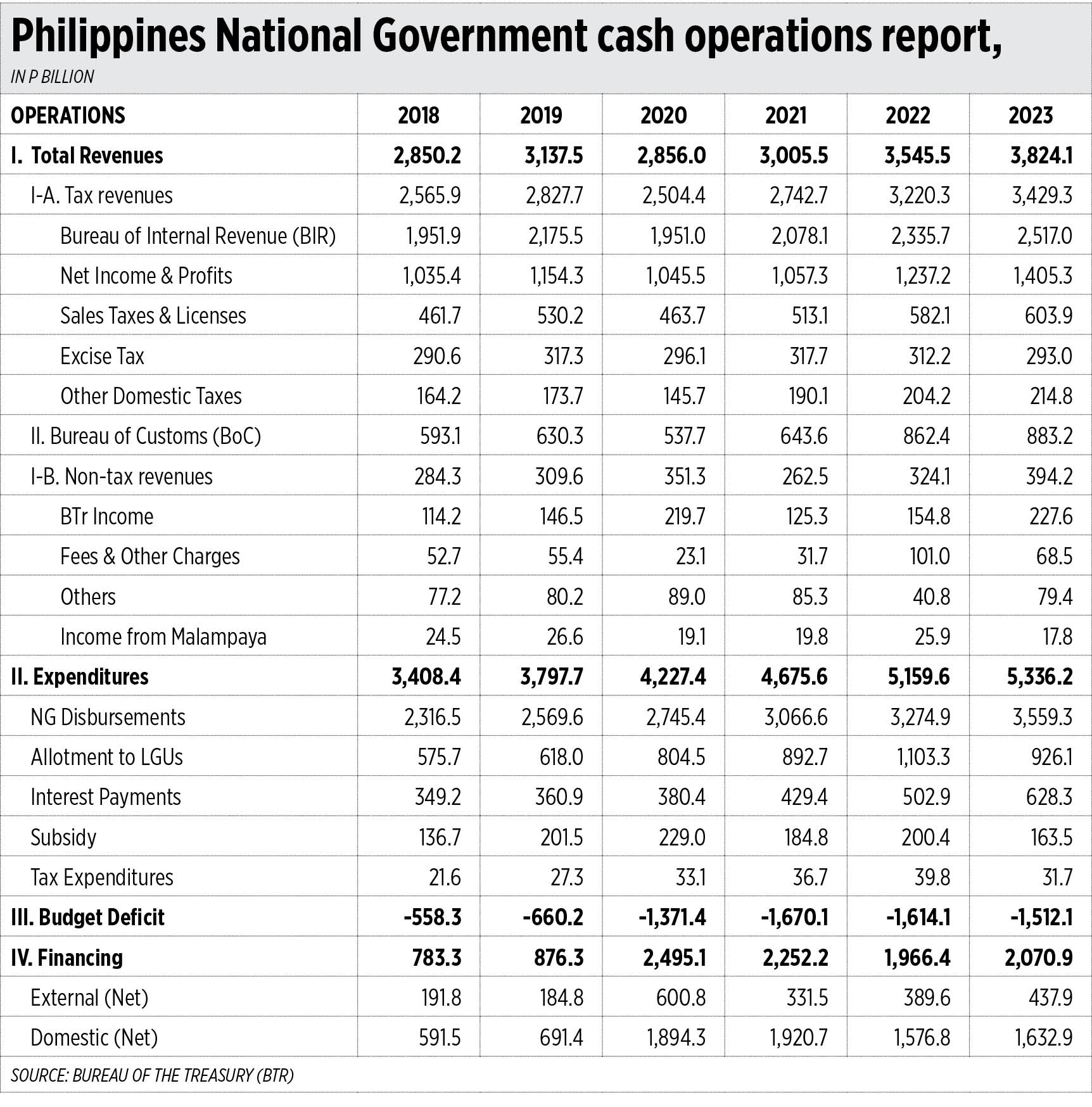
Last week, on Feb. 29, the Development Budget Coordination Committee (DBCC) released the full year cash operations report (COR) for 2023. The good news from it is that revenues have expanded significantly despite the absence of a major tax hike, from P3.55 trillion in 2022 to P3.82 trillion in 2023, and that the actual collection was higher by P95 billion than the target or programmed P3.73 trillion.

The bad news is that the actual budget deficit of P1.51 trillion was higher than the programmed deficit by P13 billion because expenditures have expanded significantly. Last year’s actual spending of P5.34 trillion was P108 billion higher than the programmed spending of P5.23 trillion.

The average budget deficit has increased from P609 billion/year in 2018-2019 to P1.542 trillion/year in 2020-2023. Consequently, the average financing or borrowings have more than doubled, from P830 billion/year in 2018-2019 to P2.196 trillion/year in 2020-2023 (see the table).
See also these recent reports in BusinessWorld: “Gov’t debt hits record P14.79 trillion at end-January” (March 1), “NG budget deficit exceeds full-year ceiling in 2023” (March 1), and, “Gross borrowings hit P2.19 trillion” (March 4).

I think there are three major reasons why the deficit in 2023 continued to remain high.

1. On the revenue side there was a continued decline in excise tax collection, mainly from tobacco tax revenues. As the tax rate has increased from P55/pack in 2021 to P60/pack in 2022, and P63/pack in 2023, the price of legal tobacco has become more expensive compared to illegal or smuggled tobacco and thus many smokers have shifted to the latter and government revenues from this product have declined.

2. On the expenditure side, National Government subsidies for both the needy and non-needy keep expanding. Among the non-needy are non-poor households that declare themselves as poor to continue receiving subsidies and freebies with no timetable, and the military and uniformed personnel (MUP) pension. The latter was about P164 billion in 2023 and could reach P200 billion this year, when it should be zero. Government doctors and nurses, teachers and professors, engineers and agriculturists, etc. pay for their own future pension via deductions from their monthly salaries but MUPs pay zero. And the pension is tax-free, so zero contribution as active personnel, zero contribution as pensioners. An average tax of 25% on the P164-billion pension, or P41 billion, will help because it goes back to them in the succeeding years. Plus, there are the monthly contributions by active MUPs.

3. The high interest rate policy of the Bangko Sentral ng Pilipinas contributed to the high interest payment of public debt, from P429 billion in 2021 to P503 billion in 2022 and further up to P628 billion in 2023. I will add that the high interest rate policy has cooled some investments in the country and adversely affected potentially higher GDP growth.

These three factors are beyond the policy changes or interventions made by the current economic team. The “sin products” tax rate was made by Congress upon the prodding of the economic teams of the last two administrations. The costly and burdensome MUP pension scheme was crafted back in the Fidel Ramos administration (1992-1998), and the high interest rate policy is made by the monetary authority.

Given these constraints, what can the current economic team do?

Finance Secretary Ralph G. Recto must go beyond revenue mobilization and help raise overall economic productivity. For instance, on the Metro Manila Subway, which is funded by huge foreign aid, he correctly announced that “this administration will deliver top-notch infrastructure projects to modernize the Philippine mass transportation system. We are working non-stop to get all of these done as soon as possible.”

Budget Undersecretary and Principal Economist Joselito R. Basilio rightly observed that “the lower National Tax Allotment shares of local government units for 2023 weighed down on overall growth of spending. Nonetheless, other productive expenditures, particularly infrastructure and other capital outlays, helped buoy government disbursements in 2023 and contributed to propping up overall GDP growth.”

PROPOSAL FOR GOVERNMENT SUBSIDIES FOR MINIMUM WAGE EARNERS
Earlier, there was a concerted lobby for Congress to legislate another minimum wage hike and, in the process, set aside the traditional tripartite negotiations among government (through the Department of Labor and Employment or DoLE), business and labor. See these recent reports in BusinessWorld: “‘Not the right time’ to raise wages — NEDA” (Feb. 23), “Legislated wage hike won’t benefit 80% of workforce — business groups” (Feb. 29), and, “Chamber warns prices will rise if wage hike bill becomes law” (Feb. 29).

Budget Secretary Amenah F. Pangandaman made the headlines in the Philippine Star, “DBM chief: Government can’t afford wage subsidies” (March 2). She was quoted as saying, “With its limited fiscal space the government is unlikely to find the resources to subsidize minimum wage earners… pushing through with such a subsidy would undermine consolidation efforts as well as the delivery of other social services. This is currently not in the budget approved by Congress. And it might eat up the budget for social services and other infrastructure priorities.”

That is a wise and rational position. As shown in the numbers above, the government keeps on borrowing a lot because domestic revenues are not enough, so we should avoid inventing new ways of spending. Rather, we should think of spending cuts in certain sectors, or the large-scale privatization of government assets to fund new or higher spending to unburden the taxpayers.

Meanwhile, I attended a lunch meeting organized by the President of the Federation of Filipino Chinese Chambers of Commerce and Industry, Inc. (FFCCCII), Dr. Cecilio K. Pedro, for business editors and columnists last week at the Makati Shangri-La hotel.

Dr. Pedro discussed the general activities for the upcoming 70th anniversary of FFCCCII, the local business sector’s desire for world peace and commerce, to have friends and not enemies in many countries so that more business and jobs can be created here, and that wages will increase with higher demand for labor and not with legislated minimum wage hike. I agree with the gentleman.


Bienvenido S. Oplas, Jr. is the president of Bienvenido S. Oplas, Jr. Research Consultancy Services, and Minimal Government Thinkers. He is an international fellow of the Tholos Foundation.

minimalgovernment@gmail.com

DMCI Homes eyes 2nd leisure property in Benguet by second quarter

CONSUNJI-LED DMCI Homes said it is targeting to open an eco-agri resort condotel in Tuba, Benguet, by the second quarter of the year.

“Being conveniently located near Baguio City, Tuba is fast becoming a favorite among travelers for its equally cool weather and captivating mountain landscapes, [and] the possibilities for eco-agri ventures are also promising,” DMCI Homes Vice-President for Project Development Dennis O. Yap said in a e-mailed statement on Friday last week.

“We aim to create a condotel that embodies the essence of a true mountain resort by integrating the natural terrain with modern Filipino architecture,” he added.

The Tuba town is accessible through Marcos Highway on the way to Baguio, and accessible via the Baguio-La Trinidad-Itogon-Sablan-Tuba-Tublay Outer Ring Circumferential Road.

In a separate e-mail, DMCI Homes said the company is currently in the process of obtaining permits for the project.

“Recognizing the demand for leisure properties, especially among those interested in healthy living and sustainability post-pandemic, we’re committed to catering to this market segment,” the company added.

The project is being developed after the company’s first leisure property, Solmera Coast in Batangas, was launched in August last year.

Solmera Coast yielded P6.8 billion in reservation sales as of Sept. 30 and sold out 74% of its launched units in less than five months, DMCI Holdings said in a statement in January. — Aubrey Rose A. Inosante

Israel agrees to revise Eurovision song lyrics that evoked Hamas attack

—EUROVISION.TV

JERUSALEM — Israel has agreed to revise the lyrics of its potential submission to the Eurovision Song Contest after the contest organizers took issue with verses that appeared to reference Hamas’ Oct. 7 attack, Israel’s national broadcaster Kan said on Sunday.

Eurovision, which this year will take place on May 7-11 in the Swedish city of Malmo, bills itself as a non-political event and can disqualify contestants deemed to have breached that rule. Broadcaster Kan is tasked with choosing Israel’s entry.

The leading Israeli submission is “October Rain,” a ballad sung by female soloist Eden Golan.

According to lyrics leaked to the media, and later confirmed by Kan, it includes lines such as “There’s no air left to breathe” and “They were all good children, each one of them” — apparent allusions to people who holed up in shelters as Hamas gunmen carried out a killing and kidnapping spree at an outdoor music festival and other sites which sparked the war in Gaza.

Kan said it has asked the writers of “October Rain” and second place finalist “Dance Forever” to revise their lyrics, while also preserving their artistic freedom. It will then officially choose the song to send the Eurovision committee.

The European Broadcasting Union, which organizes Eurovision and has previously said it was in the process of scrutinising the lyrics, did not immediately respond to a request for comment on Kan’s decision.

The Israeli broadcaster said it agreed to make the changes following a request from the country’s president, Isaac Herzog.

“The president emphasized that at this time in particular, when those who hate us seek to push aside and boycott the state of Israel from every stage, Israel must sound its voice with pride and its head high and raise its flag in every world forum, especially this year,” Kan said. — Reuters

Pueblo de Oro breaks ground for Courtyards Lipa project

REAL ESTATE developer Pueblo De Oro Development Corp. said it has started constructing its Courtyards Lipa residential project, which is targeted for completion by July 2027.

The project is part of the company’s P3.5-billion investment in Batangas this year, Pueblo De Oro said in an e-mailed statement last week.

The 10-hectare project will offer two-storey corner and inner single-attached houses for the middle-income market.

The homes will have a 106-square-meter floor area and a garden-courtyard for each cluster of residential blocks.

The amenities include a basketball court, playground, clubhouse, swimming pool, and linear park.

In line with its commitment to “prioritizing green living and sustainability,” the company incorporated key weather resilience features, such as a detention pond and sewage treatment plant, into their project, it said.

“Additionally, we have carefully devised smart land leveling plans based on thorough soil and flood studies, ensuring a flood-free community experience for all our future residents,” the company also said.

Courtyards Lipa is located near schools, institutions, shopping malls, hospitals, and leisure destinations such as beaches and resorts. The subdivision is two kilometers away from the New City Hall and Metro Lipa Medical Center, and it is also close to the Lipa bypass road.

In addition to its expansion in the province, the company said it is looking forward to launching the P1.7-billion Pueblo de Oro Westwoods Heights in Batangas City, featuring a 66 sq.m. floor area located nearby the toll exit. 

“Alongside our ongoing projects in Sto. Tomas, Malvar, Batangas City, and Lipa, we are actively exploring opportunities in Tanauan and other cities in the province,” the company also said.

Pueblo de Oro is the residential development arm of ICCP Group, which has business interests in financial services and property management. — Aubrey Rose A. Inosante

Sun Life launches new investment-linked plan

SUN LIFE of Canada (Philippines), Inc. (Sun Life Philippines) has launched a new peso-denominated, single-pay investment-linked insurance product, it said on Monday.

Sun Peso Maximizer (ProIncome) offers an annual income payout of 4.3% for seven years, the life insurer said in a statement.

Those who avail of the policy will be paid back their full single premium by policy maturity or at the end of the seven-year holding period.

The product also offers life insurance coverage with a guaranteed benefit of at least 125% of the one-time premium payment.

“With the Sun Peso Maximizer, clients can enjoy regular earnings even prior to the maturity of their policy. This will provide them with extra income to address various needs such as growing their wealth while preserving their capital,” Sun Life Philippines Chief Distribution Officer Al Quitangon said.

“It’s a complete financial solution. With the life insurance protection component, clients can have peace of mind that no matter what happens, a bright future is guaranteed for their loved ones,” he said.

Sun Life’s premium income stood at P13.21 billion in the first quarter of 2023. Its net income was at P2.94 billion in the same period. — AMCS

Manila Water subsidiary inks $110-M loan deal with 2 Singapore banks

MANILA Water Co., Inc. announced on Monday that its subsidiary signed a $110-million, or over P6 billion, three-year term loan with two Singaporean banks.

Manila Water Asia Pacific Pte. Ltd. signed the deal with Singapore branches of Mizuho Bank and ING N.V., its parent company said in a stock exchange disclosure.

“The proceeds of the loan will be used to refinance existing debt,” Manila Water said.

Manila Water Asia Pacific was established in 2010 as the holding company for international ventures.

It is the sole shareholder of Manila Water South Asia Holdings Pte. Ltd., Thu Duc Water Holdings Pte. Ltd., Kenh Dong Water Holdings Pte. Ltd., and Manila Water (Thailand) Co.

Manila Water also announced that Boracay Island Water Co., Inc. (Boracay Water) has allocated P1.1 billion “to further intensify water and wastewater services” in Boracay Island and ensure compliance with its service obligations.

Boracay Water is a unit of Manila Water through its subsidiary Manila Water Philippine Ventures and a concessionaire of Tourism Enterprise Zone Authority.

For 2023, Manila Water recorded a consolidated net income of P5.59 billion, down 6% from P5.92 billion a year earlier.

Consolidated revenues went up by 35% to nearly P31 billion. This was attributed to the recovery of the east zone’s commercial and industrial account and the 20% increase in revenues of the company’s non-east zone businesses in the Philippines.

Shares in the company climbed by 20 centavos or 0.97% to close at P20.80 each. — Sheldeen Joy Talavera

2002 murder of Run-DMC’s Jam Master Jay was by friend and godson, jury finds

THE RUN-DMC album Raising Hell helped usher hip-hop into the mainstream. The murdered Jam Master Jay was a founding member of the group. —AMAZON.COM

NEW YORK — The godson and a childhood friend of Jam Master Jay were found guilty by a jury on Tuesday for the 2002 murder of the Run-DMC rap pioneer, who was fatally shot at his New York City recording studio in one of the most infamous killings in rap history.

Ronald Washington, 59, and Karl Jordan Jr., 40, were convicted of federal charges of murder while engaged in drug trafficking in the shooting of Jam Master Jay, the stage name of Run-DMC founding member Jason Mizell, the US attorney’s office in Brooklyn said on the X social media platform.

The verdict came after a month-long trial at the US District Court in Brooklyn, where prosecutors called witnesses who were in the studio the night that Mr. Mizell, 37, was shot dead on Oct. 30, 2002. Those witnesses included Mr. Mizell’s friend Tony Rincon, who was shot in the leg that night by one of Mr. Mizell’s killers.

“It is no mystery why it took years to indict and arrest the defendants,” Breon Peace, the US attorney for New York’s Eastern District, told reporters outside the courthouse after the verdict.

“The witnesses in the recording studio knew the killers, and they were terrified that they would be retaliated against if they cooperated with law enforcement and identified the ruthless executioners of Mr. Mizell,” attorney Peace said.

Both Mr. Washington and Mr. Jordan were well known to Mr. Mizell, who prosecutors said was killed in a business dispute over a lucrative deal to distribute cocaine in Baltimore. Mr. Washington was a childhood friend, and Mr. Jordan was Mr. Mizell’s godson. All of them grew up in the same neighborhood in the New York City borough of Queens.

In the 1980s, Mr. Mizell and his Run-DMC bandmates helped usher hip-hop into the mainstream with hits including “It’s Tricky” and the cover of Aerosmith’s “Walk This Way” off the best-selling 1986 album Raising Hell.

In their lyrics and stage shows, they were known to advocate against illegal narcotics. The group even recorded a “Just Say No!” anti-drug public service announcement in the late 1980s for the US Drug Enforcement Administration.

But as Mr. Mizell’s music-industry success waned in the 1990s, he turned to dealing cocaine to help fund his music career, according to prosecutors in the US attorney’s office in Brooklyn.

They also called witnesses who told jurors that Mr. Jordan and Mr. Washington confided to people close to them that they were the killers.

Prosecutors said Mr. Jordan and Mr. Washington conspired to kill Mr. Mizell after the musician cut them out of the drug deal in Baltimore worth nearly $200,000.

Lawyers defending Mr. Washington and Mr. Jordan both bluntly told the jury that the defendants did not kill Mr. Mizell. The defense called a single witness, an expert who testified on the frailty of human memory, in order to discredit prosecution witnesses recounting decades-old events.

Washington and Jordan face a maximum sentence of life in prison and a mandatory minimum of at least 20 years.

In May, a third defendant, Jay Bryant, was also indicted in the murder and is due to face a separate trial.

In the prosecutors’ account of the night of the murder, Bryant, a friend of Jordan whom Mizell did not know, entered the front door and let Mr. Washington and Mr. Jordan in through a locked back fire exit, both armed with handguns, prosecutors said.

Mr. Mizell stood up from a couch to greet his godson. Mr. Jordan shot him in the head from a few inches away, killing him instantly, prosecutors told the jury. All three defendants fled moments later, they said.

Prosecutors said Rincon and other eyewitnesses were too afraid to tell police at the time who killed Mr. Mizell, and even fled New York in fear of their own safety. — Reuters