Home Blog Page 3567

Inflation rates in the Philippines

HEADLINE INFLATION accelerated for the first time in five months in February as prices of food, particularly rice, rose faster than expected, according to preliminary data from the Philippine Statistics Authority (PSA). Read the full story.

Inflation rates in the Philippines

Cooperation among nations with shared values as a pathway to stability

KRAKENIMAGES-UNSPLASH

The Philippines as a country and as part of the Indo-Pacific region is confronted by numerous challenges on many fronts — enhancing maritime security, promoting economic development, and combating climate change, among others.

It cannot address these challenges on its own.

Friendship and partnerships with countries that share its values are a source of strength and confidence. For example, the trilateral partnership between the Philippines, India, and Japan is a strategic move to address regional challenges. Through collaboration and the sharing of resources and expertise, these countries aim to counter the growing aggression of other actors by enhancing connectivity, strengthening supply chains, and securing the Indo-Pacific region. Sharing the best practices in the military, geopolitical, and economic realms would have a significant impact on the region, thus facilitating a free and open Indo-Pacific.

A forum precisely on this triangular collaboration, organized by the Stratbase ADR Institute and the Japan Foundation, was held on March 1. Among the topics discussed during the event was the proposed cooperation that would not only enhance security but also promote trade and economic development among the three nations.

During the forum, it was acknowledged that maritime security cooperation remains crucial amid China’s increasing aggression in the West Philippine Sea. This is highlighted by recent incidents involving Philippine vessels and interference with communication systems. China’s activities in the West Philippine Sea, including the Scarborough Shoal dispute and rejection of the 2016 arbitral ruling, have raised concerns.

Like the Philippines, Japan also faces maritime disputes with China, particularly over the Senkaku Islands in Okinawa prefecture.

Hiroyuki Akita, a commentator at Nikkei Asia, said Japan is working to establish a more horizontal and mini-lateral security alliance in the region in anticipation of the potential return of former US President Donald Trump to the White House. According to him, Trump’s return — deemed likely as recent polls indicate that the American electorate favors Trump over the incumbent President Joseph Biden because of the latter’s age and fitness for a second term — would be a significant development.

No doubt, this would cause a shift in geopolitical dynamics that could impact regional security strategies and alliances, including those involving the Philippines.

According to Dr. Renato de Castro, China’s actions should not be termed as a territorial dispute but maritime expansion. Referring to it as a territorial dispute often implies a contention over specific pieces of land or territory, which may oversimplify the broader issue at hand.

But framing the issue as Chinese maritime expansion acknowledges the broader strategic goals and actions undertaken by China to assert control and influence over maritime areas beyond its immediate territorial waters. This perspective highlights China’s efforts to expand its presence and influence in the region through various means, such as artificial island-building, military deployments, and unilateral resource exploitation, which extend beyond traditional notions of territorial disputes.

Another defense and security issue tackled during the forum was the delivery of BrahMos cruise missiles from India to the Philippine Marine Corps. This collaboration reflects a broader geopolitical strategy to address regional security challenges collectively.

PHL-AUSTRALIAN FRIENDSHIP
And then, there is our country’s special relationship with Australia. President Marcos made a state visit on Feb. 28-29 and in addressing the Australian Parliament, he articulated a comprehensive vision for security cooperation, addressing multifaceted challenges across various domains.

Central to his discourse was the pressing issue of security in the West Philippine Sea, where he emphasized the imperative of upholding international law and safeguarding freedom of navigation. Moreover, he outlined a forward-looking vision for defense and security cooperation between the Philippines and Australia.

Throughout his speech, the President reiterated the shared commitment of both nations to a rules-based order and regional stability, underscoring the critical role of collective action in confronting geopolitical threats and ensuring peace and prosperity in the Indo-Pacific region.

On the West Philippine Sea, President Marcos Jr. emphasized the importance of protecting the South China Sea as a vital global waterway for regional and global peace. Despite recent efforts to improve diplomatic ties between Beijing and Canberra, the issue of territorial disputes in the South China Sea remains a point of contention.

On Strategic Partnership and Bilateral Cooperation, the President emphasized the longstanding relationship between the Philippines and Australia, citing their 78 years of diplomatic ties and their collaboration during World War II. Australia is one of the few countries with a Visiting Forces Agreement (VFA) with the Philippines, aside from the US.

On Energy Security, President Marcos Jr. praised Prime Minister Anthony Albanese for his commitment to a world without nuclear weapons during his recent speech. He highlighted the significance of treaties such as those of Bangkok and Rarotonga in promoting nuclear disarmament. Marcos Jr. also expressed concerns about the proliferation of nuclear weapons, citing the buildup of global weapon stockpiles, particularly in North Korea, and the war between Russia and Ukraine. This stance strengthens the country’s position in global diplomacy and aligns it with other nations striving for a world free of nuclear weapons.

The emphasis on security, particularly in the West Philippine Sea, underscores the need to address pressing security concerns and strengthen defense cooperation with Australia.

Our commitment to a rules-based order, which we share with these nations, is also a shared interest in upholding international laws. This is a pathway to stability amidst geopolitical tensions that we face.


Victor Andres “Dindo” C. Manhit is the president of the Stratbase ADR Institute.

Cebu Pacific receives 2nd aircraft delivery for 2024

CEBU PACIFIC said it has received its second aircraft delivery for the year in line with its target to increase its network capacity, the budget carrier said on Tuesday. 

“This aircraft delivery is consistent with our commitment to incorporating SAF in our operations,” Alex B. Reyes, chief strategy officer of Cebu Pacific, said in a statement.

The A330-NEO, or New Engine Option aircraft, is the first of the 12 Airbus NEO deliveries expected to arrive within the year.

The airline previously received its A320ce aircraft.

Airbus’ aircraft is said to have better fuel efficiency as it is the latest generation of Airbus planes considered the most compatible to use SAF. Currently, all Airbus aircraft are certified to operate with up to a 50% SAF blend.

“Using SAF is one of the steps we are taking towards reducing carbon emissions and advance our sustainability agenda in the aviation industry,” Mr. Reyes said.

Cebu Pacific aims to use SAF across its commercial network by 2030 as part of the company’s commitment to help the aviation sector achieve its net-zero greenhouse gas emissions by 2050. 

The budget carrier is also aiming to transition to an all-NEO fleet by 2028.

To date, Cebu Pacific flies to 35 domestic and 24 international destinations in Asia, Australia, and the Middle East. — Ashley Erika O. Jose

Gov’t fully awards reissued seven-year bonds

BW FILE PHOTO

THE GOVERNMENT made a full award of the reissued Treasury bonds (T-bonds) it offered on Tuesday at a higher average rate after inflation picked up in February.

The Bureau of the Treasury (BTr) raised P30 billion as planned via the reissued seven-year bonds it offered on Tuesday as total bids reached P50.062 billion, or almost twice the amount on the auction block.

The bonds, which have a remaining life of six years and 10 months, were awarded at an average rate of 6.27%, with accepted yields ranging from 6.198% to 6.345%.

The average rate of the reissued bonds rose by 17.6 basis points (bps) from the 6.094% quoted for the papers when they were first offered on Jan. 16. It was likewise 14.5 bps above the 6.125% coupon for the series.

The yield also was 8.2 bps above the 6.188% seen for the same bond series and 3.3 bps higher than the 6.237% quoted for the seven-year bond at the secondary market before Tuesday’s auction, based on PHP Bloomberg Valuation Service Reference Rates data provided by the Treasury.

The T-bonds fetched a higher average rate after headline inflation quickened in February, Rizal Commercial Banking Corp. Chief Economist Michael L. Ricafort said in a Viber message.

“The higher auction rates today reflected the stronger-than-expected Philippine headline inflation for February 2024,” a trader likewise said in an e-mail on Tuesday.

Headline inflation accelerated to 3.4% in February from 2.8% in January, the Philippine Statistics Authority reported on Tuesday. Still, the consumer price index (CPI) was much slower than the 8.6% print in the same month a year ago.

Last month’s inflation print was above the 3% median estimate in a BusinessWorld poll of 16 analysts conducted last week, but was within the Bangko Sentral ng Pilipinas’ (BSP) 2.8-3.6% forecast for the month.

This also marked the first time that headline inflation picked up month on month since September 2023.

For the first two months, the CPI averaged 3.1%, within the BSP’s 2-4% annual target.

The BTr is looking to raise P180 billion from the domestic market this month, or P60 billion from Treasury bills and P120 billion via T-bonds.

The government borrows from local and foreign sources to help fund its budget deficit, which is capped at 5.1% of gross domestic product this year. — A.M.C. Sy

Sinéad O’Connor’s label asks Trump to stop using her music

COMMONS.WIKIMEDIA.ORG

LONDON — Late Irish singer and activist Sinéad O’Connor’s label demanded Donald Trump to stop using her music in political rallies, adding her to a list of artists from Taylor Swift to Rihanna who have denounced the former US president.

The Dublin native, who was known for her outspoken views on religion, sex, feminism, and war, would have been “disgusted, hurt, and insulted” to have her work misrepresented in this way by someone who she herself referred to as a “biblical devil,” the statement said.

Her longtime label Chrysalis Records and estate expressed “outrage” in a joint statement that Trump — the US Republican frontrunner — had been playing her 1990 chart-topping hit “Nothing Compares 2 U” at his rallies.

“Throughout her life, it is well known that Sinéad O’Connor lived by a fierce moral code defined by honesty, kindness, fairness, and decency towards her fellow human beings,” they said on behalf of the singer, who died last July at the age of 56.

“As the guardians of her legacy, we demand that Donald Trump, and his associates desist from using her music immediately.” The statement comes as Trump scored wins in Michigan, Missouri, and Idaho Republican caucuses on Saturday, moving him closer to becoming his party’s White House standard-bearer and a likely general election rematch with US President Joe Biden.

Many artists, or their representatives, have voiced similar objection to their compositions being played at Trump events over the years, including late American singer-guitarist Tom Petty, British singer-songwriter Adele, and rock band R.E.M. — Reuters

Filipino Gen X, Y prefer owning their business

WES HICKS-UNSPLASH

MORE THAN HALF or 53% of Filipino millennials and Gen Xers prefer to become entrepreneurs over traditional employment, according to a survey by PhilCare.

PhilCare’s 2023 Wellness Index survey also found that 38% of the respondents preferred flexible work arrangements over fixed hours. A third wanted to work until retirement so they could pursue other income opportunities.

Generation X refers to people aged 44 to 59, while Generation Y or millennials are aged 28 to 43.

“The result suggests a growing desire for autonomy and ownership, a desire to create something that they will be proud of in years to come,” Enrique Ona, PhilCare’s Wellness Index chairman, said in a statement on Monday.

“Employers who want to attract top Gen X and Y talents should capitalize on their entrepreneurial spirit by finding ways to keep them engaged,” he said. Companies should also give them “a sense of ownership and purpose that will help drive performance.”

The survey called “The ABCs of Pinoy Xs and Ys” which had 400 respondents nationwide was done online from October to November. It wanted to shed light on the two generations’ attitudes and priorities, as well as the evolving dynamics of the modern workplace.

Employers may need to evaluate career development plans as Gen X and Y choose prolonged careers over early retirement, PhilCare President and Chief Executive Officer Jaeger Tanco said in the statement.

“This may involve creating pathways for continuous learning, mentorship opportunities and phased retirement plans that align with the two generations’ professional journey,” he said.

It isn’t only the younger generation that views remote work as a “strong motivating factor” when considering a job, said Fernando Paragas, lead researcher for the PhilCare Wellness Index.

The demand for flexibility by millennials and Gen Xers, he said, highlights the importance both generations place on health, well-being and work-life balance.

“The shift in mindset of Gen X and Y signals a departure from the traditional 9-to-5 structure, with both generations seeking greater control over their schedules,” he said. “Any business or organization that wants to win the war for talent should make creating a flexible work arrangement top of mind.” — Patricia B. Mirasol

Tech, infra companies seen ‘favorable’ for IPO

BW FILE PHOTO

TECHNOLOGY and infrastructure companies must capitalize on the growing market interest and tap the capital market for growth, an investment management firm said.

“There are favorable industries for an IPO (initial public offering). I would say tech, and the sectors which did badly in the pandemic, they are the ones that are going to do very well this year and in the coming years and as interest rates go down,” Philequity Management, Inc. Vice President Miguel A. Agarao said at a Philippine Stock Exchange forum last week. 

The Monetary Board has kept its benchmark rate steady at a near 17-year high of 6.5% for a third straight meeting in February.

In January, electronic platform GCash announced its IPO plans as it awaited a more favorable market.

For the year, the PSE remains optimistic about achieving its target of six IPOs despite Citicore Renewable Energy Corp.’s decision to defer its listing target to the second quarter.

“Property, infrastructure, and banks will do well especially if PPP (public-private partnership) gets finalized. Because the banks will lend more, and then there will be that huge magnifying effect if interest rates can materialize,”  Mr. Agarao said.

In 2023, President Ferdinand R. Marcos, Jr. signed a measure aimed at streamlining the framework for PPPs.

The PPP Code, or Republic Act No. 11966, amended the Build-Operate-Transfer Law to create a unified legal framework for all PPPs at both national and local levels.

Last month, Pangilinan-led  Metro Pacific Investments Corp. said it was hoping to publicly list its planned joint venture company with San Miguel Corp. within the year.

It is difficult to predict growth among industries at this early stage, but the technology sector is expected to expand due to the ongoing digital transformation, according to a stock market analyst.

“As we all know, the stock market is inherently unpredictable, and various external factors such as geopolitical tensions, economic indicators, and unexpected events can influence sectoral performance,” Globalinks Securities and Stocks, Inc. Head of Sales Trading Toby Allan C. Arce said in a Viber message.

The growth of the technology sector will be driven by the global digital transformation, he said.

“Factors such as increased adoption of digital services, advancements in technology infrastructure, and demand for tech products could drive growth in this sector,” Mr. Arce said.

The infrastructure and construction sector will benefit from higher investments, especially in infrastructure projects through partnerships with the private sector, which can also spur industry growth.

“The government is expected to invest significantly in infrastructure projects through partnerships with private sector entities to stimulate economic growth. Factors such as government spending on infrastructure, urbanization trends, and demand for housing could drive growth in this sector,” he said. — Ashley Erika O. Jose

Our handicapped United Nations

JONATHAN- ANSEL MOY DE VITRY-UNSPLASH

The United Nations was formally established in 1945 right after World War 2. Its main purpose, according to its charter, was to prevent war and provide peace and security for the world. Today, we have wars in Ukraine and the Palestinian territories. People are still dying from proxy warfare in Syria and Yemen. Russia, one of the permanent members of the UN Security Council, has attacked Ukraine. And Israel is supported by the United States in its genocidal vengeance against Hamas, which has resulted in over 30,000 Palestinian deaths, more than 70,000 injured, and millions of displaced civilians, half of them women and children.

China continues to claim sovereignty over the South China Sea, including parts confirmed by the United Nations Arbitral ruling as belonging to the Philippines and other Southeast Asian countries. China has even destroyed corals and converted many islets into military bases; and constantly terrorizes Filipino fishermen who try to fish in their own country’s waters. Chinese ships have even aimed water cannons at ships of the Philippine Coast Guard. Meanwhile, the UN Arbitral Courts are unable to enforce their judgment. After all, China is a permanent member of the UN Security Council and has veto power which needs at least two thirds vote of the General Assembly to be overturned.

Antonio Guterres, the Secretary-General of the United Nations has condemned the genocidal actions of Israel against the Palestinians, and criticized Russia’s war against Ukraine which he asserts is an independent nation. But he is unable to do more than criticize as the UN does not have the power to enforce its mandates.

There are 15 members of the UN Security Council. Five of these are permanent members (China, France, Russia, the UK, and the United States) all of which are nuclear weapons states. These five countries are among the Allies which won the Second World War. Japan and Germany, losers in that war, are not members. Ten Security Council members are elected for two-year terms by the General Assembly. Almost all countries in the world are now members of the United Nations, and are represented in the General Assembly.

Resolutions passed by the General Assembly, such as those advocating a permanent ceasefire in the Gaza strip and the West Bank, have been vetoed in the Security Council by the United States which, ironically, is negotiating with Israel for a pause in the fighting to enable aid to be distributed to the millions of Palestinian refugees. The US is also providing aid to Palestinian refugees, lately via air drops. Meanwhile, the US has been providing arms to Israel. US diplomats have also questioned the proceedings in the International Court of Justice in The Hague, claiming that these are making their negotiations with Israel and Hamas difficult. The US’ contradictory positions are confusing. But the UN leadership, which should be the negotiator, is unable to assert its own positions.

Clearly, there is enough reason to call for radical reforms in the UN Charter.

The members of the General Assembly should mobilize for these reforms. There is an opportunity for leaders of ASEAN Nations to call for such reforms and to campaign with fellow developing regions such as the Arab League, Latin American and African Nations to agitate for such reforms since the UN charter is being violated. The Third World countries which are affected by these conflicts have been too quiet. The General Assembly has not, so far, called for such reforms.

The incoming president of Indonesia, Prabowo Subianto, has declared his intention to have an aggressive foreign policy. Perhaps President Ferdinand Marcos, Jr. should get together with him and initiate thinking on such reforms and how to mobilize support from ASEAN members and other developing nations’ regional organizations.

The call for radical reforms will begin modestly, perhaps, but perseverance can lead to some consciousness on the ineffectiveness of the UN to carry out its main purposes. It will help if at least some noise causes some shaking up, for a start.

There is no question that the United Nations has created, and manages, institutions that make life a little better for citizens of the least developed and least democratic nations of the world: The World Health Organization (WHO), the World Food Program, the International Labor Organization (ILO), the Food and Agriculture Organization (FAO), and the UN Development Program (UNDP). The United Nations Economic and Social Council (ECOSOC) and its units mobilize and monitor compliance with the Millennium Development Goals (MDGs) and now the Sustainable Development Goals (SDGs.) The United Nations Relief and Works Agency (UNRWA), now accused by Israel of having militaristic elements, has lost funding support from Germany with its support for Israel, perhaps because of its holocaust guilt. It continues to provide aid to the Palestinian refugees with what funding it still has. The programs and funds are financed through voluntary rather than assessed contributions.

But it is time, as we face serious threats once more to world peace and security, to question the inability of the UN to enforce its mandates against violations of its charter. The General Assembly must advocate for more power, and for a serious review of the veto power of the permanent members who are currently key actors in the threats to world peace and security.

Philippine foreign policy of course, is constrained by its need to side with US positions on global political issues since it is dependent on the US’ open support in its problems with aggression from China — which has veto power in the UN Security Council. It must therefore work within the context of ASEAN.

Perhaps former third world nations such as now prosperous Japan and South Korea can provide funding which is a source of power within the United Nations. The Third World must wake up.


Teresa S. Abesamis is a former professor at the Asian Institute of Management and fellow of the Development Academy of the Philippines.

tsabesamis0114@yahoo.com

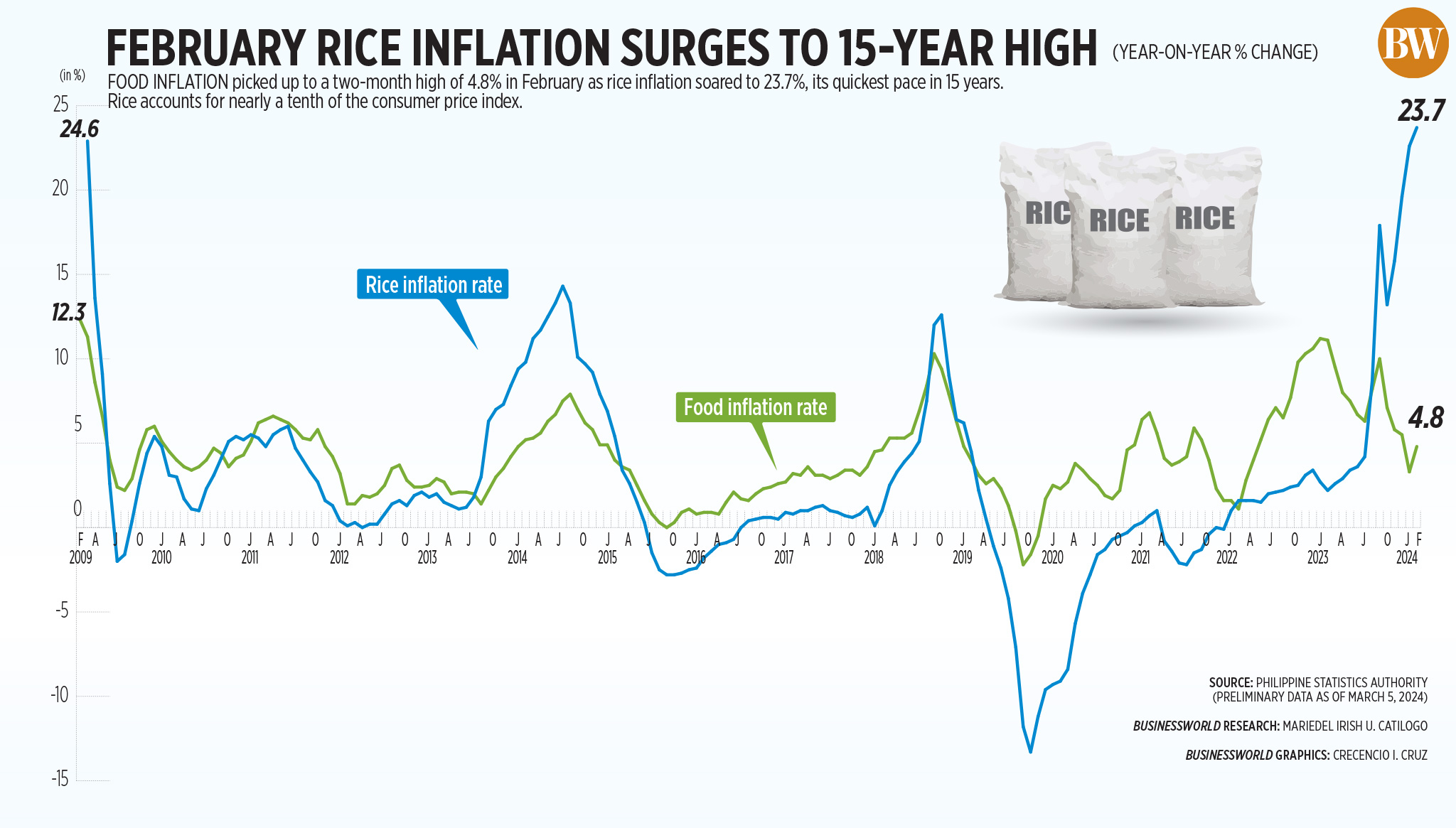
February rice inflation surges to 15-year high

HEADLINE INFLATION accelerated for the first time in five months in February as prices of food, particularly rice, rose faster than expected, according to preliminary data from the Philippine Statistics Authority (PSA). Read the full story.

February rice inflation surges to 15-year high

BSP looks to tighten MSB reporting standards to boost risk monitoring

BW FILE PHOTO

THE BANGKO SENTRAL ng Pilipinas (BSP) is looking to tighten its reporting standards for money service businesses (MSBs) to boost monitoring of risks in the sector.

A draft circular posted on its website showed the BSP wants to amend the Manual of Regulations for Non-Bank Financial Institutions (MORNBFI) “to enhance and provide structure to the regulatory standards for MSBs.”

The proposed amendments cover the reporting governance framework for MSBs.

“The amendments to the relevant sections of the MORNBFI set forth the Bangko Sentral’s initiative to enhance regulatory and supervisory activities over MSBs to ensure that attendant risks remain manageable as the industry continually evolves and business models become increasingly complex amidst emergence of new players in remittance and breakthrough financial technology,” the BSP said.

“They further the fulfillment of the Bangko Sentral’s international obligations and political commitment to strengthen its Anti-Money Laundering and Combating the Financing of Terrorism regimes,” it added.

The draft circular introduces provisions on MSBs’ risk monitoring and reporting.

“MSBs shall ensure that sufficient mechanisms are in place to monitor reputational risk across different business lines and functions. This enables the board or proprietor and management to address any significant issues and developments,” the central bank said in the circular.

It cited measures such as early warning systems to help detect and control risks.

“Sample early warning indicators include volume of complaints, number of negative news on the institution, number of violations of laws/regulations/codes of conduct with material penalties or sanctions for noncompliance,” it added.

MSBs are also tasked to notify the BSP of events which may have a “significant impact on their business or reputation and/or is likely to lead to a crisis,” such as cyber-related incidents, disruptions of financial services, liquidity ratios falling below the minimum, among others.

The BSP added that MSBs must employ an “effective” reporting system.

This is composed of a management information system; policies and procedures on the MSBs’ standards; periodic independent reviews of reporting procedures; and timely reporting to the board or proprietor and senior management.

It also revises the sanctions imposed on MSBs that do not comply with the BSP’s reporting standards, namely erroneous reports, delayed reports, and unsubmitted reports.

Under the draft rules, penalties range from P150 to P1,350 depending on the violation.

Fines for erroneous reports will be prescribed based on each occurrence while fines for delayed or unsubmitted reports will be based on each day it accumulates.

Previously, the penalty was set at P60 for each occurrence of an erroneous report or each day of a delayed or unsubmitted report.

MSBs are also required to conform to Philippine financial reporting and accounting standards, as well as adopt the Manual of Accounts under the Financial Reporting Package for MSBs for prudential reporting purposes.

The guidelines on the reporting of crimes and losses were also increased so that the amount involved per incident would start at P100,000 from P20,000 previously for incidents involving material loss, destruction or damage to the MSB’s property/facilities, other than arising from a crime.

If the draft circular is approved, MSBs will have one year from its effectivity to comply with the amended regulations.

The BSP is accepting comments on the draft circular until March 15. — Luisa Maria Jacinta C. Jocson

A new tool to aid the enforcement of intellectual property rights in the e-commerce space

SNOWING-FREEPIK

From Jan. 1 to Dec. 1, 2023, the Bureau of Customs (BoC) seized over P24.36 billion worth of smuggled counterfeit foods, up from P20 billion in the previous year.1 This indicates that the counterfeit goods market in the Philippines remains to be a pressing problem demanding the attention and best efforts of law enforcement.

Much attention has been given to the Greenhills Shopping Center, which is the only physical market in the Philippines cited in the “2023 Review of Notorious Markets for Counterfeiting and Piracy” of the United States Trade Representative (USTR)2, first appearing in the 2018 iteration and retaining its place ever since. In fact, the Intellectual Property Office of the Philippines (IPOPHL), acknowledging this fact, recently issued a statement reiterating that Greenhills remains a priority in its bid to clear the markets of counterfeit goods.3

The 2023 Review also highlights a vast array of online markets, including Singapore-based e-marketplace platform Shopee.4 This renewed focus on online markets is a response to the rise in their popularity throughout the years. Although online e-commerce platforms house a substantial number of verified sellers and legitimate goods, ranging from small entrepreneurs and businesses to worldwide household-name brands, some of them are also known to house, to varying degrees, an assortment of counterfeit goods.

In recognition of this, there have been commendable efforts from the IPOPHL and relevant stakeholders in curbing counterfeiting in the e-commerce space. In 2021, both Shopee and fellow e-commerce platform Lazada signed a memorandum of understanding (MoU) with several rights holders, establishing “a code of practice among online marketplaces” and “an efficient notice and takedown procedure” to aid the fight against counterfeit goods sold online.5 Speaking to their achievements in light of this MoU, in 2022 Shopee and Lazada both reported massive increases in listings removed from their platforms for counterfeiting, and the implementation of renewed IP rights campaigns and legitimate product guarantees.6

Recent legislation represents another helpful tool to aid in this fight, this time on the enforcement side.

On Dec. 5, 2023, Republic Act No. 11967, or the “Internet Transactions Act of 2023,” was signed into law, providing for the regulation of e-commerce to, among other things, protect consumer rights and uphold intellectual property rights.7 To this end, e-commerce merchants who are determined to have established “minimum contacts” in the Philippines may now be subject to Philippine laws and regulations despite not having a legal presence in the country.8 This brand-new law adds to the ever-growing list of applicable local laws for online transactions, a list which already includes R.A. No. 7394 (the Consumer Act of the Philippines), R.A. No. 8792 (the Electronic Commerce Act), R.A. No. 10173 (the Data Privacy Act of 2012), and R.A. No. 10175 (the Cybercrime Prevention Act of 2012).

This now makes potential sanctions and penalties under Philippine Intellectual Property laws possible for e-commerce merchants who sell their goods on the Philippine market. This development may also indirectly aid in the overhaul of Greenhills, as suppliers of merchants therein who transact primarily online may withdraw under threat of penalties.

It bears stressing the adverse effect that counterfeit goods have on the economy: they discourage innovation and product development, scare away potential foreign investment, and eat into the sales of legitimate manufacturers. It is hoped that with the applicability of Philippine laws to e-commerce merchants no longer in doubt, along with the combined efforts of the IPOPHL, law enforcement and the e-commerce marketplaces themselves, the enforcement of intellectual property rights in the e-commerce space continues to take steps forward.

1 Louisse Maureen Simeon, 2023. “Fake foods remain Philippines top smuggled item,” https://www.philstar.com/headlines/2023/12/08/2317268/fake-goods-remain-philippines-top-smuggled-item.

2 United States Trade Representative, 2023 Review of Notorious Markets for Counterfeiting and Piracy, at 49-50, https://ustr.gov/sites/default/files/2023_Review_of_Notorious_Markets_for_Counterfeiting_and_Piracy_Notorious_Markets_List_final.pdf.

3 Intellectual Property Office of the Philippines (2024), “Statement of IPOPHL on the USTR Notorious Markets Report: Greenhills Shopping Center,” https://www.ipophil.gov.ph/news/statement-of-ipophl-on-the-ustr-notorious-markets-report-greenhills-shopping-center/.

4 United States Trade Representative, 2023 Review of Notorious Markets for Counterfeiting and Piracy, Id., at 31.

5 Intellectual Property Office of the Philippines (2021), “Lazada, Shopee and IP right holders band together in fight vs. rising online counterfeiting, piracy,” https://www.ipophil.gov.ph/news/lazada-shopee-and-ip-right-holders-band-together-in-fight-vs-rising-online-counterfeiting-piracy/.

6 Intellectual Property Office of the Philippines (2022), “E-commerce MoU drives heightened takedown efforts against counterfeiting, piracy,” https://www.ipophil.gov.ph/news/e-commerce-code-of-practice-drives-heightened-takedown-efforts-against-online-counterfeiting-piracy/.

7 Republic Act No. 11967, Section 2.

8 Republic Act No. 11967, Section 5. (R.A. No. 11967 does not provide a definition or standard for what constitutes “minimum contacts.” As of the date of writing, the Implementing Rules and Regulations (IRR) for R.A. No. 11967 have not been released, therefore it remains to be seen what standard will be provided, if any.)

This article is for general informational and educational purposes only, and is not offered as, and does not constitute, legal advice or legal opinion.


Luis Alfonso F. Manlangit is an associate of the Intellectual Property Department of the Angara Abello Concepcion Regala & Cruz Law Offices (ACCRALAW).

lfmanlangit@accralaw.com

+632-8830-8000

Startup Olympian Motors making minimalist EVs for drivers sick of screens

OLYMPIANMOTORS.COM

WHEN Eren Canarslan, the co-founder and chief executive officer of Olympian Motors, removes the car cover from one of his company’s prototypes on a rainy fall day in Brooklyn, the most striking first impression is that it’s, well, cute. The two-door coupe, dubbed the Model 01, has distinctly vintage vibes, with smooth curved lines, swoopy Art Deco finishes and a front end so friendly it seems to smile. It looks more like a set piece from a classic movie than a car you’d take to the McDonald’s Drive Thru.

In an automobile landscape where cars seem to grow ever larger and more visually aggressive, Olympian, whose first vehicles are now available for pre-order, is leaning heavily in the opposite direction. Its cars are designed not to intimidate but to delight, and the company is hoping to both rebrand luxury for drivers and produce an electric vehicle (EV) that can turn a profit.

“For us, climate is luxury. For us, silence is luxury,” Mr. Canarslan says. “Luxury means a company that respects the environment. Luxury means a company that is respectful to the city.”

Founded in 2021, Olympian Motors is the outgrowth of an idea Mr. Canarslan developed with his fellow co-founder, Jasmine Sungu. The two connected in 2019 over a shared belief that traditional automakers were trapped in century-old thinking that was increasingly disconnected from intuitive design and customers’ actual needs. While car reviews are often dominated by horsepower, torque and acceleration speed, Olympian’s surveys of roughly 2,000 people across the US found that only a small percentage actually cared about those things.

“They said that as long as the performance is within the industry average, we’re good,” Ms. Sungu says.

What consumers did crave was comfort and simplicity, and a car both technologically advanced and aesthetically pleasing. So the duo decided to focus their designs on vehicles for ordinary people, not gearheads. Olympian’s Model 01 and its Model 84, which looks like a road-ready dune buggy, are the company’s first attempts.

Both the Model 01 and the Model 84 will come in two- and four-door versions, with ranges and battery capacities that are on par with much of their electric-car competition. But unlike many other EVs, which tend to have souped-up touch screens that span the entirety of their dashboards, the Model 01 and Model 84 have none.

Instead, Olympian leans into old-school controls: numbered dials for the speedometer, tachometer and battery indicator, plus a single knob for climate control. (Drivers will be able to connect their smartphone to the car for functions like streaming music and a backup camera.) The company says its cars have 80% fewer buttons and switches than a typical driver’s cockpit.

“Often when I’m driving, I’m not looking at the road. I’m looking at the screen and it’s distracting,” says Mr. Canarslan, who notes that respondents to the company’s surveys said that after a long day they’re often sick of staring at screens.

Next year, the company is hoping to roll out an augmented-reality windshield display that would provide turn-by-turn directions while letting the driver keep their eyes on the road.

The dashboard doesn’t only stand out for its lack of center-console touchscreens; it’s also made of wood. Olympian says its wood suppliers are all certified by either the Forest Stewardship Council, the Programme for the Endorsement of Forest Certification or both.

“One of Olympian’s values is we want to bring back the pleasure of driving,” Ms. Sungu says. “When you’re surrounded by plastic and unnatural materials, you actually biologically can’t relax.”

To maintain its aesthetics while streamlining manufacturing, Olympian uses a modular approach that it says reduces tooling, machinery and labor costs by 75-80% and production lead time by 60% compared to the construction-line approach of legacy US automakers. This Lego-like method simplifies manufacturing to a combination of components — platform chassis, battery, windshield, etc. While most car companies do this to some extent, the approach is suited to EVs, which have fewer moving parts. Olympian says the final assembly process that it handles only comprises about 30 pieces, with plenty of redundancy. (The Model 01 and Model 84 share a platform chassis, for example.) To offer a variety of colors, the company will rely on pre-painted panels.

While the modular approach is well-suited to quickly starting and scaling a car company, it presents its own challenges. For one, suppliers often prioritize larger auto companies with bigger orders. “If GM signs a partnership with LG, LG is going to be producing for GM first,” says BloombergNEF analyst Corey Cantor. “Only after GM are they willing to be free players.”

For now, Olympian’s anticipated production capacity is nowhere near that of its competition. The company says it has received more than 350 pre-orders from US customers (including a refundable $500 deposit) for the Model 01; to hit positive cash flow Mr. Canarslan says they would need to sell 200 cars per year. Tesla, by comparison, delivered 485,000 EVs in the fourth quarter alone, and even EV upstart Rivian made 57,000 cars in 2023.

The Model 01 isn’t cheap, either: Both the two- and four-door models will go on sale for $80,000, on par with a Tesla Model X and a touch above the cost of a Mercedes EQE SUV.

“That’s a higher-end market,” Mr. Cantor says.

The tension between a car’s cost and its capabilities — and carmakers’ ability to scale production — has taken center stage in the EV transition. After soaring by 62% in 2022 and 31% last year, global EV sales growth is expected to slow to 21% this year, according to BloombergNEF. Ford, General Motors and Volkswagen have all trimmed output of electric models or walked back production goals. Consumers, meanwhile, are contending with a dearth of affordable options as automakers prioritize higher-priced cars. Olympian joins a slate of domestic EV startups, including Rivian and Lucid, that are still struggling to reach profitability.

“If you’re competing with the big guys, there’s a real challenge for startups,” Mr.  Cantor says. “If you’re GM, you can sell more gas cars to fund the transition. If you’re a startup, it’s sink or swim based on your product. So from that standpoint, I think a lot of the startups that are around now won’t necessarily be here in 10 years.”

In 2021, Olympian received $125,000 in seed-stage funding from Y Combinator and participated in its startup accelerator program, which helped launch companies like DoorDash and Airbnb. It has since gone through three funding rounds, the last in 2023. Mr. Canarslan says the company can stand out on its customization and driver experience. “Some people pay $200,000 for a Porsche,” he says. “We want to be more affordable high-end.”

EV growing pains notwithstanding, transitioning from internal combustion to electric drivetrains is essential for reaching net zero: Transportation accounts for 24% of total carbon emissions, according to the International Energy Agency, and road vehicles are responsible for 70% of that. But research shows that, ideally, there should also be a reduction in the overall number of cars on the road and miles driven.

In that sense, Brooklyn is an interesting place to headquarter an EV startup, as New York City has some of the best mass transit in the US. Olympian’s location is in part a historical nod: A century ago, the city was a hub of custom car manufacturing, including electric vehicles. The Brooklyn Navy Yard, where Olympian is located, is also home to a number of green startups, and Olympian is betting that even NYC has a need for light, stylish electric cars. Ms. Sungu points to the rollout of curbside charging across the five boroughs.

“Yes, they want to increase foot traffic and reduce the footprint of congestion cars,” she says. “But I think there’s still room for us to play in cities.” — Bloomberg News


ADVERTISEMENT
ADVERTISEMENT