Home Blog Page 353

UN to deploy ceasefire monitoring mission in Congo, Qatar says

SANJITBAKSHI-FLICKR

DAKAR — The United Nations peacekeeping mission in Congo will send its first team to monitor a ceasefire between Congo’s government and the AFC/M23 rebel group in the coming days, Qatar’s foreign ministry said on Monday after hosting talks in Doha.

Qatar said the team would be deployed to Uvira, a strategic city in eastern Congo that AFC/M23 fighters captured in December during a rapid offensive, and which Congolese forces and allied militias re‑entered last month, restoring government control after the rebels announced they would withdraw.

The announcement late Monday is a sign of progress in Doha-mediated direct talks between Congo and the AFC/M23 rebels, who last year seized more land than they had ever held before in eastern Congo. The United States is hosting separate talks between Congo and Rwanda, which the United Nations and Western powers say backs AFC/M23, an allegation Kigali denies.

The Qatari foreign ministry said on Monday that Congo and M23 had agreed on detailed terms of reference for the ceasefire monitoring mechanism created under an agreement reached in October, and reaffirmed their commitments under the broader peace deal framework signed in November.

The latest push to activate ceasefire monitoring comes amid persistent fighting in the east.

Over the weekend explosive‑laden drones targeted the airport serving the northeastern Congolese city of Kisangani, Congolese authorities said.

If confirmed to be an AFC/M23 operation, it would be the furthest west the group has struck as part of its offensive against the government in Kinshasa. — Reuters

Venezuela interim president Rodriguez meets with US envoy

A person holds a Venezuelan flag as government supporters gather after US President Donald Trump said the US has struck Venezuela and captured its President Nicolas Maduro, in Caracas, Venezuela, January 3, 2026. — REUTERS/GABY ORAA

VENEZUELA’S government and the US embassy said on Monday that interim President Delcy Rodriguez met with US envoy Laura Dogu, as the two countries gradually resume bilateral relations broken in 2019.

The government said in a statement that the meeting took place at the Miraflores presidential palace to discuss “the work agenda between the Bolivarian Republic of Venezuela and the United States.”

Foreign Minister Yvan Gil added in comments on state television that the conversation covered the “common agenda” between the two countries, especially energy, trade, political and economic issues.

He added that Felix Plasencia, a prior foreign minister who also served as the country’s ambassador to China, will travel to Washington in the coming days to serve as Venezuela’s “diplomatic representative.”

Ms. Rodriguez’s brother, head of the National Assembly legislature Jorge Rodriguez, attended the meeting, the government said, as did Mr. Gil, with whom Ms. Dogu met over the weekend following her arrival in Caracas.

“The governments of Venezuela and the United States have set out to advance on a roadmap to address matters of bilateral interest, through diplomatic dialogue and on the basis of mutual respect and international law,” the statement added.

The US embassy in Venezuela said on social media that Ms. Dogu met with Venezuelan officials to “reiterate the three phases that US Secretary of State Marco Rubio had outlined for Venezuela: stabilization, economic recovery and reconciliation, and transition.”

After months of heightened tensions, the US captured Venezuela’s President Nicolas Maduro a month ago, setting off a chain of changes in the country, including the swearing in of Ms. Rodriguez, the passage of a reform to its flagship oil law and the release of some political prisoners. Ms. Rodriguez has said she is seeking “balanced and respectful international relations” with the US, while Mr. Trump has said the relationship with the interim government is going well.

The two countries have reached a deal to export up to $2 billion worth of Venezuelan crude to the United States, and on Friday Ms. Rodriguez announced a proposed “amnesty law” for hundreds of prisoners in the country, a move long demanded by the opposition and human rights groups. — Reuters

Jan. factory PMI at nine-month high

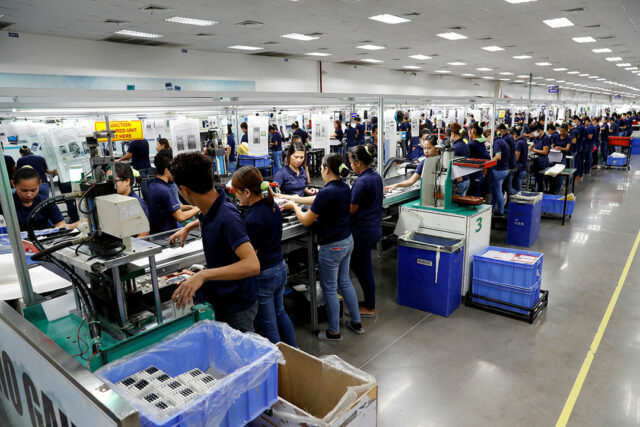
Workers at the assembly line of a factory in Malvar, Batangas in this file photo taken on Aug. 10, 2018. — REUTERS/ERIK DE CASTRO

PHILIPPINE FACTORY activity in January expanded at its fastest pace in nine months amid an increase in production and new orders, S&P Global said on Monday.

However, the latest improvement could be short-lived as business confidence remained weak due to concerns about external demand as the global economic environment remains fragile.

S&P Global Philippines Manufacturing Purchasing Managers’ Index (PMI) rose to 52.9 in January from 50.2 in December, the strongest improvement in nine months or since April’s reading of 53.
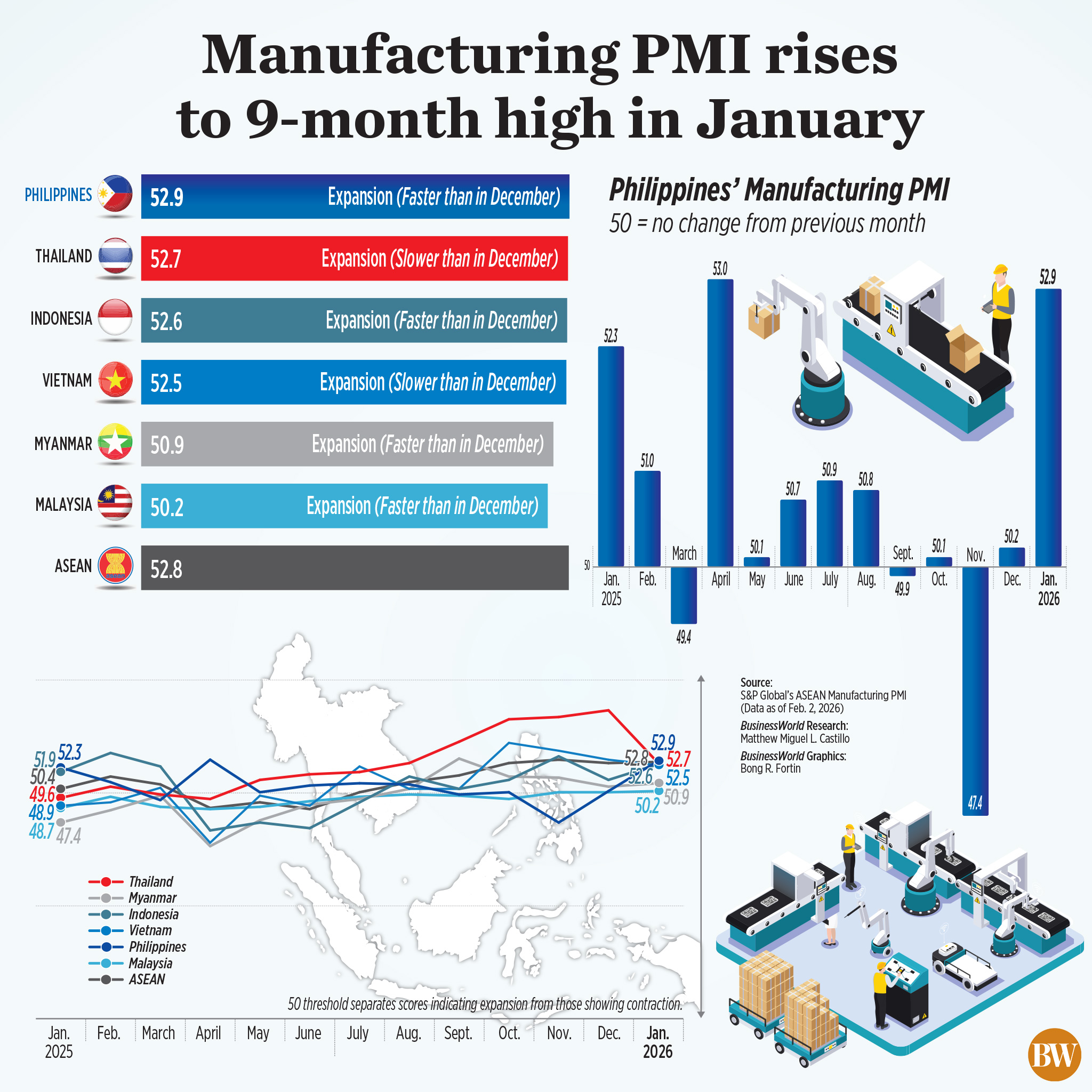
A PMI reading above 50 denotes better operating conditions than in the preceding month, while a reading below 50 shows deterioration.

“A renewed and strong uptick in output and faster growth in new orders contributed positively to the increase in the headline figure,” S&P said. “According to anecdotal evidence, strengthening underlying demand trends supported the latest uptick in new sales, which then fed through to a renewed rise in production levels.”

The Philippines recorded the fastest expansion in manufacturing activity in the Association of Southeast Asian Nations (ASEAN) region in January, based on S&P’s ASEAN PMI data, beating Thailand’s 52.7, Indonesia’s 52.6, Vietnam’s 52.5, Myanmar’s 50.9, and Malaysia’s 50.2.

The ASEAN Manufacturing PMI picked up to 52.8 in January from 52.7 in December on the back of strong growth in new orders.

“After a prolonged period of subdued growth in the second half of 2025, the first PMI data release for 2026 points to a marked shift in momentum,” Maryam Baluch, an economist at S&P Global Market Intelligence, said in the report.

“New orders registered a strong and accelerated uptick, supported in part by a renewed rise in export demand,” she added. “As a result, production returned to expansion territory for the first time in five months.”

S&P said the growth in overall orders was backed by a “modest” increase in new factory orders received from abroad, which marked the first month of expansion since September last year.

With these new orders driving production, higher production requirements led to increased staffing levels, snapping a two-month decline in job creation. “Although the pace of expansion was slight, it was the fastest since last June.”

“The recent uptick in employment allowed Filipino manufacturers to reduce backlogs of work at the start of the year. The rate at which work-in-hand contracted was marginal but marked the first reduction in three months.”

Increased output requirements also led manufacturing firms to ramp up their purchasing activity, posting the fastest growth in 12 months, S&P said.

“Additionally, firms highlighted their preference of stockbuilding in January as holdings of inputs rose for the first time in three months. Meanwhile, post-production inventories were also raised and for a second a straight month,” it said.

Meanwhile, producers’ operating expenses rose last month due to higher prices of raw materials, although input price inflation was broadly unchanged from December. This led manufacturing firms to slightly raise their goods’ prices.

Companies also reported longer input lead times in January, showing continued supply chain pressures, S&P said.

WEAK CONFIDENCE
However, despite the higher headline PMI figure in January, Ms. Baluch said the data showed a “worrying” decline in business confidence about future output.

“Overall sentiment slipped to the second-weakest level on record, surpassing only that seen at the onset of the COVID-19 pandemic. This hesitancy reflects lingering concerns regarding export demand and the sustainability of the latest improvement,” she said.

While companies remained hopeful that demand would improve, economic uncertainties in key export markets dampened confidence, S&P added.

S&P Global Market Intelligence Economics Associate Director Jingyi Pan said improved factory activity in the Philippines and across ASEAN to start the year is a “promising sign,” even as worries remain.

“Let us recall that January has been another month where geopolitical concerns have actually spread across the globe. Then, on that end itself, I think that’s something to take note of. But what I think as well that we have seen, as I mentioned, the employment index, there was a renewal and growth of employment. So, the businesses themselves are worried, but they’re still hiring. They are starting to buy inputs again,” she said in an interview on Money Talks with Cathy Yang on One News on Monday.

“If the employment index does not pick up alongside demand, if the stocks of purchases are not picking up, that’s when we are getting a little bit more worried. But I think right now, it’s more of a wait and see… So, from that perspective, I think it is telling us that they are still willing to invest to some extent, even though they are worried about how much production growth could actually materialize in 2026.”

She said they expect industrial production to rebound this year after a weak fourth quarter.

Rizal Commercial Banking Corp. Chief Economist Michael L. Ricafort said better weather conditions and less disruption may have contributed to increased production at the start of the year.

He added that further monetary easing here and abroad could provide a boost to manufacturers as lower borrowing costs will help them finance their operations and potential expansion.

Restocking after the holidays and other seasonal factors likely propped up factory activity last month, which means the January high could simply be a “blip,” especially amid the Philippine economy’s dismal performance last quarter, Filomeno S. Sta. Ana III, coordinator of Action for Economic Reforms, said.

“What is most concerning is the slump in business confidence despite the pickup in output in January 2026. That weak business confidence will predict future performance,” he said. — Aubrey Rose A. Inosante


Gov’t plans P1.44-trillion Q1 outlay for spending catch-up

FREDERICK D. GO — PHILIPPINE STAR/RYAN BALDEMOR

By Aubrey Rose A. Inosante, Reporter

FINANCE SECRETARY Frederick D. Go said the government plans to spend P1.44 trillion this quarter as part of catch-up efforts to support the economy after last year’s growth slowdown.

The planned first-quarter outlay under the P6.793‑trillion national budget will help drive economic activity to meet the government’s gross domestic product (GDP) growth target, Mr. Go said at a Foreign Correspondents Association of the Philippines event on Monday.

“I expect that for 2026, we will bounce back, and we will definitely have a GDP of at least 5%,” he said.

The government is targeting 5%-6% GDP growth this year.

The Finance chief said he met with various government agencies, including the Department of Budget and Management, to clear the spending program.

Philippine GDP growth slowed to 4.4% in 2025 from 5.7% the prior year, missing the government’s 5.5%-6.5% target.

This was the weakest annual expansion since the 3.9% in 2011, counting out the 9.5% contraction in 2020 due to the pandemic.

Officials said tighter public spending and weak investor confidence due to a wide-ranging corruption scandal tied to state infrastructure projects continued to drag growth.

“All the other pillars of growth of our country remain solid and reliable,” Mr. Go said, adding that remittances and business process outsourcing receipts remain solid. 

However, even as the government moves to speed up spending to pump-prime the economy, he reiterated that they remain committed to fiscal discipline.

“The most important part is not how much money you spend. It is how you spend that money.”

Mr. Go added that they want to focus on projects that have high multiplier effects.

He said governance reforms can help improve investor sentiment.

“I think the solution to that is simply prosecution, restitution, and genuine reform. The people want to see people punished and go to jail. That’s prosecution. People know that money has been taken. They want to see restitution. And number three, of course, we need to move on from this. We can’t keep talking about this. We need to move forward and the only way to move forward is through genuine reform,” he said.

“We continue to move the economy forward, create quality jobs, and grow, have financial inclusion for everyone.”

Several lawmakers, government officials, and contractors allegedly involved in anomalous flood control projects have already been charged, but observers have said that progress remains slow as other key figures named during the corruption probe continue to walk free.

Mr. Go added that the Public Works department, which is at the center of the graft scandal, has already moved to implement reforms to improve transparency.

NUCLEAR INDUSTRY
Meanwhile, the Finance chief said at the same event that the government is still pursuing bilateral agreements in the nuclear industry following the creation of the Philippine Atomic Energy Regulatory Authority (PhilATOM) via a law signed in September last year.

PhilATOM will serve as the country’s independent nuclear regulator, mandated to oversee the safe, secure, and peaceful use of nuclear energy and radiation sources.

“We continued to sign more bilateral agreements on technology sharing in the nuclear industry. We want to pursue that, as that will help deliver to us clean energy at lower prices,” Mr. Go said.

The Philippines’ power costs are among the highest in the region.

“I think that what everybody is talking about in the world today is what they call SMRs, or the small modular nuclear reactors, rather than these large-scale nuclear power plants,” he said.

The Department of Energy continues to pursue discussions on SMRs with various technology providers worldwide, he added.

BMI keeps 5.2% growth estimate

PHILSTAR FILE PHOTO

FITCH SOLUTIONS unit BMI has kept its 2026 growth forecast for the Philippines despite the last year’s miss as it expects public and private investments to recover.

BMI sees the Philippine economy expanding by 5.2% this year, unchanged from its earlier projection.

“For now, we are maintaining our 2026 growth forecast at 5.2%, but the lower 2025 base makes this a more pessimistic outlook,” it said in a report on Monday.

This is within the government’s 5%-6% growth target for the year.

Philippine gross domestic product (GDP) expanded by 3% in the fourth quarter, slower than 5.3% in the same period a year prior and the revised 3.9% print in the third quarter, the government reported last week.

This was the slowest quarterly print in nearly five years or since the 3.8% contraction in the first quarter of 2021. Outside of the coronavirus pandemic, this was the worst since the 1.8% growth recorded in the fourth quarter of 2009, or during the Global Financial Crisis.

This brought full-year 2025 GDP growth to 4.4%, below the government’s 5.5%-6.5% goal. This was slower than 2024’s 5.7% and was the weakest annual expansion since the 3.9% in 2011, counting out the 9.5% contraction in 2020 due to the pandemic.

Officials said tighter public spending and weak investor confidence due to the flood control scandal continued to drag growth.

BMI said it sees both public and private investments rebounding this year as the government works to ramp up spending and amid the lagged impact of the Bangko Sentral ng Pilipinas’ (BSP) past rate cuts on demand.

“The government probably underspent its capital budget in 2025… Beyond rhetoric from government officials pledging catch-up capital spending, we have not seen any indication of when the Senate investigation into corruption will conclude or when delayed infrastructure projects will be restarted,” it said.

“We would, however, be surprised if policymakers allowed the probe to drag on public capex (capital expenditure) for much longer — a quick recovery in infrastructure spending is necessary to hit the government’s 5-6% growth target for 2026. Our best guess for now is that the government will make up for the underspending of the capital budget in H2 (second half) 2026, with the low base flattering GDP growth in H2.”

It added that household consumption may also rebound this year, with the peso’s weakness to increase the value of remittances from migrant Filipinos.

However, the country’s external sector could weaken as last year’s export strength was largely driven by frontloading ahead of higher tariffs and increased electronics demand due to the artificial intelligence (AI) boom — which are both expected to lose steam this year, BMI said.

“Early indicators are starting to reflect deteriorating external orders… The global semiconductor upcycle appears to have peaked, as firms reassess the returns on AI-driven investments. This will materially affect electronic exports — about 54% of Philippine exports. Accordingly, we expect export growth to moderate as frontloading tapers and the higher 2025 base will mechanically make strong year-on-year growth hard to sustain,” it said.

“Should there be continued delays to infrastructure spending, household spending and exports will not be enough to offset weaker public spending, posing downside risks to our forecast. Inflation may also run hotter than we forecast if oil prices get another boost from rising geopolitical risks, limiting the BSP’s room for rate cuts.”

BMI expects the Monetary Board (MB) to deliver 50 basis points (bps) in cuts this year.

For its part, Deutsche Bank Research said the “surprise” growth slowdown last quarter increases the odds of a sixth straight rate cut by the BSP this month.

“We think that a February rate cut from the BSP is now almost certainly ‘on the table,’” it said in a report.

“We also see a rising likelihood of another rate cut in H1  (first half) given the likely wider-than-expected negative output gap,” it added “We will refresh our view pending more up-to-date data from 2026, including inflation, government disbursements, and BSP’s guidance in the February MB meeting.”

BSP Governor Eli M. Remolona, Jr. said on Sunday that a cut is possible at their Feb. 19 policy review if the fourth-quarter GDP slowdown proves demand-driven.

“If we can help on the demand side and still keep inflation low, then of course we’ll help,” he said.

He added that they will continue to assess the available data and decide “one meeting at a time.”

The Monetary Board has slashed benchmark borrowing costs by 200 bps since August 2024, bringing the policy rate to 4.5%. — Katherine K. Chan

PHL money market growing as repurchase transactions increase

Bangko Sentral ng Pilipinas Governor Eli M. Remolona, Jr. — COURTESY OF BANGKO SENTRAL NG PILIPINAS

By Katherine K. Chan, Reporter

DUMAGUETE CITY — The Philippines’ money market, particularly for repurchase agreement (repo) contracts, is growing rapidly and could potentially surpass the foreign exchange (FX) swaps, the Bangko Sentral ng Pilipinas (BSP) said.

“Now, our repo market, based on the GMRA (Global Master Repurchase Agreement) contract, is developing very fast so that it’s beginning to rival the FX swap market,” BSP Governor Eli M. Remolona, Jr. said during a media information session here.

“At this point, a lot of activity in the repo market is about 75% of the activity in the FX swaps. So, things seem to be developing in the right direction.”

The BSP chief said transactions in the repo market have now reached about P100 billion from “almost nothing a year and half ago,” making it the number two market in the country after FX swaps.

“I think it won’t be long before it surpasses the FX swap market and makes the FX swap market redundant (and) no longer necessary.”

Asked when he sees the repo market surpassing the FX swap market, Mr. Remolona said: “I think this year, it should overtake it.”

Rizal Commercial Banking Corp. Chief Economist Michael L. Ricafort said the repo market serves as another source of funding for banks, other financial institutions and investors, which could contribute to the development of the Philippine capital market.

“This provides greater optionality on more innovative ways to get funding in a more expeditious while stable manner, by allowing the borrower to hold on earning investments or assets, without the need to liquidate and sell them and use them as collateral instead, thereby also promoting stability and at least preventing forced liquidations and disruptions in the local financial markets,” he said in a Viber message.

Increased repo transactions could ease the pressure on the peso and dollar or other foreign currency-denominated lending rates in the FX swap market, leading to more stable funding costs, he said.

BOND MARKET
Meanwhile, the BSP chief said the bond market is also showing “very encouraging signs of development,” with about P30 billion worth of transactions seen since the peso interest rate swap market was launched in November 2024 involving longer maturities.

“So, it looks promising, I would say.”

He said the central bank is working with several partners to create a roadmap for a more accessible corporate bond market.

BSP Deputy Governor Zeno Ronald R. Abenoja added that increased activity in the capital market has helped guide yields closer to benchmark rates.

“As the liquidity in these markets continues to increase and also be evenly distributed towards other tenors, what we have seen also are improvements in the alignment of the rates relative to the different rates in the BSP facility,” Mr. Abenoja said during the same event.

“So, with increased volume, we continue this to further align among themselves in the short end of the market, and that could be transmitted all the way up to the long end, as the governor has mentioned.”

The BSP has been pushing to deepen the country’s capital market to boost liquidity, improve domestic savings and investments, and enhance monetary policy transmission.

“Money and capital markets help the BSP do its job,” Mr. Remolona said. “At the moment, these markets are makeshift markets, and they could be more helpful.”

“We need money and bond markets that transmit monetary policy more effectively. We need a corporate bond market that can serve as a spare tire in case the banking system fails.”

Manila condo oversupply seen keeping vacancy high this year — Colliers

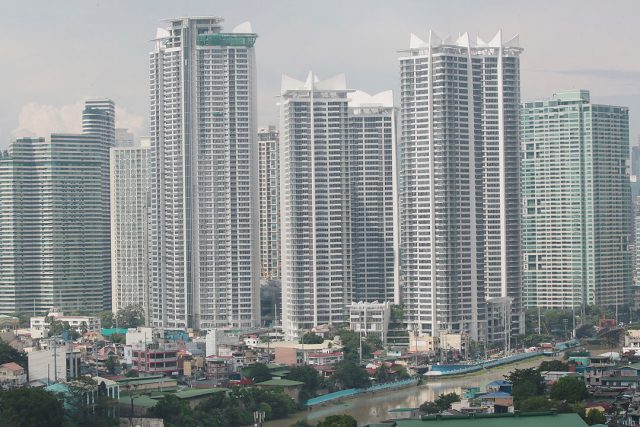
A VIEW of buildings in Makati City. — PHILIPPINE STAR/MICHAEL VARCAS

METRO MANILA’S condominium market is expected to see residential vacancy rise to 25% this year as unsold units in mid- and lower mid-income segments continue to weigh on the market, property consultancy firm Colliers Philippines said.

In its Fourth-Quarter Property Market Report, Colliers projected that the region’s residential vacancy rate would peak in 2026 before easing to 23.9% in 2027.

Metro Manila ended 2025 with a 24.7% vacancy rate, up from 23.9% in 2024.

“The mid-income segment has shown strong demand for its pre-selling units, but when owners try to resell or lease them, they have a hard time finding a renter or buyer,” Joey Roi H. Bondoc, director and head of research at Colliers Philippines, said on the sidelines of a briefing on Monday.

Colliers data show Metro Manila has roughly 30,000 unsold ready-for-occupancy units, with 36% in the lower mid-income segment, priced at P3.6 million to P6.99 million, and 33% in the affordable segment, valued at P2.5 million to P3.59 million.

By submarket, the Bay Area recorded the highest vacancy at 57.3% in the fourth quarter of 2025, while Ortigas Center had the lowest at 6.4%.

Despite elevated vacancies, net take-up improved by 8% in the fourth quarter of 2025, totaling 10,000 units, with the mid-income segment accounting for 70% of net demand. Colliers said developers’ ready-for-occupancy promotions and flexible payment schemes, such as extended down payments and early move-ins, helped drive absorption.

Colliers projected that 7,100 units would be completed on average annually from 2026 to 2028, slightly lower than the 7,400 units completed in 2025.

Absorption remains significantly below pre-pandemic levels, when roughly 14,000 units were completed annually from 2017 to 2019.

In the office sector, Colliers expects vacancies to fall to 18.9% in 2026 from 19.4% at end-2025, supported by an expected net take-up of 400,000 square meters (sq.m.).

Office transactions rose 13% in 2025 to 847,000 sq.m. from 752,000 sq.m. in 2024, while vacated spaces fell 38% to 485,000 sq.m.

Colliers said the data suggest that while demand for mid-income pre-selling condos remains steady, developers may need to focus on ready-to-occupy units, flexible payment options, and targeted submarkets to absorb excess inventory. — Beatriz Marie D. Cruz

DMCI Power allocates P2.4B for new off-grid projects this year

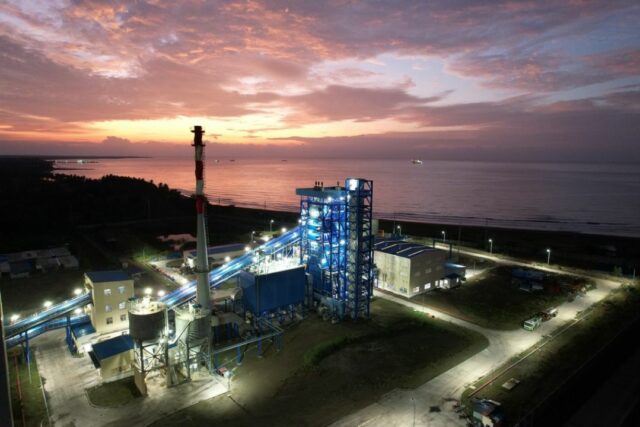
DMCIHOLDINGS.COM

OFF-GRID POWER supplier DMCI Power Corp. (DPC) is earmarking at least P2.4 billion in capital expenditure (capex) for 2026 to start construction on power projects aimed at meeting rising demand in its service areas.

Speaking to reporters last week, DPC President Antonino E. Gatdula, Jr. said this year’s capex would be significantly higher than the previous year’s P1.4-billion budget, which was used to finance various power projects.

The bulk of the capex is allocated for the expansion of its 15-megawatt (MW) coal-fired power plant in Palawan through the construction of an additional facility capable of generating 15 MW.

“Currently, we’re in the process of securing the ECC (environmental compliance certificate). So we’re targeting to receive it by the first quarter at the latest or early second quarter. After that, we can commence construction,” Mr. Gatdula said.

He added that the planned capex for the year could increase depending on the timing of regulatory approvals, as the company plans to roll out around 45 MW of power projects.

DPC is preparing to construct a 17-MW bunker-fired thermal plant in Occidental Mindoro after emerging as the winning bidder in a power supply auction.

The company has also submitted an unsolicited proposal to the electric cooperative in Antique to initially build a 1-MW diesel plant, which could later be replaced by a 4-MW solar farm and an 11-megawatt-hour battery energy storage system.

Mr. Gatdula said the company is also planning to build a 4-MW solar farm in Masbate and an 8-MW bunker-fired power plant in Roxas, Palawan.

Established in 2006, DPC focuses on supplying electricity to off-grid small and remote islands. It has 188.3 MW of installed capacity and operates thermal, bunker, diesel, and wind power plants in Masbate, Oriental Mindoro, Palawan, and Antique.

For 2025, DPC reported a 6% increase in energy sales to 522.2 gigawatt-hours (GWh) from 491.2 GWh the previous year, driven by additional output from new power plants.

“Delivering our highest sales for the 15th consecutive year reflects the growing demand in off-grid areas and our continued focus on providing reliable, cost-efficient power,” Mr. Gatdula said.

About 55% of last year’s energy sales came from newly added wind capacity, with the remainder supported by steady output from existing power plants.

During the second quarter of 2025, DPC commissioned the 12.5-MW Semirara Wind Project, marking the company’s foray into renewable energy.

“The inclusion of wind power in our portfolio supports the Department of Energy’s thrust to accelerate the development and commercialization of renewable energy, especially in off-grid areas,” Mr. Gatdula said.

An 8-MW bunker-fired power plant in Aborlan, Palawan also contributed to the company’s increased capacity. — Sheldeen Joy Talavera

Treasury bill award upsized as rates pushed lower

BW FILE PHOTO

By Aaron Michael C. Sy, Reporter

THE GOVERNMENT raised more than its programmed amount of Treasury bills (T-bills) at Monday’s auction as strong demand for short-term securities pushed yields lower, with investors factoring in weaker-than-expected economic growth ahead of the Bangko Sentral ng Pilipinas’ (BSP) policy meeting later this month.

The Bureau of the Treasury (BTr) awarded P37.8 billion in T-bills, exceeding the P27-billion offer after bids rose to P176.8 billion from P156 billion at the auction last week.

In response to the heavy demand, the Auction Committee doubled its acceptance of noncompetitive bids across all tenors to P7.2 billion each, the Treasury said in a statement. Average yields for all maturities fell from the previous week’s auction to below secondary market levels.

The Treasury awarded P12.6 billion in 91-day T-bills, above the P9-billion plan, as bids reached P62.1 billion. The three-month paper fetched an average rate of 4.579%, down 8.7 basis points (bps) from 4.666%. Accepted yields were 4.548% to 4.593%.

For the 182-day tenor, the government also borrowed P12.6 billion, surpassing the programmed P9 billion, with tenders hitting P59.818 billion. The average yield eased by 7.9 bps to 4.672% from last week. Rates accepted ranged from 4.63% to 4.7%.

The Treasury likewise raised P12.6 billion from the 364-day T-bills, more than the P9-billion offer, as bids reached P54.89 billion. The one-year paper’s average yield fell by 13.8 bps to 4.689%, with accepted rates at 4.67% to 4.735%.

Before the auction, secondary market rates stood at 4.6826% for the 91-day, 4.7725% for the 182-day and 4.8412% for the 364-day T-bills, based on PHP Bloomberg Valuation Service reference rate data provided by the Treasury.

“The T-bill auction continued to enjoy strong demand, supported by the softer growth outlook and a favorable inflation environment,” a trader said in a text message. “These conditions are already sufficient to exert downward pressure on yields.”

Philippine economic growth slowed to 3% in the fourth quarter of 2025 from 5.3% a year earlier and 3.9% in the third quarter. Full-year growth averaged 4.4%, below the government’s 5.5% to 6.5% target.

“While a BSP rate cut remains possible, the macroeconomic backdrop allows the central bank to remain data-dependent, with scope to adjust liquidity through facilities and reserve settings in the upcoming meeting rather than rush into policy easing,” the trader added.

Analysts said the weaker growth data could increase expectations for further policy easing to support domestic demand. BSP Governor Eli M. Remolona, Jr. has said a rate cut this month is not assured, noting that slower growth alone would not justify easing as inflation remains the central bank’s main focus.

The Monetary Board is scheduled to meet on Feb. 19.

Another trader said strong demand was also driven by a large volume of maturities due next week, prompting investors to reinvest in government securities.

On Tuesday, the government will auction P30 billion in reissued seven-year Treasury bonds with a remaining life of four years and 11 months.

The government plans to raise P308 billion from the domestic market this month, including P108 billion from T-bills and as much as P200 billion from Treasury bonds, to help fund the budget deficit capped at P1.647 trillion, or 5.3% of gross domestic product this year.

PAL to move turboprop flights from NAIA to provincial hubs

PHILIPPINE STAR/EDD GUMBAN

PHILIPPINE AIRLINES (PAL) will shift its turboprop operations to hubs outside Manila following the relocation of flights from Ninoy Aquino International Airport (NAIA).

“All its turboprop operations to and from Manila will be discontinued effective March 29,” the flag carrier said in a media release on Monday, adding that it will re-route all turboprop flights to alternative hubs such as Clark, Iloilo, and Cebu.

The move follows a resolution from the Transportation department’s Manila Slot Coordination Committee directing airlines to transfer turboprop operations out of NAIA.

The measure aims to prioritize larger jets while helping decongest the airport.

PAL said affected flights will be notified of updated itineraries, offering passengers options for rebooking, rerouting, travel credit conversion, or refund.

Passengers with existing bookings will be rerouted to maintain connectivity.

Manila-Coron and Manila-Siargao flights will be redirected via Siargao; Manila-Antique-Manila will operate through Iloilo; and the Manila-Catarman service will be relocated to Cebu.

PAL will also increase domestic flight frequencies starting in March to expand capacity on high-demand routes.

Manila-Cebu flights will rise to 76 weekly, Manila-Dumaguete to 21, Manila-Iloilo to 42, Manila-Roxas to 14, and Manila-Tacloban to 28 weekly. — Ashley Erika O. Jose

Bad Bunny wins top Grammy prize, first ever for Spanish-language album

BAD BUNNY accepts the award for Album of the Year for Debí Tirar Más Fotos during the 68th Annual Grammy Awards in Los Angeles, Feb. 1. — REUTERS/DANIEL COLE

LOS ANGELES — Bad Bunny, the Latino rap star whose forthcoming Super Bowl gig has ignited a culture wars controversy, won the top Grammy prize on Sunday, a first for a Spanish-language album, with Debí Tirar Más Fotos, a celebration of his Puerto Rican roots.

The 31-year-old performer-producer edged out fellow megastars Kendrick Lamar and Lady Gaga in what amounted to a three-way race to clinch his first album-of-the-year Grammy, considered the pinnacle of the music industry’s highest honors.

“I want to dedicate this award to all the people who had to leave their homeland, their country to follow their dreams,” the Puerto Rican artist said in his acceptance speech, tapping into expressions of solidarity for immigrants evident throughout the show.

Debí Tirar Más Fotos, a musical tribute to Bad Bunny’s Caribbean island homeland, marked his sixth studio set and was heavily favored after winning the Latin Grammys’ album of the year award in November.

POLITICAL OVERTONES
Grammy recognition of Bad Bunny, born Benito Antonio Martinez Ocasio, carried strong political overtones given his outspoken criticism of the Immigration and Customs Enforcement sweeps ordered by US President Donald J. Trump in cities across the country.

The singer-producer skipped the continental United States on his recent concert tour, saying he feared federal immigration agents would show up to arrest his fans.

The Grammy accolades also burnished his reputation ahead of a wider introduction to a mainstream English-speaking US audience next Sunday when he is due to headline the National Football League’s Super Bowl halftime show.

His selection for one of the marquee live sports and entertainment events on US television has rankled some traditionalists, including Mr. Trump, who called it “absolutely ridiculous” and said he had never heard of Bad Bunny.

Bad Bunny openly supported Mr. Trump’s Democratic opponent Kamala D. Harris in the 2024 presidential race.

“ICE out,” he declared from the stage as he accepted the award for best Latin urban music album for Debí Tirar Más Fotos, one of five awards he received.

“We’re not aliens,” he said on stage, after Debí Tirar Más Fotos won the Best Music Urbana award. “We are humans and we are Americans,” he added.

Often referred to as the “King of Trap,” Bad Bunny said that love is the only thing more powerful than hate and urged people to confront cruelty with compassion. “We love our people. We love our family,” he added.

Opposition to Mr. Trump’s deportation drive emerged as a recurring theme throughout the three-hour-plus live Grammy telecast, in which many attendees, including Justin Bieber, were seen sporting “ICE Out” buttons.

BEST NEW ARTIST OLIVIA DEAN
Accepting her award as best new artist, British soul-pop singer Olivia Dean paid tribute to a grandmother who immigrated to Britain from Guyana as a teenager seeking a new life.

“I must say I’m up here as a granddaughter of an immigrant,” she said, evoking cheers from the star-studded audience. “I am a product of bravery and I think those people deserve to be celebrated. We’re nothing without each other.”

Lamar, the chart-topping hip-hop sensation who led the field of Grammy contenders going into Sunday’s show with nine nominations, came away with five awards, including best rap album for his latest studio set GNX and a shared award for record of the year for “luther,” his wistful duet with R&B singer-songwriter SZA.

The award for song of the year, honoring composers, went to Billie Eilish and her brother Finneas O’Connell, for her hit single “Wildflower.”

Billie Eilish, who wore an “ICE out” pin, used her time on stage to call out ICE. “No one is illegal on stolen land,” she said. “Fuck ICE,” the “bad guy” singer added.

“Golden,” the smash hit from the Netflix animated movie KPop Demon Hunters, made history during the non-televised portion of the awards when it was named best song written for visual media, marking the first time the K-pop music genre has ever earned Grammy glory.

The song was performed in the film by a fictional band called HUNTR/X, voiced by real-life vocalists EJAE, Audrey Nuna, and Rein Ami.

Lady Gaga won Grammys for best pop vocal album with Mayhem, and best dance-pop recording for “Abracadabra.”

Trevor Noah returned to host the festivities for a sixth time, which he had said would be his last Grammys gig. The show aired live on the CBS network from the Crypto.com Arena in downtown Los Angeles.

Legendary filmmaker Steven Spielberg, 79, achieved EGOT status — one of the rarest honors in the entertainment industry — after winning his first Grammy award for best music film for Music by John Williams, which he produced. EGOT stands for Emmy, Grammy, Oscar, and Tony.

Grammy winners are chosen by the roughly 15,000 voting members of the Recording Academy — industry peers including artists, songwriters, producers and engineers — whose ranks have been revamped over the past seven years to increase diversity. About 1,000 Latin Grammys voters became eligible to vote this year, and 73% of members have joined since 2019. — Reuters

Digital marketplace rules out within 1st half

STOCK PHOTO | Image by Katemangostar from Freepik

THE BANGKO Sentral ng Pilipinas (BSP) may issue regulations governing digital marketplace activities for banks and other central bank-supervised financial institutions in the first half, a senior official said, as the regulator moves to widen access to financial and insurance products through digital platforms.

“We’re coming up with a circular on digital marketplace,” BSP Deputy Governor Lyn I. Javier told a news briefing in Dumaguete City on Sunday. “This will be open to big banks or electronic money issuers opening their platforms to other financial service providers, including insurance companies.”

She said the draft circular is undergoing its final stage of review.

“The digital marketplace is coming very soon because we’re already finalizing it based on the inputs we have,” she said. “There’s just one final review for the physical touch points.”

The BSP last year released a draft circular outlining rules for banks and electronic money issuers offering products through a single platform, or so-called digital marketplaces. Under the framework, institutions may offer their own financial and nonfinancial products, as well as those of third-party providers, including insurance companies.

The proposed rules, however, prohibit banks and electronic money issuers from offering products linked to online gambling activities.

Separately, the BSP is also revising its bancassurance rules to allow banks to distribute insurance products from firms outside their financial conglomerates, BSP Deputy Governor Bernadette Romulo-Puyat told the same event.

“We are finalizing guidelines that will allow banks to partner with insurance companies outside their existing financial conglomerate,” she said. “This broadens who banks can work with to offer insurance products.”

Bancassurance allows insurance companies to sell policies through bank branches and digital channels. Under BSP and Insurance Commission rules, banks may only distribute insurance products from companies within their corporate group.

Ms. Romulo-Puyat said expanding bancassurance partnerships would help improve access to insurance, particularly in underserved areas, given banks’ extensive nationwide reach.

The BSP expects the digital marketplace circular to be issued within the first semester, Ms. Javier said. — Katherine A. Chan

ADVERTISEMENT
ADVERTISEMENT