Home Blog Page 3472

ICTSI eyes expanding use of shipment monitoring app

RAZON-LED International Container Terminal Services, Inc. (ICTSI) through its unit Manila International Container Terminal (MICT) is planning to leverage digital solutions by including terminals outside the Philippines in its application.

“The ICTSI App provides users with 24/7, real-time information on their cargo that can lead to more accurate and timely logistics planning. With its transparency features, the app can help our customers make better business decisions,” MICT Chief Executive Officer Christian L. Lozano said in a media release on Monday. 

Launched in 2022, the “ICTSI App” allows its customers to monitor movements of shipments for MICT.

For now, ICTSI said there are plans to include other terminals under its monitoring system. The ICTSI App only covers MICT, Laguna Inland Container Terminal, NorthPort, Subic Bay International Terminals, and Mindanao Container Terminal.

“Leveraging technology, the MICT has rolled out the following innovative digital solutions to enhance transparency and make transactions more convenient for port users,” ICTSI said. 

The company said utilizing technology such as digital solutions has allowed it to streamline its operations which has a significant impact on its overall efficiency.

ICTSI has also introduced its terminal appointment booking system or TABS in 2015 resulting in optimized cargo movements by having an appointment system in place by allowing trucking companies schedule container pick-ups and drop-offs.

“Having a structured framework for truck arrivals benefits all the stakeholders in the port. TABS helps our clients to plan their trips more effectively leading to potentially lower costs. It also helps us to improve our productivity by enabling us to allocate our resources more effectively and address operational challenges more proactively,” Mr. Lozano said.

At the local bourse on Monday, shares in the company shed P1.20 or 0.38% to end at P317.20 apiece. — Ashley Erika O. Jose

FTC Group of Companies planning to open 5-star hotel Aria in Davao

VISUALSOFDANA-UNSPLASH

FTC Group of Companies, an operator of commercial buildings and real estate developments, is planning to open Aria Hotel and Residences in Davao City later this year.

Occupying the five floors and the top floor of Aeon Towers, Aria Hotel Residences will be managed by Aeon Luxe Hotel Management Co. Aeon Towers is the tallest building in Mindanao.

“We are currently completing the furnishing and we will be doing a soft launch later of this year,” Augustine Silva, chief operating officer and general manager of Aeon Luxe Hotel Management Co. told BusinessWorld.

Aria Hotel and Residences is positioned as a five-star luxury hotel and is the first of the three planned hospitality assets of the FTC Group of Companies.

It will feature 64 superior rooms, 64 club rooms, and 16 suites.

The club rooms are on the two top floors of the building.

Mr. Silva said Aria will also have 30 fully serviced residence suites equipped with kitchens.

The serviced residences will include eight studios, 18 one-bedroom suites, and four two-bedroom residences.

The company is targeting local corporate and government businesses from within Mindanao, Manila, and other cities.

Mr. Silva noted key features: rooms are large, starting at 45 square meters, with six fixtures in each bathroom, including a bathtub and a separate shower.

The rooms will also have smart controls, and fast internet, over 200 megabits per second, will be available in every room, he added.

Aria will also have a rooftop bar and a fine dining western restaurant.

The company, Mr. Silva said, is also adopting sustainability measures: solar panels for hot water and kitchen, along with double-glazed energy-saving windows. — Maya M. Padillo

Transactions via InstaPay, PESONET up at end-Feb.

TRANSACTIONS coursed through the InstaPay and PESONet payment gateways went up to P2.54 trillion as of end-February, Bangko Sentral ng Pilipinas (BSP) data showed.

The combined value of transactions done through the BSP’s automated clearing houses InstaPay and PESONet rose by 38.5% from the P1.83 trillion recorded as of the same period last year.

In terms of volume, transactions coursed through the clearing houses surged by 73.7% year on year to 202.1 million from 116.4 million.

Broken down, the value of PESONet transactions rose by 33.2% to P1.53 trillion as of end-February from P1.15 trillion in the same period a year ago.

The volume of PESONet transactions likewise increased by 8% to 15.79 million from 14.57 million as of end-February 2023.

Meanwhile, the value of transactions done through InstaPay climbed by 47.4% to P1 trillion from P681.2 billion a year earlier.

The volume of transactions that went through the payment gateway surged by 83% to 186.3 million from the 101.8 million logged in the comparable year-ago period.

Rizal Commercial Banking Corp. Chief Economist Michael L. Ricafort said the rise in InstaPay and PESONet transactions came amid the faster growth in digital transactions and online businesses.

“This may also be attributed to the expedited adoption of online banking by more Filipinos due to greater convenience, lower costs, and greater security,” he said in a Viber message.

He also noted the increased use of digital wallets and fund transfers from bank accounts as an alternative to cash.

“It’s more convenient also to do interbank transactions using mobile phones and apps, inevitably passing through InstaPay and PESONet,” he added.

The BSP wanted 50% of the total volume and value of retail transactions done online by the end of 2023.

The central bank earlier said they are confident they met the end-2023 target amid rising use of e-wallets and online banking platforms.

In 2022, the share of online payments in the total volume of retail transactions rose to 42.1% from 30.3% a year earlier. — Luisa Maria Jacinta C. Jocson

On Earth Hour, Lenten travel, and Pinoys in Toronto

As it is Holy Week, I will briefly cover four light topics to adjust to slow/non-work mode of most people.

‘EARTH HOUR’ 2024
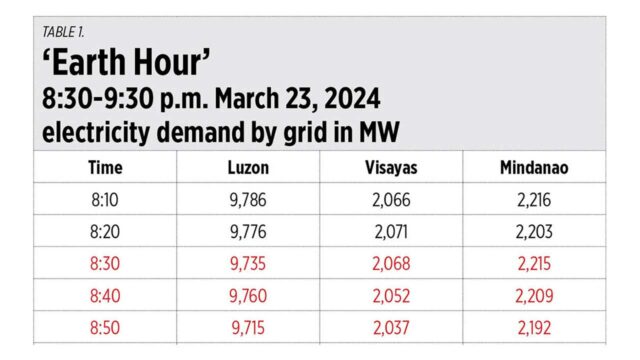
Last Saturday evening saw the annual celebration of “Earth Hour” where people shut off their lights for an hour. This is practiced in many cities around the world to help “save the planet.” How effectively was it done in the Philippines? I checked the data in the daily operations report of the Independent Electricity Market Operator of the Philippines (IEMOP). The decline in electricity use between 8:30-9:30 p.m. was mainly because people were going to sleep, which one deduces since the electricity use did not increase after 9:30 p.m. In the Luzon to Visayas to Mindanao grids (see Table 1).

That day, March 23, the electricity generation mix was: coal 67.5%, natural gas 13.3%, geothermal 9.3%, hydro 4.8%, solar + wind + biomass 4.3% combined.

So, it was a double dud for the Earth Hour campaign. First, people slowly turned off their lights to sleep not to celebrate darkness, and, second, the energy source that Earth Hour campaigners demonize, coal, provided two-thirds (68%) of the total power generation while their beloved energy sources provided less than 5% of the total. The Earth Hour narrative is a juvenile concern that businesses and the public generally ignore.

TRAFFIC AND LENTEN TRAVELS
The regular traffic congestion in Metro Manila will be absent this week and instead transfer to the provinces as millions of people move around.

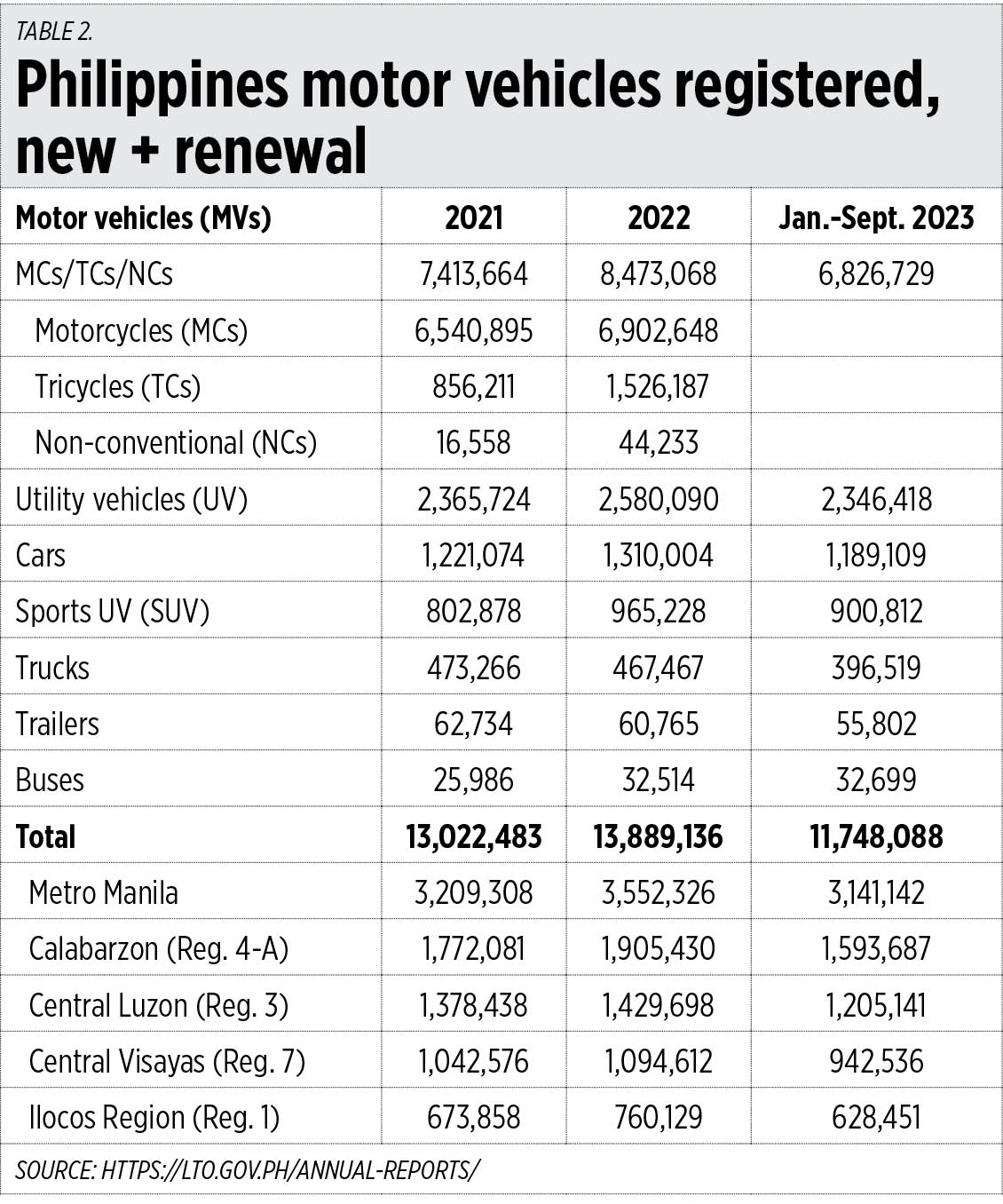
There were 13.9 million registered vehicles in the Philippines in 2022, 8.5 million of which were motorcycles (MCs), tricycles, and non-conventional MCs. There are two million cars and SUVs. The bulk of those 13.9 million vehicles are found in four big regions — Metro Manila, Region 4-A (Calabarzon), Region 3 (Central Luzon), and Region 7 (Central Visayas) — for a combined 8 million vehicles (see Table 2).
The big challenge in transportation reform is how to reduce the number of small passenger vehicles like MCs and tricycles, whether gasoline or electric. Most provincial roads now are four lanes wide, two lanes each way, with the inner lanes for overtaking or as the fast lane. The majority of tricycles in the provinces stay on the inner lane, forcing cars and other vehicles to overtake on the outer lane, which is dangerous as they travel fast and there are houses, parked vehicles, people, and dogs just one to two meters away.

Local government units (LGUs) are the ones that register, regulate (by issuing local route franchise), and monitor the tricycles. They plus the police should penalize the drivers of these tricycles but they are not doing their job.

FILIPINOS IN TORONTO
When I went to Toronto early this month (my first time to set foot in Canada), I noticed there were many Filipinos there — at the Toronto Pearson airport, at the Novotel North York where we stayed at, at the nearby Tim Hortons coffee shop, at other food shops.

After three days of work — meetings and site visits as part of the Philippines Nuclear Trade Mission to Canada — two Filipino friends toured me around other parts of the big city.

Ulysses “Uly” Veloso is my friend from the Congress Mountaineers, from back when I was working at the House of Representatives in the 1990s. Along with our buddies, we climbed many mountains, including a Mt. Pinatubo traverse climb in 1994, which started from Pampanga to the volcano crater and then exited at Zambales, a trek of six days and five nights.

Uly was an Arts and Design professor at the College of St. Benilde in Manila, with part-time video production and professional sculptor business. Ten years ago, he migrated to Toronto with his only son, Ulap, who is the same age as my older daughter. Uly is now a Lead Artist at a custom art and architectural fabrication company in Toronto. He took me to a big beer and liquor store near his place. I was amazed at the wide variety of products from Canada and abroad. I think less than 10% of those beer brands are available in Manila.

Among the things he likes in Canada are the higher skills and knowledge of the people, that arts technology and programs are comparatively cheap, and that their high school students already gain the sort of experience that are available only to university students and graduates in the Philippines. Arts workshops are freely available almost anywhere.

All this plus social and financial security, a justice system that works to protect one’s properties, and extensive and good road infrastructure. Taxes are high but people enjoy the benefits. About 80% of the people there are polite and friendly.

Another friend, May Tabujara, and her hubby toured me around another side of Toronto near the big Lake Ontario. May works as a cosmetic/oculoplastic surgery professional in a private hospital in Toronto. She has been living there since 2008. She admires the social and financial security, the infrastructure in Canada, but is a bit wary of the rising incidence of car theft and a big influx of non-vetted immigrants.

CLEAN-HEARTED FILIPINAS
I want to mention two Filipinas with clean hearts, among so many here.

First is Dr. Ma. Judea “Dea” Millora, my “kinakapatid” or non-blood related sibling. Ate Dea is my free one-text-away physician. She is an integrative medicine practitioner. I was able to discontinue my personal HMO for several years now with her help. If I feel unwell, she will sometimes request certain laboratory tests and I show her the results, or she would give me some proven medications and maintenance meds for a few months. My daughters would occasionally consult her too.

Ate Dea and family own a large agro-forestry farm in Pangasinan which is planted with mangoes, and industrial and endemic forest trees. The rest is grassland. They have considered me their kinakapatid since the 1980s when their younger brother, and my best friend in UP, Mil Millora, died in a car accident in 1986. I have helped monitor their farm since 1992 and I like it. I am not paid to do this, I like doing it — to visit a large piece of land and make certain improvements there, getting my hands dirty touching the soil and trees.

Ate Dea is a cancer survivor and has slowly moved towards a cancer specialization combining modern medicine and lifestyle and diet changes. She likes doing it and would charge poor patients little, especially those in regular severe pain. She is a devote Christian and never compromises her church duties with professional and family duties. A thousand blessings to her.

Another exemplary Filipina is Nina Bantoto, daughter of my friend from the University of the Philippines School of Economics, Arlene Bantoto. Nina has autism, diagnosed when she was three years old. She struggled to speak and could not fully express herself. But what she lacked in verbal articulation, she more than made up for with her immense talent in drawing, sketching, and painting.

Now 27 years old, she has created masterpieces of color and is an international artist who has held several exhibits in Manila and Macau, and at the United Nations and at the Philippine consulate in New York. In 2017, she was part of a select group of featured artists with autism to represent the country in the United Nations in celebration of World Autism Day in New York. In 2018, she held her first solo exhibit, Chiquitita, with a portion of the proceeds donated to REACH foundation, a nonprofit organization dedicated to helping Persons with Disabilities from depressed communities.

Last February she held her second solo exhibit, titled Enter the Dragon, about Chinese Zodiac animals, at the prestigious Galerie Joaquin at the Podium Mall in Mandaluyong City. Part of the proceeds were again donated to the REACH foundation. More blessings to you, Nina.


Bienvenido S. Oplas, Jr. is the president of Bienvenido S. Oplas, Jr. Research Consultancy Services, and Minimal Government Thinkers. He is an international fellow of the Tholos Foundation.

minimalgovernment@gmail.com

SM Investments Corp. to hold 2024 Annual Stockholders’ Meeting on April 24


Spotlight is BusinessWorld’s sponsored section that allows advertisers to amplify their brand and connect with BusinessWorld’s audience by publishing their stories on the BusinessWorld Web site. For more information, send an email to online@bworldonline.com.

Join us on Viber at https://bit.ly/3hv6bLA to get more updates and subscribe to BusinessWorld’s titles and get exclusive content through www.bworld-x.com.

PAGCOR says P4.59 billion remitted to Treasury

THE PHILIPPINE Amusement and Gaming Corp. (PAGCOR) on Monday said that it remitted P4.59 billion in cash dividends to the Bureau of the Treasury.

The remittance will help “fund the national government’s efforts in ensuring the country’s sustained economic growth and development,” it said in a statement.

PAGCOR noted that this remittance accounts for 75% of its net income in 2023.

“It is higher than the usual 50% remittance pursuant to the request of Finance Secretary Ralph G. Recto to PAGCOR to advance an additional 25% dividend to fund government expenditures.”

By law, government-owned or -controlled corporations, or GOCCs, are required to declare and remit at least 50% of their net earnings to the National Government.

Last year, PAGCOR booked P6.13 billion in net earnings from gaming operations. It also recorded P79.37 billion in gross revenues.

“[The] income performance in 2023 set the stage for this higher dividend contribution to the national government,” PAGCOR Chairman and CEO Alejandro H. Tengco said.

Broken down, its remittance is composed of its P3.06 billion dividends or  the mandated 50% of net earnings last year, as well as the P1.53 billion requested by the Finance department.

This year, PAGCOR is expecting that its revenues from gaming operations will reach P81.27 billion. — Luisa Maria Jacinta C. Jocson

US home flipping malaise pinches reality TV stars to contractors

HGTV.COM

NEW YORK — While the increase in interest rates engineered by the Federal Reserve over the last two years put a damper on the overall US housing market, it took a sledgehammer to home flippers from small contractors to reality TV stars.

Just ask Tarek El Moussa, star of HGTV’s The Flipping El Moussas and former co-host of the real estate and renovation focused channel’s mainstay, Flip or Flop.

“How do I account for [interest rates]? I got my ass kicked last year. I lost a lot of money. And that’s just the reality of the business,” said Mr. El Moussa.

Indeed, house flipping — or investing in, and often renovating, a single-family home with the intent to sell for a profit — has fallen from heights seen during the COVID-19 pandemic. The number of Americans acting as investors in the housing market dove 38.85% between 2021 and 2023’s fourth quarter, according to property data provider ATTOM Data Solutions. Through the fourth quarter of 2023, the share of homes purchased by investors fell 11% on a year-over-year basis, a report from real estate and mortgage firm Redfin said.

Even so, housing investors spent $32.3 billion on homes in the US in 2023, compared with $33.6 billion a year earlier, and flippers bought 26% of the lowest-priced homes during 2023’s fourth quarter, Redfin said.

FRENETIC MARKET
HGTV’s Mr. El Moussa bought 91 homes in 2021 — garnering him a $600,000 average monthly mortgage payment. Then mortgage rates surged, home sales in southern California plunged, and he found himself with inventory he could not offload.

Home flipping does best in a frenetic “buyer’s market,” with prices rising amid increased transactions, said Chen Zhao, Redfin’s senior economist. After the Fed began hiking rates in March 2022 to lower inflation, buyers and sellers held off, creating gridlock in the housing market.

Rates eventually reached a two-decade high near 8% in October, and the resulting market has presented investors with the same issue home-buyers face — limited inventory and lukewarm demand.

Rates have eased somewhat: Freddie Mac said on Thursday the average 30-year fixed-rate mortgage was 6.87%. Still, the current scene is a striking departure from the onset of the pandemic when sub-4% mortgage rates and heightened demand could promise a juicy profit.

LOWER MARGINS, LABOR TROUBLES
For Elisa Covington, an investor based in the San Francisco Bay Area, a return on investment during 2021 often swung between 60% and 70%, she said, occasionally hitting 100%.

“In 2021 and early 2022, my projects were getting much higher returns,” Covington said. “But this year the profit margin for most of my projects have been in line with my expectations” of 30% to 40%.

Lack of homebuyer demand would make it easier on investors looking for single family homes, but reduced inventory has largely outweighed that, cutting into acquisition trends.

Julio Martinez, co-owner and broker at JATS Properties in Los Angeles, said “2023 was kind of weird.” He acquired just six homes last year and even that was due to several of the properties being in foreclosure. If not for that, “we probably would’ve only done one or two.”

Some construction companies say cooling home investment has cut into new business activity. Ghulam Mustafa, owner of New-York based Sahara Builders, said the decline in his firm’s full-gut renovation projects since the pandemic has caused a 40% decline in profit since 2021 through the end of 2023.

Last year “was much slower than the pandemic,” Mr. Mustafa said.

For contractors who don’t build new homes, steady project supply in the absence of gut-renovations is replaced by smaller-ticket refurbishing projects for existing home-owners, RedFin’s Zhao said.

For house flippers, meanwhile, lower profits have reduced the labor they can hire for renovations, which can decelerate sales.

JATS Properties’ Mr. Martinez had to let go of a full-time handyman, he said. In addition to property flipping, his family-owned company operates as brokers and property managers, so that labor loss meant less attention to home-flip projects.

“We had to slow [workers] down on our projects, and lend them out to our clients,” said Mr. Martinez. “Typically, we take first priority because they’re our employees. But when we don’t have the funds to cover our own projects, we have them work on our clients’ homes. It’s taking the burden of expense of those employees off our backs.”

FADING STARS
Amid the slow turnover, flippers are diversifying their activities.

Mr. Martinez, who saw transaction volume in 2023 fall by half from 2021, began making property-secured loans to aspiring investors. And Mr. El Moussa, who needed to gird for losses he knew were coming from unsold flipper projects, shifted to buying home purchase contracts wholesale and selling to investors, deals that typically net smaller margins but are less risky than traditional flipping.

“In order to get prepared for those losses that were coming, I stopped buying houses to flip and I only focused on wholesaling,” he said.

The story has changed for the house flipper reality TV landscape as well.

HGTV ad revenue slid from a four-year high of $42.7 million in 2021 to $32.6 million in 2023, according to data from iSpot.TV, a television ad measurement company, though it continues to hold dominant share in its market segment.

Shows like The El Moussas have increasingly incorporated discussions on rates, slow turnover, and price acceleration in Southern California to keep viewers engaged, said Loren Ruch, head of home content at HGTV. Show development focus has turned to standalone secondary homes, for example a guest house, and multi-generational living.

“People might not be spending huge amounts of money on design or renovation projects, so we’re also looking into a variety of shows that are more approachable price points that are maybe based on not doing as much demolition, but actually focusing on the space and the configuration,” said Loren Ruch. — Reuters

Premium Leisure Corp. to conduct 2024 Annual Stockholders’ Meeting on April 22

Premium Leisure Corp. | Announcement of Annual Stockholders’ Meeting

Please see below for the Announcement of the Annual Stockholders’ Meeting of Premium Leisure Corp.

To all Stockholders:

The Annual Stockholders’ Meeting of Premium Leisure Corp. (the Company) will be held on April 22, 2024, Monday at 11:00 A.M. to be conducted in hybrid format, the Chairman and Secretary of the Meeting, as well as directors and key officers shall attend in person at the City of Dreams Manila, Entertainment City, cor. Macapagal Ave., Aseana Ave., Paranaque City; the stockholders will be participating by remote communication via Zoom Webinar. Voting shall be conducted  in absentia through the Company’s secure online voting facility.

Agenda:

  1. Call to Order
  2. Certification of Notice and Quorum
  3. Approval of the Minutes of the Annual Meeting of Stockholders held on April 24, 2023
  4. Approval of 2023 Operations and Results
  5. Ratification of all Acts of the Board of Directors, Board Committees and Management during their term of office
  6. Election of Directors for 2024-2025
  7. Appointment of External Auditor
  8. Approval of Voluntary Delisting from the Main Board of The Philippine Stock Exchange, Inc.
  9. Other Matters
  10. Adjournment

Please refer to Annex A for a brief explanation of each agenda item for approval.

The Board of Directors (Board) has fixed the end of trading hours of The Philippine Stock Exchange, Inc. on March 15, 2024 as the record date for the determination of stockholders entitled to the notice of, participation via remote communication, and voting in absentia at such meeting and any adjournment thereof.

The conduct of the meeting will be streamed live, and stockholders may attend the meeting by registering via https://asmregister.premiumleisurecorp.com and submitting the supporting documents listed there until 12 noon of April 19, 2024 (Friday). All information submitted shall be verified and validated by the Corporate Secretary.

Stockholders who wish to cast votes through a proxy may accomplish the proxy form (which need not be notarized) and submit the same on or before 12 noon of April 19, 2024. To facilitate submission, scanned forms may first be sent electronically through plccorsec@premiumleisurecorp.com with hard copies to be submitted to the office of the Corporate Secretary c/o Serrano Law at 1105 Tower 2 High Street South Corporate Plaza, 26th Street Bonifacio Global City, Taguig City 1634.

Stockholders who successfully registered can cast their votes in absentia through the Company’s secure online voting facility for this meeting. In order to participate through remote communication, they will also be provided with access   to the meeting that will be held virtually. The “Guidelines for Participation via Remote Communication and Voting in Absentia” as appended to the Information Statement and labeled as Schedule A, together with the Information Statement, Annual Report on SEC Form 17-A (once available) and other pertinent materials for the Annual Stockholders’ Meeting are posted in the Company’s website https://www.premiumleisurecorp.com/ASM2024 and PSE EDGE.

(SG­­D.)
ELMER B. SERRANO
Corporate Secretary


Spotlight is BusinessWorld’s sponsored section that allows advertisers to amplify their brand and connect with BusinessWorld’s audience by publishing their stories on the BusinessWorld Web site. For more information, send an email to online@bworldonline.com.

Join us on Viber at https://bit.ly/3hv6bLA to get more updates and subscribe to BusinessWorld’s titles and get exclusive content through www.bworld-x.com.

Malipano Island undergoes upgrades to enhance guest experience

ISLAND GARDEN CITY OF SAMAL — Malipano Island, located just a five-minute speedboat ride from Pearl Farm Beach Resort, is undergoing upgrades to offer luxury experiences to its clientele.

The seven-hectare private island houses seven luxurious villas and an exclusive three-storey villa.

Facilities on the island include a three-hole golf course, a small chapel, and the Malipano clubhouse featuring a swimming pool, bar, and pavilion.

The pavilion showcases Mindanaon-inspired designs, including chandeliers made of abaca and ceilings adorned with anahaw leaves.

It also features Capiz lights, firewood tables, balangay, which is sometimes used as a buffet table, and several jars from different parts of Mindanao.

Interior designs are a collaboration between Mañosa Architect and Maricris Floirendo-Brias, head for hospitality, designer, and creative director of Tadeco Home and Tnalak Home, said Josu Mikel Villaverde, vice-president and general manager of Pearl Farm, in an interview with BusinessWorld.

With the existing seven three-bedroom villas, the management is adding six more villas, which could accommodate four persons each.

These will be two-bedroom villas with two large rooms and a living room in the middle, fully air-conditioned. Each villa will have a deck leading to its swimming pool and will include butler service.

Construction of three villas is scheduled to begin this month, with a focus on sea-facing views of Samal Island.

“But this will not affect the operations on the island as that is located on the northern tip,” Mr. Villaverde said.

He said the villas will cater to different markets. The three-bedroom villa is for larger groups like family. Other villas will be for the executives, entrepreneurs, and professionals.

Mr. Villaverde said they are extending another hectare for other services.

He said the management is leasing the one-hectare Dela Paz Island and will connect it to Malipano Island through a bridge so that guests can explore and experience adventure.

“We are very proud of this project and have been working on it for months already. This will be the pinnacle of our accommodation nowadays. We aimed at Malipano as an upscale resort separated from Pearl Farm Beach Resort in terms of experience and services, with butler services available. It’s very high-end, and guests of Malipano will have access to Dela Paz Island,” Mr. Villaverde said.

He also said that the guests of Malipano Island can also access facilities at Pearl Farm Beach Resort for added convenience.

“Nevertheless, we are thinking of the Filipino market not only the foreign market for the island.  In terms of pricing, there will be a proportion, but not so expensive as we want the market to enjoy our resort,” he said.

“By adding more villas, we envisioned a private luxury experience for those who are looking for something really special,” Mr. Villaverde added. — Maya M. Padillo

Thrift banks’ loans rise by 16.3% in 2023

BW FILE PHOTO

LOANS disbursed by thrift banks grew by 16.3% to P677 billion in 2023 from P582.9 billion in the previous year, an industry official said.

“The thrift banking industry maintains its stability and showed encouraging growth, with key indicators such as sustained growth in resources, supported by increased deposit mobilization and adequate capitalization,” Chamber of Thrift Banks (CTB) President Cecilio D. San Pedro said in a speech at an event on Friday.

The sector’s nonperforming loan ratio stood at 6.46% as of end-2023, he said.

On the funding side, total deposits rose by 6.5% to P789.3 billion from P740.8 billion.

“As of Dec. 31, 2023, total assets stood at P1.04 trillion, higher by 7.3% vs. P986.20 billion in 2022,” Mr. San Pedro said.

Total capital increased by 10% to P157 billion from P142.8 billion, while the industry’s capital adequacy ratio stood at 16.98%, well above the Bangko Sentral ng Pilipinas’ (BSP) minimum 10% requirement, he noted.

Mr. San Pedro said the CTB will be hosting training programs for its member banks this year on sustainable finance, environmental social risk management and risk management compliance frameworks, as well as the BSP’s initiatives on digital transformation and cybersecurity.

The CTB is also urging its members to submit their data to the Credit Information Corp. to avoid penalties and ensure a robust data ecosystem, he said.

Mr. San Pedro also reiterated the CTB’s opposition to a bill proposing to cap interest rates imposed by financial institutions, noting this could result in slower credit growth and that rates should be market determined to allow for flexibility. — A.M.C. Sy

Putin forgot that Islamic State thinks he’s part of the West

VALERY TENEVOY-UNSPLASH

THREE FACTS stand out as clear amid the lack of hard information about the perpetrators of Friday’s appalling terrorist attack on Russia, and all three shine a light on dangers inherent in the new multipolar world we now inhabit.

The first is that, before the attack, Vladimir Putin dismissed a US warning that it was coming, both in public and to his top security officers. He called the American intelligence that Islamists were planning an assault on a large Russian venue blackmail, aimed at destabilizing his country — a vague goal he did nothing to explain. There was a time not so long ago when Putin understood that Washington considered Islamist radicalism a shared threat, taken so seriously that it was ring-fenced from other disputes. He would have used the warning, even if he couldn’t prevent the attack.

Yet so shredded has trust become between Moscow and Washington since Putin’s 2022 invasion of Ukraine, if not since his 2014 annexation of Crimea, that he fell victim to paranoia. Had he been able to think rationally, Russia’s president would have known this was a game the US wouldn’t play, because it could only lose. Toward the end of the short address to the nation after Friday night’s attack, Putin said he would work with all “genuinely” concerned nations to fight international terrorism — so perhaps he has recognized his mistake. I very much doubt it.

The second piece of clarity is that while Putin has, remarkably, managed to persuade much of the Global South that his invasion of a former imperial possession somehow makes him a fellow victim of Western colonialism, Islamists are having none of it. They don’t care a hoot about Ukraine, but they also make no distinction between Russian and Western colonialism.

As far as Islamic State (IS) or al-Qaeda is concerned, Putin’s military interventions in Syria and Chechnya are no different from America’s in Iraq or Libya. Nor is the presence of a large Russian military base in predominantly Sunni Muslim Tajikistan — the ex-Soviet country that the arrested suspects may have been from — any less offensive to Islamist ideas than the presence of US military bases in the Gulf. Russia is for them a part of the Christian West. It doesn’t belong anywhere on the territory of their imagined Islamic caliphate.

Finally, Putin could confidently hint at Ukrainian responsibility, thus absolving his own lapse of vigilance, because no matter what evidence emerges to the contrary, he knows he will be able to sell whatever story he likes at home — such is the totality of his control over the media, and eradication of organized opposition. Putin has demonstrated this ability repeatedly throughout his war in Ukraine, and it’s deeply worrying. He can now generate domestic popular support for virtually any decision or aggression. Worse, the creeping spread of what one might call populist “authoritocracies” makes that true for a growing number of leaders.

We can’t yet know for sure that Ukraine didn’t facilitate the Moscow attack, because it’s very hard to prove a negative. The only verifiable evidence of Ukrainian involvement that Putin has cited — namely that the killers were arrested while driving in Ukraine’s direction — is weak. It also would imply a near-suicidal stupidity in Kyiv. There was a roughly 100% chance that Putin would blame Ukraine for the attack, and the US, implicated by association, wouldn’t forgive being pulled into something that jeopardizes so core a security interest as counterterrorism.

Islamic State has claimed responsibility for the atrocity at Moscow’s Crocus City Hall concert venue, and that’s likely true. IS has put out footage of the killers that was taken before the attack, and it matches with the images Russian television showed of the men afterward. The four arrested men were identified as Tajiks, and the US believes the IS branch responsible to be Islamic State-Khorasan (IS-K), a province of Islamic State’s nonexistent caliphate that would include much of Afghanistan, the northern part of which is ethnic Tajik, as well as Pakistan and Central Asia, including Tajikistan. The Russian security services said they foiled another IS-K attack in Moscow just a month ago.

That doesn’t, of course, prove that the IS operation didn’t get an assist from Ukraine, but so far that has the smell of a conspiracy theory. The confession by a captive to his Russian guards that an anonymous caller offered him 1 million rubles ($10,850) to conduct the attack would certainly be inconsistent with an IS-directed operation, but was also offered under the definition of duress: on camera, on his knees and at the mercy of armed security officers. There’s no recording of what came before, and so we don’t know what he may have been told to say if he wanted to stay alive.

The eradication of trust breeds conspiracy theories and also makes them all but impossible to shoot down. So it’s likely Putin will stick with his Ukraine story no matter what. That wasn’t always as attractive or as easy to pull off as it is now. Yes, the US-dominated, globalized world that followed the Soviet collapse of 1991 was hardly safe; it was also deeply flawed and unequal. Yet the trade and economic integration that it relied on placed some basic boundaries — and required a minimum of mutual acceptance among governments that made space for the kind of warning the US gave to Moscow to be believed, even when relations in other areas were poor. That minimal level of confidence also allowed for organizations such as the United Nations and G-20 to function as more than gladiatorial arenas for performative diplomacy. But no more.

BLOOMBERG OPINION

MPTC unit sees 10% traffic volume surge this week

PHILSTAR FILE PHOTO

METRO Pacific Tollways South (MPT South), a unit of Metro Pacific Tollways Corp. (MPTC), is expecting traffic volume within its network to rise by up to 10% this week.

With the expected traffic influx, the toll road operator will reactivate its motorist assistance program and will deploy additional manpower like traffic management, toll collection officers as well as emergency and incident response teams.

The surge of about 8% to 10% in traffic volume is expected from Monday until Sunday, MPTC said in a media release.

Typically, around 43,000 motorists daily traverse along Cavite-Laguna Expressway (CALAX), about 170,000 motorists on Manila-Cavite Expressway (CAVITEX), and 12,300 motorists travel along MPTC’s C5 Link segment. 

Raul L. Ignacio, president and general manager of MPT South, said motorists should utilize RFID or radio frequency identification system for seamless toll transactions during this time. 

“Utilizing Easytrip RFID at MPTC Toll Plazas significantly reduces travel time compared to waiting in long cash lanes,” he said. 

Easytrip is used on MPTC’s North Luzon Expressway, Subic-Clark-Tarlac Expressway, CAVITEX, and CALAX.

The toll road developer and operator will also suspend the construction and lane closures along its roadway during this time unless repairs are necessary, it said.

MPTC is the tollways unit of Metro Pacific Investments Corp., which is one of three key Philippine units of Hong Kong-based First Pacific Co. Ltd., the others being Philex Mining Corp. and PLDT Inc.

Hastings Holdings, Inc., a unit of PLDT Beneficial Trust Fund subsidiary MediaQuest Holdings, Inc., has a majority stake in BusinessWorld through the Philippine Star Group, which it controls. — Ashley Erika O. Jose

ADVERTISEMENT
ADVERTISEMENT