Home Blog Page 3374

Moody’s affirms three PHL banks’ ratings

REUTERS

MOODY’S RATINGS has affirmed the ratings of three Philippine banks and revised its outlook for one, it said late on Tuesday.

Moody’s affirmed its “Baa2/P-2” long-term and short-term deposit and issuer ratings for China Banking Corp. (China Bank) and Security Bank Corp. and maintained its stable outlook for both, it said in a statement.

The debt watcher likewise retained the “Baa3/P-3” long-term and short-term deposit and issuer ratings for Philippine National Bank (PNB) and raised its outlook to “positive” from “stable,” Moody’s said in a separate statement.

Moody’s said it expects China Bank’s capitalization to remain stable, while Security Bank’s is expected to decrease marginally over the next 12-18 months in line with each bank’s internal capital generation abilities and dividend payouts, as well as their accelerated loan growth.

China Bank’s and Security Bank’s capitalization, as denoted by common equity to risk-weighted assets, stood at 14% and 17% at end-2023, respectively.

The debt watcher expects both banks’ profits to remain stable this year as they are expected to benefit from higher-yielding retail and small and medium enterprises (SME) loans and amid easing cost of funds despite elevated interest rates.

In terms of asset quality, the two banks’ nonperforming loan (NPL) ratios are seen improving while remaining higher than pre-pandemic levels.

Moody’s Ratings expects China Bank’s NPL ratio to be at 2% and Security Bank’s to be at 3% amid their pandemic-impacted corporate and middle-market accounts as well as their expansion into the riskier retail and SME segments.

The credit rater also expects the banks’ liquidity to remain adequate.

“The banks’ deposit franchises remain modest, with higher reliance on market funds compared with its domestic rated-peers, at 8% of total banking assets for China Bank and 12% for Security Bank as of end-2023,” it added.

Moody’s said upgrades to the banks’ credit ratings are unlikely as they are at the same level of the Philippines’ sovereign rating.

PNB RATINGS OUTLOOK RAISED
Meanwhile, Moody’s Ratings said it upgraded its ratings outlook for PNB amid a significant expansion in the bank’s net interest margin and lower provisioning costs.

The debt watcher also said PNB’s profitability will remain largely stable as its expansion into the SME and retail lending segments will help offset higher credit costs.

Meanwhile, the bank’s NPL ratio is expected to decline but remain above pre-pandemic levels in the next 12-18 months as it continues to clean up its pandemic-related exposures and manage risks from its expansion into the SME and retail segments, Moody’s said.

The debt watcher expects the PNB’s capital to decline to a “still-strong” level as it sees faster loan growth in the next 12-18 months, while its liquidity may weaken amid accelerated loan growth in the next 12-18 months.

Funding remains a credit strength for PNB, Moody’s noted, amid its lower cost of funds compared to the top three banks in the country. This is supported by PNB’s high share of current and savings account deposits.


Genome study reveals prehistoric Ethiopian origins of coffee

PIXABAY

WASHINGTON — You might call it a cup of Joe, java, mud, brew, mocha, or your morning jolt. Coffee undoubtedly is a big part of global culture, and the kind made from the Arabica bean is the most appreciated by coffee drinkers.

Researchers now have unlocked the genome of the Arabica species and traced its origins to a natural mating between two other coffee species an estimated 610,000 to one million years ago in the forests of Ethiopia. That makes this species older than our own species Homo sapiens, which arose in Africa about 300,000 years ago.

The researchers sequenced the genomes of 39 Arabica varieties, including a specimen from the 18th century, to create the highest quality genome to date of this species, whose scientific name is Coffea arabica. They also uncovered a specific region of the genome that may be pivotal for breeding or genetically engineering disease resistance.

“Arabica is one of the world’s premier commodity crops, taking up a large part of the agricultural economies of countries in which it is grown,” said plant evolutionary biologist Victor Albert of the University at Buffalo in New York, one of the leaders of the study published this week in the journal Nature Genetics.

“It’s an important part of local small stakeholder subsistence, not just farmed and exploited by major companies. Coffee is a rich source of antioxidants, and of course, caffeine which helps keep me and the rest of the world awake,” Mr. Albert added.

The research showed that Arabica’s population rose and fell over the millennia as the climate warmed and cooled. It was first cultivated by people in Ethiopia and Yemen, and then spread around the world.

“Coffee and humankind are closely related throughout history. In many producing countries, the Arabica coffee represents more than a crop, it is part of the culture and tradition,” said Patrick Descombes, a genomics senior expert at Nestlé Research and lecturer at the Swiss Federal Institute of Technology (EPFL), another of the study leaders.

Arabica was found to have low genetic diversity due to a history of inbreeding and small population size. The species, susceptible to pests and diseases, can be cultivated in a limited number of locales where climate conditions are favorable and disease threats are lower.

The research “paves the way to new breeding approaches in coffee, which will ultimately lead to development of new varieties with improved resistance to diseases, climate changes, and with new cup (flavor) qualities,” Mr. Descombes said.

Coffee is one of the world’s most widely consumed beverages — an estimated 2.25 billion cups of it is consumed daily — as well as one of the most traded commodities. Arabica represents the majority of the world’s coffee production.

Arabica formed, the researchers said, as a natural hybridization between two parent species — Coffea canephora and Coffea eugenioides. The canephora species is called Robusta coffee and its genome was sequenced in 2014.

Robusta is commonly used in instant coffee, while Arabica is considered to have a superior flavor, generally known for a milder and smoother taste. The Robusta species is indigenous to the forests of equatorial Africa.

“Robusta is also known because it is quite resistant to main coffee pests and diseases — hence its name Robusta, for robust,” Mr. Descombes said.

The eugenioides species grows in high altitudes in Kenya.

The 18th century specimen sequenced in the study was from a sample stored in London that had been used by Swedish naturalist Carl Linnaeus to name the coffea species.

“We were able to sequence its genome, and in fact we found that it was not particularly closely related to varieties in cultivation today,” Mr. Albert said. — Reuters

PHL startup Betterteem sets sights on Japanese expansion by 2025

LOCAL artificial intelligence-enabled predictive platform Betterteem Technologies, Inc. said it is planning to expand in Japan by 2025.

“We are working on doubling the efforts to penetrate the South Korean market and then venture into Japan since we’ve seen a spike in attrition in the professional industry,” Betterteem Founder and Chief Executive Officer Bo Discarga told BusinessWorld on the sidelines of the SaaScon 2024 event on Wednesday.

Founded in 2022, Betterteem serves three clients in South Korea and a new business in Thailand. It also works with 13 business process outsourcing (BPO) companies.

One of the company’s recent developments was the introduction of Flex Benefits, where clients can offer a customized benefits package based on segregated data on age group, marital status, and more.

Mr. Discarga said that instead of providing unused benefits like daycare for non-parent employees, one can convert them into a Netflix or Spotify subscription.

This feature stems from the 2023 Betterteem study, which found that benefits were driving employee resignations in the market.

According to the study, which surveyed 40,000 BPO employees, 18% of Generation Z are entering the workforce while millennials make up 48%. It also found that 70% of satisfied employees were millennials.

“You will see a lot of boomers exiting the equation and Gen Zs entering, which means there will be a big demand for work-life integration,” Mr. Discarga said.

He noted that Gen Z employees usually stay in the company for an average of 18 months, while millennials last for 34 months.

Betterteem’s platform detects quiet quitting. Apart from unwanted resignations, it can also identify the phenomenon where workers do the bare minimum to get by at work.

“We can already figure out whether performance is declining and how that dip in performance relates to the utilization of vacation leaves, sick leave, and even changes in roles, managers, and more,” Mr. Discarga said.

The company uses an attrition prediction tool that calculates the likelihood of employees leaving an organization.

Betterteem uses hundreds of data points, including changes of address, marital status updates, relocation from one city to another, amount of overtime, and workload    all of which could contribute to the decision to resign. — Aubrey Rose A. Inosante

Telegram platform to hit 1 billion users within year, founder says

DIMA SOLOMIN-UNSPLASH

THE TELEGRAM messaging app, one of the most popular social media platforms in Ukraine and Russia, will likely cross one billion active monthly users within a year, its founder said in remarks published on Tuesday.

In a rare interview, Pavel Durov told US journalist Tucker Carlson that the Dubai-based free cloud-based app that allows users to send and receive messages, calls and other files, is spreading like a “forest fire.”

“We’ll probably cross 1 billion monthly active users within a year now,” Mr. Durov, who fully owns Telegram, told Mr. Carlson, according to the video interview posted on Mr. Carlson’s account on the X social media platform.

The goal of the app, which has now 900 million active users, is to remain a “neutral platform” and not a “player in geopolitics,” Mr. Durov said. The Russia-born entrepreneur said he had fled Russia in 2014 citing government interference in a company he founded.

One of Telegram’s main rivals, Meta Platforms’ WhatsApp, has more than two billion monthly active users. The Financial Times reported in March that Telegram would likely aim for a US listing once the company had reached profitability.

After Russia launched its full-scale invasion of Ukraine in 2022, Telegram has become an instrumental tool for both governments and a go-to place for posting and accessing unfiltered information about the war.

Almost all major media, government entities and public figures in both Russia and Ukraine operate content channels on Telegram.

Ukraine’s President Volodymyr Zelenskyy posts his daily video addresses on the app, while his armed forces warn of air raids and document battlefield developments. The Kremlin announces President Vladimir Putin’s activities on Telegram, while Russia’s opposition rallies for support.

But the app, critics said, has also become a tool of misinformation and manipulation. A bill submitted to the Ukrainian parliament in March looks at stricter regulation of Telegram and other social networks.

The Kremlin told Mr. Durov to be more attentive after the messaging application was allegedly used to help recruit the gunmen who attacked a concert hall outside Moscow in March. — Reuters

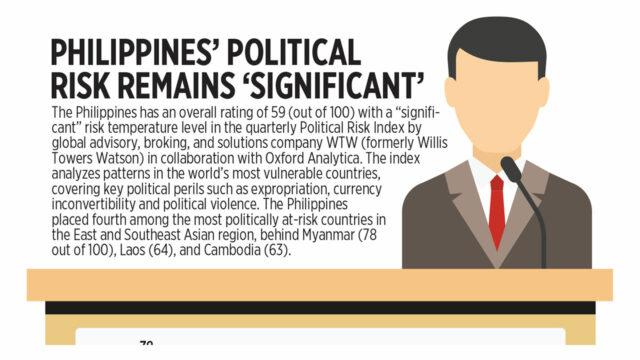
Philippines’ political risk remains ‘significant’

The Philippines has an overall rating of 59 (out of 100) with a “significant” risk temperature level in the quarterly Political Risk Index by global advisory, broking, and solutions company WTW (formerly Willis Towers Watson) in collaboration with Oxford Analytica. The index analyzes patterns in the world’s most vulnerable countries, covering key political perils such as expropriation, currency inconvertibility and political violence. The Philippines placed fourth among the most politically at-risk countries in the East and Southeast Asian region, behind Myanmar (78 out of 100), Laos (64), and Cambodia (63).


Philippines’ political risk remains ‘significant’

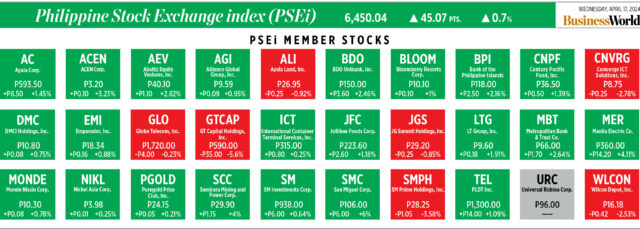
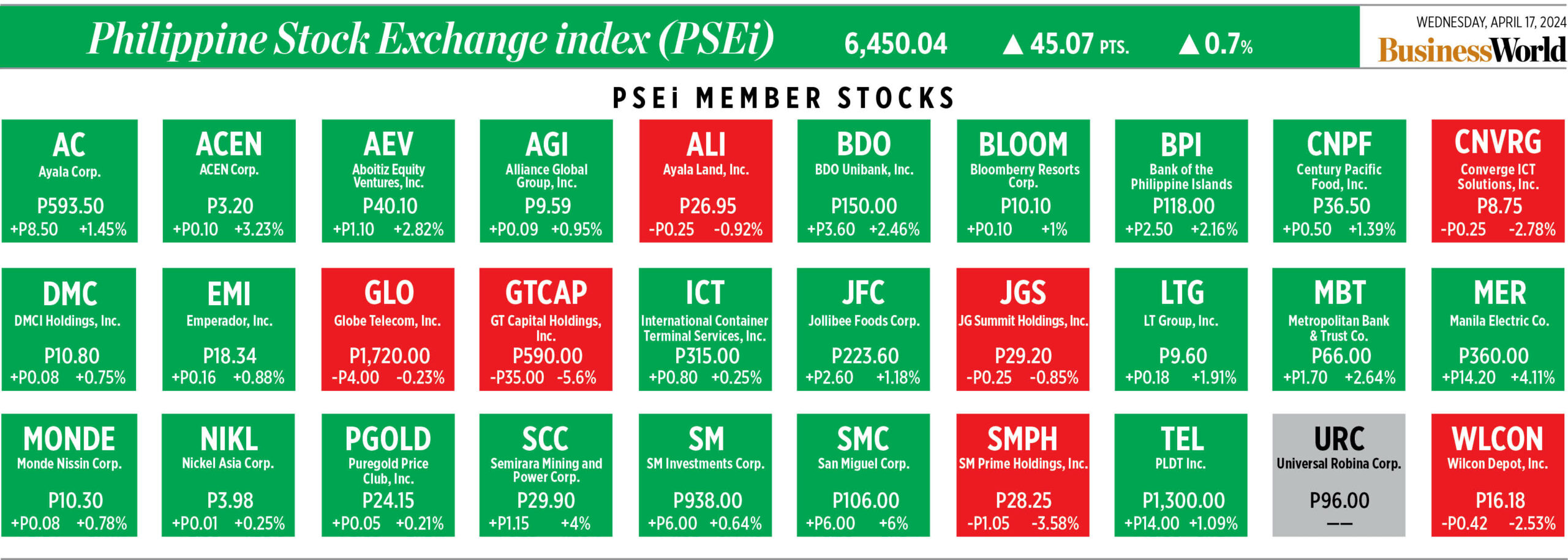
How PSEi member stocks performed — April 17, 2024

Here’s a quick glance at how PSEi stocks fared on Wednesday, April 17, 2024.


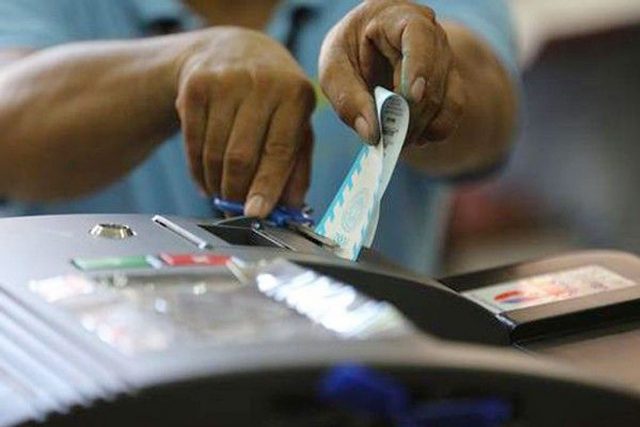
SC rules Comelec committed grave abuse in disqualifying Smartmatic

By Chloe Mari A. Hufana

THE PHILIPPINE Supreme Court (SC) has ruled that the Commission on Elections (Comelec) committed grave abuse of discretion when it disqualified Smartmatic Philippines from bidding for the 2025 election automation project before it had even submitted a bid.

In a decision penned by Justice Jose Midas P. Marquez, the SC en banc stated that the Comelec’s disqualification of Smartmatic “without any reference to the eligibility requirements prescribed” by its own Bids and Awards Committee (BAC) was unjustified and contrary to the Government Procurement Reform Act.

“The Court recognized that requiring Comelec to conduct another round of public bidding would disrupt preparations for the 2025 National and Local Elections (NLE) and could jeopardize the elections themselves,” the SC said in a statement.

The ruling also cited “considerations of equity, justice, practicality, and the doctrine of operative fact,” which recognizes the legality of a law before it became illegal.

SC Spokesperson Camille Sue Mae L. Ting in a media forum said the decision will not affect the award given to Miru Systems for the upcoming automated elections.

“We welcome the Supreme Court’s ruling in our favor, which restores justice and sends a clear message to those at the helm of COMELEC that due process matters,” Smartmatic legal counsel Christian Robert S. Lim said in a statement.

Smartmatic said the decision of some COMELEC commissioners to declare voting counting machines as unserviceable despite several more years of functionality and ongoing warranty was “questionable”.”

It said the continued use of the machines could have saved billions of pesos for Filipinos.

The COMELEC en banc disqualified Smartmatic citing its “constitutional mandate to enforce and administer all laws & regulations relative to the conduct of elections under the Constitution.”

Ms. Ting said Smartmatic — the provider of automation services for elections in the Philippines since 2010 — could sue COMELEC for civil damages.

“The COMELEC being part of the government and an independent constitutional body, cannot be sued without consent (under the principle of state immunity from suit), and this, according to the SC extends to government officials who acted in the performance of their duties and functions,” National Union of Peoples‘ Lawyers Ephraim B. Cortez said in a Viber message to BusinessWorld.

“COMELEC will now be cautious and ensure that at the very least a bidder has already submitted its bid documents. It means disqualification should be made after it reviewed the documents submitted by the bidder,” Mr. Cortez added.

Comelec Spokesperson John Rex C. Laudiangco told BusinessWorld in a Viber message that they have yet to receive a copy of the decision and told other media outlets that preparations for the 2025 elections remained on track.

Later, Comelec Chairman George Erwin M. Garcia sent BusinessWorld a Viber message that they have decided to file a motion for reconsideration.

House calls for probe of ‘dubious’ Chinese schemes in Philippines

BW FILE PHOTO

By Kenneth Christiane L. Basilio

MEMBERS of the progressive bloc in the House of Representatives have filed a resolution aimed at investigating China’s alleged recruitment of Filipino military personnel and the presence of Chinese sleeper cells in the Philippines.

“The number of reports on dubious Chinese activities in the country is increasing,” Party-list Rep. France L. Castro said in a statement on Wednesday.

Ms. Castro and her fellow Makabayan bloc members filed on Monday House Resolution No. 1682 which sought to examine alleged Chinese activities in the Philippines in response to fears that they could destabilize the country.

“The alleged recruitment of Filipino active and retired military personnel by foreign-based firms… and the alleged existence of sleeper cells in the country are serious matters of national security,” read the resolution.

Ms. Castro noted the alleged presence of Chinese sleeper cells — secret groups of China’s People’s Liberation Army personnel — as alarming in addition to Chinese involvement in other crimes associated with Philippine Offshore Gaming Operators (POGO).

“Amidst the escalating aggressive actions of China… as well as the ‘secret deal’ between former Pres. Rodrigo Duterte and Chinese Pres. Xi Jinping, reports of supposed Chinese operations to recruit active and retired AFP (Armed Forces of the Philippines) and PNP (Philippine National Police) personnel have surfaced,” she said.

The PNP said it is investigating the alleged existence of Chinese sleeper cells in the country last November.

Sought for comment, the Chinese Embassy in Manila addressed the allegations by sending a link of its statement last month which read: “Those are merely malicious speculation and groundless accusation against China with the purpose of inciting Sinophobic sentiments in the Philippines.”

Welcoming the probe, Surigao del Norte Rep. Robert Ace S. Barbers reiterated his call that the House also investigate the influx of Chinese nationals near the Enhanced Defense Cooperation Agreement (EDCA) military sites in Cagayan province in Northern Luzon as they may pose security risks for the country.

“The deployment, land purchases, and business creation by Chinese nationals near EDCA sites demand attention from our agencies,” Mr. Barbers said on Wednesday.

On Tuesday, he scored the Department of Foreign Affairs (DFA) and the Bureau of Immigration (BI) and other government agencies for allowing suspicious arrivals of Chinese nationals, some of whom have acquired Philippine documents like passports, birth certificates, and driver’s licenses, among others.

He alleged a “Chinese mafia” was providing Philippine documentation to Chinese nationals. “What have these agencies done to counter document tampering?” Mr. Barbers questioned.

Filipinos advised to suspend nonessential travel to Israel

REUTERS

By John Victor D. Ordoñez, Reporter

THE PHILIPPINE Embassy in Tel Aviv has recommended that Filipinos suspend non-essential travel to Israel at least until hostile situations stabilize amid the ongoing conflict with Iran and the war in Gaza.

In a statement, Philippine Department of Foreign Affairs (DFA) said it is maintaining Alert Level 2 in Tel-Aviv, which restricts non-essential movement for Filipinos there and urges them to avoid public places as well as prepare for possible evacuation.

“All Filipinos in the region are advised to be alert and updated with the security pronouncement of their host governments,” the DFA said.

“For contingency planning purposes, all Filipinos are likewise encouraged to coordinate with their overseas community leaders and our Philippine Embassies and Consulates,” it added.

At the weekend, Iran launched a barrage of missiles and drones at Israel after an Israeli attack on Iran’s consulate in Syria. A seven-year-old girl was hurt in the Iranian strike.

On Monday, the Philippines called on both Israel and Iran to resolve their conflict peacefully and abide by international law.

Meanwhile, Senator Rafael T. Tulfo said he is coordinating with the DFA and the Department of Migrant Workers (DMW) to ensure the safe return of four Filipino seafarers aboard a commercial vessel seized by Iran last April 13.

“I am continuously monitoring and coordinating with the DFA and the DMW to ensure that our countrymen get home safely,” read Mr. Tulfo’s statement written partly in Filipino.

On Tuesday, the DMW said that it is urging the International Bargaining Forum to classify the Strait of Hormuz, where the Israel-linked ship was seized, as a high-risk area that would heighten the monitoring of movement in the area.

Earlier, the DFA released data that there are about 30,000 Filipinos in Israel and 2,000 more in Iran.

Israel Ambassador to the Philippines Ilan Fluss told a virtual briefing on Monday that he would be open to holding dialogues with Philippine state agencies to explain Israel’s mechanisms to ensure the safety of Filipinos and other people who visit the country amid the ongoing conflict.

“I fully respect what the authorities in the Philippines will decide to do,” he said.

New Zealand PM arrives in Manila Thursday

PCO.GOV.PH

NEW ZEALAND Prime Minister (PM) Christopher Luxon and a delegation of top business leaders will be in Manila on Thursday to meet with Philippine President Ferdinand R. Marcos, Jr. to discuss the Philippine government’s development agenda.

“He (Mr. Luxon) has been very clear that he wants to come to the Philippines,” outgoing New Zealand Ambassador the Philippines Francis Tavita Kell said in his farewell call to Mr. Marcos in Malacañang on Wednesday.

“Putting it simply — his mission is to show the rest of his delegation [the] 25 top business leaders, they should be doing more in this part of the world, they should be doing more in the Philippines.”

Last year, New Zealand was Manila’s 28th trading partner with trade amounting to $495.37 million. It is also the country’s 38th export destination and 24th import source.

There are about 100,000 Filipinos based in New Zealand, according to the New Zealand government’s official website.

“The Philippines is one of the fastest growing economies in the region and expected to be a top 20 global economy by 2050,” Mr. Luxon said in a statement on the same site. “I am looking forward to reconnecting with President Marcos, to advancing our countries’ relationship of nearly 60 years and to scoping more opportunities of New Zealand businesses.” — John Victor D. Ordoñez

It’s time to tap nuclear energy, lawmaker tells government

THE GOVERNMENT should immediately construct and deploy nuclear power plants to meet the country’s increasing electricity needs, a congressman said on Tuesday amid supply concerns in the summer season.

“The DoE (Department of Energy) must fulfill their mandate without delay,” Pangasinan Rep. Marcos Juan Bruno O. Cojuangco said in a statement. “We cannot keep having rotational brownouts nationwide when Red Alerts are issued during the summer season.”

The government expects nuclear power to start feeding into the grid by 2032 at the earliest, the Department of Energy (DoE) told a House committee last month.

The Philippines plans to create eight small modular reactor units, each capable of producing 150 megawatts (MW), with a total nuclear energy output of at least 1,200 MW providing supply to the grid in the next decade, according to the Philippine Energy Plan.

Commenting on the DoE’s plan, Mr. Cojuangco said it should reevaluate its nuclear energy plans by setting a nuclear output target of 16,000 MW come 2045.

However, he called on the DoE to “exhibit the requisite flexibility to scale up to 32,000 MW” by the same year should the country’s “economic growth necessitate such expansion.”

Mr. Cojuangco, who chairs the House Special Committee on Nuclear Energy, said nuclear energy is important in attaining economic development as it provides stable electricity output capable of meeting the country’s increasing demand.

“If our supply does not increase, all our plans for economic development will remain unattainable,” he said.

“Every time the lights go out, business operations are derailed and precipitate a domino effect on our manufacturing and service industries resulting to diminished economic output,” he added, referring to the economic repercussions of an unstable energy supply. — Kenneth Christiane L. Basilio

Doctor tops latest poll for senators

CARDIOLOGIST Willie T. Ong topped the list of potential candidates for the upcoming 2025 senatorial elections, with former president Rodrigo R. Duterte placing second, according to a March survey conducted by PUBLICUS Asia, Inc.

In the group’s PAHAYAG survey published on Wednesday, 41% of Filipinos said they would vote for Mr. Ong, while 38% supported Mr. Duterte from a field of 54 individuals in the list.

ACT-CIS Rep. Erwin T. Tulfo took third place with 37%, followed by Senator Christopher Lawrence T. Go and former senate president Vicente C. Sotto III, who both garnered 32%; Sen. Ronald M. dela Rosa with 28%; and Sen. Maria Imelda “Imee” R. Marcos and former Manila Mayor Francisco “Isko” M. Domagoso tied with 27%.

Oppositionist former vice president Maria Leonor “Leni” G. Robredo (27%), Defense Secretary Gilberto C. Teodoro, Jr. (26%) and Senator Pilar Juliana “Pia” S. Cayetano (23%) closed out the “Magic 12.” 

PUBLICUS interviewed 1,500 registered Filipino voters on March 14 to 18.

Liberal Party spokesperson and former Senator Leila M. de Lima earlier said former Senators Francis “Kiko” N. Pangilinan, and human rights lawyer Jose Manuel “Chel” I. Diokno “intend to be opposition candidates” in next year’s midterm elections. — John Victor D. Ordoñez

ADVERTISEMENT
ADVERTISEMENT