Home Blog Page 3341

Pryce Corp. net income climbs 39.5% in first quarter

LISTED Pryce Corp. saw a 39.5% rise in its first-quarter net income to P713.68 million from P511.54 million in the same period last year, driven by higher profits from liquefied petroleum gas (LPG) in the Luzon market.

The company’s first-quarter revenue dropped by 9.5% to P4.69 billion from P5.18 billion last year, Pryce Cor p. said in a stock exchange disclosure on Wednesday.

Its LPG business segment took up P4.4 billion or 93.71% of the consolidated revenues, followed by industrial gases at 4.35% or P204.22 million, real estate at 1.63% or P76.26 million, and pharmaceuticals at 0.31% or P14.58 million.

The lower revenue was attributed to the 10.5% drop in the average contract price (CP) to $633.67 per metric ton (MT) in the first quarter from $708.17/MT last year as well as lower sales volume.

“The drop in the CP has a consequent effect of lowering domestic LPG prices, while the decrease in sales volume is caused by the return of the market to the pre-pandemic out-of-home consumption levels as Pryce is predominantly a household retail oriented business,” the company said.

“The household consumers returned to dine in restaurants and other commercial establishments post the occurrence of the coronavirus disease 2019 pandemic,” it added.

Industrial gases sales volume jumped by 14.7%.

Meanwhile, Pryce Corp. logged a 10.2% increase in operating expenses to P747.03 million from P677.8 million last year due to inflation and an increase in compensation, cost of logistics, and fuel.

The country’s inflation rate rose to 3.7% in March due to higher prices of food products.

On Wednesday, Pryce Corp. shares fell by 2.11% or 12 centavos to P5.57 apiece. — Revin Mikhael D. Ochave

Adobe to bring full AI image generation to Photoshop

ADOBE said on Tuesday it plans to place a tool for full artificial intelligence (AI) image generation in its Photoshop software later this year.

Adobe’s image and video editing tools are widely used by creative professionals, but it faces rising competition from startups such as Microsoft-backed OpenAI, Midjourney, and Stability AI, all of which offer services that can generate images from text prompts.

Adobe is developing its own image-generation AI system called Firefly, which is trained on data that Adobe has rights to, in order to avoid copyright infringement claims against users.

Adobe previously released image-generation tools in Photoshop that can fill in or expand parts an existing image. At a conference in London on Tuesday, the company said full image generation will come later this year, based on a new AI system called Firefly Image 3.

Much of Adobe’s focus has been on speeding up the work of professionals who use its software. The new image-generation tool will have the ability to tap a user’s uploaded image as a reference for the general composition of an image.

For example, a designer could make a quick sketch of a scene on a napkin, snap a photo of that napkin with a smartphone and then ask Photoshop to generate fully featured images in a variety of styles, said Ely Greenfield, chief technology officer for digital media at Adobe.

“Rather than having to very carefully describe exactly what goes where and try to make sure that I’m specifying the things I want things and that I don’t, it’s borrowing from the reference. So this is an amazingly powerful capa-bility,” Mr. Greenfield said.

Adobe said a test “beta” version of the software was available to some users on Tuesday but did not give a date for general availability. — Reuters

Comparative disadvantage

THE economic law of “comparative advantage” states that goods and services tend to be outsourced to countries with lower costs or a more available workforce. Thus, production of American cars is largely offshored to Mexico. There is sometimes the additional advantage of having an available base of software engineers in a particular country like Taiwan for the manufacture of hand phones or integrated circuits. For the Philippines, a ready pool of Eng-lish-speaking low-cost transaction handlers has created the thriving Philippines business process outsourcing (BPO) industry serving offshore clients.

Is there too an applicable law of comparative advantage (or disadvantage) in determining social status?

Is status a comparative evaluation of the social standing of individuals or groups? One can be happy having a nice house and three meals a day plus two cars in a gated community. Should the neighbor with a bigger house on three lots, a pool, and five cars in his garage shake up the erstwhile feeling of contentment?

Self-esteem can be eroded by odious comparisons with others more fortunate that pull down happiness and contentment.

Resentment arising from a comparative disadvantage drives envy. And can this same feeling of being disadvantaged be a motivating force? What are celebrity endorsers after all but high-status personalities promoting products and services? If she can use this product to make herself desirable, can it do the same for the aspirational consumer?

The law of comparative advantage can also result in a feeling of superiority. Schadenfreude is a smugness that finds pleasure in the misfortune of others. This unseemly delight is enhanced when directed at someone who was once the object of envy, now fallen from a high pedestal. (Maybe financial ruin has resulted from losing a popular TV show.)

A milder version of this aberrant happiness is taking comfort in being less unfortunate than another. It is even promoted as a kind of balm when feeling distressed over one’s misfortune. (I was crying over not having shoes until I met someone with no feet.)

This type of consolation achieved over another’s miserable state can be as offensive as envy itself. But unless envy translates into causing the downfall of the envied one as in the case of Iago in Shakespeare’s Othello, scheming to drive a wedge in a happy marriage, it is just a deadly sin to be aware of.

Still, like the food chain, there must be those at the end of the misery line who have no one left to feel superior to. Biblical characters like Job are subjected to divine tests for worthiness in the kingdom of God. A prosperous person can be brought down by catastrophes. It is patience here that is tested in the face of divinely inflicted calamities. Job continued to be a faithful servant. His good fortune was thus restored as a re-ward for his faithfulness through trials and tribulations.

In determining a skill in which we can excel, it is best to follow the theory of comparative advantage. Even with Renaissance Men, or those claiming to be such, having many talents can only be confusing. In launching stars, good talent managers determine what skill can best define a particular celebrity. She can’t be a singer and a comedienne at the same time. It is best to pick one outstanding skill, with such others as terpsichorean excellence as mere adjuncts.

Somebody else’s good fortune should not depress us. Life is not a contest, even if it seems to be. Envy can be dispensed with by achieving happiness, as defined by ourselves. Still, role models (or objects of envy) can be useful in eliciting creativity and hard work. In contemplating how one can fall farther behind, envy provides the motivation for honing skills and moving upward.

It’s healthier to be motivated by more positive things. Anyway, success and failure should not be determined by others. Only in sports are there winners and losers. In life it is more of a choice between happiness and misery.

Being less conscious of status, and how others see us (compared to more accomplished peers), is the key to contentment and happiness. Social media posts can promote a feeling of comparative disadvantage, when accom-panied by photos of a former classmate and his grandchildren with the Eiffel Tower in the background — wish you were here. Yeah… right.


Tony Samson is chairman and Ceo of Touch xda

ar.samson@yahoo.com

mWell partner Fullerton Health opens executive health screening center in BGC

mWELL HANDOUT

HEALTHCARE platform Fullerton Health has opened an executive health screening center in Bonifacio Global City (BGC), its partner mWell, the digital healthcare arm of Metro Pacific Investments Corp. (MPIC), said on Wednesday.

The facility offers advanced diagnostic imaging services from Radlink Philippines, enhancing preventive healthcare standards, mWell said in an e-mailed statement.

Founded in Singapore, Fullerton Health has a network across nine markets.

Fullerton Health has partnered with mWell to provide access to its services through mWell HealthHub on the mWell app.

App users can browse Fullerton Health’s executive health screening packages and radiology services, as well as schedule appointments using their smartphones.

Fullerton Health, located at 32nd St. corner 2nd Avenue, Bonifacio Global City, Taguig, offers a three-hour turnaround time for patients, according to mWell.

Business class pods are available, providing privacy and technology-driven clinic management as part of service innovations addressing market gaps, it added.

mWell is a fully integrated health and wellness mega app. It offers 24/7 access to partner-doctors online, including family doctors, specialists, and mind health experts, with home care and emergency services available. The app includes free fitness and nutrition programs for preventive healthcare and features the mWellness Score to track physical activity for long-term health.

MPIC is one of the three key Philippine units of Hong Kong-based First Pacific Co. Ltd., the others being Philex Mining Corp. and PLDT Inc. Hastings Holdings, Inc., a unit of PLDT Beneficial Trust Fund subsidiary MediaQuest Holdings, Inc., has a major-ity share in BusinessWorld through the Philippine Star Group, which it controls. — ALB

GSIS net profit climbs by 21% in 1st quarter amid strong revenues

GSIS FACEBOOK PAGE

THE GOVERNMENT SERVICE Insurance System (GSIS) saw its net income rise by 21% in the first quarter driven by strong revenues, it said on Wednesday.

Its net income stood at P37 billion at end-March, up from P30.75 billion in the same period last year, GSIS said in a statement.

GSIS’ revenues grew by 17% year on year to P85 billion in the first quarter.

“Our commitment to support the nation’s growth story saw increases in GSIS investments in key sectors such as real estate, infrastructure, food, energy and mining. Further, the GSIS is boosting revenue streams as it focuses on building efficiencies in its various businesses,” GSIS President and General Manager Jose Arnulfo “Wick” A. Veloso said.

For its global investments, income from financial assets grew by 45%, it said.

“GSIS would like to be a catalyst supporting investments in various sectors to bring down the cost of power and allow vertical integration for mining companies to process raw materials into intermediate and finished products,” Mr. Veloso said.

GSIS said its fund life is now up to 2058 amid sustained investment returns.

Net gains on the sale and mark-to-market valuation of local equities and exchange-traded funds resulted in a 234% growth in revenues to P10 billion, it said.

Interest income from fixed-income securities reached P9 billion in the quarter, including earnings from its holdings of dollar and peso sovereign bonds, Treasury bills, and corporate bonds.

GSIS’ total assets went up by 10% year on year to P1.74 trillion in the January to March period.

“Bolstering its commitment to support its 2 million members, the GSIS enhanced its lending program to allow its members to better manage their finances and, for some, to ease their debt burden,” it said.

GSIS said it has disbursed P136 billion through its Multi-Purpose Loan Flex program as of March, which was availed of by 506,000 members.

Meanwhile, maintenance and other operating expenses were 41% below budget during the first quarter, GSIS said.

Administrative cost ratio was at 2.98%, below the 12% allowed under the GSIS charter. — A.M.C. Sy

High demand for Gen AI seen in PHL

FREEPIK

PHILIPPINE demand for generative artificial intelligence (Gen AI) has surpassed that from developed countries as local firms and individuals aim to leverage these tools for growth. 

Aparna Bharadwaj, global leader of Boston Consulting Group’s (BCG) Global Advantage Practice, said in a briefing on Monday that Filipinos use Gen AI to “help them get ahead in their careers.” 

“In emerging markets, there is a higher use of Gen AI as they see it as a driver of growth and success,” she added. 

The Philippines scored more than average in a study conducted across 21 countries with 21,400 respondents in terms of awareness and usage of Gen AI in the workplace. 

Ms. Bharadwaj urged leaders to be innovative in the use of Gen AI but underscored the importance of building trust through transparency. 

“When launching new consumer products or services with Al, double down on transparency and a balanced sell on value and impact,” the report said. “Reassure consumers before scaling new Al services and products too fast. Consumer trust, once eroded, can be difficult to regain.” 

The study found that 43% of the respondents are excited about Gen AI, with 39% saying it improves daily lives. 

In the Philippines, 38% said they are excited about Gen AI, while 43% said they are conflicted. 

However, respondents said data privacy is the biggest risk presented by Gen AI. 

Meanwhile, for employees, the report showed that 55% of the respondents said their jobs cannot be easily replaced by AI or other technologies. 

Jessica Apotheker, BCG global chief marketing officer and leader of AI in marketing, said employees in jobs that require face-to-face interactions, such as the healthcare industry, are less worried about AI taking over their jobs. 

“Anticipate the impact on your workforce. Focus 10% of your AI effort on algorithms, 20% on the underlying data and technology, and 70% on people,” the report said. — C.M.A. Hufana 

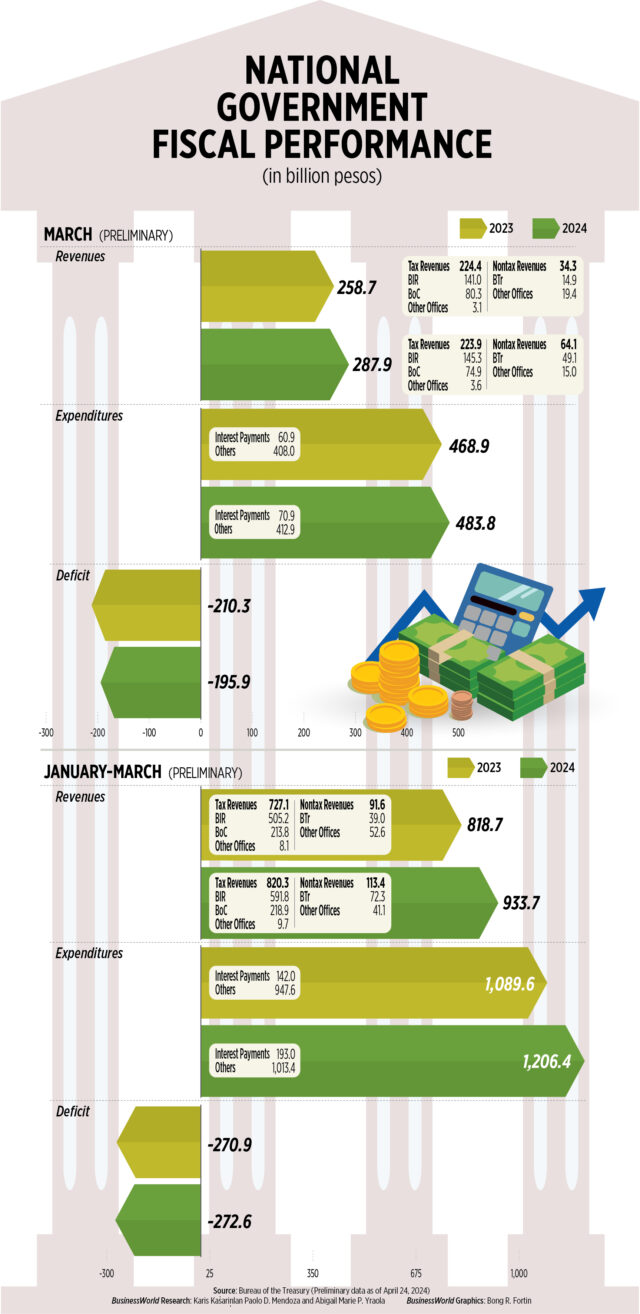
National government fiscal performance (in billion pesos)

THE National Government’s (NG) budget gap narrowed in March amid a dip in tax collection and muted spending, the Bureau of the Treasury (BTr) reported on Wednesday. Read the full story.

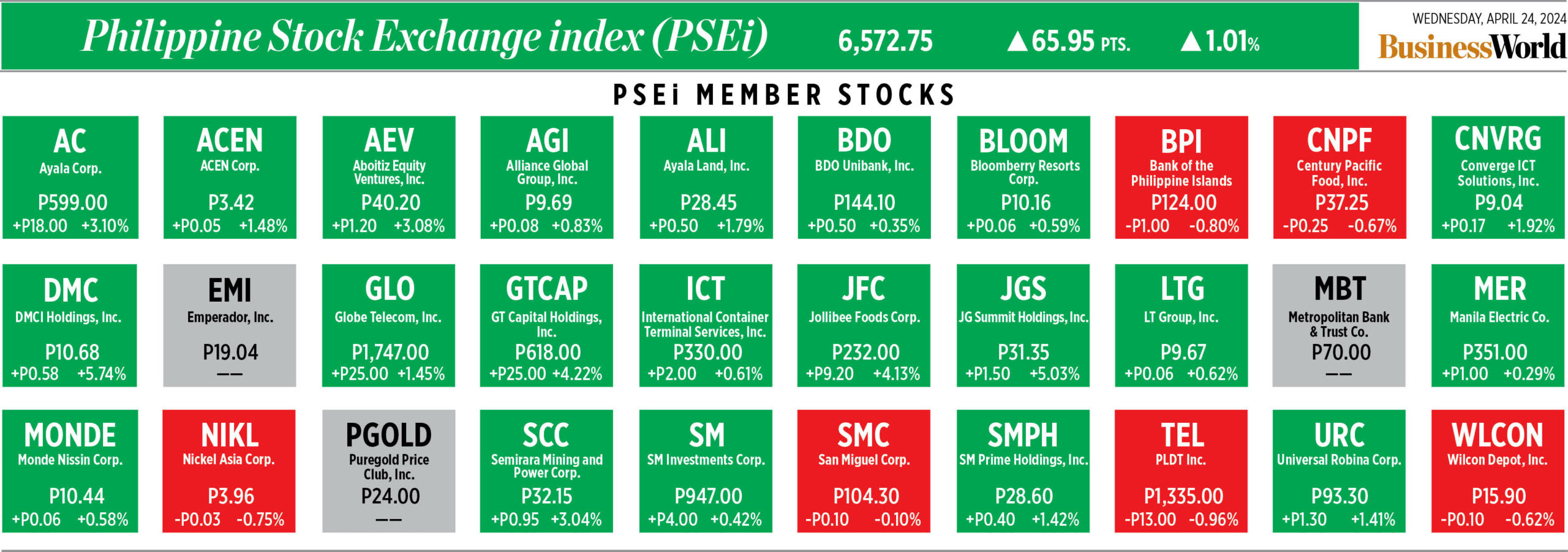
How PSEi member stocks performed — April 24, 2024

Here’s a quick glance at how PSEi stocks fared on WednesdayApril 24, 2024.


Critics slam paltry Philippine share in $95-B US aid package for its allies

THE BRP SIERRA MADRE, a marooned transport ship which Philippine Marines live in as a military outpost, is pictured in the disputed Second Thomas Shoal, part of the Spratly Islands in the South China Sea. — REUTERS

By Kyle Aristophere T. Atienza, Reporter

SECURITY experts on Wednesday criticized the paltry share of the Philippines in the United States’ $95-billion (P5.5 trillion) aid package — mostly military assistance to Ukraine, Israel and Taiwan and US partners in the Indo-Pacific region — saying Manila should demand more as it deals with China, the world’s biggest naval power.

The Philippines will get $500 million in aid under a US Senate-approved bill, compared with $61 billion for Ukraine’s efforts against Russia’s invasion and $26 billion for Israel and humanitarian aid for civilians in conflict zones around the world.

The Philippine share is part of the $8.12 billion allotted to “counter communist China” in the Indo-Pacific region.

“Since a conflict could spark at any time due to miscalculations or decisive escalations, aid is better than none,” said Joshua Bernard B. Espeña, vice-president at Manila-based International Development and Security Cooperation.

“However, the Philippines must negotiate for a bigger yet granulated piece of the pie if both allies are serious about building up Philippine defense,” he said in a Facebook Messenger chat.

With a 79–18 vote in the US Senate, the proposed package that President Joseph R. Biden is expected to sign this week is seen as a bipartisan victory, getting support from most Democrats and traditional Republicans wary of ultra-nationalist sentiments among their ranks.

The House passed its version of the proposed package on Saturday in the form of individual bills combined for Senate action.

“I expect that given the strong bipartisan congressional support, Manila has reasons to be optimistic in asking for these reasonable packages given the mutual security concerns posed by China,” Mr. Espeña said.

He added that the US should offer a more affordable package for the Philippines’ planned acquisition of combat aircraft under its Multirole Fighter program.

President Ferdinand R. Marcos, Jr. in February said the Philippines was on the frontline of a battle for regional peace as it faces China’s growing assertiveness in the South China Sea.

China claims the waterway almost in its entirety, including waters that fall within the Philippines’ exclusive economic zone.

It continues to block resupply missions at Second Thomas Shoal, where Manila grounded a World War II-era ship in 1999 to assert its sovereignty, by firing water cannons at much smaller Philippine boats.

Richard J. Heydarian, a senior lecturer at the Asian Center of the University of the Philippines, said the Philippines got less 1% of the aid package while it is “bullied by the world’s largest naval power.”

“Even Jordan and Pakistan have enjoyed far more defense aid and modern weapon transfers than the Philippines,” he tweeted.

‘SELLING OUT’
The Philippines and the US have been treaty allies since 1951, when the two countries signed their Mutual Defense Treaty, which compels both sides to defend each other in case of an armed attack.

The treaty was updated last year to cover attacks on the Philippine armed forces, vessels and other assets in the South China Sea.

House Speaker Ferdinand Martin G. Romualdez said the bipartisan measure was a result of “extensive deliberations” between a Philippine delegation that he led and American legislators at Capitol Hill in Washington, D.C.

The deliberations coincided with the recent trilateral summit among Mr. Biden, Mr. Marcos and Japanese Prime Minister Fumio Kishida, he added.

“The aid package comes with strings attached and it involves the selling out of our sovereignty,” Bagong Alyansang Makabayan Secretary-General Raymond Palatino said in a Facebook Messenger chat.

He noted that the US does not pay for military bases under its 2014 Enhanced Defense Cooperation Agreement (EDCA) with the Philippines.

Mr. Marcos has expanded the deal, giving the US access to four more sites on top of the five existing ones.

“A pitiful price tag for allowing the US to turn the country into an extension of its military network,” Mr. Palatino said. “Only corrupt officials of the Marcos government stand to benefit from this aid coming from the world’s biggest enabler of genocide and war profiteer.”

It is in Washington’s best interest to invest more in its key allies in the region, Don Mclain Gill, who teaches international relations at De La Salle University, said via Messenger chat.

“For the past two decades, China has significantly controlled the South China Sea short of [declaring] war with the US,” he said. “The Philippines is at the frontline of an emerging geopolitical transition in the world, particularly with China’s growing assertiveness and expansionist ambitions.”

Mr. Gill said US policymakers should keep in mind that Washington’s preoccupation away from the region at the start of the 21st century had set the ground for China’s expansionism, “which can critically derail not just regional, but also international security.”

Mr. Espeña urged the Marcos government to “maximize all the funds by identifying which capabilities in the Armed Forces of the Philippines needed short and long-term modernization.”


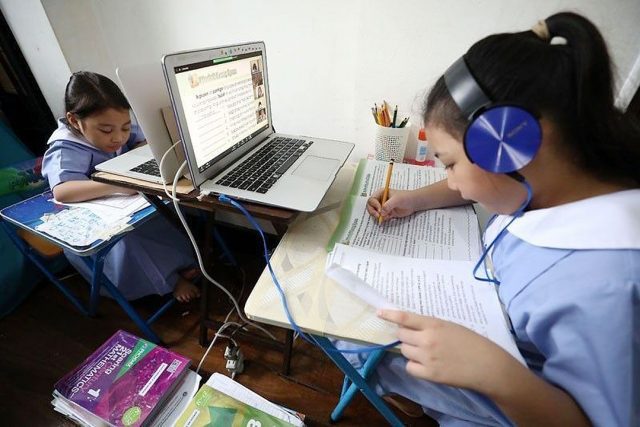
Filipino students return to online classes due to heat

PHILIPPINE STAR/ MIGUEL DE GUZMAN

RECORD HEAT in the Philippines this month has forced schools to send children home for online classes, reviving memories of COVID lockdowns and raising fears that more extreme weather in the years to come could deepen educational inequalities.

Pupils at 7,000 public schools in the Southeast Asian country were sent home last week due to unusually hot weather in many areas that forecasters have linked to the effects of the El Niño weather phenomenon.

Teacher Erlinda Alfonso, who works at a public elementary school in Quezon City near the capital, said she did not know what was worse for her pupils — sweltering in an overcrowded classroom or trying to study at home.

“Some students told me they prefer going to school because the heat is worse at home,” she said, adding that many of her students live in nearby shantytowns and have no internet connection to take part in online classes.

While teachers are providing offline assignments to students without internet access, Ms. Alfonso said the arrangement left children with no one to raise questions with.

“If there’s something they could not understand, their parents or siblings are often not at home because they need to earn a living,” said the 47-year-old, who also heads the city’s association of public school teachers.

The Philippines had one of the world’s longest school shutdowns during the COVID-19 pandemic, which highlighted the education gap faced by children from low-income families without computers or sufficient internet access.

But with most public schools in the country of 115 million people poorly equipped to deal with soaring temperatures and other extreme weather, online classes have become the safest option during the heatwaves, teachers and unions say.

The Health department on Wednesday said it had recorded 34 cases of heat-related illness, including six deaths, from Jan. 1 to Apr. 18.

These were from central Visayas, the Ilocos region in the country’s north and the Soccsksargen region in the southern Philippines.

The state weather bureau expected 30 areas in the country to experience scorching temperatures of up to 46C on Wednesday.

‘UNBEARABLE’

In public schools in Metro Manila, the capital region, a survey of more than 8,000 teachers last month showed 87% of students had suffered from heat-related conditions.

More than three-quarters of teachers described the heat as “unbearable” in the survey conducted by the Alliance of Concerned Teachers of the Philippines — National Capital Region (ACT-NCR), a teaching association.

Nearly half or 46% of teachers said classrooms have only one or two electric fans, highlighting inadequate ventilation measures to deal with rising temperatures. “The heat had tremendous impact on children. Some students even col-lapsed inside classrooms. Teachers suffered from the heat, too, but often they would prioritize their students’ health inside classrooms,” Ruby Bernardo, spokesperson of ACT-NCR, told the Thomson Reuters Foundation.

As climate change fuels the frequency and severity of heatwaves, the problems faced by teachers and students in the Philippines look set to play out elsewhere.

About 243 million children in Asia and the Pacific are expected to be exposed to hotter and longer heatwaves over the coming months, the United Nations children’s agency, UNICEF, said last week.

Children are particularly susceptible to heat stroke, and UNICEF said prolonged exposure to intense heat also affects their ability to concentrate and learn.

Since the start of El Niño, “danger category” temperatures as high as 44C have been predicted by the country’s weather agency.

Filipino teachers say more measures are needed to deal with extreme heat in schools — from tackling shortages of classrooms and teachers, which lead to overcrowding, to providing free drinking water and having a school nurse or doctor on site.

The Alliance of Concerned Teachers has called on the Department of Education (DepEd) to address such issues.

It has also proposed the immediate reversion to the pre-pandemic school calendar, when the hot months of April and May fell during the long school break.

Asked to comment, a DepEd spokesperson said its policy of letting head teachers decide when to switch to online or offline home classes “provides a more immediate and effective response to heat conditions rather than knee-jerk changes that would further compromise learning recovery.”

Some teachers say the situation also underlines the need for more education about climate change.

“Climate change has not been comprehensively taught in our classrooms. But it’s a pressing issue linked to all the other challenges our education system is facing now,” Ms. Bernardo said.

For many low-paid public sector teachers, working in packed schools with nonexistent or inadequate cooling has been the last straw.

“The heat makes me want to resign or retire early,” Ms. Alfonso said. — Thomson Reuters Foundation with Kyle Aristophere T. Atienza


Rene Saguisag, former senator and Erap defense lawyer, dies at 84

RENE AUGUSTO V. SAGUISAG, a former senator and human rights lawyer who was one of the key defense lawyers in the corruption trial of ex-President Joseph E. Estrada (Erap), died on Wednesday. He was 84.

His family did not disclose the cause of his death.

Mr. Saguisag fought the late dictator Ferdinand E. Marcos Sr.’s martial rule in the 1970s and later became spokesman of his successor Corazon C. Aquino after a popular street uprising toppled the strongman’s regime in February 1986.

“Rene Saguisag was a dedicated public servant, and his tireless endeavors as a human rights advocate, senator and writer stand as a testament to his unwavering commitment to justice, truth and democracy,” according to a statement by his family posted on his son Rebo’s Facebook account.

“For him, expertise in law was a means to serve the poor and disenfranchised, and he provided free legal aid to those in need. “

Senate President Juan Miguel F. Zubiri described Mr. Saguisag as a true statesman who prioritized helping poor Filipinos who needed legal aid.

“Senator Saguisag leaves behind a legacy of service and excellence that continues to be a benchmark for many young lawyers and public servants,” he said in a statement.

Mr. Saguisag was a senator from 1987 to 1992 and did not run for reelection, as he promised during the campaign.

During his time in the Senate, he co-authored the bill on the Code of Conduct and Ethical Standards for Public Officials. He was chairman of the ethics committee and was part of the ad hoc committee on the Bataan Nuclear Power Plant.

He was among the 12 senators in 1991 who voted against the extension of a treaty with the United States that would have given Washington 10 more years of access to military bases in the Philippines.

Senator Mary Grace Poe-Llamanzares in a statement said Mr. Saguisag was a “legal luminary” who used his expertise to help the poor. “We condole with the nation for the loss of a staunch advocate for good gov-ernance and justice.”

Mr. Saguisag was part of the Free Legal Assistance Group or FLAG, a lawyer’s group founded in 1974. As a FLAG lawyer, he helped prosecute the Manero brothers for the murder of Italian Catholic priest Tullio Favali in 1985.

“He was steadfast in defending our democratic values and protecting the rights of all,” Senator Ana Theresia Hontiveros-Baraquel said in a statement, calling him a staunch defender of democracy and human rights.

At the House of Representatives, the Makabayan bloc said Mr. Saguisag had an “unwavering commitment to upholding justice and defending the rights of the Filipino People.”

“His legacy as a human rights lawyer and public servant will continue to inspire generations of Filipinos to fight for a more just and equitable society,” it said in a statement. — John Victor D. Ordoñez

DMW bars deployment of Filipino seafarers to Red Sea, Gulf of Aden

By John Victor D. Ordoñez, Reporter

THE DEPARTMENT of Migrant Workers (DMW) has barred the deployment of Filipino seafarers on passenger and cruise ships to the Red Sea and the Gulf of Aden amid recent attacks by Houthi rebels.

Department Order No. 2 issued on Wednesday requires manning agencies to sign an affirmation letter guaranteeing vessels do not pass through the Red Sea or the Gulf of Aden.

Under the order, Filipino seafarers listed as crew members on board the vessels must also sign the letters acknowledging that their ships will not enter these areas.

The letters would then be uploaded to the DMW’s online processing system to ensure transparency, the agency said.

The department earlier required commercial vessels to register a “significant event” when they sail through the areas after two Filipino seafarers died aboard an Israel-linked bulk carrier after a Houthi missile attack last month.

In November, Houthi rebels seized an Israel-linked cargo ship in the Red Sea and took 17 Filipino seamen hostage.

The order comes after the DMW consulted with the Philippine Maritime Industry Tripartite Council to come up with ways to ensure the safety of Filipinos amid the recent attacks.

“The DMW remains steadfast in its commitment to safeguarding the well-being of Filipino seafarers,” it said. “These measures reflect the DMW’s dedication to ensuring safe working conditions and protecting our seafaring workforce.”

ADVERTISEMENT
ADVERTISEMENT