Home Blog Page 330

NEO Office PH partners with Holcim to co-process office waste

NEOOFFICE.PH

SUSTAINABLE OFFICE developer NEO Office PH has partnered with Holcim Philippines, Inc. to adopt cement kiln co-processing for waste collected in its office buildings, aiming to reduce landfill waste.

The partnership leverages Holcim’s global waste management brand Geocycle to ensure responsible co-processing of post-consumer waste from NEO’s office towers, the company said in a statement.

Qualified residual waste will be converted into alternative fuels and raw materials for cement production. Waste collected from NEO buildings will be processed at Holcim’s Norzagaray Cement Plant in Bulacan.

“Together, we are turning everyday building waste into valuable resources, proving that responsible development can drive both environmental impact and business value,” NEO Group Chief Executive Officer Raymond D. Rufino said.

The move supports NEO’s push for a low-carbon office portfolio by integrating circular economy practices.

“By bringing Geocycle’s co-processing technology into our waste management approach, we’re reinforcing our commitment to circular economy principles, turning waste into value and helping deliver real, measurable ESG (environmental, social, and governance) outcomes,” NEO Co-Managing Director and Chief Sustainability Officer Gie L. Garcia said.

NEO’s portfolio spans 289,000 square meters across seven office buildings in Bonifacio Global City — One/NEO, Two/NEO, Three/NEO, Four/NEO, Five/NEO, Six/NEO, and Seven/NEO.

Its towers have been recognized by local and international green building certifications, including the 5-Star Building for Ecologically Responsive Design Excellence (BERDE), Advancing Net Zero Philippines (ANZ/PH), International Finance Corporation’s EDGE Zero Carbon, and the WELL Health-Safety Rating under the International WELL Building Institute. — Beatriz Marie D. Cruz

Antidote to noise

STOCK PHOTO | Image by GarryKillian from Freepik

Is the world making too much noise? Are we drowning in toxic sound?

On the streets one hears tooting horns, sirens wailing, motorcycles revving up, and cars zooming around. It seems that sounds are amplified beyond decent decibel levels. The radio has blaring music. Television has hard news about disasters and violence. Restaurants and bars have loud music that make the customers cringe. People walk around with earphones and headphones, oblivious.

Noise is loud, hyper, and disconcerting.

Humans react in diverse ways to the sounds in the environment. Constant exposure conditions the mind and allows the individual to accept, reject, or adapt certain sounds as part of his lifestyle.

At the office, people are accustomed to the various sounds of computers, monitors, intercoms, telephones and cellphones, and chatter.

As one goes up the corporate ladder, sounds become mellow.

Executives prefer to be insulated from office chaos. They and their staff speak in hushed tones and modulated voices. Footsteps in the hallways are muted as well.

In the service industries, employees hear stressful noise that causes migraines and heart palpitations. Factory workers are subjected to deafening repetitive mechanical noise. Soldiers, firemen, policemen, humanitarian workers, and airport crew are bombarded by ear-splitting sounds of panic, riots, sirens, traffic, disasters.

Party animals, rock stars, pop musicians and their fans, players and fans of basketball, boxing, and other sports all develop steel eardrums. They learn how to withstand ear-shattering synthesized music, pounding drums and cymbals clashing, whooping cheers, screaming, and suffer the resultant brain damage.

Is noise toxic?

Prolonged exposure to hazardous sounds causes hypertension, and ear and brain damage. Some people have internal coping defense mechanisms.

Weary eardrums tune out — selectively or permanently. Perhaps this explains a social affliction among creatures of the night — acquired hearing impairment or premature deafness.

Social celebrations are occasions where one can learn about people. By switching off the sound, body language is more revealing — gestures, posture, eye and facial expressions. A sensitive ear would discern speech patterns, intonations, and accents. Or distinguish aural differences among nationalities, regions, and classes.

On another level, the volume of sound corresponds to a specific class of people. How a person sounds says a lot about them, like appearance and behavior do.

Well-born, well-bred, cultured individuals are discreet, genteel, and quiet. Their subtle gestures and dignified mannerisms reflect good breeding. Loud and brassy people crave attention. Exaggerated gestures, vulgar words, and rough mannerisms are seen in rowdy politicians, tacky showbiz celebrities, and declassee social mountaineers.

At business and social affairs, class differences become more apparent. The low-key, well-bred individuals tend to downplay their presence, unless they are guests of honor or celebrants.

At a deluxe hotel’s lobby, braggarts discuss money and stocks. The flashy types strut about while speaking on their cellphones. Loud mouths gloat and compare new acquisitions toys, possessions, houses, cars, club shares, and girls.

Ladies who lunch make an interesting case study. The vamps are in tight stretch minis. The lacquered matrons glisten in glittering jewelry and shrill voices. Their inane chatter covers gossip about scandals and foreign trips, shopping orgies, petty rivalries, and fashion trends and events.

On vacations, the rules of acceptable behavior still apply. The sophisticated blend in discreetly. They are simple, elegant, proper, and wear appropriate clothes. No fuss and fanfare. The upstarts are the opposite as they advertise money and power. They flaunt things and act contrived, loud.

In contrast, nature lovers and contemplative types can savor the sounds of the outdoors — cooing bird calls, chirping crickets, the rushing wind, breaking waves, rain showers, the sounds of petals and leaves and snow flurries. These are the sounds that calm and inspire creatives.

Musicians are hypersensitive to the nuances of sound. Composers, conductors, and artists transform random notes into melodies, sonatas, etudes, and symphonies inside their minds. They produce music for opera and concerts that nourish the spirit, relax the mind and body, and soothe the heart.

If only we could switch off all the offensive, grating, discordant noise, the battlefield bombs, the cries, and explosions of war.

We could bask in a long period of silence.

These precious heavenly moments would make us feel sane and serene.

Can wishful thinking become reality?


Maria Victoria Rufino is an artist, writer and businesswoman. She is president and executive producer of Maverick Productions.

mavrufino@gmail.com

January inflation quickens to 11-month high

PHILIPPINE INFLATION accelerated to its fastest pace in nearly a year in January amid a faster rise in rents and electricity rates, the Philippine Statistics Authority (PSA) reported. Read the full story.

How PSEi member stocks performed — February 5, 2026

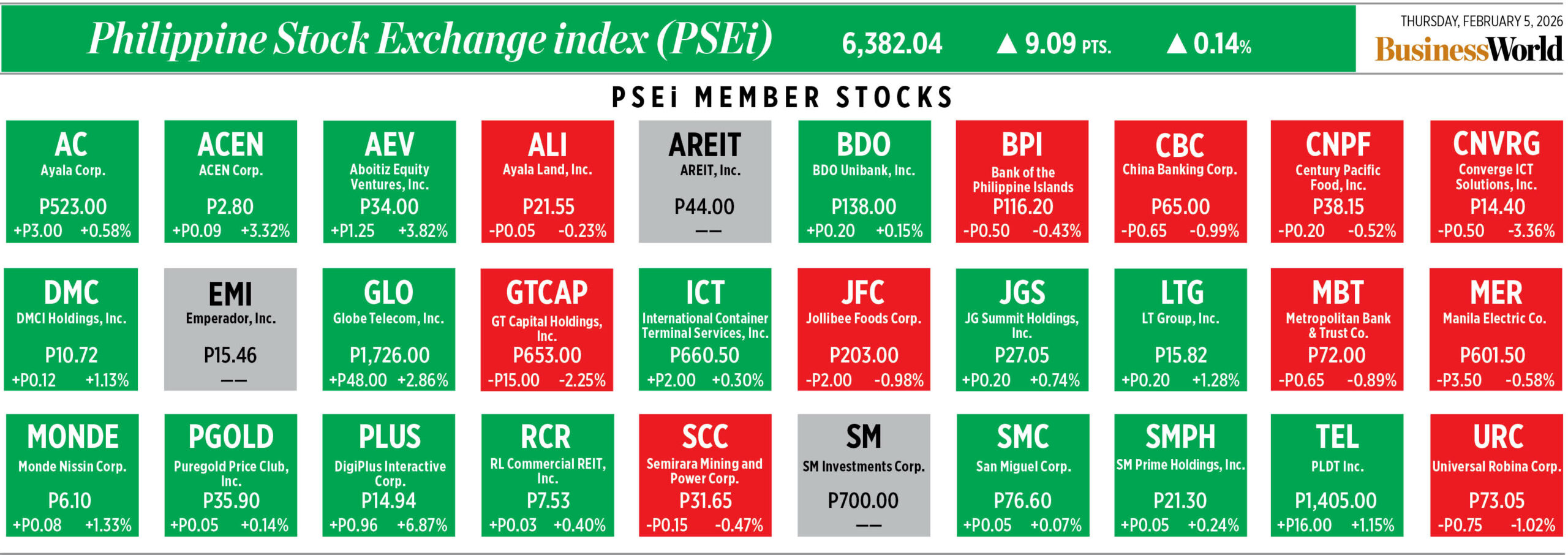
Here’s a quick glance at how PSEi stocks fared on Thursday, February 5, 2026.


PHL shares move sideways as inflation picks up

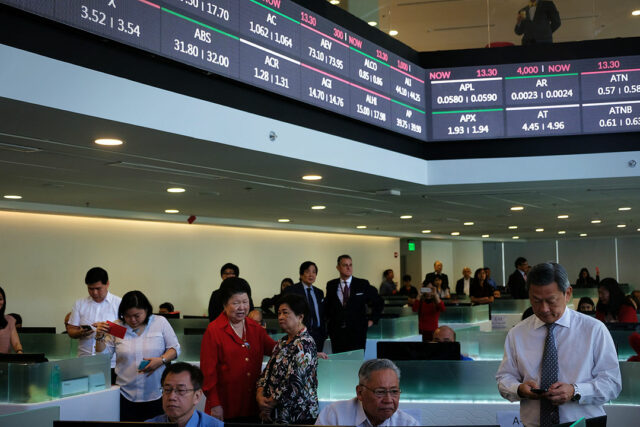
BW FILE PHOTO

PHILIPPINE SHARES moved sideways on Thursday as investors were cautious following the release of data showing that inflation picked up to a near one-month high in January.

The Philippine Stock Exchange index (PSEi) inched up by 0.14% or 9.09 points to close at 6,382.04, while the broader all shares index increased by 0.92% or 32.83 points to 3,587.83.

“The PSEi ended almost flat following the release of a slightly higher-than-expected inflation rate. Market sentiment remained cautious as investors digested the inflation data,” Luis A. Limlingan, head of sales at Regina Capital Development Corp., said in a Viber message. “Attention turned to the potential impact of these figures on the upcoming BSP (Bangko Sentral ng Pilipinas) policy meeting.”

The main index posted slight gains as the data showed that inflation remained “controlled” despite the pickup, Philstocks Financial, Inc. Research Manager Japhet Louis O. Tantiangco said.

“S&P Global Ratings saying the Philippines is still on track for a possible credit rating upgrade also helped in Thursday’s session,” he said.

“The PSEi closed higher on Thursday… as investor sentiment was supported by optimism over the Philippines’ sovereign credit outlook. This followed S&P Global Ratings’ indication of a potential rating upgrade over the next one to two years, citing improving fiscal and external balances,” Unicapital Securities, Inc. Research Head Wendy B. Estacio-Cruz said.

Headline inflation rose to 2% in January from 1.8% in December, but was slower than the 2.9% in the same month last year, the government reported on Thursday.

This was the fastest in 11 months or since the 2.1% in February 2025, which was also the last time the monthly print was within the central bank’s 2%-4% annual target.

It was also higher than the 1.8% median forecast from a BusinessWorld poll of 18 economists, but was within the BSP’s 1.4%-2.2% estimate for the month.

Meanwhile, S&P said in a Feb. 3 report that the Philippines remains on track for a possible credit rating upgrade as improving fiscal and external balances outweigh risks from the government’s flood control controversy

Sectoral indices ended mixed. Services climbed by 0.57% or 15.12 points to 2,662.06; holding firms increased by 0.46% or 23.44 points to 5,052.84; and property rose by 0.17% or 3.87 points to 2,208.49.

Meanwhile, mining and oil dropped by 1.08% or 190.07 points to 17,267.75; industrial retreated by 0.38% or 35.13 points to 9,095.71; and financials decreased 0.23% or 4.90 points to 2,121.09.

Value turnover went down to P6.70 billion on Thursday with 1.07 billion shares traded from the P6.94 billion with 1.13 billion issues exchanged on Wednesday.

Advancers outnumbered decliners, 98 versus 90, while 73 names were unchanged.

Net foreign selling was at P22.65 million, a reversal of the P279.62 million in net buying recorded in the previous session. — Sheldeen Joy Talavera

Lufthansa Technik in talks to set up $400-M Clark facility

LUFTHANSA TECHNIK FACEBOOK PAGE

LUFTHANSA TECHNIK Philippines is currently in talks to establish a $400-million 15-hectare aircraft maintenance and repair operation at the Clark Aviation Capital that can service jets as large as the Airbus A380, the Bases Conversion and Development Authority (BCDA) said.

BCDA President and Chief Executive Officer Joshua M. Bingcang said Lufthansa Technik “sent a letter of proposal to us, so we are negotiating right now,” he told reporters on Thursday, noting that the operation could eventually occupy a bigger area.

“Our target is to close this deal by the first quarter,” he said, adding that the initial facility is expected to take two or three years to build.

“Because of the quality of the runway at Clark Airport, they will be building hangars for the A380, the biggest commercial aircraft,” he added.

Lufthansa Technik also operates a facility at the Ninoy Aquino International Airport (NAIA).

Lufthansa “has done the initial survey and ground assessment. So ginastusan na nila ’yong pre-development activities, nagtatawaran na lang ng commercial lease (It has invested in pre-development activities, and we are discussing commercial lease terms),” he said.

He said that the contract is expected to run for 25 years, renewable for another 25.

The BCDA is investing P7 billion for improvements at the airport, including a new apron, runway, and taxiway.

“Right now, there is a shortlist of consultants. By March, it will be awarded. This is going to be a milestone contract,” he said, referring to the apron project.

He said the apron will cost P2 billion, and forms part of the BCDA’s commitment to Federal Express Corp., which is planning to expand its 3,000-square-meter facility.

“The investment of FedEx for the facility will cover 80,000 square meters; that is bigger than NAIA Terminal 1 and NAIA Terminal 2 and is almost as big as the Clark Airport,” he said.

“FedEx really made Clark their Southeast Asian hub. Right now, they have three to four flights a day, but when their new headquarters is finished, it is going to be 20 planes a day,” he added.

He said the FedEx headquarters alone will require an investment of $80 million.

Pero, ’yong laman (But the contents), the equipment, I think is worth twice,” he added, estimating the company’s investment in the expansion at around $240 million.

FedEx plans to open the new facility by the third quarter of 2027, putting pressure on the BCDA to complete the apron.

“Dapat two months kaming mauna kasi i-tetest pa nila. (We need the apron completed two months in advance to allow FedEx to run tests). “They have chosen a developer, and permits have been applied for,” he added. — Justine Irish D. Tabile

Most runways to be upgraded to accommodate narrowbody jets

BW FILE PHOTO

THE Department of Transportation (DoTr) said it is embarking on a runway-upgrade program that will make most Philippine airports capable of handling single-aisle jet aircraft like the Airbus A320 or the Boeing 737.

Transportation Acting Secretary Giovanni Z. Lopez said runways will be brought up to the 2,100-meter standard to accommodate regional jets, except for those runways with topographical constraints.

The program is being positioned as a means of ultimately lowering air ticket prices as airlines benefit from the scale offered by switching to narrowbodies from the turboprop aircraft that currently serve smaller airports. 

The Air Carriers Association of the Philippines said airports with shorter runways involve higher costs, making service to many domestic destinations challenging.

The DoTr has said it is working to expand the runway of Calbayog airport in Samar and on a feasibility study to upgrade Siargao airport.

The DoTr and the Civil Aviation Authority of the Philippines (CAAP) are also pushing to get key airports night-rated to give passengers the option of more night or early-morning flights, which also have the potential to lower fares. 

Mr. Lopez said CAAP and DoTr are also considering the possibility of reducing terminal fees. — Ashley Erika O. Jose

4-5% growth likely this year as corruption fallout continues, says Teves

PHILIPPINE STAR/WALTER BOLLOZOS

PHILIPPINE GROWTH is expected to come in at 4-5% this year due to the lingering effects of the public works corruption scandal, former Finance Secretary Margarito B. Teves said.

Mr. Teves, who headed the Department of Finance during the Arroyo administration, said: “I don’t see the economy growing more than 5% unless there are some more changes.”

He made the remarks in an appearance on the Money Talks with Cathy Yang program on One News on Thursday.

He said effective reforms should bring about accountability “(that) will really be felt by the people, resulting in improved levels of confidence.

Any such momentum will likely build in the second half, he said.

The economy grew 4.4% in 2025, the weakest reading in five years. If the pandemic is excluded, it was the weakest since the 3.9% expansion in 2011.

He urged the government to reform the budgeting process and further improve the ease of doing business.

“All of these things are necessary to grow better than what most economists are predicting, which is about 5%,” he said.

Mr. Teves also argued that unprogrammed appropriations — budget items for which no definite funding has been nailed down — not all bad.

“Unprogrammed appropriations, for as long as they’re limited, well-studied, and probably not more than 2-3% of the total budget, will still be important,” Mr. Teves said.

Former Budget Secretary Amenah F. Pangandaman has called for a cap on unprogrammed appropriations of no more than 5% of the national budget.

The P150.9 billion in unprogrammed appropriations in 2026 amounted to 2.21% of the national budget.

President Ferdinand R. Marcos, Jr. vetoed unprogrammed appropriations worth P92.5 billion in signing the budget into law.

He noted that the negative reputation of such appropriations stems from legislators using them to fund pet projects.

“These are the things that are difficult and should not be tolerated. Things like funding for foreign-assisted projects, counterpart funds… should remain programmed appropriations and not unprogrammed,” he said. — Aubrey Rose A. Inosante

IMF says PHL transition to RE plagued by bottlenecks

STOCK PHOTO | Image by Matthew Henry from Unsplash

RECENT REFORMS in the Philippine energy sector have boosted investment in renewable energy (RE), but the power system must still resolve bottlenecks to achieve its clean-energy goals, the International Monetary Fund (IMF) said.

In a Jan. 30 report, the IMF said inadequate grid systems, land acquisition issues, and labor shortages are hindering the shift to RE.

“Recent reforms such as liberalizing the RE sector (through) 100% foreign ownership for certain RE sources), Energy Virtual One Shared System, and Green Lanes for Strategic Investments have increased investor confidence leading to record high RE investments,” the IMF said.

“However, critical barriers persist, including limited grid infrastructure, high capital costs, disparities in energy access gaps across regions, and complex land acquisition,” it added.

The IMF also noted that the lack of qualified workers have the potential to stall progress.

“While the Philippines has the largest RE development pipeline in the region, there is currently a substantial gap in the skilled RE workforce,” it said.

According to the IMF, the Philippines rode a wave of  strong investor confidence in attracting private investment in solar, wind energy and hydropower between 2022 and 2024.

The Board of Investments and the Department of Trade and Industry have tallied RE investments of P1.38 trillion in 2024. 

The IMF noted that RE investment accounted for 3.7% of gross domestic product that year.

“At the same time, the entry of multinational energy firms has brought in fresh capital, technology, and expertise,” the IMF said. “Multinational partnerships — often through joint ventures and strategic partnerships with local developers — also drove substantial foreign investment in wind farms, reaching P330 billion in 2023 and P314 billion in 2024.”

Investment in solar farms hit P462 million in 2024, which the IMF is expecting to nearly double to P905 million in 2025. — Katherine K. Chan

BCDA receives unsolicited proposal for New Clark City water system PPP

NEW CLARK CITY

THE Bases Conversion and Development Authority (BCDA) said it received an unsolicited proposal from the Public-Private Partnership (PPP) Center for a water supply and management system at New Clark City.

BCDA President and Chief Executive Officer Joshua M. Bingcang said that it received a P15-billion proposal from Korean Water Resources Corp. (K-Water) and Metro Manila west zone concessionaire Maynilad Water Services, Inc.

“Yesterday, I got a notice from the PPP Center na kumpleto na ’yong (about the completion of the) unsolicited proposal of K-Water and Maynilad to build a long-term water supply and wastewater management system in New Clark City,” he told reporters on Thursday.

“We were given by the PPP Center 10 days to respond whether we will accept, and then I think 80 days to negotiate. This is something that we have committed to our locators, especially data centers — that water will be available on time,” he added. 

If realized, it will result in the creation of a 50-year joint venture between the BCDA, K-Water, and Maynilad.

“It is a joint venture where BCDA will be a part of the company so that the risk will be reduced,” he said.

“Once the negotiations are successful, the next step will be a Swiss challenge” sometime this year, he added.

The BCDA expects to take a 30% stake in the joint venture, with Maynilad and K-Water controlling 30% and 40%, respectively. 

The BCDA partnered with K-Water in 2024 to conduct feasibility studies on developing comprehensive water resource plans for New Clark City in Tarlac and Camp John Hay in Baguio.

The studies aim to minimize water loss and ensure a stable water supply through smart water network management and artificial intelligence-driven purification plants.

A similar system is expected to rise for the Poro Point Special Economic and Freeport Zone, a major transport and logistics hub in La Union.

K-Water is a government agency specializing in national management of water source development.

Maynilad is the primary provider of water and wastewater services for 11 cities in Metro Manila, including partial coverage for three, as well as parts of Cavite province.

Metro Pacific Investments Corp., Maynilad’s majority shareholder, is one of three Philippine subsidiaries of Hong Kong-based First Pacific Co. Ltd., along with Philex Mining Corp. and PLDT Inc.

Hastings Holdings, Inc., a unit of MediaQuest Holdings, Inc., which is a subsidiary of PLDT Beneficial Trust Fund, has an interest in BusinessWorld through the Philippine Star Group. — Justine Irish D. Tabile

Tower sharing, fiber network expansion seen attracting more investment — DICT

STOCK PHOTO | Image by Aopsan from Freepik

THE Department of Information and Communications Technology (DICT) said the National Digital Connectivity Plan, which calls for tower sharing and fiber network expansion, is expected to attract more investment.

“If we fix the entire industry, we fix everything, we can add (1.1 percentage points) to GDP,” Information and Communications Technology Secretary Henry Rhoel R. Aguda told reporters on the sidelines of the Philippine Telecommunications Summit on Thursday. 

Mr. Aguda said infrastructure sharing will reduce operating costs, while also enabling rapid expansion and wider coverage.

The Konektadong Pinoy Act, also known as the Open Access in Data Transmission Act, lapsed into law on Aug. 24, while its implementing rules and regulations (IRR) were signed on Nov. 5. The law removed the requirement for a legislative franchise for data transmission entrants and promoted infrastructure sharing.

“Smart regulation is not anti-business. It allows businesses to scale. But reform alone is not enough. That’s why we have the National Digital Connectivity Plan, or NDCP,” Mr. Aguda said, noting that the 11-year roadmap could attract P5.6 trillion worth of investment. 

The NDCP, which was approved by President Ferdinand R. Marcos, Jr., in January, seeks to deliver universal, affordable and secure internet access as the government moves to close a connectivity gap with its Southeast Asian peers. 

The plan’s highlights include regulatory reform, universal access, public-private partnerships, and the strengthening of overall digital infrastructure.

The DICT has said that it is hoping to increase the share of the digital economy relative to GDP to 12.5% by 2028. It plans to achieve this by fast-tracking digital infrastructure projects and attracting more hyperscalers to operate in the Philippines.

The digital economy’s share of the Philippine economy was little changed at 8.5% in 2024. It had been 9.2% in 2021.

Mr. Aguda said that part of the plan to accelerate the development of digital is to increase the number of cell sites and ensure the use of fiber networks.

“These are infrastructure, and these investments will translate to more business and job creation,” he said, adding that to date the country has 30,000 cell sites and needs about 60,000 more. — Ashley Erika O. Jose

PRA touts GS1 2D barcodes for operational gains

GS1.ORG

THE Philippine Retailers Association (PRA) urged retailers to transition to GS1 2D barcode technology, saying those who switch stand to gain from supply chain efficiencies, traceability, and interoperability.

“Globally, the goal is for all retailers to be fully ready to scan GS1 2D barcodes at the point of sale by the end of 2027,” Roberto S. Claudio, PRA chairman, said in a statement. 

“While we recognize the significant investments and systems (retailers) have already implemented, we would like to inform and encourage (the adoption of) GS1 2D barcodes,” he said.

As GS1 Philippines president and chief executive officer, Mr. Claudio also offered support to organizations during the transition.

“We are ready to provide guidance, share best practices, and connect you with solution providers capable of facilitating a smooth GS1 2D migration,” he said.

“We strongly encourage all retail partners to engage with their suppliers and explore opportunities to adopt GS1-compliant 2D barcodes, helping us collectively move toward the 2027 global readiness goal,” he added.

For consumers, he said that the shift will allow them to direct communications with brands with their concerns regarding the products in the market.

“We have most of the multinationals already undergoing the preparation phase. We are targeting about 1,000 manufacturers to start printing the 2D barcode this year,” he said. — Justine Irish D. Tabile