Home Blog Page 328

ACEN takes full control of India RE business after stake buyout

THE SITARA SOLAR PLANT in Rajasthan. — ACENRENEWABLES.COM

AYALA-LED ACEN CORP. has strengthened its footprint in India after acquiring the remaining stake held by Singapore-based UPC Renewables in their joint venture, allowing it to take the lead in developing more than a gigawatt (GW) of renewable energy (RE) projects.

ACEN told the local bourse on Thursday that its subsidiary ACEN Renewables International Pte. Ltd. acquired a 50% voting interest in Unlimited Renewables Holdings B.V. (URH) from UPC Renewables.

The transaction involves 2,724 common shares of URH, though the company kept the deal’s value undisclosed.

Following the acquisition, ACEN will assume full ownership of URH, which is currently developing three renewable energy projects across Rajasthan and Karnataka with a combined capacity of 1,059 megawatts (MW), spanning both the construction and advanced development stages.

“This platform is the result of years of close collaboration and shared commitment to developing high-quality renewable energy projects. As ACEN takes full ownership, I am looking forward to continue growing this portfolio and make a meaningful contribution to India’s clean energy transition,” UPC Renewables India Chief Executive Officer Alok Nigam said.

ACEN aims to seize opportunities from “a fast-growing and diversified renewables portfolio in one of the world’s most attractive clean energy markets.”

Patrice Clausse, group chief investments officer and president and chief executive officer of ACEN International, said the company is well positioned to scale up its renewable energy portfolio.

“India’s strong policy support, maturing market structures, and growing demand for renewables provide a solid foundation for sustainable growth,” he said.

As of September 2025, the India market accounts for 37% of ACEN’s net attributable capacity across its international operations. The company operates three solar power projects with a combined capacity of 630 MW.

ACEN is banking on India’s “strong fundamentals” and “supportive policy environment” in the renewable energy market for long-term growth.

The company said India’s regulatory framework is “well-established and predictable,” with strong regulations and effective mechanisms for redress and compensation in case of changes in regulation.

“Combined with an increasingly mature banking sector that can provide long-tenor project financing, India offers a compelling environment for both growth and capital recycling,” ACEN said.

ACEN currently manages a renewable energy portfolio of 7.1 GW across the Philippines, Australia, Vietnam, India, Indonesia, Laos, and the United States. — Sheldeen Joy Talavera

Modernizing frontlines of trade: Inside BoC’s digitalization drive

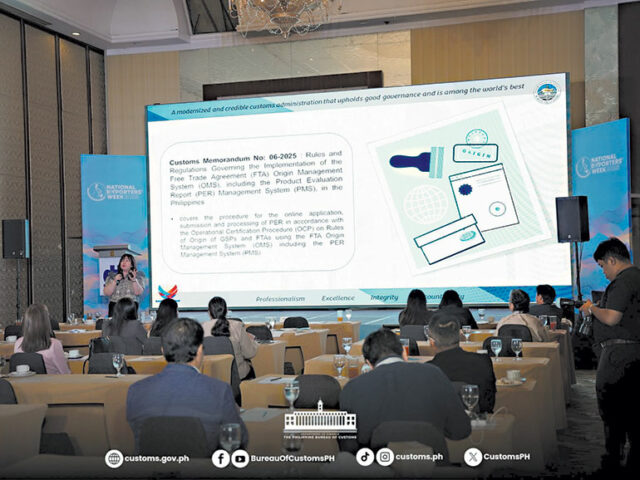
The BoC announced the full digital adoption of the Origin Management System (OMS) during the National Exporters’ Week last December 2025. — Photo from facebook.com/BureauOfCustomsPH

In an era increasingly defined by digital governance, the modernization of border control and customs administration has become a strategic imperative for national development.

The Bureau of Customs (BoC) has embarked on an extensive digital transformation program designed to enhance trade facilitation, increase operational efficiency, strengthen transparency, and reinforce border security.

Anchored on the Philippine Customs Modernization Program (PCMP) and aligned with international frameworks such as the World Trade Organization’s Trade Facilitation Agreement (TFA), the BoC’s digitalization agenda reflects a long-term commitment to building a modern, responsive, and globally competitive customs administration.

The BoC’s digitalization drive is firmly rooted in the implementation of the Customs Modernization and Tariff Act (CMTA), which mandates the adoption of information and communications technology (ICT) to simplify procedures, improve regulatory compliance, and promote efficiency in cross-border trade.

To operationalize this mandate, the agency launched the PCMP, supported by the World Bank Group. Central to this program is the development of a unified Customs Processing System (CPS), which consolidates multiple customs modules into a single digital platform, enabling end-to-end electronic processing of import, export, and transit transactions.

The CPS builds on the legacy of Electronic-to-Mobile (E2M) system, enhancing its functionality by integrating risk-based compliance management, advanced cargo targeting, and non-intrusive inspection services.

This integrated digital architecture enables the BoC to shift from labor-intensive manual processes to data-driven operation.

Over the past years, the BoC has rolled out a wide range of digital solutions that collectively form a comprehensive e-customs ecosystem.

By 2023, the agency had successfully digitalized 160 out of 166 custom processes, achieving a digitalization rate of approximately 96.39%. This remarkable feat contributed to the Philippines ranking second among ASEAN member states in the 2023 United Nations Global Survey on Digital and Sustainable Trade Facilitation, with a score of 87.10%.

Among the major systems introduced were the Liquidation and Billing System (LBS), Electronic Customs Baggage and Currencies Declaration (iDeclare) System, Raw Materials Liquidation System, National Customs Intelligence System (NCIS), and the integration of E2M system with the Electronic Tracking of Containerized Cargo (ETRACC).

In addition, the Payment Application Secure 6 (PAS6) system was deployed to enhance electronic payment processing, ensuring secure, real-time exchange of transaction data. Meanwhile, the ASEAN Customs Declaration Document (ACDD) system supports cross-border data exchange among ASEAN member states, facilitating faster verification of trade documents.

Advancing trade facilitation

In 2025, the BoC intensified its digital reform agenda through the deployment of advanced platforms designed to further streamline trade processes.

Notably, the upgraded Online Tax Estimator enables importers to forecast duties and taxes more accurately before submitting declarations, thereby reducing valuation disputes and compliance risks.

The launch of the Origin Management System (OMS) automated the issuance of Product Evaluation Reports for exports under free-trade agreements, significantly cutting processing time and enhancing export competitiveness.

To improve export documentation, the agency also proposed the integration of the Automated Export Declaration System (AEDS) across economic zones, expected to standardize export submissions, reduce human error, and enhance regulatory oversight.

Parallel upgrades included the full rollout of the electronic Certificate of Origin (e-CO) portal and the ASEAN Electronic Document Exchange, which strengthens cross-border paperless trade.

Strengthening transparency and integrity

Digitalization has also been leveraged as a strategic tool to combat corruption and enhance institutional integrity. By automating discretionary processes and minimizing direct contact between Customs officers and traders, the BoC reduces opportunities for rent-seeking behavior.

The near-complete digitalization of procedures ensures that transactions are traceable, auditable, and governed by standardized workflows.

Complementing technological upgrades, the BoC has institutionalized stakeholder engagement through the establishment of the Customs Industry Consultative and Advisory Council (CICAC). These platforms foster structured dialogue between Customs officials and the private sector, facilitating the identification and resolution of operational issues while reinforcing trust and accountability.

Enhancing regional and international cooperation

The BoC’s digitalization efforts extend beyond national borders, aligning with regional and global frameworks on paperless trade. Through its participation in ASEAN initiatives and cooperation with the United Nations Economic and Social Commission for Asia and the Pacific (ESCAP), the Philippines has committed to the Framework Agreement on the Facilitation of Cross-Border Paperless Trade.

The framework aims to promote interoperability among national single windows and facilitate the mutual recognition of electronic trade documents.

By adopting common data standards and digital protocols, the BoC enhances the Philippines’ integration into global value chains.

Operational efficiency and service delivery

Operational gains from digitalization are evident in faster cargo clearance times, improved risk profiling, and more effective border surveillance.

The integration of cargo electronic tracking systems enables real-time monitoring of containerized cargo, enhancing supply chain visibility and reducing the risk of diversion or smuggling.

Moreover, the rollout of the e-Travel System, a joint initiative with the Bureau of Immigration and other government agencies, allows passengers and crew members to submit baggage and currency declarations electronically prior to arrival or departure.

For traders, the expansion of the Authorized Economic Operator (AEO) and Super Green Lane (SGL) programs, supported by digital risk management tools, provides expedited processing and preferential treatment to compliant businesses. These trust-based facilitation mechanisms reward good governance while allowing Customs authorities to concentrate enforcement efforts on high-risk shipments.

Challenges and future directions

Despite substantial progress, the BoC’s digitalization journey still has its difficulties. Interoperability among legacy systems, cybersecurity risks, capacity-building requirements, and resistance to organizational change remain critical concerns.

Sustained investment in ICT infrastructure, human capital development, and regulatory harmonization will be essential to ensure the longevity of digital reforms.

The digital transformation of the BoC represents a landmark reform in Philippine public administration. Through sustained investment in technology, institutional restructuring, and international cooperation, the BoC has redefined the delivery of customs services, aligning national practices with global standards.

With over 96% of processes now digitalized, the agency stands as a regional leader in trade facilitation and digital governance.

As the Philippines continues to pursue inclusive economic growth and deeper integration into the global trading system, the BoC’s modernization agenda will remain a critical pillar of national competitiveness. — Krystal Anjela H. Gamboa

Korea-backed firm plans P64.3-B pumped storage project in Benguet

COHECOBA.COM

FILIPINO-KOREAN firm Coheco Badeo Corp. is planning to develop a 500-megawatt (MW) pumped storage hydropower project in Kibungan, Benguet.

The proposed Kibungan pumped storage facility is expected to provide additional power supply to the Luzon grid, according to its filing with the Department of Environment and Natural Resources (DENR).

The P64.3-billion project will span 36 hectares and will include upper and lower dams with a combined reservoir capacity of about 3.53 million cubic meters, as well as intake facilities, underground tunnels, an underground powerhouse, and access roads.

Located in Barangay Badeo near the Amburayan River, the facility is expected to store large amounts of energy and respond quickly to fluctuations in power supply and demand.

“With the growing concern on the environment, it has been proven that mini and small hydropower have the least adverse effect on the environment thereby making it the most socially acceptable energy source,” Coheco said.

The company secured a service contract from the Department of Energy in 2016, but the project experienced delays in regulatory proceedings, which it attributed to the COVID-19 pandemic and other challenges.

Based on its project schedule, construction will start once an environmental compliance certificate has been issued, with completion targeted by 2031.

The pumped storage project was among the winning bids in last year’s Green Energy Auction, where more than 6,600 MW of capacity was awarded.

The proposed project is scheduled for public scoping on Feb. 26. The activity is an early stage of the environmental impact assessment process, during which the project proponent will present an overview of the development and gather issues and concerns from stakeholders. — Sheldeen Joy Talavera

Amazon plans to use AI to speed up TV and film production

THE STUDIO points to its hit series, House of David, as an example of how AI could be used in the future. For the second season, the director used AI combined with live-action footage to create battle scenes, seamlessly editing the two together to expand the scope of sequences at lower cost.

LOS ANGELES — Amazon plans to use artificial intelligence (AI) to speed up the process for making movies and TV shows even as Hollywood fears that AI will cut jobs and permanently reshape the industry.

At the Amazon MGM Studio, veteran entertainment executive Albert Cheng is leading a team charged with developing new AI tools that he said will cut costs and streamline the creative process. Amazon plans to launch a closed beta program in March, inviting industry partners to test its AI tools. The company expects to have results to share by May.

Mr. Cheng described AI Studio as a “startup” operating under Amazon founder Jeff Bezos’ “two pizza team” philosophy — keeping the group small enough to be fed by two pizzas. The team consists primarily of product engineers and scientists, with a smaller creative and business contingent.

Amazon is publicly embracing AI in response to spiraling production budgets that limit the number of shows and films companies can finance. The technology will fast-track certain processes to make more movies and TV shows more efficiently.

“The cost of creating is so high that it really is hard to make more and it really is hard to take great risk,” Mr. Cheng said in an interview. “We fundamentally believe that AI can accelerate, but it won’t replace, the innovation and the unique aspects that (humans) bring to create the work.”

The move to adopt artificial intelligence comes as A-list actors like Emily Blunt have expressed fears about the rise of AI — and particularly AI actress Tilly Norwood would make their jobs obsolete.

Amazon emphasized that writers, directors, actors, and character designers will be involved at every stage of production, using AI as a tool to enhance creativity.

Like many other tech companies, Amazon is also pushing nearly every division to find uses for AI and pointed to the successes of the technology as among the reasons it cut about 30,000 corporate jobs since October, its largest layoff ever. That included a number of job cuts at Prime Video.

Mr. Cheng said AI could help Prime Video overcome some of the inherent challenges of large scale film and television production.

The AI Studio is building tools that bridge what Mr. Cheng described as “the last mile” — perhaps a cheeky reference to Amazon’s delivery operation — between existing consumer AI offerings and the granular control directors need for cinematic content. That includes improving character consistency across shots, and integrating with industry-standard creative tools.

Amazon is leaning on its cloud computing division, Amazon Web Services, for help and plans to work with multiple large language model providers to give creators a wider array of options for pre- and post-production filmmaking. Mr. Cheng said protecting intellectual property and ensuring AI-created content won’t be absorbed into other AI models are essential to making the AI Studio work.

The AI Studio is working with producers Robert Stromberg (Maleficent) and his company Secret City, Kunal Nayyar (The Big Bang Theory) and his company Good Karma Productions; and former Pixar and ILM animator Colin Brady, as it explores new tools and how best to implement them.

The Studio, which launched last August, points to its hit series, House of David, as an example of how AI could be used in the future.

For the second season of the biblical epic, director Jon Erwin used AI combined with live-action footage to create battle scenes, seamlessly editing the two together to expand the scope of sequences at lower cost. — Reuters

RCR posts 35% revenue growth on mall asset infusions

Robinsons Magnolia — ROBINSONSLAND.COM

RL COMMERCIAL REIT, Inc. (RCR), the real estate investment trust of Robinsons Land Corp. (RLC), reported a 35% increase in unaudited revenues for 2025, reaching P11.08 billion, driven by asset infusions from its sponsor.

Occupancy rates remained steady at 96% last year, RCR said in a statement to the Philippine Stock Exchange (PSE) on Thursday.

In the fourth quarter alone, unaudited revenues — excluding changes in the fair market value of investment properties — jumped 49% year on year, while quarter-on-quarter revenues rose 12% to P358 million, boosted by the acquisition of nine retail assets from RLC.

The August 2025 property-for-share swap added nine malls to RCR’s portfolio: Robinsons Dasmariñas (Cavite), Robinsons Starmills (Pampanga), Robinsons General Trias (Cavite), Robinsons Cybergate (Cebu), Robinsons Tacloban (Leyte), Robinsons Malolos (Bulacan), Robinsons Santiago (Isabela), Robinsons Magnolia (Quezon City), and Robinsons Tuguegarao (Cagayan).

In 2024, RLC also injected P33.9 billion worth of assets into RCR through a property-for-share swap deal that consist of 11 malls and two office buildings. The malls are located in Novaliches, Cainta, Luisita, Cabanatuan, Lipa, Sta. Rosa, Imus, Los Baños, Palawan, and Ormoc.

“RCR continues to benefit from the upside of mall rental income from the 2024 asset infusion (two offices and eleven malls), together with the 2025 infusion (nine malls),” RCR President and Chief Executive Officer Jericho P. Go said.

The REIT reported unaudited total assets of P167.76 billion and shareholders’ equity of P162.19 billion, remaining debt-free. It was recently included in the PSE index, highlighting its liquidity and capitalization.

RCR ended 2025 with 38 assets, comprising 21 malls and 17 offices, and noted that RLC has a strong pipeline of potential future infusions, including over 1.1 million square meters (sq.m.) of mall gross leasable area (GLA), about 250,000 sq.m. of office GLA, nearly 300,000 sq.m. of logistics space, and around 4,000 hotel rooms.

The REIT is also open to acquiring third-party assets for long-term growth.

Its board has approved a fourth-quarter cash dividend of P0.1112 per share.

For the full year, RCR declared P7.54 billion in dividends, equivalent to over 90% of its unaudited distributable income, payable on March 2 to shareholders of record as of Feb. 20.

RCR’s market capitalization stood at P156.78 billion as of Dec. 31, 2025.

RCR shares rose 0.4% or three centavos to close at P7.53 apiece on Thursday. — Beatriz Marie D. Cruz

Tightening the gates against smuggling

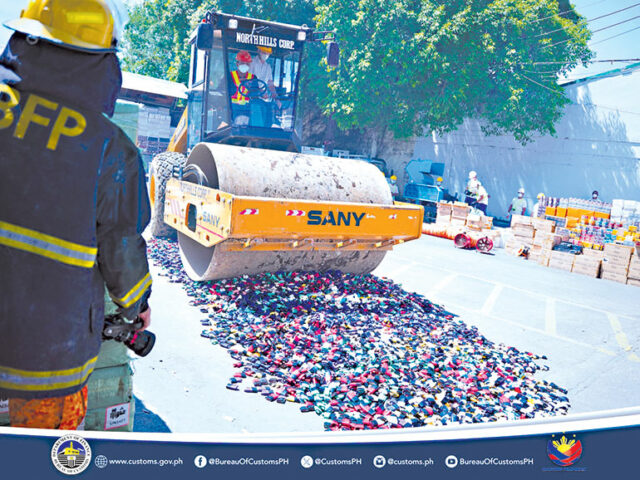
In April 2025, at the BoC’s main office in South Harbor, Manila, 2,977,925 pieces of seized smuggled electronic cigarettes, vape parts, and accessories, valued at P3.26 billion, were publicly condemned. — Photos from facebook.com/BureauOfCustomsPH

Annually, billions of pesos worth of goods and produce pass through the thousands of ports in the Philippines, making up the country’s trade industry that fuels local markets and sustains livelihoods for millions of Filipinos. Yet, alongside the legitimate flow runs a shadow economy of sorts run by smugglers. Hidden in mislabeled containers, routed through informal landing sites, slipped past inspections with forged documents, or allowed through by paid officials, illicit goods quietly enter the country every day.

The government entity tasked with preventing these mishaps and stopping these illegal activities is the Bureau of Customs (BoC). The BoC is tasked with enhancing trade facilitation, strengthening border control, and improving the collection of lawful revenues. While the agency has made strides in enhancing the country’s trade and collecting lawful revenues, the BoC has also significantly strengthened its crusade against smuggling in recent years.

First on the long list of initiatives of the BoC to combat the crime is a sweeping reform agenda being implemented in coordination with the American Chamber of Commerce as well as the US Embassy. The reform comes after the agency was listed as one of the most corrupt offices in the country as per the United States Department of State. The said reform was aimed at curbing corruption issues.

In September, the BoC intercepted two 40-foot container shipments at the Manila International Container Port found to contain misdeclared frozen chicken breasts and fish balls from China.

Another improvement is the bureau’s efforts to further accelerate digitalization in the agency to thwart smuggling. In an interview last year, BoC Commissioner Ariel F. Nepomuceno revealed a Public-Private Partnership (PPP) initiative eyed to modernize how imports and transactions are taxed. Under the proposal, importers would be charged a flat fee of P350 per transaction, regardless of whether it covers a single container van or multiple units. The program is expected to be rolled out within the next one to one-and-a-half years.

Aside from modernization and reform initiatives, the BoC has also signed various partnerships with private organizations and other government agencies to strengthen its campaign against smuggling.

In October last year, the agency signed a Memorandum of Agreement (MoA) with the Land Transportation Office (LTO) seeking to establish a more efficient system connecting vehicle importation and registration. As vehicles are some of the most valuable goods smuggled into the country, the MoA highlights the shared commitment of both agencies to ensure the timely and accurate exchange of data, streamline the tracking of imported motor vehicles, and curb illegal or fraudulent transactions.

In addition, the Philippine National Police and the BoC worked together last year for a series of successful police-initiated operations that led to the confiscation of billions of pesos worth of smuggled cigarettes and other goods.

Partnerships with private organizations have proven beneficial for the agency as well. Earlier this year, the BoC and the Philippine Iron and Steel Institute (PISI) agreed to establish a technical working group tasked with creating a centralized database to track steel imports, improve commodity classification, and support standardized customs valuation anchored on historical data. The partnership also covers initiatives on digitalization, automation, and data-driven governance, including enhanced stakeholder accreditation through the use of artificial intelligence and data analytics.

Similarly, the Federation of Filipino-Chinese Chambers of Commerce and Industry, Inc. (FCCCII) voiced its backing of the Bureau of Customs as it moves to implement broad and stringent governance reforms aimed at preventing corruption both within the agency and in its external dealings.

“In light of the recent issues affecting the Philippine government, it is good that there are leaders such as Commissioner Nepomuceno, who uphold integrity in good governance and create a very competitive and business-friendly environment for businesspeople such as the FFCCCII,” FFCCCII President Victor Lim was quoted as saying.

These improvements in modernization, reform, and partnerships are directly reflected in the agency’s performance to start 2026. Recent developments show that the bureau exceeded its January revenue target while sustaining aggressive nationwide operations against large-scale and high-value smuggling activities.

Last month alone, the BoC collected P80.744 billion, surpassing its revenue target by P513 million and posting a 100.6% collection efficiency. The figure also reflects a P1.49-billion increase, or 1.9% growth, compared to the P79.254 billion collected in January 2025.

Along with robust revenue performance, the BoC scaled its enforcement efforts across the country. In January alone, the agency carried out 66 successful operations, leading to the confiscation of smuggled and prohibited goods estimated at around P886.8 million. Among the most significant captures were illegal drugs valued at more than P309 million, including P114.566 million worth of narcotics hidden in shipments falsely declared as malachite stones. Authorities also seized illicit cigarettes and tobacco products worth roughly P209 million, highlighted by the discovery of an illegal cigarette manufacturing facility in Pampanga during a raid last Jan. 28.

These gains in policy, technology, and interagency cooperation have also translated into tangible results on the ground, most evident in a series of seizures that show the BoC’s efforts.

In the first week of January, Customs authorities seized smuggled cigarettes worth more than P105 million in Bataan and shut down an alleged illegal cigarette manufacturing facility in Mexico, Pampanga in line with President Ferdinand R. Marcos, Jr.’s directive to dismantle illicit trade networks and protect government revenues.

Back in August, the BoC, through its Intellectual Property Rights Division, has seized counterfeit wearing apparel valued at an estimated P428 million at the Port of Manila.

At the same time, Mr. Nepomuceno ordered an investigation into alleged smuggling activities at the Port of Manila, temporarily relieving a Customs Intelligence and Investigation Service field station chief to reinforce internal accountability.

These efforts were further underscored by the seizure of P428 million worth of suspected counterfeit clothing in Tondo, Manila, involving a shipment of 1,287 boxes of counterfeit apparel that arrived in the country in August 2025, reflecting the bureau’s continued focus on both border enforcement and institutional integrity.

Overall, recent reforms, partnerships, and sustained enforcement show the BoC making measurable progress in curbing smuggling while protecting revenues, trade integrity, and public trust. — Jomarc Angelo M. Corpuz

To mourn or not to mourn

A STILL from Hamnet.

Movie Review
Hamnet
Directed by Chloé Zhao

CHLOÉ ZHAO’S latest film — adapted by Zhao and Maggie O’Farrell from O’Farrell’s well-regarded 2020 novel — is a tearjerker, most people will agree. The question one might ask is: does it earn its tears, or are we overindulging?

Right off I start by saying I haven’t read O’Farrell’s book so I can’t approach the material that way — I can only go off on what’s visible on the big screen.

The film starts impressively enough Zhao’s camera looking up into the sky or down a hole, both sky and ground crowded by giant beech, their roots furry with moss. We see a hawk swoop down to the glove of one Agnes Hathaway (Jessie Buckley), catching along its glide path the eye of a young man (Paul Mescal).

Attraction, connection, commitment: Agnes marries the man, is disowned by her family, is forced to move in with her newfound husband. Gives birth to a daughter, Susana (Bodhi Rae Breathnach). And at about this point more or less one notices an oddity: we hear the man referred to as “tutor,” “husband,” “son,” “father” but not by name, the reason for this being simple: this isn’t the man’s story.

Zhao’s film — and O’Farrell’s novel presumably — is a member of that subgenre of metafiction, where a well-known tale is retold not through the eyes of the protagonist but of a supporting character’s, in this case Agnes. Tom Stoppard did this as early as Rosencrantz and Guildenstern are Dead, (about the eponymous pair and their adventures with a certain Danish prince) back in 1966; Gerardo de Leon pulled it off (with the help of Teodorico Santos) 15 years earlier than Stoppard with Sisa (the story of Noli Me Tangere through the eyes of its most memorable minor character). Sidenote: 32 years later Stoppard wrote a version of Romeo and Juliet where the author immortalizes his true love in a play; Mario O’Hara that same year remade Sisa with its equally real-life writer-hero immortalizing his true love in a novel. Might strictly be me but Stoppard seems to write fanfic in eerie parallel with Filipino filmmakers, was even at one point anticipated by a decade and a half.

I’m being silly of course. Stoppard retells a well-known play through the eyes of one of its minor characters; O’Farrell retells a well-known life through the eyes of the man’s wife. Stoppard is working with an established text (The Tragedy of Hamlet: Prince of Denmark), O’Farrell is filling in the gaps in a biography with guesswork and imagination.

Another noted difference: Stoppard’s play (I saw the 1990 adaptation directed by the author) is often funny, full of absurdist Beckettian humor (as befits two characters with little else to do); Hamnet offers few laughs, if any, and the dearth can be overwhelming. This is heavy drama, and gets heavier as it unfolds.

Paul Mescal has been dinged for being too pretty and I see the critics’ point: if O’Farrell’s purpose is to tell the story of Agnes and not of Agnes’ husband, or at least only enough of Agnes’ husband to establish that he’s emotionally distant or becomes emotionally distant when tragedy strikes, it doesn’t help to have an actor with melting Spaniel eyes, with a gaze so soulful he keeps you worshipping even when he’s a self-centered jerk. The smarter money would have been to cast someone less immediately eye-catching — this generation’s equivalent of Gary Oldman or Tim Roth (I don’t know that many young uns), able to alienate us then (if they or the filmmaker so chooses) eventually win our affections the hard way. A Humphrey Bogart, if you like, of contemporary indie cinema.

Critics also ding Jessie Buckley for being one-note and I say: phooey. The actor knows a good thing when she sees it and as far as she’s concerned, she’s going all the way, from playful coyness to hard births to desperate resuscitation attempts to primal screams loud enough to raise the dead. And it isn’t all acting with a capital “A”: Towards film’s end, when she finally attends a performance of her husband’s long-awaited handiwork, her expressions and mutterings — consistent with her tendency to mutter incantations during moments of stress or when she needs to focus — help us to a better understanding of what her husband hath wrought onstage.

O’Farrell notes that she based much of her novel’s emotions on her feelings when her child was sick — in this case of meningitis, a terrifying disease — and of her own experiences as a child suffering from encephalitis. If she presumably invests so much feeling in her novel, can Zhao do no less? Should Zhao hold back, make the scenes of sickness and suffering tasteful, maybe even artful? More phooey; any parent — me included — knows exactly what Agnes and through her O’Farrell are going through, and any husband or father will be just as dumbfounded when they realize that whatever terror or sadness or despair they’ve experienced is nothing, a mere foothill, to the volcanic upheavals a wife and mother will have undergone. 

I already admitted to having failed to read O’Farrell’s book (I am currently committed to a really long read, likely take years to finish), and will admit to being a sorry nonexpert on Elizabethan drama (I’ve seen film adaptations if that helps). If more knowledgeable heads can hang the label “grief porn” on this film then so be it — but it’s well-made porn, I submit, nevertheless, and I’ll admit to having given in to its spell more than a few times. 

Megaworld to develop 18-ha beachside village in Nasugbu

MEGAWORLDGLOBAL-ESTATESOUTH.COM

LISTED property developer Megaworld Corp. is developing a beachside residential village along the coast of Nasugbu, Batangas, which is expected to generate P7 billion in sales by 2032.

The 18-hectare (ha) project, called Villa Scala, will rise within the 116-hectare Nascala Coast and will feature 217 prime residential lots, the company said in a disclosure to the stock exchange on Thursday.

Villa Scala will be developed by Megaworld subsidiary Global-Estate Resorts, Inc. (GERI), which specializes in master-planned tourism and leisure townships.

Lot sizes will range from 407 square meters (sq.m.) to 1,081 sq.m. The village is scheduled for completion by 2032.

Inspired by Italy’s Amalfi Coast, the development will offer views of Nasugbu Bay, the West Philippine Sea, and nearby mountain ranges.

Future residents will also have access to nearby leisure facilities for activities such as yachting and sailing, Megaworld said.

The village will feature its own Villa Scala Clubhouse, designed with Positano-style, cliffside Mediterranean architecture that reflects Southern Italian coastal living.

The clubhouse will have floor-to-ceiling glass walls that allow natural light to enter, while its infinity pool will offer seaside views. Other amenities include function rooms, a fitness center, and an open courtyard.

About 40% of the village will be allocated to open spaces, with 15-meter-wide roads and an underground cabling system for electrical and telecommunications utilities.

The village will be complemented by commercial hubs, leisure destinations, expansive commercial lots, mixed-use centers, and town centers within Nascala Coast.

Nasugbu, located about 112 kilometers south of Metro Manila, is home to several luxury resorts and private beaches.

“With this village, we envision to continue developing Nascala Coast into a thriving coastal address where generations of families can flourish,” Megaworld Global-Estate, Inc. First Vice-President Rachelle P. Hernandez said.

Villa Scala is about a 2.5-hour drive from Metro Manila and an hour from Tagaytay City.

It is accessible from Bonifacio Global City and the Makati central business district via major roads such as the South Luzon Expressway (SLEX), Manila-Cavite Expressway (CAVITEX), the Ternate-Nasugbu Highway, and the upcoming Cavite-Batangas Expressway (CBEX).

Megaworld is ramping up its provincial expansion this year with a P65-billion capital expenditure budget, 30% higher than the P50 billion allocated last year.

The company reported a 14% increase in earnings in the first nine months of 2025.

Megaworld shares rose by 0.45% or one centavo to close at P2.24 apiece on Thursday. — Beatriz Marie D. Cruz

EastWest Bank expects sustained asset growth

EASTWESTBANKER.COM

EAST WEST BANKING Corp. (EastWest Bank) expects sustained asset growth this year, still driven by its consumer business.

“We’ve looked at it, maybe [assets could grow by] low to mid-teens. Again, keep it steady. We’ve been doing that for the last three years, so no change in strategy. It’s really how you sustain that growth over time that really matters,” EastWest Bank Chief Executive Officer Jerry G. Ngo told reporters late on Wednesday.

He said their consumer business will be the main asset growth driver as it still accounts for a majority of its loan portfolio.

“Most of our assets are consumer lending. So, that’s what we’re looking at. Maybe, again, for the past three years, it’s been low to mid-teens. And that is sustainable over a period of time.”

The bank is looking to further expand its auto and home loan portfolios, Mr. Ngo said, adding that about 25% of EastWest Bank’s loan book is made up of auto loans, while credit cards comprise a bigger portion. Salary loans also take up about a quarter of its portfolio.

Their loan-to-deposit ratio is at the 70%-80% range, he added.

Steady expansion in assets, loans, and deposits, which are all growing at about the same pace, keeps the bank liquid, giving them the flexibility to be opportunistic in tapping the bond market, Mr. Ngo said.

“We’re actively looking. We’re actively waiting for the right time. But there’s no impetus. Our liquidity is strong and sufficient. But the pricing is good right now, so we’re also waiting for the right time.”

He added that the Bangko Sentral ng Pilipinas’ ongoing easing cycle and potential cuts to banks’ reserve requirement ratios could also boost their liquidity further.

While EastWest Bank could consider issuing bonds if there is enough investor demand, corporate activity in the capital markets has been increasing, he said. “We’re waiting for a clear market.”

In 2023, the bank approved a P30-billion bond program, with issuances expected over a five-year period. No drawdown has been made so far.

EastWest Bank last tapped the domestic market in February 2020, raising P3.7 billion from an issuance of three-year fixed-rate bonds.

Meanwhile, the bank will also continue to invest in improving its artificial intelligence capabilities, Mr. Ngo added, which they expect to help in managing their operating costs over time.

“We’re studying that specifically. But I think the most important improvements are how do we leverage on those capabilities to make our relationship managers more effective? How do we augment capabilities? How do you make advice better?” he said.

“That’s something that we want to focus on going forward, is to see how we could take that across relationship managers. It will still be people to people, but people augmented with artificial intelligence.”

EastWest Bank’s attributable net income rose by 6.25% year on year to P2.48 billion in the third quarter of 2025, driven by its consumer book. This brought its nine-month profit to P6.62 billion, up by 13.81% from the same period in 2024.

Its shares went down by 10 centavos or 0.8% to end at P12.46 apiece on Thursday. — Aaron Michael C. Sy

Harry Potter villain emerges as unlikely Lunar New Year symbol

TOM FELTON in Harry Potter and the Chamber of Secrets (2002).

HONG KONG — Draco Malfoy, the villainous student who was Harry Potter’s rival in the fantasy book series, has become an unlikely Chinese Lunar New Year mascot, with his face plastered across red festive decor and merchandise from posters to phone covers.

Malfoy, played by actor Tom Felton in the films of J.K. Rowling’s books, has surged in popularity due to the Chinese translation of his surname — Ma-er-fu. Meaning horse and fortune, it bodes well for China’s lunar year of the Horse.

Social media has been flooded with images of people sticking red Malfoy posters on their doors. Fans can buy four of them for 11 yuan ($1.60) on e-commerce platform Taobao.

“Year of the Horse’s blessing, so stick on a Malfoy,” said one user on China’s Rednote.

Other posts on the social media platform appeared to show a massive image of Malfoy in his uniform hanging across several floors of a shopping mall in central Henan province.

The Harry Potter franchise is incredibly popular in China, where foreign films make up a relatively small percentage of the box office due to strict quotas and a shift to local content.

Warner Bros. has agreed to develop a Harry Potter Studio Tour in Shanghai with Chinese group Jinjiang International, Jinjiang said last year.

A Universal Studios theme park in Beijing features The Wizarding World of Harry Potter, a section dedicated to Harry Potter-themed rides and attractions.

The eight Harry Potter films were re-released in Chinese cinemas in 2024. — Reuters

SM Prime unit completes 8.3-ha Provence village in Batangas

TAGAYTAYHIGHLANDS.COM

SY-LED SM Prime Holdings, Inc., through its leisure residential arm Highlands Prime, Inc., has finished its 8.3-hectare (ha) French-themed residential development, Provence, in Talisay, Batangas.

The development features 119 residential lots sized between 240 square meters (sq.m.) and 451 sq.m., with about 14 lots per hectare. It is located within Tagaytay Midlands along Lakeside Fairways Drive in Talisay.

Provence takes inspiration from French countryside living, rising on an elevated site with views of Taal Lake. Amenities include an infinity pool, multipurpose pavilion, tree-lined roads, and independent infrastructure to ensure stable water and power supply.

“To capture the tranquil beauty of the French countryside, generous open spaces and landscaping are woven throughout this 8.3-hectare development, a vision that clearly resonated with discerning buyers as reflected in the substantial number of lots already sold,” Highland Prime Senior Vice-President Mary Eleanor Mendoza said.

She added that the property’s cool climate, nature-oriented spaces, and leisure amenities complement the exclusivity associated with Tagaytay Highlands.

“Provence also offers a refined residential setting that complements Tagaytay Highlands’ signature brand of luxury mountain living,” Ms. Mendoza said.

The development is accessible from Metro Manila via the South Luzon Expressway (SLEX), Cavite-Laguna Expressway (CALAX), and Manila-Cavite Expressway (CAVITEX).

The project reflects SM Prime’s ongoing expansion into the premium, lot-only residential segment as an alternative to its urban high-rise projects, amid an oversupply of mid-income condominiums in Metro Manila.

In the first nine months of 2025, SM Prime’s net income rose 10% to P37.2 billion, with the residential segment contributing P32.6 billion in profit.

On Thursday, SM Prime shares gained 0.24% or five centavos to close at P21.30 apiece. — Beatriz Marie D. Cruz

Impeachment complaints: Not exactly bad timing

STOCK PHOTO | Image by Fabrikasimf from Freepik

At first glance, the impeachment complaints filed against President Ferdinand Marcos, Jr. and Vice-President Sara Duterte appear ill-timed. With 2025 growth sharply undershooting expectations and 2026 prospects softening, politically explosive moves risk amplifying uncertainty. That concern is understandable but ultimately misplaced.

What defines the growth moment is not just the magnitude of the slowdown in 2025, but the nature of the forces driving it. In fact, the slowdown and its causes reinforce each other. Ignoring one in favor of the other misses the point.

The growth deceleration is stark: the weakest since the pandemic, occurring precisely when faster growth is needed to absorb labor slack. Unemployment and underemployment are rising, job quality has deteriorated, and pandemic scarring has yet to be fully reversed. This alone would be troubling. But the anatomy of the slowdown makes it more so.

Household consumption, the backbone of the economy, has weakened. Although inflation eased in 2025, this largely reflects disinflation from elevated levels. Absolute prices of food, transport, and utilities remain high, continuing to erode real incomes. Combined with a soft labor market, this has inevitably dampened private consumption, which accounts for over 70% of GDP.

More alarming is the collapse in investment momentum. Gross domestic capital formation declined outright, a rare and serious signal of weakening confidence. Foreign direct investment fell sharply by 40% year on year in October 2025, underscoring investor unease. This matters not simply because investment comprises more than one-fifth of GDP, but because it anchors productivity growth, labor absorption, and future capacity. Weak investment today locks in weaker growth tomorrow.

External trade has offered some relief, but its contribution is neither strong nor secure. Export growth has benefited from higher global demand for electronics, machinery, transport equipment, and selected agro-based products. Yet part of this rebound reflects front-loading ahead of anticipated US tariff increases, as well as temporary tariff exemptions and trade facilitation measures. Imports moderated, but this is not an unambiguous positive. Philippine exports are structurally import-dependent; slower import growth now may constrain export performance ahead. Net exports, moreover, remain a drag on real output.

At the center of these dynamics lies a deeper issue: confidence — not in policy intent, but in policy execution.

The Philippines is not short of growth strategies or reform blueprints. What is binding is the failure to implement them cleanly, predictably, and at scale. The investigation into flood control anomalies and the creation of an independent infrastructure commission have coincided with a freeze in public works execution. Public consumption provided only marginal support, driven mainly by government employment and operating expenditures, not by productivity-enhancing investment.

This context frames two familiar but incomplete interpretations of the country’s growth problem.

One emphasizes structural weaknesses: deindustrialization, weak tradables, persistent external imbalances, high real interest rates, and a fragile, services-heavy growth model. Policy incoherence and limited state capacity, in this view, explain why growth has been neither durable nor inclusive.

This diagnosis is largely correct but insufficient. By treating policy failure as technocratic error, it abstracts from politics. In reality, these failures are not neutral. Deindustrialization reflects regulatory capture, selective protection of entrenched interests, chronic budget misallocation, and uneven enforcement of competition policy. Agricultural stagnation stems from rent-seeking in import controls, politicized price interventions, and corruption in subsidy and incentive systems. These distortions persist because they are politically rewarded.

Policy errors matter but so does explaining why reform remains elusive here while it has succeeded elsewhere.

The other critique argues that focusing on corruption is analytically convenient, allowing reformists to avoid harder questions about power, oligarchy, and foreign dominance.

We reject the notion that corruption is secondary. In the Philippine context, corruption and weak governance are the binding constraints that prevent even democratic-developmental reforms from being seriously considered, much less implemented. Industrial policy has failed not because it is absent, but because subsidies are captured, protection becomes permanent, and project selection is politicized. East Asian comparators were not governance-pure, but they possessed enforcement capacity. In Korea and Taiwan, senior politicians and industrialists went to jail. That distinction is decisive.

Democratic institutions, as currently structured, often transmit clientelism rather than discipline. Governance alone does not guarantee development, but bad governance can decisively block it.

This brings us to the question of whether the current slowdown reflects a temporary confidence shock or the onset of structurally lower growth. The answer is both. Confidence has been damaged by persistent governance failures, as reflected in business surveys and investor behavior. At the same time, chronic underinvestment in infrastructure, education, health, and state capacity leaves the economy structurally ill-prepared for accelerated, inclusive growth.

It is against this backdrop that the impeachment complaints should be assessed.

The House Committee on Justice found the impeachment complaints against the President sufficient in form but lacking in substance. While some dismiss the process as a numbers game, the allegations — corruption and graft, abuse of authority, constitutional violations, and betrayal of public trust — were serious. Had they proceeded, a Senate trial could have provided a formal venue for accountability and clarification. That said, prolonged proceedings against a sitting president carry risks: legislative paralysis, political grandstanding, and further erosion of confidence. Speed and procedural discipline would have been essential.

The impeachment complaints against the Vice-President are more expansive. They allege misuse of confidential funds, failure to submit to budget oversight, corruption, threats against public officials, unexplained wealth, and other high crimes. As Senator JV Ejercito noted, dual impeachment proceedings at the top of government can signal instability. Political uncertainty can weigh on markets, foreign investment, and the currency. Even without removal, impeachment may be perceived as regime risk.

Yet it is analytically wrong to assume that impeachment necessarily worsens uncertainty. When handled transparently and decisively, it can demonstrate that accountability mechanisms are real, that due process applies even at the highest levels. Markets are often less forgiving when institutions appear unwilling or unable to enforce rules consistently.

In that sense, the timing is not exactly bad. What would be worse for growth, confidence, and democratic legitimacy is the perception that accountability exists only on paper, and that governance failures are tolerated when they reach the top.

If accountability mechanisms weaken or stall, whether through premature dismissal, procedural delay, or political accommodation, the risk is not simply reputational. The economic consequences would be tangible and compounding.

For instance, when credible allegations at the highest levels are neither decisively prosecuted nor convincingly dismissed, risk premiums rise not abruptly, but persistently. Capital does not flee in panic; it reallocates quietly. The result is not crisis, but stagnation: fewer long-term projects, shorter planning horizons, and a bias toward low-commitment, low-productivity activities.

Public investment efficiency also deteriorates. If the current investigations do not yield accountability at high levels or culminate in clear institutional correction, bureaucratic paralysis becomes rational behavior. Delays, under-execution, and cost overruns become entrenched, further weakening growth.

Fiscal space erodes without drama. Weak growth and inefficient spending reduce revenue buoyancy while raising social demands, leaving less room to respond when the next external shock arrives.

Labor market damage hardens. Weak investment constrains job creation and locks the economy into low-productivity services, making recovery increasingly difficult.

Even democratic credibility carries economic consequences. When enforcement appears selective, trust erodes. Households become cautious, firms defer risk, and savings rise defensively — outcomes that matter in an economy where domestic demand is the primary growth engine.

Seen in this light, impeachment is not the shock. Ambiguity is.

This by no means suggests impeachment is costless. Poorly handled, it can deepen polarization, distract Congress and the Palace, and unsettle markets. But the greater risk lies in signaling that the political system is incapable of confronting credible allegations at the top — either by clearing them decisively or by enforcing accountability.

The choice, then, is not between stability and accountability. It is between managed accountability and unmanaged decline.

Handled swiftly, transparently, and within constitutional bounds, impeachment can function as a credibility reset, demonstrating that governance risks are not merely discussed, but addressed. In an economy already constrained by weak execution and fragile confidence, that signal may matter more than short-term political calm.

In that sense, the timing is not merely acceptable. It may be decisive.


Diwa C. Guinigundo is the former deputy governor for the Monetary and Economics Sector, the Bangko Sentral ng Pilipinas (BSP). He served the BSP for 41 years. In 2001-2003, he was alternate executive director at the International Monetary Fund in Washington, DC. He is the senior pastor of the Fullness of Christ International Ministries in Mandaluyong.