Home Blog Page 3121

DoubleDragon to issue up to P10-B retail bonds 

BW FILE PHOTO

THE BOARD of property developer DoubleDragon Corp. has approved a planned retail bond issuance of up to P10 billion as part of the company’s fundraising initiatives. 

The proposed bond offering was approved by the company’s board on June 7, DoubleDragon said in a statement to the stock exchange on Monday.

DoubleDragon said the planned retail bond issuance has secured a “PRS Aaa” credit rating from the Philippine Rating Services Corp. (PhilRatings).

The rating is the highest rating awarded by PhilRatings, which are given to  obligations that are “of the highest quality with minimal credit risk and the issuing company’s capacity to meet its financial commitment on the obligations is extremely strong.”

DoubleDragon said its total equity is set to breach P100 billion for the first time in 2024.

It added that the upcoming listing of its hotel subsidiary Hotel 101 Global Pte. Ltd. on the NASDAQ Stock Exchange in the United States will “further strengthen” the company’s balance sheet. 

Hotel101 will list on the NASDAQ via a merger with a special purpose acquisition company JVSPAC Acquisition Corp. The merger brought Hotel101’s equity value to over $2.3 billion.

The combined entity will be listed on the NASDAQ under the ticker symbol “HBNB.”

“DoubleDragon’s string of titled investment properties strategically planted in prime locations spread out in Luzon, Visayas, Mindanao, and Overseas serves as its strong underlying solid foundation,” the company said. 

Hotel101 is targeting to have one million rooms across over 100 countries.

It seeks to have presence in 25 countries by 2026. These include Philippines, Japan, Spain, United States, United Kingdom, the United Arab Emirates, India, China, Thailand, Malaysia, Vietnam, Indonesia, Singapore, Cambodia, Bangladesh, Mexico, South Korea, Australia, Canada, Switzerland, Turkey, Italy, Germany, France, and Saudi Arabia.

The hotel operator recently started development on a 680-room hotel in Madrid, Spain. It is also building a 482-room hotel in Hokkaido, Japan.

For 2023, DoubleDragon saw a 23.3% increase in its net income to P15.93 billion as revenue improved by 75% to P24.74 billion.

DoubleDragon shares fell by 4.01% or 50 centavos to P11.98 apiece on Monday. — Revin Mikhael D. Ochave

Mitsukoshi eyes increased Japanese brand presence in PHL

By Arjay L. Balinbin, Corporate Editor

JAPAN-BASED department store chain Mitsukoshi is gearing up to introduce more Japanese brands and local partnerships at its Philippine branch Mitsukoshi BGC, a company official said.

“What we are trying to do in Mitsukoshi BGC is to become a place where you can find and experience a bit of Japan, and where also new value is created through a combination of Filipino culture and Japanese culture,” Momoko Umemura, manager at Isetan Mitsukoshi Holdings Ltd.’s corporate real estate department, said in a media briefing in Tokyo on May 29. 

“Mitsukoshi BGC is becoming one of the starting points for Japanese companies to start their business in the Philippines,” she added.

Set to delight Filipinos is the Japanese treat anmitsu, a classic chilled dessert featuring white, semi-translucent jelly. This delicacy will be available for P450.

Mitsukoshi BGC is also expanding its selection of Japanese rice wines. Among the new offerings are the Kakurei Junmai Ginjo, priced at P1,980, and the Gangi Junmai Dai Ginjo Yunagi, which will be available for P2,980.

“It’s not only about Japanese companies. We’re trying to co-create new value and synergy. One good example is the collaboration between Mitsukoshi Fresh and Auro Chocolate,” Ms. Umemura said. Auro Chocolate is a premium bean-to-bar chocolate brand in the Philippines.

She added that the company is also looking to partner with more local suppliers.

Mitsukoshi BGC, the first Japanese mall in the Philippines established in Bonifacio Global City (BGC), Taguig, in 2022, recently introduced 15 new brands, bringing the total number of purely Japanese brands to 38.

Japanese furniture retailer Nitori also recently opened its store in Mitsukoshi BGC.

The origins of Mitsukoshi trace back to 1673, during Japan’s Edo period, when Takatoshi Mitsui, a visionary businessman, established the Kimono Fabric store “Echigoya” in Edo, now known as Tokyo.

In 1904, the department store declaration was issued, saying: “We aim to pursue the improvement of customer satisfaction and convenience by providing the latest business presentations and assortment of cutting-edge department products.” Consequently, Mitsukoshi established itself as Japan’s pioneering department store. Its flagship store is situated in Nihonbashi, a vibrant commercial district renowned for its iconic 17th century canal bridge.

Mitsukoshi BGC, a commercial facility located in the basement of a residential building, is a partnership between local company Federal Land, Inc., the property arm of the Ty-led conglomerate GT Capital Holdings, Inc., and Japan’s Nomura Real Estate (NRE) Development and Isetan Mitsukoshi Holdings.

Their mixed-use residential and commercial development project “was designed based on a Japanese concept and received the highest award in the Residential High-rise Development category at the International Property Awards, recognizing outstanding real estate projects worldwide,” said Masato Yamauchi, director and head of NRE’s overseas business division, during a briefing.

“Through managing this property, we aim to continually enhance the lifestyle offerings in Manila, providing a uniquely Japanese experience to the Filipino community,” he added. The residential tower, named “The Seasons Residences,” features units named “Haru” (spring), “Natsu” (summer), “Aki” (autumn),” and “Fuyu” (winter), representing Japan’s four seasons.

“As seen, there are a lot of things to look forward to, a lot of products that will come soon to the shores of Mitsukoshi BGC,” said Charmaine N. Bauzon, commercial business group head at Federal Land NRE Global, Inc.

“We will not stop at just these products. I think we will continue to surprise our Filipino customers,” she added.

FWD Life Philippines launches new investment-linked insurance product

FWD Life Insurance Corp. (FWD Life Philippines) has launched a new investment-linked insurance product with yearly payouts for a limited time as part of its 10th anniversary.

FWD Golden 7 is a one-time payment plan that offers 4% annual payouts for seven years and 100% return of premiums at the end of the 7th year, as long as no death benefit has been claimed, the insurer said in a statement on Friday.

The policy beneficiary is also guaranteed a death benefit amounting to 125% of the single premium or 105% of the account value, whichever is higher, it said.

“Most investments and investment-linked insurance policies typically take time to generate returns, depending on market conditions… But with FWD Golden 7, our customers get 4% payout right after the first year and continue to do so annually for seven years,” FWD President and Chief Executive Officer Antonio “Jumbing” G. De Rosas said.

“Through FWD Golden 7, Filipinos can be protected from life’s uncertainties while getting extra value with annual payouts. This way, they can build their best future by earning and enjoying the benefits of their insurance plan, even if they don’t make a claim,” he added.

FWD Golden 7 is available until maximum product allocation is reached.

Its one-time premium starts at P500,000 and it is available to individuals aged 15 days old up to 70 years old upon issue date.

FWD Life Philippines’ premium income stood at P24.26 billion at end-2023, based on latest data from the Insurance Commission.

The life insurer booked a net income of P1.22 billion last year. — A.M.C. Sy

SEC OKs ACE Medical Center Zamboanga direct public offering

THE Securities and Exchange Commission (SEC) has approved the planned direct public offering (DPO) of Allied Care Experts Medical Center-Zamboanga, Inc. (ACE-MCZ) worth up to P1 billion.

The commission en banc rendered effective ACE-MCZ’s registration statement covering 360,000 common shares during a June 6 meeting, the corporate regulator said in a statement on Monday.

ACE-MCZ, which operates under the name and style of Premier Medical Center Zamboanga, will offer 3,600 blocks composed of 15 shares per block, with a price ranging from P150,000 to P400,000.

The company is expecting to generate P997.51 million worth of net proceeds from the offer, which will be used to fund the construction of its hospital, acquisition of medical equipment, payment of loans, and pre-operational and operational expenses.

ACE-MCZ is building the 10-story Premier Medical Center Hospital in Barangay Tetuan, Zamboanga City. The 200-bed hospital is scheduled to be completed by the end of the second quarter. 

The hospital will offer various services such as primary care, specialty care, and diagnostic testing.

“The shares will be traded over the counter through the hospital’s internal staff. The intended market for its shares will be mostly medical specialists and their relatives,” the SEC said.

ACE-MCZ’s DPO was filed via the SEC’s Securing and Expanding Capital for Hospital Entrepreneurs program, which seeks to improve the medical industry’s access to capital by streamlining the registration process for public offerings intended to finance hospital projects. — Revin Mikhael D. Ochave

For an AI lesson India must look back — 300 years

FREEPIK

INDIA’s dominance in tech outsourcing is facing an existential challenge not unlike what its world-beating textile industry battled — and lost — 300 years ago.

In the early 1700s, it took 50,000 hours to spin 100 pounds of cotton. “Indian spinners were regarded as the most productive in the world, and they produced the best-quality product,” as Daron Acemoglu and Simon Johnson, economists at the Massachusetts Institute of Technology (MIT), note in a new paper. By 1795, however, automation had crunched the labor demand to 300 person-hours.

The profound impact of the industrial revolution on cotton-spinning may be poised for a repeat in a $250 billion white-collar powerhouse. Each year, 5 million Indians churn out billions of lines of code for global banks, manufacturers, and retailers. Research by McKinsey & Co. showed last year that with generative artificial intelligence (AI) it’s possible to cut the time taken for code generation by 35% to 45%, and slash documentation time by nearly half.

This is just the beginning. As generative AI morphs into artificial general intelligence — machines rivaling human cognitive abilities — even highly complex tasks may not require expert programmers.   

The improvement in speed “can be translated into an increase in productivity that outperforms past advances in engineering productivity, driven by both new tooling and processes,” McKinsey says. But how will the gains be distributed between customers and software vendors? More importantly, how will they be shared between shareholders of outsourcing firms and their employees?

Acemoglu and Johnson glean insights for the interplay of machine and labor by comparing the age of AI to the early industrial revolution and the shift it produced in the thinking of David Ricardo, a prominent classical economist, ace bond trader, and politician. As the spinning jenny became progressively more efficient, suddenly there was a lot of yarn looking for weavers, creating lucrative  new jobs. The golden age of weaving, the MIT economists surmise, is probably when Ricardo came to his famous conclusion that “machinery did not lessen the demand for labor.”

It was when handlooms gave way to power looms in the early 19th century — leaving no alternative occupation for displaced labor — that Ricardo updated his view. He acknowledged in an 1819 speech to the British parliament that “the inadequacy of the wages to the support of the laboring classes” was one of “two great evils for which it was desirable to provide a remedy.”

India’s tech companies are stuck on Ricardo 1.0, and investing very little into a future where artificial intelligence has made their current code-writing business irrelevant. The optimistic view goes like this: Someone needs to prompt generative AI’s large language models with the right questions. Natural-language processing and prompt engineering will create jobs. Finding unique and affordable use cases — especially in local languages — may be another avenue for the most-populous nation to utilize its talent.

According to Nandan Nilekani, co-founder and chairman of Infosys Ltd., India’s second-largest outsourcing firm, building foundational AI models is for people with capital. “Our advantage currently lies not in compute*, cloud, or chips,” he said in a speech. “Our advantage is our population and their aspirations.”

The trouble is that artificial intelligence will come with its own power loom. Companies will recover their hefty investment costs by selling souped-up devices. “We expect AI-enabled hardware to be the only sustainable and meaningful way consumers and corporations begin paying for AI features, justifying billions of dollars invested in GenAI,” writes Nilesh Jasani of GenInnov, a Singapore-based global innovation fund.

The computers, phones and tablets that come out ahead may control access to the smartest tutors and navigators, the best office assistants, and the most empathetic robotic friends. To extract value from this new world, Indian outsourcing firms may have no choice except to emulate the transformation at Alphabet, Inc. and Microsoft Corp.

Ten years ago, these software giants didn’t see the need to invest the truckloads of money that came in routinely via advertising or subscription. But they paid attention to Nvidia Corp., which would go on to become the world’s most valuable chipmaker by enabling the artificial-intelligence revolution: “AI is eating software,” Nvidia CEO Jensen Huang said in 2017. Nowadays, Alphabet and Microsoft put a third of cash from operations into capital expenditure.

Infosys, and its bigger rival, Tata Consultancy Services Ltd,. seem to have ignored the memo. Billionaire founders of Indian outsourcing firms enjoy the society’s admiration for all the jobs and wealth they have helped create. Why should they bet any of it on risky moonshots?

Ultimately, though, the shareholders’ quest for high dividends and liberal stock buybacks may jeopardize the future of young engineers. The vaunted Indian Institutes of Technology haven’t been able to place all their graduates this year. For the first time in more than a quarter century, the country’s outsourcing industry is shrinking.

Some of the downturn may be cyclical. But what if a part of the decline is AI-induced, mirroring the misgivings Ricardo would go on to harbor about the textile industry? And he was right — real wages for handloom weavers collapsed between 1800 and the early 1820s. “We find little evidence for offsetting employment or wage gains in other industries,” the MIT economists note.

It’s still not too late to pivot. There is plenty of capital available. The Biden administration is giving billions of dollars in grants and loans to Samsung Electronics Co. and Taiwan Semiconductor Manufacturing Co. for chips that will be used in AI. Elon Musk’s xAI just raised $6 billion to challenge OpenAI. Closer to home, the economic rivalry of MBS and MBZ — Saudi Crown Prince Mohammed bin Salman and the UAE President Mohammed Bin Zayed Al Nahyan — is a wishing tree that Indian entrepreneurs ought to be shaking vigorously.

Sadly, the pedigreed outsourcing companies are missing the trick.

BLOOMBERG OPINION

*Industry jargon for computing resources.

Microsoft unveils all-digital Xbox consoles, Doom title at Games Showcase

DOOM.BETHESDA.NET

MICROSOFT kicked off its annual Xbox Games Showcase on Sunday, unveiling a new all-digital version of its Xbox Series X and S consoles as well as trailers for more than a dozen games including the next installment of Call of Duty.

The Games Showcase comes at a crucial time for Xbox and Microsoft as the gaming industry faces a downturn and publishers grapple with softer sales, layoffs, and studio shutdowns.

Microsoft showed off three gaming consoles including a disc-less version of the Xbox Series X and S consoles, and a special edition of the Series X with 2 terabytes of storage.

The hardware refresh could help Xbox boost sales of its consoles which compete with Sony’s 6758.T PlayStation 5.

Among the games on display was Doom: The Dark Ages, the latest installment in the long-running Doom franchise, as well as a sneak peek at the newest Gears of War title, ending a five-year wait for one of Xbox’s most popular properties.

A sizable number of games including the new Doom and Call of Duty will be available on Xbox Game Pass on the day of launch, indicating that Microsoft is making big bets on the subscription service as it tries to woo consumers grappling with a relatively softer economy.

The Games Showcase was followed by a special feature from Activision Blizzard’s studios that highlighted features, characters, and gameplay of the new Call of Duty: Black Ops 6, which is slated for a release in October.

Developers Treyarch and Raven software showed clips from the campaign of the game that takes place in the early 1990s, touting features such as a new movement system allowing players to sprint in all directions, and a glimpse at the fan-favorite Zombies mode. — Reuters

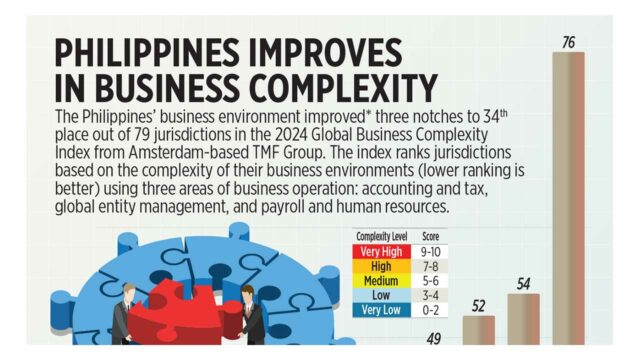
Philippines improves in business complexity

The Philippines’ business environment improved* three notches to 34th place out of 79 jurisdictions in the 2024 Global Business Complexity Index from Amsterdam-based TMF Group. The index ranks jurisdictions based on the complexity of their business environments (lower ranking is better) using three areas of business operation: accounting and tax, global entity management, and payroll and human resources.

Philippines improves in business complexity

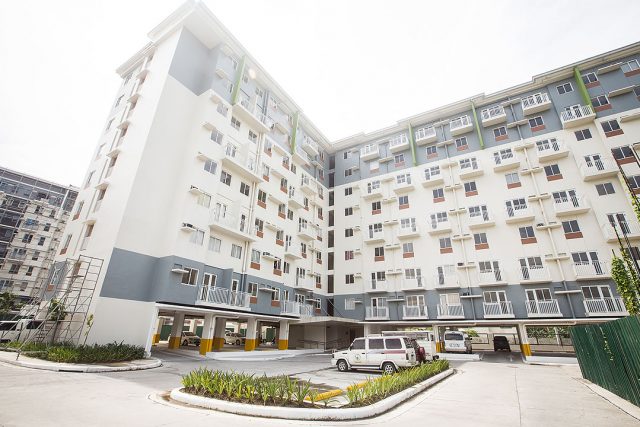
Amaia Steps Pasig tops off 4th mid-rise condo building

AMAIA Land Corp., a subsidiary of Ayala Land, Inc., recently topped off its Clara Building, the fourth mid-rise condominium building in its residential project Amaia Steps Pasig.

The nine-story Clara Building is the final structure in the 4.5-hectare residential development, joining the three other nine-story buildings named Aria, Blanca, and Esperanza, Amaia Land said in an e-mailed statement on June 7.

Situated on Eusebio Avenue in Barangay San Miguel, Pasig City, the project offers residents close proximity to Pasig General Hospital, Sacred Heart Academy, and Robinsons Supermarket.

The 464-unit Amaia Steps Pasig is less than six kilometers away from the Ortigas Central Business District and just four kilometers from C5 Road.

“Offering both accessibility and a serene retreat, Amaia Steps Pasig features retail spaces right at homeowners’ doorsteps, placing everyday essentials within reach. One can grab a quick bite or run important errands just steps away from their homes,” the company said.

The Clara building offers unit options such as studio, deluxe, and premier units, with sizes ranging from 23 to 42 square meters.

According to Amaia Land’s website, the project’s unit prices range from approximately P3.7 million to P5.8 million.

Among the amenities available for residents are a basketball court, swimming pool, multi-purpose hall, play area, and landscaped gardens.

The company said the project is aimed at newlyweds and young families starting out.

The Amaia Steps condominiums are also available in various locations including Alabang, Bulacan, Bicutan, Cebu, Laguna, Parañaque, Quezon City, and Bacolod.

In April, Amaia expanded its community in San Fernando, Pampanga, with the 5.4-hectare Amaia Scapes San Fernando Sector 2 located in Barangay Baliti. This project comprises 315 finished residential units and features the Single-Home 60 model.

Amaia Land is the affordable housing property arm of Ayala Land. — Aubrey Rose A. Inosante

Chinabank changes ticker to CBC as part of rebrand

BW FILE PHOTO

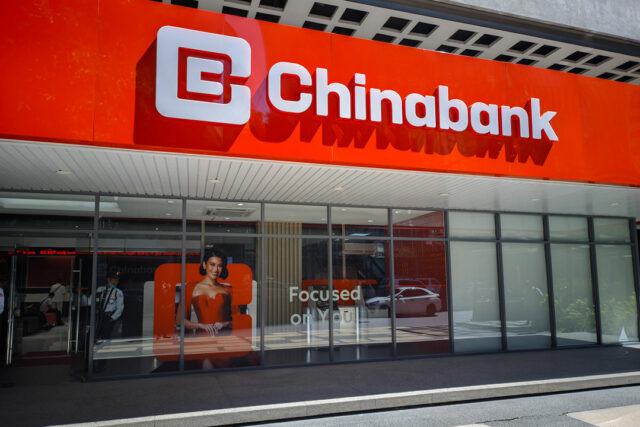
CHINA BANKING Corp. (Chinabank) has changed its stock symbol to CBC from CHIB as part of its corporate rebranding efforts, it said on Monday.

“Please be informed that during the regular board meeting held on June 5, 2024, the Board of Directors of China Banking Corp. approved to change of the stock symbol of the Bank from “CHIB” to “CBC” as part of its corporate brand refresh exercise,” the Sy-led bank said in a disclosure to the local bourse.

Chinabank launched its brand refresh program and digital campaign last month to focus more on its customers and to target the younger generation.

The bank has refreshed the CBC monogram in its logo and replaced the signages of its head office and branches.

As of end-2023, Chinabank was the fifth-largest bank in terms of assets with P1.54 trillion, central bank data showed. It has 648 branches and 1,069 automated teller machines.

Its net income grew by 17.72% to P5.9 billion in the first quarter amid robust core business growth.

Chinabank’s shares went up by five centavos or 0.12% to end at P40.30 apiece on Monday. — Aaron Michael C. Sy

PHL companies told to review IPO plans

BW FILE PHOTO

PHILIPPINE companies should reassess their plans as the country saw a sluggish start in the number of initial public offerings (IPOs) this year, according to professional services company SyCip Gorres Velayo & Co. (SGV).

“It was a slow start for the IPO scene in Asia-Pacific, including the Philippines, in 2024,” SGV Assurance Partner and Philippine EY Private Leader Kristopher S. Catalan said in an e-mailed statement on Monday, citing data from the EY Global IPO Trends Q1 2024 report.

“With a generally cautious optimism with the expectation of modest growth in the global economy, companies must reevaluate their readiness to go public given the shifting investor preferences, and look into whether they have strong fundamentals and business models to offer to public investors, not just a promise of growth in their prospectuses,” he added.

Mr. Catalan said it is important for companies that plan an IPO to be well-prepared to obtain a fair valuation for their companies “when the right conditions are in play.”

The Philippine Stock Exchange (PSE) saw two IPOs so far this year, consisting of OceanaGold (Philippines), Inc. in May and Citicorp Renewable Energy Corp. on Friday last week. The local bourse operator is eyeing to have six IPOs this year and P175 billion worth of capital raised.

SGV data said that IPO activity across Southeast Asia “was lukewarm” for the first quarter with 38 deals raising $1 billion, lower than the 51 deals and $1.4 billion raised last year.

 The most active Southeast Asian exchanges in the first quarter were Indonesia (20 IPOs raising $224 million), Malaysia (nine IPOs raising $279 million), and Thailand (six IPOs raising $273 million). The Philippines, Singapore, and Sri Lanka each saw one IPO on their exchanges, raising $202 million, $20 million, and $2 million, respectively.

“The IPO market in Southeast Asia was subdued as high interest rates and inflationary pressures continued to impact the confidence levels of both investors and issuers. This challenging economic environment has prompted companies in the region to recalibrate their strategies, placing a heightened emphasis on achieving profitability,” EY ASEAN and Singapore IPO leader Chan Yew Kiang said.

“As inflationary pressures begin to subside, the anticipated reduction in interest rates is likely to create a more favorable climate for IPOs. A strong performance from the global IPO markets will encourage Southeast Asian companies that have been hesitant to go public to reevaluate their position,” he added.

Globally, SGV said the IPO market saw 287 deals raising $23.7 billion, down by 7% in volume and 7% higher in proceeds compared with last year.

Meanwhile, EY Global IPO Leader George Chan said that those eyeing an IPO should remain flexible and prepared to seize the right moment for their public debuts to succeed in the shifting environment.

“As 2024 unfolds, participants in the IPO market are entering uncharted territory. IPO candidates are influenced by the recent pivot in investors’ preference toward proven profitability in an altered interest rate landscape, and are doing this while facing the intricate dynamics of an intensified geopolitical climate and the buzz around artificial intelligence,” he said.

SGV & Co. is a member firm of Ernst & Young Global Ltd. It is the largest professional services firm in the Philippines.

 The EY Global IPO Trends Q1 2024 report analyzed data up to March 18 to identify key IPO market trends and the outlook for 2024. EY analysts utilized data provided by Dealogic, S&P Capital IQ, Mergermarket, and PitchBook. — Revin Mikhael D. Ochave

Declining growth and rising unemployment: East Asia vs Europe

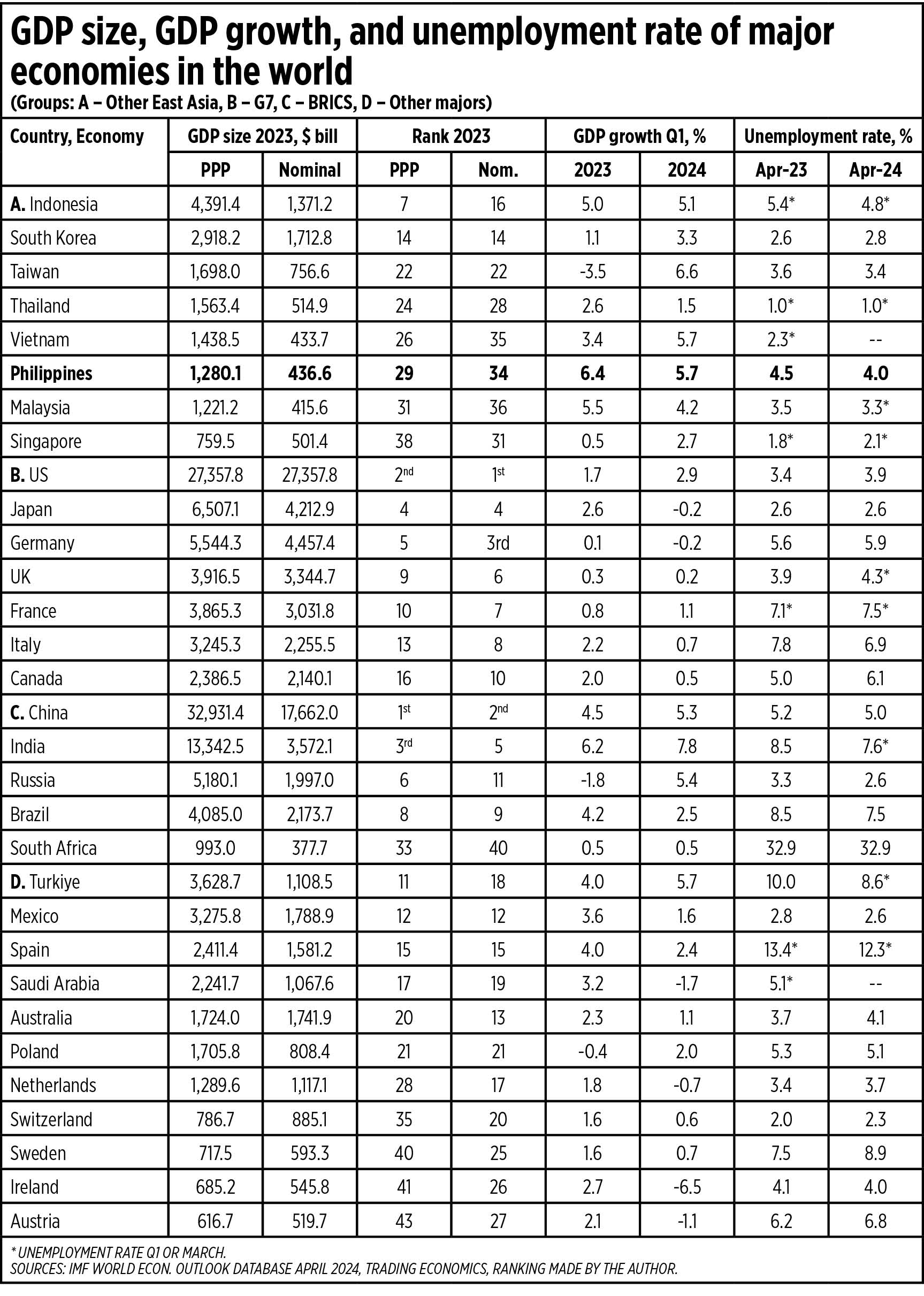
Now that most major economies in the world have reported their first quarter (Q1) 2024 GDP performance, I will resume my global economic scanning. Major economies are those with GDP size at Purchasing Power Parity (PPP) value of $600 billion and higher in 2023, and there are 43 of them.

For the purpose of brevity, I will not show all the 43 countries in the accompanying table. I excluded some due to their incomplete data in GDP growth and unemployment, plus I limited the list of European countries. The countries I excluded along with their respective rank in GDP-PPP are: Egypt 18, Iran 19, Pakistan 23, Bangladesh 25, Nigeria 27, Argentina 30, Colombia 32, the United Arab Emirates 34, Romania 36, Belgium 37, Algeria 39, and Kazakhstan 42.

I used a country’s GDP size both in Nominal and PPP values then ranked them. The Nominal values are GDP in national currencies divided by the average US$ exchange rate, while the PPP values consider the cost of living. I also included these countries’ GDP growth in Q1 2023 vs Q1 2024, and their unemployment rate in April 2023 vs April 2024 unless specified as March or Q1.

As seen in the table, the Philippines is doing fine. In 2023 GDP size, it ranked 34th in Nominal value but ranked higher at 29 in PPP value. In GDP growth, the Philippines was ranked as the 3rd fastest growing among 43 economies in 2023, next to India and Bangladesh. It was also the 3rd fastest among the 36 economies that reported their Q1 2024, next to India and Taiwan. And the unemployment rate showed improvement, from 4.5% in 2023 to 4% this year. This is a good achievement and shows good management by the Philippine economic team. Thank you, Finance Secretary Ralph G. Recto, Budget Secretary Amenah F. Pangandaman, and Economics Secretary Arsenio M. Balisacan.

In 2024, growth deceleration is evident in most of the G7 industrial countries except the US and France, with the latter having escaped deceleration but growing at only 1%. Japan and Germany have contractions this year. Growth deceleration, if not contraction, is also evident in other major economies except Turkey. Poland’s growth this year is due to base effect — it had contraction in Q1 2023. The worst contraction this year is seen in Ireland, Saudi Arabia, Austria, and the Netherlands.

The unemployment rate increased in G7 countries except Italy, while Japan had no change. Other major economies also showed an increase in their unemployment rate, or a slight decrease but still at high levels like Spain with 12%, Turkey with 8.6%, and Poland with 5%.

The BRICS countries — Brazil, Russia, India, China, and South Africa — have accelerated their growth this year except for Brazil and South Africa. They also have decreased their unemployment rate, except for South Africa.

East Asian nations in general have faster growth this year except for Thailand and Malaysia. The Philippines’ 5.7% growth this year is lower than that of last year, but it is still the third fastest among the major economies. Unemployment rates are either declining or remain at low levels (see the table).

What are the implications and opportunities for the Philippines of these global economic trends?

I see one path here — the slow migration of businesses from the G7 countries and other major economies to their smaller neighboring countries in America and Europe, and to East Asia including the Philippines.

Currently there are three major policy mistakes that afflict the G7 countries and other major economies. One, the mass immigration of illegals that sap the developed countries’ social and economic resources. Two, expensive and unstable energy from the use of more intermittent sources that require more backup power from fossil fuel and nuclear plants, plus imported energy from neighbors. And, three, the endless war in Ukraine that pulls the developed countries’ fiscal resources and further raises their public debt.

The Philippines and neighboring East Asian countries should avoid or minimize these pitfalls. One, they should encourage only legal, vetted migration and disallow unvetted illegal migration. Two, they should keep their fossil fuel plants plus nuclear, expand their power supply big time, and anticipate high power demand in the coming years. And, three, step away from taking sides in ongoing major military conflicts between the US vs. Russia in Ukraine, the US vs. China in Taiwan and the South China Sea, and the US-Israel vs. Iran in Palestine and Syria.

We should focus on sustaining high growth, more job creation, and lower unemployment and inflation rates. We should have no blackouts or yellow-red alerts and have stable electricity prices despite rising power demand from more economic activity, especially with the projected migration of businesses from G7 countries and other major economies to East Asia and the Philippines. And we should attract talented migrants and professionals from abroad while we continue expanding professional and business opportunities for our returning OFWs.


Bienvenido S. Oplas, Jr. is the president of Bienvenido S. Oplas, Jr. Research Consultancy Services, and Minimal Government Thinkers. He is an international fellow of the Tholos Foundation.

minimalgovernment@gmail.com

Will Smith tests public’s memory with new Bad Boys film

IMDB
IMDB

MORE than two years after Will Smith shocked movie fans by slapping Oscars host Chris Rock on national television, the actor returned to movie theaters in a big way with Bad Boys: Ride or Die last weekend.

Ride or Die is the first real test of Smith’s commercial appeal since he blew up at the 2022 Oscars ceremony and damaged his marketability as a major star. The film is expected to open at No. 1 in US theaters. But a wide range of box office forecasts suggests Hollywood insiders aren’t sure how the moviegoing public will react to Mr. Smith’s return.

Representatives for the 55-year-old star have been reaching out to other studios in recent weeks in hopes that the film reignites Smith’s career, according to the Hollywood Reporter. A spokesperson for his talent agency declined to comment.

Responding to jokes about his wife by Mr. Rock, Mr. Smith rose from his front-row seat at the Oscars ceremony and smacked the comedian onstage before a live TV audience of millions. In the aftermath, he resigned from the Motion Picture Academy and was banned from its events for 10 years. Since then, he’s had just one film in theaters, the Apple Inc. production Emancipation, which played briefly in a limited number of locations before going online.

Ride or Die, starring Mr. Smith and Martin Lawrence, follows two Miami police officers as they investigate the suspicious death of their former captain. It’s getting decent reviews: Two thirds of critics are recommending the picture, according to Rotten Tomatoes, which aggregates reviews. Audience approval was much higher.

At a screening Thursday night in New York, attendees cheered at appropriate times. Amara Carter, a student attending, said she’s already put the slap behind her.

“I didn’t really care, like, it’s Will Smith,” she said.

The film, which cost $100 million to make, is the fourth installment in the series that dates back to 1995. The most recent release, 2020’s Bad Boys for Life, is the best performer in the franchise. It opened with US sales of $62.5 million and went on to take in $426.5 million globally.

Ride or Die was expected to generate sales of about $55 million in North America over the weekend, according to forecaster Box Office Pro.

Sony Group Corp., which released the film, had said before the debut that it would be happy with anything over $30 million. On Saturday, the company upped its three-day forecast to $53 million, based on strong initial ticket sales.

There have been other factors at play. Domestic box-office revenue has been down 24% year-to-date, with major releases delivering disappointing numbers.

Shawn Robbins, an independent forecaster and founder of the Box Office Theory, is among the more optimistic.

“There’s pent-up demand for a fun action movie,” Mr. Robbins said in an interview. The picture will also face little direct competition until next month, when Twisters and Deadpool & Wolverine are released, he said.

Bad Boys: Ride or Die is now showing in Philippine theaters with an MTRCB rating of R-13. — Bloomberg

ADVERTISEMENT
ADVERTISEMENT