Home Blog Page 311

Celebrating Japan and its Foundation Day

Photo by brgfx / Freepik

The Philippines has its Independence Day. The US has the Fourth of July. And Japan, dissimilar to most countries that celebrates its freedom from colonial powers or independence through revolutions, has its National Foundation Day.

Known in the country as Kenkoku Kinen no Hi, this observance is dedicated to commemorating the founding of the nation and fostering a love for the country.

Annually celebrated on Feb. 11, the holiday remembers the traditional enthronement of Japan’s first emperor, Emperor Jimmu. Early Japanese historical texts, such as the Nihon Shoki, place this event nearly three millennia ago in 660 BCE. Although modern scholars generally regard this date as legendary rather than historical, it continues to serve as a symbolic reference point for the perceived unbroken continuity of the Japanese imperial lineage and the nation.

The holiday itself has gone through several changes. It was first established in 1873 during the Meiji era as Kigensetsu (Empire Day). Following Japan’s defeat in World War II, the observance was abolished. It later returned in a revised form when the government reinstated it in 1966, with the first renewed celebration held in 1967.

Compared to typical celebrations of other countries’ national holidays with fireworks and massive street parties, Japan’s founding anniversary is commemorated in a relatively toned-down manner, similar to how the Philippines marks its Independence Day. Many Japanese people treat it simply as a day of rest rather than a day of intense patriotic demonstration. However, there are still several ways they observe the day.

On this day, many Shinto shrines hold ceremonies known as Kenkoku-sai. Shinto is Japan’s indigenous, nature-revering spirituality focused on practicing rituals to honor spirits and deities found in nature, ancestors, and places.

The most notable observances take place at Meiji Jingu in Tokyo and Kashihara Jingu in Nara. Kashihara Jingu holds special importance because it is dedicated to the first emperor himself and stands on the traditional site of his accession. Visitors to these shrines can expect ceremonial processions, performances of classical music, and appearances by officials and other dignitaries offering formal prayers.

One of the few major public spectacles is a commemorative parade in Tokyo, which usually follows a route between Meiji Jingu Gaien and Meiji Jingu itself. The parade features marching bands, portable shrines (mikoshi), and participants carrying Japanese flags. The festive atmosphere makes it a popular attraction, particularly for those in the Harajuku and Omotesando areas, as well as tourists, where it provides striking photo opportunities.

Much like how it’s celebrated in the country, the Japanese national flag, also known as the Nisshōki or Hinomaru, is commonly displayed on city buses, government offices, and some private establishments throughout the day. It is one of the rare occasions when the flag is so visibly present across the urban landscape.

While there have been no official announcements from the Japanese Embassy in the Philippines, the holiday is celebrated through various events in the Philippines as well.

Last year, esteemed dignitaries from the public and private sectors gathered to commemorate this significant occasion at a traditional event held in the country. The festivities featured a traditional Japanese dance, showcasing colorful kimono-clad performers. Among those in attendance were Japanese Ambassador to the Philippines Kazuya Endo, former Senate President Francis “Chiz” G. Escudero, former House Speaker Ferdinand Martin G. Romualdez, and Supreme Court Chief Justice Alexander G. Gesmundo, who shared a toast (kanpai) to mark the occasion.

Observed with their world-renowned discipline rather than spectacle, the National Foundation Day reflects Japan’s quiet yet enduring reverence for its origins, blending legend, history, and cultural continuity. — Jomarc Angelo M. Corpuz

Private wealth investors favor Asia, emerging markets, Metrobank says

PHILSTAR FILE PHOTO

METROPOLITAN Bank & Trust Co. (Metrobank) is seeing its high-net-worth and ultra-high-net-worth clients investing more in Asia and emerging markets amid volatility in developed countries, it said on Tuesday.

“Investors are no longer simply chasing returns; they are being far more selective about how and where capital is deployed,” Ma. Cristina Gabaldon, Metrobank Head of Investment Management, said in a statement on Tuesday. “This has led to more differentiated portfolios that reflect both opportunity and caution.”

Wealthy investors are allocating their assets in these markets as these offer better valuations and earnings prospects, Metrobank said.

“As market outcomes become more differentiated, private wealth investors are placing greater value on active advisory, risk and return trade-offs, and access to diversified investment solutions.”

Metrobank said majority of investors’ portfolios are invested in equities and increasingly through exchange-traded funds with global and regional equity allocations, particularly in Asia, as the rise of artificial intelligence technologies has driven interest in semiconductor companies in the region.

“Equities remain the primary growth engine for medium-risk private wealth portfolios as these investors maintain overweight positions relative to fixed income.”

Investors are also diversifying their asset allocation as they are now adding select fixed-income exposure through mutual funds to improve their portfolios’ resilience.

“These mutual funds provide global credit exposure, expertise in duration management, access to agency-backed securities and other specialized segments. Fixed-income exposure act as stabilizers in a very volatile market amid expectations that interest rate cycles may turn more supportive later in the year,” it said.

Wealthy individuals are also increasing their investments in alternative assets, such as commodities like gold and silver, to hedge against geopolitical and currency risks.

Meanwhile, their younger ultra-high-net-worth clients are also investing in digital assets such as cryptocurrencies, Metrobank added.

“In contrast, appetite for private equity, real estate, and hedge funds remains muted, as higher financing costs continue to weigh on sentiment toward less liquid assets,” it said.

The bank said these trends show that private wealth investors are becoming “more disciplined and opportunity-driven” in their asset allocation decisions. “Portfolios are becoming more intentional, anchored on equities for growth, supported by selective fixed-income, and complemented by alternatives that enhance risk management.”

“This shift reflects a more mature investment mindset,” Ms. Gabaldon said. “Private wealth investors are building portfolios that are not just positioned for upside, but are also designed to navigate uncertainty in a more fragmented global market.”

For their part, the bank said they offer clients curated global and investment strategies that cater to their diverse needs, providing active advisory and insights on risk and return trade-offs, and access to diversified investment solutions.

Metrobank’s attributable net income rose by 2.56% to P12.43 billion in the third quarter last year. This brought its nine-month profit to P37.28 billion, up by 4.34% year on year.

Its shares closed at P73.80 apiece on Tuesday, up by 60 centavos or 0.82% from Monday’s finish. — Aaron Michael C. Sy

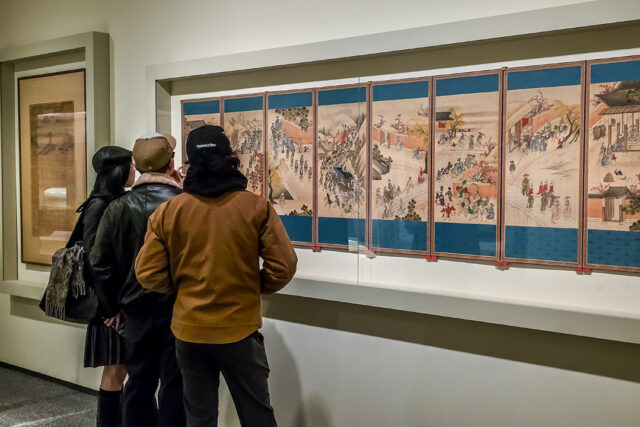
Samsung family’s art collection goes on world tour

The exhibit Korean Treasures: Collected, Cherished, Shared at the Smithsonian ended on Feb. 1 and will be moving the Art Institute of Chicago where it will be on display from March through July and then to the British Museum in London for a special exhibit from September through January 2027. — NEWS.SAMSUNG.COM

FOR DECADES, one of the world’s most historically significant collections of Korean art has been kept largely out of public view, quietly assembled by South Korea’s richest family: Samsung’s Lee family. Now, the works are on their first-ever overseas tour, riding a global wave of interest in Korean culture that extends well beyond pop music and film into the country’s deepest artistic traditions.

Called Korean Treasures: Collected, Cherished, Shared, more than 200 works from the late Samsung Chairman Lee Kun-hee’s vast art collection opened for viewing at the Smithsonian’s National Museum of Asian Art in Washington in November. Jointly organized by South Korea’s National Museum of Korea and the National Museum of Modern and Contemporary Art, the exhibition will be traveling to Chicago in March and London’s British Museum in September.

The art pieces span roughly 1,500 years of Korean history, from Goryeo dynasty celadon to Joseon-era treasures and notable paintings by famed modern artist Kim Whan-ki. Lee’s private collection, which was donated to the state in 2021 at a time when the Samsung family revealed inheritance plans, encompassed more than 23,000 pieces.

Experts estimated the collection had an appraised value of between 2 trillion won ($1.4 billion) and 3 trillion won when it was donated, while market value could be around 10 trillion won.

The overseas tour comes as Korean culture — both traditional and contemporary — is gaining unprecedented global visibility. Netflix’s KPop Demon Hunters has drawn huge international audiences by weaving Korean folklore and traditional imagery into a modern pop narrative. K-pop sensation BTS has announced their return with an album titled Arirang, referencing the centuries-old folk song often described as Korea’s unofficial national anthem.

“Memory and history are important to Koreans,” Samsung Electronics Co. Executive Chairman Jay Y. Lee said at a gala event in Washington on Jan. 28. “Despite the hardships of colonial rule and the Korean War, my father and grandfather believed it was their duty to safeguard the future of our culture.”

For much of the 20th century, the Korean Peninsula’s cultural heritage was damaged or dispersed, first under Japanese colonial rule and later during decades of authoritarian rule that prioritized industrial growth over preservation.

Samsung’s involvement in cultural patronage dates back to founder Lee Byung-chull, who established the Samsung Cultural Foundation with the aim of recovering lost cultural assets. His vision was partly inspired by US philanthropic models such as the Rockefeller and Carnegie foundations.

“As I grew older, a sense of duty — to ensure that our national cultural heritage would no longer be lost overseas — increasingly led me down the path of collecting art,” Lee Byung-chull wrote in his memoir Ho-Am.

That philosophy shaped Lee Kun-hee’s collecting, which later became the foundation of Seoul’s Leeum Museum of Art. The collection expanded into modern and contemporary art under the leadership of his wife, Hong Ra-hee, and later their children.

The collection will eventually have a permanent public home in South Korea. The country’s culture ministry plans to open the Lee Kun-hee Art Museum near Gyeongbokgung Palace in central Seoul in 2029.

Beyond collecting, the Lee family continues to support Korean culture through artist development programs, including fellowships for classical musicians and overseas residencies in France for contemporary artists.

“Cultural competitiveness is not built overnight,” Lee Kun-hee wrote in a 1997 essay. “Companies need to help raise the cultural infrastructure of society as a whole. Businesses are part of the society, and the 21st century will be an era of cultural competition.” — Bloomberg

Globe says it spent $2.7M in 2025 to fight spam, scams

RAWPIXEL.COM-FREEPIK

GLOBE TELECOM, INC. said it spent $2.7 million (around P158 million) in 2025 to strengthen its content-filtering systems, part of efforts to curb spam, scams, and other online threats on its network.

“We protect our customers through advanced filtering, real-time threat blocking, and easy-to-use reporting tools like the Globe StopSpam portal. But true protection also means education, giving every Filipino, especially the youth, the knowledge and confidence to stay safe and speak up online,” Globe Chief Sustainability Officer Yoly C. Crisanto said in a media release on Tuesday.

The listed telecommunications company said the investment supports its broader cybersecurity initiatives, including its anti-spam portal and real-time threat detection systems.

In 2025, Globe said it blocked 967 million scam and spam messages and deactivated 272,746 subscriber identity modules (SIMs) linked to fraudulent activities. The company also said it removed 17,384 malicious domains, including 8,704 illegal gambling sites.

Under its Digital Thumbprint Program, Globe said it reached 16,560 students and educators in 2025 through workshops focused on digital citizenship, online privacy, and child protection.

“These efforts form part of Globe’s broader strategy to minimize digital threats and reduce the spread of harmful content. Child protection remains a core priority,” Globe said.

The company also said it blocked 3,096 domain names associated with child sexual exploitation and abuse, noting that online exploitation of children remains among the most serious risks in the digital environment.

In a separate media release on Tuesday, global network testing firm Ookla said Globe posted the most consistent mobile and fixed network performance in the Philippines for the second half of 2025.

Globe said it recorded a mobile consistency score of 87.51% for the third and fourth quarters of 2025, while its fixed broadband service achieved a consistency score of 88.84% over the same period. The company also said it obtained the highest 5G coverage score, which it attributed to its network footprint strategy.

At the local bourse on Tuesday, Globe shares fell by P3, or 0.17%, to close at P1,730 apiece. — Ashley Erika O. Jose

NGA 911 eyes cities for growth

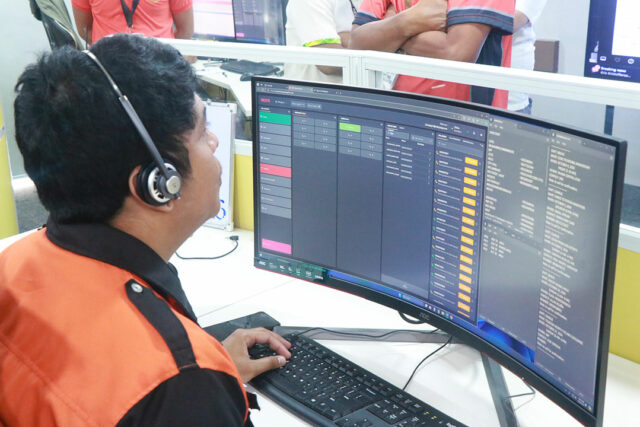
THE UNIFIED 911 SYSTEM command center in Cebu City. — NGA 911

By Vonn Andrei E. Villamiel

WHEN Ishka Villacisneros first began advocating for a modern 911 system in the Philippines in 2019, the idea was often dismissed as fiction rather than public policy.

“If you asked someone to call 911, they’d say, ‘Isn’t that just in movies?’” she said in an interview with BusinessWorld. “I was going back and forth here for probably three years. Almost anyone I talked to had no idea what 911 was.”

At the time, emergency response in the Philippines was deeply fragmented. Ms. Villacisneros, a Filipino-American who is chief financial officer at US-based Next Generation Advanced 911 LLC and president at Next Generation Advanced (NGA) 911 Philippines, said emergency services were spread across thousands of local hotlines run independently by villages, police stations, fire departments and local government units.

“Before, we had several emergency lines across the whole Philippines,” she said. “Imagine every barangay, 40,000 barangays. You need to figure it all out.”

That fragmentation often translated into slow or failed responses. Calls were misrouted, unanswered or passed between agencies without clear accountability.

In September 2025, the Department of Interior and Local Government launched the P1.4-billion Unified 911 System, consolidating emergency response nationwide under a single number. NGA 911 was appointed to provide the emergency technology that powers the system.

Ms. Villacisneros said the impact was immediate. Average emergency response time has fallen to under five minutes, a sharp improvement from earlier response times that could stretch into hours or result in no response at all.

“Before NGA 911, the response time was like two hours or never,” she said. “But on average, it was never.”

NGA 911 generates revenue by licensing and selling its next-generation emergency response systems to governments and public safety agencies. It also makes money through partnerships with telecommunication companies that resell or integrate its systems.

Ms. Villacisneros said NGA 911’s next phase would focus on expanding regional hubs and satellite command centers to strengthen coverage and improve disaster response nationwide.

Unlike legacy emergency systems that rely largely on landline calls, NGA 911 was designed to handle a broader range of communication channels. At the center of the network is NEXiS Connect, the call-handling platform that receives, routes and manages emergency requests across command centers.

Emergency call centers can now receive text messages, photos, videos and messages sent through mobile apps, alongside traditional voice calls. GPS-based location data are transmitted automatically, allowing dispatchers to locate callers even if they can’t clearly describe where they are.

The platform also lets command centers integrate data from closed-circuit television (CCTV) cameras and other local government systems, giving dispatchers real-time situational awareness during emergencies.

“This is how emergency response works in developed countries,” Ms. Villacisneros said. “We brought that same capability to the Philippines.”

She said the integrated digital backbone has improved coordination across agencies, enabling faster decision-making and clearer lines of responsibility during crises.

BRIDGING THE GAP
While call-taking and dispatch have improved, Ms. Villacisneros said one challenge remained: maintaining visibility and coordination once responders are deployed.

“There’s a point where the call taker no longer knows what’s happening on the ground,” she said.

To address this, NGA 911 Philippines recently  launched the Unified Platform for Communications and Dispatch (UPCAD), an upgraded system that will be integrated into national 911 services.

UPCAD is designed to strengthen real-time communication between call takers, dispatchers and first responders operating in high-risk environments.

“UPCAD allows us to bridge that gap,” Ms. Villacisneros said.

The system is being rolled out with support from PLDT Inc. and ePLDT Inc., which provide network infrastructure and cloud hosting for the Unified 911 System. It is also backed by French software firm Streamwide S.A., which develops mission-critical communication platforms, and RugGear, a maker of rugged communication devices for emergency and industrial use.

Streamwide’s Team on the Run app enables secure, fast coordination beyond traditional handheld radios, letting responders share voice, data and situational updates in real time.

Ms. Villacisneros said the Philippine experience shows that a developing country could operate an emergency response system on par with those in advanced economies.

Since the system’s launch, she said NGA 911 has received inquiries from public safety agencies across the region seeking to understand how the platform was implemented.

“They are looking at what the Philippines has built and how it was implemented,” she said.

Vietnam’s police, Indonesia’s national security sector and the Royal Thai Police have all expressed interest in benchmarking the Philippine system. Beyond Southeast Asia, agencies in Qatar, the Maldives, Mexico, Brazil and Canada have also reached out to study the technology and operating model.

“The goal from the beginning was to make the Philippines a model for public safety,” Ms. Villacisneros said. “Now, other countries are following.”

AI is changing the way we work — women and youth must not be left behind

AI GENERATED IMAGE/FREEPIK

By Khalid Hassan

AFTER NEARLY a decade working in the Philippines, I have seen two very different futures unfolding side by side. I have walked through fast-growing business districts and high-rise offices in Metro Manila, and I have traveled to places like the Bangsamoro, where too many children are still pushed into labor instead of classrooms.

These contrasts raise an uncomfortable but urgent question: when the future of work arrives faster than expected, who gets left behind?

That question matters now more than ever, as generative artificial intelligence (AI) begins to reshape work across the Philippines.

A new research brief by the International Labor Organization (ILO) shows that more than one in four jobs or around 12.7 million in total are exposed to generative AI in the Philippines, the highest rate among ASEAN countries with comparable data. Exposure does not mean jobs will disappear overnight. Most will not. But many will change, sometimes quickly, sometimes painfully — demanding new skills, better protection, and deliberate policy choices.

What concerns me most is this: the shift is not gender-neutral.

The same ILO research shows that women in the Philippines face twice the rate of AI exposure as men, particularly young and educated women concentrated in clerical, administrative, and service roles — occupations that AI can automate or fundamentally transform. In regions such as Metro Manila, Central Luzon, and Calabarzon, where digital and business services dominate, women shoulder a disproportionate share of the risk.

Without targeted action, AI could widen existing inequalities, reinforcing barriers that women and young people already face due to poverty, informality, or conflict. Yet this outcome is not inevitable. The same technology can also be a powerful equalizer if we choose to govern it well.

I have seen this possibility firsthand. Through ILO programs supported by development partners, women-led enterprises in Iloilo, Pampanga, and Siargao Island are using digital hubs, e-commerce platforms, and AI-enabled tools to grow their businesses, increase sales, and raise productivity. Under our partnership with the Government of Japan, and now through the United Nations Joint Program Digital PINAS. These women have shown something important: the real constraint is not talent, but access. Systems that fail to keep pace with change hold people back far more than technology ever could.

I am reminded of a young woman who once received an ILO-supported scholarship to study web development under a partnership with J.P. Morgan. With the right support, she built her skills, moved into robotic process automation, and today works as an automation developer in Europe. Her story is not exceptional — it is a clear example of what becomes possible when barriers are removed and pathways into STEM and digital careers are opened.

As a father to a daughter, these changes matter deeply to me. When a girl is given access to quality education, relevant skills, and decent work, she does not merely adapt to new technologies, she helps shape them. Yet for many girls in the Philippines, especially those growing up in poverty or conflict-affected areas, that future remains frustratingly out of reach.

This is why this year’s International Day of Women and Girls in Science, with its focus on “Synergizing AI, Social Science, STEM and Finance,” is so timely. The future of work shaped by AI will not be inclusive by default. Inclusion must be designed through policy, investment, and social dialogue.

The ILO’s research points to clear priorities: investing in AI and digital skills for women and youth; embedding STEM pathways early in education; supporting workers through transitions; and financing women-led innovation and enterprises. Women and young people should not be treated merely as workers adapting to AI, but as innovators shaping how it is used.

If we want AI to create decent work rather than deepen divides, we must act now. The message from the ILO’s new research is clear: AI can raise productivity and job quality, but only if no one is left behind.

The future of work is being built today. The real question is whether we build it with inclusion, dignity, and social justice at its core or allow old inequalities to be hard-wired into new technologies.

The choice is ours.


Khalid Hassan is the director of the International Labor Organization Country Office for the Philippines.

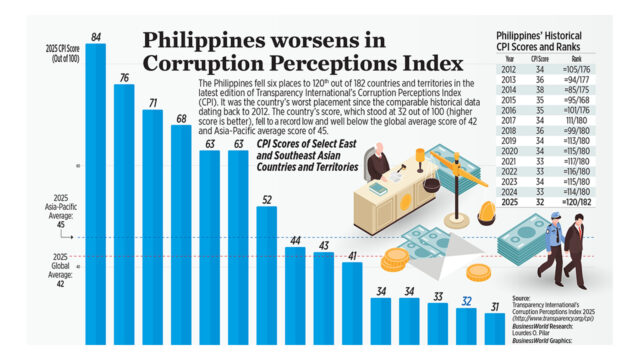
Philippines worsens in Corruption Perceptions Index

THE PHILIPPINES fell six spots to its worst-ever ranking in 2025 in a global corruption perceptions index by Transparency International, as the country grappled with a corruption scandal that slowed economic growth and weighed on investor and consumer confidence. Read the full story.

Peso weakens as markets eye key US data

REUTERS

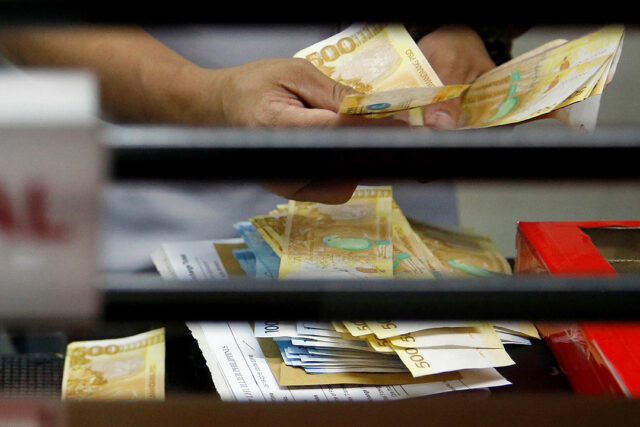
THE PESO went down against the dollar on Tuesday as market players stayed on the sidelines before key US economic data releases later this week.

The local unit weakened by 7.5 centavos to close at P58.53 versus the greenback from its P58.455 finish on Monday, data from the Bankers Association of the Philippines showed.

The currency opened Tuesday’s trading session slightly stronger at P58.40 against the dollar. It climbed to as high as P58.38, while its worst showing was its closing level of P58.53

Dollars traded increased to $1.179 billion from $1.08 billion on Monday.

“The peso weakened ahead of a likely upbeat US retail sales report,” the first trader said in an e-mail.

“The dollar-peso traded with a slight upward bias but closed at its intraday high on cautious positioning ahead of US data,” the second trader said, adding that the market is awaiting reports on retail sales, nonfarm payrolls, and inflation.

For Wednesday, the first trader expects the peso to range from P58.40 to P58.65 per dollar, while the second trader sees it moving between P58.30 and P58.60.

Meanwhile, the US dollar extended Monday’s decline against the yen after Prime Minister Sanae Takaichi’s election victory, while remaining little changed against European currencies before key economic data due on Wednesday.

The Japanese currency snapped a six‑day losing streak on Monday after falling toward the 160 threshold against the greenback, triggering fears of intervention by Japanese authorities to support the yen.

However, analysts also noted that Ms. Takaichi’s policy, which includes tax cuts and more fiscal spending, is expected to boost the economy and lift the stock market, potentially prompting a more hawkish Bank of Japan, all factors that could support the yen.

The yen rose 0.23% to ¥155.52 against the dollar after jumping 0.85% the day before.

It was up 0.32% at ¥185.18 versus the euro after being roughly unchanged on Monday.

“With Prime Minister Sanae Takaichi moving from a relatively fiscally conservative stance to one favoring carefully targeted stimulus, the balance of risks has tilted toward additional tightening from the Bank of Japan,” said Harvey Bradley, co-head of global rates at Insight Investment, arguing that a neutral rate around 1.5% looks reasonable.

“Takaichi’s planned election is aimed at consolidating her position, but a realignment among opposition parties may complicate that ambition and should reassure markets that the fiscal outlook is not going to meaningfully deteriorate,” he added.

Investor attention will be on the monthly reports covering US employment and consumer prices that were pushed back slightly due to a recent three-day government shutdown.

White House economic adviser Kevin Hassett said on Monday that US job gains could be lower in the coming months due to slower labor force growth and higher productivity. Investors are trying to assess whether weakening in the labor market has tapered off.

The dollar index, which measures the greenback against six other currencies, was roughly unchanged at 96.90, after hitting a fresh one-week low at 96.789. — A.M.C. Sy with Reuters

Mandatory tender offer opens after Monte Sur acquires 70% of Dominion Holdings

STOCK PHOTO | Image by Mindandi from Freepik

FOLLOWING its acquisition of a controlling stake in listed investment holding company Dominion Holdings, Inc. (DHI), Monte Sur Equity Holdings is set to conduct a mandatory tender offer for the remaining shares, as required under Philippine securities regulations.

In a disclosure on Tuesday, Dominion Holdings said Monte Sur submitted an initial tender offer report to the Securities and Exchange Commission (SEC) and the Philippine Stock Exchange (PSE), offering to buy up to 247,762,205 common shares, equivalent to about 11.4% of DHI’s outstanding common capital stock. The initial offer price is estimated at P1.69 per share.

The tender offer is part of the regulatory requirements and closing conditions Monte Sur must satisfy following its Jan. 19 transaction with BDO Unibank, Inc. (BDO), in which BDO sold 1,513,732,718 shares, or 70% of DHI, at P1.68 per share.

Under the Securities Regulation Code (SRC) and its Implementing Rules and Regulations (IRR), acquiring more than 50% of a public company’s outstanding equity securities triggers a mandatory tender offer to all remaining shareholders.

Based on its initial tender offer report, the tender offer period will run from Feb. 10 to March 11.

In a separate disclosure on Tuesday, Dominion Holdings said the tender offer price could see a minor adjustment.

In response to queries from the PSE, the company clarified that the preliminary price is P1.68 per share, based on DHI’s net asset value from its quarterly report ended Sept. 30 last year. It added, however, that based on projected year-end 2025 figures, the price may adjust upward to an estimated P1.69 per share, depending on the closing date of the Monte Sur-BDO transaction.

“Hence, the tender offer price will be finalized once the net asset value of DHI as of the closing date of the transaction is determined and agreed upon, and will be announced before the cross date,” the company noted.

DHI posted a net income of P34.81 million in the third quarter of 2025, down from P36.53 million a year earlier. This brought its nine-month profit to P106.43 million, declining from P171.01 million previously.

On Tuesday, Dominion Holdings shares fell 3.45% to P4.20 apiece. — Alexandria Grace C. Magno

Chappell Roan no longer represented by talent agency led by Casey Wasserman

FLICKR/RAPH_PH

WASHINGTON — Pop star Chappell Roan said on Monday she was no longer represented by the talent agency led by Los Angeles 2028 Olympics chief Casey Wasserman, who has faced criticism for flirtatious e-mail exchanges with convicted sex trafficker Ghislaine Maxwell more than 20 years ago.

Mr. Wasserman has apologized for communicating with Maxwell, after the publication of a series of personal e-mails between the two.

New files related to late financier and sex offender Jeffrey Epstein, Ms. Maxwell’s former boyfriend, published by the US Justice Department late last month, included flirtatious e-mail exchanges between Mr. Wasserman, who was married at the time, and Ms. Maxwell dating from 2003.

“As of today, I am no longer represented by Wasserman, the talent agency led by Casey Wasserman,” Roan said on Instagram.

“Artists deserve representation that aligns with their values and supports their safety and dignity. This decision reflects my belief that meaningful change in our industry requires accountability and leadership that earns trust.”

Mr. Wasserman, who is a sports and entertainment executive, has denied having a personal or business relationship with Mr. Epstein. In his apology for his association with Ms. Maxwell, he said that relation came before her or Mr. Epstein’s crimes were revealed.

The talent agency had no immediate comment on Monday.

Ms. Maxwell is serving a 20-year prison sentence after being found guilty in 2021 by a jury in New York on charges including sex trafficking of a minor.

Ms. Maxwell was arrested in 2020 after being accused by federal prosecutors of recruiting and grooming girls for sexual encounters with Mr. Epstein between 1994 and 2004.

The US Justice Department’s release of millions of internal documents related to Mr. Epstein has revealed the late financier and sex offender’s ties to many prominent people — both before and after he pleaded guilty in 2008 to prostitution charges, including soliciting an underage girl. His 2019 death in a Manhattan jail cell was ruled a suicide. — Reuters

Philippines’ 2025 startup funding lags Southeast Asian peers

FREEPIK/ATLASCOMPANY

THE PHILIPPINES drew $120 million (P7 billion) in equity funding in 2025, trailing most of its Southeast Asian peers as investors stayed cautious on the local startup market, according to a report by Kickstart Ventures, Inc. and Singapore-based DealStreetAsia Pte. Ltd.

By deal value, the country lagged Singapore, which raised $4.2 billion, as well as Vietnam ($360 million), Indonesia ($340 million) and Malaysia ($260 million). The Philippines ranked ahead of Thailand, which attracted $80 million, and Cambodia with $20 million.

Funding momentum weakened through the year. Deal value fell to $33 million in the second half of 2025 from $86 million in the first six months, reflecting smaller transactions and limited appetite for risk.

The number of deals from July to December dropped 64% to nine from 25 a year earlier.

“Capital is returning selectively, increasingly to later-stage, higher-conviction opportunities, as the market continues to shift from growth at all costs toward business fundamentals — governance, unit economics and credible paths to profitability,” Kickstart Ventures General Partner Joan Yao said in a statement on Tuesday.

Fintech startups accounted for the biggest share of disclosed funding in the Philippines last year, raising $72 million across nine transactions.

Other sectors that attracted investment included human resource technology and food and beverage, which raised $18 million each, followed by healthcare at $8 million.

Smaller amounts went to health tech ($2 million), e-commerce ($1 million), agricultural tech ($1 million) and green tech, which raised about $200,000.

Kickstart said there were no late-stage funding rounds in the Philippines in 2025, underscoring investor reluctance to commit to large-ticket deals amid heightened scrutiny of valuations and execution risks.

Across Southeast Asia, startup funding remained under pressure from geopolitical tensions, tighter financial conditions, longer fundraising cycles and stronger focus on governance, it added. — Beatriz Marie D.  Cruz

Everyone in Asia wants a stronger Japan. Except China

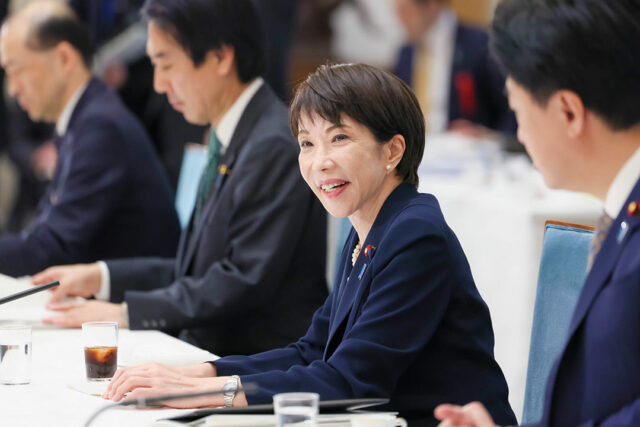
JAPAN’s Prime Minister Sanae Takaichi met with Keidanren (Japan Business Federation) at the Prime Minister’s Office on Jan. 19. — JAPAN.KANTEI.GO.JP

By Karishma Vaswani

ACROSS ASIA, the reaction to Prime Minister Sanae Takaichi’s election triumph has been near unanimous: A stronger Japan is good for the region. Everyone, that is, except China.

Japan’s first-ever female premier secured a historic victory, handing her the strongest mandate of any leader in the country’s postwar era. The scale of this win matters far beyond Japan. Under Takaichi, Tokyo is increasingly viewed as a stabilizing force in the Indo-Pacific region — a stunning reversal for a country that once made Asia deeply wary of any resurgence in its military power. That shift is not happening because the region has forgotten the past. Rather, it’s pragmatically trying to manage the present.

Japan’s occupation of much of Southeast Asia between 1941 and 1945 was marked by severe brutality. Beijing continues to invoke this history — and its own traumatic experience — to warn against any revival of Tokyo’s military role.

But Asia’s middle powers are adapting. Two forces are driving that recalibration: A recognition that US President Donald Trump prizes self-interest and leverage over diplomacy and cooperation, and China’s increasing willingness to use coercion as a routine instrument of statecraft. As the former Indian Foreign Secretary Nirupama Menon Rao has argued, a more transactional US foreign policy “inevitably increases the importance of allies like Japan in providing continuity and strategic ballast in the Indo-Pacific.”

Trump’s America-First approach has left many Asian allies uneasy about his commitments on trade and defense. The US remains engaged, but that no longer comes with predictability. From India to Taiwan, governments have felt that volatility keenly. Last week, New Delhi came to an agreement on trade with Washington, but only after a bruising round of talks with the cards stacked firmly in the White House’s favor. Details are still being finalized but few doubt which side emerged as the winner.

Taipei, meanwhile, has watched anxiously as its future is discussed as leverage in US-China diplomacy ahead of a potential meeting between the US leader and President Xi Jinping. The lesson many regional capitals are drawing is that Washington’s support is conditional, and subject to seemingly fickle changes.

China is making that instinct to hedge more urgent. Whether through coercive trade measures, the harassment of vessels in the South China Sea, or the selective use of economic tools such as restrictions on tourism and critical minerals, Beijing has demonstrated how quickly it can punish behavior it dislikes.

Its sharp reaction to Takaichi’s comments last year — when she suggested that a crisis in the Taiwan Strait could directly implicate Japan’s security — underscores this reality. The fact that she hasn’t walked those comments back, despite repeatedly saying she wants stable relations with China, is telling. Beijing’s pressure has instead backfired, strengthening public support in Japan for reducing economic dependence on the world’s second-largest economy, and boosting domestic resilience on rare earths and energy. 

A more confident Tokyo complicates Beijing’s preferred regional order. For many of Asia’s middle powers, that makes Japan an appealing counterweight. South Korea is a case in point. Long skeptical of Japan’s rise because of historical enmity, Seoul has shown a noticeable shift. Takaichi’s recent “drum diplomacy” with President Lee Jae Myung was more than a viral K-pop moment. It signaled a willingness to set aside old hostilities and deepen cooperation.

This relationship will be a critical one to watch. South Korean ties with Japan have been marked by periods of close security cooperation, oscillating with sharp diplomatic freezes rooted in nationalism. But increasingly there is a shared recognition in both capitals that they need a functional partnership to manage growing pressure from China and the persistent threat posed by North Korea.

This regional calculation is also reshaping Japan’s own security debate. Defense spending is rising to record levels, and the once-taboo discussion of militarization is moving into the mainstream. A 2025 Cabinet Office survey found that 45.2% of respondents now believe the Self-Defense Forces’ size and capabilities should be strengthened. That’s up from 42% in 2022, the last time the survey was conducted. China’s military power and activities in the region were cited as a key reason for the sentiment.

Takaichi now faces both opportunity and risk as she considers revisiting sensitive constitutional questions. She has long pushed for reform of the pacifist constitution, which was imposed by the US after World War II and never amended — but she will have to walk a fine line. Moving too cautiously would undercut her mandate, but moving too boldly could alarm neighbors. It would also feed into Beijing’s narrative that Japan’s military threat has merely been dormant.

For now, the wind is at her back. Her victory gives Tokyo rare political stability to play a larger part in a region squeezed between American volatility and mounting Chinese pressure. For much of Asia, that balance is not just welcome — it is increasingly essential. For China, that is precisely the problem.

BLOOMBERG OPINION

ADVERTISEMENT
ADVERTISEMENT