Home Blog Page 3104

​Aboitiz Data Innovation eyes to expand offerings of AI solutions

Artificial Intelligence words are seen in this illustration taken March 31, 2023. — REUTERS/DADO RUVIC/ILLUSTRATION/FILE PHOTO

ABOITIZ Data Innovation (ADI) targets to increase its offerings of artificial intelligence (AI)-powered solutions across Asia, its top official said last week.

The Singapore-based startup company has a presence in Hong Kong, Malaysia, Thailand, and Azerbaijan, together with its collaboration with the Aboitiz Group in the Philippines.

“Our effective focus and growth are in Asia, establishing the Philippines as our base of operations in creating formulation of how to make it work and bringing that… to markets that we operate in — commercial service, industrial, and the public sector as well,” ADI Chief Executive Officer David R. Hardoon told BusinessWorld at the sidelines of a briefing.

ADI wants to become the “go-to partner” for AI solutions in the Philippines in 10 years, Mr. Hardoon said, and “truly believes” local firms are ready to adopt new technologies.

According to the Work Trend Index 2024 of Microsoft Corp. and LinkedIn Corp., 86% of knowledge workers in the Philippines use generative AI at work, also higher than the 83% regional and 75% global average.

“It’s the willingness. Maybe they’re not sure in terms of what’s the value and the return of investment. Sometimes, it’s a lack of will because it just seems very challenging and they’re not sure how do we begin,” Mr. Hardoon said.

ADI aims to achieve its 10-year goal through identifying companies’ business challenges and using data science and AI solutions, he said.

“The solution is a combination of technology, business know-how, and operational process deployment,” he said.

He cited one of the use cases implemented in its partnership with Republic Cement & Building Materials, Inc., which aims to reduces wastage in cement creation.

ADI Head of Public Sector Carlos Streegan said they also helped develop the Department of Budget and Management’s (DBM) AI-powered inflation forecasting, which helps policy makers decide whether to give subsidies to certain sectors.

DBM now uses a data management system as well, he added.

Meanwhile, ADI also collaborated with UnionBank of the Philippines, Inc. on AI solutions for credit scoring and risk management, Mr. Streegan said. — A.R.A. Inosante

Malaysia is looking to AI to get its mojo back

ISHAN SEEFROMTHESKY-UNSPLASH

FIVE DECADES after electronics gained a toehold in Malaysia and helped drive years of stellar growth, leaders are again putting their faith in chips. Artificial intelligence (AI), and the competition to present itself as the friendliest destination for investment, stands to give the place a much-needed lift. Once seen as a template for developing economies, the country now contends with a slower expansion and fractious politics. The trick will be sorting the AI hype from the substance — and whether Malaysia can avoid some own goals.

Prime Minister Anwar Ibrahim recently made his pitch. The government promised 25 billion ringgit ($5.3 billion) to support the semiconductor industry. Anwar nodded to a long-standing challenge, which is the need to graduate from a center for assembly and testing to more lucrative areas like design. The premier is also betting that Malaysia, one of the biggest chip exporters to the US but with a history of cordial ties to China, can be a player in an era when supply chains are increasingly sorted along national security lines. “I offer our nation as the most neutral and non-aligned location,” he said.

The mania for most things AI, and a couple of pledges from technology icons, is generating good press. An educated workforce, relatively low costs, and proximity to Singapore has companies singing Malaysia’s praises in the way they did during the glory days of Mahathir Mohamad, the former prime minister who ruled with a strong hand but recognized the need to make life easy for big multinationals. Satya Nadella, chairman of Microsoft Corp., last month vowed $2.2 billion to build digital infrastructure. YTL Power International Bhd became a market darling after it announced a venture with Nvidia Corp. for a $4.3-billion data center in the southern state of Johor.

The enthusiasm for Malaysia led me to recall the history of Penang, an island in the north. On visits there, I was always struck by the reverence for Intel Corp. and early leaders Gordon Moore and Andrew Grove. They came to the place when it had a port, fantastic seafood, and not a whole lot more. Though it did have a state administration eager to promote development. Intel opened its first assembly and testing business outside the US there in 1972, and the place is still a major hub for the company. Chips are now almost everything to Penang, which residents have come to call Silicon Island. Large-scale dredging and land reclamation are underway to add space for more industrial parks. 

So, is AI and a new wave of technology investment going to give Malaysia its mojo back? Gross domestic product rose at an average of about 4% in the past decade, markedly slower than the heady days of 1990s and early 2000s. The federation also offered stability; one party dominated from independence through 2018. That was followed by rickety coalitions and a succession of leaders until Anwar forged a government of national unity in late 2022.  It’s anybody’s guess whether this team can last a full five-year term.

The investment that flocked to Penang became a template for development and urbanization, as factory workers moved from rural villages to urban centers. The trend was repeated throughout emerging markets. To keep the money coming, nations had to invest heavily in education, and infrastructure, and develop regulatory regimes that supported this. Growth was there to be had; societies were radically transformed. Malaysia is today on the cusp of becoming a high-income nation but is crawling across the finish line.   

Another challenge: Southeast Asia’s semiconductor scene is concentrated around assembly, testing, and packaging (ATP). “Although the rise of AI offers vast business opportunities and growth potential for the semiconductor industry, the benefits are not evenly distributed along the chain,” Sunny Liu, an economist at Oxford Economics, wrote in report. “As long as ASEAN countries remain focused on ATP, the benefits they derive will be limited compared to economies engaged in design and fabrication.”

The idea of neutrality, as framed by Anwar, is also a stretch. The clamor for a slice of the AI pie might bind countries more tightly to the US, or at least America’s West Coast. Diplomats may mouth bromides about not wanting to pick sides, but decision-by-decision officials will probably align with one camp more than the other. Straddling Washington and Beijing, something at which Malaysia has excelled, gets harder.

The country is right to woo AI. It can’t let growth slow too far, nor afford to let neighbors steal a march. And let’s have some realism. Mistakes have been made and will again. Malaysia can talk a big game and not always come through.

Bad luck can also play a role. In 1996, Mahathir began to develop plans for the Multimedia Super Corridor, a tech zone that stretched from Kuala Lumpur through the new administrative capital and down to the airport. Then the nation endured a massive electricity failure. The premier was humiliated.

Anwar will be hoping a different historical analogy prevails. In 1975, a few years into Intel’s presence in Penang, fire destroyed a huge part of the facility. Employees were determined to press on and fill orders. They were given T-shirts emblazoned with the words “Intel Still Delivers.” If Malaysia is in the market for a rally cry, it could do worse than emulate that sentiment.

BLOOMBERG OPINION

On the role of coal in Asia and renewing Meralco’s franchise

A friend sent me a beautiful recent study, “Assessment of the Role of Coal in the ASEAN Energy Transition and Coal Phase-out,” published by the Jakarta-based ASEAN Energy Center (ACE) and guided by the ASEAN Forum on Coal (AFOC) and the ASEAN Secretariat. It is 58 pages long, released this May.

I checked my data to answer this question: What is the contribution of coal in the ASEAN, in Asia, and the industrial west?

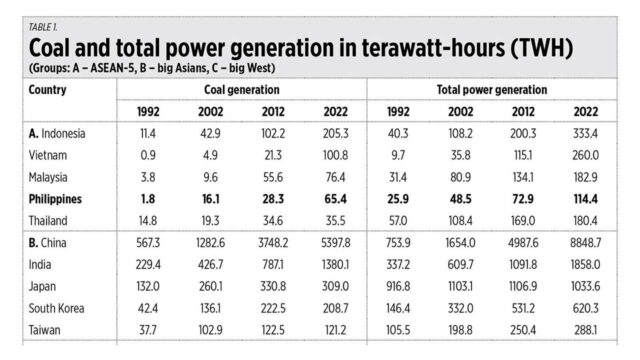
Over the past three decades, 1992-2022, big countries in Asia including Japan were increasing their coal power generation while the US, Canada, Germany, and the UK had been downscaling their coal use. With this trend, the total power generation of the Asian nations jumped, like Vietnam, which went from 10 terawatt-hours (TWh) in 1992 to 260 TWh in 2022 or an expansion of 26 times; China, which went from 754 TWh in 1992 to 8,849 TWh in 2022, expanding by 11.7 times (see Table 1).
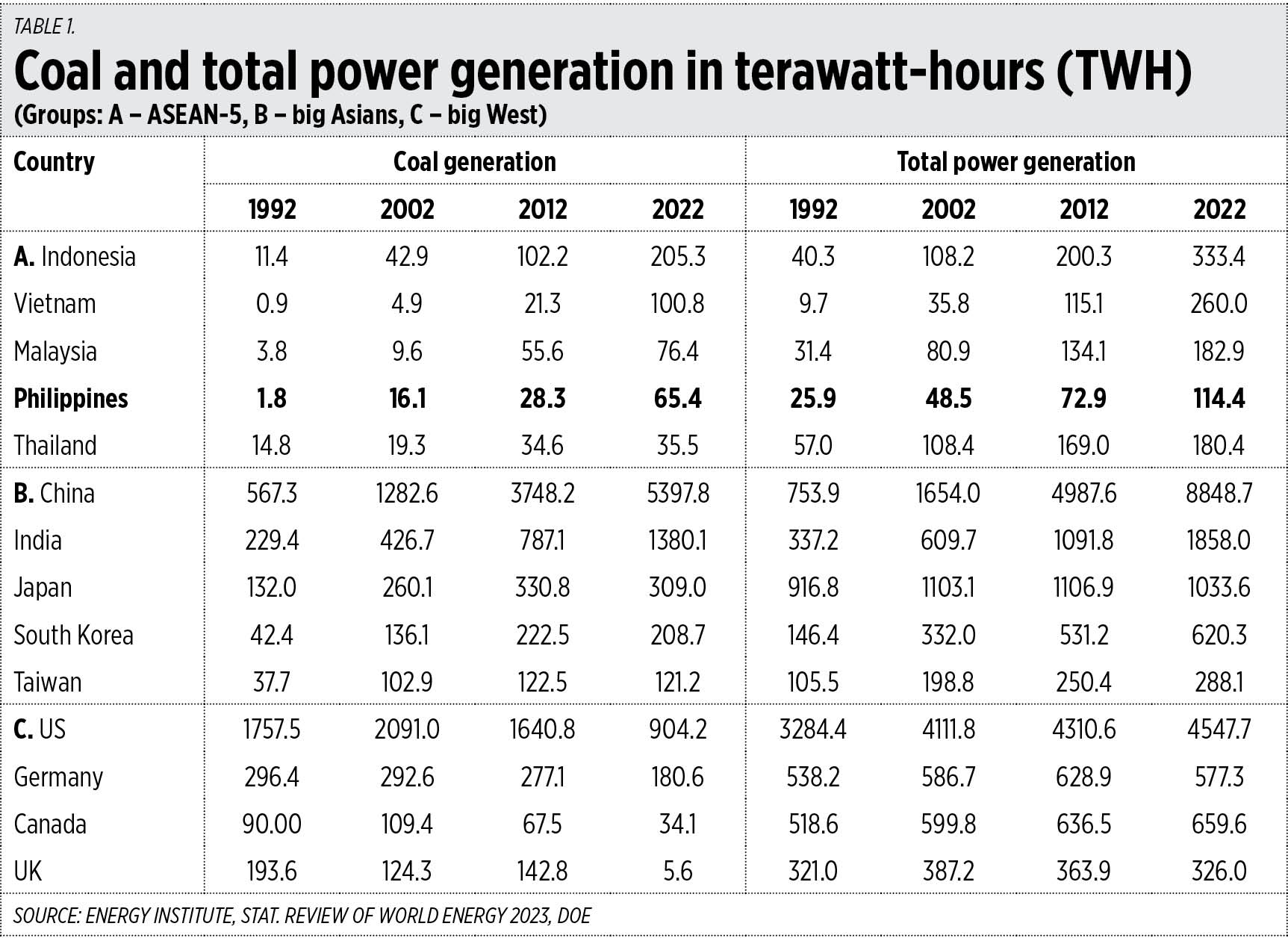
I computed the share of coal to total generation, then the average GDP growth of these countries over comparative years. The result shows that the use of coal in ASEAN-5 (Indonesia, Malaysia, the Philippines, Singapore, and Thailand) is rising, like Indonesia, which went from 28% in 1992 to 62% in 2022, and the Philippines, which rose from 7% to 57% over the same period. Thailand is the exception, with its share of coal declining from 26% to 20% as it began to use more gas, which is still a fossil fuel.

As the Asian nations used more coal as a cheap and stable source of energy for their modernization and industrialization, their average GDP growth was also high, ranging from 3% to 10% (except in Japan) from the 1990s to the 2010s. In contrast, the big western nations, with their declining shares of coal/total generation, saw low average growth, only 1% to 3% over the same period (see Table 2).

Here are some important points from the paper by ACE that I mentioned at the beginning of this column: “Relying primarily on the (International Energy Agency) IEA’s Net Zero Emission (NZE) Pathway as the Taxonomy’s foundation is also overly ambitious and not sufficiently tailored to the unique circumstances found in Southeast Asia…. After all, coal phase-out poses tremendous challenges for ASEAN due to the role of coal in providing sufficient energy supplies at the lowest cost possible, its contributions to the region’s economy… coal currently outperforms other energy sources in terms of supply security, reliability, affordability and — to some extent — sustainability in ASEAN’s power generation.”

MORE NONRENEWABLES NEEDED
There were two energy reports of interest in BusinessWorld this week: “No red alerts projected in coming weeks — DoE” (June 9), and “AboitizPower says nonrenewables needed” (June 11).

During the Asia Clean Energy Forum (ACEF) on June 10 at the Asian Development Bank, one of the panel speakers was Carlos Aboitiz, the Chief Corporate Services Officer of Aboitiz Power Corp. He correctly pointed out that aside from “energy transition,” there is “another transition, a human one that aspires to lift people out of poverty and into modern society.”

Mr. Aboitiz argued — and I agree with him — that using the levelized cost of electricity (LCOE) only captures the cost of variable renewable energy (VRE) when the sources are available. But intermittency and lack of resources in solar and wind during different times of the day and year should also be considered and this should be reflected in a Levelized Full Cost of Electricity (LFCOE). The LFCOE incorporates the full costs of running the electrical grid reliably 24/7, hence it considers and includes the price and cost of technologies and capacities to fill the demand gap and minimize the intermittencies of VRE.

I particularly liked his concluding notes: “Lastly, we need to acknowledge when the narratives we use no longer serve us. The ‘renewable is hero and coal is evil’ narrative is no longer useful. It silences conversation about the need for a gradual transition and sacrifices understanding for the sake of convenience and comfort…. Holding all countries to the same standards is no longer useful. It ignores that imbalances in wealth, value, and responsibility that exist and this impedes climate politics from advancing.”

MERALCO FRANCHISE RENEWAL
One important bill currently under deliberation in Congress is on the early renewal of Meralco’s franchise. See these recent reports in BusinessWorld: “MAP urges House to renew Meralco franchise” (May 31), “House told to fast-track hearings on Meralco’s franchise renewal bid” (June 2), “Makati Business Club backs Meralco franchise renewal” (June 5), and “Meralco ownership a ‘non-issue’” (June 9).

Aside from the Management Association of the Philippines (MAP) and the Makati Business Club (MBC), I read in other newspapers that there are five other groups and industry associations that have publicly endorsed an early renewal of Meralco’s franchise. These are: the Society of Philippines Electrotechnical Constructors & Suppliers, Inc. (SPECS), the Semiconductor and Electronics Industries in the Philippines Foundation, Inc. (SEIPI), the Philippine Iron and Steel Institute (PISI), the IT and Business Process Association of the Philippines (IBPAP), and the Advocates and Keepers Organization of OFW, Inc. (AKO OFW).

I also support this move for many reasons, but I will mention just one — Meralco’s Interruptible Load Program (ILP). This is the voluntary participation by large power users, like big manufacturing plants, to temporarily disconnect themselves from Meralco when the power supply is insufficient and reserve margins are thin and hence may lead to blackouts. Instead, they run their generator sets on diesel, and reconnect to Meralco later when the reserve margins have increased. They are later reimbursed for the higher generation cost of their diesel gensets.

There are two reasons why the ILP is very important.

One, it helps expand the power supply by up to 300 MW when the combined capacities of the gensets of many large companies are added, even temporarily, and hence helps avoid a bigger problem of rotating blackouts.

Two, it proves that the electricity price control at the Wholesale Electricity Spot Market (WESM) is bad and blackout-inducing. “Cheap but not available” electricity is wrong. Higher prices in the short-term are necessary to incentivize power producers to buy big oil gensets or build oil peaking plants to avoid blackouts and darkness, to avoid damaging the food in refrigerators, and damaging goods in manufacturing, etc.

Meralco should be commended for this innovation and it deserves a franchise renewal so it can further improve this program.

Meanwhile, the Philippine Chamber of Commerce and Industry (PCCI) will hold a Power Summit 2024 with the theme, “Moving the Economy Forward with Energy and Power Security and Competitiveness,” on June 19 at the Makati Diamond Residences. Among the speakers will be Consul Enunina V. Mangio, the President of PCCI; David Chua and George Barcelon, Chairs for Energy and Power of PCCI, Energy Secretary Raphael P.M. Lotilla, and Energy Regulatory Commission Chairperson and CEO Monalisa Dimalanta.


Bienvenido S. Oplas, Jr. is the president of Bienvenido S. Oplas, Jr. Research Consultancy Services, and Minimal Government Thinkers. He is an international fellow of the Tholos Foundation.

minimalgovernment@gmail.com

Pangilinan says Maya needs firm market standing before considering IPO

By Ashley Erika O. Jose, Reporter

MAYA Bank, Inc. is not positioned to pursue an initial public offering (IPO) in the near future, PLDT Chairman and Chief Executive Officer Manuel V. Pangilinan said.

“They have to demonstrate that they can be profitable starting 2025 and to be consistently profitable for at least another year,” Mr. Pangilinan told reporters on the sidelines of the company’s annual stockholders meeting on Tuesday. 

He added that Maya needs to establish a firm market standing first before the company can consider an IPO, admitting that GCash, the company’s counterpart electronic wallet platform, dominates the market.

“Whatever GCash is doing, they are doing something right. Certainly better than we are. We have a lot of work ahead of us. To dream of an IPO in the next two years is simply an illusion. It won’t happen, plus the fact the market here is not conducive to an IPO,” Mr. Pangilinan said.

“We are way behind in the digital wallet space. What is the vocabulary, the vernacular for digital wallet? It is not Maya, right? It is GCash,” he said.

Digital lender Maya is expecting to launch more loan and investment products this year to help boost the company’s goal to serve unbanked and underserved markets.

For the first quarter, Maya disbursed P34 billion in loans, with 59% of its borrowers having Maya as their first and only bank, PLDT said in its first-quarter financial briefing, adding that this highlights the digital inclusion roadmap of the company.

For stock market analysts, the decision of Maya to shy away from an IPO at the moment is smart considering the current market conditions.

“Valuations are too low for it to be lucrative enough for Maya to list,” COL Financial Group, Inc. Chief Equity Strategist April Lynn Lee-Tan said in a Viber message on Wednesday. 

Chinabank Capital Corp. Managing Director Juan Paolo E. Colet said the current equity market conditions are not optimal for large IPOs, citing the two companies that went public only got the discounted price on their market debut. 

Mr. Colet was referring to OceanaGold Philippines, Inc.’s (OGP) after its stock price closed 6% lower than its IPO price on its market debut; while Citicore Renewable Energy Corp. (CREC) finalized its IPO price at P2.70 per share, down from its initial offer price of up to P3.88 per share.

“The recent offerings of OGP and CREC were priced at a significant discount, so investor appetite is not yet strong enough to support better valuations. Maya is right to wait until conditions are in place to get them the best price for their IPO,” Mr. Colet said.

The current market conditions at the moment indicates cautious market sentiments, Seedbox Securities, Inc. equity trader Jayniel Carl S. Manuel said, citing the Philippine Stock Exchange index thin trading volumes and limited participant activity.

“Without a significant catalyst to boost investor confidence, launching an IPO at this time may not be prudent. Recent IPOs have faced challenges under similar conditions, reinforcing this cautious approach,” Mr. Manuel said in an e-mail on Wednesday.

Further, Mr. Manuel said Maya’s strategy to enhance its EBITDA or (earnings before interest, taxes, depreciation, and amortization) through its premium offerings and innovative financial products positions are good to further establish its foothold in the financial digital space.

“If they continue to deliver impressive financial performance, supported by their integrated payments and banking solutions, an IPO could become a viable option once market conditions improve,” Mr. Manuel said.

Maya Bank is owned by Voyager Innovations, Inc. PLDT Inc. is Voyager’s main shareholder. Hastings Holdings, Inc., a unit of PLDT Beneficial Trust Fund subsidiary MediaQuest Holdings, Inc., has a majority stake in BusinessWorld through the Philippine Star Group, which it controls.

Jin, oldest member of K-pop’s BTS, finishes army service in South Korea

AMAZING FULL TV YOUTUBE CHANNEL

SEOUL — Jin, the oldest member of K-pop phenomenon BTS, was discharged from South Korea’s army on Wednesday after 18 months of duty, the first member of the group to wrap up mandatory national service that put their music careers on hold.

Jin, 31, wearing his army uniform and a black beret, appeared emotional as he hugged his colleagues at a military base in Yeoncheon, Gyeonggi province, television footage showed.

South Korean media reported several other members of the septet who are currently serving in the military applied for leave to celebrate the occasion.

Among them was rapper RM, who greeted Jin with a saxophone to play the group’s hit single “Dynamite.”

Jin became the first member of the group to enlist in the military in December 2022. The final four members of the group began their service in December 2023, with the band expected to reunite as a whole in 2025 after all complete their duty.

Jin plans to kick off his post-army activities with an event in Seoul on Thursday where he will greet fans as well as an hour-long performance as part of the annual FESTA designed to celebrate BTS.

The group debuted on June 13, 2013, and has since become the face of K-pop, South Korea’s pop music industry, one of the country’s largest cultural exports.

Livestreams of Jin’s military discharge were watched on YouTube by hundreds of thousands of people.

South Korea requires all able-bodied men between the ages of 18 and 28 to serve between 18 to 21 months in the military or social service, but it revised the law in 2020 to let globally recognized K-pop stars delay signing up until age 30. — Reuters

UBS market strength puts Swiss finance experts, industry on edge

REUTERS

ZURICH — UBS’s takeover of Credit Suisse has fed a creeping anxiety that Swiss companies will pay a price for the enlarged bank’s outsize market strength.

The historic 2023 deal created a bank with a balance sheet twice the size of the Swiss economy, and at a stroke eliminated one of the two giants of the Swiss banking landscape.

It also narrowed the financing options for the country’s high-cost, highly competitive export-orientated companies, especially with Credit Suisse seen as the bank which supported entrepreneurs in areas like export finance.

UBS Chief Executive Sergio Ermotti says market competition is robust, and that his bank would only be the second-largest player after cantonal lenders in most product areas.

Still, last month Mr. Ermotti said Credit Suisse had run an “unsustainable business model, too much cost, too little revenue, too much risk,” hinting at price increases.

“Services and credit were subsidized or priced at an unacceptable level, well below where UBS prices, and well below (where) every competitor prices. So, it’s true that in a selective way, we’re going to have to relook at repricing things,” he said.

The bank pointed to Mr. Ermotti’s remarks when asked for comment on this story, but declined to quantify prospective changes.

Reuters spoke to over a dozen finance experts and industry executives who expect UBS to raise prices as new loans are negotiated.

Meanwhile almost half the firms recently surveyed by Swissmem, an association representing industry heavyweights including ABB and Siemens, reported services from banks had worsened, or said they feared they would.

“Some companies are seeing a negative effect on banking services. But many fear this is going to happen,” said Jean-Philippe Kohl, deputy director of Swissmem, whose survey showed availability of credit was companies’ biggest worry.

So far evidence of higher costs feeding through is scarce, and analysts said it was still too early to assess how much costs could rise. That would become more apparent in coming months as old loans give way to new agreements, they said.

Some said UBS is being careful for now to avoid drawing tougher antitrust regulation. Financial regulator FINMA or the Swiss Financial Market Supervisory Authority is still weighing up a hitherto unpublished report by Switzerland’s competition commission (ComCo) into UBS’s market strength.

In the report, ComCo told FINMA it favors a deeper investigation into UBS’s dominance of parts of the market, Reuters reported in February.

Andreas Heinemann, who was ComCo president from 2017 to 2022, said FINMA from the outset ruled out making the takeover subject to certain conditions such as asset disposals, and waved the deal through before ComCo had given its expert opinion.

“FINMA gave the impression that this opinion did not carry much weight in its analysis,” he said.

FINMA said it could review the competition impact of the takeover, and would comment on the ComCo report in due course.

Some senior executives at Swiss-listed firms privately worry that issuing corporate bonds could get more expensive.

“There’s less competition,” one told Reuters.

The enlarged UBS had a 45% market share for underwriting Swiss franc-denominated bonds in 2023, according to figures from finance industry data provider Dealogic.

The two banks also had a 31% share of the Swiss non-mortgage loan market in May 2023, the last available month of data from the Swiss central bank. In some sectors like manufacturing, the proportion was higher (39%).

RISK AVERSION
One senior finance expert, speaking on condition of anonymity, forecast that once regulatory risks eased, UBS could hike financing costs by a high double-digit basis point amount, based on some early data.

Fears particularly stalk manufacturing, which contributes 21% of national output with goods including machine tools, medical implants, chocolate and watches.

Train maker Stadler Rail said it has not been approached by UBS for higher interest margins or fees, and believes it will be protected due to its access to over 30 different banks.

But it worries smaller firms could feel pain, with UBS expected to adopt a more top-down, risk averse approach.

“Many companies are too big to be supported by cantonal banks only and yet too small to attract a wide range of larger international banks to fill the gap CS left behind,” Stadler Rail Chief Financial Officer Raphael Widmer told Reuters. “They might end up being caught between a rock and a hard place.”

Swissmechanic, which represents small- and medium-sized firms, said its members have been evaluating their banking relationships.

“We need banks that understand the importance of the industrial sector and support us,” said Swissmechanic President Nicola Tettamanti, who has spoken to more than 100 companies in recent weeks. “We don’t want a free lunch.”

Although UBS does not have a monopoly, it does have a very strong position that could mean higher prices, he said.

The Swiss pricing watchdog has so far received no formal complaints, but says it is following the situation closely. — Reuters

Younger Filipinos ride the wave of buy now, pay later for increased financial flexibility

PIXABAY

By Weihan Sun

THE Philippine peso recently closed at P58 to $1, marking its worst close since November 2022. Headline inflation also increased to 3.9% in May, with housing, utility, and transport mainly contributing to the hike.

Despite these recent developments, I believe that there are still reasons to be optimistic after a year beset by various economic and financial challenges. The World Bank has projected the Philippines to be among the fastest-growing economies in the region on the back of the acceleration of private consumption. Results from our TransUnion Philippines Q1 2024 Consumer Pulse Survey conducted on Feb. 6-14 also show that Filipinos are becoming financially savvy. This is amid the increased usage of financial technology (fintech) services and a more proactive attitude towards financial literacy and responsible credit management.

TransUnion’s Q1 2024 Consumer Pulse Survey involved 977 Filipino consumers aged 18 years and older. Generations are defined as follows: Gen Z, 18-26 years old; Millennials, 27-42 years old; Gen X, 43-58 years old; and Baby Boomers, ages 59 and above.

THE RISING TIDE OF BUY NOW, PAY LATER
Between 2021 and 2023, the fintech landscape in the Philippines grew over 38%, going from 216 companies to 299, each offering various financial services. This indicates a growing demand for industry players who seek to make financial processes easier, increasingly digital, faster, and more secure.

One of the more noticeable areas that has seen growth in usage is buy now, pay later (BNPL). Defined as an alternative credit-enabled payment method that allows consumers to immediately finance purchases and pay them back in fixed installments over a relatively short period of time, the results from our Q1 2024 survey show that reported BNPL service usage in the past twelve months grew to 42% in the period from 39% a year prior.

Awareness of BNPL services is high among the younger generations, as 81% of Gen Z and 86% of Millennials said they’ve heard of such offerings. Among those who’ve heard of BNPL, 65% of Gen Z and 68% of Millennials reported using BNPL services at least once in the past 12 months.

Among these generations, some of the top reasons they cited for using BNPL were that it was easy to apply for, they wanted to try it, to spread payments over time, and to afford a larger purchase. I see this as a highly positive sign. With younger generations comprising a sizable chunk of the local workforce, having both an openness and affinity for fintech services and alternative credit options indicate a strong desire for financial flexibility and to join the formal financial credit ecosystem.

CREDIT MONITORING MAKING A BIGGER SPLASH
Since both Gen Z and Millennials are Internet and smartphone-savvy, they are more inclined to utilize available resources not only to enjoy better financial flexibility with digitally enabled services such as BNPL, but also to build credit literacy and good financial habits.

One of the findings that stood out to me from our Q1 2024 survey was the increase in credit monitoring among Filipinos. In terms of frequency, 70% of Filipinos reported checking their credit reports at least once a month, up from 66% in Q1 2023.

With the overall perception of the importance of credit monitoring remaining high, this uptick reflects a growing awareness about the importance of credit health and its implications on personal financial opportunities. Our latest survey results show that almost all (96%) of Filipinos consider credit and lending products to be important factors in achieving their financial goals.

I see this as another huge positive. With more Filipinos growing accustomed to transacting online and taking an active stance in monitoring credit, this suggests not only a more responsible attitude in credit management, but also a more vigilant attitude towards monitoring for possible instances of fraud.

DIVING INTO GREATER FINANCIAL FLEXIBILITY FOR GROWTH
With the summer season almost here, there is an opportunity for businesses to generate summer sales growth by aligning their business strategies with the consumer preference for flexible payment options.

As the popularity and awareness of alternative solutions such as BNPL continue to grow among younger generations, there are opportunities to further stimulate credit market growth across these emerging and increasingly credit-hungry consumers. To do so, further strengthening the decisioning process can help industry players expand access to a wider consumer base while protecting both the consumer and themselves from undue risk. By making credit more accessible through alternative credit methods like BNPL, banks and other formal financial institutions can drive operational efficiency and cater to the needs of those in search of added financial flexibility in a trusted and safe environment.


Weihan Sun is the principal of Research and Consulting for Asia Pacific at TransUnion.

The art of the spin

JEROEN BOSCH-UNSPLASH

THERE is no such thing as an unmitigated disaster or even bad news to a communications person who has mastered the art of spinning. This narrative skill tries to put a positive slant on even the worst news. It can even take credit for random items to look good, like the increase of tourists or even the easing of the heat wave. (Our carbon policy is bearing fruit.)

Spinning embraces the ability to make positive developments that just happened seem like part of a grander plan. This is known in spinning circles as taking credit for a sunny day… unless it is too hot.

The art of spinning (some call it deception) is a skill employed by individuals even in a social setting. Accepting bad news can be less traumatic if spinned properly. What about a car collision with a motorcycle? (At least, nobody in the car was injured or hospitalized.) Of course, the motorcycle was wasted.

In a crisis, the media are looking for someone to blame or a quote to put in the headlines. They are looking for narrative bait, some “sound bite” to embarrass the ambushed interviewee.

Here are some techniques the spinner resorts to.

Shift the discussion to the future. If there are questions on the bad numbers of a company, like staggering losses and high levels of debt that need to be restructured, the CFO can mention plans that are already underway — we are looking at a strategic partner to help address these issues. We will disclose details at the proper time.

Change the subject. If a local government unit head is questioned about her foreign background and disqualifying attributes, like the wrong citizenship, can she describe the tourist spots in her town — we have a lovely military camp with the nicest park? Maybe she can congratulate another local official on getting married at age 80?

Reframe the question. If there are questions on the role of intelligence funds in a non-military setting, the interrogator can be put in his place by the subject being interviewed. (Intelligence is our goal in education. This is what we strive to impart, so we need intelligence funds.) Next question, please.

Delay the response. How many times do those spinners hide behind “getting more details on a subject”? It’s too early to determine what really happened or who is at fault. We have set up an investigative team to investigate the matter and come up with a report.

The penchant to spin personal disasters (say, losing a position to somebody else) into a welcome development — I will have more time with my family. The victim of an ouster tends to protest too much and too often, justifying his misfortune as a stroke of good luck. Nobody is fooled.

Is spin also needed for good news?

Sometimes success requires deft spinning too. Grabbing the credit for victory in a competition solely for oneself, and not sharing it with “the team,” can have disastrous effects. This is why winners in award ceremonies have a list of people they thank profusely… without whose help and support, the prize would not have been possible.

Public recognition of credit can be as long as the guest list to a wedding. The enumeration uses a dramatic pause near the end of a list to honor either the spouse or the boss, sometimes the same person, anyway — She is my great inspiration. (And she will not feel good about my getting this one instead of her.)

Why do events always need a spin?

The spinner’s rule on both fortune and misfortune holds that events, awards, public disgrace don’t make sense unless provided a proper narrative. So even a successful accomplishment can be dismissed as a case of good luck. (He was at the right place at the right time.)

A promotion may seem self-evidently beneficial to the subject. This triumph, however, can be tarnished when given the wrong context. He has been kicked upstairs to a useless position. He is reporting to a former subordinate. The job pays the same but has more stress. He is being taken out of the decision loop.

Positively spinning the narrative of unforeseen events may even be necessary for one’s wellbeing. Self-deception may be the key to happiness… until misfortune can no longer be spun away.


Tony Samson is chairman and CEO of TOUCH xda

ar.samson@yahoo.com

ERC partially approves Meralco, San Miguel’s power deal

KENNY ELIASON-UNSPLASH

THE Energy Regulatory Commission (ERC) said it has partially approved the power deal between Manila Electric Co. (Meralco) and the subsidiary of San Miguel Corp. for the supply of 910 megawatts (MW).

The regulator granted its provisional authority to Meralco to source the capacity from the 1,200-MW Ilijan natural gas plant of South Premiere Power Corp. (SPPC) at the base rate of P5.9282 per kilowatt hour (kWh).

The capacity was lower than what Meralco and SPPC jointly filed for approval of their 1,200-MW power supply agreement (PSA).

The ERC said that the 290 MW is still contracted under an earlier contract previously issued authority by the commission at the levelized cost of electricity rate of P5.1363 per kWh.

“Thus, the Commission ordered the parties to continue honoring the subsisting contract and lower rate in respect of the 290MW capacity,” the regulator said.

The ERC said that the issuance of provisional authority “will further protect Meralco’s consumers from exposure to volatile prices in the Wholesale Electricity Spot Market (WESM) and displace volumes contracted by Meralco also from the Ilijan plant at higher prices.”

“Based on the Commission’s simulations, Meralco’s blended generation rate will be lower by an estimated amount of P0.2828/kWh, subject to adjustment after the Commission’s deliberation on the PSA’s final authority,” the ERC said.

It ordered the companies to submit proof of compliance with the requirement under the bidding’s terms of reference that “from December 26, 2023, and for the duration of the PSA, no capacity and electrical output within the contract capacity shall be contracted under an agreement apart from the resulting PSA of this bidding.” — Sheldeen Joy Talavera

Thai central bank holds rate despite calls for cut

BANGKOK — Thailand’s central bank left its key interest rate unchanged for a fourth straight meeting on Wednesday, as widely expected, despite public calls by the government to reduce borrowing costs to help revive Southeast Asia’s second-largest economy.

The Bank of Thailand’s (BoT) monetary policy committee voted 6-1 to hold the one-day repurchase rate at 2.5%. One member voted for a 25-basis-point (bp) rate cut.

“The majority of the Committee deems that the current policy interest rate is consistent with the economy converging to its potential, as well as conducive to safeguarding macro-financial stability,” the BoT said in a statement.

All but three of 27 economists in a Reuters poll had expected the BoT to keep the rate unchanged on Wednesday. The three economists had predicted a quarter-point cut.

Earlier on Wednesday, Prime Minister Srettha Thavisin said he was hoping for a rate cut at the rate meeting, repeating his call for lower rates to help revive the economy, which has lagged regional peers as it confront high household debt and interest rates as well as sluggish exports. 

However, Finance Minister Pichai Chunhavajira has said he was more worried about people’s access to credit than interest rates. He said the government is aiming for at least 3% growth this year.

The BoT raised its key rate by 200 bps to 2.5% over eight meetings between August 2022 and September 2023, taking it to the highest level in more than a decade, and has held steady since then.

The economy expanded 1.9% last year, with average annual growth at 1.73% over the past decade.

The central bank maintained its forecasts for 2.6% gross domestic product growth in 2024 and for 3% growth in 2025.

Headline consumer inflation in May returned to the BoT’s target range of 1% to 3% for the first time in a year.

The BoT maintained its headline inflation forecast for 2024 at 0.6%, and slightly lowered its core inflation forecast to 0.5% from 0.6% seen earlier.

The next rate review is on Aug. 21. — Reuters

Martin Shkreli copied one-of-a-kind Wu-Tang Clan album, lawsuit claims

PLEASR.MIRROR.XYZ

NEW YORK — Martin Shkreli has been sued in New York by a digital art collective that said it paid $4.75 million for a one-of-a-kind album by the hip-hop group Wu-Tang Clan, only to learn that the convicted pharmaceutical executive made copies and is releasing the music to the public.

Mr. Shkreli paid $2 million in 2015 for Once Upon a Time in Shaolin, and gave it up to partially satisfy a $7.4 million forfeiture order after his 2017 conviction for defrauding hedge fund investors and scheming to defraud investors in a drugmaker.

The plaintiff PleasrDAO said Mr. Shkreli has, since his May 2022 release from prison, told fans on live streams and social media platform X that he kept and had shared the album, once saying, “I was playing it on YouTube the other night even though somebody paid $4 million for it.”

PleasrDAO also said thousands of people tuned in on Sunday to hear the album on a live stream that Mr. Shkreli called a “Wu tang official listening party.”

Such activity violates the forfeiture order, amounts to misappropriation of trade secrets, and “greatly diminishes and/or destroys the album’s value,” according to the complaint filed Monday night in Brooklyn federal court.

PleasrDAO wants Mr. Shkreli to destroy his copies, turn over profits from disseminating the music, and pay compensatory and punitive damages.

US District Judge Pamela Chen issued a temporary restraining order on Tuesday night that blocks Mr. Skhreli from disseminating the album, or risk contempt of court. She may issue an injunction later this month.

Lawyers who have represented Mr. Shkreli in criminal and civil matters declined to comment or did not immediately respond to requests for comment.

The plaintiff is displaying Shaolin this month at the Museum of Old and New Art in Hobart, Tasmania.

Mr. Shkreli, 41, became notorious and gained the nickname “Pharma Bro” when, as chief executive of Turing Pharmaceuticals in 2015, he raised the price of the life-saving antiparasitic drug Daraprim overnight to $750 per tablet from $17.50.

He was released early from his seven-year prison sentence, but remains on supervised release.

Mr. Shkreli was banned in January 2022 from the pharmaceutical industry and ordered to repay $64.6 million for antitrust violations related to Daraprim. A federal appeals court upheld the ban and payout in January. — Reuters

MediaTek designs Arm-based chip for Microsoft’s AI laptops, say sources

TRUSTPAIR.COM

TAIPEI/SAN FRANCISCO — Taiwanese chip design giant MediaTek is developing an Arm-based personal computer chip that will run Microsoft’s Windows operating system, according to three people familiar with the matter.

Last month, Microsoft unveiled a new generation of laptops that feature chips designed with Arm Holdings tech which provide enough horsepower to run the artificial intelligence (ai) applications executives said were the future of consumer computing. The MediaTek chip is geared toward this effort.

The software company’s plans take aim at Apple, which has released its own Arm-based chips for Mac computers for roughly four years. And Microsoft’s decision to optimize Windows for Arm could threaten Intel’s long-standing dominance in the PC market.

MediaTek and Microsoft declined to comment.

The MediaTek PC chip is set to launch late next year after Qualcomm’s exclusive deal to supply chips for laptops expires, two of the people said. The chip is based on Arm’s ready-made designs, which can significantly speed development because less design work is needed using ready-made, tested chip components.

It was not immediately clear whether Microsoft has approved MediaTek’s PC chip for the Copilot+ Windows program.

Executives at Arm have said one of its customers used the ready-made components to build a chip in roughly nine months for a design that is already complete, which MediaTek’s is not. For experienced chip design businesses, advanced chips typically take considerably more than a year to construct and test, depending on the complexity.

In 2016, Microsoft tapped Qualcomm to spearhead moving the Windows operating system to Arm’s underlying processor architecture, which has long powered smartphones and their small batteries. Microsoft granted Qualcomm an exclusivity arrangement to develop Arm-based Windows-compatible chips until 2024, Reuters reported last year.

Because the Qualcomm exclusivity arrangement with Microsoft is expiring, other designers have opted to build chips to help power Microsoft’s latest push to use Arm designs. For decades, Windows machines have relied on chip architecture made by Advanced Micro Devices (AMD) and Intel.

Nvidia and AMD are working on Arm designs for Windows machines, Reuters reported last year. The Nvidia effort for its PC chip involves help from MediaTek, according to a person familiar with the matter. The MediaTek effort for a PC chip is separate from its collaboration with Nvidia, two of the people said. Reuters

ADVERTISEMENT
ADVERTISEMENT