Home Blog Page 3

Political dynasties are an evil institution

STOCK PHOTO | Image by Inksyndromeartwork from Freepik

Many studies by political scientists on political dynasties in the Philippines have shown the harmful effects that these dynasties have had on the country’s democracy, such as concentrating power in the hands of a few, entrenching inequality, undermining democratic competitiveness, reducing accountability, prioritizing personal loyalty over competence, and promoting patronage politics and corruption.

One dimension of political dynasties that should perhaps be examined more closely is the moral dimension, the rightness or wrongness of these dynasties. Over a decade ago, current Makati mayor Nancy Binay, then running for senator, declared, “There’s nothing wrong with political dynasties. At the end of the day, it’s the people who vote.” Four years ago, then President Rodrigo Duterte defended political dynasties, saying that “dynasties are not bad,” the only problem being that some of them are involved in unlawful acts, such as the illegal drug trade.

Since Binay and Duterte belong to powerful political dynasties, their statements can well be viewed as self-serving. But now even former Chief Justice Artemio Panganiban echoes the same line, maintaining that political dynasties are “neutral” and “not evil per se, merely abused” and that there are “good” and “bad” (or “corrupt”) political dynasties. Instead of upholding the constitutional provision on prohibiting political dynasties, he seeks to remove the sting from it. For him, the challenge to Congress is not really to enact legislation to ban political dynasties, but rather “to define and regulate dynasties so these can be used only for good, not for evil.”

Some scholars propagate the idea of “good” and “bad” dynasties by citing Mancur Olson’s theory of “roving and stationary bandits.” They argue that while some dynastic politicians act like “roving bandits” by engaging in predatory activity at the expense of their constituents, others behave like “stationary bandits” by promoting economic development while also expanding their family’s wealth and power.

Political dynasties are evil. By their very nature, they negate the ethical and democratic principles of fairness and equality, transparency and accountability, objectivity and impartiality and are thus anathema to ethics and democracy.

Amid the spate of grand corruption scandals over the last few decades, however, what perhaps most starkly illustrates the evilness of political dynasties is the disintegration of the ethical principle of integrity — the quality of being honest and truthful and adhering firmly to strong moral and ethical norms and values.

With so many dynasts being implicated, indicted or sometimes convicted in major scams and nefarious transactions, political dynasties have become associated with corruption and plunder. In scandal after scandal, the same names or family names appear. Impunity, pure and simple.

The moral decay does not just reside in the corrupt politician. It spreads and contaminates the entire clan, including non-politicians. Through the corruption scandals that have broken out, when was the last time a whistleblower came forward from within a dynastic family?

The clan members know or they can find out for themselves, then speak out. But they lack the guts and moral fiber. They choose silence over truth. In times of scandal, they close ranks. They have to protect the brand name, because it is a key factor to the family’s wealth, power, prestige, and privilege. Damage to one is damage to all. As the main beneficiaries of a dynast’s corruption, the members of a dynastic clan revel in luxurious lifestyles and travel the world without ever revealing or questioning the source of their riches.

Dynast Senator Alan Cayetano articulately explains how corruption breeds new politicians: “[Let’s say that] 30-40 years from now, the grandson of [Janet] Napoles’ decides to run. He cannot be blamed for what his lola did. But his lola’s money that was stolen from you will be used for his campaign ads, for giving to the mayor, for giving to everyone.”

In times of scandal, the members of a dynastic family or clan maintain unity towards the public. Some come to the defense of the tainted member even in the face of irrefutable evidence. But others just try to avoid the topic. When conversations in social gatherings touch on the scandal, they remain silent or change the subject. When asked, they utter such niceties as “respect for due process” or “let the courts decide.”

As the PDAF pork barrel scam has shown, many of the dynasts implicated, indicted, or even convicted in a corruption scandal, try to “rehabilitate” and re-legitimize themselves by running again for public office. The dynast’s relatives often still give them full backing. If the dynast is much too dirtied, another family member runs instead — to ensure the dynasty’s continuity. After skipping an election, the tainted dynast attempts a comeback. Delicadeza* is a word that has long been expunged from the vocabulary of political dynasties.

In times of scandal, when a member is tainted, the silence of the dynastic family is deafening. Integrity disintegrates. The silence epitomizes the moral rot that has devoured entire dynastic clans.

There are certainly some good politicians within political dynasties, but they are the exceptions. They know that they have been born into a world of wealth, power, and privilege. They too want an end to the iniquities of political dynasties. But one has to view beyond individual dynasts and examine the institution as a whole.

Political dynasties have become institutionalized in the Philippines — so terribly, in fact, that nowadays, after a non-dynasty politician wins an election, he starts building a political dynasty. The Philippines has become, as the late Senator Miriam Defensor Santiago put it, “the world capital of political dynasties.”

Political dynasties carry on the tradition of absolute monarchy and aristocracy — institutions that enshrined the concentration of wealth, power, privilege, and entitlement to a few, and worse, not on the basis of merit or capability but on bloodline. There were good and bad kings, queens and aristocrats, but on the whole, the institutions of absolute monarchy and aristocracy oppressed, immiserated, and repressed millions of the working masses through centuries.

There were thousands of revolts against these extractive and evil institutions. The American and French Revolutions put an end to them once and for all in the US and France. In democratic countries, there are no absolute monarchs, no aristocrats anymore. Precisely because political dynasties are in the tradition of absolute monarchy and aristocracy, democracies have sought institutional safeguards against political dynasties as well, integrated in constitutions, in political party and electoral systems, or other institutions.

In weak democracies and even some established ones, political dynasties have persisted or even thrived. Free and fair elections have been compromised or even undermined by patronage, vote-buying, and media and social media manipulation. In the Philippines, dynasts have particularly taken advantage of that patronage tool known as “name recall.”

The argument of the “good dynast” or the good “stationary bandit” merely serves as an excuse for preserving or even strengthening an extractive and evil institution. Perhaps it would do well to review the fall of the ancien regime in France. The French Revolution of 1789 mainly targeted and did away with the institutions of absolute monarchy and aristocracy and it did not distinguish much among members of the ruling elite. The guillotine chopped off the heads of both “bad” and “good” members of the royal family and the aristocracy.

Fortunately, we live in much more modern times. To do away with the evil institution of political dynasties, a law banning them can be enacted, and this can be buttressed by reforms in the electoral and political party systems and other spheres.

* Delicadeza — a strict sense of propriety, moral integrity, and refinement in actions.


Nathan Gilbert Quimpo is the author of Contested Democracy and the Left in the Philippines after Marcos and co-author of Subversive Lives: A Family Memoir of the Marcos Years.

Peso may be range-bound as traders eye US-Iran negotiations, BSP meet

BW FILE PHOTO

THE PESO could continue to move in a tight range against the dollar this week as markets continue to watch developments in the Middle East, with the Bangko Sentral ng Pilipinas’ (BSP) policy meeting on Thursday to also be a key source of leads.

On Friday, the local unit closed at P60.035 against the dollar, weakening by 6.5 centavos from its P59.97 finish on Thursday, Bankers Association of the Philippines (BAP) data showed.

Week on week, the peso likewise depreciated 6.5 centavos from its P59.97 finish on April 10.

“The market closed a tad higher but remained range-bound on a lack of major catalysts,” a trader said in a phone interview on Friday.

The peso was also dragged by higher global crude oil prices amid continued uncertainty over the Iran war, Rizal Commercial Banking Corp. Chief Economist Michael L. Ricafort said in a Viber message.

For this week, the trader said the peso may continue to move sideways against the greenback as markets await the outcome of the United States and Iran’s second attempt on peace talks.

Iran’s top negotiator said recent talks with the US had made progress but gaps remained over nuclear issues and the Strait of Hormuz, while President Donald J. Trump cited “very good conversations” with Tehran despite warning against “blackmail” over the key shipping channel, Reuters reported.

The peso could get some support if the BSP hikes benchmark rates at its policy meeting this week, the trader added.

The trader sees the peso moving between P59.80 and P60.20 per dollar this week, while Mr. Ricafort expects it to range from P59.75 to P60.25.

A BusinessWorld poll showed that 11 out of 19 analysts expect the Monetary Board to raise its target reverse repurchase rate by 25 basis points (bps) to 4.5% at its policy meeting on Thursday (April 23). 

This would mark the BSP’s first tightening move since October 2023.

Meanwhile, the remaining eight analysts said the central bank could hold fire to support economic growth as current inflation risks are supply-driven.

The BSP slashed borrowing costs by a total of 225 bps from August 2024 to February this year amid manageable inflation. In an off-cycle meeting last month, it kept rates steady but signaled vigilance and readiness to act amid the war-driven oil shock, which it expects to stoke domestic consumer prices.

BSP Governor Eli M. Remolona, Jr. told BusinessWorld on the sidelines of the International Monetary Fund and World Bank’s 2026 Spring Meetings in Washington, D.C. last week that the central bank has room to raise rates to cool rising inflation amid the conflict as they expect government spending to support growth.

He said second-round effects may emerge sooner than expected as the global oil shock is expected to spill over into domestic food and transport costs. In March, elevated oil prices due to the war drove inflation to a near two-year high of 4.1%, faster than the BSP’s 3.1%-3.9% forecast and 2%-4% target for the year. — A.M.C. Sy with Reuters

Filipino social enterprises are building a sustainable future for communities

As the 2030 deadline for the United Nations Sustainable Development Goals (SDGs) approaches, Philippine social enterprises are being positioned as critical localized actors in the country’s development roadmap. With fewer than five years remaining, advocates suggest these community-based organizations are filling gaps in logistics, energy access, and employment that traditional sectors often struggle to reach.

While social enterprises are frequently categorized as niche players in national strategy, the Foundation for a Sustainable Society, Inc. (FSSI) argues that their “triple bottom line” (3BL) approach — prioritizing people, planet, and profit — offers a viable model for scalable development.

According to FSSI Executive Director Sixto Donato C. Macasaet, the 3BL strategy acts as an operating discipline. “We look at worker treatment, farmworker protections, and how business impacts people and the environment. Through this strategy, we help enterprises strengthen weaker areas of their triple bottom line so growth is both viable and responsible.”

Several cooperatives and enterprises across the archipelago have integrated this model into their operations. In Nueva Ecija, Kilusang Lima (5) Para sa Lahat Multipurpose Cooperative (K5 MPC) supports farmers and micro, small, and medium enterprises (MSMEs) through microfinance, credit, production, trading, marketing, and rentals.

Kauyagan Savers Multi-Purpose Cooperative in Bukidnon improved access to affordable essentials through its grocery and co-op center. In Agusan del Sur, JMJ Solar Panel and Equipment Store brought clean energy to off-grid communities, enabling households and cooperatives to operate independently. Meanwhile in Cebu, Mandaue City Public Market Vendors Multi-Purpose Cooperative (MAVENCO) expanded livelihoods for public market vendors through financial services, training, and business support.

These innovations align with the Philippines’ Sustainable Development Goals, the country’s 2030 roadmap for inclusive and sustainable development, demonstrating the sector’s potential to advance national progress. From creating jobs and fostering community cohesion to improving access to essentials, expanding renewable energy, and empowering entrepreneurs, social enterprises can help achieve 2030 targets like reducing unemployment (SDG 8.5), ensuring food access (SDG 2.1), providing electricity (SDG 7.1), and promoting inclusion (SDG 10.2).

To formalize this sector’s contribution, FSSI is currently advocating for institutional frameworks, like the Poverty Reduction through Social Enterprises (PRESENT) Bill. The proposed legislation seeks to establish a Social Enterprise Registry, providing these organizations with a clear legal identity and easier integration into national development programs.

Under its 2025-2029 Strategic Plan, FSSI reported it will focus on upgrading technology and staff capabilities to better support these enterprises. The organization also maintains partnerships with broader movements, such as Zero Poverty 2030 (ZeP2030), to help translate national goals into tangible actions in communities.

By 2026 and beyond, FSSI will continue to equip social enterprises with the tools, partnerships, and guidance to lead and drive a more equitable and sustainable Philippines.


SparkUp is BusinessWorld’s multimedia brand created to inform, inspire, and empower the Philippine startups; micro, small and medium enterprises (MSMEs); and future business leaders. This section will be published every other Monday. For pitches and releases about startups, e-mail to bmbeltran@bworldonline.com (cc: abconoza@bworldonline.com). Materials sent become BW property.

GAC GS8 hybrid introduced, P2.338M

Flanking a GAC GS8 HEV are (from left) GAC International Philippines Senior Regional Sales Manager John Paul Del Rosario, GAC International Philippines Sales Head Lincoln Lan, GAC International Philippines General Manager Calvin Cheng, and GAC International Philippines Chief Brand Officer Reggie See. — PHOTO BY KAP MACEDA AGUILA

GAC INTERNATIONAL Philippines, Inc. officially launched the GS8 HEV (hybrid electric vehicle) at the Manila International Auto Show, alongside previews of the E8 HEV and the 2026 Emzoom. The brand also revealed the pricing for the GN8 PHEV.

The GS8 HEV is “engineered to deliver a refined driving experience for those who value sustainability, power, and versatility. Whether in the city or on more demanding terrain, it is built to perform with confidence while maintaining comfort and control.” Its exterior bears the brand’s “Star Diamond” design ethos, melding strength with elegance. A 2-3-2 seating setup gets premium leather with diamond stitching. The front seats are power-adjustable with memory and ventilation functions for added comfort, while the second row provides generous legroom and flexibility.

Powering the GS8 HEV is GAC’s 2.0T Mega Wave Powertrain paired with the fourth-generation Toyota Hybrid System, delivering a maximum output of 140kW and 320Nm of torque.

Equipped with an intelligent E-Four 4WD system, the GS8 HEV offers multiple driving modes (Eco, Comfort, Sport, and Off-road). Convenience features include a 14.6-inch HD touchscreen infotainment system paired with a 12.3-inch full LCD instrument cluster. It supports seamless smartphone integration and features a premium 10-speaker Alpine sound system.

The GAC GS8 HEV has an introductory price of P2.338 million.

Soybean meal imports expected to rise due to higher demand for feed

REUTERS

PHILIPPINE soybean meal imports will likely increase by 0.2% to 3.26 million metric tons (MMT) in marketing year 2026-2027, driven by higher feed demand from the poultry, aquaculture, and pet food industries, according to the US Department of Agriculture (USDA).

In a report, the USDA’s Foreign Agricultural Service (FAS) in Manila said soybean meal (SBM) imports are forecast to increase slightly from 3.25 MMT in the previous marketing year, due to high feed demand from key livestock and aquaculture segments.

Despite an ongoing African Swine Fever (ASF) outbreak affecting the hog industry, overall SBM consumption is projected to expand as poultry and aquaculture production offset weaker swine industry demand.

“Ongoing ASF cases continue to limit hog feed demand relative to pre‑ASF years, but feed use for poultry and aquaculture maintains overall SBM consumption growth in marketing year 2026/27,” according to the report.

FAS Manila projects SBM feed use to rise by 0.9% to 3.28 MMT in marketing year 2026-2027, reflecting higher demand for both commercial and self-mixed feed.

It said higher output in poultry and aquaculture also drives SBM demand, as feed in these sectors typically have the highest soybean mixes.

Meanwhile, FAS Manila said soybean imports are forecast to grow 2.4% to 128,000 metric tons, driven by rising demand for soybean-based food and beverage products such as soy drinks, soy sauce, and tofu.

“Demand for soy drinks and soy sauce continues to expand year on year. In the Philippines, soybeans are processed into a range of food products… including soymilk, soy sauce, soy oil, tofu, bean curd, and fermented soybean products,” it said.

FAS Manila said total sales volume of soy-based products rose by an average of 0.3% per year between 2023 and 2025, and is expected to further increase by an average of 2% between 2025 and 2026. 

It said the Philippines will continue to rely on imports of both soybeans and soybean meal due to limited domestic production and processing capacity. — Vonn Andrei E. Villamiel

Cinemas see summer sizzle in Spider-Man and Star Wars

Spider-Man: Brand New Day (2026)

LAS VEGAS — A new Spider-Man adventure, a Steven Spielberg UFO movie, and Baby Yoda’s big-screen debut will light up movie screens this summer in what cinema operators hope will be their hottest season since they reopened from the lengthy pandemic shutdown.

At last week’s CinemaCon convention in Las Vegas, theater owners cheered clips from upcoming movies such as Spider-Man: Brand New Day, Toy Story 5, and director Christopher Nolan’s epic tale The Odyssey.

Hollywood’s summer season, which typically brings in about 40% of the year’s box office dollars, kicks off in early May with high-fashion comedy The Devil Wears Prada 2. Other notable releases include Star Wars movie The Mandalorian and Grogu, featuring the popular Baby Yoda character, and Disclosure Day, Spielberg’s alien movie.

“Front to back, this is going to be one of the best summers for movie theaters ever,” said box office analyst Paul Dergarabedian, head of marketplace trends for Comscore.

Movie theaters have been struggling to return to pre-pandemic ticket sales. After cinemas reopened from COVID-19 shutdowns, production was halted again by Hollywood labor strikes in 2023. That left an uneven supply of films that cinema operators say is finally returning to healthy levels.

“I think the narrative on our sector is going to change very significantly after this summer,” said Tim Richards, founder and chief executive officer (CEO) of Vue Entertainment, Europe’s largest privately held cinema operator. “If this is not the biggest summer in history, it’s going to be very close. Our audiences worldwide are coming back.”

The summer box office record was set in 2013, when Iron Man 3 was released and receipts hit $4.8 billion.

Theaters are celebrating a strong start to the year with hits such as Project Hail Mary and The Super Mario Galaxy Movie driving year-to-date ticket sales 19% higher than a year ago at $2.3 billion, according to Comscore.

Compared to the pre-pandemic times of 2019, however, ticket sales are down 18%.

Industry leaders also worry that the proposed merger of Paramount Skydance and Warner Bros. Discovery will leave them with fewer movies in future years.

At the moment, though, they are optimistic that they have reached a post-pandemic turning point.

“We’re working our way back,” said Greg Marcus, president and CEO of The Marcus Corp., the operator of the fourth-largest theater chain in the US.

He noted that Universal Pictures recently promised to play films exclusively in theaters for at least 45 days before they go to streaming, a welcome development after the studio had yanked some movies earlier. Paramount Skydance CEO David Ellison also vowed to follow the 45-day minimum.

Mr. Spielberg hailed the move, though he called for more. “Do I hear 60 days?” he said to huge cheers. “Those days have got to be coming back to us soon.”

Theaters have invested in upgrades and taken steps to make movies into bigger events, encouraging costumes or selling themed concessions to help lure people off their couches.

“We have people all in costume for Super Mario Brothers and it makes the experience better and more fun,” Mr. Marcus said. “I’m sure we will have special cocktails for Devil Wears Prada 2. That’s a movie that’s made for a fun cocktail.”

There is always a chance, of course, that movies that look like sure-fire hits will not live up to expectations.

Still, theater owners often repeat how they have survived disruptions over the decades.

“I lost count of how many times people have said movie theaters are dead,” said Ellis Jacob, president and CEO of Canadian chain Cineplex and a 40-year industry veteran. “Time and again, we have proven them wrong.” — Reuters

JFC shares slip despite upbeat global updates

REUTERS

By Pierce Oel A. Montalvo, Researcher

SHARES of Jollibee Foods Corp. (JFC) edged lower last week despite positive developments from its international brands, as economic shocks linked to the Middle East conflict weighed on sentiment, analysts said.

Philippine Stock Exchange (PSE) data showed JFC was the third most actively traded stock during the week, with 11.63 million shares worth P1.89 billion traded from April 13 to 17.

The stock closed at P163.60 last Friday, down 3.5% from its P169.50 close on April 10. The decline was steeper than the PSE benchmark index’s (PSEi) 1.6% drop and contrasted with the industrial sector’s 0.7% gain.

Year to date, the stock has fallen 9.1% from its P180 close at end-2025, compared with the PSEi’s 0.9% decline and the industrial sector’s 2.6% gain.

Last week, the company issued four press releases on developments across its brands.

On Tuesday, JFC reported that Smashburger, its wholly owned US burger chain, improved from negative mid-teen same-store sales growth (SSSG) to positive double-digit growth by March 2026. The company attributed this to a $4.99 value platform and new menu items. The brand is targeting 10 to 12 new store openings in 2026, including five airport locations.

On Thursday, the company said Compose Coffee, its 70%-owned South Korean brand, posted a “strong” debut in Taiwan, generating about NT$70,000 in Day 1 sales. The brand, which operates about 3,000 stores in South Korea, plans to enter the Philippine market later in 2026.

Also on Thursday, JFC said Highlands Coffee, its Vietnam-based café brand owned 60% through SuperFoods Group, recorded high double-digit revenue growth in fiscal year 2025 from a year earlier, with high single-digit SSSG in the first quarter of 2026.

On April 16, JFC said South Korea’s Fair Trade Commission approved its planned acquisition of All Day Fresh Co., operator of Shabu All Day, the country’s largest all-you-can-eat hot pot chain with about 170 stores. The deal is expected to add around 2% to group revenues and 8% to global earnings before interest and taxes on an annualized basis, with an estimated payback period of two to three years.

Adrian Geoffrey S. Go, an equity analyst at Sun Life Investment Management and Trust Corp., said the updates reflect a shift toward capital-efficient expansion.

“JFC is aggressively pivoting toward a capital-light growth model,” he said in an e-mail. “By doubling down on scalable, franchise-ready brands across a variety of categories, they are de-risking their international expansion while accelerating the path to stronger profitability and growth.”

He added that the company is focusing on improving capital efficiency through expansion of acquired brands in Asia and the turnaround of Smashburger and its China business. “The common theme is to push for higher returns on invested capital. Success across these fronts, combined with the resilience of the Philippine business, provides a clear roadmap for boosting shareholder returns,” Mr. Go said.

Juan Alfonso G. Teodoro, an equity trader at Timson Securities, Inc., said Asia is driving JFC’s growth, while the US market remains under improvement.

“The recent updates from Jollibee Foods Corp. show that the company is focusing more on expanding in Asia, where its brands like Highlands Coffee and Compose Coffee are growing faster,” he said in a Viber message.

“At the same time, its US business, particularly brands like Smashburger, is still in the improving stage, as JFC still works on strengthening operations and profitability. For investors, this means Asia is currently the main driver of growth, while the US market remains a work in progress with potential upside over time.”

Despite the positive developments, analysts said geopolitical risks tied to the Middle East conflict continue to weigh on investor sentiment and could affect JFC’s expansion plans.

Mr. Go said the conflict affects JFC mainly through margin pressure. “Beyond the immediate spike in logistics, raw material, and energy costs, a significant secondary risk is a slowdown in capital deployment,” he said. “A persistent economic fallout could lead franchisees to adopt a more tentative investment posture which would act as a drag on JFC’s international scaling efforts, regardless of the underlying resilience of its portfolio.”

Mr. Teodoro said JFC’s exposure to geopolitical issues is mostly indirect. “Geopolitical issues can lead to higher costs for fuel, shipping, and raw materials, which may affect overall expenses,” he said. “Although, since JFC operates in many countries, it is not heavily reliant on one market, which is also helping reduce risk. If conditions worsen, investors will mainly watch how rising costs and global disruptions affect JFC’s operations.”

Luis A. Limlingan, head of sales at Regina Capital Development Corp., said it is difficult to identify which specific brand or region would be most affected.

“The Middle East conflict doesn’t really just affect the countries involved but the spillover of the war to heightened commodity prices and possibly pushing inflation higher which then disrupts or changes consumption behavior,” he said in a Viber message.

He added that JFC has expanded across multiple regions and brands. “It’s difficult to pinpoint which specific brand or geographic location would get hit the worst,” Mr. Limlingan said.

Analysts said the gap between improving fundamentals and the declining share price reflects broader market concerns rather than company-specific issues.

Mr. Go said stock prices and fundamentals can diverge for several reasons. “In this case, we think that the market’s fear of weaker business results because of the war in Iran is adding on to negative passive flows that are driving JFC’s stock price lower despite positive news flow on JFC’s business,” he said.

Mr. Teodoro said the decline despite positive earnings shows that stock prices do not always move in line with fundamentals in the short term. “Investors may possibly have priced in the good results earlier, leading to profit taking, or they could also be concerned about broader market conditions and global risks,” he said.

“For ordinary investors, this means that even if the company is performing well, the stock can still go down due to sentiment and expectations.”

Mr. Limlingan said the stock is trading at a discount. “One thing for sure is the stock is certainly trading at a discount with record lows of price-to-earnings,” he said.

JFC’s attributable net income rose 5.4% to P10.87 billion in 2025, while consolidated revenues increased 13.03% to P305.11 billion.

Mr. Go said JFC is expected to meet its 2026 guidance of 15% to 18% operating profit growth, supported by high single-digit systemwide sales growth and mid-single-digit SSSG.

Mr. Teodoro estimated first-quarter 2026 earnings at about P2.92 billion and projected full-year earnings at about P12 billion.

Mr. Limlingan sees support at P159 and resistance at P175 to P185. Mr. Go placed near-term support at P159 and resistance at P175. Mr. Teodoro set support at around P150 per share and resistance at around P170 to P172 per share.

Inside Southeast Asia’s scam compounds: A trafficked worker tells of fraud, coercion, and torture

STOCK PHOTO | Image from Freepik

By Randall Hansen

I was recently in Phnom Penh, Cambodia, and approached a group of young men in front of the Indian embassy. I told them I was a University of Toronto researcher.

I asked: “Are you from the scam compounds?” Scam compounds are industrial-scale complexes where trafficked workers are confined and forced to carry out online fraud.

They were. One man in his early 30s named Akshit told me his story.

Akshit was not your typical human trafficking victim. His English is perfect, he is educated, and he has worked in banks and call centers. But he was trafficked. In 2024, a friend told him of a friend who knew about a job in Cambodia paying twice what he earned in India.

After a quick interview, he paid $500 to fly to Phnom Penh via Kuala Lumpur. The flight and his car ride to Sihanoukville, a coastal city in southwest Cambodia, were comfortable, and on arrival at an apartment block he was given a welcome bag and a nice room. It all seemed above board.

It was anything but. He was in a scam compound where hundreds of workers sat at computers and convinced Asians and westerners to invest in fake schemes or love interests. Workers were arranged in teams of eight, led by a team leader, with a manager overseeing several teams and a Chinese criminal syndicate above them. His recruiter had sold him for $5,000.

LABOR VIOLATIONS
Hundreds of thousands of people have been trafficked in Cambodia and Myanmar alone. Media coverage of scam compounds has often focused on the beatings, broken bones and workers screaming as they are tasered. These outrages are real, but they are only the most extreme form of abuse.

At the core of scam compounds is a system of paid but forced labor: 15-hour days, seven days a week, multiple chats open, texting victims in English and workers’ native languages.

Akshit worked in English and Hindi, targeting southern Indians. The chats started at 10:30 a.m. — latecomers were fined — and ended at 2 a.m.

They followed a fluid but predictable script: a “developer” texts multiple clients. When they engage, he passes them on to a “chatter.” The chatter texts with the victim for three to four days, determining whether they’re interested in love or financial gain. He then passes them on to the “killer,” who seals the deal, instructing the victim on how to transfer the funds.

Akshit moved between the three roles.

The original investment would be small — around $250 — and would build from there. Once the victim had transferred enough money, it would all go quiet. The amounts varied by victim, but large transfers — hundreds of thousands of dollars or more — were rare; it was usually a few thousand.

THE ROLE OF THE PANDEMIC
Scam compounds took off in Cambodia during the COVID-19 pandemic, as closed casinos and apartment blocks in cities such as Sihanoukville and the border towns of Bavet (Vietnam), Koh Kong and O’Smach (Thailand) were repurposed to house scam operations. They then spread to Myanmar (clustering along the border with Thailand) and Laos (especially the “Golden Triangle,” where Laos, Myanmar, and Thailand meet).

Operations on this scale are recent, but the business model is far older: large gains based on low margins per transaction.

Billions are siphoned from victims — American losses to cryptocurrency scams alone reached $5.6 billion in 2023 — but spread across hundreds of compounds and hundreds of thousands of workers, the returns per operation are far less impressive.

In Akshit’s team, everyone had a target of $10,000 per month, for which they received $800; beyond that, there was a gradually increasing cut. But not everyone made the target.

Payroll sheets Akshit showed me recorded a few payouts of more than $5,000, but many were in the low hundreds, meaning they brought in only a few thousand dollars monthly. Those who failed to make the target got less, or no, pay. Those who refused to work were abused, threatened, and, in some cases, tortured.

One night, Akshit was awoken by screams several doors down. A Pakistani national had refused to comply and instead pleaded for help in texts to those he was supposed to scam. A team leader reported him, and his supervisors and security personnel used electroshock batons on him.

ILLUSION OF SHUTDOWNS
A scam compound’s fixed costs are high once housing, food, security, transportation, and team leaders’ and managers’ salaries are factored in. Forced labor makes the operation profitable. In its structural reliance on cheap labor, in fact, human trafficking in illegal scam compounds bears similarities to human trafficking in the legal fish processing or garments sectors.

The fact that so many victims come from wealthy western and East Asian countries explains the immense pressure on the Cambodian government. Hundreds of scam centers have closed with January 2026, and thousands of Chinese, South Asian, African, and Indonesian workers were on the streets of Phnom Penh, struggling to get home.

But appearances deceive. Akshit’s compound was raided only after the owners had been tipped off; they moved workers to a hotel. Investigative journalist Danielle Keeton-Olsen told me in an interview that many of those released were low-level workers. Several other sources confirmed this.

What’s more, as Nathan Paul Southern from the Eyewitness Project explained to me: “There is a huge difference between being raided and being shut down. The majority of the Prince Group (compound) closures were not raids; they just ceased operations. The cops said you need to go but keep us paid. And the doors closed.”

Much infrastructure remains, he noted, and some compounds are reportedly filling up again. The aggregate profits, generated on the back of cheap labor, are too large.

LUCRATIVE ENTERPRISE
The total annual revenue from scams in Cambodia was $12.9 billion in 2023, about 40% of the country’s GDP. Officials throughout Cambodia — police, border guards, and civil servants — receive bribes to look the other way.

Many powerful entities, including criminal organizations, businesses, and politicians, have an interest in the system continuing. If scam compounds close in Cambodia, they will open elsewhere.

There is also worker agency. Some do the work voluntarily; Akshit estimates 40% in his compound were willing, earning around $5,000 per month. The figure may be exaggerated, but some clearly have an interest in the system continuing.

Globally, there are millions desperate enough to take the risk. In one form or another, scam compounds — and the trafficking that sustains them — are here to stay. n

THE CONVERSATION VIA REUTERS CONNECT


Randall Hansen is a professor and Canada research chair in Global Migration & director of the Global Migration Lab, at the University of Toronto. He receives funding from his Canada Research Chair in Global Migration.

Yields on government debt end lower

YIELDS on government securities (GS) closed mostly lower last week as traders stayed cautious over developments in the Middle East conflict while pricing in a potential rate hike from the Bangko Sentral ng Pilipinas (BSP) as early as Thursday.

GS yields, which move opposite to prices, went down by an average of 3.41 basis points (bps) week on week, according to PHP Bloomberg Valuation Reference Rates data as of April 17 published on the Philippine Dealing System’s website.

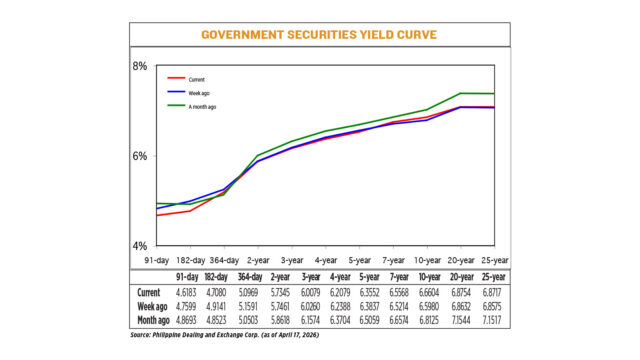
At the short end, yields fell across all tenors. Rates of the 91-, 182, and 364-day Treasury bills dropped by 14.16 bps (to 4.6183%), 20.61 bps (4.708%), and 6.22 bps (5.0969%), respectively.

Rates at the belly ended mostly lower, with the two-, three-, four-, and five-year Treasury bonds (T-bonds) dropping by 1.16 bps (to 5.7345%), 1.81 bps (6.0079%), 3.09 bps (6.2079%), and 2.85 bps (6.3552%), respectively. Meanwhile, the seven-year debt rose by 3.54 bps to yield 6.5568%.

On the other hand, the long end moved higher. Yields on the 10-, 20-, and 25-year bonds climbed by 6.24 bps (to 6.6604%), 1.79 bps (6.8754%), and 0.85 bp (6.8717%), respectively.

GS volume traded reached P42.76 billion, lower than the P68.27 billion recorded the previous week.

Traders said developments in the Middle East conflict took center stage for bond markets last week.

“Bond yields broadly declined over the week as participants welcomed the resumption of diplomatic talks between US and Iran, despite the apparent failure of the first stage of discussions from last weekend,” the first bond trader said.

“As tensions appeared to ease, risk appetite gradually returned, with the week ending with a slight upward pressure on yields,” the second bond trader added. “That said, the adjustment was likely measured rather than aggressive given that geopolitical risks remain fluid.”

Meanwhile, rate hike hints from BSP Governor Eli M. Remolona, Jr. led to “bearish” sentiment towards the end of the week, the second trader said.

“Investors responded by prioritizing short-term to belly tenors (two to five years)… in order to avoid the duration risk that came with the longer end of the yield curve. Additionally, demand for higher yields was observed on the belly to long end as [this] week’s meeting is anticipated to include a policy rate hike,” the trader said.

The first trader said that the above-target inflation print in March could push the BSP to hike benchmark interest rates this week.

“This move could help in arresting any upward spillover in inflation expectations from second-round effects, which is very critical in fulfilling the BSP’s price stability mandate.”

The Monetary Board will meet to review policy on Thursday (April 23). In a BusinessWorld poll, 11 of 19 analysts said they expect the BSP to begin tightening to stave off second-order inflation impact from the global oil price shock.

Mr. Remolona told BusinessWorld on the sidelines of the International Monetary Fund and World Bank’s 2026 Spring Meetings in Washington, D.C. last week that the central bank has room to raise rates to temper rising inflation amid the Middle East conflict as they expect government spending to support growth.

The Monetary Board last raised rates in October 2023. Its policy rate now stands at 4.25% following 225 basis points worth of cuts since it began its easing cycle in August 2024.

In an off-cycle meeting last month, it left benchmark interest rates unchanged, but said that they remain vigilant about potential price risks amid the war.

For this week, the traders said that besides the Middle East war, the BSP’s policy meeting will be one of the main trading drivers for the market.

“Yields might remain sideways as the market participants will likely remain on watch ahead of the BSP meeting. Nevertheless, traders are expected to look for policy cues about the assessed inflationary path by the BSP that could hint at its future monetary actions,” the first bond trader said. “Any positive progress on the diplomatic talks between US and Iran could likewise pull yields lower.”

“Local yields are likely to exhibit upward-biased movement due to policy rate hike expectations in [this] week’s Monetary Board meeting,” the second trader added. “Investors would likely remain cautious, waiting for concrete progress in peace negotiations and broader macroeconomic stability before materially reducing bond exposure, especially since both negotiating parties have been going back and forth for so long.” — M.M.L. Castillo

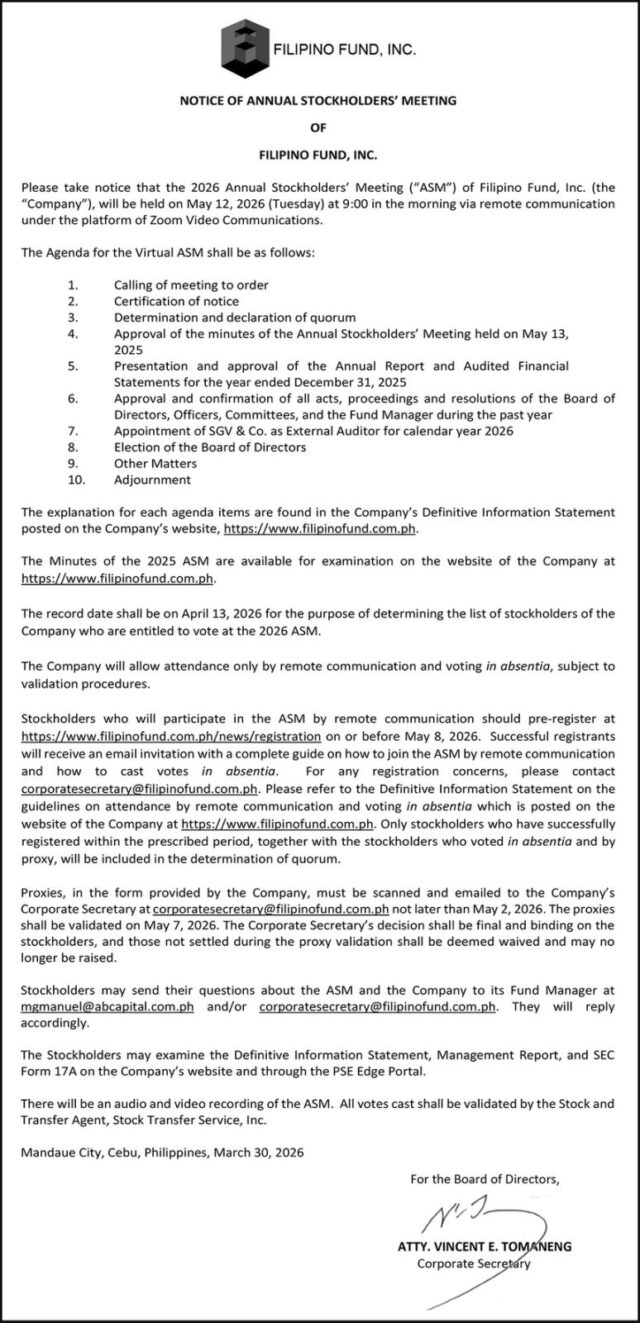
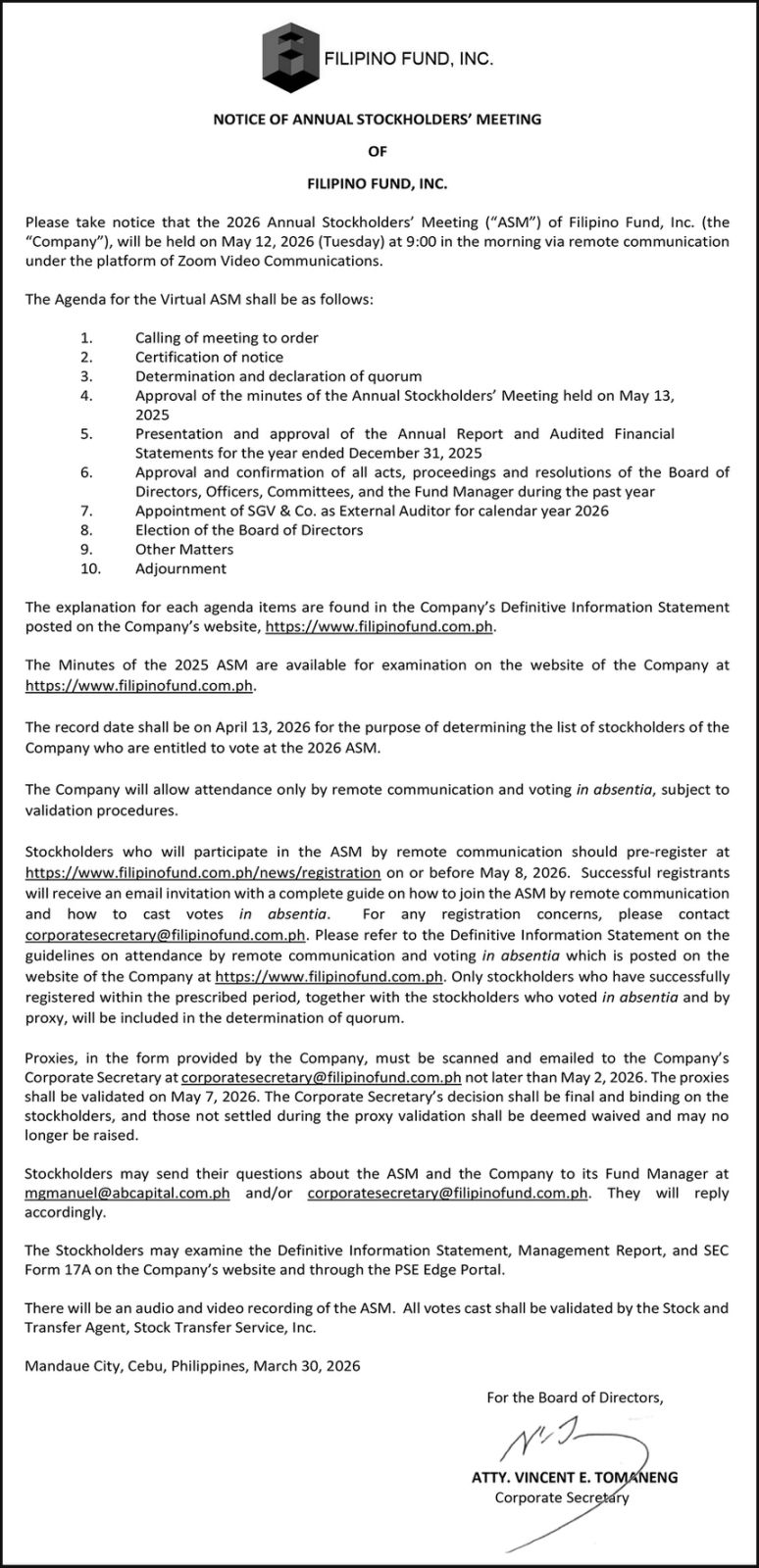
Filipino Fund, Inc. to hold 2026 Annual Stockholders’ Meeting on May 12 via remote communication


Spotlight is BusinessWorld’s sponsored section that allows advertisers to amplify their brand and connect with BusinessWorld’s audience by publishing their stories on the BusinessWorld Web site. For more information, send an email to online@bworldonline.com.

Join us on Viber at https://bit.ly/3hv6bLA to get more updates and subscribe to BusinessWorld’s titles and get exclusive content through www.bworld-x.com.

UE expands scholarships for SY 2026-2027 ahead of 80th founding anniversary

The University of the East (UE) has opened scholarships for school year 2026-2027 to support academically qualified students, as it prepares to mark its 80th founding anniversary in September.

UE President and Chief Academic Officer Zosimo Battad said the scholarship initiatives reflect the university’s continuing commitment to access and inclusion in higher education as enrollment for the incoming academic year opens in May.

“As UE approaches its 80th year, we continue to strengthen pathways to access and opportunity in higher education through our scholarship programs to support qualified and deserving students,” said Mr. Battad.

Among the flagship programs is the UE-Tan Yan Kee Foundation, Inc. legacy scholarship, in partnership with the corporate social responsibility arm of the LT Group of Companies. It covers full tuition and miscellaneous fees, along with allowances for books, transportation, and uniforms, and monthly stipend. Scholars may continue to receive benefits for the duration of their degree program, subject to maintaining prescribed academic requirements per semester.

UE also offers entrance scholarships for academically high-achieving senior high school graduates from both public and private schools. These include students who graduated with highest honors, high honors, and honors.

Additional financial assistance mechanisms include special tuition discounts for Filipino senior high school graduates, children of UE alumni, overseas Filipino workers, and dependents of employees of LT Group member-companies.

UE also provides athletic service grants for student-athletes competing at the University Athletic Association of the Philippines, as well as cultural service grants for students who qualify for membership in UE’s performing groups, including the UE Chorale, UE Silanganan Dance Troupe, UE Band, and UE Drama Company.

A separate Student Financial Assistance Program also provides up to P15,000 per semester to support qualified undergraduate students.

Interested applicants may inquire or apply via www.ue.edu.ph or on campus at the UE Admissions Office in Manila or Caloocan.

UE operates campuses in Manila and Caloocan, offering programs from basic education to graduate studies in fields such as law, dentistry, engineering, business, fine arts, and information technology. UE Manila holds an autonomous status from the Commission on Higher Education (CHED), while UE Caloocan is CHED-deregulated. A new UE campus is rising in Eton City, Sta. Rosa, Laguna, its first expansion outside Metro Manila.

UE currently ranks fifth among Philippine private universities in Asia in the Applied Higher Education Private University Ranking: All Asia, and number six in Manila and number 16 in the Philippines based on EduRank.org. Its College of Computer Studies and Systems continues to be recognized by CHED as a Center of Excellence in Information Technology education.


SparkUp is BusinessWorld’s multimedia brand created to inform, inspire, and empower the Philippine startups; micro, small and medium enterprises (MSMEs); and future business leaders. This section will be published every other Monday. For pitches and releases about startups, e-mail to bmbeltran@bworldonline.com (cc: abconoza@bworldonline.com). Materials sent become BW property.

German pork import ban lifted after ASF regionalization deal

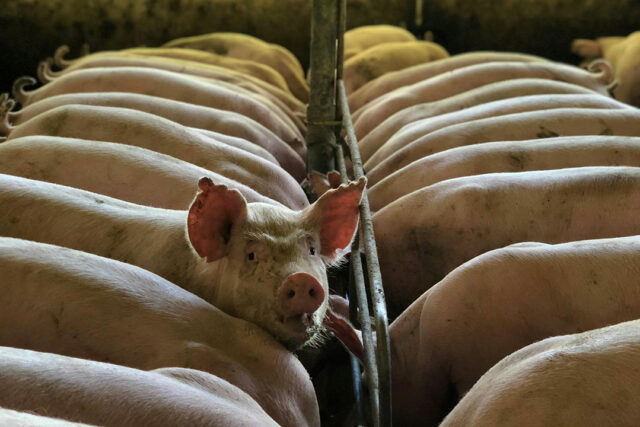
STOCK PHOTO | Image by Barbara Barbosa from Pexels

THE Department of Agriculture (DA) said it lifted its temporary ban on imports of swine products from Germany following a bilateral agreement recognizing regionalization measures for African Swine Fever (ASF).

In Department Circular No. 18, the DA said it now recognizes Germany’s regionalization approach for ASF, allowing the resumption of imports of pork and related by-products from designated disease-free zones. 

The Philippines imposed a ban in 2020 to prevent the entry of ASF through imports of live pigs and pork products from Germany, one of Europe’s largest hog producers.

According to the circular, the DA’s Bureau of Animal Industry found that Germany maintains “sufficient veterinary oversight” and has implemented control and mitigation measures that reduce the risk of ASF transmission from identified regions.

The DA said the decision was based on compliance with Administrative Circular No. 12, Series of 2025, which sets guidelines for bilateral recognition of regionalization for ASF among accredited exporting countries. 

Under ASF regionalization rules, live swine must come from ASF-free zones, show no clinical signs of infection, and avoid restricted areas during transport.

Pork products must also originate from ASF-free regions, be transported in sealed vehicles directly to approved slaughterhouses, and pass both ante- and post-mortem inspections.

Exporting countries’ veterinary authorities must also provide detailed reports on ASF surveillance, control measures, and boundaries of ASF-free regions. — Vonn Andrei E. Villamiel

ADVERTISEMENT
ADVERTISEMENT