Home Blog Page 2930

PHL rice imports hit 2.37 million MT as of July 11

BW FILE PHOTO

THE PHILIPPINES’ rice imports totaled 2.37 million metric tons (MT) as of July 11, according to data from the Bureau of Plant Industry.

Shipments for the first two weeks of July alone amounted to 35,594 MT, data from the agency showed. These were already imported under the lower tariff regime, Agriculture Assistant Secretary and Spokesperson Arnel V. de Mesa said in a briefing on Friday.

Last month, President Ferdinand R. Marcos, Jr. signed Executive Order (EO) No. 62, which lowered the tariff on imported rice to 15% from 35% until 2028. The order is aimed at reducing prices of the staple.

The Department of Agriculture (DA) earlier said the EO is expected to lower the retail price of rice by about P6 to P7 per kilogram.

Meanwhile, in the first semester, rice imports amounted to 2.33 million MT, 25.3% higher than the 1.86 million MT recorded in the same period last year, the data showed.

Vietnam remained the top supplier of rice with total shipments at 1.76 million MT as of July 11, accounting for 74.3% of the total.

The Philippine and Vietnamese governments signed an agreement giving the Philippines an annual quota of 1.5 million to 2 million MT of rice for five years.

Thailand supplied 358,727 MT during the period or 15.1% of the total. It was followed by Pakistan with 151,883 MT or a 6.4% share.

Rounding out the top five were Myanmar and India, which shipped 66,120 MT (2.7%) and 21,745 MT (0.92%) of rice, respectively.

The Philippines imports about 20% of its rice requirement amid insufficient domestic production.

The US Department of Agriculture raised its Philippine rice import estimates for 2024 to 4.7 million MT from 4.6 million MT previously due to the increased shipments seen during the first half of the year.

Meanwhile, palay or umilled rice production is projected to decline by 8.6% to 3.88 million MT this year from the 4.25 million MT in actual output in 2023, according to the Philippine Statistics Authority. For its part, Agriculture department expects palay output to hit 20.44 million MT in 2024.

Former Agriculture Undersecretary Fermin D. Adriano said rice imports may pick up further in the coming months due to the projected decline in production amid the El Niño weather phenomenon and the incoming La Niña spell during the fourth quarter.

Rice imports may increase amid the reduced tariff on the commodity, Federation of Free Farmers National Manager Raul Q. Montemayor added.

“Retail prices would be around P50 per kilo — maybe lower but not by much, or it could go higher if traders are able to sell higher in order to increase their profits,” Mr. Montemayor said in a Viber message.

“We will also have to watch Vietnam if they will raise their export prices in response to the tariff cut to 15%,” he added.

According to the DA’s price monitoring of Metro Manila markets, imported well-milled rice cost between P51 and P54 per kilo as of July 20, while regular milled rice cost was priced at P47-49 a kilo. — A.H. Halili

Free trade deals with EU, UAE seen to lift FDI inflows

A EUROPEAN UNION’S flag flutters outside the European Commission headquarters in Brussels, Belgium, Oct. 15, 2020. — REUTERS

FOREIGN direct investments (FDIs) into the Philippines are expected to get a lift once the free trade agreements (FTAs) with the European Union (EU) and United Arab Emirates (UAE) are finalized, the Philippine Exporters Confederation, Inc. (Philexport) said.

Philexport President Sergio Ortiz-Luis, Jr. said the Philippines had one of the lowest number of new projects that received FDIs within the Asia-Pacific region last year.

“Still, there are reasons to remain hopeful; one is that the EU-Philippines FTA, expected to be finalized by 2027, will boost two-way trade and investment by 6 billion euros, or around P367.7 billion,” he said at the Philexport’s general membership meeting on July 9.

In 2023, FDI net inflows dropped by 6.6% to $8.9 billion from $9.5 billion in 2022. This was the second straight year of lower net inflows of FDI into the Philippines.

For the first four months of 2024, FDI net inflows jumped by 18.7% to $3.525 billion.

Mr. Ortiz-Luis said the sectors that are expected to benefit from the EU-Philippine FTA include renewable energy, electronic manufacturing, data analytics and software, agriculture, and fishery processing.

Earlier this year, the EU and the Philippines formally resumed FTA negotiations seven years after talks were stalled due to the trade bloc’s concern over human rights violations under the previous administration.

THIRD ROUND
Meanwhile, Trade Undersecretary for International Trade Group Allan B. Gepty said the next round of negotiations for the EU-Philippines FTA are scheduled to start on Oct. 14.

“You can look at it as the third round of negotiations because we already had two, or you can also refer to it as a new round, but of course the elements or chapters that will be discussed there will be more comprehensive,” he said in a press briefing on July 19.

At a minimum, Mr. Gepty said the Philippines will try to secure from the FTA the same benefits it gets from the EU Generalized Scheme of Preferences Plus (GSP+).

The GSP+ scheme, which was extended to run through 2023, grants the Philippines zero duties on 6,274 locally made products.

“And then, of course, we will negotiate to liberalize the rules of origin so we can at least source some raw materials from other countries and be able to export them to the EU,” Mr. Gepty said.

FREE TRADE DEAL WITH UAE
The Philippines also targets to conclude negotiations on the Comprehensive Economic Partnership Agreement (CEPA) with the UAE by October.

Mr. Gepty told BusinessWorld that the Philippines just recently concluded the second round of negotiations two weeks ago, while the third round is expected in the last week of August.

“So far, our progress is still on track. We achieved significant progress on several chapters in the second round, so we’ll focus now on market access negotiations in the third round,” he said.

“And hopefully on the fourth round, which will be in October, it will just be more of addressing the remaining issues,” he added.

If completed, the CEPA with the UAE will be the country’s first trade deal with a Middle Eastern country, which is expected to provide access to other Gulf Cooperation Council states.

“This FTA is important as our interest in the UAE is not just employment opportunities but also business opportunities … That is what we want to optimize with this FTA,” he said.

“Our target, hopefully, is to conclude this by October, which will be just before a state visit scheduled in November in time for the celebration of our 50th diplomatic anniversary with the UAE,” he added. — JIDT

DTI studying free trade pacts with LatAm, African countries

BW FILE PHOTO

THE PHILIPPINES is exploring free trade agreements (FTAs) with Canada and Chile, as well as other countries in Latin America (LatAm) and Africa, the Department of Trade and Industry (DTI) said.

Trade Undersecretary for International Trade Group Allan B. Gepty said that the DTI is looking at free trade deals with Latin American and African countries in answer to the President’s call to expand trade with more countries.

Mr. Gepty told a news briefing on Friday that the DTI is seeing progress in exploring an FTA with Chile.

“We just need to update the feasibility study of having a bilateral FTA with Chile, and hopefully within the year we will be able to formally announce the result of the study,” he said. “But most probably it would turn out positive.”

In terms of products, Mr. Gepty said that the FTA is expected to expand market access for Philippine agricultural and processed products, as well as semiconductors. It will also give the Philippines more access to Chile’s wine products, among others.

“But more than the goods, what is also important in this engagement with Chile would be on the services and investment side,” he said.

“They are also interested in critical minerals and, of course, our professionals in research, development, and innovation, which Chile is known for,” he added.

Meanwhile, Mr. Gepty said that talks around the FTA with Canada have already started but are still in the exploratory stage.

He said the Philippines is also looking to accede to the Comprehensive and Progressive Agreement for Trans-Pacific Partnership (CPTPP). The CPTPP is an FTA between 11 countries, which are Australia, Brunei, Canada, Chile, Japan, Malaysia, Mexico, New Zealand, Peru, Singapore, and Vietnam.

Last year, the United Kingdom (UK) signed the protocol of accession to join the CPTPP, and its entry into force is expected by the second half of 2024.

“We’re pursuing that, and we’re eyeing, hopefully, to at least formally apply for it this year. It’s a good FTA for the Philippines in the sense that once we become a party of the CPTPP, the value added here, in terms of market access, will be Chile, Mexico, Peru, and also Canada,” he said.

“And now that the UK is there, there is more reason for us to join so that our market access will be more comprehensive,” he added.

Mr. Gepty said the International Trade Group is still looking at possible candidates for an FTA in Africa.

“But this is for the medium-term direction. So, we will still have to conduct feasibility studies on that,” he added.

The Philippines is part of multilateral FTAs, including the Regional Comprehensive Economic Partnership, the European Free Trade Association, and the ASEAN+6 FTA.

It also has bilateral agreements with Japan and South Korea, with the latter waiting to be ratified. 

Meanwhile, there are ongoing negotiations for the European Union-Philippines FTA and the Philippines-United Arab Emirates Comprehensive Economic Partnership Agreement. — Justine Irish D. Tabile

Philippines fails to hit select core development targets

PHILIPPINE STAR/BALDEMOR

THE PHILIPPINES missed some of its targets for 2023 core development indicators like food inflation and poverty reduction, according to a report from the Philippine Statistics Authority (PSA).

According to the Statistical Indicators on Philippine Development 2023 report released on Monday, poverty incidence in 2023 was at 15.5%, lower than the target range of 16.0-16.4% stated in the Philippine Development Plan  2023-2028.

Food inflation in 2023 was 8%, higher than the 2-4% target.

Meanwhile, the Philippines’ ranking in the global innovation index was at 56th out of 132 economies.

Subsistence incidence, or the proportion of Filipinos whose income is not enough to meet their basic food needs, fell to 4.3% last year from 5.9% in 2022, but was still above the 2.5-3.5% target.

The PSA said some indicators with high probabilities of meeting their respective targets for 2028 were capital adequacy, profitability, liquidity, and primary expenditure-to-gross domestic product (GDP) ratio.

It classified 33.3% of the 374 indicators to have a “low likelihood” of being achieved as of 2023. Six out of 14 categories of indicators were classified as having at least 50% of their indicators turning in “average to good” performance. Meanwhile, four categories were estimated to have at least 50% of their indicators turning in “poor” performances.

Philippine GDP expanded by 5.5% in 2023, below the 6.0-7.0% target range.

Meanwhile, the unemployment rate in 2023 dropped to 4.3% against a target of 4.4-4.7%, while the underemployment rate stood at 12.3%.

In terms of governance, among the categories seen as having an average chance of meeting their targets by 2028 were the corruption perception index and local government units with local cultural inventories.

Meanwhile, the indicator categories classified to have a “poor” likelihood of hitting their targets were social protection, trade and investment, industry, agriculture and agribusiness. — Lourdes O. Pilar

CCAP launches campaign to improve understanding of credit card terms

PJCOMP-FREEPIK

THE CREDIT CARD Association of the Philippines (CCAP) is launching an awareness campaign simplifying credit card terminologies to help improve financial literacy.

The campaign is meant to “bridge the gap between regulatory language and everyday understanding,” CCAP said in a statement on Monday.

“This initiative aims to ensure that credit cardholders can easily grasp the essential information, promoting better financial decision-making,” it added.

CCAP is an organization that aims to mediate between the credit card industry, merchants, and consumers. It has 16 member institutions.

The group will share the simplified credit card terminologies through various formats such as comics and videos across social media platforms, including Facebook, Instagram, TikTok, and YouTube.

Some of the credit card terms often misunderstood by consumers cited by CCAP are payment due date, total and minimum amount due, late penalties, interest charges, credit limit, billing cycle or cut-off date, and card verification value or CVV.

“By fully understanding the credit card terminologies, consumers can reap the full benefits of their credit card, such as using it interest-free by paying in full on or before the due date or maximizing the credit float by making large purchases just after the billing cutoff date to enjoy up to 51 days of credit without interest, thereby managing their cashflows more effectively,” CCAP Executive Director Alex G. Ilagan said in a statement on Monday.

This campaign forms part of CCAP’s advocacy to push for responsible credit and enhance credit card literacy in the country, it said.

The group’s other initiatives include appearances on public service radio and TV programs to discuss credit card issues, releasing educational materials via print and social media, conducting seminars at educational institutions, and hosting webinars for private and public sector employees, and participation in international conferences, among others.

Credit card spending increased by 29% year on year to P853 billion in the first half of 2023, according to latest CCAP data.

The banking system’s credit card receivables increased by 30.1% year on year to P722.6 billion as of end-December 2023, central bank data showed. — AMCS

Philippines tenders for up to 240,000 tons corn, traders say

REUTERS

HAMBURG — An importer group in the Philippines has issued an international tender to buy up to 240,000 metric tons of animal feed corn, European traders said on Monday.

The deadline for submission of price offers in the tender is believed to be on Wednesday, July 24.

Arrival in the Philippines was sought in four consignments.

One 70,000-ton consignment was sought for arrival between Oct. 16-31, one of 60,000 tons for between Nov. 1-15, one of 60,000 tons for between Dec. 16-30 and another of 50,000 tons also for Dec. 16-30 arrival.

It is possible that not all consignments will be purchased, traders said. — Reuters

To give credit where credit is due

“A gape” is an ancient Greek word usually defined as unconditional love, which is to give without expecting to receive anything in return. Despite having this world full of love, sometimes there are things that need reciprocity. An example is the contract of sale, which, according to the Civil Code, consists of contracting parties in which one obligates himself to transfer ownership and deliver a determinate thing and the other to pay a price certain in money or equivalent. This means that the seller shall give something to the buyer and expect to receive payment from the latter. For value-added tax (VAT) purposes, what would happen if the other one failed to compensate?

Generally, VAT-registered persons subject their sales to VAT. The next question is, when should the sales be subject to VAT? Republic Act No. 11976, also known as the Ease of Paying Taxes (EoPT) Act, adopted the accrual basis for VAT recognition for both the sale of goods and services. Hence, sellers of goods and services are required to remit VAT regardless of whether the amount has already been collected from the buyer or not. With that, there is a possibility that the sellers will be shouldering VAT for sales that may be uncollectible.

OUTPUT VAT CREDIT ON UNCOLLECTED RECEIVABLES
To address this concern, the EoPT Act also introduced the Output VAT credit on uncollected receivables, which was implemented upon the effectivity of Revenue Regulations (RR) No. 3-2024 in April 2024. This will allow sellers of goods and services who previously remitted the VAT on sales that were not yet collected after the lapse of the credit term to use the VAT paid as credit for the Output VAT reported in the next quarter after the lapse of the said credit term.
To ensure that the sellers are entitled to VAT credit, all of the following must be observed pursuant to RR No. 3-2024, which was clarified under Revenue Memorandum Circular (RMC) No. 65-2024 issued on June 13, 2024:

1. The sale has been made after the effectivity of RR No. 3-2024, or April 27, 2024;

2. Both parties agreed that the buyer will pay at a certain period and that the credit term is indicated on the invoice or any written document;

3. The VAT is separately shown on the invoice and declared in the quarterly VAT return within the period prescribed under existing rules;

4. The buyer is separately identified in the Summary List of Sales during the quarter when the sale was made and not reported under “various” sales;

5. The credit term, whether extended or not, has already lapsed; and

6. The VAT component of the uncollected receivable was not claimed as deductible bad debts for income tax purposes.

SELLER’S PERSPECTIVE
Once the entitlement has already been established, the seller may claim the VAT credit in the next quarter after the lapse of the credit term. Suppose that the lapse of the credit term falls on the quarter ending Sept. 30, 2024. The VAT credit is allowed to be claimed in the quarter ending Dec. 31, 2024. The seller is required, however, to stamp “Claimed Output VAT Credit” on the seller’s copy of the related invoice.

In cases of partial collection, the amount collected, and the remaining uncollectible amount shall be separately indicated. The seller may, at its option, also issue a supplementary document such as a credit memo or credit note, provided that the phrase “Claimed Output VAT Credit” and the related invoice are indicated in such a document. Once the stamped invoice and supplementary documents, if any, are secured, the seller is required to provide a copy to the buyer, as they must also reverse the claimed Input VAT.

If the receivable was subsequently recovered after the claiming of the VAT credit, the corresponding VAT of the collected amount shall be declared in the VAT returns during the taxable quarter when the collection was made. Failure to report the said amount will subject the seller to a possible VAT deficiency and applicable penalties.

Moreover, the seller is required to stamp “Recovered” on the seller’s copy of the related invoice. In cases of partial recovery, the collection and remaining uncollectible amount shall be separately indicated. The seller may also issue a supplementary document, such as a debit memo or debit note, provided that the phrase “Recovery of Previously Reported Uncollected Receivable” and the related invoice are indicated in such a document. Once the stamped documents are secured, the seller is required to provide a copy to the buyer to claim the previously disallowed Input VAT.

Since there is a possibility of recovery of previously uncollected receivables, sellers may not necessarily claim the VAT credit if there is a high chance that the buyer pays the credit despite the lapse of the term. Provided that this availment is merely an option, sellers may consider first the likelihood of collectability to avoid the burden of claiming credit and subsequent reversal recovery.

However, failure to claim the Output VAT credit on the next quarter after the lapse of the credit term will no longer allow the seller to claim the same afterwards and can only demand the buyer to pay what is due or to return the sold goods to recover the output VAT shouldered due to such sales.

BUYER’S PERSPECTIVE
Upon receipt of the documents from the seller evidencing VAT credit, the buyer shall deduct the corresponding Input VAT previously claimed. However, despite the non-receipt of such documents, the buyer can voluntarily reverse the Input VAT in the quarterly VAT returns. Failure to deduct the said amount will subject the buyer to a possible VAT deficiency and applicable penalties.

Subsequently, if the buyer was able to pay, either fully or partially, after the seller’s availment of the VAT credit, the buyer may claim the previously disallowed Input VAT upon receipt of the documents evidencing recovery from the seller.

With the additional load brought by this scenario, the relationship between the two parties might be compromised. Hence, buyers shall consider their capacity to pay before entering into the agreement. In any case where the buyer may not be able to pay on time after what was agreed upon, the buyer may request a possible extension to fulfill the obligations, provided that it is indicated in the invoice or any document showing the extended credit term.

PRESENTATION TO THE VAT RETURNS
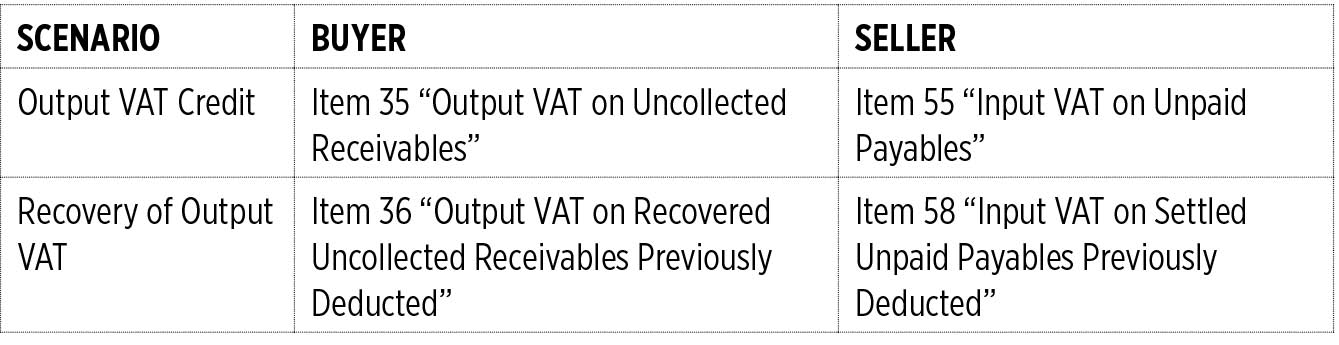
The BIR issued RMC No. 68-2024 on the availability of the revised Quarterly VAT returns (BIR Form No. 2550Q – April 2024 ENCS version), which include the following items to be used by the seller and buyer for the purpose of Output VAT credit. (see the table)

However, this version is not yet available in the Electronic Filing and Payments System (eFPS) and Electronic BIR Forms (eBIRForms).  Accordingly, for eFPS and eBIRForms filers who are not required to report any amount related to Output VAT credit, they may still use the existing version of the return available in their respective systems.

Please note, however, that if eFPS and eBIRForms filers are required to report on any of the above items, they shall file the return manually by downloading and printing the revised return available on the BIR website (www.bir.gov.ph) under the BIR Forms — VAT/Percentage Tax Returns section and filling out all the applicable fields. If the return has a VAT payable, payment shall be made through any authorized agent bank (AAB) or with the Revenue Collection Officer (RCO) under any Revenue District Office (RDO).

Some eFPS and eBIRForms fillers, however, are hoping that the BIR will consider allowing them to just use the VAT return available in the system rather than manual filing, as online filing is more efficient and convenient.

TO GIVE CREDIT WHERE CREDIT IS DUE
Taxpayers may have a hard time dealing with these notable changes, coupled with several questions to ensure their compliance with tax matters. However, the government’s vision to ease paying taxes did not stop with just implementing the Act. With the BIR’s continuous efforts to address concerns raised by taxpayers with these revenue issuances, it is proper to give credit where credit is due.

Let’s Talk Tax is a weekly newspaper column of P&A Grant Thornton that aims to keep the public informed of various developments in taxation. This article is not intended to be a substitute for competent professional advice.


Raymart F. Cinco is a senior in-charge of the Tax Advisory & Compliance division of P&A Grant Thornton, the Philippine member firm of Grant Thornton International Ltd.

pagrantthornton@ph.gt.com

The West Philippine Sea is ours – Marcos

Screenshot from RTVM's live stream of Pres. Ferdinand R. Marcos, Jr.'s third State of the Nation Address

President Ferdinand “Bongbong” R. Marcos, Jr. expressed a firm stance on the Philippines’ claim to the West Philippine Sea (WPS) amidst ongoing negotiations with China aimed at maintaining peace. 

Ang West Philippine Sea ay hindi kathang-isip natin lamang; ito ay atin. At ito ay mananatiling atin hangga’t nag-aalab ang diwa ng ating minamahal na bansang Pilipinas [The West Philippine Sea is not a figment of our imagination; it is ours. This will remain ours so long as the spirit of our beloved country, the Philippines, burns bright],” Mr. Marcos said during his third State of the Nation Address (SONA) at the Batasan Pambansa.  

Mr. Marcos stressed the importance of peace as the sole acceptable method for settling conflicts, highlighting the fact that the nation is set to lead and organize the ASEAN (Association of Southeast Asian Nations) Summit in 2026. 

“We continuously strive to find ways to deescalate tensions in contested areas with our counterparts without compromising our position and our principles.” 

The country is bolstering its defensive posture by enhancing aerial and maritime domain awareness, through self-reliance and partnership with allied states, he said.  

Mr. Marcos also guarantees that the country will enhance awareness of issues over the West Philippine Sea, especially among the youth and for future generations.  

“Laws on our maritime zones and archipelagic sea lanes make sure that this intergenerational mandate will firmly take route in the hearts and minds of the Filipino people,” he explained.    

These bold statements from the Philippine president were applauded by attendees, who responded with a standing ovation. 

“The Philippines cannot yield. The Philippines cannot waiver,” Mr. Marcos said. 


Defending sovereign rights, one of Marcos’ major accomplishments  

A law analyst emphasized that one of Mr. Marcos’ major achievements is his defense of sovereign rights over the West Philippine Sea.  

“We gain the trust of our security allies that we have a more reliable defense posture… We proved our military’s professionalism, increased the military’s morale… Evolve ourselves with strategic alliances with a number of countries,” Jemy Gatdula, the Dean of the Institute of Law at the University of Asia and Pacific said in an interview. 

Mr. Gatdula emphasized that Marcos’ administration’s foreign policy is independent due to its key efforts to gather support from the international community.  

“The Marcos administration is very much pro-Filipino just because of the fact that we decided to gather the support of the international community: US, Japan, Australia… EU (European Union), ASEAN… that all of it is the exercise of an independent foreign policy,” Mr. Gatdula said.  

The Philippine government voluntarily initiated these defense agreements with international communities without being coerced, indicating that the Philippines maintains its independent foreign policy, he furthered. – Edg Adrian A. Eva

SGA sweeps Jones Cup with OT win against Chinese Taipei-A

STRONG GROUP ATHLETICS-PILIPINAS — JONES CUP/SGA

STRONG GROUP-PILIPINAS hacked out a thrilling 83-79 comeback win in overtime (OT)  against Chinese Taipei-A to cap a perfect title run in the 43rd William Jones Cup over the weekend in Taiwan.

The Philippine representative erased a seven-point deficit in the final minute of regulation before pulling through in extra session to score an 8-0 sweep and bring home the country’s seventh overall title in the annual invitational tournament.

Mighty Sports, also under the tutelage of now Strong Group Athletics (SGA) mentor Charles Tiu, was the last Philippine team to win the Jones Cup in 2019 as Rain or Shine from the PBA finished seventh last year.

There was no stopping the Filipino cagers this time around, even at the jaws of a 64-71 deficit with only 1:08 to play on the road.

American reinforcement Tajuan Agee shrugged off his illness that sidelined him in the past two games by hauling down 21 points, seven rebounds, three assists, two steals and a block to spearhead Strong Group.

Mr. Agee’s eruption made up for Chris McCullough’s untimely struggle as he bled for only 12 points on a dismal four-of-16 shooting after leading Strong Group in the first seven games.

He drew solid coverage from Fil-American ace DJ Fenner and RJ Abarrientos with 15 and 14 points, respectively.

Floor general Kiefer Ravena also chipped in nine points, four rebounds, four assists and two steals, including the go-ahead triple to punctuate Strong Group’s 9-0 run for a 73-71 lead in the last 13 seconds.

Chinese Taipei went on to force OT with Brandon Gilbeck tipping in a bucket off a Rhenz Abando block as Mr. Ravena misfired his game-winner.

It was all Strong Group in the extra time with Mr. McCullough saving his best for last by drilling a crucial jumper to hand the Filipinos an 80-78 lead that they just protected heading home.

Robert Tsang Hinton (16), Chen Ying Chun (13), Gilbeck (11) and Tseng Hsiang Chun (10) led the fight for Chinese Taipei A, which also went unbeaten in seven games before a tough loss at home in the virtual gold medal match.

Jones Cup features a single-round robin format with the No. 1 team at the end of the eliminations securing the title right away. — John Bryan Ulanday

Team Manila clinches softball girls’ under-18 Pony World Series title

TEAM MANILA — FACEBOOK.COM/TEAMMANILASOFTBALL

TEAM MANILA showed last year’s domination was no fluke as it topped the softball girls’ 18-under Pony World Series at the Municipal Park (Bicentennial) grounds in McAllen, Texas in the United States over the weekend.

The Filipinas blanked the Texas Futures belles, 3-0, in the championship round to crown themselves champions of the prestigious annual tournament for the second straight year.

While it wasn’t as immaculate as a year back when the country swept their way to the crown, it was still as impressive as it only conceded one match, which came in a stinging 2-0 defeat against the Texans in Pool Four of the group stages.

But fittingly though, Manila came back roaring from that defeat by beating Texas Futures in a gripping 1-0 result in the playoff round and the most important stage of all — the finals.

The Filipinas’ other victories came at the expense of La Mochis-Ahome twice, 7-2 and 11-3, Force Fastpitch, 6-1, Nogales-Nogalense, 6-2, and Glory Atkins Bejar, 10-9, in the pool stage, and RGV Pride, 4-2, in the playoff round leading up to the finale.

Interestingly, Team Manila’s amazing back-to-back title reign replicated what the country achieved before the pandemic when it reigned supreme two in a row in 2017 and 2018.

And don’t be surprised if Manila shoots for a three-peat next year. — Joey Villar

Canino to pursue GM title at European chess circuit

RUELLE CANINO — FACEBOOK.COM/BANGKOKCHESSCLUB

TEENAGE sensation Ruelle Canino will leave soon to wade into the deep and murky waters of the European chess circuit where she hopes to pursue her dream of becoming the country’s next Woman Grandmaster (WGM).

The 16-year-old reigning national women’s champion will participate in the HZ University of Applied Sciences Chess Tournament slated Aug. 3 to 10 in Vlissingen, the Netherlands, the Dortmund Open set Aug. 10 to 18 in Germany and the Open Internacional D’escacs Santis-Ciutat de Barcelona scheduled Aug. 23 to Sept. 1 in Spain.

It will also serve as part of her preparation for the Asian Indoor and Martial Games slated this November in Thailand and the FIDE World Chess Olympiad set Sept. 10 to 23 in Budapest, Hungary.

In Vlissingen, the Far Eastern University star will join fellow national team mainstays WGM Janelle Mae Frayna, whom the former would like to emulate, and Woman International Master Jan Jodilyn Fronda, who left the country recently for a tournament in Switzerland.

“She will use this European tour to become a WGM and improve her game just like Janelle (Frayna) did when she was then pursuing the WGM title,” said national women’s team coach and NCFP CEO GM Jayson Gonzales, whose trip is funded by the Philippine Sports Commission.

Ms. Canino and the lean but mean delegation will then fly back to the country Sept. 3 and then will leave the country a few days later alongside the rest of the Philippine squad including the GM Eugene Torre-coached men’s team for Budapest where they will battle the world’s best and brightest. — Joey Villar

Ardina finishes joint seventh at Dana Open in Ohio

DOTTIE ARDINA — PHILIPPINE STAR FILE PHOTO

DOTTIE ARDINA boosted her stock ahead of her Paris Olympics debut as she posted her best finish in the LPGA Tour at joint seventh in the Dana Open in Sylvania, Ohio on Sunday.

Saving the best for last, Ms. Ardina went bogey-free and racked up five birdies in the last nine holes of the Highland Meadows Golf Club en route to a closing 66 and a 72-hole aggregate of 10-under 274.

From 26th after three rounds, the ICTSI-backed Pinay leapfrogged to No. 7 in the final standings and surpassed her previous LPGA high of tied 10th in last year’s Walmart NW Arkansas Championship.

The 30-year-old Ms. Ardina banked a cool $38,232 (around P2.23 million) in clinching her second Top 10 finish in the premier tour. It was also her biggest earning to date, eclipsing her $37,933 take in Arkansas.

Ms. Ardina, who had earlier rounds of 71, 69 and 66 in the $1.3-million event held three weeks before the women’s golf competition in Paris, finished 10 strokes behind winner Chanettee Wannasaern of Thailand.

Ms. Wannasaern, 20, birdied her last two holes to shoot a 67 for a 264 that powered her to a one-stroke victory over Korean Haeran Ryu (265 after a 65).

Taiwanese Ssu-Chia Cheng (68) and Swedish Linn Grant (68) shared third at 270 ahead of fifth-placed Chinese bets Mary Liu (69) and Xiyu Lin (70) at 272.

Ms. Ardina was joined at seventh by Thai Jasmine Suwannapura (68), Norwegian Celine Borge (69), American Stacy Lewis (70), Australian Sarah Kemp (70) and Korean Hye-Jin Choi(70). — Olmin Leyba

ADVERTISEMENT
ADVERTISEMENT