Home Blog Page 2928

Harvesting the fruits of a deepening international partnership

Photo from pco.gov.ph

In April, the Philippines, the United States, and Japan have recently announced a significant partnership for the development of the Luzon Economic Corridor. The move aims to accelerate investments in critical sectors like railways; modernized ports; clean energy and semiconductor supply chains and deployments; and agribusiness, among others, bringing these high-impact projects into the future.

Unveiled during the historic trilateral summit of President Ferdinand R. Marcos, Jr. with US President Joe Biden and Japanese Prime Minister Fumio Kishida at the White House in Washington, D.C., the planned development of the Luzon Economic Corridor is the latest addition to the Partnership for Global Infrastructure and Investment (PGII) founded by the G7 countries and marks the first such initiative in the Indo-Pacific region.

This, however, was only the continuation of a deepening relationship between the three countries since the start of the Marcos administration. In 2023, the first-ever meeting of the national security advisors (NSAs) of the United States, Japan, and the Philippines took place in Tokyo, with the United States reaffirming its “ironclad alliance commitments” to both countries. All three NSAs agreed to enhanced trilateral cooperation and response capabilities since then.

The joint statement issued by Messrs. Marcos, Biden, and Kishida highlighted the importance of this collaboration, stating, “Our three nations are proud to partner on the first Partnership for Global Infrastructure and Investment corridor in the Indo-Pacific. Today, we are launching the Luzon Economic Corridor, which will support connectivity between Subic Bay, Clark, Manila, and Batangas in the Philippines.”

“The Luzon Corridor is a demonstration of our enhanced economic cooperation, focused on delivering tangible investments across multiple sectors. Japan, the Philippines, and the United States are also partnering to expand cooperation and investments in other areas of the Philippines.”

Furthering the alliance is the US International Development Finance Corp.’s intention to open a regional office in the Philippines to facilitate further investments across the country. Japan, meanwhile, through the Japan International Cooperation Agency (JICA), will continue to support connectivity in the area, including rail and road projects, as they have in the past.

Messrs. Marcos, Biden, and Kishida also emphasized the need for close coordination in dealing with “economic coercion,” aiming to promote enduring, inclusive economic growth and resilience in their countries and the broader Indo-Pacific region.

“We are pursuing economic projects that advance our shared objectives: promoting broad-based and sustainable economic growth, and investing in resilient, reliable, and diversified supply chains,” the joint statement said.

Strengthening Philippines-Japan economic and security relations

Japan has long been an ally to the Philippines particularly in economic, security, and social development through the Philippines-Japan Economic Cooperation Agreement (PJEPA), which entered into force in 2008 and acts as the cornerstone of the bilateral relationship. Notably, the PJEPA is the first and only bilateral economic treaty signed by the Philippines, a symbol of its unique relationship with Japan.

For instance, in 2021, Japan was the Philippines’ second-largest trading partner and its third-largest export market. Japan has also provided Manila with consistent development assistance like concessional loans to finance important infrastructure and capacity-building projects, social safety-net programs, education, agriculture, and science and technology support.

This partnership was enhanced even further with the establishment of the Japan-Philippines High-Level Joint Committee on Infrastructure Development and Economic Cooperation in 2017, and again with both countries agreeing to accelerate negotiations on a Reciprocal Access Agreement (RAA) that facilitates procedures and sets guidelines for military forces visiting partner countries for training and joint exercises.

Part of the security cooperation between the two nations include humanitarian assistance and disaster relief. Historically, Japan had been instrumental in the recovery efforts during natural disasters like Super-Typhoon Yolanda (international name: Haiyan) in 2014.

Back then, Japan had sent its largest international emergency relief team to the Philippines, comprising of approximately 1,200 personnel) alongside Self-Defense Force destroyers, transport ships, supply ships, helicopters, and transport aircraft. This cooperation eventually led to the signing of “Terms of Reference” for HA/DR cooperation in February 2023.

Japan has also played a crucial role in peace-building and social-sector development in Mindanao through initiatives like the Japan-Bangsamoro Initiatives for Reconstruction and Development (J-BIRD). Launched in 2006, J-BIRD is a comprehensive initiative aimed at socioeconomic development in Mindanao. Japan’s commitment to providing aid even during times of heightened tension has earned the trust of various actors, including armed rebel organizations.

An example is in 2008 when Western aid organizations withdrew their employees due to the deadlocked peace process with rebel forces at the time, leading to a deterioration in security.

On the other hand, JICA stayed and expanded its staff, winning the confidence of MILF locally. This is one of the reasons that led to the decision to hold the first meeting between the President of the Philippines and the leaders of MILF in Japan in 2014.

Last year, President Marcos and Prime Minister Kishida also announced several economic agreements, including Tokyo’s pledge to provide ¥600 billion in development aid and private-sector investment to the Philippines through the end of fiscal 2023, with the sum aimed at supporting projects that would help the Philippines attain Upper Middle Income Country status by 2025.

Included in the agreements is a loan provided by Japan worth ¥377 billion for the development of the Philippines’ North-South Commuter Railway and its extension. Mr. Kishida also reiterated that they are ready to grant an additional loan for further maintenance and rehabilitation of the Metro Rail Transit Line 3.

Cooperation in agriculture, cybersecurity and people-to-people exchanges are also included in the deals, as well as the promotion of health care-related projects.

As these efforts continue to progress, the partnership between the Philippines and Japan is poised to become even more robust, contributing to the overall stability and prosperity of the Indo-Pacific region. It is an optimistic sign for both countries as the strengthening collaboration of the two nations opens up opportunities that could bear fruit even in the far future. — Bjorn Biel M. Beltran


GoTyme Bank expects deposits to reach P20B

GOTYME BANK expects its deposits to hit over P20 billion by yearend as it plans to launch more loan products and add more kiosks, its top official said.

“We’ll end up with over P20 billion this year,” GoTyme Bank President and Chief Executive Officer Nathaniel D. Clarke told reporters last week.

The Gokongwei-led digital bank last week said it booked P17.3 billion in deposits to date as its customers reached 3.7 million amid an increase in monthly transactions.

Mr. Clarke said Gotyme Bank is looking at launching a quick-response or QR code-based credit card early next year.

He said they will not be launching a physical credit card yet as this kind of product takes more time to develop due to its complexity and with the current credit card interest rate cap currently set at 3%.

Meanwhile, Mr. Clarke said their loan product that was launched through a pilot last year in partnership with early wage access provider PayMongo has been performing “above expectations,” with credit losses being manageable.

The product will exit the pilot phase soon, he said, which will allow GoTyme Bank to approve more loans to merchants. The bank will add bigger partner merchants this semester, he added.

GoTyme Bank is also looking to expand its loan book through new product offerings following their acquisition of SAVii in May, Mr. Clarke said.

SAVii, previously known as Uploan, is a financial technology salary lender with a loan book of over P3 billion.

“I think the bigger growth from a lending perspective though in the next year will come through our shareholders’ acquisition of SAVii,” Mr. Clarke said. “We’re going to be partnering with them to expand salary lending but also expand our payroll account offering because they have about 150 corporates and they serve over half-a-million employees.”

GoTyme Bank is also awaiting regulatory approval to roll out cryptocurrency and equity investment features on its app, he added.

“We have both local and international partners for crypto and shares. We’ve actually already developed the product. We’re just waiting for regulatory approval, so I can’t give a timeline because it’s out of our hands now. It’s ready to go,” Mr. Clarke said.

GoTyme Co-CEO and Chief Commercial Officer Albert Raymund O. Tinio added that the digital bank is looking to roll out 100 more kiosks by the end of the year.

“It’s an expansion outside of supermarket and retail. What we’ve seen is that we’re getting very good traction in office buildings and outside of the Gokongwei ecosystem as well. We’re seeing a lot of excitement and traction in new customers in large office buildings that house business process outsourcing (BPO) workers,” Mr. Clarke added.

The digital bank partnered with Accenture last year and with Concentrix last month, and is set to announce another BPO partnership soon, he said. — AMCS

Manila prime office cost down 3.2% in Q2, 3rd cheapest in APAC

ANDREY ANDREYEV-UNSPLASH

MANILA, which remained the third-cheapest prime office market among 23 cities in the Asia-Pacific (APAC) region in the second quarter (Q2), saw a 3.2% decline in occupancy cost compared with the same period last year, according to real estate consultancy Knight Frank.

The average prime office cost in Manila was $27.93 per square foot for the second quarter, down from $28.28 per square foot in the previous quarter, data from the latest Knight Frank Asia-Pacific Office Markets report showed.

Manila’s decline of 3.2% slightly exceeded the regional average decrease of 3.1% during the period.

Knight Frank: Manila 3<sup>rd</sup> cheapest prime office cost in Asia Pacific in Q2

“The average rents fell in Manila as downward adjustments from older prime projects outweighed rental increases for the period,” the firm said.

Knight Frank noted that Manila saw a vacancy rate of 11% in the second quarter and is expected to experience further rent declines in its 12-month outlook.

Kuala Lumpur ($17.99) was the cheapest, followed by Jakarta ($22.99). Rounding out the bottom six were Phnom Penh ($34.13), Guangzhou ($34.38), and Bengaluru ($36.35). The most expensive were Hong Kong ($154.76), Singapore ($118.93), and Sydney ($97.42).

Meanwhile, APAC’s vacancy rate stabilized at 14.8%, halting an upward trend that had been ongoing since the third quarter of 2022.

The consultancy firm said that Brisbane recorded the highest year-on-year rental growth rate at 8.1%, while Beijing saw the largest drop, falling 11.1% in the second quarter of 2024.

In APAC, prime rents continued to decline, reflecting ongoing challenges impacting the occupier market.

“The downward trend has persisted for two consecutive years. Mainland Chinese cities remain the primary drivers of this decline, with rents there decreasing by 10.8% year on year,” the consultancy firm said.

The firm anticipates that APAC’s prime office sector will remain tenant-favorable in 2024.

“The current trend reflects a business cycle downturn. Major office sectors, such as finance and technology, continue to downsize amid ongoing uncertainty in the business environment,” said Tim Armstrong, global head of occupier strategy and solutions at Knight Frank.

“This selective approach will likely keep demand for office spaces restrained.”

Mr. Armstrong added that lease renewals will remain popular, while companies may also consider consolidating their office spaces due to falling rents, prompting a flight-to-quality move.

The report said that the APAC Grade A office inventory stands at 189 million square meters (sq.m.), with 11.3 million sq.m. of new supply expected in 2024. Knight Frank anticipates a 6% increase in office inventory this year.

“No doubt, occupiers face a slate of competing factors, balancing new office culture and ESG objectives against business considerations,” Mr. Armstrong said.

He noted that despite reduced capital expenditure, occupiers are encouraged to stay aware of the region’s ample supply pipeline to explore quality options and capitalize on current conditions by securing favorable rates.

“Given that new supply is expected to tighten due to high interest rates impacting future construction,” he added. — A.R.A. Inosante

Apple in talks to license more films from Hollywood

FREEPIK/WIKIMEDIA

APPLE, INC. is having discussions about licensing more films from major Hollywood studios as it looks to bolster its Apple TV+ streaming service, people familiar with the matter said.

The iPhone maker has spoken to several of the largest studios about acquiring more programming from their libraries to offer customers both in the US and abroad, said the people, who asked not to be identified discussing private negotiations. A representative for Apple didn’t respond to a request for comment.

While most other streaming services have offered customers a mix of splashy new series and deep libraries of old TV shows and movies, Apple has built its paid streaming service almost entirely around original productions. It has scored a few breakout hits, such as the soccer comedy Ted Lasso and the TV news drama The Morning Show, and last week received 72 Emmy nominations, the most in its history.

But the big hits have been few and far between and many of its original films, such this year’s spy action picture, Argylle, have been duds. Just 11% of US households use Apple TV+, compared with 55% for Netflix, Inc., according to the research firm MoffettNathanson LLC.

Customers are far less likely to cancel a service that they watch more. Netflix, which offers thousands of titles, suffers the lowest rate of cancellation of major streaming video services, according to Antenna, while Apple TV+ is on the higher end.

Apple licensed about 50 movies from Hollywood studios earlier this year in the US, adding classics such as Mean Girls and Titanic. That experiment went well enough that Apple has gone back to many studios for more, either to license those titles internationally or to add more.

Hollywood studios have been waiting for Apple to add more older programs. As Wall Street’s focus has shifted from subscriber growth to profitability, many entertainment giants have embraced such sales as a way to boost their revenue. Companies including Warner Bros. Discovery, Inc. and Walt Disney Co. have become more open to licensing programs to competitors. — Bloomberg

NKS Solar seeks ERC approval for connection facility

NKS Solar One, Inc. is seeking the approval of the Energy Regulatory Commission (ERC) to develop and operate a dedicated point-to-point limited transmission facility to connect its floating solar photovoltaic power plant to the Luzon grid.

NKS Solar One, a joint venture between Blueleaf Energy Philippines and NKS Energy Utilities, Inc., aims to construct a dedicated facility project with an estimated cost of P1.62 billion, the company said in its filing with the ERC.

However, the amount may vary depending on the final cost from the engineering, procurement, and construction contractor.

The company will build a floating solar power project (FSPP) with a capacity of 250 megawatt-peak (MWp), situated in Lake Caliraya and Lake Lumot in Laguna, NKS Solar One said in its filing to the ERC.

It is expected to produce an annual energy output of 350 gigawatt-hours and can provide electricity to up to 200,000 households.

The construction of the floating solar project consists of two phases.

Phase One involves the 162-MWp Caliraya FSPP, while Phase Two focuses on the 88-MWp Lumot FSPP.

The project is targeted for construction to begin in the fourth quarter and is scheduled to come online by the first quarter of 2026.

The dedicated facility project is expected to be completed by January 2026.

NKS Solar One is proposing to connect the Caliraya FSPP to the 230-kilovolt (kV) Lumban Substation of the National Grid Corp. of the Philippines via a six-kilometer double-circuit 230-kV transmission line.

The Lumot FSPP will be connected to the NKS Caliraya Substation via a six-kilometer single-circuit 230-kV transmission line.

NKS said that the dedicated facility project will be exclusively funded by the company and will not impact any regulated charges. 

The connection point modification at the 230 kV NGCP Lumban Substation will be subject to reimbursement by the grid operator, it said.

“Needless to say, the construction of the dedicated facility project is a prerequisite for the testing and commissioning, and ultimately, the commercial operations of the NKS Solar One Project,” the company said. — Sheldeen Joy Talavera

On food inflation, agriculture spending, and last year’s SONA

Yesterday, President Ferdinand R. Marcos, Jr. gave his third State of the Nation Address (SONA) in Congress. As this piece was submitted several hours before the SONA, I will discuss it in the next two columns.

In SONA 2023, the President said that “the biggest problem that we encountered was inflation.” He discussed many measures taken to help address it, from monetary to energy to agriculture policies.

Here are some of the trade and agriculture measures, with numbers, that the President mentioned in his 2023 SONA: 7,000+ KADIWA stores rolled out nationwide; giving away 28,000+ modern agricultural machines; giving away 50+ million sacks of rice seeds, one million sacks of corn seeds, and various vegetable seeds; and 100,000+ coconut saplings planted in nearly 10,000 hectares. All seeds and saplings were modern, hybrid, high quality varieties.

There were also fuel and fertilizer discount vouchers; fertilizer donations from China; 600+ kilometers of additional farm to market roads (FMRs) built; irrigation for 49,000+ hectares of farms; almost 4,000 additional fabrication labs, production and cold storage facilities; and 24,000+ multi-species hatcheries built for fishery production and expansion.

The government also gave away 70,000+ land titles to agrarian reform beneficiaries (ARBs), the release of the new Agrarian Emancipation Act, and some P57 billion in ARB debt was waived.

Those are huge measures by the government to address high inflation. The question is, after a year, have they succeeded in bringing down overall inflation, and particularly food inflation?

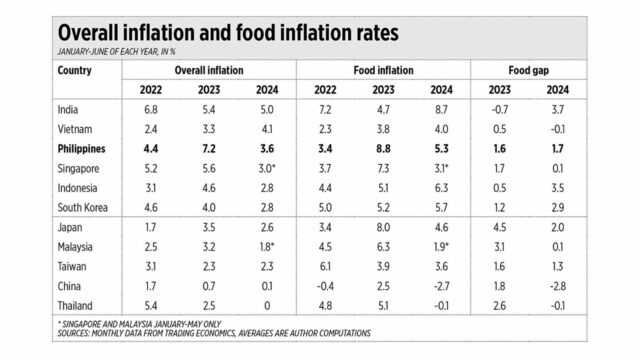
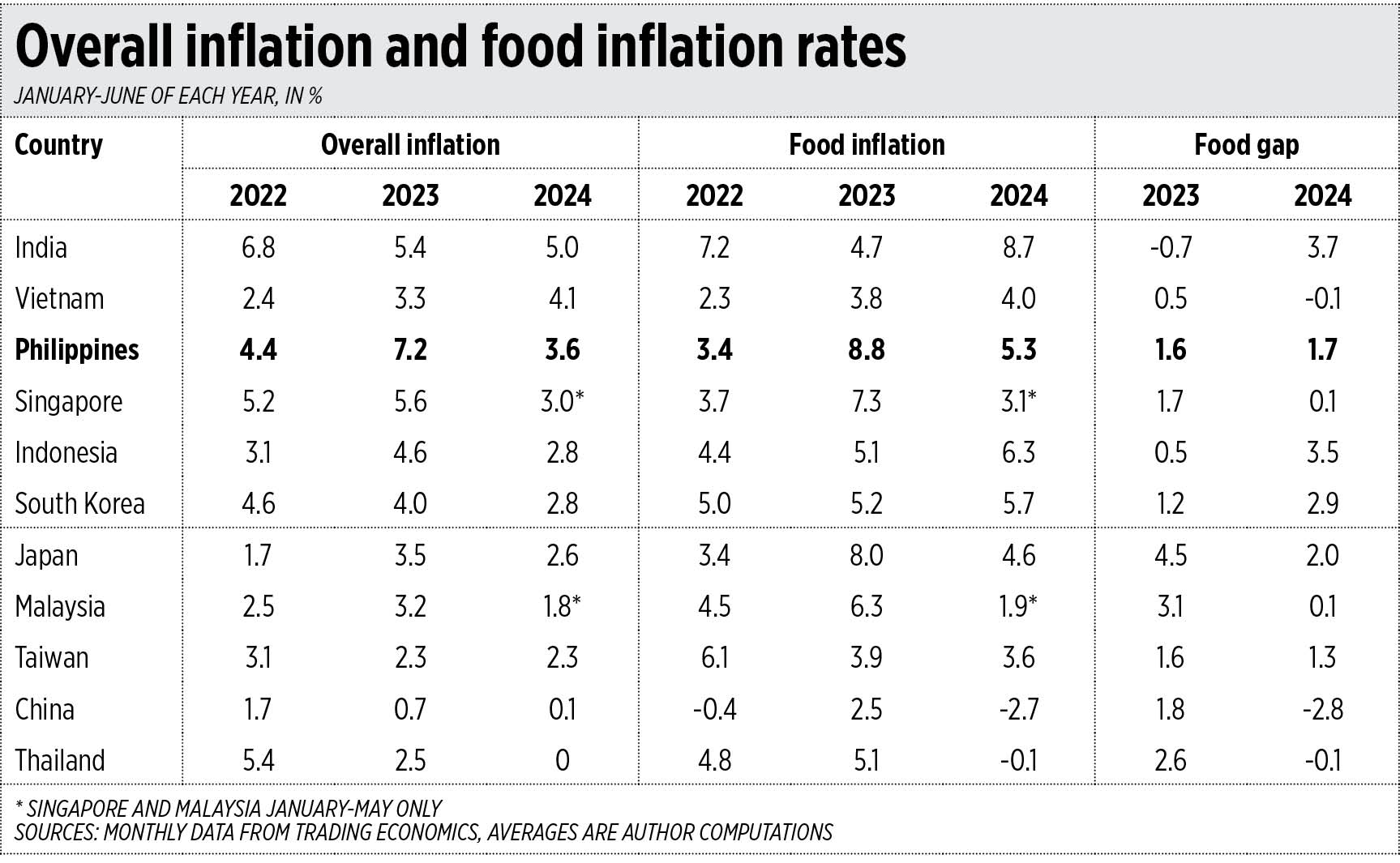
Comparing the first halves of 2023 and 2024, it seems that the answer is “yes.” In 2023, the Philippines had the highest overall inflation rate among the major Asian economies, and the highest food inflation. Then the overall inflation declined from 7.2% in 2023 to 3.6% in 2024; food inflation also declined, from 8.8% in 2023 to 5.3% in 2024. “Base effect” has a contributing factor here aside from the government’s considerable agriculture freebies for farmers.

But one emerging trend in many countries, including the Philippines, is that food inflation is higher than overall inflation and that is bad news because it affects the poor more than the middle and upper classes. In 2023-2024, our food inflation rates were higher by 1.6 and 1.7 percentage points than overall inflation.

So, if we compare our situation with, say, Vietnam, we see that their overall inflation rate of 4.1% this year is higher than the Philippines’ 3.6%, but their food inflation is lower by -0.1 percentage point (see the table).

The three largest rice exporters in the world are India, Thailand, and Vietnam. And the three top rice importers in the world are the Philippines, China, and Indonesia (according to statista). This year, India and Indonesia have the highest food inflation rates at 8.7% and 6.3% respectively, while China and Thailand have had contractions of -2.7% and -0.1% respectively in food inflation.

The reduction in the tariff on imported rice will obviously have a positive effect on reducing domestic rice prices, so it was a good move by the economic team. Tax revenues will decline but this will be more than compensated for by the decline in inflation.

I think many of the freebies given away by the government to farmers cooperatives and similar organizations did not translate to lower prices for consumers.

I observed that the government gave away big tractors that cost between P1.5-2 million each to certain farmer cooperatives in rice farming villages and barangays in western Pangasinan. Since the cooperatives had zero capex — they got the tractors for free — they only have to shoulder operating expenses like diesel and the regular maintenance of the machines. Thus, the cooperatives’ tractor rental rate should be lower than private tractor rental. So, if the prevailing private tractor rental rate is P3,200/hectare, the cooperatives’ rental rate should be lower, say, P2,500/hectare. Then the farmers will have larger revenues and savings and can cut the price of their harvest which will benefit the consumers and help reduce food inflation.

From what I heard and observed in those rice farming villages, the cooperatives’ officers (some of whom are non-farmers but rather the neighbors and friends of leaders) would meet and eat in fast food chains whereas before they would meet in public places in the barrio. The tractors’ revenues are not plowed back into the maintenance of the machines but are instead spent somewhere else. Soon the cooperatives’ tractors would be in bad condition.

I propose that the revenues from the tariffs on imported rice and agriculture should be used to either build more, wider and longer, cemented rural roads; or to reduce public debt and reduce the annual interest payment. This is instead of the government buying those expensive machines that benefit coop officers and their friends more than the average farmer and consumer.


Bienvenido S. Oplas, Jr. is the president of Bienvenido S. Oplas, Jr. Research Consultancy Services, and Minimal Government Thinkers. He is an international fellow of the Tholos Foundation.

minimalgovernment@gmail.com

MB prohibits Bohol cooperative bank from operating

THE MONETARY BOARD (MB) has banned a cooperative bank in Bohol from doing business, the Bangko Sentral ng Pilipinas (BSP) said.

In a circular letter, the central bank said its policy-setting Monetary Board has “decided to prohibit the Cooperative Bank of Bohol from doing business in the Philippines,” according to its Resolution No. 818-B dated July 18.

This was pursuant to Section 30 of Republic Act (RA) No. 7653 or the New Central Bank Act.

Section 30 of the Act is concerned with proceedings in receivership and liquidation.

“The Philippine Deposit Insurance Corp. has been designated as receiver with a directive to proceed with the takeover and liquidation of the aforementioned cooperative bank in accordance with Section 12 (a) of RA No. 3591 (PDIC Charter) as amended,” the BSP added.

The Cooperative Rural Bank of Bohol, Inc. was organized by 320 cooperative organizations called “Samahang Nayons” from various towns in Bohol, according to its website.

It is the first cooperative bank in Central Visayas. The bank began operating in November 1980 with an initial capital of P840,000.

Cooperative Bank of Bohol has branches in Candijay, Inabanga, and Panglao Island. — L.M.J.C. Jocson

Poet and translator Marne Kilates, 71

MARNEK2.WIXSITE.COM/MARNESKRIPTS

MARIANO L. KILATES (known as Marne by his family and friends) passed away at the age of 71 on July 20, announced the largest organization of Filipino writers, Unyon ng mga Manunulat sa Pilipinas (UMPIL), in a statement.

Marubdob na hinihiling sa sambayanang Filipino ang taimtim na panalangin para sa kaniyang ganap na ikapapayapa at lubos na mapag-ukulan nawa ng nararapat na pagpapahalaga ang kaniyang di-mumunting ambag sa lawas ng Pambansang Panitikan ng Filipinas,” it said.

(We sincerely request that the Filipino people fervently pray for his peace and that his considerable contribution to Philippine literature be given full due appreciation.)

Mr. Kilates, a poet, translator, and editor, had a career in writing that spanned more than three decades. This includes six volumes of poems, including Children of the Snarl in 1987 and Mostly in Monsoon Weather in 2007. He regularly published his poems on social media, and on his own website, marnek2.wixsite.com/marneskripts.

His body of work as a prolific translator encompassed Filipino and Bikol poetry and prose translated into English. These translations are of works by fellow poets Virgilio S. Almario, Rogelio Mangahas, Bienvenido L. Lumbera, Fidel Rillo, Victor Dennis Nierva, and Kristian Sendon Cordero, among others.

Mr. Almario said in a Facebook post that with Mr. Kilates’ passing, the Philippines “has lost a creative and patriotic literary voice.”

Mr. Kilates was born in Daraga, Albay, and his home province influenced a large part of his work. He received the Most Outstanding Albayano for Literary Arts award in 2014. Albay 2nd District Representative Joey Salceda mourned his passing in a statement, which described him as a “guiding light to Albay in our ethnographic efforts.”

He obtained his bachelor’s degree in English at the Divine Word College in Legazpi City in 1976. He was a fellow of the University of the Philippines National Writers Workshop in 1984 and the Silliman University National Writers Workshop in 1987.

The many accolades he earned for his work include the SEAWrite Award, the Gawad Pambansang Alagad ni Balagtas from UMPIL, a Carlos Palanca Memorial Award for Literature, and the Manila Critics Circle’s National Book Award for Poetry, Poet of the Year at the Nick Joaquin Literary Awards, and the Bulawanan na Bikolnon Award from the Ateneo de Naga University.

Mr. Kilates’ wake is being held at Chapel 7 in Heritage Park, Taguig City. A mass will be held on July 23 at 3 p.m. Funeral details will be announced. — BL Lacsamana

Damosa Land, Inc. eyes September launch for Kahi Estates in Davao City

KAHI ESTATE FACEBOOK ACCOUNT

DAVAO CITY — Damosa Land, Inc. (DLI) is targeting a September launch for its Kahi Estates project in Puan, Davao City, according to the company’s president.

Kahi Estates will be built on a five-hectare property and will feature an open-lot subdivision with only 62 lots available for sale. The lot sizes will range from 500 to 600 square meters.

“It’s only about five hectares for now, but we have adjacent properties very close to it and, hopefully, we will be able to connect all of them,” DLI President Ricardo “Cary” Lagdameo said during a recent business forum.

“We are hoping to launch Kahi Estates soon. We are working through the permitting process and have made progress. Our estimate is that we will officially launch it by September this year,” he added.

The project combines green and sustainable technologies with creative ideas that integrate living and farming, featuring urban gardening and a community farm.

Mr. Lagdameo said the company aims to make it a model for all of its sustainability efforts.

Solar panels will be installed on various structures, and urban home gardening will be promoted.

“There will be areas within the project for a community farm, similar to what we are doing in Agriya in Panabo City,” he said.

Mr. Lagdameo was referring to the 88-hectare agritourism development in Panabo City, Davao del Norte.

He also mentioned that the company is aiming to minimize the import and export of materials for the project.

“We are trying to reduce the need to bring in earthfill materials from distant locations,” he said.

Additionally, a water detention facility will be installed to mitigate flooding.

“It will also serve as a water feature on the property but primarily reduce the risk of flooding,” he added.

“Kahi” is a stylized term derived from the Visayan word “kahilum,” which means silence, tranquility, and peace — feelings that DLI aims to evoke for homeowners on the property. — Maya M. Padillo

DoE says energy efficiency strategies led to higher savings for gov’t in Q1

PHILSTAR FILE PHOTO

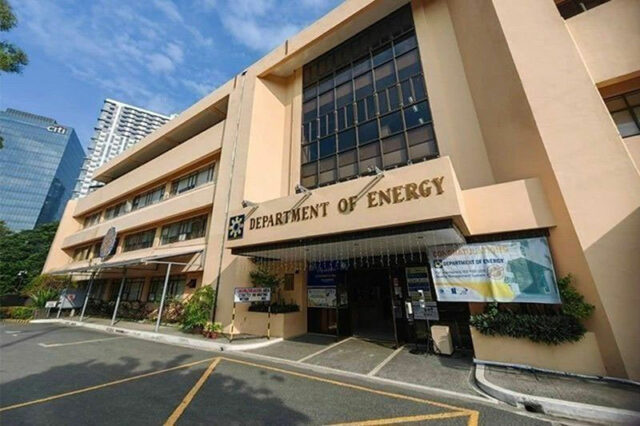
THE DEPARTMENT of Energy (DoE) said on Monday that the government saved around 31 gigawatt-hours (GWh) in electricity usage, equivalent to P365 million in cost savings, in the first quarter (Q1).

In a statement, the DoE said that more than a billion liters of fuel have been conserved, resulting in almost P35 million in savings.

The reported electricity savings are higher compared to P205 million or an equivalent of over 20 GWh in the first quarter of 2023.

“Deploying strategies to enhance energy efficiency in government buildings and facilities could lead to substantial savings for the government, create new jobs, and reduce carbon emissions,” the department said.

According to the DoE Energy Utilization Management Bureau, some of the strategies employed include the intensive implementation of Republic Act 11285, or the Energy Efficiency and Conservation (EE&C) Act.

The DoE said it also aggressively promoted EE&C technology, conducted energy audits to identify areas for improvement, and set energy reduction targets, among other measures.

In January, President Ferdinand R. Marcos, Jr. issued Administrative Order (AO) 15, directing government agencies to accelerate the Government Energy Management Program (GEMP).

GEMP aims to reduce the government’s electricity and fuel consumption by at least 10% through energy efficiency and conservation initiatives.

AO 15 operationalizes the EE&C Act for all government entities within the executive branch, including government-owned and -controlled corporations, government financial institutions, their subsidiaries, and state universities and colleges.

The DoE said it will kick off its first regional GEMP summit for EE&C professionals on July 23 in Mandaue City, Cebu.

The summit aims to address challenges and seize opportunities in implementing EE&C projects in government establishments.

It will also highlight best practices in energy efficiency applicable to the government, as well as processes for formulating EE&C plans for local government units and other entities.

“EE&C professionals in the public sector have a dual responsibility — to lead by example and to inspire broader societal change. By demonstrating the tangible benefits of energy management, this summit will foster momentum for the wider adoption of sustainable solutions and practices within the government sector,” Energy Secretary Raphael P.M. Lotilla said.

Sought for comment, Alexander D. Ablaza, president of the Philippines Energy Efficiency Alliance, Inc. (PE2), said that the first DoE-led GEMP summit would be “an excellent opportunity” for the DoE to understand the early progress of government entities in designating their EE&C professionals and having them trained.

“PE2 believes that GEMP will ultimately achieve a significantly larger reduction in final energy consumption after capacitating EE&C professionals, who in turn will plan and implement their respective energy efficiency improvement programs and projects,” he said in a Viber message. — Sheldeen Joy Talavera

The CrowdStrike outage showed that risk management is essential. Why are so many businesses reluctant to do it?

BW FILE PHOTO


In the wake of the widespread chaos we saw on Friday, one old adage perhaps feels even truer now than when it was first coined in the 1960s: “To err is human, but to really foul things up you need a computer.”

As the world continues to assess the fallout of what has been called “the largest IT outage in history,” industry and government leaders will naturally be pondering how exactly this all could have happened.

Most tragically, the company at the heart of all this — cybersecurity firm CrowdStrike — is explicitly meant to protect the IT systems across our hyperconnected global economy. Is CrowdStrike to blame or were they just unlucky? Could this happen again?

For businesses, these are risk management questions as much as they are technical IT questions. Risk is unavoidable in business and life. We can never completely escape it, but we can proactively manage it.

Many big companies hate thinking about and preparing for so-called “black swan” events — major catastrophes that are hard to predict. Friday’s events have shown just how important it is that they do.

Businesses face many different types of risks. Of these, Friday’s IT outage was an example of an operational risk event. Operational risk is broadly defined as: “the risk of loss as a result of ineffective or failed internal processes, people, systems, or external events.”

In simpler terms, it’s the risk that something goes wrong in the way a business runs.

Friday’s outage instantly wrought havoc on a wide range of technology integrated businesses. It might feel like the kind of event that’s impossible to predict.

But was this operational risk event foreseeable? In general terms — yes! An event like this was inevitable. And it will happen again. Let’s explore some reasons why.

We benefit daily from our networked world, which enables our economy to function at a speed undreamed of decades ago. We depend now on technology for virtually every aspect of our lives.

But this network and speed of activity means when things go wrong, they can go wrong fast, and everywhere. It’s a trade-off decision. If we want the benefits of our data-driven, networked economy, we must accept some risk here.

The trade-off decision extends to the choices made by providers of the upstream software and services we rely upon. This painful lesson was learned by some businesses that had never heard of CrowdStrike last Friday but soon found out key software relied on it. Choosing upstream providers means accepting the risks of their trade-off decisions.

A fundamental tenet of economics is that competition is good. Yet in technology markets, we often see only a few players dominate. This is in part due to what economists call network externalities.

Positive network externalities arise when increasing the number of users of a product or service increases its value.

Microsoft Windows, for example, is ubiquitous because it has a critical mass of users. Many people know how to use it, which attracts many developers to provide useful applications. Network externalities drive market dominance.

Friday’s events were so wide-reaching because Microsoft and CrowdStrike are dominant players in their respective markets.

Though it wasn’t a Microsoft incident, the company estimated that the outage affected about 8.5 million Windows devices around the world. This is less than 1% of all Windows machines. Microsoft said while this percentage may seem small: “the broad economic and societal impacts reflect the use of CrowdStrike by enterprises that run many critical services.”

We have benefited tremendously from the network externalities of these companies’ dominance, at the price of exposing ourselves to the risk of such narrow dependencies.

Such vulnerabilities don’t mean we can’t still manage these risks. Effective risk management entails the interplay between three factors: risk appetite — how much risk we are willing to accept; understanding the risks we face — keeping an organizational risk register; investing in risk treatments to keep risks within our appetite.

Risk appetite and understanding varies significantly across different businesses, so too does the extent of investment in treatments.

But the risk of an outage like Friday’s should have been on the risk register of the affected organizations. We can choose our risk appetite and accordingly invest in risk treatments to keep the identified risks within it.

For example, investing in fully redundant systems as a treatment could have limited some of the damage of Friday’s events. Many systems that weren’t using CrowdStrike weren’t directly impacted. Some organizations were able to revert to paper-based systems.

But redundancy in systems is very expensive, and there is always the risk that multiple systems will fail at once.

Risk management is complex. CrowdStrike itself is a risk treatment — for the risk of cyberattacks. Friday’s outage resulted in part from fast patching — a rapid roll out of an update to treat a specific cyberattack risk. In treating one risk, we can expose ourselves to new risks.

Given the consequences of black swan events, effective risk management for such possibilities would seem essential. But businesses can’t prepare for every contingency and so are reluctant to invest now to protect against a future risk event of unknown impact.

It’s a matter of perspective: we need to take a systemic view as we evaluate the trade-offs in our networked economy. Or as Nassim Taleb, author of The Black Swan aptly said: “let’s not be turkeys.”

THE CONVERSATION VIA REUTERS CONNECT


Michael J. Davern is a professor of Accounting and Business Information Systems at The University of Melbourne. He has received research grant funding in the past from the Australian Research Council in conjunction with National Australia Bank and Great Southern Bank for research in operational risk management practices.

A decade-strong cooperation for defense and security

The Philippines-Japan Reciprocal Access Agreement was signed by Defense Secretary Gilberto Teodoro, Jr. (foreground, third from left) and Japanese Foreign Minister Yoko Kamikawa (foreground, second from left) in the presence of President Ferdinand R. Marcos, Jr. (background, second from left) last July 8. — Photo from pco.gov.ph

Recently, it was reported that the two countries signed a defense agreement that allow their military forces to visit each other’s soil. The Philippines-Japan Reciprocal Access Agreement is a significant milestone that marks this era in the partnership between the two countries enhancing defense cooperation and promoting regional security amidst Chinese aggression in disputed waters.

While negotiations for this agreement started only in November last year, the partnership between Japan and the Philippines in the area of national security is more than a decade strong and started building momentum in 2011.

That was when on an official working visit to Japan in September 2011, the late President Benigno S.C. Aquino III held a summit meeting with then-Japanese Prime Minister Yoshihiko Noda to exchange courtesies, reinforced the “strategic partnership,” and discussed cooperation in the field of maritime affairs.

One year later, the Philippines’ Department of National Defense and the Ministry of Defense in Japan signed the 2012 Statement of Intent on Defense Cooperation and Exchanges, which provides the institutional framework for defense exchanges and cooperation for both militaries.

This framework was responsible for allowing Japanese forces and medical workers to land in Visayas to help with relief efforts after the region was devastated by the Super-Typhoon Yolanda in 2013. Aside from sending troops and paramedics, Tokyo also sent about $10 million in emergency aid.

During the height of the tensions in the West Philippine Sea in 2015, Japanese surveillance planes flew over the disputed waters as part of joint drills with Philippine Armed Forces, simulating maritime search and rescue operations as well as disaster response. Such drills have been conducted several other times since.

Shortly afterwards, a new defense agreement was signed in 2016 by then-Philippine Defense Military Voltaire Gazmin and Japanese Ambassador to the Philippines Kazuhide Ishikawa that allows equipment and technology transfer for both countries, joint research and development, and even joint production of these defense materials.

In 2022, the First Japan-Philippines Foreign and Defense Ministerial Meeting, or “2+2”, was conducted in Tokyo. Attended by Hayashi Yoshimasa, former Minister for Foreign Affairs of Japan; Kishi Nobuo, former Minister of Defense of Japan; Teodoro L. Locsin, Jr., former Secretary of Foreign Affairs; and Delfin. N. Lorenzana, former Secretary of National Defense, the meeting affirmed the two countries’ commitment to further strengthening the coordination in response to regional and international issues and began the talks that led to the recently agreed upon agreement.

The transformation of the Philippines-Japan relationship from conflict to cooperation highlights the power of reconciliation and mutual interests in forging robust alliances. With the Philippines-Japan Reciprocal Access Agreement, the two countries reaffirm their commitment to working jointly towards a more stable and prosperous future in the Asia-Pacific region. — Jomarc Angelo M. Corpuz

ADVERTISEMENT
ADVERTISEMENT