Home Blog Page 2908

North Korea vows ‘total destruction’ of enemy on Korean War anniversary

KCNA VIA REUTERS

SEOUL — North Korea vowed to “totally destroy” its enemies in case of war when leader Kim Jong Un gives an order, state media KCNA reported on Sunday.

Senior military officials including Army Colonel Ri Un Ryong and Navy Lieutenant Commander Yu Kyong Song made the comments “out of surging hatred” towards the U.S. and South Korea at a meeting on Saturday attended by Kim to celebrate the 71st Korean War armistice anniversary, according to KCNA.

North Korea and the United States do not have diplomatic ties and talks over reducing tensions and denuclearizing North Korea have been stalled since 2019. North Korea’s state media recently said it doesn’t expect that to change no matter who is next elected in the White House.

While accusing the U.S. and South Korea of “being hell-bent on provoking a nuclear war,” the military officials vowed to strengthen war efficiency to stage an “overwhelming attack on the enemy anytime and without delay and totally destroy them once the respected Supreme Commander Kim Jong Un gives an order.”

North Korea signed an armistice agreement with the United States and China on July 27, 1953 ending hostilities in the three-year war. U.S. generals signed the agreement representing the United Nations forces that backed South Korea.

North Korea calls July 27 “Victory Day” while South Korea does not mark the day with any major events.

Hostilities ended with a truce, not a treaty, meaning the two sides are still technically at war. — Reuters

Oil spill at Bataan endangers marine life – Greenpeace

BW FILE PHOTO

Reproduction rates of marine biodiversity are at risk following the sinking of an oil tanker at 3.6 nautical miles east of Lamao Point, Limay, Bataan, Greenpeace Climate Campaigner Jefferson M. Chua said in an interview on July 26. 

“It really disrupts and affects the reproductive rates of marine life when fish ingest hydrocarbons, other carbons, and other compounds from the oil,” Mr. Chua told BusinessWorld. 

He added that Limay has a rich aquatic life, and many fishermen are in the areas surrounding it. 

“The ship that has sunk in a place that is rich in marine life, specifically fisheries of the coast of Limay, there’s a lot of fishing grounds now, and then there’s a lot of fishing communities lining the Bataan Peninsula,” Mr. Chua said. 

Apart from the long-term damage it will cause to marine life, the livelihood of fisherfolks is one of the most affected by the impacts of the spill. 

“So it makes less, fish volume in the area which means in the long term, less fish catch for the fishermen,” Mr. Chua said. 

Mr. Chua added that based on the recent reports from their team on the grounds, fishing is now restricted in the area due to the toxic emitted by the Philippine-flagged Motor Tanker (MT) Terra Nova.  

Based on the assessment of the Philippine Coast Guard (PCG) shared by PCG Spokesperson CG Rear Admiral Armando Balilo today, the vicinity waters of Parañaque, Manila, Navotas, Bulacan, and Pampanga may be affected if the worst-case scenario occurs. 

“We are utilizing our manpower, mobilizing our resources, consulting with experts, and collaborating with LGUs and other stakeholders to avoid a marine environment catastrophe,” Mr. Balilo said. 

In the recent report of PCG, the siphoning operation will take seven days due to MT Terra Nova sinking 34 meters deep.Almira Louise S. Martinez

VST ECS appointed as authorized distributor for Hytera Communications in the Philippines

Hytera and VST ECS management at the certificate awarding ceremony

Hytera Communications (SZSE: 002583), a leading global provider of professional communications technologies and solutions, is delighted to announce the appointment of VST ECS Phils., Inc., a leading ICT distributor in the Philippines, as its authorized distributor in the country. This strategic partnership enables VST ECS to offer Hytera’s cutting-edge Push-to-talk over Cellular (PoC) and Body-worn Camera (BWC) products.

VST ECS Philippines is one of the leading ICT distributors in the country, recognized for its extensive portfolio of products, solutions, and services across diverse market segments. Its portfolio is unparalleled, representing over 100 renowned brands and encompassing a wide range of technology solutions. The company has established itself as the go-to partner for businesses in need of reliable, state-of-the-art solutions to address their evolving ICT needs. Its meticulously tailored solutions serve the retail, mobility, commercial, and enterprise markets, precisely meeting industry-specific requirements and driving innovation across sectors.

Founded in Shenzhen, China in 1993, Hytera has forged a distinguished track record for delivering communication solutions that reimagine connectivity and collaboration for mission and business-critical sectors. Renowned for its innovative critical communication technology and comprehensive product portfolio, Hytera has successfully served a diverse array of customers, including public safety, utility, oil and gas, transportation, emergency response, hospitality, private security, and facility management.

In light of the current challenges faced by communication infrastructures, the availability of Hytera’s advanced solutions will significantly boost user performance, ensuring faster, safer, and more efficient operations. This collaboration with Hytera marks a significant milestone for VST ECS, enhancing its already impressive portfolio of ICT solutions. This partnership will empower VST ECS to cater to broader markets, creating new business opportunities for its channel partners. 

“We are excited to partner with VST ECS Phils., Inc. as our authorized distributor in the Philippines,” said Stanley Song, VP of Hytera. “This partnership aligns with our vision to expand our global reach and deliver our innovative communication solutions to a broader audience. VST ECS’s strong market presence and commitment to excellence make it an ideal partner to distribute Hytera’s advanced technologies. Together, we aim to enhance connectivity and operational efficiency for businesses and mission-critical users across the country.”

 “We are thrilled to join forces with Hytera Communications. This collaboration not only strengthens our product offerings but also reinforces our commitment to delivering best-in-class service to our customers. With Hytera’s innovative communication solutions, we are well-positioned to address the evolving needs of our clients and enhance operational efficiency across various sectors,” said Jimmy Go, President and CEO of VST ECS Phils.

Since its inception in 1998, VST ECS Philippines has been committed to delivering high-quality ICT products, solutions, and services to its valued channel partners and customers. As a proud member of VST ECS Holdings, a leading regional IT distribution firm, it benefits from a vast operational network spanning Hong Kong, Singapore, Malaysia, Indonesia, Thailand, Myanmar, Laos, China, and the Philippines. This distribution network empowers VST ECS Philippines to access global technologies and partnerships, ensuring the delivery of cutting-edge solutions to its customers.


Spotlight is BusinessWorld’s sponsored section that allows advertisers to amplify their brand and connect with BusinessWorld’s audience by publishing their stories on the BusinessWorld Web site. For more information, send an email to online@bworldonline.com.

Join us on Viber at https://bit.ly/3hv6bLA to get more updates and subscribe to BusinessWorld’s titles and get exclusive content through www.bworld-x.com.

SpaceX’s Falcon 9 cleared to return to space, FAA says

REUTERS

SpaceX’s Falcon 9 rocket has been cleared to return to space by the US aviation regulator after it was grounded by a rare mid-flight failure, the Federal Aviation administration (FAA) said on Thursday.

The FAA said it did not find any public safety issues in the anomaly that occurred during the failed July 11 launch and the rocket can return to flight operations while the overall investigation continues.

SpaceX said in a post on X that it was ready to return the rocket to flight as soon as Saturday, July 27.

Falcon 9, which is the world’s most used rocket, was grounded after one broke apart in space and doomed its payload of Starlink satellites, the first failure in more than seven years of a rocket relied upon by the global space industry.

In a statement on Thursday, SpaceX said that a liquid oxygen leak led to excessive cooling of one of its engine components and damaged its hardware.

“A crack in a sense line for a pressure sensor” was identified as the cause of the leak and that the failed sense line and sensor on the second stage engine will be removed for near term launches, SpaceX added.

Falcon 9 is the only US rocket capable of sending NASA crews to the International Space Station. NASA is expecting to launch its next astronaut mission in August, with SpaceX’s Crew Dragon astronaut capsule launching atop the rocket. – Reuters

North Korea’s economy surged in 2023 after years of contraction, South estimates

MICHA BRANDLI-UNSPLASH

 – North Korea’s economy grew sharply in 2023 after shrinking for three straight years as trade with China increased after COVID-19 pandemic border controls were eased, according to estimates by South Korea’s central bank.

Gross domestic product (GDP) in 2023 likely expanded 3.1% in real terms, the biggest percentage growth since 2016, the Bank of Korea (BOK) said on Friday.

The BOK’s estimates are considered among the most reliable indicators of economic activity in the secretive North, which does not publish official data.

“Although economic sanctions remained, the economy grew on eased COVID-related restrictions, growth in trade with China and favorable weather conditions,” a BOK official told reporters.

North Korea’s economy contracted by 0.2% in 2022, 0.1% in 2021 and 4.5% in 2020 amid COVID restrictions and U.N. sanctions.

During the pandemic, humanitarian groups raised concerns about food shortages for many North Koreans, and as recently as January leader Kim Jong Un said a failure to provide people with basic living necessities including food was a “serious political issue”.

“Most experts assess the rebound in 2023 to be temporary, but there are also positive factors, such as the possibility of further growth in trade with China and expansion in economic cooperation with Russia,” the BOK official said.

Pyongyang and Moscow agreed last month to expand cooperation in trade, economy and investment as they signed a mutual defense pact during Russian President Vladimir Putin’s first visit to North Korea since 2000.

In 2023, North Korea’s trade with China accounted for 98.3% of the total trade volume, according to the BOK.

The data showed industrial output jumped 4.9%, the fastest in seven years, led by production of metal items and wigs, and the construction sector grew by 8.2%, the biggest since 2002, on more housing projects. The agricultural sector increased by 1.0%.

The industrial sector accounted for 30.7% of the economy in 2023, while the agricultural and construction sectors accounted for 22.0% and 11.0%, respectively.

The North’s trade volume rose 74.6% to $2.77 billion in 2023, after growing by a record high of 123.9% in 2022, when the North started to ease border controls from the pandemic. The figure, however, was still lower than $3.25 billion in 2019 before COVID.

Its exports jumped 104.5% in 2023, led by shoes, hats and wigs, while imports rose 71.3% with a surge in demand for fertilizers.

North Korea’s nominal gross national income in 2023 was estimated to be 1.59 million won ($1,147.56) per capita, equivalent to just 3.4% of the South’s 47.25 million won.

The BOK has been publishing its estimates of the North Korean economy since 1991, based on information from various sources including intelligence and foreign trading agencies and data from the South’s unification ministry. – Reuters

Harris gains ground in polls as Trump tries to brand her a Marxist

UNITED States Vice-President Kamala Harris at Camp Pendleton — OFFICE OF KAMALA HARRIS

 – Vice President Kamala Harris took her presidential campaign blitz to the largest US teachers’ union on Thursday, promising a “fight for the future” as new opinion polls showed her narrowing the gap with Republican rival Donald Trump.

Ms. Harris’ swift emergence as the successor to President Joe Biden, 81, as the Democratic presidential candidate in the Nov. 5 election has shaken up a stagnant presidential race, with polls showing her narrowing former President Trump’s advantage.

In an address in Houston to the American Federation of Teachers, Harris, 59, focused on economic policy and workers’ rights, touting plans for affordable healthcare and child care and criticizing Republicans for blocking gun limits in the wake of school shootings.

“Ours is a fight for the future,” Ms. Harris told a crowd of about 3,500 people. “We are in a fight for our most fundamental freedoms. And to this room of leaders, I say: Bring it on.”

More than 100,000 predominantly white women later joined a Zoom call to raise money for Harris and discuss strategy, organizers of #AnswerTheCall said. The call followed similar ones recently among Black women, Black men and Latinas.

A series of polls conducted since Mr. Biden ended his reelection bid on Sunday, including one by Reuters/Ipsos, show Ms. Harris and Mr. Trump beginning their head-to-head contest on roughly equal footing, setting the stage for a close-fought campaign over the next three-and-a-half months.

A New York Times/Siena College national poll published Thursday found Harris has narrowed what had been a sizable Mr. Trump lead. Trump was ahead of Harris 48% to 46% among registered voters, compared with a lead of 49% to 41% over Biden in early July, following Biden’s disastrous debate performance that led to a wave of Democratic calls for him to step aside as candidate.

While nationwide surveys give important signals of American support for political candidates, a handful of competitive states typically tilt the balance in the US Electoral College, which ultimately decides who wins a presidential election.

Harris also got good news on that front as Emerson College/The Hill published a poll finding that she had begun to close the gap with Trump in five critical battleground states: Arizona, Georgia, Michigan, Pennsylvania and Wisconsin. Trump still narrowly leads Harris in all but Wisconsin, which is tied, according to the poll of registered voters in those states.

Together, the polls suggest that while Mr. Trump, 78, retains a narrow advantage, he has not seen the sort of bump in support following last week’s Republican National Convention that candidates hope to get out of the highly scripted, televised and expensive events.

Mr. Trump on Wednesday night laid into Ms. Harris in his first rally since she replaced Biden atop the ticket, then continued his criticism online on Thursday.

“We’re not ready for a Marxist President, and Lyin’ Kamala Harris is a RADICAL LEFT MARXIST, AND WORSE!” Trump posted on his social media platform.


DEBATE UP IN THE AIR

Mr. Trump’s campaign on Thursday cast doubt about a Sept. 10 debate that had been previously scheduled against Mr. Biden. Ms. Harris has said she is prepared to debate Mr. Trump that day, but the Trump campaign said in a statement that debate details cannot be finalized until the Democrats formally name a candidate, which could happen the first week of August.

More than 40 former US Justice Department officials, primarily from Democratic administrations, signed a letter endorsing Harris and calling Trump a threat to the rule of law in the US.

“Former President Trump presents a grave risk to our country, our global alliances and the future of democracy. As President, he regularly ignored the rule of law,” reads the letter, a copy of which was seen by Reuters and signed by former US Attorney General Loretta Lynch and other former officials.

Former President Barack Obama has been in regular contact with Ms. Harris and plans to soon endorse her as the Democratic presidential candidate, a source familiar with his plans said on Thursday.

The Harris campaign released its first video advertisement online on Thursday. Ms. Harris narrates the ad, framing the campaign as a battle to protect Americans’ individual liberties to the sound of Beyonce’s song “Freedom.”

Ms. Harris also reached out to younger voters by creating an account on TikTok, amassing over 500,000 followers in a few hours.

The next highly anticipated development will be Ms. Harris’ choice of a vice-presidential candidate to counter Mr. Trump’s selection of US Senator JD Vance of Ohio.

The list of contenders amounts to a who’s-who of rising Democrats, including US Senator Mark Kelly of Arizona, Governors Josh Shapiro of Pennsylvania, Roy Cooper of North Carolina and Andy Beshear of Kentucky, as well as Transportation Secretary Pete Buttigieg.

Ms. Harris’ rise has largely pushed Mr. Trump out of the headlines, a week after the Republican National Convention and 12 days after he narrowly survived an assassination attempt that wounded his ear.

FBI Director Christopher Wray told a House panel on Wednesday that investigators are not certain whether Trump’s injury was caused by a bullet or by shrapnel. Trump has said a bullet hit his ear.

A Trump campaign spokesperson, Jason Miller, called the idea that Mr. Trump was not hit by a bullet a “conspiracy,” adding an expletive. – Reuters

Harris pushes Netanyahu to ease suffering in Gaza: ‘I will not be silent’

US Vice President Kamala Harris speaking at a forum in October. — VICE PRESIDENT KAMALA HARRIS/TWITTER

 – US Vice President Kamala Harris pressured Israeli Prime Minister Benjamin Netanyahu on Thursday to help reach a Gaza ceasefire deal that would ease the suffering of Palestinian civilians, striking a tougher tone than President Joe Biden.

“It is time for this war to end,” Ms. Harris said in a televised statement after she held face-to-face talks with Netanyahu.

Ms. Harris, the likely Democratic presidential nominee after Mr. Biden dropped out of the election race on Sunday, did not mince words about the humanitarian crisis gripping Gaza after nine months of war between Israel and Hamas militants.

“We cannot allow ourselves to be numb to the suffering and I will not be silent,” she said.

Ms. Harris’ remarks were sharp and serious in tone and raised the question of whether she would be more aggressive in dealing with Netanyahu if elected president on Nov. 5. But analysts do not expect there would be a major shift in US policy toward Israel, Washington’s closest ally in the Middle East.

The conflict began on Oct. 7 when Hamas militants attacked southern Israel from Gaza, killing 1,200 people and taking more than 250 captives, according to Israeli tallies.

Israel’s retaliatory attack in Gaza has killed more than 39,000 people and caused a humanitarian calamity with most of the coastal enclave leveled, people displaced from their homes, famine and a shortage of emergency relief.

Mr. Biden met with Mr. Netanyahu earlier and told him that he needed to close gaps to reach a ceasefire in Gaza and remove obstacles in the flow of aid, according to a readout of the meeting provided by the White House.

Mr. Netanyahu will meet Ms. Harris’ Republican rival, Donald Trump, on Friday at Mr. Trump’s Mar-a-Lago club in Florida.

A ceasefire has been the subject of negotiations for months. US officials believe the parties are closer than ever before to an agreement for a six-week ceasefire in exchange for the release by Hamas of women, sick, elderly and wounded hostages.

“There has been hopeful movement in the talks to secure an agreement on this deal, and as I just told Prime Minister Benjamin Netanyahu, it is time to get this deal done,” Ms. Harris said.

Although as vice president she has mostly echoed Mr. Biden in firmly backing Israel’s right to defend itself, she made clear on Thursday that she was losing patience with Israel’s military approach.

“Israel has a right to defend itself. And how it does so matters,” Ms. Harris said.

In March, she bluntly stated that Israel was not doing enough to ease a “humanitarian catastrophe” during its ground offensive in the Palestinian enclave. Later, she did not rule out “consequences” for Israel if it launched a full-scale invasion of refugee-packed Rafah in southern Gaza.


A DIVIDED PARTY

The Gaza conflict has splintered the Democratic Party, and sparked months of protests at Biden events. A drop in support among Arab Americans could hurt Democratic chances in Michigan, one of a handful of states likely to decide the Nov. 5 election.

In a nod to those concerns, Ms. Harris urged Americans to help “encourage efforts to understand the complexity, the nuance and the history of the region.”

“To everyone who has been calling for a ceasefire and to everyone who yearns for peace, I see you and I hear you,” she said. “Let’s get the deal done so we can get a ceasefire to end the war.”

In an Oval Office address on Wednesday, Mr. Biden cited a desire for unity in the Democratic Party as it seeks to defeat Trump as a main reason he decided not to seek reelection but to instead support Harris for the 2024 race.

Ms. Harris maintains closer ties to Democratic progressives, some of whom have urged Biden to attach conditions to US weapons shipments to Israel out of concern for high Palestinian civilian casualties in Gaza. The US is a major arms supplier to Israel and has protected the country from critical United Nations votes.

Mr. Biden and Mr. Netanyahu met together with the families of Americans held by Hamas, who expressed hope for a ceasefire including a release of hostages. “We came today with a sense of urgency,” said Jonathan Dekel-Chen, whose son is a captive. – Reuters

Watch our Filipino athletes shine at Paris 2024 for FREE via Smart

All eyes are on Paris as the world’s best athletes compete for gold and glory in the much-anticipated Olympic Games Paris 2024 happening from July 27 to August 12, 2024 (PH Time).

To give Filipinos a front-row view of the events wherever they are, mobile services Smart Communications, Inc. (Smart), an official broadcast partner of the Olympic Games Paris 2024, is offering the most comprehensive live digital coverage via the Smart LiveStream App, which is accessible for FREE to subscribers of ALL networks, regardless your mobile carrier.

Downloadable on the Google Play Store and App Store, Smart LiveStream is scheduled to broadcast 24/7, while select events will also be streamed live on the Smart Sports and Puso Pilipinas social media pages.

A total of 22 Filipino athletes are about to embark on the fight of their lives for gold and country, led by EJ Obiena, currently ranked among the top pole vaulters in the world.

Obiena is aiming to surpass his personal best and bring home the highly-coveted gold medal for Team Philippines.

Meanwhile, world champion gymnast Carlos Yulo, known for his exceptional and thrilling performances on the floor, is a strong contender as well for multiple medals in Paris.

In the boxing ring, Nesthy Petecio, Aira Villegas, and Hergie Bacyadan have shown remarkable skill, resilience and determination.

Petecio, in particular, is looking to build on her silver medal performance from Tokyo 2020. Joining them are Eumir Marcial and Carlo Paalam, both expected to deliver powerful, knockout performances, with Marcial aiming to improve on his bronze medal from the previous Olympics while Paalam hopes to get a gold after his silver medal finish, also at Tokyo 2020.

The weightlifting team, following in the footsteps of Olympic Games gold medalist Hidilyn Diaz, includes John Ceniza, Elreen Ando, and Vanessa Sarno, are all poised to make their mark in Paris.

Also worth rooting for are Lauren Hoffman in the Women’s 400m Hurdles; John Cabang Tolentino in the Men’s 110m Hurdles, talented gymnasts Aleah Finnegan, Levi Jung-Ruivivar, and Emma Malabuyo in the all-around events; Joanie Delgaco in the Women’s Single Sculls, and Samantha Catantan in Women’s Foil Fencing.

Golf enthusiasts can cheer for Bianca Pagdanganan and Dottie Ardina, and swimming fans will be following Kayla Sanchez in the Women’s 100m Freestyle and Jarod Hatch in the Men’s 100m Butterfly.

Last but certainly not the least, Kiyomi Watanabe will represent the Philippines in Judo, competing in the Women’s -63kg category

All-time high motivation

To get an intimate glimpse of our athletes’ pre-game training and motivation, Puso in Paris 2024—a Smart-produced documentary series—will be available for streaming on the Smart LiveStream App and Smart’s social media pages (Smart Communications, Smart Sports, and Puso Pilipinas).

Sports fans may start streaming the Puso in Paris 2024 episodes on the following dates: July 18 featuring Carlos Yulo, July 19 with our Filipino boxers, July 23 with our weightlifters, and last but not the least, July 24 featuring EJ Obiena.

EJ Obiena assured fans and supporters across the country that they will be witnessing him at peak performance. “When I was young, my dream was to be an Olympian. Now, there’s another dream and hopefully, it’s to become an Olympic gold medalist,” Obiena said.

Nesthy Petecio echoed this by saying, “If I don’t become an Olympian, my career as an athlete would not be complete.”

On the other hand, Eumir Marcial emphasized the sacrifices they had to make. “Just to qualify for the Olympics, an athlete has to go through so much,” he said.

“I think to myself, ‘How does it feel to hear the National Anthem being played for you at the Olympics?’ That’s what I want for myself,” said Aira Villegas.

“I want to break the mentality that your first time at the Olympics is just for experience,” Vanessa Sarno said. “Even if it’s your first time, you can win.”

“We’re fighting for the Philippines. We’re representing the flag so let’s bring home medals if we can,” John Ceniza summed up.

Don’t miss any Olympic moment by downloading the Smart LiveStream App now and following the official social media pages for Smart Sports and Puso Pilipinas.


Spotlight is BusinessWorld’s sponsored section that allows advertisers to amplify their brand and connect with BusinessWorld’s audience by publishing their stories on the BusinessWorld Web site. For more information, send an email to online@bworldonline.com.

Join us on Viber at https://bit.ly/3hv6bLA to get more updates and subscribe to BusinessWorld’s titles and get exclusive content through www.bworld-x.com.

US military, seeking strategic advantages, builds up Australia’s northern bases amid China tensions

STOCK PHOTO | Pixabay.com

 – The US military is building infrastructure in northern Australia to help it project power into the South China Sea if a crisis with China erupts, a Reuters review of documents and interviews with US and Australian defense officials show.

Closer to the Philippines than Australia’s east coast capital, Canberra, Darwin has long been a garrison town for the Australian Defense Force and a US Marine Rotational Force that spends six months of each year there.

A few hundred kilometers to the south, RAAF Base Tindal is home to key elements of Australia’s airpower, and was a temporary base for US jets in recent exercises.

As northern Australia re-emerges as a strategically vital Indo-Pacific location amid rising tensions with China, the United States has quietly begun constructing hundreds of millions of dollars’ worth of facilities there to support B-52 bombers, F-22 stealth fighters, and refueling and transport aircraft – all part of a larger effort to distribute US forces around the region and make them less vulnerable.

“When you look at the positioning of northern Australia, particularly Darwin, in relation to the region … it’s always good to have multiple options in where you would want to put your forces in any type of crisis,” said Colonel Brian Mulvihill, commanding officer of the US Marine Rotational Force.

Tender documents show that intelligence briefing rooms, upgraded runways for bombers, warehouses, data centers and maintenance hangars are in the works. Massive fuel storage facilities are already built, officials told Reuters on a rare visit to the two northern bases.

The projects, scheduled for construction in 2024 and 2025, make northern Australia the top overseas location for US Air Force and Navy construction spending, with more than $300 million set aside under the US congressional defense authorizations for those years.

There is more on the horizon: The US Navy in June sought contractors for projects worth up to $2 billion to build wharves, runways, fuel storage and hangars in places including Australia’s Cocos Islands, and neighboring Papua New Guinea and Timor Leste, under a program to counter China.

China’s defense ministry did not immediately respond to a request for comment.

Air Commodore Ron Tilley, the Royal Australian Air Force director-general of capital facilities and infrastructure, confirmed Washington was paying for the facilities at Darwin and Tindal, which would support US operations.

“I don’t believe the US would be spending all this money on our northern bases if there wasn’t an arrangement in place where they could use those facilities they are funding in times of conflict,” he added.

Canberra has drawn closer to its top security ally, Washington, under the AUKUS pact to transfer US nuclear submarine technology to Australia next decade. Yet it has been largely silent on US military construction in the north.

The Australian government recently highlighted its own plans to spend A$14 billion “hardening” the northern bases under the country’s biggest defense shakeup since World War Two.

The Australian and US defense officials interviewed for this story said the new facilities should not be characterized as US bases. Foreign basing is a sensitive domestic political issue for Australia; successive governments, including that of Prime Minister Anthony Albanese, have said there are no US bases on Australian soil.

“All the bases will remain Australian bases, but will be able to be utilized by our international partners,” Mr. Tilley said.


LAYING FOUNDATIONS

A 2011 agreement with Australia for the US Marine Corps to temporarily train in Darwin has evolved into a regional deterrence role for about 2,000 Marines each year, Mulvihill said. War games this month included troops from the Philippines and Timor Leste.

The Marines are adding facilities at Darwin for their MV-22 Osprey aircraft, which can shuttle troops and equipment.

“Darwin is absolutely key terrain for us to help bring stability to the region,” he said in an interview at Darwin’s Larrakeyah Barracks. “We are more focused on that interoperability with the Australian Defence Force – how can we project power from northern Australia into the region.”

The United States wants to be able to disperse its forces from its largest bases in the Pacific, such as Guam and Okinawa, to reduce vulnerability.

For Australia, the northern bases offer greater access to the South China Sea, and with Tindal, a secure inland location for Australia’s F-35A stealth aircraft and its MQ-4C Triton long-range surveillance drone. A US F-22 Raptor squadron shared the facilities this month during Exercise Pitch Black.

Tindal’s location is “vitally important”, said RAAF Base Tindal Wing Commander Fiona Pearce, with “greater reach into our near region”.

US tender documents and engineering plans for Tindal show parking and hangars for six B-52 bombers and refueling aircraft.

Australia is spending A$1.5 billion ($981.45 million) on Tindal’s redevelopment, and by July a new terminal, control tower, hangars and accommodation for extra personnel were near completion. Separate US and Australian jet fuel stores sit side by side, and the tarmac is being dug up for the bomber expansion.


‘ALREADY A TARGET’

A third of residents in the sparsely populated Northern Territory are Indigenous Australians, although they make up just 10% of Darwin’s population.

Traditional Owners, as Indigenous Australians who have cultural access rights to an area of land or sea are referred to in Australiacan visit sacred sites on the bases, U.S. and Australian officials said.

Tibby Quall, 75, is among several Traditional Owners who say growing demand for defence-related housing in Darwin has led to land-clearing of forests they want protected, while rising prices have pushed Indigenous families out of the city.

Despite visitation rights, he says, his family has no real voice on how the land is used.

“Defence are the prominent citizens,” said Mr. Quall, a military veteran.

Darwin Mayor Kon Vatskalis says his city, where a Chinese company runs the port, welcomes the economic boost as the defense presence grows, although some residents have raised concerns that hosting the US military could make the city a target.

“The reality is that we are already a target: We are the most northern port in Australia, we are the city that serves the gas and oil industry,” said Mr. Vatskalis, who supports the military expansion. – Reuters

A decade of dedication: ISOG celebrates 10 years of securing PH cyberspace

The Information Security Officers Group (ISOG), the leading professional information security organization in the Philippines, celebrated its 10th anniversary on July 10, 2024, with a renewed pledge to strengthen cybersecurity in the country. The event, held at the Peak Music Lounge of the Grand Hyatt Hotel in BGC, Taguig, gathered over a hundred information security professionals from various organizations and industries.

In his opening remarks, ISOG President Archie Tolentino emphasized the organization’s role in safeguarding the nation amid a surge in digital intrusions targeting the Philippines. These developments underscore the urgent need for robust cybersecurity measures. “At ISOG, our commitment remains steadfast: to protect, to educate, and to empower. We will continue to advance our knowledge, share our expertise, and collaborate with partners across industries to create a resilient cyber ecosystem,” said Mr. Tolentino. “Our goal is to not only react to threats but to anticipate and prevent them, ensuring that the Philippines stands strong in the face of cyber adversity.”

ISOG Chairman Emeritus Joey Regala took the stage to recount the organization’s history and remind the community of its foundational purpose. He reflected on ISOG’s inception on July 7, 2014, when nine visionary Chief Information Security Officers convened at the UCPB Board Room. Recognizing the growing cybersecurity challenges confronting their organizations and the nation, they decided to unite their efforts, laying the groundwork for what would become ISOG.

Chito Jacinto, ISOG VP & Chairman of Membership & Events, talked about the significance of active involvement within the organization. He emphasized that being a part of ISOG extends beyond merely attending events and networking with fellow cybersecurity professionals. “Getting involved in our community reflects our dedication and drive to contribute to cybersecurity excellence for our nation. It’s about sharing knowledge, supporting each other, and working together to tackle the challenges we face in the digital world,” said Mr. Jacinto.

The event recognized the 2022 ISOG Cybersecurity Excellence Awardees. ISOG also announced that nominations for Season 2 of the prestigious cybersecurity awards will soon open, with the awarding ceremonies scheduled for Oct. 17. Additionally, ISOG honored the Top 5 most active and contributing members and board of trustees, along with the Top 20 sponsors and stakeholders who have supported the ISOG I AM Secure initiative for three years or more.

The ceremony also included the presentation of ISOG certificates and pins to regular, institutional, honorary, and lifetime members.

Initially founded as an organization for information security professionals in the finance and banking industry, ISOG has since expanded its reach significantly. Today, it has over a hundred members from various industries and companies, with a growing global impact. The organization upholds three fundamental pillars: education and awareness of information security practices for their members and clients; inter-institutional incident response; and intelligence-sharing on critical information, such as the latest operational methods to counter cybercriminals.

The event concluded with an oath of commitment, where members reaffirmed their values and pledged to uphold the highest standards in the profession. This solemn vow symbolizes their collective responsibility to protect and secure the information that powers our world, reinforcing their dedication to a safer digital future.

Organized by XMS, the event was made possible by the generous support of its sponsors. Titanium Sponsors included Huawei, NMI, Cisco through Trends, Sophos through WSI, Sangfor through WSI, F5 through Westcon, Fortinet through Netsec & VST-ECS, Eclypsium through Netsec & MDI, TrendMicro through CTLink & VST-ECS, Theos Cyber, and Check Point. Platinum Sponsors were Forcepoint, Rapid7, Pentera, KnowBe4, SecurityScorecard through WSI, Palo Alto through Trends & Westcon, Yubico through WSI, Vectra through NEXTGEN, Netskope through NEXTGEN, Zscaler through Westcon, and Tehtris. Gold Sponsors included Tenable through Westcon, Cyble through NEXTGEN, Gatewatcher & Wallix through Bizsecure, Gyptol through Netsec, and Edgio through WSI. Silver Sponsors were Gigamon through Westcon, Blancco, Arista through NEXTGEN, and XM Cyber; and Exhibitor sponsor Cloudflare through NEXTGEN.

The event was also supported by media sponsors BusinessWorld, Digi PH, and Back End News.

The evening concluded with joyful cheers as attendees enjoyed the festivities, featuring delicious food, drinks, games, gifts, and raffle prizes. The celebration ended on a high note with nostalgic hits performed by Freestyle, who serenaded the crowd throughout the night.

For more details about ISOG, visit its official website at www.isog-org.ph and socials at LinkedIn: ISOG (Information Security Officers Group), Facebook: ISOGPH, YouTube Channel: ISOG SUMMIT.

ISOG 10th Year Anniversary Video:


Spotlight is BusinessWorld’s sponsored section that allows advertisers to amplify their brand and connect with BusinessWorld’s audience by publishing their stories on the BusinessWorld Web site. For more information, send an email to online@bworldonline.com.

Join us on Viber at https://bit.ly/3hv6bLA to get more updates and subscribe to BusinessWorld’s titles and get exclusive content through www.bworld-x.com.

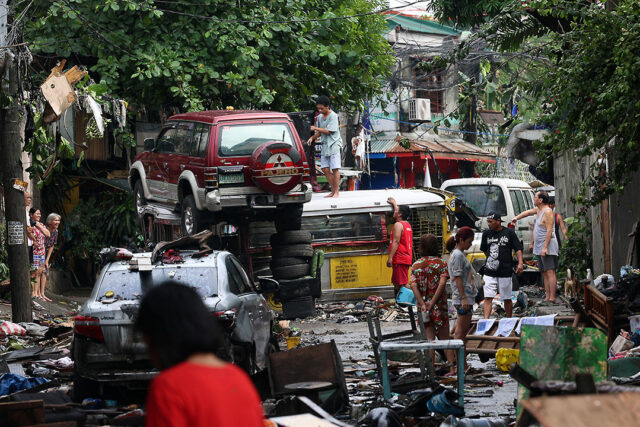
In the aftermath of Typhoon Carina: ‘Ineffective’ flood-control projects hit

A VEHICLE is seen on top of a jeepney in Barangay Del Monte in Quezon City on Thursday, a day after torrential rains caused flooding in Metro Manila. — PHILIPPINE STAR/MIGUEL DE GUZMAN

By Kyle Aristophere T. Atienza, Reporter and Kenneth Christiane L. Basilio

EXPERTS AND LAWMAKERS are now focusing on how flood-control projects have failed to prevent massive flooding in Metro Manila and nearby provinces during the onslaught of Typhoon Carina (Gaemi).

A southwest monsoon enhanced by Typhoon Carina on Wednesday triggered torrential rains that caused heavy flooding in the capital region, with authorities putting the death toll at 21 as of Thursday morning.

Most climate-related programs at the local and national levels have been solely focused on flood-control projects, said Dr. Pamela Cajilig, who teaches at the Building Science Studio Laboratory of the University of the Philippines’ College of Architecture.

“They have failed precisely because the mindset is ‘flood-control,’ which leads to measures that do not work well with nature and therefore lead to maladaptation, ‘solutions’ that negate their very aims, which is to reduce flood risks,” she said.

“We are not acting fast enough in terms of long-term disaster prevention and disaster mitigation.”

“Greater preparedness can reduce the need for post-disaster relief and ensure that allocated funds are able to reach further,” she said, noting that based on evidence globally, every dollar invested in preparedness not only saves lives but also reduces the financing needed for disaster response by at least $4 to $11 million.

On Wednesday, torrential rains and floods forced many residents to evacuate, while vehicles were swept away by raging floodwaters.

The Marikina River, which spans 16 bridges, reached as high as 20 meters. Its water level rose to 21.5 meters during the 2009 devastation of Typhoon Ondoy, which killed over 700 people, and to 22 meters during 2020’s Typhoon Ulysses, which killed about 100 people.   

The House of Representatives said it will look into the government’s flood management budget to determine if it was properly spent.

“We have to have accountability if the budget [on flood mitigation projects] was spent properly,” Mr. Romualdez said in Filipino, based on a document from his office. “We will check [if the budget] was spent effectively, efficiently, and properly.”

Senator Maria Imelda Josefa Remedios R. Marcos has said almost P1.4 billion is spent on flood-control projects daily.

Her brother, President Ferdinand R. Marcos, Jr., said in his third address to Congress on Monday that the government had already put up 5,500 flood-control projects. “Many more are still under construction.”

Mr. Romualdez said funding for flood mitigation projects will remain in the proposed 2025 national budget.

“Of course, [funding for flood mitigation projects] will always be there. We just need to update it, check if the projects are effective and whether they were implemented,” he added.

The Department of Public Works and Highways (DPWH) allocated P244.5 billion for its flood management program this year, according to a copy of the 2024 General Appropriations Act. It allotted an additional P104.7 billion for the construction and maintenance of flood mitigation structures protecting public infrastructure.

“That is almost P1 billion of funds a day, but they failed catastrophically to do their jobs,” Deputy Minority Leader and Party-list Rep. France L. Castro said in a statement.

‘CHRONIC’ FLOODING
Metro Manila has been placed under a state of calamity amid the massive flooding.

Senate President Francis “Chiz” G. Escudero said legislators should work to determine why — over a decade after Typhoon Ondoy — “chronic, severe flooding continues to afflict the nation’s capital.”

The capital region has been undergoing a “repetitive cycle” after massive rains, he said.

“Swaths of the National Capital Region are flooded so work and classes are suspended; we deploy our frontliners who rescue and evacuate affected families; generous volunteers and groups organize donation efforts and distribute aid; after the rains end, we assess the costs of the damage and evacuees are sent home,” he said in a statement. “Repeat.”

He urged the DPWH and the Metropolitan Manila Development Authority to work with LGUs in inspecting flooded areas and “recommend medium- and long-term solutions.”

The senator earlier said 2024 allocation for flood-control projects was “disproportionately large” compared with other critical sectors.

It far “exceeded the allocations” for irrigation (P31 billion) and even the capital outlay budgets of the Department of Agriculture (P40.13 billion) and the Department of Health (P24.57 billion), he noted.

It also surpassed the proposed budgets of entire departments, including the Department of National Defense (P232.2 billion) and the Department of Social Welfare and Development (P209.9 billion), he added.

The Department of Budget and Management (DBM) will submit the proposed P6.352-trillion budget for 2025 to Congress on July 29.

Mr. Escudero said the Senate Committee on Public Works, chaired by Senator Ramon “Bong” Revilla, Jr., a known ally of the Marcos administration, will conduct an inquiry into the apparent “inefficacy of the flood control projects despite the substantial funding.”

There is a need to increase funding for flood mitigation efforts to support the construction and maintenance of flood drainage systems, Pangasinan Rep. Maria Rachel J. Arenas told BusinessWorld in a Viber message.

“We are actively advocating for increased funding to support the construction and maintenance of flood-mitigation structures and drainage systems such as retention ponds, floodwalls, levees, and stormwater,” she said.

There should be new drainage facilities that can withstand disasters, said Ms. Arenas, a vice chairperson of the House Public Works and Highways Committee.

“We are committed to implementing resilient design practices in the construction of new drainage facilities to withstand extreme weather events and minimize the impact of flooding.”

Ms. Cajilig said the government has failed to engage communities that will be most affected by flood intervention. “[It] ends with the construction of the intervention rather than monitoring long-term impact on areas like housing and livelihood.”

Mr. Marcos has proposed the implementation of 10 flood control projects worth P500 billion from 2024 to 2037, including the Central Luzon-Pampanga River Floodway Project, Parañaque Spillway/Tunnel Project, Ambal-Simuay River and Rio Grande de Mindanao River Flood Control and Riverbank Protection, and Davao City Flood Control and Drainage Project.

A SHIFT IN ‘MINDSET’
“The future is a moving target — just recently the global warming predictions have been found to be worse than initially thought,” Ms. Cajilig said. “We need an agile and responsive mindset that is open to change at any time.”

Ms. Cajilig said the government needs a “flood management” mindset that opens more possibilities for “non-structural approaches” like revisiting land use plans and soft-structural approaches like wetland restoration.

“These are less environmentally destructive and are more likely to provide socio-ecological benefits such as livelihood,” she added. “They are also premised on the fact that we humans are part of nature, not superior to it.”

A proposal to implement a National Land Use policy included in the first year of the Marcos administration. But it was nowhere to be found in the latest list of over a dozen priority bills that both houses of Congress plan to pass before the midterm elections in 2025.

The House already approved the bill on final reading in May last year, while a counterpart measure remains pending in the Senate.

Negros Occidental Rep. Jose Francisco Benitez said the Department of Human Settlements and Urban Development’s land use and urban planning bureau was in the process of “crafting new guidelines for development of green open spaces and resilient urban design.”

“I hope LGUs will apply these new guidelines in updating their Land Use Plans and Comprehensive Development Plans,” he said in an e-mail to BusinessWorld sent by his staff.

Mr. Benitez, chair of the House Committee on Housing and Urban Development, also cited the need to promote “biophilic urbanism,” which calls for nature-based solutions in cities, to “support natural circularity.”

“Our cities should be designed to become sponge cities with more porous or permeable surfaces that will allow rainwater to percolate into the soil,” he said.

The House has already passed a bill mandating cities to invest more in urban greening and climate change adaptation on third and final reading, but it is not among the Marcos administration’s priority legislation.

Mr. Benitez, meanwhile, urged the government to revisit and fully implement an old law for the development of rainwater harvesting infrastructure or Republic Act No. 6716.

Renowned Filipino urban planner and architect Felino “Jun” A. Palafox, Jr. said he was not surprised with the massive floods because “the solutions were put forward in the mid-70s,” noting that he had sent recommendations to former four Philippine presidents but to no avail.

“It’s 90% less expensive to address the hazards before,” he said in a text message.

Maria Ela L. Atienza, a political scientist who has conducted research on the impacts of disasters on Philippine communities, said there have been significant improvements after Typhoon Ondoy, including the passage of the Philippine Disaster Risk Reduction and Management (DRRM) Act of 2010. However, she said there is still no national land use plan and climate-centered urban planning and “not all officials, both national and local, have done well in terms of implementation of the laws.”

Economic plans and environmental plans have not been integrated properly, she added.

Ms. Atienza said some LGUs and their constituents have fared relatively well in learning lessons, including Marikina, in introducing preemptive evacuation plans and disaster preparedness. “Deaths have been minimized in succeeding calamities in areas that have prepared well.”

“There is still a need to have more integrated plans that combine urban planning, geographic data, climate change and economic growth,” she added, lamenting that the Duterte administration invested more in reclamation projects, infrastructure projects, and economic activities that are “destructive” and “lead to more flooding and other hazards.”

She also noted that the Duterte administration stopped funding Project NOAH, which was then the Philippines’ primary disaster risk reduction and management program that was initially administered by the Department of Science and Technology from 2012 to 2017 and has since been housed at the University of the Philippines.

Ms. Atienza also said climate funds have been prone to corruption. Unless there is feedback from experts, politicians may use these funds for infrastructure and other projects that are “not actually useful,” she added.


Faster infrastructure development needed to ensure growth — S&P

A man is seen working on the rehabilitation of a portion of Commonwealth Avenue in Quezon City. — PHILIPPINE STAR/ MIGUEL DE GUZMAN

MORE INVESTMENTS in infrastructure assets are needed to unlock faster growth rates for emerging Asian economies like the Philippines, S&P Global said.

“A marked improvement in infrastructure and logistics will support the next leg of growth for the emerging markets of Asia,” it said in a report.

“Economies can unlock higher growth rates through accelerated investment in infrastructure assets on top of infrastructure efficiency gains.”

S&P Global said that efficient and improved infrastructure will underpin robust growth in emerging Asia-Pacific, excluding China.

If infrastructure projects are accelerated, it said the Asia-Pacific region can nearly double its economy to $11.4 trillion by 2033 from $6.6 trillion in 2023.

“This translates to an annual real growth rate of about 5.5%. Our baseline forecast incorporates improved infrastructure as a cornerstone supporting these strong growth outcomes,” S&P Global said.

In the region, several governments, such as the Philippines, Indonesia, India, Malaysia and Vietnam, are prioritizing infrastructure development in their policies and reforms.

“The National Economic and Development Authority (NEDA) coordinates flagship infrastructure projects such as a new airport in Manila, a heavy rail project linking ports in Subic, Manila, and Batangas, and several highway projects,” it said.

Infrastructure is one of the Marcos administration’s priority investment areas. The NEDA Board has so far approved 185 infrastructure flagship projects with a total value of P9.5 trillion.

The flagship projects cover physical and digital connectivity, water resources, agriculture, health and energy, among others.

The government targets to spend 5-6% of gross domestic product (GDP) on infrastructure annually.

Latest data from the Budget department showed that infrastructure spending jumped by 18.2% to P335.7 billion as of end-April.

Meanwhile, S&P Global said the public sector usually undertakes more infrastructure projects, since the return on investments are spread over two or more decades “meaning duration risk for the private sector is high.”

Infrastructure operators may also find it difficult to turn a profit on these projects, putting more onus on the public sector.

“This does not rule out a role for the private sector. The private sector favors bottom lines and is hence better at innovating and can typically operate faster and more efficiently.”

“Private capital can ease the capital outlay burden on cash-strapped governments already committed to wide-ranging spending priorities. Still, the durations, regulated rates of return, and other project risks mean that the public sector dominates the space.”

S&P Global noted that the region’s public assets relative to economic size “have not been deepening significantly.”

It said that public fixed-investment assets are “relatively low” in the Philippines and Indonesia.

“However, in the Philippines and Indonesia public-private partnership (PPP) capital assets are higher than global averages. In the Philippines they are about 6.7% of GDP; in Indonesia it is about 4.2% of GDP, which would add to the available total public assets,” it added.

The government has also been pushing for more PPP projects. In December, President Ferdinand R. Marcos, Jr. signed the PPP Code, which seeks to streamline the framework for PPPs.

S&P Global said that the logistics sector has shown improvements in recent years.

“India and the Philippines have seen the largest improvement since 2014 whereas Vietnam, Thailand, and Malaysia saw more modest improvements. In Indonesia, the logistics performance score declined marginally.”

Antonio A. Ligon, a law and business professor at De La Salle University in Manila, noted that the government is “doing its best” to implement the necessary reforms to attract investments in infrastructure.

“However, the implementation of these measures must be strengthened. For example, an efficient implementation of the ease of doing business (and) effective marketing showcasing areas where infrastructures development can be done,” he said in a Viber message.

Nigel Paul C. Villarete, senior adviser on PPP at the technical advisory group Libra Konsult, Inc., said local government units (LGUs) must increase support to fast-track infrastructure projects.

“Oftentimes the National Government (NG) machinery is somewhat cumbersome rolling our projects,” he said in a Viber message. “Many of the upcoming projects may be achieved through PPP with the LGUs.  This will also free up the NG to just deal with the major ones.”

Terry L. Ridon, a public investment analyst and convenor of think tank InfraWatch PH, said that infrastructure investments “have always provided a backdrop for economic growth in other areas of the economy.”

“New routes will have faster travel times, and economic efficiencies such as lower fuel costs may translate to lower prices of goods,” he said via e-mail.

“Resolving the traffic gridlock, whether through better and more railways or more efficient transport systems, allows commuters to spend more time doing other productive or economy-impactful activities instead of being stuck in traffic,” he added.

POWER
In a separate report, S&P Global also noted the need to increase investments in the power sector amid expectations of more demand.

“Power demand over 2024-2025 will grow 5-7% in India, Indonesia, and the Philippines, (and) about 3% in Singapore, Malaysia and Thailand.”

S&P Global said that increasing investments for the energy transition will “keep capital expenditures and leverage elevated.”

“Moderating fuel costs provide some relief to lagging generation and distribution firms,” it added.

In his State of the Nation Address on Monday, Mr. Marcos said that he expects the country’s power supply to “increase at a steady pace to meet our growing demand in the next few years.”

“Nonetheless, we are continuously diagnosing and urgently addressing power shortages, as well as the systemic causes of blackouts in unserved and underserved areas,” he added.

The government is aiming to increase the share of renewable energy in the country’s power mix to 35% by 2030 and 50% by 2040. — Luisa Maria Jacinta C. Jocson with input from Beatriz Marie D. Cruz

ADVERTISEMENT
ADVERTISEMENT