Home Blog Page 2844

The number of top-ranked restaurants in California continues to fall

ATELIERCRENN.COM/

IN THE last several weeks, a handful of big businesses have announced they’re leaving California, namely Chevron and Elon Musk’s SpaceX and X.

Likewise, the state’s restaurants have taken a little hit in the latest Michelin Guide release. The number of starred dining rooms has continued to drop; there are now 85, compared with 87 in 2023 and 89 in 2022.

Nothing changed at the top of the list: there are still six 3-star restaurants, the highest ranking, designated as “exceptional cuisine.” Five of those top-of-the-line spots are in Northern California, including SingleThread Farms in Healdsburg and San Francisco’s Atelier Crenn. “With each Guide reveal, we have the opportunity to come together with our colleagues throughout California to celebrate the advancement of gastronomy in our great state,” said William Bradley, chef and director of Addison in San Diego, the only three-star restaurant in southern California, after the announcement.

This year’s list features three new two-star spots, serving “excellent cuisine.” The Scandi-accented Sons & Daughters in San Francisco features a $295 tasting menu, with dishes such as cured trout in fish bone broth, while Aubergine, in scenic Carmel, has an internationally influenced menu and a 4,500-bottle-strong wine list. Both were upgraded from one star.

A new showing on this year’s list is the reopened Vespertine in Los Angeles, where chef Jordan Kahn has diners move across floors over the course of a meal. The restaurant also received a Green star, Michelin’s designation for an eco-minded establishment.

It was a good night for Mr. Kahn. His live-fire-focused Meteora was one of seven new one-star spots (a “very good restaurant”) in California. Another is San Francisco’s 7 Adams, from chefs Serena and David Fisher, who manage to serve a five-course, Cal-Italian menu in San Francisco for $87. There are 66 one-star spots this year; last year there were 69.

More notable than the new additions, though, were the places that dropped, particularly in Los Angeles. N/naka, chef Niki Nakayama’s inspired Japanese restaurant, may have garnered a cult following, but dropped from two stars to one; so did the revered Sushi Ginza Onodera, one of the few outposts of the famed Tokyo counter.

“It’s important for restaurants to maintain consistent quality,” said the chief inspector for Michelin Guide North America, who spoke on condition of anonymity because of his job. “If a restaurant’s culinary standards are observed to no longer be aligned with its current distinction, this could impact their retention the following year.” He added that the decision to demote a restaurant comes only after multiple visits.

In fact, in years past, having the word “sushi” in your restaurant name practically guaranteed a star — last year eight spots had sushi in their title, and at least one star to their credit. This year it’s down to five. Besides the demotion of Ginza Onodera, places that fell off the starred list entirely include the revered eight-seat Sushi Yoshizumi in San Mateo and Sushi Takodoro in San Diego; both specialize in Edomae sushi, a traditional style, with fish flown in from Japan, particularly Tokyo Bay.

Another famed restaurant that suffered in this year’s rankings is Gary Danko, a Bay Area institution almost since it opened in 1999; it’s held a Michelin star since they were first awarded in San Francisco in 2008. This year, that star was taken away.

In Los Angeles, a couple of high-profile spots have closed or are closing and were cut from the list. Earlier this year, Walter and Margarita Manzke shut down their lauded, extravagant tasting-menu spot Manzke, citing financial issues. Later this year, star chef Curtis Stone will transform his small, stylish dining room Maude into a bakery, the Pie Shop; in a statement he said it was to make room “for new endeavors.” These closures come as the state is dealing with a $27-billion-plus deficit, driven in part by the exodus of some tech jobs.

California restaurateurs have been hard hit by increased operating costs from rent to food costs and especially labor. In January, the state’s minimum wage was raised to $16 per hour,  one of the highest in the country;  fast food workers’ wages were set at a minimum of $20 per hour, making salaries even more competitive. In the Los Angeles area, there’s also been an ongoing impact from last year’s long-lasting Hollywood strikes.   

It’s not just high-end tasting-menu spots that were hit on this year’s list; in fact, the news was worse for lower priced spots. At the event, Michelin also announced its Bib Gourmand, or cheap eats picks. There are 132; a year ago there were 142.

Michelin has been giving out stars statewide since 2019; this year’s awards took place at the Ritz-Carlton in Half Moon Bay.

A month ago, the guide announced it’s latest expansion, an inaugural guide in five Texas cities — Austin, Dallas, Fort Worth, Houston, and San Antonio. A representative for Houston First, the city’s tourism board, revealed it was paying the guide $270,000 for three years of coverage, according to Eater.

As it happens, Chevron, SpaceX, and X are all headed to Texas. — Bloomberg

Driverless transport in airports

PORT AUTHORITY OF NEW YORK AND NEW JERSEY

With Manila’s international airport set to undergo improvements starting this September, I wonder if the planned upgrade will include autonomous transport — driverless vehicles to move around staff, crew, passengers, cargo, supplies. The airport has four terminals. It needs to find an efficient way to move around people and goods in its vast compound.

Autonomous or automated transport lowers labor costs and mitigates labor-related issues. It can also result in higher productivity and efficiency. While capital investment in equipment and systems is high at the start, operating cost can be lower in the long run. If done right, and with proper safety systems in place, autonomous transport can also minimize accidents.

These are all hypothetical, of course. No system is totally error-free. Mistakes and accidents can still occur. But there are lessons to be learned from New York, Tokyo, Singapore, and many other airports around the world that have all embarked on autonomous or driverless transport systems, either for staff, luggage, or passengers — either as mass transit or for personal mobility.

In July, it was reported that New York’s John F. Kennedy International Airport started using self-driving shuttle buses to transport passengers from parking lots to the AirTrain terminals. The shuttles, which carry eight passengers each, run a route that is 1.5 miles long. The shuttles do not have drivers. But they have “safety attendants” that can manually drive them when needed.

In Tokyo, The Japan Times reported that Haneda Airport was testing “a driverless vehicle” that can tow up to 13 metric tons of cargo containers. The autonomous transport can pull six containers at a time between aircraft and airport buildings for over two kilometers, said the Times. The system is jointly developed by All Nippon Airways (ANA) and Toyota Industries.

In Singapore, The Star reported that a self-driving bus would transport workers around Changi Airport’s restricted area by the third quarter of 2024, under a two-year proof of concept. The autonomous buses are to be used airside, or the part of the airport where the loading and unloading of aircraft, as well as take-offs and landings, take place, The Star said.

Also to be tested at Changi is the use of self-driving buses in “a live operational environment alongside non-autonomous vehicles,” The Star said. It added that there were about 2,500 airside vehicles at Changi at present, which include cars, vans, minibuses, tractors, and forklifts. Driverless baggage tractors and baggage handling vehicles are undergoing testing to date.

The Star noted that at the Hong Kong International Airport, a driverless shuttle bus service has been transporting staff around the airport’s restricted area. It also reported that driverless shuttles will soon be transporting people between Hong Kong Port and SkyCity, a business and entertainment complex adjacent to the airport.

Also in Hong Kong, the South China Morning Post reported that the Hong Kong government contracted a consortium to plan and design a new railway line in East Kowloon that will most likely run driverless trains. The estimated length of the proposed railway is about seven kilometers. It would link eight stations from Choi Hung East to Yau Tong East.

Meanwhile, the use of autonomous transport at the Miami International Airport (MIA) and the Los Angeles International Airport (LAX) is a little different. A company called WHILL, in collaboration with Envoy Air, deploys self-driving wheelchairs that allow passengers with disabilities to get to their boarding gates on their own.

And at the Phoenix Sky Harbor International Airport, a company called Waymo provides fully autonomous ride-hailing services between the airport and downtown. The driverless car service runs 24 hours, and uses all-electric Jaguar I-PACE vehicles. The services run to and from the airport and downtown Phoenix and the East Valley.

In Hawaii, the Daniel K. Inouye International Airport in Honolulu has reportedly started an 18-month autonomous shuttle pilot program to transport airport staff within the airport’s restricted areas. Four autonomous and electric shuttles that can transport 11 passengers, including a shuttle attendant, between the airport’s C and G Gates with several stops.

Over at Heathrow Airport in the UK, it uses driverless pod cars that transport passengers between Terminal 5 and the business car park. According to airport authorities, these pods are energy-efficient and provide a smooth, on-demand ride for passengers. They also help reduce congestion by eliminating approximately 50,000 bus journeys annually. Heathrow is also testing autonomous baggage dollies at Terminal 5.

With all these ongoing testing programs in various airports all over the world, and given the long timeline for the Manila airport’s upgrading, perhaps in about three years’ time driverless shuttles will also be moving about the Philippine airport compound. With four terminals in operation, driverless shuttles might make more sense instead of an airport monorail.

Inevitably, there will be safety concerns. To date, no major errors or accidents have been reported involving driverless airport shuttles and cargo handling transport. But the potential for technical failure will always be a concern, as with anything automated. Continuous monitoring and improvements can help ensure that driverless transport operates without accidents.

More important, people will have to learn to be comfortable with autonomous transport. Otherwise, acceptance and effective use may be compromised. One research study notes the importance of calibrating public trust so that airport staff and passengers can feel safe and confident using new technologies like driverless transport.


Marvin Tort is a former managing editor of BusinessWorld, and a former chairman of the Philippine Press Council

matort@yahoo.com

BSP could still cut rates next week, Recto says

BW FILE PHOTO

THE BANGKO SENTRAL ng Pilipinas (BSP) may still cut benchmark interest rates at its policy meeting next week, Finance Secretary Ralph G. Recto said on Wednesday.

“I expect a reduction in rates within the year. It could happen in August, it could happen off-cycle, it could happen in the next board meeting. I would prefer lower rates so we can borrow domestically at lower rates as well,” Mr. Recto, who is also a member of the BSP’s policy-setting Monetary Board, told reporters on Wednesday.

“The Fed (US Federal Reserve) will probably do a rate cut in September, then us in August. The difference is just one month,” he added.

The Finance chief said he expects 50 basis points (bps) worth of BSP cuts this year. “But (that) could even be higher, but it depends on what the Fed does also. It depends on our inflation expectations,” he added.

The Monetary Board in June kept its policy rate at an over 17-year high of 6.5% for a sixth straight meeting.

BSP Governor Eli M. Remolona, Jr. said on Tuesday they are now “a little bit less likely” to cut rates at their Aug. 15 policy review amid “slightly worse than expected” inflation.

Headline inflation quickened to 4.4% in July, the fastest pace in nine months or since the 4.9% recorded in October 2023 and marking the first time that it breached the central bank’s 2-4% annual target range since November.

Mr. Recto said he is also open to an off-cycle cut if necessary.

“I’m definitely open to reducing interest rates. That is the objective. Whether it’s a regular cycle or off-cycle. I think the BSP governor also said that we could do an off-cycle. There’s no meeting in September, but he can call for an off-cycle. It depends. Like I said, it all depends on our briefings. We will get market updates,” he added.

Meanwhile, Nomura Global Markets Research said it still sees the BSP starting its easing cycle this month as the spike in July inflation is likely temporary.

“In terms of monetary policy, the July consumer price index (CPI) outturn does not change our latest view that BSP’s rate-cutting cycle could begin in August given its pickup is likely to have been temporary,” it said in a report.

“BSP also retained in its post-CPI statement that headline inflation will start easing in August and assessed that the balance of risks to the inflation outlook has “shifted to the downside.”

Nomura expects the central bank to slash benchmark rates by 25 bps at its meeting next week.

“If inflation has indeed already peaked, then BSP may not have to wait for its next meeting, which is two months away (Oct. 17),” it added.

Meanwhile, it expects full-year inflation to average 2.8% this year, well below the BSP’s 3.3% forecast, noting that this outlook was primarily due to the impact of the recent cut in tariffs on rice imports.

“Assuming full pass-through, we estimate the tariff cut could lower headline inflation sharply to around 2.1% in August before settling between 1.7% and 2.1% by the fourth quarter. This suggests the pickup in July is likely to have been temporary and will prove to be the peak,” Nomura said. — Luisa Maria Jacinta C. Jocson

PHINMA Corp. faces 63% earnings slump

DEL ROSARIO-LED conglomerate PHINMA Corp. reported a 63% decrease in its consolidated net income for the first half, down to P170.93 million from P456.74 million the previous year, in the face of economic challenges.

“The company focused on growing its business and expanding institutional partnerships in anticipation of market recovery given the challenging macroeconomic environment in construction materials and property development,” PHINMA Corp. said in a stock exchange disclosure on Wednesday.

First-half consolidated revenue grew by 17% to P10.37 billion from P8.89 billion in 2023 due to the higher enrollment of PHINMA Education Holdings, Inc. and the consolidation of the conglomerate’s property and hospitality businesses.

“The 17% increase was driven by higher enrollment in PHINMA Education’s rising volume in the PHINMA Construction Materials Group as well as revenues of the property and hospitality groups which were consolidated starting July 2023,” the conglomerate said.

PHINMA Education grew its first-half earnings by 36% to P418.13 million as consolidated revenue increased by 17% to P2.46 billion on higher enrollment in the second semester of school year 2023-2024.

The conglomerate’s construction materials group (CMG), consisting of Union Galvasteel Corp., Philcement Corp., and PHINMA Solar Energy Corp., saw a 59% decline in first-half net income to P106.49 million from P262.01 million last year. CMG recorded a 4.3% increase in combined first-half revenue to P6.87 billion.

PHINMA Property Holdings Corp. recorded a P313.1-million net loss as well as P590.43 million in revenues due to shortfall in volume and delayed construction.

The combined net income of Coral Way City Hotel Corp., PHINMA Hospitality, Inc., and PHINMA Microtel Hotels, Inc. reached P27.75 million while combined revenue totaled P296.97 million.

Meanwhile, PHINMA Corp. said its board approved a P1-billion stock rights offering consisting of primary common shares to support the conglomerate’s investment and expansion plans.

AB Capital & Investment Corp. will serve as the issue manager, book runner, and lead underwriter for the transaction. The offer will be listed in the fourth quarter.

“The stock rights offering reflects investor confidence in PHINMA’s growth prospects while allowing us funding flexibility as we pursue investments that will make lives better,” PHINMA Corp. Chief Financial Officer EJ A. Qua Hiansen said.

The stock rights offering will complete the conglomerate’s consolidation efforts, placing it in a better position to provide essentials to dignified lives through education, construction materials, property development, and hospitality.

“With this offering, PHINMA can better support its investments in current and upcoming business ventures — allowing us to cater to more Filipino families and communities. The Group will become stronger and better prepared for what lies ahead because of this,” PHINMA Corp. Chairman and Chief Executive Officer Ramon R. del Rosario, Jr. said.

On Wednesday, PHINMA Corp. shares rose by 4.43% or 95 centavos to P22.40 apiece. — Revin Mikhael D. Ochave

DoST-PCIEERD to fund more AI, smart city projects

THE Department of Science and Technology-Philippine Council for Industry, Energy, and Emerging Technology Research and Development (DoST-PCIEERD) is proposing a higher artificial intelligence (AI) and smart city project budget for 2025.

About P87 million is proposed to be allotted for smart city and AI projects in 2025 from the approved P54 million this year, the DoST-PCIEERD said on July 18.

“AI for governance, I think it will become a big field… Many of our systems in the government, although digitalized, are not made as intelligent systems,” DoST-PCIEERD Executive Director Enrico C. Paringit said.

One example is Project MInERVA (Monitoring of Indicators for Efficient Redevelopment and Value Assessment) in Baguio City, which addresses urban decay and promotes smart city development.

Mr. Paringit said DoST-PCIEERD will sign a memorandum of agreement in October for projects that will be approved for 2025 and 2026.

“In a broader view, DoST will launch big-ticket programs highlighting the initiatives of the DoST agencies, many research and development information systems,” he said.

These programs will focus on AI, Industry 4.0, circular economy, smart technologies, and smart and sustainable cities.

In 2024, the DoST unit allotted P800 million for 204 projects in nine priority areas, with   P570 million going to STI or Science, technology, and innovation Governance initiatives that are mostly implemented in the second semester.

Meanwhile, Mr. Paringit said there will be no startup grant fund next year, although it will still support spin-offs.

“They’re sort of startups, but these are technologies that are coming out of universities. It means that we encouraged to spin off or start as a university project to becoming the chief executive officer establishing their own,”he said. — A.R.A. Inosante

US appeals court revives cognac trademark fight with hip-hop label

COGNAC.FR

A UNITED STATES appeals court on Tuesday revived a complaint from the French union of cognac makers against music label Cologne & Cognac Entertainment over the use of “cognac” in its name.

The US Court of Appeals for the Federal Circuit sent the case back to the US Patent and Trademark Office (USPTO) to reconsider the agency’s ruling that the hip-hop and R&B label’s name would not confuse consumers into thinking it was affiliated with the spirit.

Spokespeople and attorneys for the union — the Bureau National Interprofessionnel du Cognac (BNIC) — and the label did not immediately respond to requests for comment on the decision.

BNIC represents growers, producers, and sellers of cognac, the grape brandy made in the Cognac region of France. It opposed Cologne & Cognac’s attempt to register a federal trademark covering “Cologne & Cognac Entertainment” at the USPTO, arguing that the mark would mislead customers into thinking the label was affiliated with the alcohol.

The PTO ruled for the label, finding that its name would not cause confusion when used in the music production field. A three-judge Federal Circuit panel threw out the decision on Tuesday and sent the case back to the trademark office.

US Circuit Judge Alan Lourie said that the PTO miscalculated how famous “cognac” is in a way that improperly favored the label in the office’s confusion analysis.

The office should have considered “whether or not [BNIC’s] mark was famous as an indicator of its geographic origin” — like Florida oranges, Georgia peaches, or Darjeeling tea — “but it did not do so,” Mr. Lourie said.

Mr. Lourie also found that the office made mistakes in analyzing the marks’ similarity and the relatedness of the goods and services they cover, noting that several hip-hop artists have partnered with cognac brands and used “cognac” in song titles and lyrics. — Reuters

Performance of Philippine Agriculture

THE PHILIPPINES’ agricultural output fell in the second quarter, as the crops and livestock sector continued to bear the brunt of the El Niño weather phenomenon. Read the full story.

Performance of Philippine Agriculture

Yields on term deposits mixed on policy easing bets

BW FILE PHOTO

YIELDS on the central bank’s term deposit facility (TDF) ended mixed on Wednesday amid hawkish policy bets following faster-than-expected July inflation.

The Bangko Sentral ng Pilipinas’ (BSP) offering of term deposits fetched bids amounting to P179.018 billion on Wednesday, just short of the P180 billion on the auction block but higher than the P121.893 billion in tenders for the P250-billion offer a week ago.

Broken down, tenders for the seven-day papers reached P90.542 billion, higher than the P80 billion auctioned off by the central bank and the P51.047 billion in bids for a P120-billion offering seen the previous week.

Banks asked for yields ranging from 6.495% to 6.52%, narrower than the 6.4925% to 6.525% band seen a week ago. This caused the average rate of the one-week deposits to slip to 6.5155% from 6.5161% previously.

Meanwhile, bids for the 14-day term deposits amounted to P88.476 billion, below the P100-billion offering but higher than the P70.846 billion in tenders seen on July 31 for the P130 billion on the auction block.

Accepted rates for the tenor were from 6.53% to 6.57%, narrower than the 6.52% to 6.575% margin seen a week ago. With this, the average rate for the two-week deposits rose by 0.29 basis point (bp) to 6.5523% from 6.5494% logged in the prior auction.

The BSP has not auctioned off 28-day term deposits for more than three years to give way to its weekly offerings of securities with the same tenor.

The term deposits and the 28-day bills are used by the BSP to mop up excess liquidity in the financial system and to better guide market rates.

Term deposit yields were mixed following the release of July inflation data, which prompted slightly hawkish signals from BSP Governor Eli M. Remolona, Jr., Rizal Commercial Banking Corp. Chief Economist Michael L. Ricafort said in a Viber message.

Headline inflation accelerated to a nine-month high of 4.4% in July from 3.7% in June.

This was slower than the 4.7% print in the same month a year ago and was within the BSP’s 4%-4.8% forecast for the month. However, this was higher than the 4% median estimate in a BusinessWorld poll of 15 analysts and was the fastest in nine months or since the 4.9% clip in October 2023.

The July print marked the first time since November that headline inflation exceeded the central bank’s 2-4% annual target.

The central bank is now “less likely” to cut rates at its Aug. 15 policy meeting next week following the worse-than-expected July inflation print, Mr. Remolona said on Tuesday.

The BSP chief earlier signaled that they were on track to cut rates for the first time in over three years this month, possibly by 25 bps, adding that another 25-bp cut is likely next quarter.

After next week’s review, the central bank’s remaining policy-setting meetings this year are scheduled for Oct. 17 and Dec. 19. — Luisa Maria Jacinta C. Jocson

All-time low unemployment, revenue enhancement against illicit trade

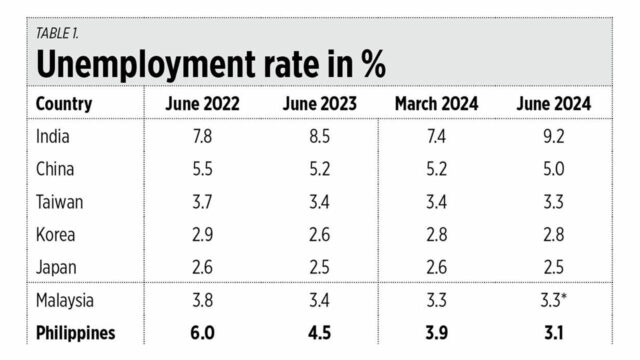
Yesterday the Philippine Statistics Authority (PSA) released the labor force data for June 2024, and we saw that the unemployment rate was only 3.1% which tied with December 2023’s level — the Philippines’ all-time low unemployment rate since the 1980s, and possibly since the 1970s although records from that period are scanty or not available.

So, I compared the Philippines’ unemployment rate with that of other Asian countries, and with major economies of North America and Europe. Not only is ours among the lowest, but ours has had the biggest drop over the last two years, from 6% in June 2022 to 3.1% in June 2024. In contrast, some countries experienced an increase over the same period, like Sweden, Germany, the UK, the US, and Canada (see Table 1).

This is a big economic achievement by the Marcos Jr. administration in general, and the economic team in particular.

It also serves as further proof that the high GDP growth in 2022, 2023, and the first quarter of 2024 was indeed job-creating growth and not the “jobless growth” usually claimed by some detractors.

In a Viber message to this writer, Budget Secretary Amenah F. Pangandaman reiterated the optimistic economic outlook of the Philippines, noting that “our prudent public spending especially in hard infrastructure is bearing fruit, helped improve our people’s productivity and helped our domestic businesses to create more jobs, reduce poverty in the country.”

Last Monday I briefly watched the presentation by the House of Representatives’ Development Budget Coordination Committee on the first day of public hearings on the 2025 budget. The secretaries of the departments of Finance (DoF) and Budget and Management, the head of the National Economic and Development Authority, and the central bank governor plus their respective officials were there.

Finance Secretary Ralph G. Recto gave an opening presentation and highlighted, among others, that “the DoF hiked the government-owned and -controlled corporations’ (GOCCs) dividend rates to 75% from 50% in 2024 as among the major sources of non-tax revenues…. Total revenue collection from January to June 2024 grew by 15.6% amounting to P2.15 trillion. Of which, tax collections increased by 10% to P1.84 trillion, while non-tax grew by 63.3% to P314.2 billion.”

On July 25, I attended the First National Anti-Illicit Trade Summit at the Manila Hotel, organized by the Federation of Philippine Industries (FPI). Dr. Jesus L. Arranza, chairman of FPI and Fight Illicit Trade (FightIT) noted in his opening message that a study they commissioned showed that the government is losing around P250 billion/year in value-added tax (VAT) due to smuggling.

Since VAT is 12% of the price of imported goods, that means around P2.3 trillion worth of smuggled products are sold here annually and unfairly competing against locally produced products in the domestic market.

I checked again the revenue performance of the government and saw that overall tax collections are increasing, except excise tax which experienced a revenue decline in 2022 and 2023, and possibly also this year. The main source of revenue losses is in tobacco tax collections, which peaked at P176 billion in 2021 and went down to only P135 billion in 2023, and seems on its way to declining further to around P120 billion by the end of this year (see Table 2).

Finance Undersecretary Charlito Martin Mendoza also gave a presentation in the same forum. He said that the Bureau of Internal Revenue and the Bureau of Customs are campaigning against smugglers and illicit traders through the “BRAVE” project: B (Border Security Enhancement), R (Revenue Collection and Protection), A (Adaptive Regulations and Compliance), V (Vigilant Enforcement Operations), and E (Effective Engagement with Stakeholders and Inter-Agency Cooperation).

The government — the DoF and Congress in particular — need to address this big conjoined issue of sustained illicit trade and smuggling and high tax rates (like a VAT rate of 12%, a tobacco tax of P63/pack and rising yearly) which are among the key factors why legal products are getting more expensive and the alternative smuggled products are getting more affordable. A downward shift in tax rates, especially in VAT (our 12% is possibly the highest in Asia), should be considered in exchange for the removal of many VAT exemptions.

Finally, the Philippines’ high inflation remains a big hurdle in our people’s economic advancement.

The big flood in the National Capital Region last July caused the destruction of many properties and a temporary shortage of some commodities. I saw an empty bread shelf in one of the SM groceries in Makati that day of heavy flooding, plus a long queue of shoppers stocking up on mostly food items for fear that another heavy flood might happen again soon.

I expect the country’s inflation rate to taper off in the last five months of this year as most harvests in the first rice crop are due starting late August to September, with the second crop due for harvest in December-January.

We must stay the course of focused public spending on productive infrastructure and productivity enhancing programs and projects, and tap other domestic sources of additional revenues while avoiding higher taxes and additional borrowings as much as possible.


Bienvenido S. Oplas, Jr. is the president of Bienvenido S. Oplas, Jr. Research Consultancy Services, and Minimal Government Thinkers. He is an international fellow of the Tholos Foundation.

minimalgovernment@gmail.com

Average data breach cost in ASEAN climbs to all-time high

TRUSTPAIR.COM

THE AVERAGE COST of data breaches in the Association of Southeast Asian Nations (ASEAN) region has reached an all-time high of $3.23 million this year, the International Business Machines Corp. (IBM) said on Wednesday.

This was 6% higher than $3.05 million in 2023 and affected companies in the Philippines, Singapore, Indonesia, Malaysia, Thailand, and Vietnam, IBM’s 2024 Cost of a Data Breach Report showed.

Globally, the average cost of data breaches spiked by 10% year on year to $4.88 million.

The report surveyed 604 organizations globally between March 2023 and February 2024.

“ASEAN’s critical infrastructure organizations experienced the highest breach costs, with financial services participants saw the costliest breaches across industries ($5.57 million), followed by the industrial sector ($4.18 million) and technology ($4.09 million),” IBM said in a statement.

“Disruption is the new cost of insecurity, and security is becoming the new cost of doing business. The 2024 report shows the extent and cost of business disruption caused by data breaches, which can even lead to a complete business shutdown. As the collateral damage from data breaches intensifies, lost business and post-breach customer response costs drove the annual spike,” IBM ASEAN General Manager Catherine Lian was quoted as saying.

Ms. Lian said investing in cybersecurity has become more important amid increased use of artificial intelligence (AI) technologies.

“The stakes are higher than ever in the AI era. While generative AI can help address the skills shortage in today’s landscape where security teams are understaffed, it is also being used to create and launch attacks at scale. Security can no longer be an afterthought. ASEAN companies need to invest in AI-driven defenses to stay ahead and harness the potential of these technologies, ensuring business continuity and protecting their customers,” she added.

About 56% of the surveyed organizations are deploying security AI and automation across their security operation center, 8% higher than in 2023.

“When these technologies were used extensively, companies shortened the data breach lifecycle by 99 days and incurred an average $1.42 million less in breach costs, compared to those without security AI and automation deployments. While AI technologies provide defenders with new tools for rapidly identifying and automating responses to threats, they are also expanding the attack surface and are expected to present new risks for security teams,” IBM said.

The report also showed that 41% of breaches in the ASEAN region involved data stored across multiple environments, including public cloud, private cloud, and on-site. These were the most expensive, costing $3.44 million on average and taking the longest to identify and contain (287 days).

Migration to the cloud and security system security were among the top factors blamed for increased breach costs, with ASEAN companies surveyed needing an average of nearly nine months or 264 days to identify and contain incidents.

“Lost business costs — operational downtime, lost customers, and reputation damage, among others — escalated nearly 31%, compared to the prior year. Post-breach customer response jumped 16% and notification cost increased almost 13% over the same time frame,” IBM said.

“At 16%, phishing was the most common initial attack vector and represent an average total cost of $3.39 million per breach, followed by stolen or compromised credentials ($3.12) and business e-mail compromise ($3.46) accounting for 13% of incidents each. Attacks using zero-day vulnerability were the most expensive entry point ($3.62) at 9% of breaches studied,” it added.

Meanwhile, globally, organizations that fell victim to ransomware saved an average of $1 million in breach costs when they enlisted the help of law enforcement, with 63% of these firms being able to avoid paying a ransom. — ARAI

Monde Nissin’s Q2 earnings drop despite sales boost

MONDE Nissin Corp. saw its attributable net income fall to P606.23 million for the second quarter (Q2) from P1.55 billion a year ago, despite higher revenues.

The listed food and beverage manufacturer said its revenues rose to P19.82 billion for the April to June period, marking an increase of 3.6% from last year’s P19.14 billion.

Broken down, the company recorded a revenue increase for its Asia-Pacific branded food and beverage (APAC BFB) business, which increased by 5.6% to P16.46 billion from P15.58 billion.

For its meat alternative segment, Monde Nissin reported that its revenues declined by 5.6% to P3.37 billion from last year’s P3.57 billion.

Reported net income for the second quarter declined by 60.7% to P610 million, which the company attributed to the loss of P1.5 billion in guaranty asset gain in its meat alternative business.

“During the second quarter, APAC BFB saw modest top-line growth and continued expansion of gross margin and core net income on a year-on-year basis,” Henry Soesanto, chief executive officer and executive vice-president of Monde Nissin, told the stock exchange.

Mr. Soesanto said the company is hoping to sustain the growth of its APAC BFB segment in the third quarter.

“Our APAC BFB gross margins have substantially rebounded from last year’s levels, and while we believe further sequential gains will be limited, we expect to see continued improvement in Q3 on a year-on-year basis,” he said.

Further, the company’s attributable net income for the first half climbed by 17.2% to P4.09 billion from P3.49 billion, as shown in the company’s financial statement.

For the first half, Monde Nissin registered a combined revenue of P40.14 billion, up by 2.4% from last year’s P39.19 billion.

At the local bourse on Wednesday, shares in the company gained 19 centavos or 2.07% to end at P9.35 apiece. — Ashley Erika O. Jose

Philippine Labor Force Situation

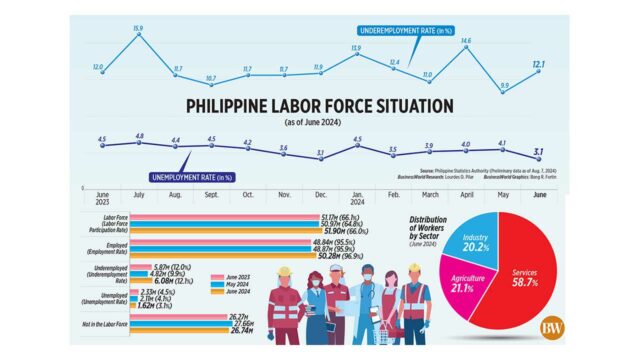
THE UNEMPLOYMENT RATE in June fell to 3.1%, the lowest in two decades, as hiring in the construction sector surged, the Philippine Statistics Authority (PSA) reported on Wednesday. Read the full story.

Philippine Labor Force Situation